PRESBYOPIA
OPTOM MO JUNED
B. Optom
( Intern )
SUBHARTI UNIVERSITY
MEERUT
ACCOMMODATION
• The focusing performed by our eyes for near viewing is
called accommodation.
• Accommodation is achieved by an increase in the plus
power of our natural crystalline lens.
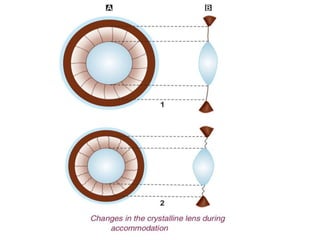
• When we are looking at distance, the ciliary muscle is
relaxed and the taut zonular fibers pull on the crystalline
lens. Near viewing is accomplished by contracture of the
ciliary muscle which loosens the pull of the zonular fibers.
This results in the crystalline lens reverting to a more
convex shape, thus increasing its plus power .
• Near point (Punctum Proximum ) : Nearest point
at which object can be seen clearly.
• Far point (Punctum Remotum ): The farthest point
at which any object can be seen clearly.
• The distance between the near point and far point
is called Range of accommodation.
• Amplitude of accommodation is the maximum
increase in diopter power the eye can achiev
through accommodation.
PRESBYOPIA
• The term presbyopia comes from the greek
presbyteros which means old age vision.
• Presbyopia is the age-related decrease in
accommodative ability that occurs inevitability in
everyone — whether one is nearsighted, farsighted
or emmetropic.
• Presbyopia is referred to an age related loss of
accommodative ability of the eye.
PATHOPHYSIOLOGY
Near point varies with age
• 10 years - 7 cm, 40 years - 25 cm, 45 years - 33 cm
• After the age of 40 years near point of accommodation
recedes beyond the normal reading or working
distance.
• This condition of failing near vision due to age-related
decrease in the amplitude of accommodation or
increase in punctum proximum is called presbyopia.
CAUSES OF PRESBYOPIA
1. Age related changes in the lens :
• Decrease in elasticity of the lens capsule.
• Progressive increase in size and hardness of lens
substance.
2. Age related changes in cilicary muscles power .
Common risk factors
1. Hyperopia : Additional accommodative demand
2. Occupation : Near vision demand
3. Gender : Earlier onset in females ( short stature &
menopause )
4. Systemic diseases : Diabetic melitus , multiple
sclerosis , cardiovascular accidents
5. Drugs : Alcohol , Anti anxiety agents.
6. Geographical factor : Proximity to the equator
(higher average annual temperature greater
exposure toradiation )
TYPES OF PRESBYOPIA
Incipient Presbyopia :
• Beginning stage of presbyopia when symptoms or
difficulty are first encountered in newr vision.
• Patient will have more difficulty in dim illumination
while can do well in light.
Premature Presbyopia :
• Occuring at early age than expected for normal people.
• Usually associated with ocular diseases , nutritional
deficiencies or ingestion of certain drugs.
Manifest Presbyopia :
• Presbyopia with some amplitude of accommodation
present.
Absolute Presbyopia :
• Presbyopia with amplitude of accommodation
completely absent.
SYMPTOMS
1. Difficulty in near vision
2. Asthenopic symptoms
• All symptoms of presbyopia are aggravated by
fatigue , illness , fever and other debilitating
conditions.
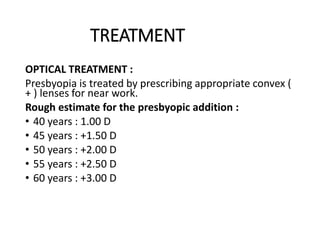
TREATMENT
OPTICAL TREATMENT :
Presbyopia is treated by prescribing appropriate convex (
+ ) lenses for near work.
Rough estimate for the presbyopic addition :
• 40 years : 1.00 D
• 45 years : +1.50 D
• 50 years : +2.00 D
• 55 years : +2.50 D
• 60 years : +3.00 D
Basic principles for presbyopic
correction
1. Always find out refractive error for distance and first
correct it.
2. Find out the presbyopic correction needed and add it
to the distant correction.
3. Near point should be fixed by taking due
consideration for profession of the patient.
4. The weakest convex lens with which an individual can
see clearly at the near point should be prescribed,
since overcorrection will also result in asthenopic
symptoms.
Five point about correcting
presbyopia with an addition
1. Rule of thumb for Add ( Power- Age )
2. Let the patient hold the near card at their usual reading distance
rather than at average distance.
3. It is important to ensure the the lens strength they prefer is making
the letter/numbers on the near chart clearer rather than larger.
4. The purpose is to make sure that the Add not only provides clear
vision at the patient's ideal reading position but also nearer and
farther than that position.
5. Stronger Add of +3.00, +3.50 D or higher can be given for individual
who prefer an usually close reading distance or as a low vision aid
given with intention of provide magnification.
Modes of prescription
1. Single vision
2. Bifocal glasses
3. Trifocal glasses
4. Multifocal or varifocal glasses
Thanks you

Presbyopia by Juned ppt.

  • 1.
    PRESBYOPIA OPTOM MO JUNED B.Optom ( Intern ) SUBHARTI UNIVERSITY MEERUT
  • 2.
    ACCOMMODATION • The focusingperformed by our eyes for near viewing is called accommodation. • Accommodation is achieved by an increase in the plus power of our natural crystalline lens. • When we are looking at distance, the ciliary muscle is relaxed and the taut zonular fibers pull on the crystalline lens. Near viewing is accomplished by contracture of the ciliary muscle which loosens the pull of the zonular fibers. This results in the crystalline lens reverting to a more convex shape, thus increasing its plus power .
  • 4.
    • Near point(Punctum Proximum ) : Nearest point at which object can be seen clearly. • Far point (Punctum Remotum ): The farthest point at which any object can be seen clearly. • The distance between the near point and far point is called Range of accommodation. • Amplitude of accommodation is the maximum increase in diopter power the eye can achiev through accommodation.
  • 5.
    PRESBYOPIA • The termpresbyopia comes from the greek presbyteros which means old age vision. • Presbyopia is the age-related decrease in accommodative ability that occurs inevitability in everyone — whether one is nearsighted, farsighted or emmetropic. • Presbyopia is referred to an age related loss of accommodative ability of the eye.
  • 6.
    PATHOPHYSIOLOGY Near point varieswith age • 10 years - 7 cm, 40 years - 25 cm, 45 years - 33 cm • After the age of 40 years near point of accommodation recedes beyond the normal reading or working distance. • This condition of failing near vision due to age-related decrease in the amplitude of accommodation or increase in punctum proximum is called presbyopia.
  • 7.
    CAUSES OF PRESBYOPIA 1.Age related changes in the lens : • Decrease in elasticity of the lens capsule. • Progressive increase in size and hardness of lens substance. 2. Age related changes in cilicary muscles power .
  • 8.
    Common risk factors 1.Hyperopia : Additional accommodative demand 2. Occupation : Near vision demand 3. Gender : Earlier onset in females ( short stature & menopause ) 4. Systemic diseases : Diabetic melitus , multiple sclerosis , cardiovascular accidents 5. Drugs : Alcohol , Anti anxiety agents. 6. Geographical factor : Proximity to the equator (higher average annual temperature greater exposure toradiation )
  • 9.
    TYPES OF PRESBYOPIA IncipientPresbyopia : • Beginning stage of presbyopia when symptoms or difficulty are first encountered in newr vision. • Patient will have more difficulty in dim illumination while can do well in light. Premature Presbyopia : • Occuring at early age than expected for normal people. • Usually associated with ocular diseases , nutritional deficiencies or ingestion of certain drugs.
  • 10.
    Manifest Presbyopia : •Presbyopia with some amplitude of accommodation present. Absolute Presbyopia : • Presbyopia with amplitude of accommodation completely absent.
  • 11.
    SYMPTOMS 1. Difficulty innear vision 2. Asthenopic symptoms • All symptoms of presbyopia are aggravated by fatigue , illness , fever and other debilitating conditions.
  • 12.
    TREATMENT OPTICAL TREATMENT : Presbyopiais treated by prescribing appropriate convex ( + ) lenses for near work. Rough estimate for the presbyopic addition : • 40 years : 1.00 D • 45 years : +1.50 D • 50 years : +2.00 D • 55 years : +2.50 D • 60 years : +3.00 D
  • 13.
    Basic principles forpresbyopic correction 1. Always find out refractive error for distance and first correct it. 2. Find out the presbyopic correction needed and add it to the distant correction. 3. Near point should be fixed by taking due consideration for profession of the patient. 4. The weakest convex lens with which an individual can see clearly at the near point should be prescribed, since overcorrection will also result in asthenopic symptoms.
  • 14.
    Five point aboutcorrecting presbyopia with an addition 1. Rule of thumb for Add ( Power- Age ) 2. Let the patient hold the near card at their usual reading distance rather than at average distance. 3. It is important to ensure the the lens strength they prefer is making the letter/numbers on the near chart clearer rather than larger. 4. The purpose is to make sure that the Add not only provides clear vision at the patient's ideal reading position but also nearer and farther than that position. 5. Stronger Add of +3.00, +3.50 D or higher can be given for individual who prefer an usually close reading distance or as a low vision aid given with intention of provide magnification.
  • 15.
    Modes of prescription 1.Single vision 2. Bifocal glasses 3. Trifocal glasses 4. Multifocal or varifocal glasses
  • 16.