TYPES OF SPECTACLE LENSES
MEHEDI HASAN
SINGLEVISION OR UNIFOCAL LENSES
This lens provides correction only for a given distance.This
means that the optical power is the same at every point on
the lens’s surface.
Prescribed only for single vision.
- Distance vision glass
- Near vision glass
- Vocational glass
BIFOCAL LENSES
Bifocal lenses combine vision correction for near-sightedness and far-sightedness.
The top of the lens is for distance viewing and the bottom half is for close-up.These
are often prescribed for people whose near-vision has declined due to age.
There are several types of bifocal :
A. Two pieces bifocal
B. Fused bifocal
C. One piece or solid bifocal
BIFOCAL LENSES
Fused bifocals are mostly used.
Types are :
A. Kryptok : suitable for hypermetropic patients.
B. Flat top / D shaped : suitable for myopic patients.
C. Executive : Best for pseudophakic paediatric patients and also for presbyopic
patients as well.
TRIFOCAL LENSES
Trifocals are eyeglasses with lenses that
have three regions which correct for
distance, intermediate (arm's length), and
near vision. John Isaac Hawkins
developed the trifocal lens in
1827. Trifocals are mostly used by people
with advanced presbyopia who have been
prescribed 2 diopters or more of reading
addition.
PROGRESSIVE LENSES
Progressive lenses are line-free
multifocals that have a seamless
progression of added magnifying
power for intermediate and near
vision .The junction between these
distinctly different power zones
is defined by a visible "bifocal line"
that cuts across the center of
the lens.
HI-INDEX LENS
Hi-index lens material reduces lens thickness, making these lenses more comfortable and
better looking by minimizing the size of visible lens edges for nearsighted wearers and
reducing the magnified “bug eye” appearance associated with farsighted wearers .Variety
of hi-index 1.67 and 1.74 lenses that are thinner and lighter than plastic. High Index 1.74
lenses are the thinnest, flattest, and most cosmetically appealing lens ever developed.
These ultra thin lenses are nearly 50% thinner than plastic and 5% thinner than 1.67 high
index lenses, offering you the ultimate in technology and cosmetics
HI-INDEX LENS
Advantages of High-Index Lenses :
 Thinner. Because of their ability to bend light more efficiently, high-index lenses
for nearsightedness have thinner edges than lenses with the same prescription
power that are made of conventional plastic material.
 Lighter.Thinner edges require less lens material, which reduces the overall
weight of the lenses. Lenses made of high-index plastic are lighter than the same
lenses made in conventional plastic, so they're more comfortable to wear.
 High-index glass lenses also have thinner edges, but high-index glass is heavier
than conventional glass, so there is not as much weight savings with glass as there
is with plastic lenses
HI-INDEX LENS
PHOTOCHROMIC LENSES
 Photochromic lenses are optical lenses that darken on exposure to specific types of light
of sufficient intensity, most commonly ultraviolet (UV) radiation. In the absence of
activating light the lenses return to their clear state. Photochromic lenses may be made
of glass, polycarbonate, or another plastic.They are principally used in eyeglasses that
are dark in bright sunlight, but clear in low ambient light conditions. They darken
significantly within about a minute of exposure to bright light, and take somewhat
longer to clear. A range of clear and dark transmittances are available.
 In one sort of technology, molecules of silver chloride or another silver halide are
embedded in photochromatic lenses.They are transparent to visible light without
significant ultraviolet component, which is normal for artificial lighting. In another sort
of technology, organic photochromic molecules, when exposed to ultraviolet (UV) rays
as in direct sunlight, undergo a chemical process that causes them to change shape and
absorb a significant percentage of the visible light, i.e., they darken.These processes are
reversible; once the lens is removed from strong sources of UV rays the photochromic
compounds return to their transparent state.
PHOTOCHROMIC LENSES
A photochromic eyeglass lens
(polymer film), after exposure
to sunlight with part of the lens
covered by paper. Note the two
levels of coloration around the
dark-light interface, arising
from the fact that the
photochromic molecules are
located in two thin films (on the
front and back surfaces of the
lens).
PHOTOCHROMIC LENSES
POLARIZED LENSES ( ANTI GLARE)
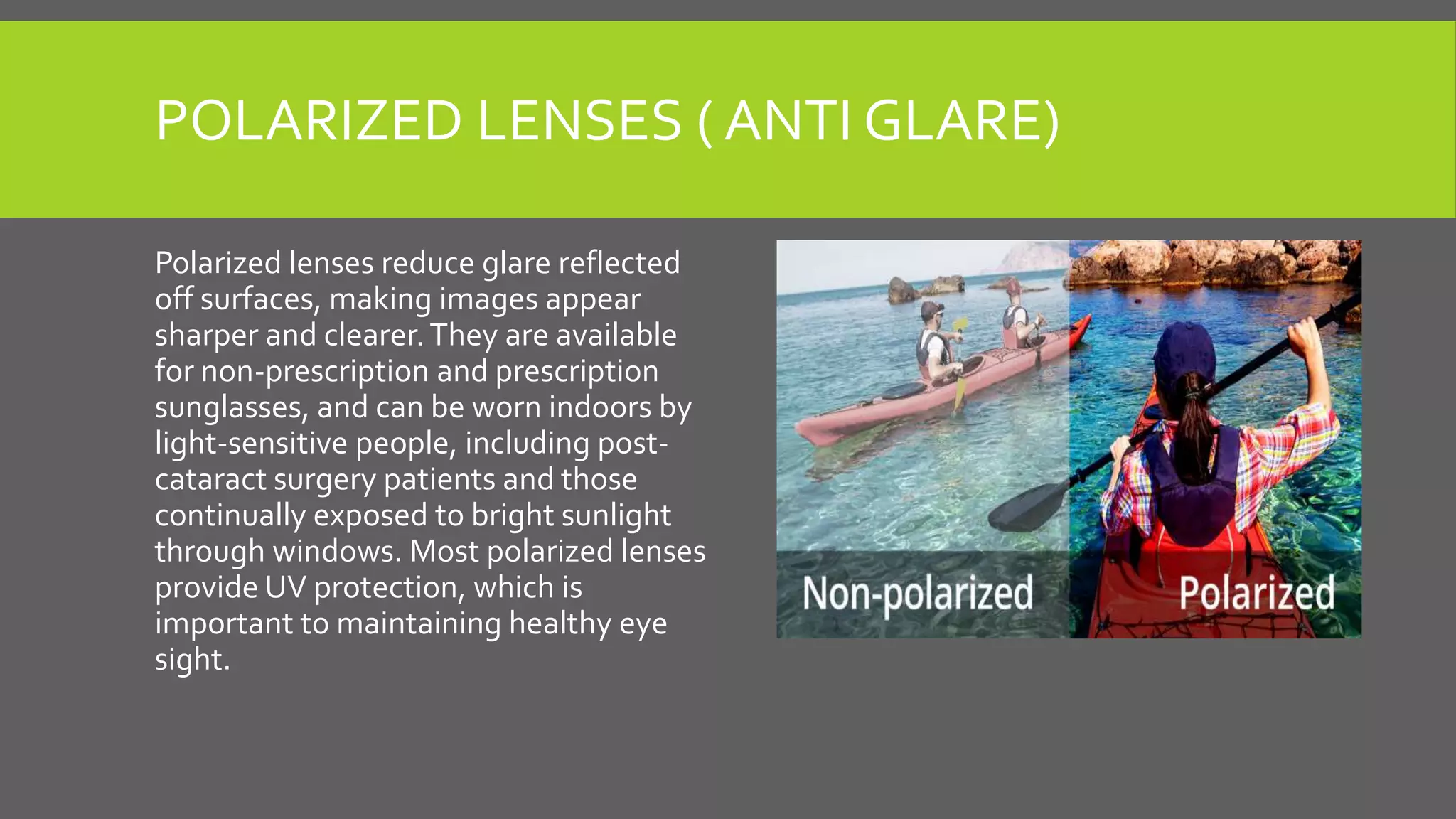
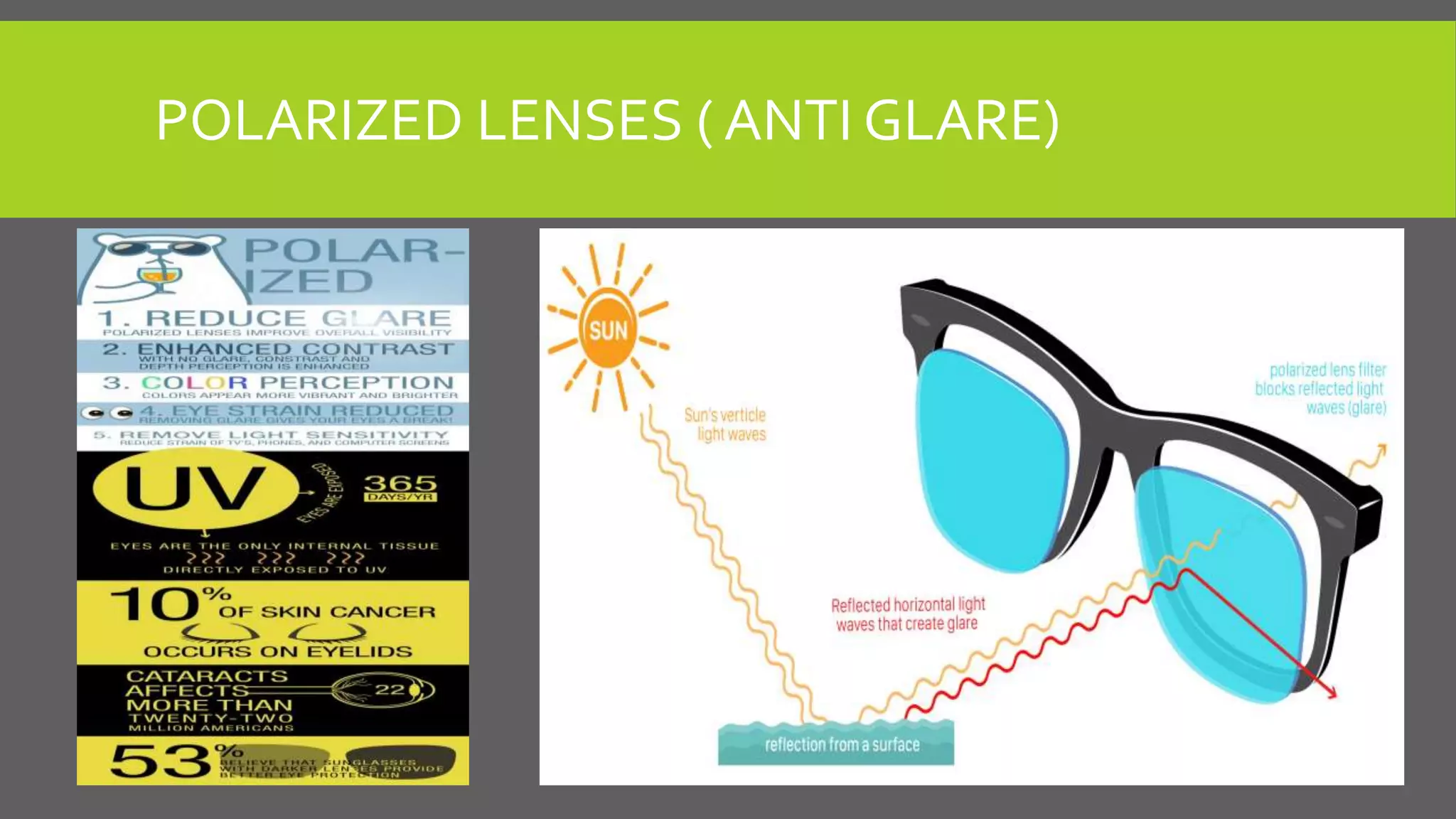
Polarized lenses reduce glare reflected
off surfaces, making images appear
sharper and clearer.They are available
for non-prescription and prescription
sunglasses, and can be worn indoors by
light-sensitive people, including post-
cataract surgery patients and those
continually exposed to bright sunlight
through windows. Most polarized lenses
provide UV protection, which is
important to maintaining healthy eye
sight.
POLARIZED LENSES ( ANTI GLARE)
TINTED LENSES
Colored or tinted sunglasses come in
and out of style all the time. But as well
as complimenting your summer threads,
lens tints serve a variety of important
purposes. A good tinted lens protects
your eyes against UV radiation.They can
also give you a high-contrast vision
experience even in glaring or diffuse
light.
TINTED LENSES
TINTED LENSES
GREENTINTED LENSES
Benefits :
 Transmits all colors evenly
 Good for general purpose use
 Dims glare while brightening shadows
 Sport/Activity
 All outdoor activities
 Weather Conditions
 Good in rain or shine
TINTED LENSES
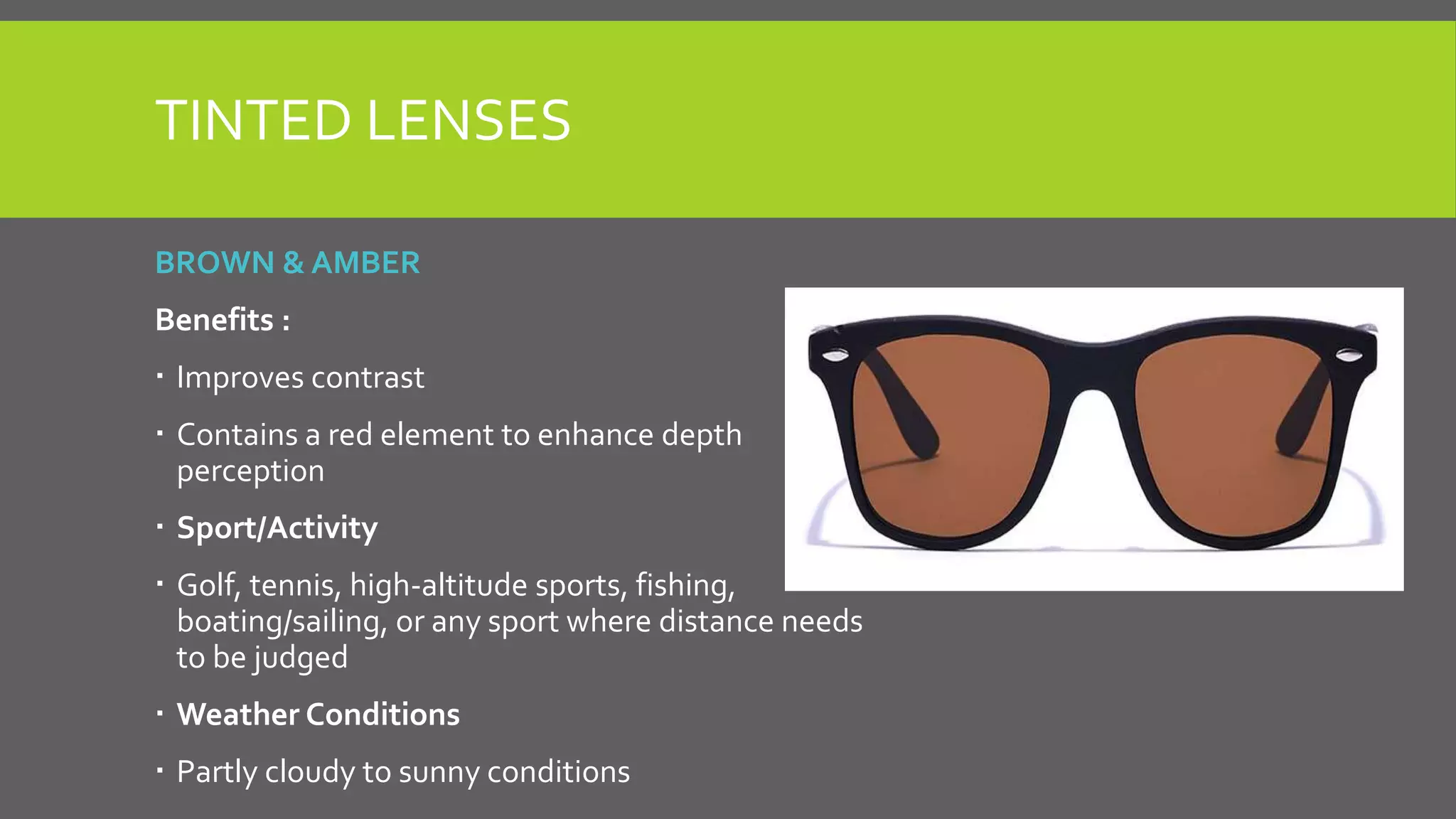
BROWN & AMBER
Benefits :
 Improves contrast
 Contains a red element to enhance depth
perception
 Sport/Activity
 Golf, tennis, high-altitude sports, fishing,
boating/sailing, or any sport where distance needs
to be judged
 Weather Conditions
 Partly cloudy to sunny conditions
TINTED LENSES
YELLOW
Benefits :
 Provides greater clarity in fog, haze,
and other low-light conditions
 Filters out blue light that can make
focusing difficult
 Skiing, mountain biking, hunting,
aviation, tennis, and target shooting
Note: may cause color distortion
 Good for first and last light. Also good
in foggy or hazy conditions
TINTED LENSES
BLUE, PURPLE & DOUBLE GRADIENT
Benefits :
 Fashionable
 Cosmetically appealing
 Reduces glare
 Helps to see contours
 Improves color perception
 Spectator and golf
 Good in misty, foggy and snowy
conditions
TINTED LENSES
GRAY : is a natural tint
 Benefits
 Good for general purpose use
 Anti-fatigue
 True color perception
 Dark enough to provide overall protection
 Reduces glare, especially off water
 Driving, baseball, tennis, football, soccer, water sports, and all other outdoor activities
 Good variable weather tint-sunny or overcast days
TINTED LENSES
PINK & RED
Benefits :
 Enhances visual depth
 Reduces eye strain
 Provides good road visibility
 Comforting to the eyes
 Helps adjust contrast
 Cycling, racing
 Good in most weather
conditions, especially in
snow.
POLYCARBONATE LENSES
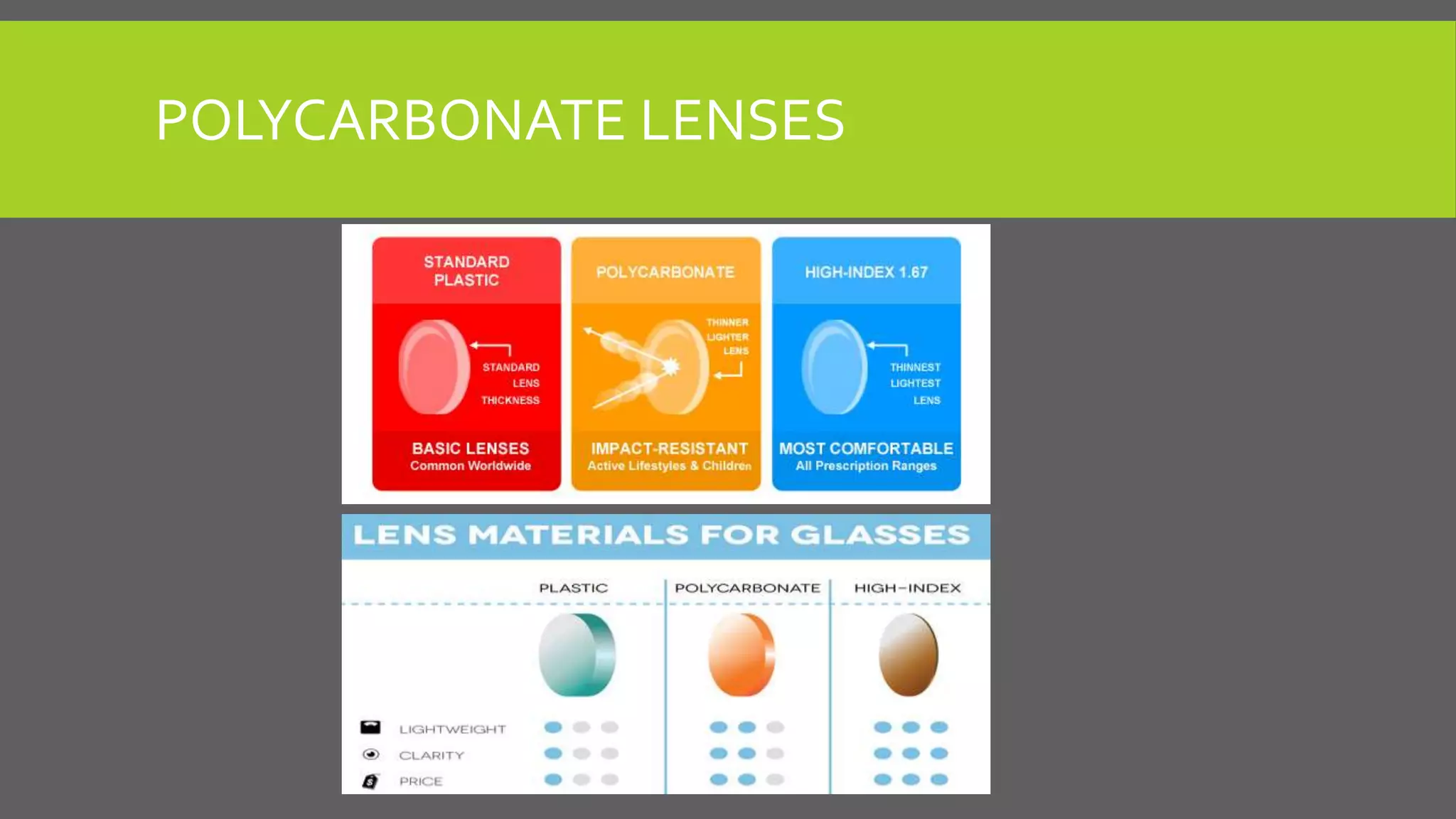
Polycarbonate lenses are resilient, impact-resistant and a favorite among active
individuals. Savvy parents choose polycarbonate lenses for children who may not take
good care of their glasses.The durability of polycarbonate lenses makes them a good
choice for rimless eyeglasses. Plus, polycarbonate lenses have built-in UV filters to help
prevent eye problems such as macular degeneration (breakdown of macula) and
cataracts (clouding of the eye lens).
Polycarbonate lenses are up to 10 times more impact-resistant than plastic or glass
lenses and they provide 100% protection from the sun's harmful UV rays.They are also
lightweight, adding to the comfort of your eyeglasses, sunglasses, and sports eyewear.
POLYCARBONATE LENSES
ANTI-REFLECTIVE
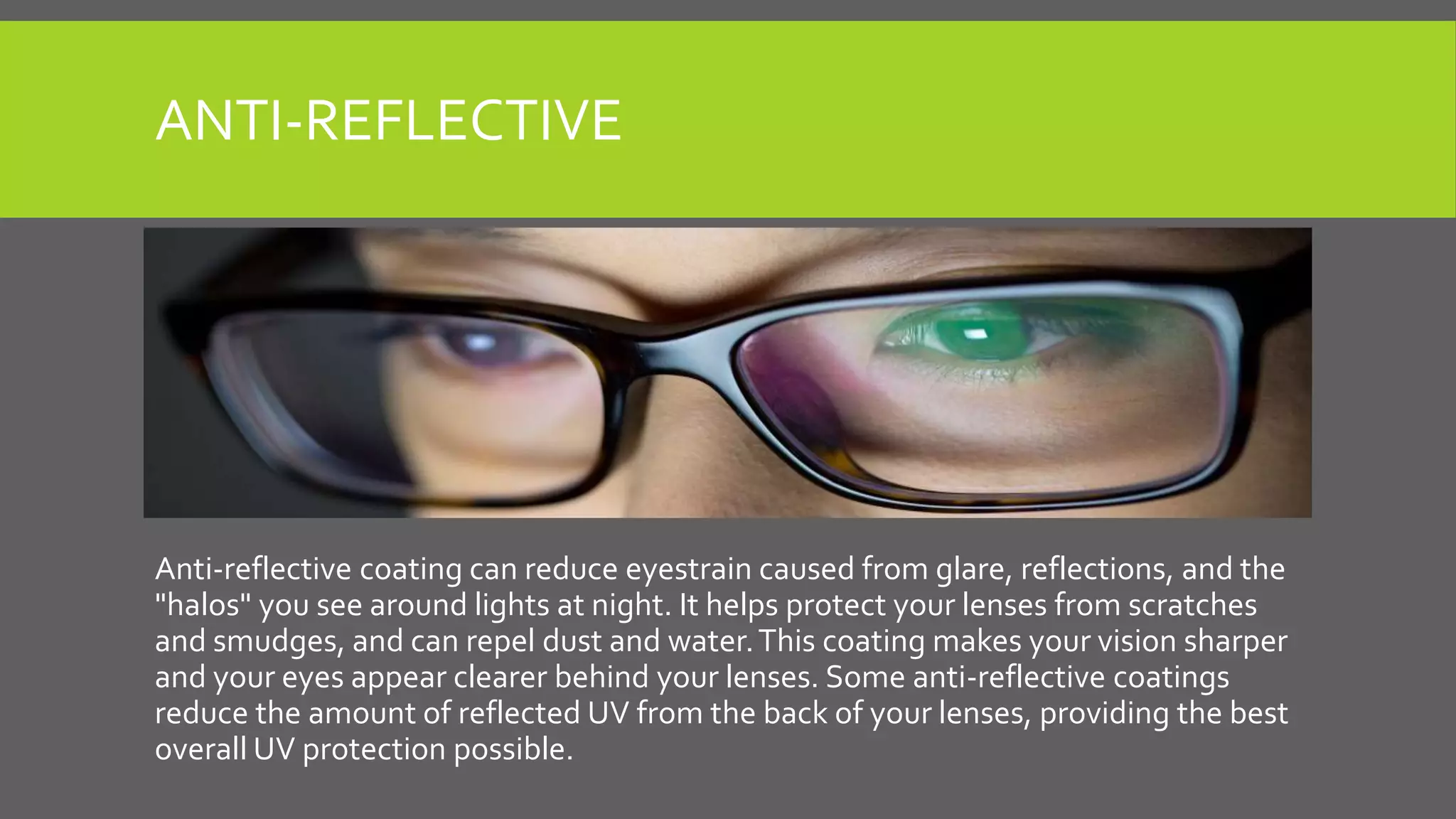
Anti-reflective coating can reduce eyestrain caused from glare, reflections, and the
"halos" you see around lights at night. It helps protect your lenses from scratches
and smudges, and can repel dust and water.This coating makes your vision sharper
and your eyes appear clearer behind your lenses. Some anti-reflective coatings
reduce the amount of reflected UV from the back of your lenses, providing the best
overall UV protection possible.
ANTI-REFLECTIVE
BLUE-LIGHT REDUCTION
Blue-light reduction is a next-generation
lens coating that combats digital eye strain
by reducing your exposure to blue light from
smartphones, tablets, computer screens,
televisions, energy-efficient lighting, and
the sun.This attractive, near-clear coating
also optimizes visual performance, improves
visual comfort, enhances your appearance,
and extends the life of your lenses.
Used mostly for computer using.
SCRATCH-RESISTANT
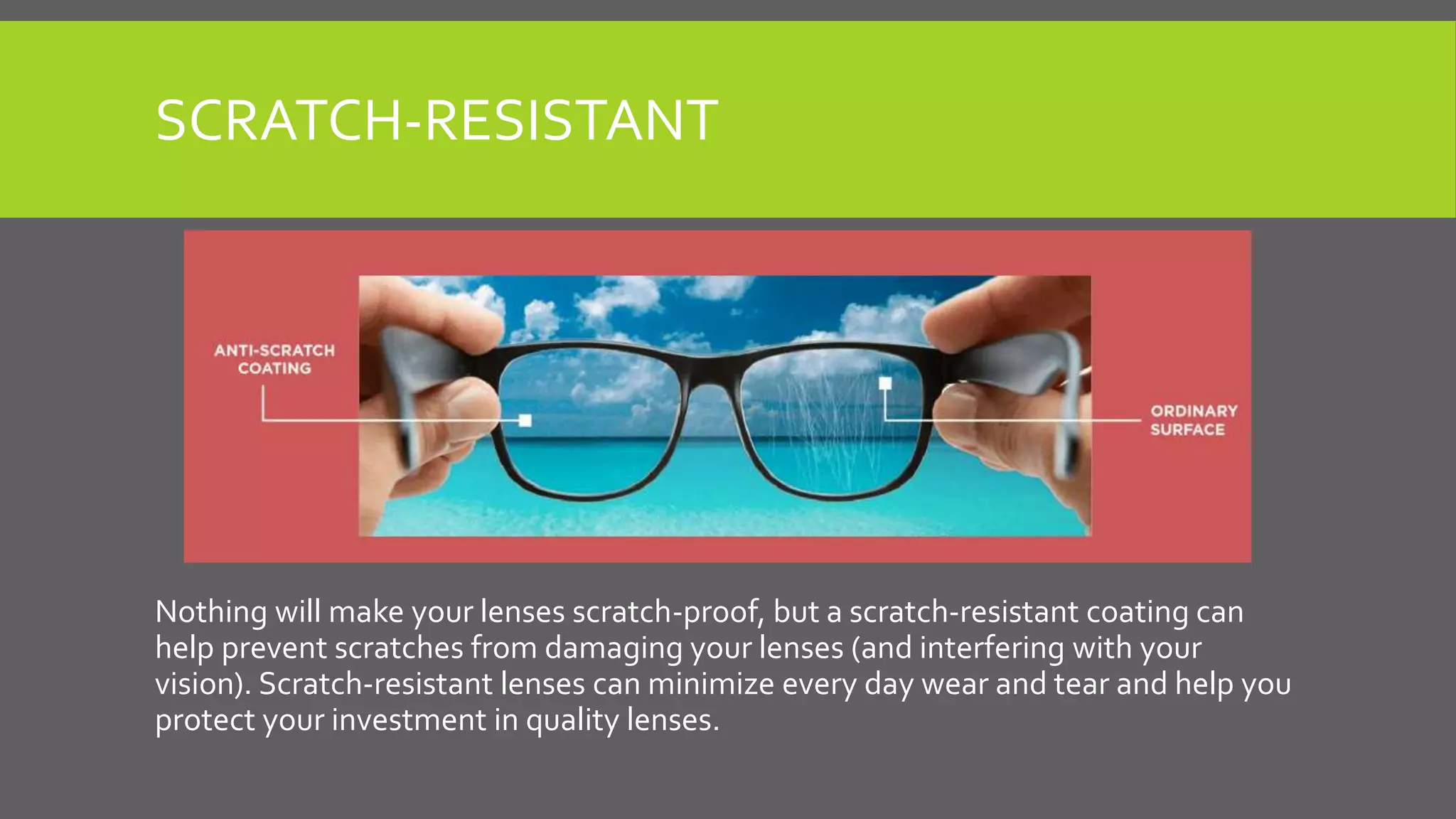
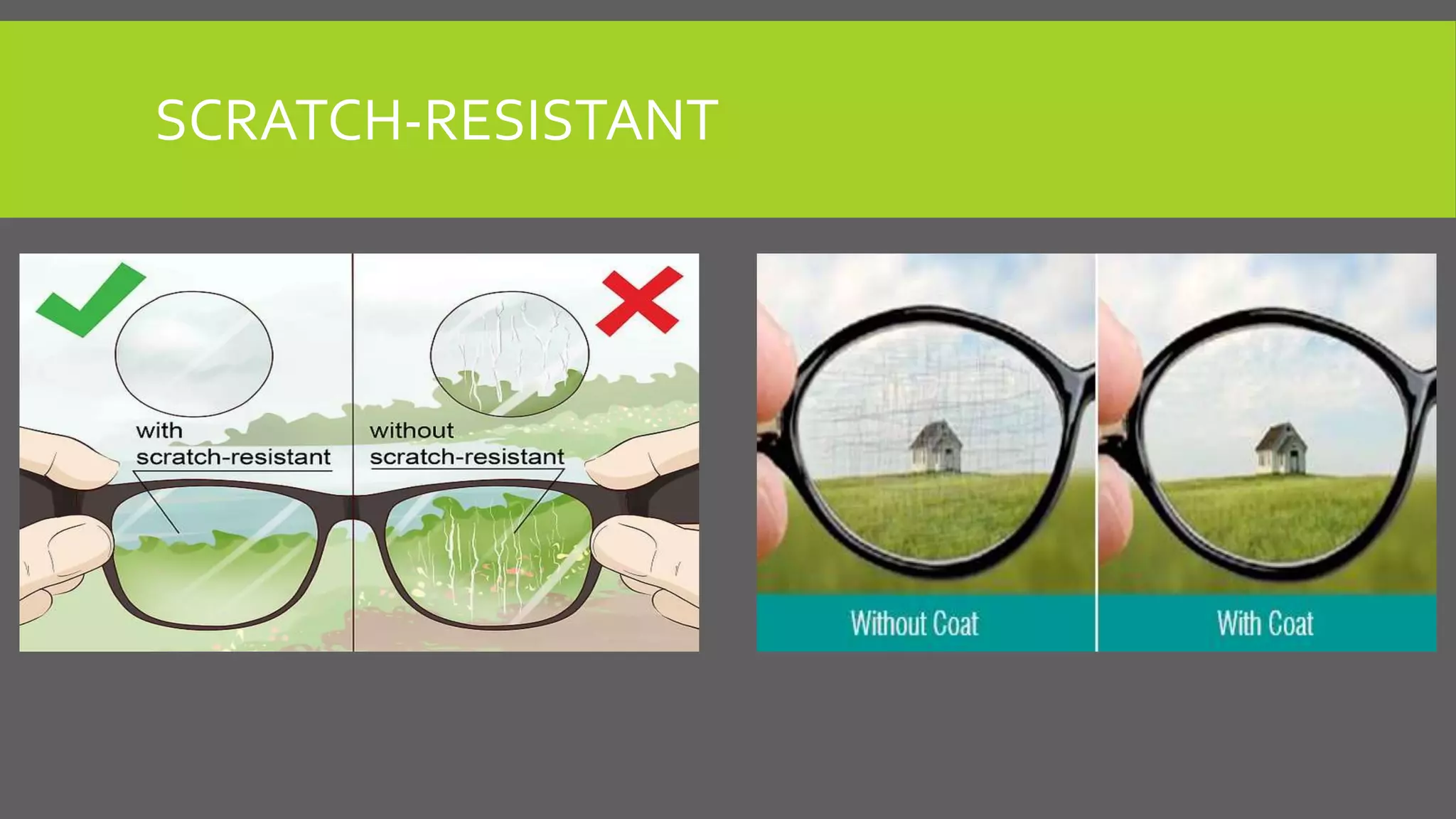
Nothing will make your lenses scratch-proof, but a scratch-resistant coating can
help prevent scratches from damaging your lenses (and interfering with your
vision). Scratch-resistant lenses can minimize every day wear and tear and help you
protect your investment in quality lenses.
SCRATCH-RESISTANT
ANTI-FOG COATING
Anti-fog agents, also known as anti-fogging agents and treatments, are chemicals
that prevent the condensation of water in the form of small droplets on a surface
which resemble fog. Anti-fog treatments were first developed by NASA during
Project Gemini, and are now often used on transparent glass or plastic surfaces
used in optical applications, such as the lenses and mirrors found in glasses,
goggles, camera lenses, and binoculars.The treatments work by minimizing surface
tension, resulting in a non-scattering film of water instead of single droplets.This
works by altering the degree of wetting. Anti-fog treatments usually work either by
application of a surfactant film, or by creating a hydrophilic surface.
ANTI-FOG COATING
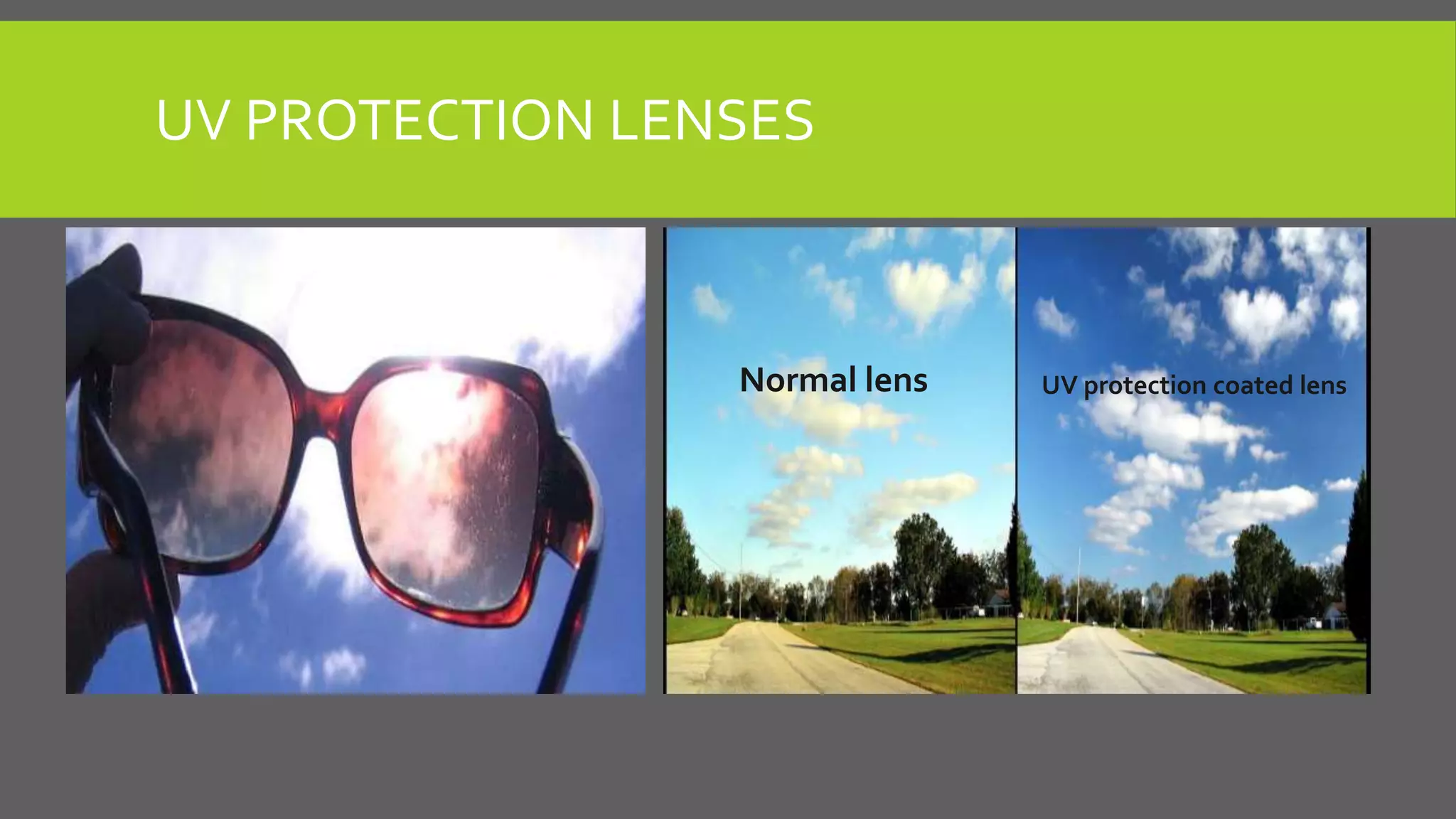
UV PROTECTION LENSES
UV glasses, which protect against ultraviolet radiation, are growing in popularity as
more and more people learn about the harmful rays from the sun.While most
people protect their skin from the sun, some don't realize they should protect their
vision. After all, your eyes absorb the same harmful rays. UV blocking glasses can
help prevent serious damage.The health risks are real and include cataracts and
macular degeneration.
There are three different types of ultraviolet radiation — UV-A, UV-B, and UV-C.
You probably don't hear much about UV-C because the earth's ozone layer absorbs
it so its threat is minimal to nonexistent. But UV-A and UV-B each can cause long-
term and short-term damage to your eyes and your vision. And while the sun is the
daily risk when it comes to ultraviolet radiation, welding machines, tanning beds,
and lasers can also produce UV rays.
UV PROTECTION LENSES
Normal lens UV protection coated lens
TRIBRID LENS
Tribrid is a premium
performance lens material that
combines excellent optical quality
(ABBE 41), lightweight (1.23 g/cm
specific gravity), thinness (1.60
index of refraction) and strength
(up to 5X more impact resistant
than other high index lens
materials). Tribrid also blocks
100% of harmful ultra-violet
radiation
TRIBRID LENS
TRIVEX LENS
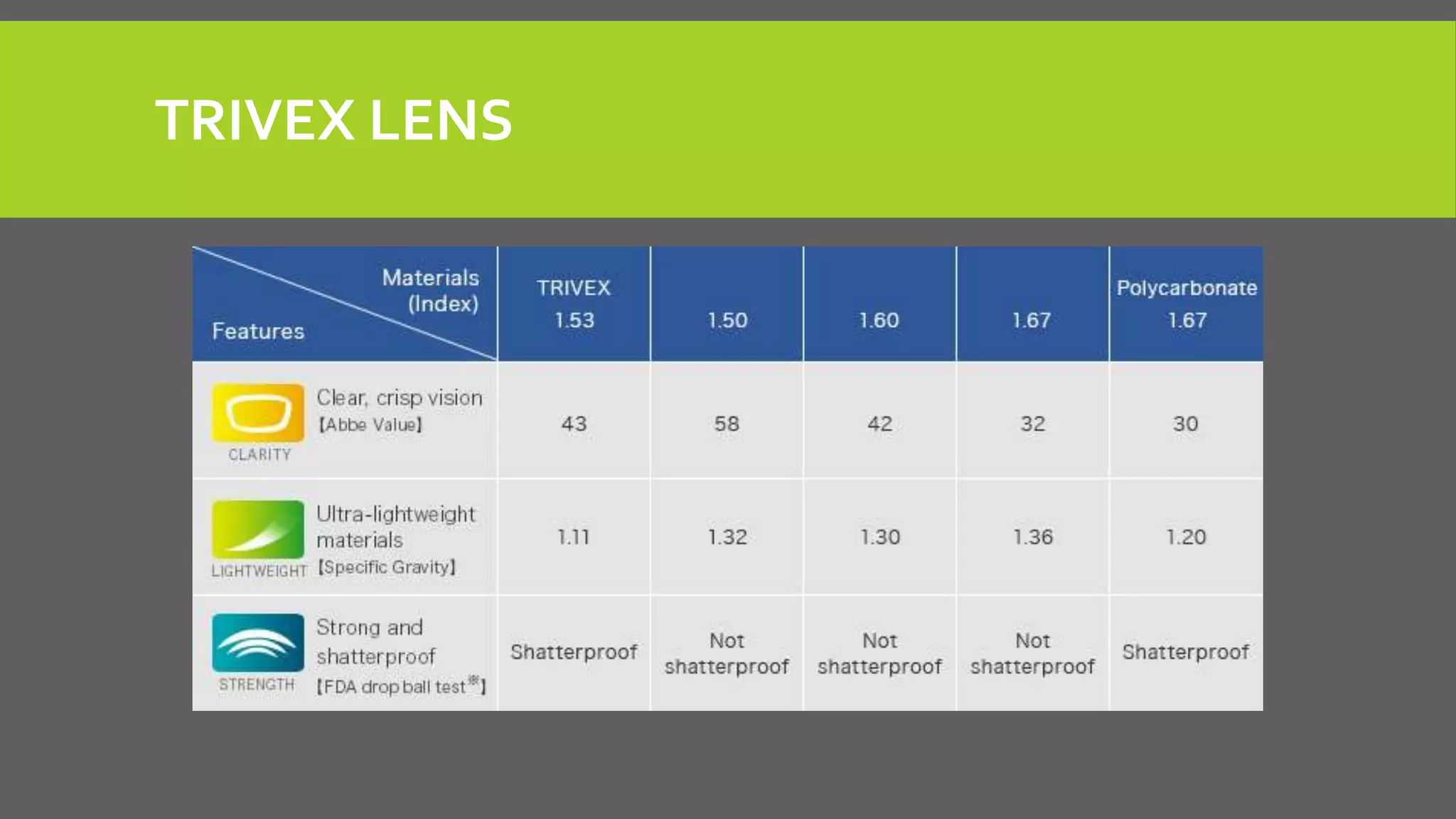
Trivex lenses are a relatively new development in the lens world. Trivex lenses have
a 1.53 index which makes them a bit thinner than regular plastic lenses, and a bit
thicker than polycarbonate lenses. TheTrivex lens material is lighter than
polycarbonate, and also has better visual acuity than polycarbonate, and is also
recommended as a safety material similar to polycarbonate.
However, there are few choices inTrivex lenses andTrivex is more expensive than
polycarbonate lenses. WhileTrivex has a slightly lower refractive index than
polycarbonate (making it slightly thicker), its specific gravity, makes it light and
gives it better optical clarity.This means the lens may be a little thicker than
polycarbonate but similar in weight.Trivex is an excellent choice for sunglasses,
becauseTrivex accepts tint better than polycarbonate and the lenses can become
darker. Trivex is also available with polarization. Similar to polycarbonate,Trivex
has inherent UV protection and is an excellent choice for rimless drill mounted
frames.
TRIVEX LENS
TRIVEX LENS
TRIVEX LENS
Thanks All.

Types of spectacle lenses

  • 1.
    TYPES OF SPECTACLELENSES MEHEDI HASAN
  • 2.
    SINGLEVISION OR UNIFOCALLENSES This lens provides correction only for a given distance.This means that the optical power is the same at every point on the lens’s surface. Prescribed only for single vision. - Distance vision glass - Near vision glass - Vocational glass
  • 3.
    BIFOCAL LENSES Bifocal lensescombine vision correction for near-sightedness and far-sightedness. The top of the lens is for distance viewing and the bottom half is for close-up.These are often prescribed for people whose near-vision has declined due to age. There are several types of bifocal : A. Two pieces bifocal B. Fused bifocal C. One piece or solid bifocal
  • 4.
    BIFOCAL LENSES Fused bifocalsare mostly used. Types are : A. Kryptok : suitable for hypermetropic patients. B. Flat top / D shaped : suitable for myopic patients. C. Executive : Best for pseudophakic paediatric patients and also for presbyopic patients as well.
  • 5.
    TRIFOCAL LENSES Trifocals areeyeglasses with lenses that have three regions which correct for distance, intermediate (arm's length), and near vision. John Isaac Hawkins developed the trifocal lens in 1827. Trifocals are mostly used by people with advanced presbyopia who have been prescribed 2 diopters or more of reading addition.
  • 6.
    PROGRESSIVE LENSES Progressive lensesare line-free multifocals that have a seamless progression of added magnifying power for intermediate and near vision .The junction between these distinctly different power zones is defined by a visible "bifocal line" that cuts across the center of the lens.
  • 7.
    HI-INDEX LENS Hi-index lensmaterial reduces lens thickness, making these lenses more comfortable and better looking by minimizing the size of visible lens edges for nearsighted wearers and reducing the magnified “bug eye” appearance associated with farsighted wearers .Variety of hi-index 1.67 and 1.74 lenses that are thinner and lighter than plastic. High Index 1.74 lenses are the thinnest, flattest, and most cosmetically appealing lens ever developed. These ultra thin lenses are nearly 50% thinner than plastic and 5% thinner than 1.67 high index lenses, offering you the ultimate in technology and cosmetics
  • 8.
    HI-INDEX LENS Advantages ofHigh-Index Lenses :  Thinner. Because of their ability to bend light more efficiently, high-index lenses for nearsightedness have thinner edges than lenses with the same prescription power that are made of conventional plastic material.  Lighter.Thinner edges require less lens material, which reduces the overall weight of the lenses. Lenses made of high-index plastic are lighter than the same lenses made in conventional plastic, so they're more comfortable to wear.  High-index glass lenses also have thinner edges, but high-index glass is heavier than conventional glass, so there is not as much weight savings with glass as there is with plastic lenses
  • 9.
  • 10.
    PHOTOCHROMIC LENSES  Photochromiclenses are optical lenses that darken on exposure to specific types of light of sufficient intensity, most commonly ultraviolet (UV) radiation. In the absence of activating light the lenses return to their clear state. Photochromic lenses may be made of glass, polycarbonate, or another plastic.They are principally used in eyeglasses that are dark in bright sunlight, but clear in low ambient light conditions. They darken significantly within about a minute of exposure to bright light, and take somewhat longer to clear. A range of clear and dark transmittances are available.  In one sort of technology, molecules of silver chloride or another silver halide are embedded in photochromatic lenses.They are transparent to visible light without significant ultraviolet component, which is normal for artificial lighting. In another sort of technology, organic photochromic molecules, when exposed to ultraviolet (UV) rays as in direct sunlight, undergo a chemical process that causes them to change shape and absorb a significant percentage of the visible light, i.e., they darken.These processes are reversible; once the lens is removed from strong sources of UV rays the photochromic compounds return to their transparent state.
  • 11.
    PHOTOCHROMIC LENSES A photochromiceyeglass lens (polymer film), after exposure to sunlight with part of the lens covered by paper. Note the two levels of coloration around the dark-light interface, arising from the fact that the photochromic molecules are located in two thin films (on the front and back surfaces of the lens).
  • 12.
  • 13.
    POLARIZED LENSES (ANTI GLARE) Polarized lenses reduce glare reflected off surfaces, making images appear sharper and clearer.They are available for non-prescription and prescription sunglasses, and can be worn indoors by light-sensitive people, including post- cataract surgery patients and those continually exposed to bright sunlight through windows. Most polarized lenses provide UV protection, which is important to maintaining healthy eye sight.
  • 14.
    POLARIZED LENSES (ANTI GLARE)
  • 15.
    POLARIZED LENSES (ANTI GLARE)
  • 16.
    POLARIZED LENSES (ANTI GLARE)
  • 17.
    POLARIZED LENSES (ANTI GLARE)
  • 18.
    POLARIZED LENSES (ANTI GLARE)
  • 19.
    TINTED LENSES Colored ortinted sunglasses come in and out of style all the time. But as well as complimenting your summer threads, lens tints serve a variety of important purposes. A good tinted lens protects your eyes against UV radiation.They can also give you a high-contrast vision experience even in glaring or diffuse light.
  • 20.
  • 21.
    TINTED LENSES GREENTINTED LENSES Benefits:  Transmits all colors evenly  Good for general purpose use  Dims glare while brightening shadows  Sport/Activity  All outdoor activities  Weather Conditions  Good in rain or shine
  • 22.
    TINTED LENSES BROWN &AMBER Benefits :  Improves contrast  Contains a red element to enhance depth perception  Sport/Activity  Golf, tennis, high-altitude sports, fishing, boating/sailing, or any sport where distance needs to be judged  Weather Conditions  Partly cloudy to sunny conditions
  • 23.
    TINTED LENSES YELLOW Benefits : Provides greater clarity in fog, haze, and other low-light conditions  Filters out blue light that can make focusing difficult  Skiing, mountain biking, hunting, aviation, tennis, and target shooting Note: may cause color distortion  Good for first and last light. Also good in foggy or hazy conditions
  • 24.
    TINTED LENSES BLUE, PURPLE& DOUBLE GRADIENT Benefits :  Fashionable  Cosmetically appealing  Reduces glare  Helps to see contours  Improves color perception  Spectator and golf  Good in misty, foggy and snowy conditions
  • 25.
    TINTED LENSES GRAY :is a natural tint  Benefits  Good for general purpose use  Anti-fatigue  True color perception  Dark enough to provide overall protection  Reduces glare, especially off water  Driving, baseball, tennis, football, soccer, water sports, and all other outdoor activities  Good variable weather tint-sunny or overcast days
  • 26.
    TINTED LENSES PINK &RED Benefits :  Enhances visual depth  Reduces eye strain  Provides good road visibility  Comforting to the eyes  Helps adjust contrast  Cycling, racing  Good in most weather conditions, especially in snow.
  • 27.
    POLYCARBONATE LENSES Polycarbonate lensesare resilient, impact-resistant and a favorite among active individuals. Savvy parents choose polycarbonate lenses for children who may not take good care of their glasses.The durability of polycarbonate lenses makes them a good choice for rimless eyeglasses. Plus, polycarbonate lenses have built-in UV filters to help prevent eye problems such as macular degeneration (breakdown of macula) and cataracts (clouding of the eye lens). Polycarbonate lenses are up to 10 times more impact-resistant than plastic or glass lenses and they provide 100% protection from the sun's harmful UV rays.They are also lightweight, adding to the comfort of your eyeglasses, sunglasses, and sports eyewear.
  • 28.
  • 29.
  • 30.
    ANTI-REFLECTIVE Anti-reflective coating canreduce eyestrain caused from glare, reflections, and the "halos" you see around lights at night. It helps protect your lenses from scratches and smudges, and can repel dust and water.This coating makes your vision sharper and your eyes appear clearer behind your lenses. Some anti-reflective coatings reduce the amount of reflected UV from the back of your lenses, providing the best overall UV protection possible.
  • 31.
  • 32.
    BLUE-LIGHT REDUCTION Blue-light reductionis a next-generation lens coating that combats digital eye strain by reducing your exposure to blue light from smartphones, tablets, computer screens, televisions, energy-efficient lighting, and the sun.This attractive, near-clear coating also optimizes visual performance, improves visual comfort, enhances your appearance, and extends the life of your lenses. Used mostly for computer using.
  • 33.
    SCRATCH-RESISTANT Nothing will makeyour lenses scratch-proof, but a scratch-resistant coating can help prevent scratches from damaging your lenses (and interfering with your vision). Scratch-resistant lenses can minimize every day wear and tear and help you protect your investment in quality lenses.
  • 34.
  • 35.
    ANTI-FOG COATING Anti-fog agents,also known as anti-fogging agents and treatments, are chemicals that prevent the condensation of water in the form of small droplets on a surface which resemble fog. Anti-fog treatments were first developed by NASA during Project Gemini, and are now often used on transparent glass or plastic surfaces used in optical applications, such as the lenses and mirrors found in glasses, goggles, camera lenses, and binoculars.The treatments work by minimizing surface tension, resulting in a non-scattering film of water instead of single droplets.This works by altering the degree of wetting. Anti-fog treatments usually work either by application of a surfactant film, or by creating a hydrophilic surface.
  • 36.
  • 37.
    UV PROTECTION LENSES UVglasses, which protect against ultraviolet radiation, are growing in popularity as more and more people learn about the harmful rays from the sun.While most people protect their skin from the sun, some don't realize they should protect their vision. After all, your eyes absorb the same harmful rays. UV blocking glasses can help prevent serious damage.The health risks are real and include cataracts and macular degeneration. There are three different types of ultraviolet radiation — UV-A, UV-B, and UV-C. You probably don't hear much about UV-C because the earth's ozone layer absorbs it so its threat is minimal to nonexistent. But UV-A and UV-B each can cause long- term and short-term damage to your eyes and your vision. And while the sun is the daily risk when it comes to ultraviolet radiation, welding machines, tanning beds, and lasers can also produce UV rays.
  • 38.
    UV PROTECTION LENSES Normallens UV protection coated lens
  • 39.
    TRIBRID LENS Tribrid isa premium performance lens material that combines excellent optical quality (ABBE 41), lightweight (1.23 g/cm specific gravity), thinness (1.60 index of refraction) and strength (up to 5X more impact resistant than other high index lens materials). Tribrid also blocks 100% of harmful ultra-violet radiation
  • 40.
  • 41.
    TRIVEX LENS Trivex lensesare a relatively new development in the lens world. Trivex lenses have a 1.53 index which makes them a bit thinner than regular plastic lenses, and a bit thicker than polycarbonate lenses. TheTrivex lens material is lighter than polycarbonate, and also has better visual acuity than polycarbonate, and is also recommended as a safety material similar to polycarbonate. However, there are few choices inTrivex lenses andTrivex is more expensive than polycarbonate lenses. WhileTrivex has a slightly lower refractive index than polycarbonate (making it slightly thicker), its specific gravity, makes it light and gives it better optical clarity.This means the lens may be a little thicker than polycarbonate but similar in weight.Trivex is an excellent choice for sunglasses, becauseTrivex accepts tint better than polycarbonate and the lenses can become darker. Trivex is also available with polarization. Similar to polycarbonate,Trivex has inherent UV protection and is an excellent choice for rimless drill mounted frames.
  • 42.
  • 43.
  • 44.
  • 45.