ANIMAL KINGDOM
PLATYHELMINTHES
Hello!
I am Swetha
Bachelors in Optometry
You can find me at @
https://unacademy.com/user/swetha.chandran304/courses
Place your screenshot here
Introduction, Other features, Body layers, Nervous
system, Digestion, Circulation and skeleton, Respiration,
Excretion, Reproduction
Synopsis
Introduction
INTRODUCTION
◈ Gegenbour suggested the name Platyhelminthes.
◈ Included flat worms most primitive bilateral animals.
◈ Free living (terrestrial, fresh water or marine) or
parasite.
◈ Study of worms causing parasitic infestation in human
is Helminthology.
◈ Most members of this phylum are the parasites of
vertebrate. Some are found in aquatic habitat.
Other features
OTHER FEATURES
◈ Body organisation is of tissue organ grade.
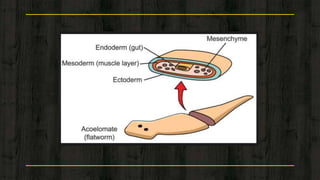
◈ Body is Triploblastic i.e. body is formed from three germinal
layers i.e. Ectoderm, Endoderm & Mesoderm.
◈ Body is bilaterally symmetrical.
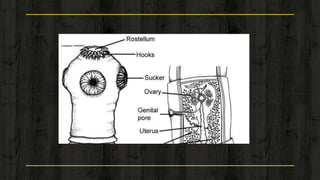
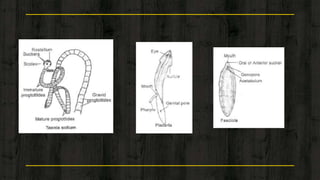
◈ Locomotary organs are absent in these animals but adhesive
organs are present like suckers, hook etc
◈ These are acoelomate. In between various organs a solid,
loose mesodermal tissue called Mesenchyma or Parenchyma
is present.
Body layers
BODY LAYERS
◈ Epidermis is syncytial and is some time ciliated. On
the body wall of parasitic animals a thick cuticle is
present i.e. Tegument.
◈ This cuticle protects the parasite from the digestive -
enzymes of the host. It is secreted by the epidermis.
◈ Muscles in the body-wall are mesodermal. Below the
epidermis, longitudinal, circular and oblique muscles
are present.
Nervous system
NERVOUS SYSTEM
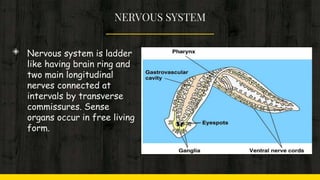
◈ Nervous system is ladder
like having brain ring and
two main longitudinal
nerves connected at
intervals by transverse
commissures. Sense
organs occur in free living
form.
Digestion
DIGESTION
◈ In Turbellaria and Tramatoda class an incomplete
(blind sac body plan) and without anus digestive
system is present.
◈ In animals of class Cestoda, digestive system is
completely absent.
Circulation and
Skeleton
CIRCULATION AND SKELETON
◈ Skeleton and circulatory systems are absent.
Turgidity of the fluid in the parenchymal meshes
maintains the form of the body (Hydroskeleton).
Respiration
RESPIRATION
◈ Animal respire through body surface. Anaerobic
respiration in internal parasite like Taenia.
Excretion
EXCRETION
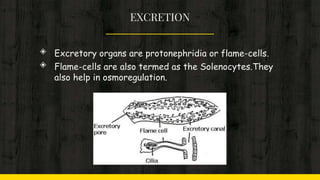
◈ Excretory organs are protonephridia or flame-cells.
◈ Flame-cells are also termed as the Solenocytes.They
also help in osmoregulation.
Reproduction
REPRODUCTION
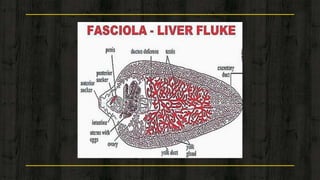
◈ All animals of this phylum are bisexual.
◈ Reproductive system is complex and well-developed.
◈ Fertilization may be self or cross and internal.
◈ Cleavage is spiral & determinate.
◈ Development may be direct or indirect.
◈ In indirect development, larva may be one of more
types. In these animals yolk/vitelline glands are
present which provide nutrition to the eggs.
Thanks!
Any questions?
You can find me at @
https://unacademy.com/user/swetha.chandran304/courses
Follow me or drop your queries in the comment box

Platyhelminthes

  • 1.
  • 2.
    Hello! I am Swetha Bachelorsin Optometry You can find me at @ https://unacademy.com/user/swetha.chandran304/courses
  • 3.
  • 4.
    Introduction, Other features,Body layers, Nervous system, Digestion, Circulation and skeleton, Respiration, Excretion, Reproduction Synopsis
  • 5.
  • 6.
    INTRODUCTION ◈ Gegenbour suggestedthe name Platyhelminthes. ◈ Included flat worms most primitive bilateral animals. ◈ Free living (terrestrial, fresh water or marine) or parasite. ◈ Study of worms causing parasitic infestation in human is Helminthology. ◈ Most members of this phylum are the parasites of vertebrate. Some are found in aquatic habitat.
  • 7.
  • 8.
    OTHER FEATURES ◈ Bodyorganisation is of tissue organ grade. ◈ Body is Triploblastic i.e. body is formed from three germinal layers i.e. Ectoderm, Endoderm & Mesoderm. ◈ Body is bilaterally symmetrical. ◈ Locomotary organs are absent in these animals but adhesive organs are present like suckers, hook etc ◈ These are acoelomate. In between various organs a solid, loose mesodermal tissue called Mesenchyma or Parenchyma is present.
  • 10.
  • 11.
    BODY LAYERS ◈ Epidermisis syncytial and is some time ciliated. On the body wall of parasitic animals a thick cuticle is present i.e. Tegument. ◈ This cuticle protects the parasite from the digestive - enzymes of the host. It is secreted by the epidermis. ◈ Muscles in the body-wall are mesodermal. Below the epidermis, longitudinal, circular and oblique muscles are present.
  • 13.
  • 14.
    NERVOUS SYSTEM ◈ Nervoussystem is ladder like having brain ring and two main longitudinal nerves connected at intervals by transverse commissures. Sense organs occur in free living form.
  • 15.
  • 16.
    DIGESTION ◈ In Turbellariaand Tramatoda class an incomplete (blind sac body plan) and without anus digestive system is present. ◈ In animals of class Cestoda, digestive system is completely absent.
  • 17.
  • 18.
    CIRCULATION AND SKELETON ◈Skeleton and circulatory systems are absent. Turgidity of the fluid in the parenchymal meshes maintains the form of the body (Hydroskeleton).
  • 19.
  • 20.
    RESPIRATION ◈ Animal respirethrough body surface. Anaerobic respiration in internal parasite like Taenia.
  • 21.
  • 22.
    EXCRETION ◈ Excretory organsare protonephridia or flame-cells. ◈ Flame-cells are also termed as the Solenocytes.They also help in osmoregulation.
  • 23.
  • 24.
    REPRODUCTION ◈ All animalsof this phylum are bisexual. ◈ Reproductive system is complex and well-developed. ◈ Fertilization may be self or cross and internal. ◈ Cleavage is spiral & determinate. ◈ Development may be direct or indirect. ◈ In indirect development, larva may be one of more types. In these animals yolk/vitelline glands are present which provide nutrition to the eggs.
  • 27.
    Thanks! Any questions? You canfind me at @ https://unacademy.com/user/swetha.chandran304/courses Follow me or drop your queries in the comment box