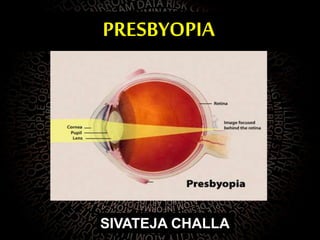
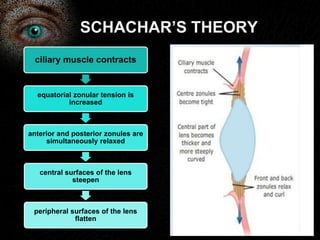
PRESBYOPIA 
SIVATEJA CHALLA
DEFINITION 
• Greek presbys elderly; opos eye 
• Presbyopia is the irreversible loss of the 
accommodative ability of the eye that occurs due 
to aging 
• It is a normal physiological state due to the loss 
of the accomodative capacity with the passage 
of time.
EPIDEMIOLOGY 
• Worldwide in 2005 over 1.04 billion 
• By the year 2020 the worldwide prevalence is expected 
to rise to 1.37 billion 
• The average age of those first reporting symptoms of 
presbyopia is between 42 and 44 years of age 
• early loss of accommodative ability can be induced by 
certain systemic disease, medications, and trauma.
PATHOPHYSIOLOGY 
Lenticular and extralenticular theories 
• Lenticular 
sclerosis of the nuclear lens tissue, 
decreased distance between ciliary muscle and lens 
equator 
lens capsule with age becomes thicker,less extensible and 
brittle
Extralenticular 
age related hyalinization of ciliary processes and ciliary 
muscles 
loss of elasticity in the zonules 
even decreasing resistance of the vitreous humor against 
the accommodating lens capsule
• In emmteropic eye far point is infinity and near point 
varies with age 
7 cm at 10yrs age 
25-40,33-45 
• At 10 yrs amplitude of accomodation 
A=100/7 =14D 
40 yrs A=100/25=4D 
• Since we keep the book at 25 cm can read comfortably 
till 40 yrs 
• After 40 yrs the NPA decrease beyond normal working 
range leading to presbyopia
Some of the theroies include 
1.Helmholtz theory 
2.Coleman theory 
3. Schachar theory
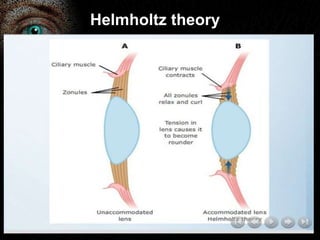
Helmholtz theory
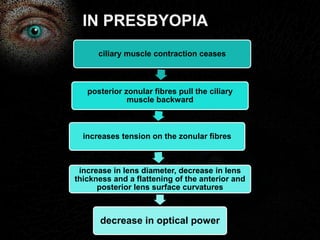
IN PRESBYOPIA 
ciliary muscle contraction ceases 
posterior zonular fibres pull the ciliary 
muscle backward 
increases tension on the zonular fibres 
increase in lens diameter, decrease in lens 
thickness and a flattening of the anterior and 
posterior lens surface curvatures 
decrease in optical power
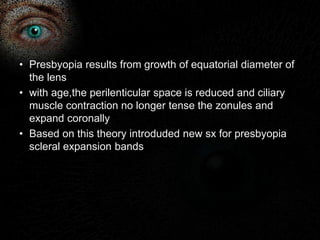
SCHACHAR’S THEORY 
ciliary muscle contracts 
equatorial zonular tension is 
increased 
anterior and posterior zonules are 
simultaneously relaxed 
central surfaces of the lens 
steepen 
peripheral surfaces of the lens 
flatten
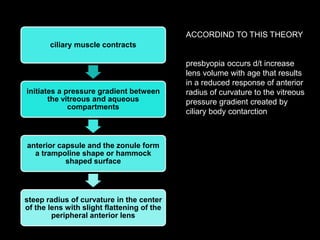
• Presbyopia results from growth of equatorial diameter of 
the lens 
• with age,the perilenticular space is reduced and ciliary 
muscle contraction no longer tense the zonules and 
expand coronally 
• Based on this theory introduded new sx for presbyopia 
scleral expansion bands
CATENARY THEORY 
• Proposed by coleman 
• Says that lens zonules and anterior vitreous comprises 
of a diaphram b/w AC and vitreous
ciliary muscle contracts 
initiates a pressure gradient between 
the vitreous and aqueous 
compartments 
anterior capsule and the zonule form 
a trampoline shape or hammock 
shaped surface 
steep radius of curvature in the center 
of the lens with slight flattening of the 
peripheral anterior lens 
ACCORDIND TO THIS THEORY 
presbyopia occurs d/t increase 
lens volume with age that results 
in a reduced response of anterior 
radius of curvature to the vitreous 
pressure gradient created by 
ciliary body contarction
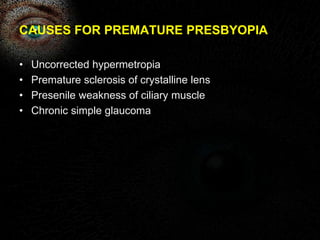
CAUSES FOR PREMATURE PRESBYOPIA 
• Uncorrected hypermetropia 
• Premature sclerosis of crystalline lens 
• Presenile weakness of ciliary muscle 
• Chronic simple glaucoma
SYMPTOMS 
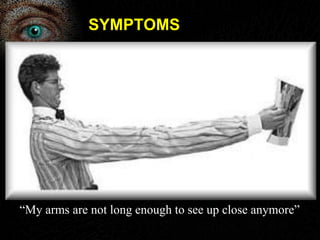
“My arms are not long enough to see up close anymore”
SYMPTOMS AND SIGNS 
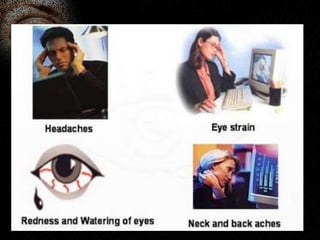
• Difficulty in near vision initially in evening and dim light 
and latter even in good light 
• Asthenopic symptoms like headache d/t fatigue of ciliary 
muscles 
• Intermittent diplopia due to associated disturbances of 
convergence 
All symptoms aggravated by fatigue illness fever or other 
chronic conditions 
SIGNS reduced amplitude of accomodation
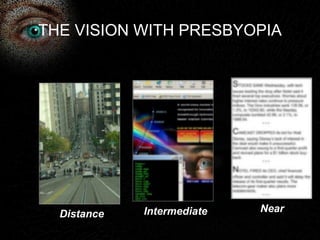
THE VISION WITH PRESBYOPIA 
Distance Intermediate Near
TREATMENT 
OPTICAL CORRECTION OF PRESBYOPIA 
Trial method 
Age method
Basic principles 
• Find ref error for distance n correct it first 
• Find presbyopic correction needed in each eye 
seperately and add it to distance correcction 
• Presbyopic add should leave atleast 50% acomodation 
in reserve 
• Near point should be taken consideration according to 
profession of patient 
• Do not give over correction 
• Additional correction for intermediate distance may be 
required
Trial method 
• Trial method 
– Patient with Rx in DV, test to 40 cm (or habitual distance of NV) 
well lit 
– Mono and/or binocularly 
• Cover LE and go on adding +0.25D in the RE until the patient sees 
clearly 
• The same for LE 
• Refine the result adding  0.25D binocularly
Age method 
– Empirical method based on clinical experience 
– Patient with Rx for DV 
– Reading test at a habitual distance in NV with convex 
lens of appropriate power 
– There are approximated addition tables depending on 
age 
– Refine the result adding  0.25D binocularly
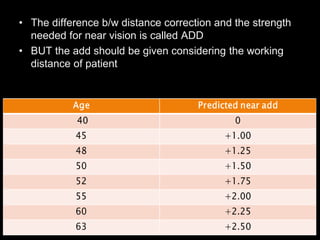
• The difference b/w distance correction and the strength 
needed for near vision is called ADD 
• BUT the add should be given considering the working 
distance of patient
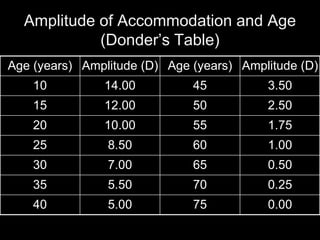
Amplitude of Accommodation and Age 
(Donder’s Table) 
Age (years) Amplitude (D) Age (years) Amplitude (D) 
10 14.00 45 3.50 
15 12.00 50 2.50 
20 10.00 55 1.75 
25 8.50 60 1.00 
30 7.00 65 0.50 
35 5.50 70 0.25 
40 5.00 75 0.00
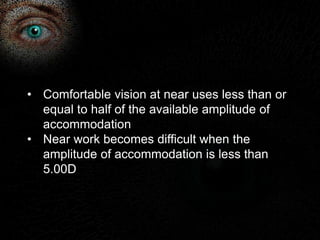
• Comfortable vision at near uses less than or 
equal to half of the available amplitude of 
accommodation 
• Near work becomes difficult when the 
amplitude of accommodation is less than 
5.00D
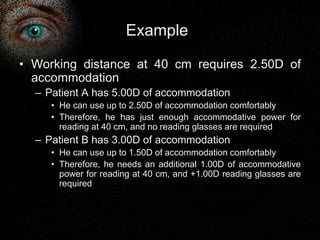
Example 
• Working distance at 40 cm requires 2.50D of 
accommodation 
– Patient A has 5.00D of accommodation 
• He can use up to 2.50D of accommodation comfortably 
• Therefore, he has just enough accommodative power for 
reading at 40 cm, and no reading glasses are required 
– Patient B has 3.00D of accommodation 
• He can use up to 1.50D of accommodation comfortably 
• Therefore, he needs an additional 1.00D of accommodative 
power for reading at 40 cm, and +1.00D reading glasses are 
required
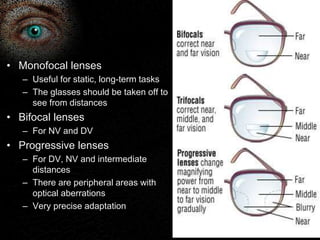
• Monofocal lenses 
– Useful for static, long-term tasks 
– The glasses should be taken off to 
see from distances 
• Bifocal lenses 
– For NV and DV 
• Progressive lenses 
– For DV, NV and intermediate 
distances 
– There are peripheral areas with 
optical aberrations 
– Very precise adaptation
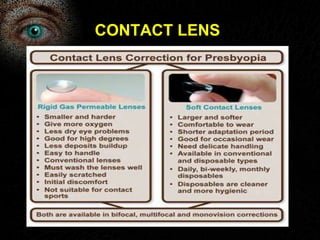
CONTACT LENS
surgical treatment 
• Surgery 
– Laser in-situ keratomileusis (LASIK) 
• More for presbyopic hyperopia than presbyopia 
myopia at the moment 
– Multifocal intraocular lens (IOL) 
– Conductive keratoplasty (monovision) 
– Scleral expansion
THANK YOU

Presbyopia

  • 1.
  • 2.
    DEFINITION • Greekpresbys elderly; opos eye • Presbyopia is the irreversible loss of the accommodative ability of the eye that occurs due to aging • It is a normal physiological state due to the loss of the accomodative capacity with the passage of time.
  • 3.
    EPIDEMIOLOGY • Worldwidein 2005 over 1.04 billion • By the year 2020 the worldwide prevalence is expected to rise to 1.37 billion • The average age of those first reporting symptoms of presbyopia is between 42 and 44 years of age • early loss of accommodative ability can be induced by certain systemic disease, medications, and trauma.
  • 4.
    PATHOPHYSIOLOGY Lenticular andextralenticular theories • Lenticular sclerosis of the nuclear lens tissue, decreased distance between ciliary muscle and lens equator lens capsule with age becomes thicker,less extensible and brittle
  • 5.
    Extralenticular age relatedhyalinization of ciliary processes and ciliary muscles loss of elasticity in the zonules even decreasing resistance of the vitreous humor against the accommodating lens capsule
  • 6.
    • In emmteropiceye far point is infinity and near point varies with age 7 cm at 10yrs age 25-40,33-45 • At 10 yrs amplitude of accomodation A=100/7 =14D 40 yrs A=100/25=4D • Since we keep the book at 25 cm can read comfortably till 40 yrs • After 40 yrs the NPA decrease beyond normal working range leading to presbyopia
  • 7.
    Some of thetheroies include 1.Helmholtz theory 2.Coleman theory 3. Schachar theory
  • 8.
  • 9.
    IN PRESBYOPIA ciliarymuscle contraction ceases posterior zonular fibres pull the ciliary muscle backward increases tension on the zonular fibres increase in lens diameter, decrease in lens thickness and a flattening of the anterior and posterior lens surface curvatures decrease in optical power
  • 10.
    SCHACHAR’S THEORY ciliarymuscle contracts equatorial zonular tension is increased anterior and posterior zonules are simultaneously relaxed central surfaces of the lens steepen peripheral surfaces of the lens flatten
  • 11.
    • Presbyopia resultsfrom growth of equatorial diameter of the lens • with age,the perilenticular space is reduced and ciliary muscle contraction no longer tense the zonules and expand coronally • Based on this theory introduded new sx for presbyopia scleral expansion bands
  • 12.
    CATENARY THEORY •Proposed by coleman • Says that lens zonules and anterior vitreous comprises of a diaphram b/w AC and vitreous
  • 13.
    ciliary muscle contracts initiates a pressure gradient between the vitreous and aqueous compartments anterior capsule and the zonule form a trampoline shape or hammock shaped surface steep radius of curvature in the center of the lens with slight flattening of the peripheral anterior lens ACCORDIND TO THIS THEORY presbyopia occurs d/t increase lens volume with age that results in a reduced response of anterior radius of curvature to the vitreous pressure gradient created by ciliary body contarction
  • 14.
    CAUSES FOR PREMATUREPRESBYOPIA • Uncorrected hypermetropia • Premature sclerosis of crystalline lens • Presenile weakness of ciliary muscle • Chronic simple glaucoma
  • 15.
    SYMPTOMS “My armsare not long enough to see up close anymore”
  • 16.
    SYMPTOMS AND SIGNS • Difficulty in near vision initially in evening and dim light and latter even in good light • Asthenopic symptoms like headache d/t fatigue of ciliary muscles • Intermittent diplopia due to associated disturbances of convergence All symptoms aggravated by fatigue illness fever or other chronic conditions SIGNS reduced amplitude of accomodation
  • 18.
    THE VISION WITHPRESBYOPIA Distance Intermediate Near
  • 19.
    TREATMENT OPTICAL CORRECTIONOF PRESBYOPIA Trial method Age method
  • 20.
    Basic principles •Find ref error for distance n correct it first • Find presbyopic correction needed in each eye seperately and add it to distance correcction • Presbyopic add should leave atleast 50% acomodation in reserve • Near point should be taken consideration according to profession of patient • Do not give over correction • Additional correction for intermediate distance may be required
  • 21.
    Trial method •Trial method – Patient with Rx in DV, test to 40 cm (or habitual distance of NV) well lit – Mono and/or binocularly • Cover LE and go on adding +0.25D in the RE until the patient sees clearly • The same for LE • Refine the result adding  0.25D binocularly
  • 22.
    Age method –Empirical method based on clinical experience – Patient with Rx for DV – Reading test at a habitual distance in NV with convex lens of appropriate power – There are approximated addition tables depending on age – Refine the result adding  0.25D binocularly
  • 23.
    • The differenceb/w distance correction and the strength needed for near vision is called ADD • BUT the add should be given considering the working distance of patient
  • 24.
    Amplitude of Accommodationand Age (Donder’s Table) Age (years) Amplitude (D) Age (years) Amplitude (D) 10 14.00 45 3.50 15 12.00 50 2.50 20 10.00 55 1.75 25 8.50 60 1.00 30 7.00 65 0.50 35 5.50 70 0.25 40 5.00 75 0.00
  • 25.
    • Comfortable visionat near uses less than or equal to half of the available amplitude of accommodation • Near work becomes difficult when the amplitude of accommodation is less than 5.00D
  • 26.
    Example • Workingdistance at 40 cm requires 2.50D of accommodation – Patient A has 5.00D of accommodation • He can use up to 2.50D of accommodation comfortably • Therefore, he has just enough accommodative power for reading at 40 cm, and no reading glasses are required – Patient B has 3.00D of accommodation • He can use up to 1.50D of accommodation comfortably • Therefore, he needs an additional 1.00D of accommodative power for reading at 40 cm, and +1.00D reading glasses are required
  • 27.
    • Monofocal lenses – Useful for static, long-term tasks – The glasses should be taken off to see from distances • Bifocal lenses – For NV and DV • Progressive lenses – For DV, NV and intermediate distances – There are peripheral areas with optical aberrations – Very precise adaptation
  • 28.
  • 29.
    surgical treatment •Surgery – Laser in-situ keratomileusis (LASIK) • More for presbyopic hyperopia than presbyopia myopia at the moment – Multifocal intraocular lens (IOL) – Conductive keratoplasty (monovision) – Scleral expansion
  • 30.