PRESBYOPIA
TREATMENT OPTICAL + SURGICAL
Presenter : Dr Anoop L
Moderator : Dr Soumya Sharath
Presbyopia :
Greek word meaning "Old Eyes"
It's not an error of refraction but a physiological
insufficiency of accomodation due to reduced amplitude,
leading to progressive fall in near vision.
Begins between 40 and 45 years of age
General insight on :
1. Accommodation:
Its a mechanism by which the eye changes refractive
power by altering the shape and position of its
crystalline lens.
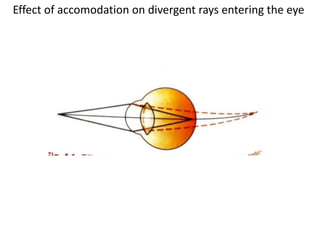
It's a process by which our eyes can focus diverging rays
coming from a near object on the retina inorder to see
clearly.
Effect of accomodation on divergent rays entering the eye
Near point / Punctum Proximum
The nearest point at which small objects can be seen
clearly is called near point.
Far point /Punctum Remotum
The farthest point at which object can be seen clearly is
called Far point
Range of Accommodation :
Distance between far point and near point
Amplitude of accommodation (A)
Difference between diopteric power needed to focus at
near point ( P) and to focus at far point (R)
A = P-R
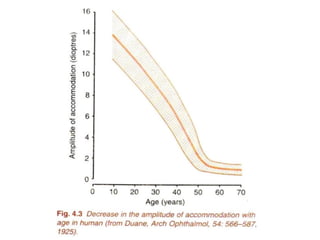
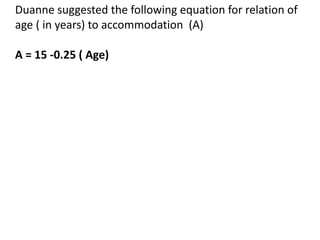
Duanne suggested the following equation for relation of
age ( in years) to accommodation (A)
A = 15 -0.25 ( Age)
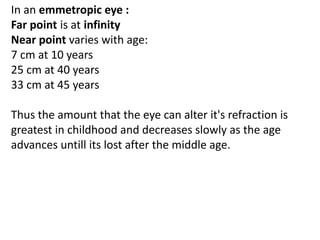
In an emmetropic eye :
Far point is at infinity
Near point varies with age:
7 cm at 10 years
25 cm at 40 years
33 cm at 45 years
Thus the amount that the eye can alter it's refraction is
greatest in childhood and decreases slowly as the age
advances untill its lost after the middle age.
Calculation:
At the age of 10 years , amplitude of accommodation=
Diopteric power for near point - Diopteric power for far
point
100/7 - 100 / infinity
Therefore Amplitude of Accommodation at the age of 10
years : 14
Since we usually keep the book at 25 cms while reading
, so we can ready comfortably upto the age of 40 years.
After 40 years near point of accommodation recedes
beyond the normal reading range
This condition of failing Near vision due to age related
decrease in amplitude of accommodation or increase in
Punctum Proximum is called Presbyopia
Causes of Presbyopia:
1. Age related changes in lens include:
■ Decrease in elasticity of lens capsule
■ Progressive increase in size and hardness of lens,
which is less easily moulded.
Causes of premature Presbyopia include:
■ Uncontrolled hypermetropia
■ Premature sclerosis of crystalline lens
■ Generalized debility causing Presenile weakness of
ciliary muscles
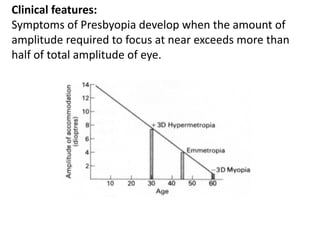
Clinical features:
Symptoms of Presbyopia develop when the amount of
amplitude required to focus at near exceeds more than
half of total amplitude of eye.
An undercorrected hypermetrope and chronically under-
corrected myopia will both develop presbyopic symptoms
earlier than an emmetropic patient.
Difficulty in near vision:
Initially occurs in dim light/evening and later even in good
light. Finally near work becomes impossibility.
Asthenopic symptoms:
Due to fatigue of ciliary muscles on doing near work
Intermittent diplopia:
Can develop at near due to inter- relationship between
accommodation and convergence
All symptoms of Presbyopia are aggravated by fatigue,
illness, fever or other debilitating conditions.
Management of Presbyopia:
1. Optical correction of Presbyopia:
By supplementing accommodation with convex lens of
appropriate power, required for a clear and comfortable
near vision.
The difference between the distance correction and
strength needed for near vision is called as the ADD(
PRESBYOPIC ADD)
Addition Determination can be done by following
methods in routine:
1. Age based
2. Measuring the amplitude of accommodation
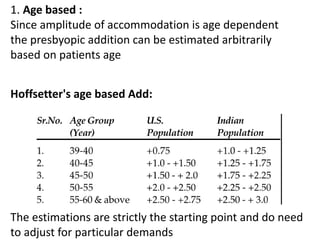
1. Age based :
Since amplitude of accommodation is age dependent
the presbyopic addition can be estimated arbitrarily
based on patients age
Hoffsetter's age based Add:
The estimations are strictly the starting point and do need
to adjust for particular demands
After the add is determined the range is tested, that
is move the chart further and closer reading the smallest
line visible.
This range should coincide with the required working
distance
If the patient desires near range away reduce by 0.25 D
steps and if closer range is desired then increase in
0.25D steps.
2. Measure the amplitude of accommodation:
Method employed is Dodder's or duanne's method
The patient reads the near vision chart (the
smallest line visible) and the chart is brought closer till
the print blurs.
This punctum proximum is converted in diopters
( eg 20cm = 100/20 = 5 Diopters.)
Based on Amplitude the ADD is calculated.
Determine NPA .
Eg. If it is 50cms.
The Amplitude of accommodation is 2 Diopters
Keep 1/3rd in reserve for comfort so the available
accommodation is 1.33 .
If the patient desires to read at 33cms.He needs 3.0
diopters(100/33) .
Thus the extra add required is 3 - 1.33 i. e 1.67 Diopters
Adjustment of working distance:
The power of PRESBYOPIC add should be adjusted by
taking into consideration the working distance required
by a particular patient and the remaining amplitude.
Eg . At the age of 40 with only 3D total amplitude left, the
following ADDS give variable working distance and leave
comfortable (1/3rd of accommodation ) in reserve
• +2.5 D = 25 cm
• +1.5 D = 33 cm
• + 1 D = 40 cm
• + 0.5 D = 50 cm
Inmportance of working distance and individualization
of ADDS:
Eg 1. A tall person habitually holds the book away to
read, so may require lesser addition to have comfortable
range further away
Eg2. Patients with nuclear cataracts shift towards myopia
for distance They are used to higher plus for near may
not accept reduced additions.
ADDS for intermediate distance:
As the ADD increases and the amplitude of
accommodation decreases the range of clear vision also
decreases.
Thus strong reading adds which limit the range of clear
normal vision to a small area very near to the patient
are a common cause of patient dissatisfaction
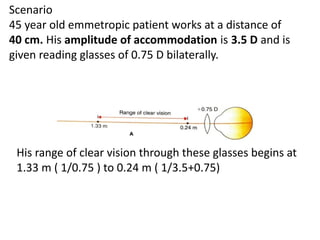
Scenario
45 year old emmetropic patient works at a distance of
40 cm. His amplitude of accommodation is 3.5 D and is
given reading glasses of 0.75 D bilaterally.
His range of clear vision through these glasses begins at
1.33 m ( 1/0.75 ) to 0.24 m ( 1/3.5+0.75)
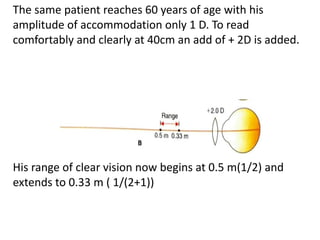
The same patient reaches 60 years of age with his
amplitude of accommodation only 1 D. To read
comfortably and clearly at 40cm an add of + 2D is added.
His range of clear vision now begins at 0.5 m(1/2) and
extends to 0.33 m ( 1/(2+1))
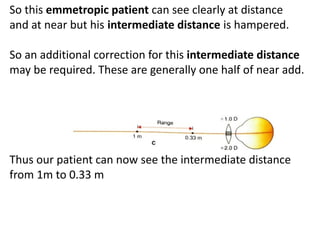
So this emmetropic patient can see clearly at distance
and at near but his intermediate distance is hampered.
So an additional correction for this intermediate distance
may be required. These are generally one half of near add.
Thus our patient can now see the intermediate distance
from 1m to 0.33 m
Basic principles of PRESBYOPIC correction:
• Find out refractive error for distance at first and correct
it .
• Find out PRESBYOPIC Add required to each eye and
add it to distance correction
• The PRESBYOPIC ADD prescribed should leave 1/3rd of
accommodation in reserve.
• Near point should be fixed by taking due consideration
of patient's profession
• Weakest convex lens that the individual requires to see
clearly should be prescribed. Overcorrection avoided
• An additional correction for intermediate distance to
be taken into consideration
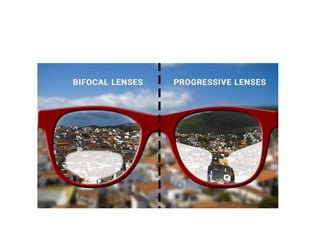
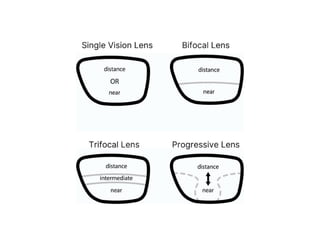
Following spectacles can be prescribed :
1. Single vision reading glasses :
Suited for those with no Distance refractive error.
2. Bifocal glasses
3. Trifocal glasses
4. Progressive focal OR Multifocal glasses
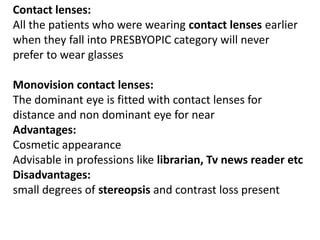
Contact lenses:
All the patients who were wearing contact lenses earlier
when they fall into PRESBYOPIC category will never
prefer to wear glasses
Monovision contact lenses:
The dominant eye is fitted with contact lenses for
distance and non dominant eye for near
Advantages:
Cosmetic appearance
Advisable in professions like librarian, Tv news reader etc
Disadvantages:
small degrees of stereopsis and contrast loss present
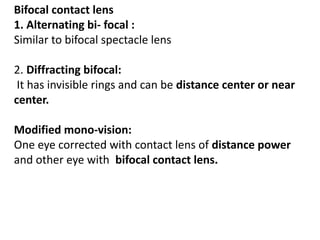
Bifocal contact lens
1. Alternating bi- focal :
Similar to bifocal spectacle lens
2. Diffracting bifocal:
It has invisible rings and can be distance center or near
center.
Modified mono-vision:
One eye corrected with contact lens of distance power
and other eye with bifocal contact lens.
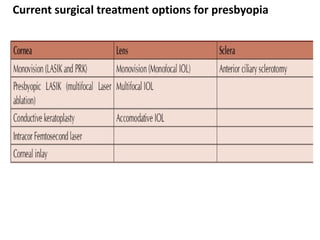
Current surgical treatment options for presbyopia
Corneal procedures:
1. Monovision LASIK and surface ablations (PRK, LASEK,
EpiLASIK)
Monovision has been used to compensate for presbyopia
by optically correcting one eye for distance vision and the
other eye for near vision
The amount of target refraction in monovision remains
controversial. Some authors suggest correcting up to
–2.50 D, whereas others suggest not exceeding –2.00D
Success rates for monovision refractive laser
correction have been reported to be high (72 to 92%)
( acc to Farid M, Steinert RF. Patient selection for
monovision laser refractive surgery. Curr Opin
Ophthalmol. 2009;20:251–4.)
Disadvantages:
This strategy induces Anisometropia with consequent
reduction in binocular acuity and stereopsis
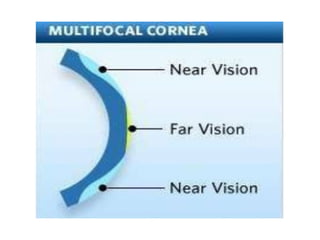
PRESBYOPIC excimer laser ablation:
It is to create Multifocal profiles on cornea by using
excimer laser
Alio et al. reviewed three different approaches that
have been used for corneal multifocality: transitional
multifocality, central presbyLasik (center for near) and
peripheral presbyLasik (peripheral cornea for near) and
concluded that although central
presbyLasik creates a bifocal cornea, the other
techniques inrease the depth of focus based on the
ablation of the peipheral cornea
Drawbacks:
Transitional multifocality creates inentionally an increase
in coma aberration
A neuroadaptation process is necessary for peripheral
presbyopic LASIK
RECENT ADVANCES:
New proprietary ablation pattern (Supracor, Bausch and
Lomb/Technolas, Munich, Germany) was applied using a
profile that steepens the center of the
cornea to create hyperprolate shape resulting about 2D
near addition with controlled higher order aberrations
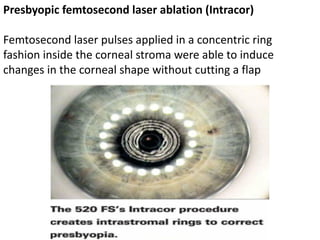
Presbyopic femtosecond laser ablation (Intracor)
Femtosecond laser pulses applied in a concentric ring
fashion inside the corneal stroma were able to induce
changes in the corneal shape without cutting a flap
Procedure :
In this proprietary procedure, the pattern of laser delivery
is entirely intrastromal, without impacting the
endothelium, Descemet’s membrane, Bowman’s layer, or
epithelium at any point throughout the operation,
creating a central steepening of the anterior corneal
surface
Advantages:
No epithelial dissruption
No pain and inflammation related to absence of
epithelium
Quick recovery
No significant regression of visual acuity or further
corneal steepening occurred during the follow-up period.
Disadvantages:
Reduction of mesopic contrast sensitivity
Increase of glare sensitivity
possible consequences on night driving ability should be
discussed with the patients prior to treatment
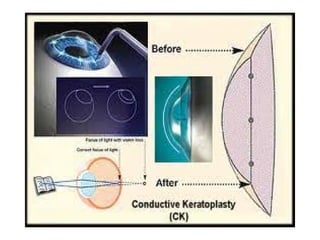
Conductive Keratoplasty:
It is based on radiofrequency energy delivered through a
fine needle tip that is inserted into the peripheral
corneal stroma in a ring pattern.
A series of spots (8-32) are placed in up to three rings of
6-, 7-, 8-mm optical zones in the corneal
periphery.
The shrinkage of collagen between the spots
creates a band of tightening, which results in steepening
of the central cornea
It is applied as a monovision procedure in the non-
dominant eye of presbyopic individuals
Advantages:
Minimally invasive
Office procedure
Cost - effective
Although satisfactory NUCVA was reported initially,
significant regression of refractive and keratometric
effects of CK has been observed over short-, mid- and
long-term follow up period, limiting the usage of this
procedure.
Corneal Inlays:
Currently there are 3 different designs of PRESBYOPIC
corneal Inlays:
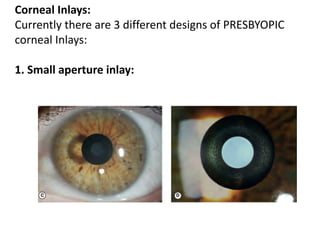
1. Small aperture inlay:
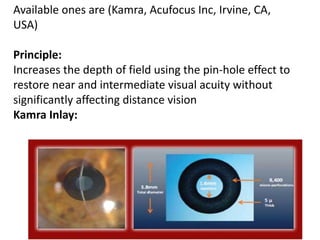
Available ones are (Kamra, Acufocus Inc, Irvine, CA,
USA)
Principle:
Increases the depth of field using the pin-hole effect to
restore near and intermediate visual acuity without
significantly affecting distance vision
Kamra Inlay:
It's placed in the non dominant eye.
Advantages:
Increases depth of field
Recent advances:
The Kamra inlay implantation can be combined
with LASIK improving near vision with a minimal effect
on distance vision, resulting in high patient satisfaction
and less dependence on reading glasses according to a
paper by Tomita et al
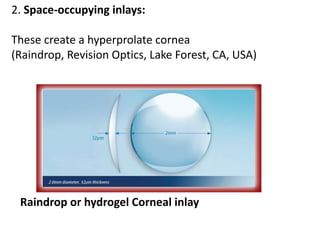
2. Space-occupying inlays:
These create a hyperprolate cornea
(Raindrop, Revision Optics, Lake Forest, CA, USA)
Raindrop or hydrogel Corneal inlay
In the first published paper in a peer-reviewed journal,
Garza et al. concluded that the hydrogel corneal inlay
improved uncorrected near and intermediate visual
acuity in 20 patients with emmetropic presbyopia, with
high patient satisfaction and little effect on distance
visual acuity at 1 year postoperatively.
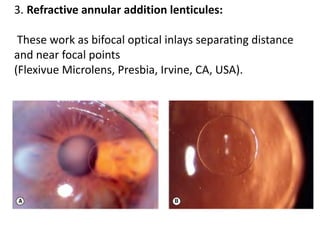
3. Refractive annular addition lenticules:
These work as bifocal optical inlays separating distance
and near focal points
(Flexivue Microlens, Presbia, Irvine, CA, USA).
A great advantage of the corneal inlays is their
potential reversibility
Lens procedures:
Acronyms used include:
Clear lens exchange (CLE)/
Refractive lens exchange (RLE)
PRESBYOPIC lens exchange (PreLEx)
1. Multifocal IOLs:
Principle : Work on refractive and diffractive technology.
can optically restore some reading vision, but reading
glasses still have to be used for some tasks
Disadvantages:
Nocturnal glare
Reduced Contrast sensitivity
Implantation of a Multi-focal IOL is a contra - indication
for holding a private or commercial pilot license and in
military services
2. Accommodative IOL:
Current accommodative IOL designs have either single
double lens systems that are based on the “focus shift”
principle.
Theoretically, the contraction of the ciliary muscle moves
the optic anteriorly, thereby increasing the
dioptric power of the eye
But several studies have disapproved the above principle
SCLERAL PROCEDURES:
1. Anterior Ciliary Sclerotomy:
Anterior ciliary sclerotomy is based on Schachar’s theory
and involves making radial incisions in the sclera
overlying the ciliary muscle.
According to this theory, radial sclerotomies allow
expansion of the sclera overlying the ciliary body,
increasing the space between the lens equator and the
ciliary body.
This may place more resting tension on the equatorial
zonules, allowing for increased tension to develop
during ciliary muscle contraction.
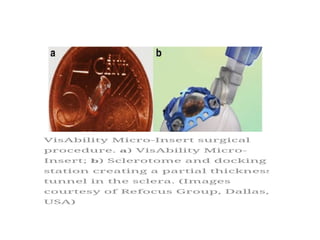
2. Scleral Spacing procedure using PRESVIEW scleral
implants:
The PRESVIEW implant is inserted in scleral tunnel
placed posterior to equator.
The effect of the implant is to allow the lens greater
movement of accommodation
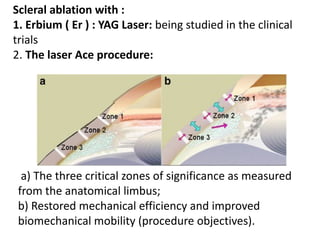
Scleral ablation with :
1. Erbium ( Er ) : YAG Laser: being studied in the clinical
trials
2. The laser Ace procedure:
a) The three critical zones of significance as measured
from the anatomical limbus;
b) Restored mechanical efficiency and improved
biomechanical mobility (procedure objectives).
Visiolite Erbium : Yag laser used to ablate 600micrometre
spots in sclera which are presumed to free the ciliary
muscle contract normally
The spots are delivered in a diamond matrix pattern of 9
laser spots into each oblique quadrant
This effectively increases the focal power and focal depth
Currently this procedure is in stage 3 clinical trial
References :
1. Theory and Practice of Optics and refraction AK
Khurana 2nd edition
2. Clinical Optics 3rd edition A R ELKINTON
3. AAO 2020-21 refractive surgery
4. Cornea - DOS articles Volume 20
5. Refractive Surgery - Kanski's Clinical Ophthalmology
9th edition
6.Hipsley, A., Hall, B. & Rocha, K.M. Scleral surgery for
the treatment of presbyopia: where are we today?. Eye
and Vis 5, 4 (2018)
Thank You

PRESBYOPIA the presentation ophthalmology

  • 1.
    PRESBYOPIA TREATMENT OPTICAL +SURGICAL Presenter : Dr Anoop L Moderator : Dr Soumya Sharath
  • 2.
    Presbyopia : Greek wordmeaning "Old Eyes" It's not an error of refraction but a physiological insufficiency of accomodation due to reduced amplitude, leading to progressive fall in near vision. Begins between 40 and 45 years of age
  • 3.
    General insight on: 1. Accommodation: Its a mechanism by which the eye changes refractive power by altering the shape and position of its crystalline lens. It's a process by which our eyes can focus diverging rays coming from a near object on the retina inorder to see clearly.
  • 4.
    Effect of accomodationon divergent rays entering the eye
  • 5.
    Near point /Punctum Proximum The nearest point at which small objects can be seen clearly is called near point. Far point /Punctum Remotum The farthest point at which object can be seen clearly is called Far point Range of Accommodation : Distance between far point and near point Amplitude of accommodation (A) Difference between diopteric power needed to focus at near point ( P) and to focus at far point (R) A = P-R
  • 7.
    Duanne suggested thefollowing equation for relation of age ( in years) to accommodation (A) A = 15 -0.25 ( Age)
  • 8.
    In an emmetropiceye : Far point is at infinity Near point varies with age: 7 cm at 10 years 25 cm at 40 years 33 cm at 45 years Thus the amount that the eye can alter it's refraction is greatest in childhood and decreases slowly as the age advances untill its lost after the middle age.
  • 9.
    Calculation: At the ageof 10 years , amplitude of accommodation= Diopteric power for near point - Diopteric power for far point 100/7 - 100 / infinity Therefore Amplitude of Accommodation at the age of 10 years : 14
  • 10.
    Since we usuallykeep the book at 25 cms while reading , so we can ready comfortably upto the age of 40 years. After 40 years near point of accommodation recedes beyond the normal reading range This condition of failing Near vision due to age related decrease in amplitude of accommodation or increase in Punctum Proximum is called Presbyopia
  • 11.
    Causes of Presbyopia: 1.Age related changes in lens include: ■ Decrease in elasticity of lens capsule ■ Progressive increase in size and hardness of lens, which is less easily moulded. Causes of premature Presbyopia include: ■ Uncontrolled hypermetropia ■ Premature sclerosis of crystalline lens ■ Generalized debility causing Presenile weakness of ciliary muscles
  • 12.
    Clinical features: Symptoms ofPresbyopia develop when the amount of amplitude required to focus at near exceeds more than half of total amplitude of eye.
  • 13.
    An undercorrected hypermetropeand chronically under- corrected myopia will both develop presbyopic symptoms earlier than an emmetropic patient. Difficulty in near vision: Initially occurs in dim light/evening and later even in good light. Finally near work becomes impossibility. Asthenopic symptoms: Due to fatigue of ciliary muscles on doing near work Intermittent diplopia: Can develop at near due to inter- relationship between accommodation and convergence
  • 14.
    All symptoms ofPresbyopia are aggravated by fatigue, illness, fever or other debilitating conditions.
  • 15.
    Management of Presbyopia: 1.Optical correction of Presbyopia: By supplementing accommodation with convex lens of appropriate power, required for a clear and comfortable near vision. The difference between the distance correction and strength needed for near vision is called as the ADD( PRESBYOPIC ADD)
  • 16.
    Addition Determination canbe done by following methods in routine: 1. Age based 2. Measuring the amplitude of accommodation
  • 17.
    1. Age based: Since amplitude of accommodation is age dependent the presbyopic addition can be estimated arbitrarily based on patients age Hoffsetter's age based Add: The estimations are strictly the starting point and do need to adjust for particular demands
  • 18.
    After the addis determined the range is tested, that is move the chart further and closer reading the smallest line visible. This range should coincide with the required working distance If the patient desires near range away reduce by 0.25 D steps and if closer range is desired then increase in 0.25D steps.
  • 19.
    2. Measure theamplitude of accommodation: Method employed is Dodder's or duanne's method The patient reads the near vision chart (the smallest line visible) and the chart is brought closer till the print blurs. This punctum proximum is converted in diopters ( eg 20cm = 100/20 = 5 Diopters.)
  • 20.
    Based on Amplitudethe ADD is calculated. Determine NPA . Eg. If it is 50cms. The Amplitude of accommodation is 2 Diopters Keep 1/3rd in reserve for comfort so the available accommodation is 1.33 . If the patient desires to read at 33cms.He needs 3.0 diopters(100/33) . Thus the extra add required is 3 - 1.33 i. e 1.67 Diopters
  • 21.
    Adjustment of workingdistance: The power of PRESBYOPIC add should be adjusted by taking into consideration the working distance required by a particular patient and the remaining amplitude. Eg . At the age of 40 with only 3D total amplitude left, the following ADDS give variable working distance and leave comfortable (1/3rd of accommodation ) in reserve • +2.5 D = 25 cm • +1.5 D = 33 cm • + 1 D = 40 cm • + 0.5 D = 50 cm
  • 22.
    Inmportance of workingdistance and individualization of ADDS: Eg 1. A tall person habitually holds the book away to read, so may require lesser addition to have comfortable range further away Eg2. Patients with nuclear cataracts shift towards myopia for distance They are used to higher plus for near may not accept reduced additions.
  • 23.
    ADDS for intermediatedistance: As the ADD increases and the amplitude of accommodation decreases the range of clear vision also decreases. Thus strong reading adds which limit the range of clear normal vision to a small area very near to the patient are a common cause of patient dissatisfaction
  • 24.
    Scenario 45 year oldemmetropic patient works at a distance of 40 cm. His amplitude of accommodation is 3.5 D and is given reading glasses of 0.75 D bilaterally. His range of clear vision through these glasses begins at 1.33 m ( 1/0.75 ) to 0.24 m ( 1/3.5+0.75)
  • 25.
    The same patientreaches 60 years of age with his amplitude of accommodation only 1 D. To read comfortably and clearly at 40cm an add of + 2D is added. His range of clear vision now begins at 0.5 m(1/2) and extends to 0.33 m ( 1/(2+1))
  • 26.
    So this emmetropicpatient can see clearly at distance and at near but his intermediate distance is hampered. So an additional correction for this intermediate distance may be required. These are generally one half of near add. Thus our patient can now see the intermediate distance from 1m to 0.33 m
  • 27.
    Basic principles ofPRESBYOPIC correction: • Find out refractive error for distance at first and correct it . • Find out PRESBYOPIC Add required to each eye and add it to distance correction • The PRESBYOPIC ADD prescribed should leave 1/3rd of accommodation in reserve. • Near point should be fixed by taking due consideration of patient's profession • Weakest convex lens that the individual requires to see clearly should be prescribed. Overcorrection avoided • An additional correction for intermediate distance to be taken into consideration
  • 28.
    Following spectacles canbe prescribed : 1. Single vision reading glasses : Suited for those with no Distance refractive error. 2. Bifocal glasses 3. Trifocal glasses 4. Progressive focal OR Multifocal glasses
  • 31.
    Contact lenses: All thepatients who were wearing contact lenses earlier when they fall into PRESBYOPIC category will never prefer to wear glasses Monovision contact lenses: The dominant eye is fitted with contact lenses for distance and non dominant eye for near Advantages: Cosmetic appearance Advisable in professions like librarian, Tv news reader etc Disadvantages: small degrees of stereopsis and contrast loss present
  • 32.
    Bifocal contact lens 1.Alternating bi- focal : Similar to bifocal spectacle lens 2. Diffracting bifocal: It has invisible rings and can be distance center or near center. Modified mono-vision: One eye corrected with contact lens of distance power and other eye with bifocal contact lens.
  • 33.
    Current surgical treatmentoptions for presbyopia
  • 34.
    Corneal procedures: 1. MonovisionLASIK and surface ablations (PRK, LASEK, EpiLASIK) Monovision has been used to compensate for presbyopia by optically correcting one eye for distance vision and the other eye for near vision The amount of target refraction in monovision remains controversial. Some authors suggest correcting up to –2.50 D, whereas others suggest not exceeding –2.00D
  • 35.
    Success rates formonovision refractive laser correction have been reported to be high (72 to 92%) ( acc to Farid M, Steinert RF. Patient selection for monovision laser refractive surgery. Curr Opin Ophthalmol. 2009;20:251–4.) Disadvantages: This strategy induces Anisometropia with consequent reduction in binocular acuity and stereopsis
  • 36.
    PRESBYOPIC excimer laserablation: It is to create Multifocal profiles on cornea by using excimer laser Alio et al. reviewed three different approaches that have been used for corneal multifocality: transitional multifocality, central presbyLasik (center for near) and peripheral presbyLasik (peripheral cornea for near) and concluded that although central presbyLasik creates a bifocal cornea, the other techniques inrease the depth of focus based on the ablation of the peipheral cornea
  • 37.
    Drawbacks: Transitional multifocality createsinentionally an increase in coma aberration A neuroadaptation process is necessary for peripheral presbyopic LASIK
  • 38.
    RECENT ADVANCES: New proprietaryablation pattern (Supracor, Bausch and Lomb/Technolas, Munich, Germany) was applied using a profile that steepens the center of the cornea to create hyperprolate shape resulting about 2D near addition with controlled higher order aberrations
  • 40.
    Presbyopic femtosecond laserablation (Intracor) Femtosecond laser pulses applied in a concentric ring fashion inside the corneal stroma were able to induce changes in the corneal shape without cutting a flap
  • 41.
    Procedure : In thisproprietary procedure, the pattern of laser delivery is entirely intrastromal, without impacting the endothelium, Descemet’s membrane, Bowman’s layer, or epithelium at any point throughout the operation, creating a central steepening of the anterior corneal surface
  • 42.
    Advantages: No epithelial dissruption Nopain and inflammation related to absence of epithelium Quick recovery No significant regression of visual acuity or further corneal steepening occurred during the follow-up period.
  • 43.
    Disadvantages: Reduction of mesopiccontrast sensitivity Increase of glare sensitivity possible consequences on night driving ability should be discussed with the patients prior to treatment
  • 44.
    Conductive Keratoplasty: It isbased on radiofrequency energy delivered through a fine needle tip that is inserted into the peripheral corneal stroma in a ring pattern. A series of spots (8-32) are placed in up to three rings of 6-, 7-, 8-mm optical zones in the corneal periphery. The shrinkage of collagen between the spots creates a band of tightening, which results in steepening of the central cornea
  • 46.
    It is appliedas a monovision procedure in the non- dominant eye of presbyopic individuals Advantages: Minimally invasive Office procedure Cost - effective Although satisfactory NUCVA was reported initially, significant regression of refractive and keratometric effects of CK has been observed over short-, mid- and long-term follow up period, limiting the usage of this procedure.
  • 47.
    Corneal Inlays: Currently thereare 3 different designs of PRESBYOPIC corneal Inlays: 1. Small aperture inlay:
  • 48.
    Available ones are(Kamra, Acufocus Inc, Irvine, CA, USA) Principle: Increases the depth of field using the pin-hole effect to restore near and intermediate visual acuity without significantly affecting distance vision Kamra Inlay:
  • 49.
    It's placed inthe non dominant eye. Advantages: Increases depth of field Recent advances: The Kamra inlay implantation can be combined with LASIK improving near vision with a minimal effect on distance vision, resulting in high patient satisfaction and less dependence on reading glasses according to a paper by Tomita et al
  • 50.
    2. Space-occupying inlays: Thesecreate a hyperprolate cornea (Raindrop, Revision Optics, Lake Forest, CA, USA) Raindrop or hydrogel Corneal inlay
  • 51.
    In the firstpublished paper in a peer-reviewed journal, Garza et al. concluded that the hydrogel corneal inlay improved uncorrected near and intermediate visual acuity in 20 patients with emmetropic presbyopia, with high patient satisfaction and little effect on distance visual acuity at 1 year postoperatively.
  • 52.
    3. Refractive annularaddition lenticules: These work as bifocal optical inlays separating distance and near focal points (Flexivue Microlens, Presbia, Irvine, CA, USA).
  • 53.
    A great advantageof the corneal inlays is their potential reversibility
  • 54.
    Lens procedures: Acronyms usedinclude: Clear lens exchange (CLE)/ Refractive lens exchange (RLE) PRESBYOPIC lens exchange (PreLEx)
  • 55.
    1. Multifocal IOLs: Principle: Work on refractive and diffractive technology. can optically restore some reading vision, but reading glasses still have to be used for some tasks Disadvantages: Nocturnal glare Reduced Contrast sensitivity Implantation of a Multi-focal IOL is a contra - indication for holding a private or commercial pilot license and in military services
  • 56.
    2. Accommodative IOL: Currentaccommodative IOL designs have either single double lens systems that are based on the “focus shift” principle. Theoretically, the contraction of the ciliary muscle moves the optic anteriorly, thereby increasing the dioptric power of the eye But several studies have disapproved the above principle
  • 57.
    SCLERAL PROCEDURES: 1. AnteriorCiliary Sclerotomy: Anterior ciliary sclerotomy is based on Schachar’s theory and involves making radial incisions in the sclera overlying the ciliary muscle. According to this theory, radial sclerotomies allow expansion of the sclera overlying the ciliary body, increasing the space between the lens equator and the ciliary body. This may place more resting tension on the equatorial zonules, allowing for increased tension to develop during ciliary muscle contraction.
  • 58.
    2. Scleral Spacingprocedure using PRESVIEW scleral implants: The PRESVIEW implant is inserted in scleral tunnel placed posterior to equator. The effect of the implant is to allow the lens greater movement of accommodation
  • 60.
    Scleral ablation with: 1. Erbium ( Er ) : YAG Laser: being studied in the clinical trials 2. The laser Ace procedure: a) The three critical zones of significance as measured from the anatomical limbus; b) Restored mechanical efficiency and improved biomechanical mobility (procedure objectives).
  • 61.
    Visiolite Erbium :Yag laser used to ablate 600micrometre spots in sclera which are presumed to free the ciliary muscle contract normally The spots are delivered in a diamond matrix pattern of 9 laser spots into each oblique quadrant This effectively increases the focal power and focal depth Currently this procedure is in stage 3 clinical trial
  • 62.
    References : 1. Theoryand Practice of Optics and refraction AK Khurana 2nd edition 2. Clinical Optics 3rd edition A R ELKINTON 3. AAO 2020-21 refractive surgery 4. Cornea - DOS articles Volume 20 5. Refractive Surgery - Kanski's Clinical Ophthalmology 9th edition 6.Hipsley, A., Hall, B. & Rocha, K.M. Scleral surgery for the treatment of presbyopia: where are we today?. Eye and Vis 5, 4 (2018)
  • 63.