Presbyopia : Refraction and
Management Guidelines
Moderators Presenter
Dr. Sanjeev Bhattarai Archana Sharma
Suraj Chhetri B. Optometry
Third Year
Objectives
•To describe different methods used in refraction for
presbyopia
•To explain about different management techniques
for presbyopia
Presentation layout
•Introduction
•Types of presbyopia
•Risk factors
•Symptoms and signs
•Methods of determining near add
•Refractive error and presbyopia
•Management of presbyopia
Introduction
•Presbyopia (from Greek presbys = old man
+ ops = see like, sight)
•Gradual, irreversible decrease in amplitude of
accommodation as expected with age
•Normal physiological state
•Eye exhibits a progressively diminished ability to
focus on near objects
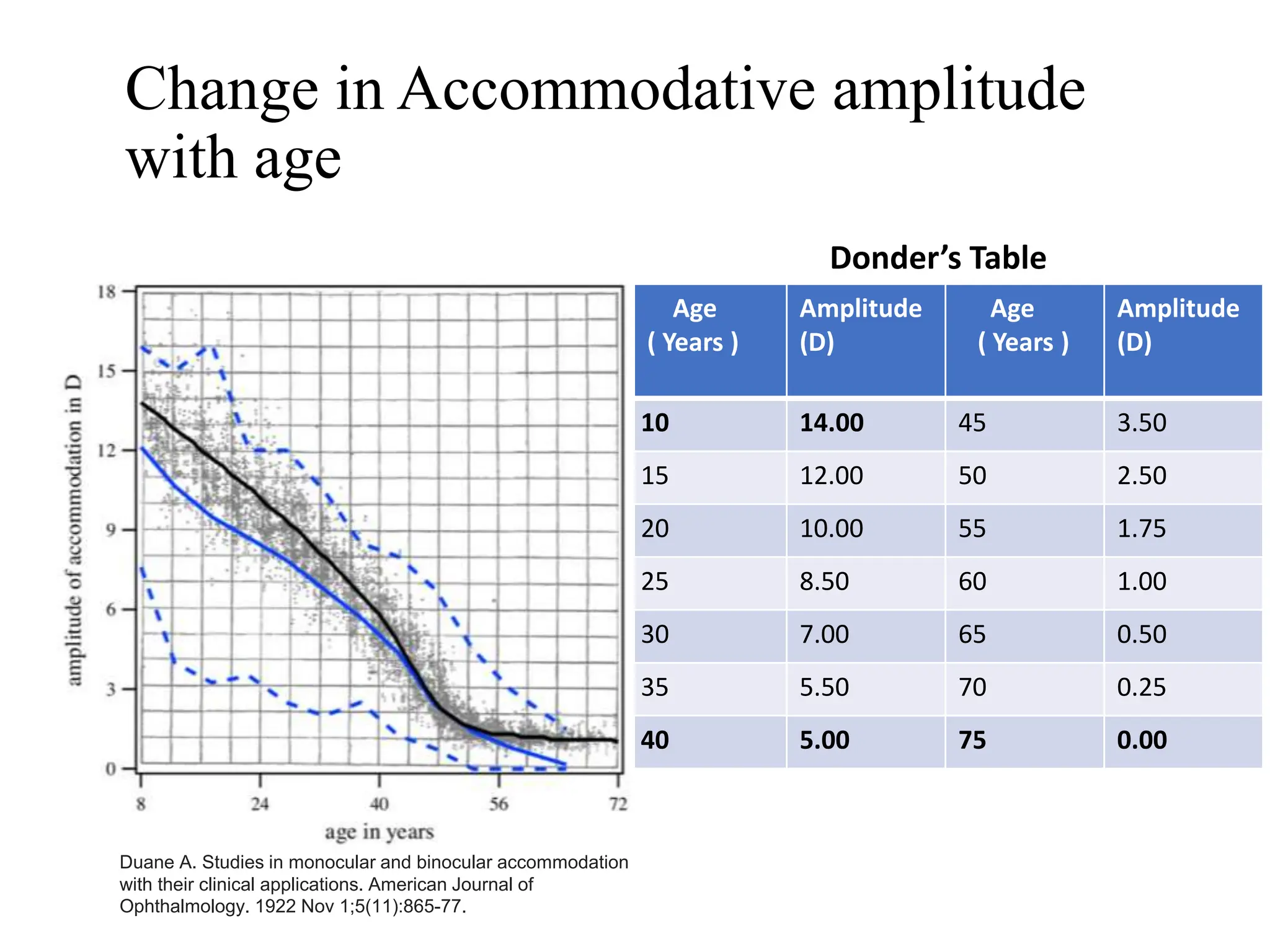
Change in Accommodative amplitude
with age
Age
( Years )
Amplitude
(D)
Age
( Years )
Amplitude
(D)
10 14.00 45 3.50
15 12.00 50 2.50
20 10.00 55 1.75
25 8.50 60 1.00
30 7.00 65 0.50
35 5.50 70 0.25
40 5.00 75 0.00
Donder’s Table
Duane A. Studies in monocular and binocular accommodation
with their clinical applications. American Journal of
Ophthalmology. 1922 Nov 1;5(11):865-77.
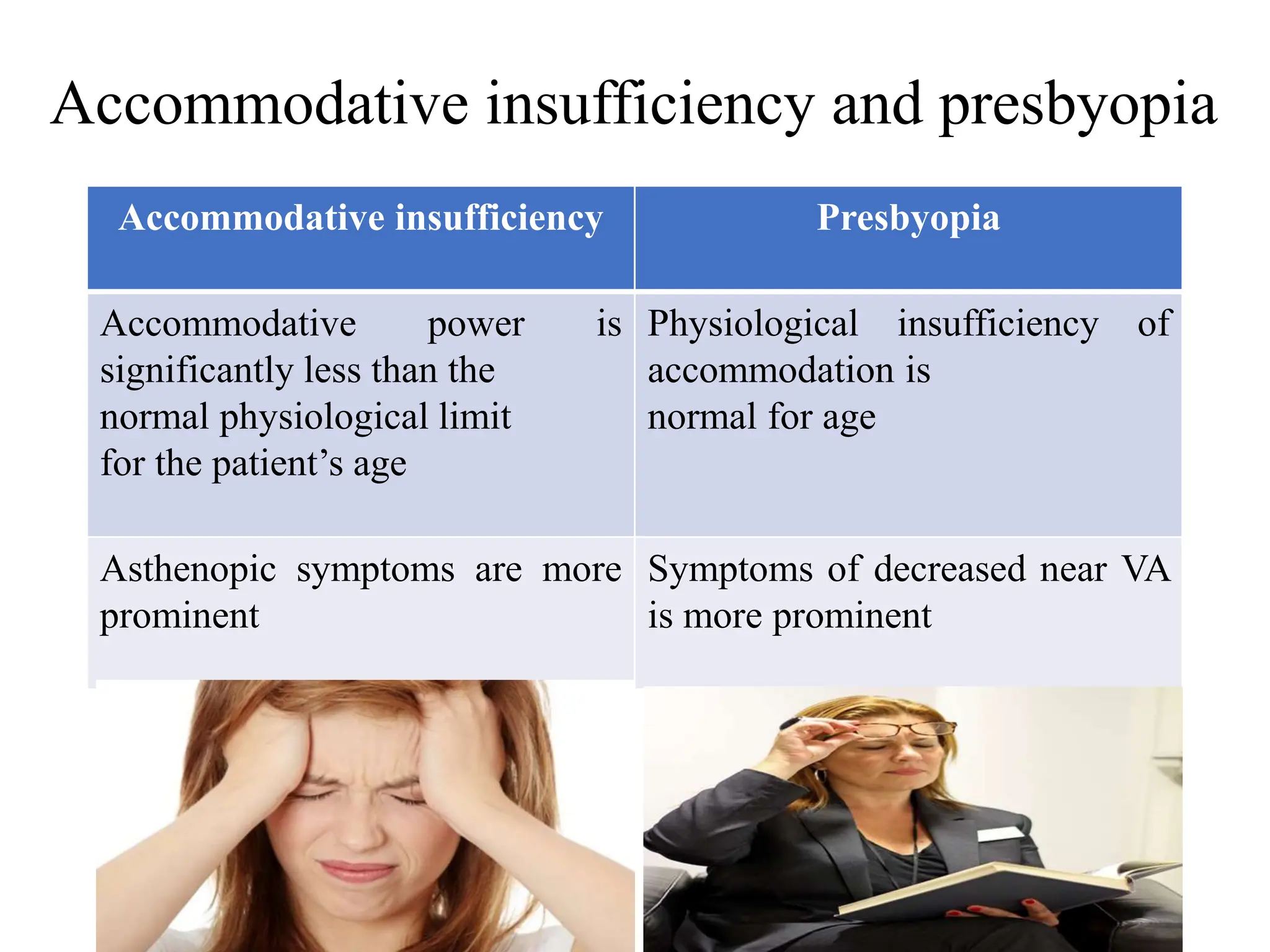
Accommodative insufficiency and presbyopia
Accommodative insufficiency Presbyopia
Accommodative power is
significantly less than the
normal physiological limit
for the patient’s age
Physiological insufficiency of
accommodation is
normal for age
Asthenopic symptoms are more
prominent
Symptoms of decreased near VA
is more prominent
Prevalence
• Worldwide 1.9 billion people with presbyopia in 2020
• Expected to peak at approximately 2.1 billion in 20301
1
1Global Prevalence of Presbyopia and Vision Impairment from Uncorrected Presbyopia: Systematic Review, Meta-
analysis, and Modelling ,October 2018
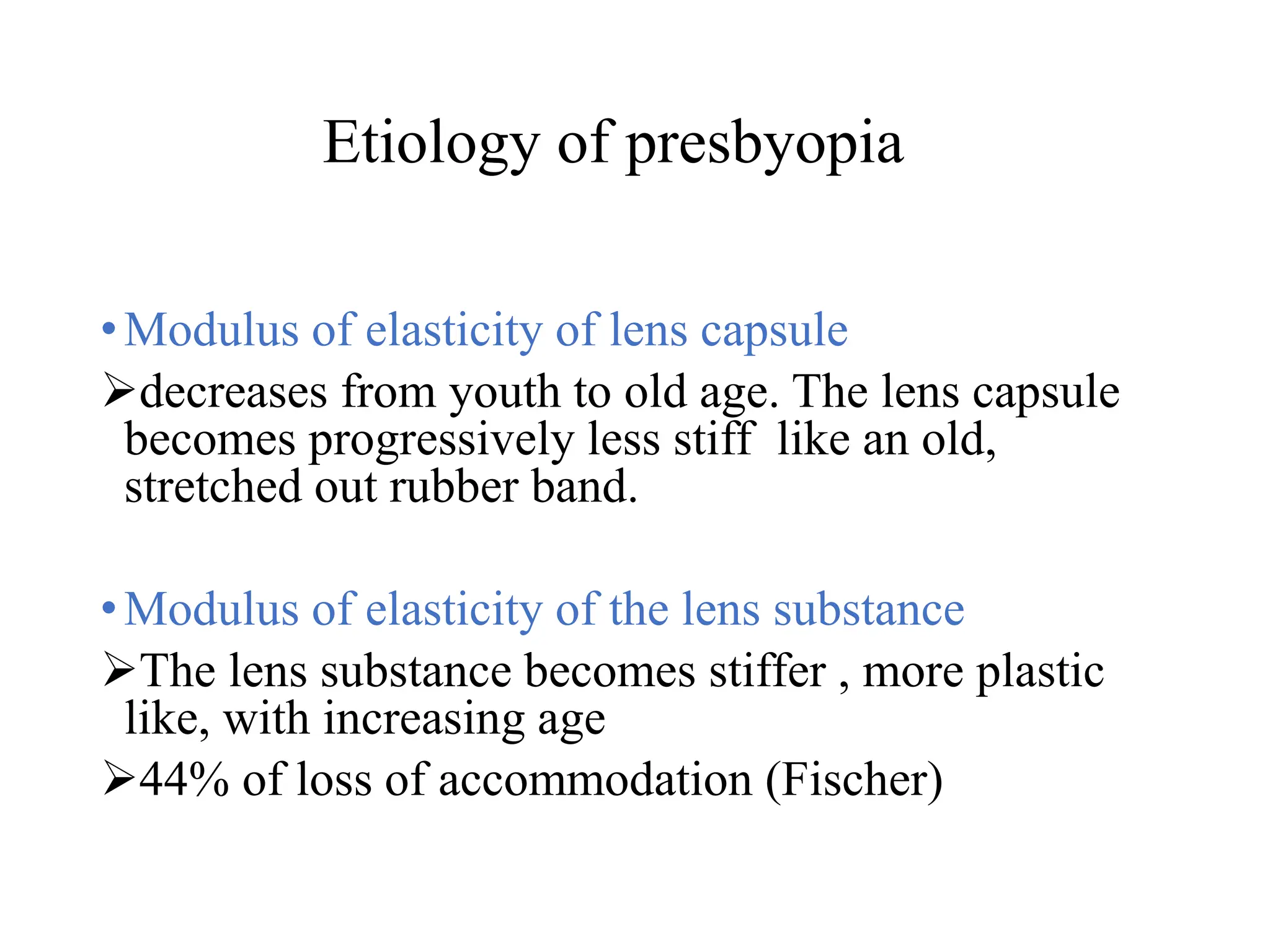
Etiology of presbyopia
•Modulus of elasticity of lens capsule
decreases from youth to old age. The lens capsule
becomes progressively less stiff like an old,
stretched out rubber band.
•Modulus of elasticity of the lens substance
The lens substance becomes stiffer , more plastic
like, with increasing age
44% of loss of accommodation (Fischer)
Etiology
•Lens size/Volume
 increases progressively with age that makes lens
capsule function less effective.
The increased lens size/volume and the decreased
elasticity of lens capsule contributed to 55% of the
loss of accommodation. (Fischer)
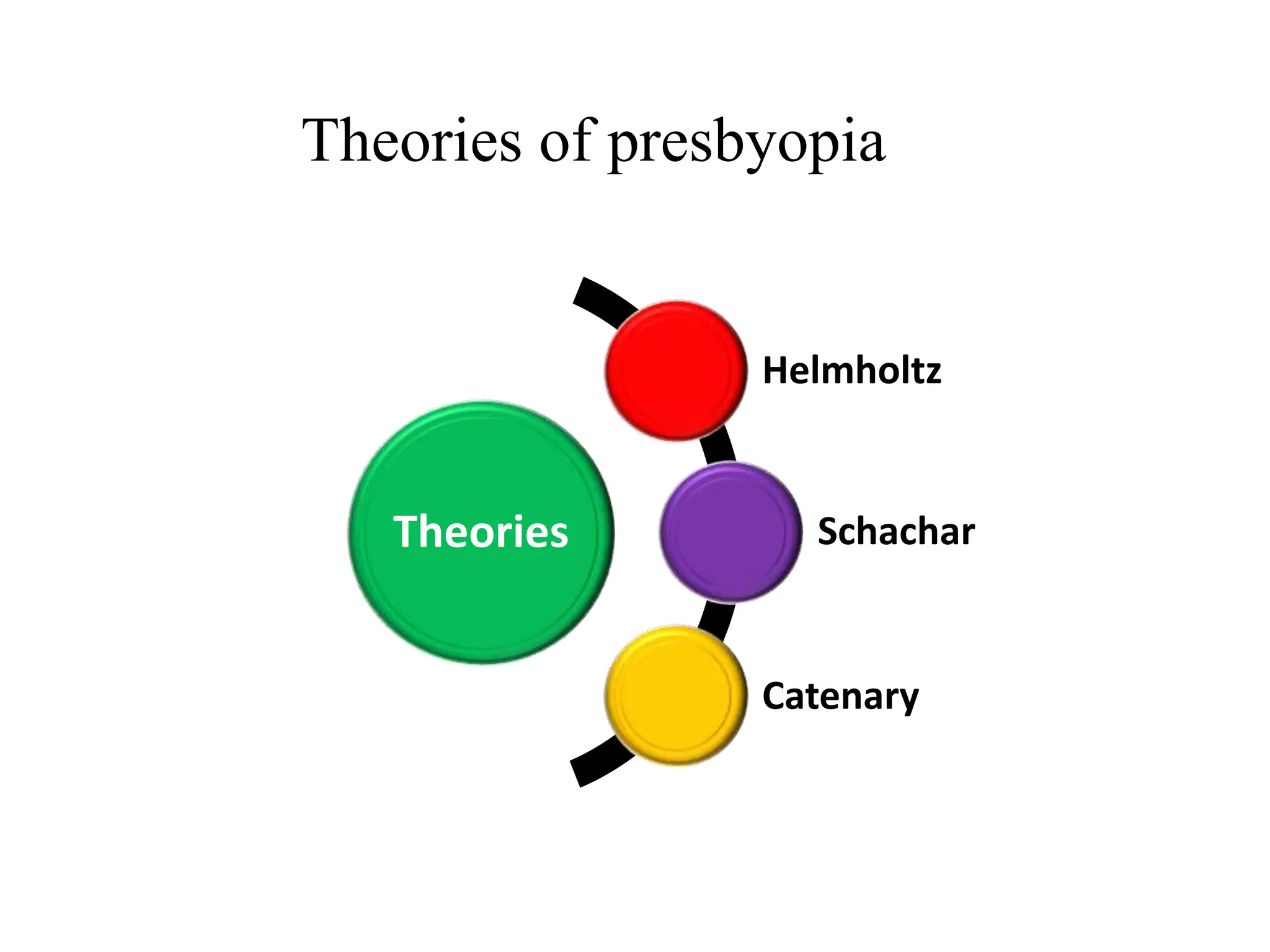
Theories of presbyopia
Theories
Helmholtz
Schachar
Catenary
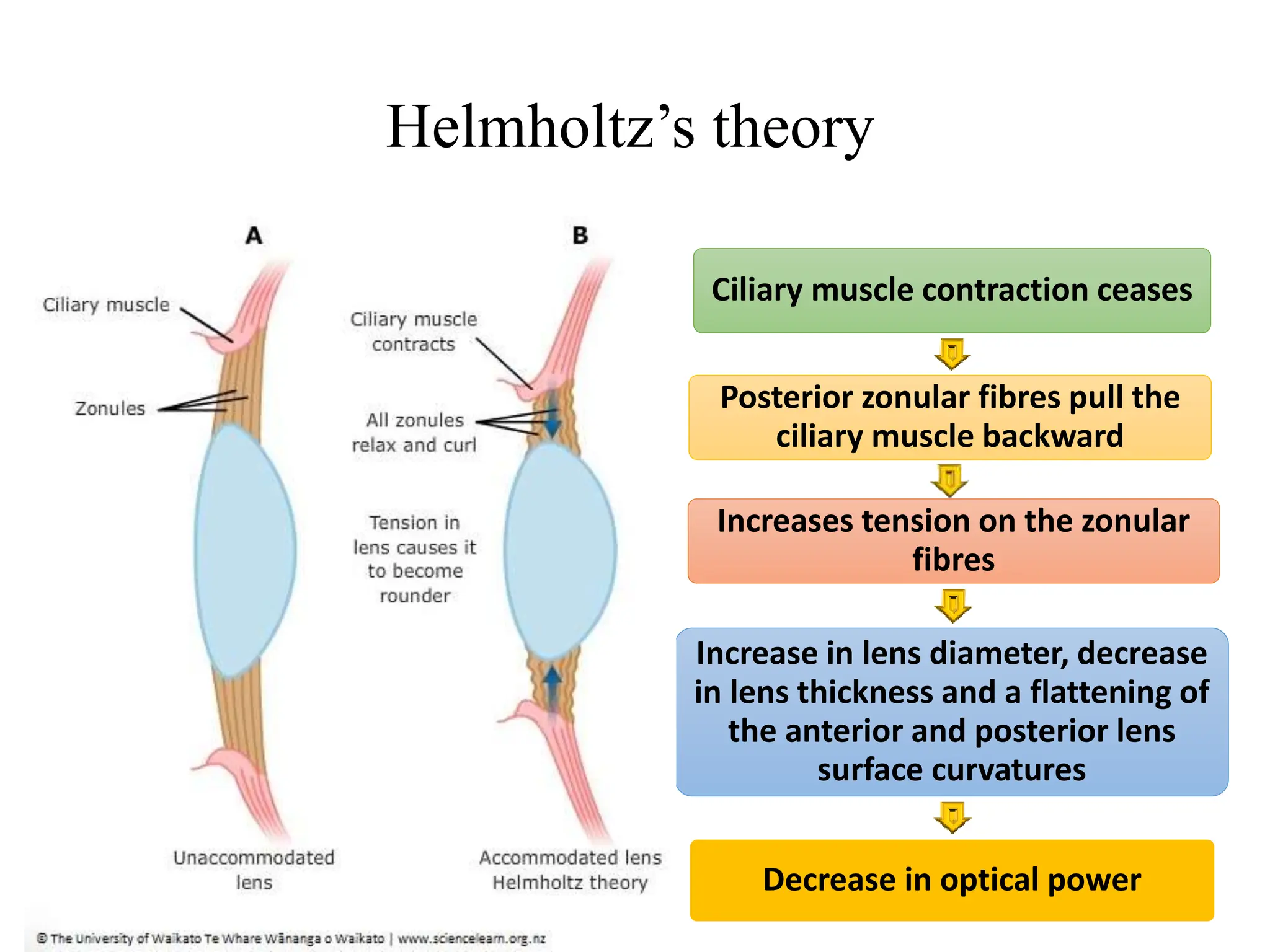
Helmholtz’s theory
Ciliary muscle contraction ceases
Posterior zonular fibres pull the
ciliary muscle backward
Increases tension on the zonular
fibres
Increase in lens diameter, decrease
in lens thickness and a flattening of
the anterior and posterior lens
surface curvatures
Decrease in optical power
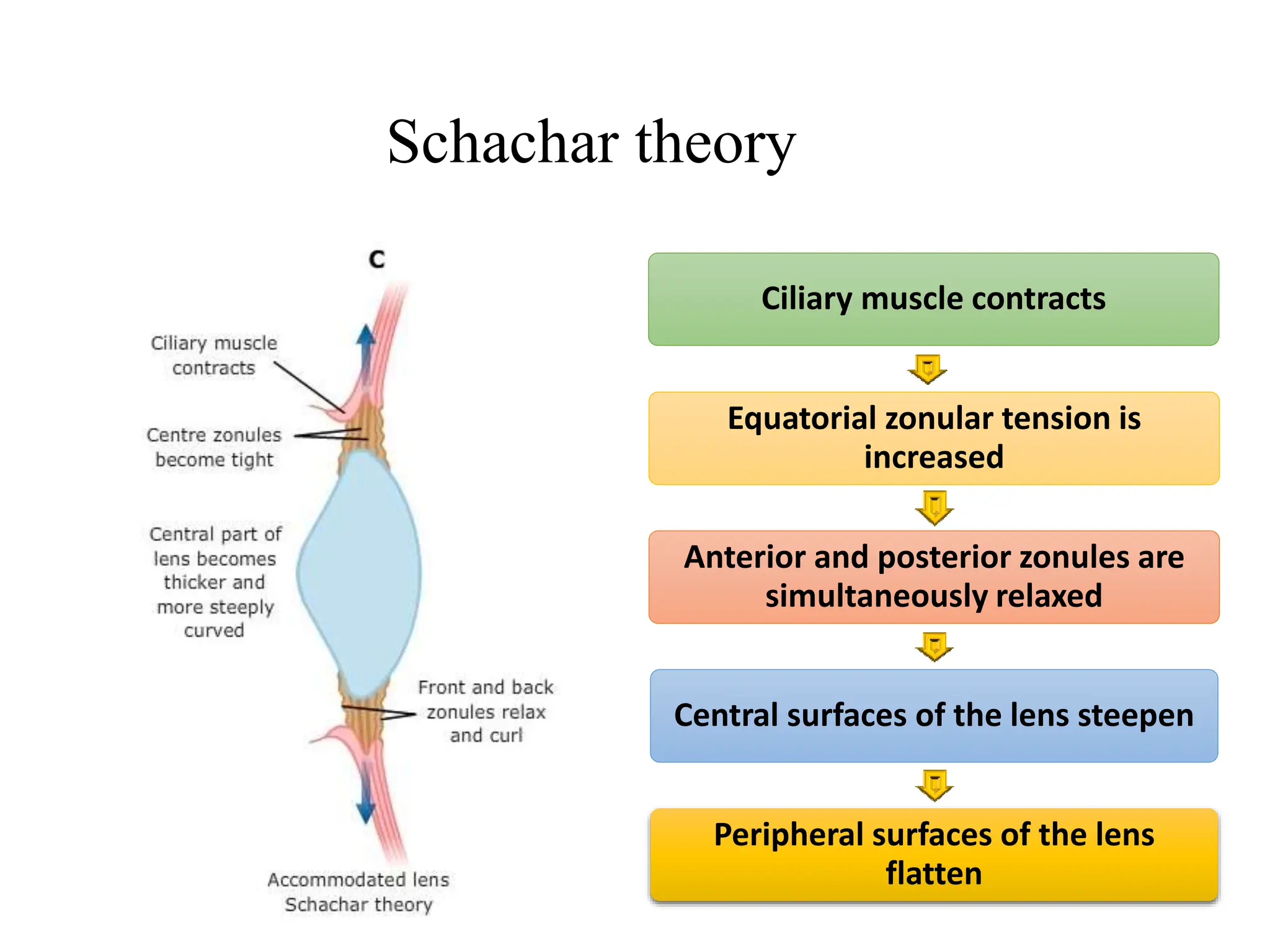
Schachar theory
Ciliary muscle contracts
Equatorial zonular tension is
increased
Anterior and posterior zonules are
simultaneously relaxed
Central surfaces of the lens steepen
Peripheral surfaces of the lens
flatten
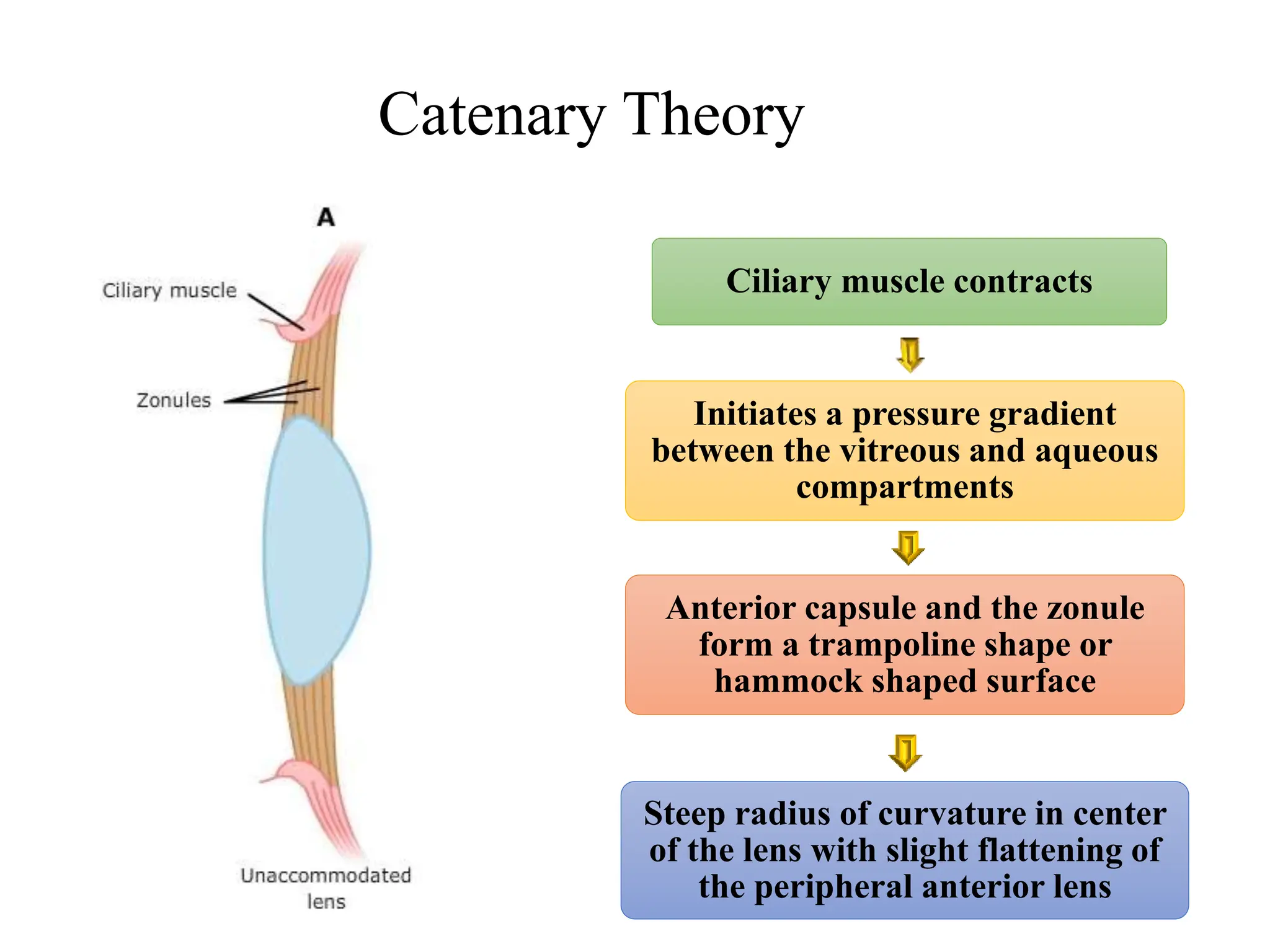
Catenary Theory
Ciliary muscle contracts
Initiates a pressure gradient
between the vitreous and aqueous
compartments
Anterior capsule and the zonule
form a trampoline shape or
hammock shaped surface
Steep radius of curvature in center
of the lens with slight flattening of
the peripheral anterior lens
Types of presbyopia
Presbyopia
Functional
Incipient
Premature Nocturnal
Manifest
Absolute
Types of Presbyopia
1. Incipient presbyopia
•Borderline, beginning, early or pre-presbyopia
•Earliest stage when symptoms or difficulty are first
encountered in near vision
Types of Presbyopia
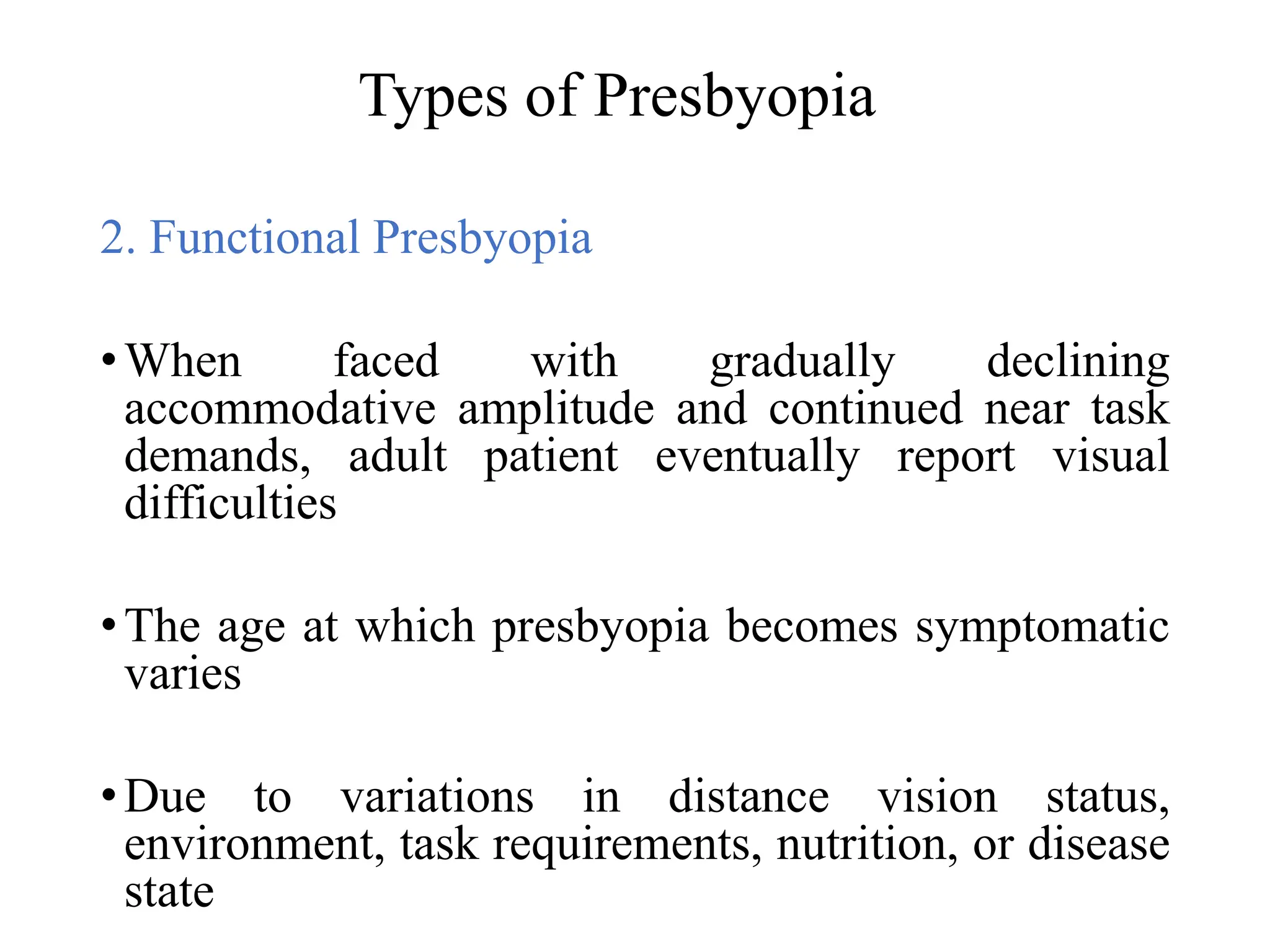
2. Functional Presbyopia
•When faced with gradually declining
accommodative amplitude and continued near task
demands, adult patient eventually report visual
difficulties
•The age at which presbyopia becomes symptomatic
varies
•Due to variations in distance vision status,
environment, task requirements, nutrition, or disease
state
Types of Presbyopia
3. Premature presbyopia
•Presbyopia occuring at an earlier age than expected
for normal population
•Usually associated with ocular diseases , uncorrected
hyperopia
Types of Presbyopia
4. Nocturnal Presbyopia
Near vision difficulties result from an apparent
decrease in the accommodative amplitude in dim light
5. Manifest presbyopia
Presbyopia with some amplitude of accommodation
present
6. Absolute presbyopia
Presbyopia with amplitude of accommodation
completely absent
Risk factors
•Age
•Hyperopia
•Occupation
•Gender
•Ocular disease
•Drugs
•Iatrogenic factors
•Geographic factors
Symptoms
•Blurred vision at customary near working distance
•Ocular discomfort
•Headache and asthenopia
•Fatigue or drowsiness from near work
•Increased working distance
•Transient diplopia
Signs
•Reduced amplitude of accommodation
•Recession of near point of accommodation
Basic principles
•Find refractive error for distance and correct it first
•Find presbyopic correction needed in each eye
separately and add it to distance correction
•Near point should be taken consideration according
to profession of patient
Basic principles
•Over correction should be avoided
•Additional correction for intermediate distance may
be required
•Presbyopic add should leave certain percentage of
amplitude of accommodation (AA) in reserve
Accommodation amplitude in reserve (AA)
Amount of a new addition should permit a certain
percentage of amplitude of accommodation to
remain in reserve
Rule-of-thumb
- Leaving ½ of the AA in reserve
(Lawrence and Maxwell)
- Leaving ⅓ of the AA in reserve
(Sheard and Giles)
Methods of determining near add
1. Addition based on amplitude of accommodation
2. Tentative addition based on age
3. Plus build-up method
4. Bichrome method
5. Cross-cylinder method
6. Relative accommodation method
7. Dynamic Retinoscopy
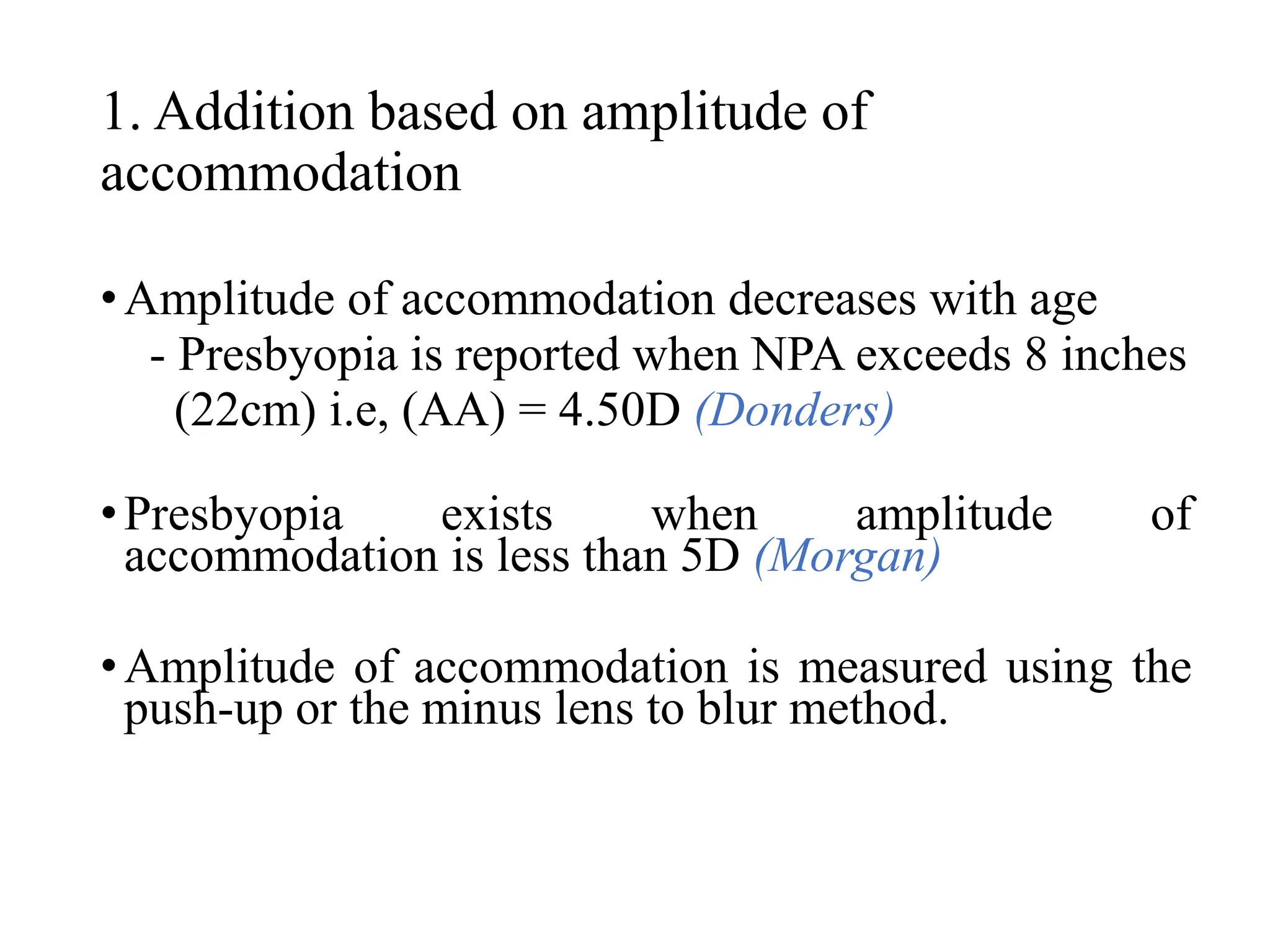
1. Addition based on amplitude of
accommodation
•Amplitude of accommodation decreases with age
- Presbyopia is reported when NPA exceeds 8 inches
(22cm) i.e, (AA) = 4.50D (Donders)
•Presbyopia exists when amplitude of
accommodation is less than 5D (Morgan)
•Amplitude of accommodation is measured using the
push-up or the minus lens to blur method.
Addition based on amplitude of
accommodation
Example 1 : Working distance (WD)= 40cm
RAF (AA) = 2.00D
What should be the near addition
Accommodation required for WD = 2.50 D
Accommodation in Reserve = 1.00D
Amount of accommodation left = 1.00D
Amount of Near addition = (2.50 –1.00)
= +1.50D
Addition based on amplitude of
accommodation
Example 2 :
Working distance (WD)= 25cm
RAF (AA) = 1.50D
What should be the near addition
Accommodation required for WD = 4.00 D
Accommodation in Reserve = 0.50D
Amount of accommodation left = 1.00D
Amount of Near addition = (4.00 –1.00)
= +3.00D
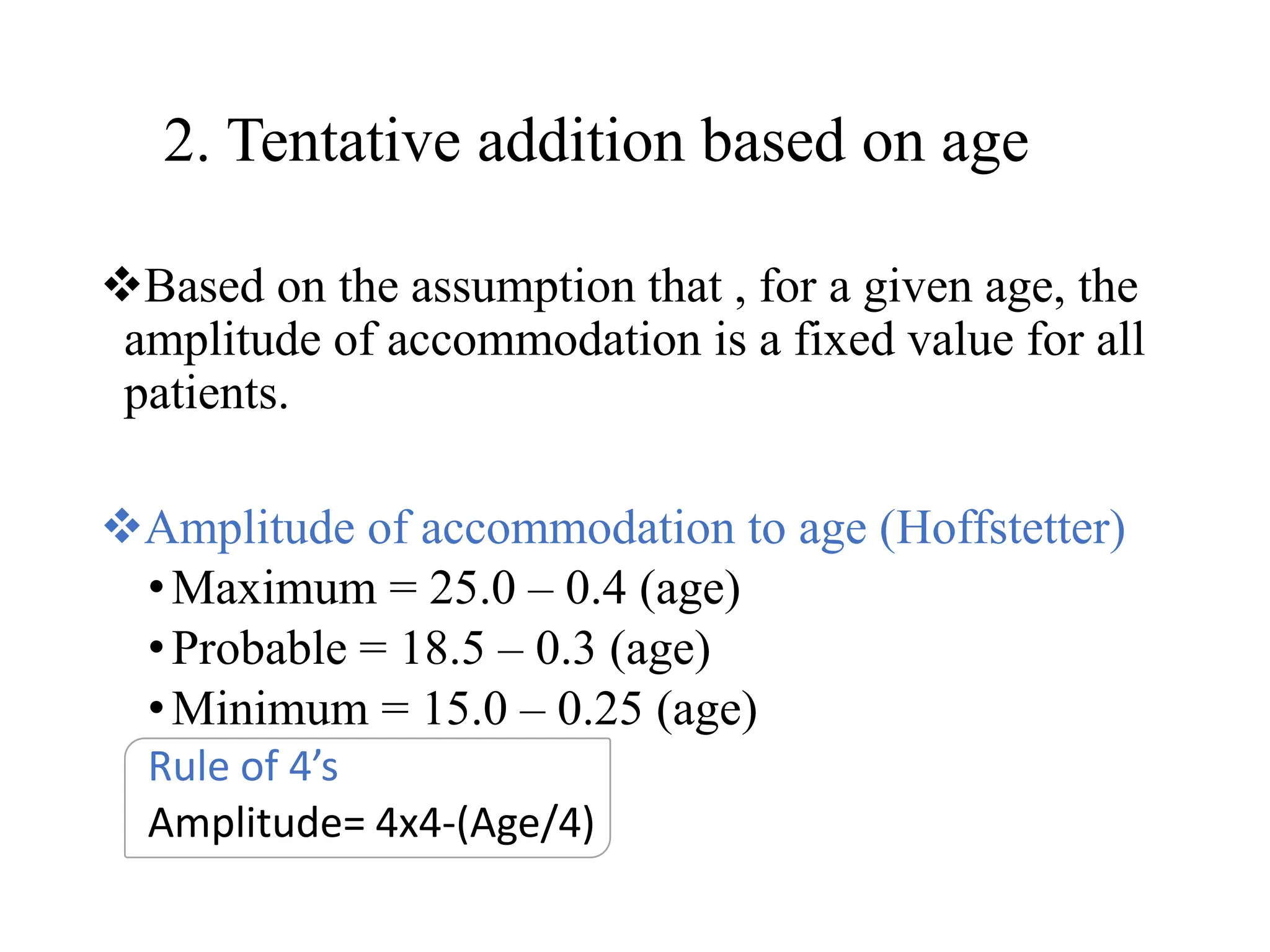
2. Tentative addition based on age
Based on the assumption that , for a given age, the
amplitude of accommodation is a fixed value for all
patients.
Amplitude of accommodation to age (Hoffstetter)
•Maximum = 25.0 – 0.4 (age)
•Probable = 18.5 – 0.3 (age)
•Minimum = 15.0 – 0.25 (age)
Rule of 4’s
Amplitude= 4x4-(Age/4)
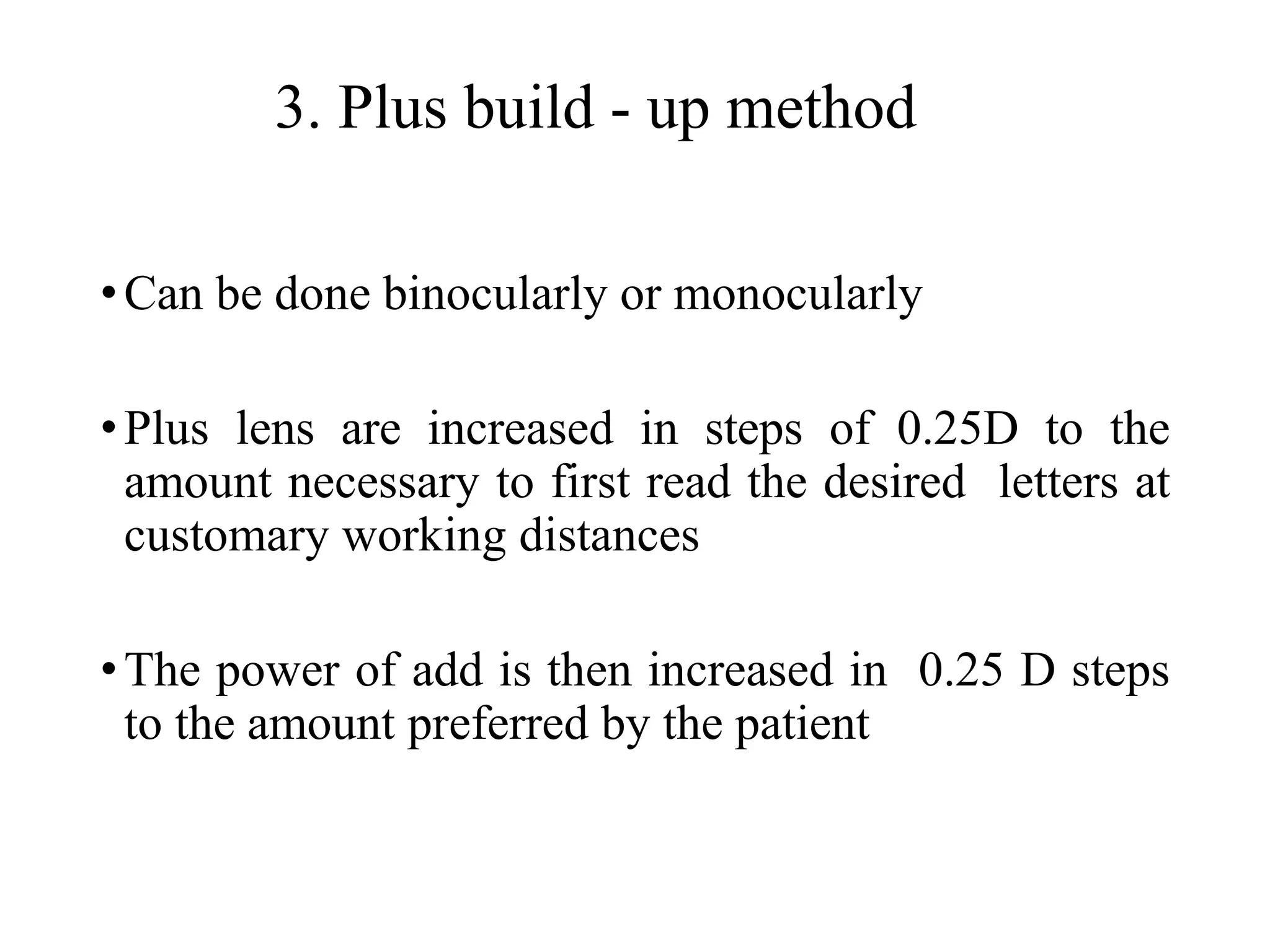
3. Plus build - up method
•Can be done binocularly or monocularly
•Plus lens are increased in steps of 0.25D to the
amount necessary to first read the desired letters at
customary working distances
•The power of add is then increased in 0.25 D steps
to the amount preferred by the patient
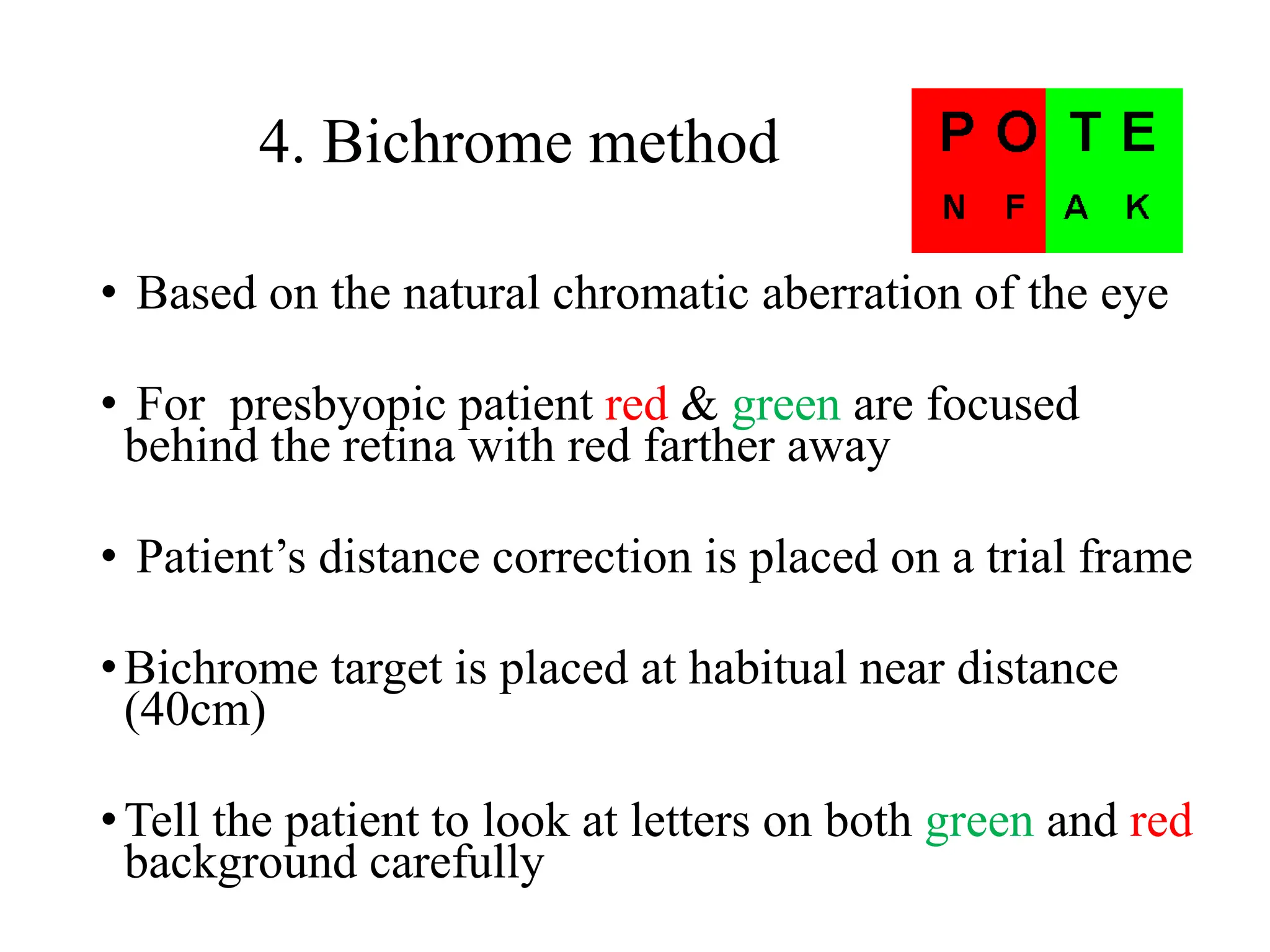
4. Bichrome method
• Based on the natural chromatic aberration of the eye
• For presbyopic patient red & green are focused
behind the retina with red farther away
• Patient’s distance correction is placed on a trial frame
•Bichrome target is placed at habitual near distance
(40cm)
•Tell the patient to look at letters on both green and red
background carefully
Bichrome method
• Ask the patient which side has the sharper and
clearer letters
- Green clear : add plus in 0.25 step
- Red clear : remove plus
- until patient sees letters
equally clear in both
background
5. Cross – cylinder method
Target containing 4 to 5 vertical and horizontal
lines is presented to the patient
Can be done monocularly or binocularly
Place the best distance correction on the phoropter
(trial frame)
Put the cross cylinder grid at customary near
working distance (40cm) of the patient
Cross Cylinder method
•If patient is unable to see the lines initially, sufficient
plus lens power is added until the lines are
recognized so that horizontal and vertical lines
appear equally blacker
•Place the JCC in front of both of the patient’s eyes,
with the minus cylinder axis at 900 (Red marks
vertical) (+0.50DS/-1.00DC x 090)
Cross- cylinder method
•Cross cylinder creates artificial astigmatism with an
interval of Sturm of 1.00D
•If patient accommodates exactly for the target, both
sets of lines are equally clear
•If patient under-accommodates, the horizontal lines
appear clear ( add plus )
•If vertical lines are clear ( reduce plus )
6. Relative Accommodation method
•Based on the concept of placing the accommodative
demand in the middle of the range of relative
accommodation
•To measure NRA and PRA,
- Patient’s distance refraction and a tentative add is
placed in the phoropter (Trial frame)
- the near point test card (N6 target) is placed at the
reading distance (usually 40 cm)
Relative Accommodation method
•NRA is determined by adding plus power lenses
binocularly until the patient is no longer able to read
the fine print on the test card
• PRA is determined by adding minus power lenses
until the patient is no longer able to read the fine
print
• Near add = (NRA+PRA)/2
7. Dynamic Retinoscopy
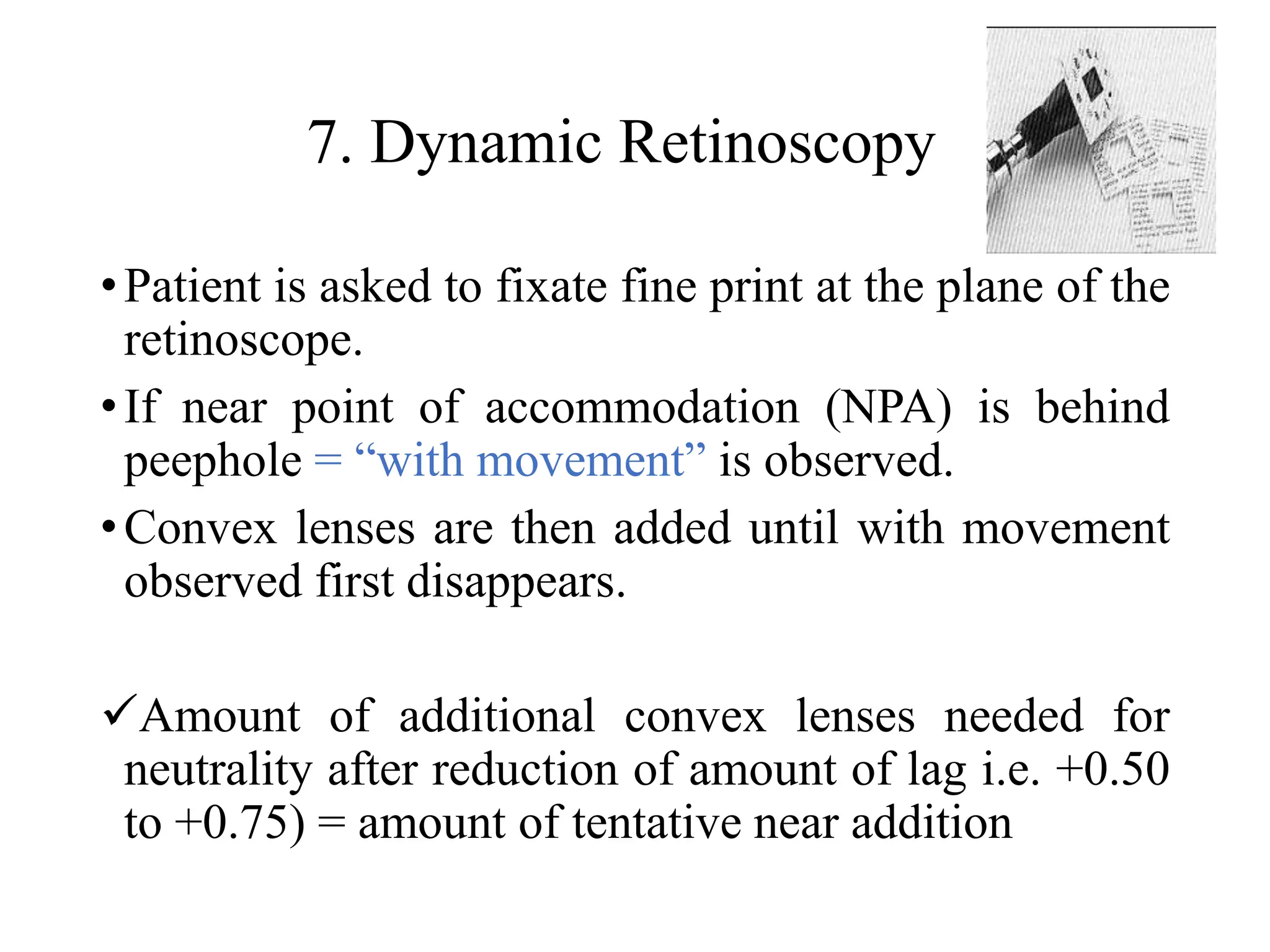
•Patient is asked to fixate fine print at the plane of the
retinoscope.
•If near point of accommodation (NPA) is behind
peephole = “with movement” is observed.
•Convex lenses are then added until with movement
observed first disappears.
Amount of additional convex lenses needed for
neutrality after reduction of amount of lag i.e. +0.50
to +0.75) = amount of tentative near addition
Comparing methods of determining
addition in presbyopes
•All the techniques display similar behavior and
provide a tentative addition close to the final
addition
•Among the methods used, the age-expected
procedure is recommended, as this technique
produce results that correlate best with the final add
•Likelihood of error is high and supports the idea that
any tentative add has to be adjusted according to the
particular needs of each patient
CLINICAL AND EXPERIMENTAL OPTOMETRY 2008; B. Antona, F. Barra, A. Barrio, A. Gutierrez, E. Piedrahita, Y. Martin
Department of Optics II, Universidad Complutense, Madrid, Spain
Determination of Final Add
•Customary near working distance
•Nature of the near work
•Physical nature of the patient
•Illumination level
•Status of the accommodation-convergence
relationship
•Change in the amount of the addition
Relation with Refractive error
• Hyperope
- Near point is considerably further than emmetropes
-Thus effectively become presbyopic few years
earlier than myopes or emmetropes.
• Myope
- Develop presbyopia later in life
- Better to take off distance prescription for near work
Relation to refractive error
Anisometropic distance correction
•Unequal adds may also be prescribed
•Measure the ranges monocularly
•Bifocals may produce reading discomfort because of
an induced vertical prismatic effect in the reading
position
•Specially designed slab-off lenses or single vision
reading glasses may be required
Management of Presbyopia
1. Spectacles 2. Contact Lens
3. Surgery 4. Pharmacological treatment
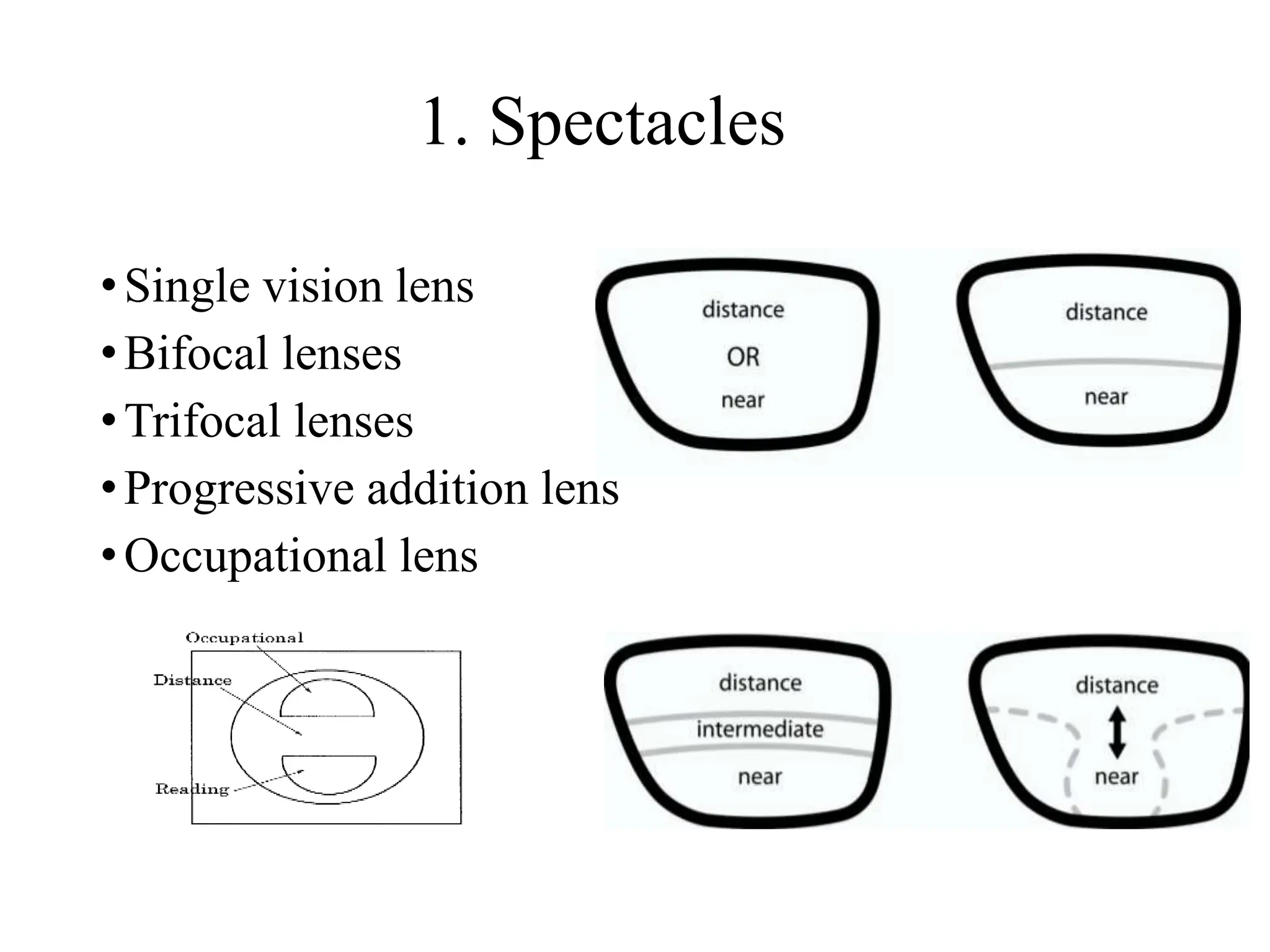
1. Spectacles
•Single vision lens
•Bifocal lenses
•Trifocal lenses
•Progressive addition lens
•Occupational lens
Bifocals
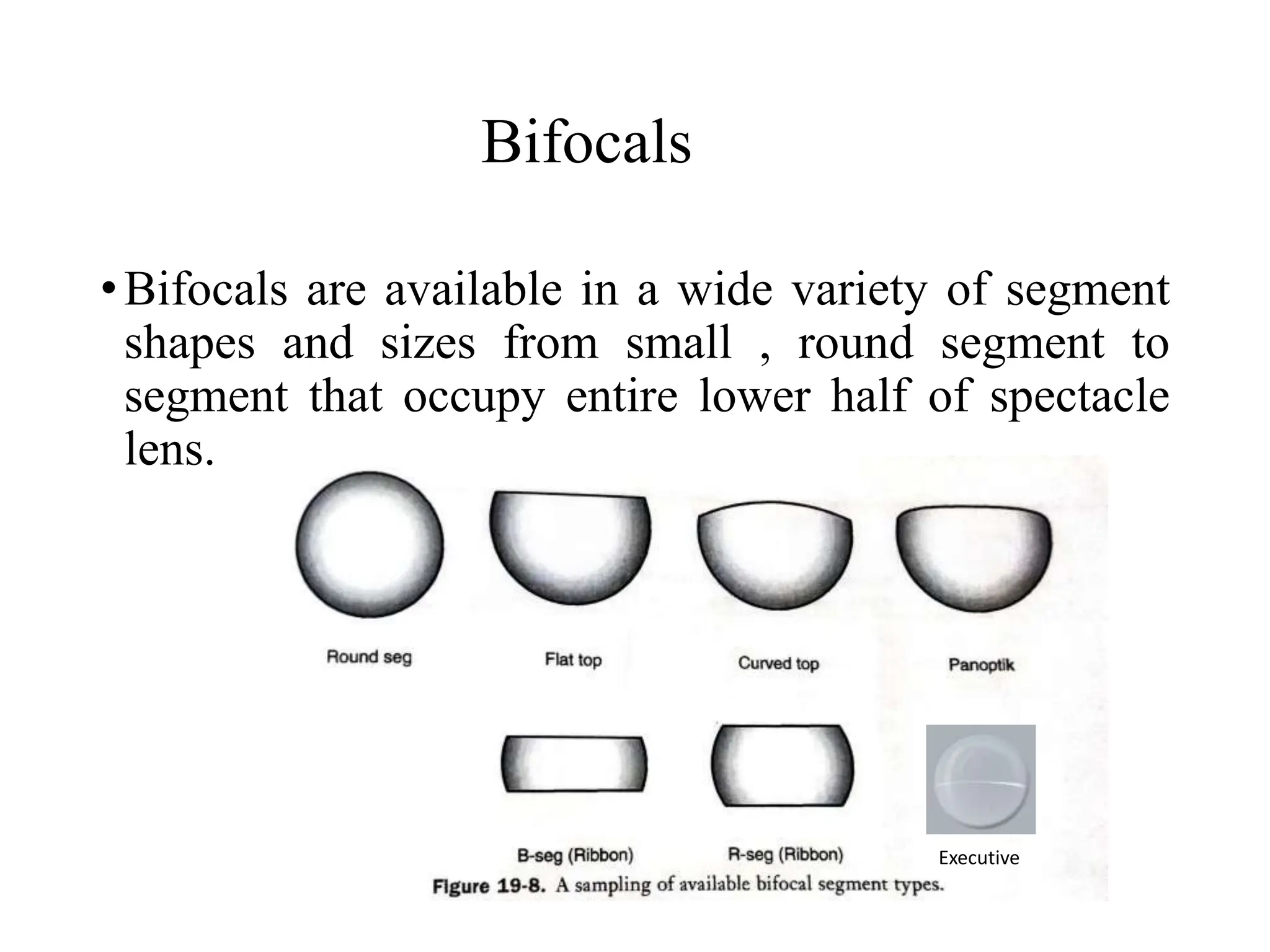
•Bifocals are available in a wide variety of segment
shapes and sizes from small , round segment to
segment that occupy entire lower half of spectacle
lens.
Executive
Trifocals
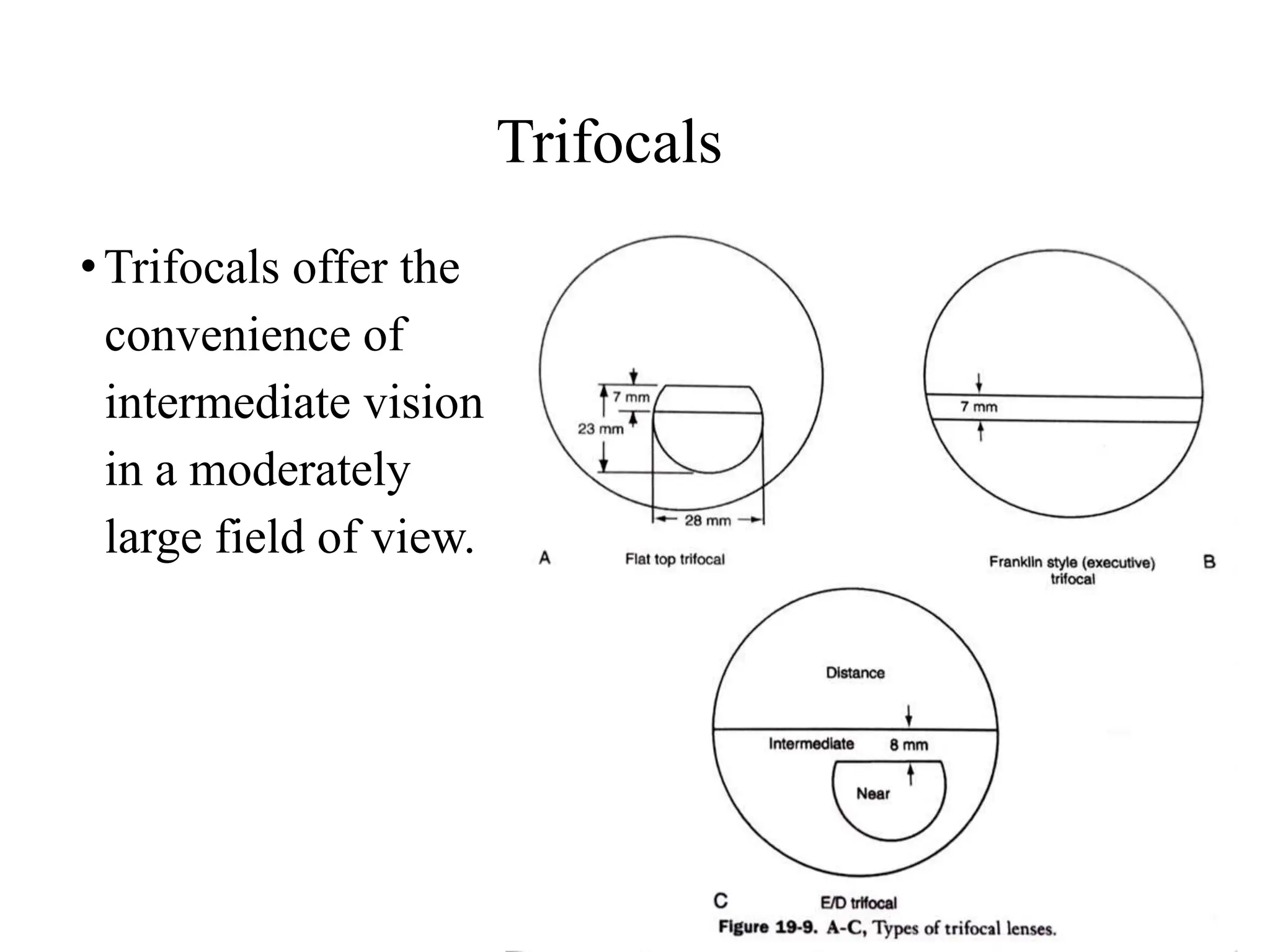
•Trifocals offer the
convenience of
intermediate vision
in a moderately
large field of view.
Progressive Additional lenses
•Progressive lenses offer a smooth transition in
power along a relatively narrow corridor on the lens
surface.
•Wavefront technology is the most advanced
technology used in progressive lenses nowadays
Latest progressive lenses
•Hoya ID Mystyle 2 and ID Lifestyle 3
•Independent Owners Network (ION) Love Our Lens
•IOT Camber Steady and Camber Mobile
•Shamir Autograph Intelligence
•Varilux X and Comfort Max
•Zeiss Individual Smart Life and DriveSafe
2. Contact lens
•Monovision- Optical means of correction for
presbyopia in which one is optimally corrected for
distance vision(usually dominant eye) and other for
near.
•Extended or enhanced monovision- One eye is fitted
with distance correction and other receives a bi- or
multi-focal contact lens.
•Bifocal and multifocal lens design
3. Surgical Options
Cornea based
procedures
Lens based
procedures
Sclera based
procedures
Monovision conductive
keratoplasty
Multifocal or
accommodating IOL
Anterior ciliary
sclerotomy(ACS)
Monovision LASIK Monovision with IOL Scleral spacing
procedures
Presbyopic bifocal
LASIK or LASIK-PARM
Scleral expansion
Presbyopic multifocal
LASIK (PML)
Corneal Inlays for
presbyopia
Intracor treatment
(Presbyopic femtosecond
laser ablation )
Surgical Options
Recently, a new type of scleral expansion implant,
Preview(PSI, Refocus, Dallas, Texas, USA) is being
evaluated as a treatment of presbyopia, in an FDA
monitored investigational device exemption(IDE)
clinical trial currently underway in the USA.1
1 Current management of presbyopia. Middle East Afr J Ophthalmology, 2014
Review
Pharmacological Treatment in Presbyopia
AGrzybowski A, Ruamviboonsuk V 3March , 2022
•Two main agents
1. Miotics
Pilocarpine 1.25% , Phentolamine 1% , Carbachol
2. Lens softeners
Lipoic acid choline ester 1.5%
Review
Pharmacological Treatment in Presbyopia
AGrzybowski A, Ruamviboonsuk V. 3 March , 2022
Miotics
Pinhole
effect
Increases
depth of
focus
Lens
softeners
Increases
elasticity of
lens
Targets
etiologic
mechanisms
Mode
of
action
Review
Pharmacological Treatment in Presbyopia
AGrzybowski A, Ruamviboonsuk V. 3 March , 2022
•In November 2021, U.S. FDA has approved 1.25%
pilocarpine hydrochloride ophthalmic solution
(AGN-190584) as an eye drop for treating presbyopia
Summary
•Presbyopia is normal physiological state
•Amount of a new addition should permit a certain
percentage of amplitude of accommodation to
remain in reserve
• Hyperopes become presbyopic few years earlier
than myopes or emmetropes
•Spectacles , contact lenses , surgery, and
pharmacological treatment are the options for the
management of presbyopia
Summary
•Recommendations are made on the basis of the pt.'s
specific vocational and avocational needs
•Success of treatment depends on
 lens power
 specific visual tasks and characteristics of the
patient
 appropriate patient education given by the
practitioner
 appropriate mode of correction
References
• Borish's Clinical Refraction William J. Benjamin, Irvin M.
Borish - 1998
• Clinical Procedures in Optometry J. Boyd Eskridge, John F.
Amos, Jimmy D. Bartlett - Medical - 1991
• Clinical Procedures in Primary Eye Care David B. Elliott-
2007
THANK YOU!

Presbyopia - refraction and management-Archana.pptx

  • 1.
    Presbyopia : Refractionand Management Guidelines Moderators Presenter Dr. Sanjeev Bhattarai Archana Sharma Suraj Chhetri B. Optometry Third Year
  • 2.
    Objectives •To describe differentmethods used in refraction for presbyopia •To explain about different management techniques for presbyopia
  • 3.
    Presentation layout •Introduction •Types ofpresbyopia •Risk factors •Symptoms and signs •Methods of determining near add •Refractive error and presbyopia •Management of presbyopia
  • 4.
    Introduction •Presbyopia (from Greekpresbys = old man + ops = see like, sight) •Gradual, irreversible decrease in amplitude of accommodation as expected with age •Normal physiological state •Eye exhibits a progressively diminished ability to focus on near objects
  • 5.
    Change in Accommodativeamplitude with age Age ( Years ) Amplitude (D) Age ( Years ) Amplitude (D) 10 14.00 45 3.50 15 12.00 50 2.50 20 10.00 55 1.75 25 8.50 60 1.00 30 7.00 65 0.50 35 5.50 70 0.25 40 5.00 75 0.00 Donder’s Table Duane A. Studies in monocular and binocular accommodation with their clinical applications. American Journal of Ophthalmology. 1922 Nov 1;5(11):865-77.
  • 6.
    Accommodative insufficiency andpresbyopia Accommodative insufficiency Presbyopia Accommodative power is significantly less than the normal physiological limit for the patient’s age Physiological insufficiency of accommodation is normal for age Asthenopic symptoms are more prominent Symptoms of decreased near VA is more prominent
  • 7.
    Prevalence • Worldwide 1.9billion people with presbyopia in 2020 • Expected to peak at approximately 2.1 billion in 20301 1 1Global Prevalence of Presbyopia and Vision Impairment from Uncorrected Presbyopia: Systematic Review, Meta- analysis, and Modelling ,October 2018
  • 8.
    Etiology of presbyopia •Modulusof elasticity of lens capsule decreases from youth to old age. The lens capsule becomes progressively less stiff like an old, stretched out rubber band. •Modulus of elasticity of the lens substance The lens substance becomes stiffer , more plastic like, with increasing age 44% of loss of accommodation (Fischer)
  • 9.
    Etiology •Lens size/Volume  increasesprogressively with age that makes lens capsule function less effective. The increased lens size/volume and the decreased elasticity of lens capsule contributed to 55% of the loss of accommodation. (Fischer)
  • 10.
  • 11.
    Helmholtz’s theory Ciliary musclecontraction ceases Posterior zonular fibres pull the ciliary muscle backward Increases tension on the zonular fibres Increase in lens diameter, decrease in lens thickness and a flattening of the anterior and posterior lens surface curvatures Decrease in optical power
  • 12.
    Schachar theory Ciliary musclecontracts Equatorial zonular tension is increased Anterior and posterior zonules are simultaneously relaxed Central surfaces of the lens steepen Peripheral surfaces of the lens flatten
  • 13.
    Catenary Theory Ciliary musclecontracts Initiates a pressure gradient between the vitreous and aqueous compartments Anterior capsule and the zonule form a trampoline shape or hammock shaped surface Steep radius of curvature in center of the lens with slight flattening of the peripheral anterior lens
  • 14.
  • 15.
    Types of Presbyopia 1.Incipient presbyopia •Borderline, beginning, early or pre-presbyopia •Earliest stage when symptoms or difficulty are first encountered in near vision
  • 16.
    Types of Presbyopia 2.Functional Presbyopia •When faced with gradually declining accommodative amplitude and continued near task demands, adult patient eventually report visual difficulties •The age at which presbyopia becomes symptomatic varies •Due to variations in distance vision status, environment, task requirements, nutrition, or disease state
  • 17.
    Types of Presbyopia 3.Premature presbyopia •Presbyopia occuring at an earlier age than expected for normal population •Usually associated with ocular diseases , uncorrected hyperopia
  • 18.
    Types of Presbyopia 4.Nocturnal Presbyopia Near vision difficulties result from an apparent decrease in the accommodative amplitude in dim light 5. Manifest presbyopia Presbyopia with some amplitude of accommodation present 6. Absolute presbyopia Presbyopia with amplitude of accommodation completely absent
  • 19.
  • 20.
    Symptoms •Blurred vision atcustomary near working distance •Ocular discomfort •Headache and asthenopia •Fatigue or drowsiness from near work •Increased working distance •Transient diplopia
  • 21.
    Signs •Reduced amplitude ofaccommodation •Recession of near point of accommodation
  • 22.
    Basic principles •Find refractiveerror for distance and correct it first •Find presbyopic correction needed in each eye separately and add it to distance correction •Near point should be taken consideration according to profession of patient
  • 23.
    Basic principles •Over correctionshould be avoided •Additional correction for intermediate distance may be required •Presbyopic add should leave certain percentage of amplitude of accommodation (AA) in reserve
  • 24.
    Accommodation amplitude inreserve (AA) Amount of a new addition should permit a certain percentage of amplitude of accommodation to remain in reserve Rule-of-thumb - Leaving ½ of the AA in reserve (Lawrence and Maxwell) - Leaving ⅓ of the AA in reserve (Sheard and Giles)
  • 25.
    Methods of determiningnear add 1. Addition based on amplitude of accommodation 2. Tentative addition based on age 3. Plus build-up method 4. Bichrome method 5. Cross-cylinder method 6. Relative accommodation method 7. Dynamic Retinoscopy
  • 26.
    1. Addition basedon amplitude of accommodation •Amplitude of accommodation decreases with age - Presbyopia is reported when NPA exceeds 8 inches (22cm) i.e, (AA) = 4.50D (Donders) •Presbyopia exists when amplitude of accommodation is less than 5D (Morgan) •Amplitude of accommodation is measured using the push-up or the minus lens to blur method.
  • 27.
    Addition based onamplitude of accommodation Example 1 : Working distance (WD)= 40cm RAF (AA) = 2.00D What should be the near addition Accommodation required for WD = 2.50 D Accommodation in Reserve = 1.00D Amount of accommodation left = 1.00D Amount of Near addition = (2.50 –1.00) = +1.50D
  • 28.
    Addition based onamplitude of accommodation Example 2 : Working distance (WD)= 25cm RAF (AA) = 1.50D What should be the near addition Accommodation required for WD = 4.00 D Accommodation in Reserve = 0.50D Amount of accommodation left = 1.00D Amount of Near addition = (4.00 –1.00) = +3.00D
  • 29.
    2. Tentative additionbased on age Based on the assumption that , for a given age, the amplitude of accommodation is a fixed value for all patients. Amplitude of accommodation to age (Hoffstetter) •Maximum = 25.0 – 0.4 (age) •Probable = 18.5 – 0.3 (age) •Minimum = 15.0 – 0.25 (age) Rule of 4’s Amplitude= 4x4-(Age/4)
  • 30.
    3. Plus build- up method •Can be done binocularly or monocularly •Plus lens are increased in steps of 0.25D to the amount necessary to first read the desired letters at customary working distances •The power of add is then increased in 0.25 D steps to the amount preferred by the patient
  • 31.
    4. Bichrome method •Based on the natural chromatic aberration of the eye • For presbyopic patient red & green are focused behind the retina with red farther away • Patient’s distance correction is placed on a trial frame •Bichrome target is placed at habitual near distance (40cm) •Tell the patient to look at letters on both green and red background carefully
  • 32.
    Bichrome method • Askthe patient which side has the sharper and clearer letters - Green clear : add plus in 0.25 step - Red clear : remove plus - until patient sees letters equally clear in both background
  • 33.
    5. Cross –cylinder method Target containing 4 to 5 vertical and horizontal lines is presented to the patient Can be done monocularly or binocularly Place the best distance correction on the phoropter (trial frame) Put the cross cylinder grid at customary near working distance (40cm) of the patient
  • 34.
    Cross Cylinder method •Ifpatient is unable to see the lines initially, sufficient plus lens power is added until the lines are recognized so that horizontal and vertical lines appear equally blacker •Place the JCC in front of both of the patient’s eyes, with the minus cylinder axis at 900 (Red marks vertical) (+0.50DS/-1.00DC x 090)
  • 35.
    Cross- cylinder method •Crosscylinder creates artificial astigmatism with an interval of Sturm of 1.00D •If patient accommodates exactly for the target, both sets of lines are equally clear •If patient under-accommodates, the horizontal lines appear clear ( add plus ) •If vertical lines are clear ( reduce plus )
  • 36.
    6. Relative Accommodationmethod •Based on the concept of placing the accommodative demand in the middle of the range of relative accommodation •To measure NRA and PRA, - Patient’s distance refraction and a tentative add is placed in the phoropter (Trial frame) - the near point test card (N6 target) is placed at the reading distance (usually 40 cm)
  • 37.
    Relative Accommodation method •NRAis determined by adding plus power lenses binocularly until the patient is no longer able to read the fine print on the test card • PRA is determined by adding minus power lenses until the patient is no longer able to read the fine print • Near add = (NRA+PRA)/2
  • 38.
    7. Dynamic Retinoscopy •Patientis asked to fixate fine print at the plane of the retinoscope. •If near point of accommodation (NPA) is behind peephole = “with movement” is observed. •Convex lenses are then added until with movement observed first disappears. Amount of additional convex lenses needed for neutrality after reduction of amount of lag i.e. +0.50 to +0.75) = amount of tentative near addition
  • 39.
    Comparing methods ofdetermining addition in presbyopes •All the techniques display similar behavior and provide a tentative addition close to the final addition •Among the methods used, the age-expected procedure is recommended, as this technique produce results that correlate best with the final add •Likelihood of error is high and supports the idea that any tentative add has to be adjusted according to the particular needs of each patient CLINICAL AND EXPERIMENTAL OPTOMETRY 2008; B. Antona, F. Barra, A. Barrio, A. Gutierrez, E. Piedrahita, Y. Martin Department of Optics II, Universidad Complutense, Madrid, Spain
  • 40.
    Determination of FinalAdd •Customary near working distance •Nature of the near work •Physical nature of the patient •Illumination level •Status of the accommodation-convergence relationship •Change in the amount of the addition
  • 41.
    Relation with Refractiveerror • Hyperope - Near point is considerably further than emmetropes -Thus effectively become presbyopic few years earlier than myopes or emmetropes. • Myope - Develop presbyopia later in life - Better to take off distance prescription for near work
  • 42.
    Relation to refractiveerror Anisometropic distance correction •Unequal adds may also be prescribed •Measure the ranges monocularly •Bifocals may produce reading discomfort because of an induced vertical prismatic effect in the reading position •Specially designed slab-off lenses or single vision reading glasses may be required
  • 43.
    Management of Presbyopia 1.Spectacles 2. Contact Lens 3. Surgery 4. Pharmacological treatment
  • 44.
    1. Spectacles •Single visionlens •Bifocal lenses •Trifocal lenses •Progressive addition lens •Occupational lens
  • 45.
    Bifocals •Bifocals are availablein a wide variety of segment shapes and sizes from small , round segment to segment that occupy entire lower half of spectacle lens. Executive
  • 46.
    Trifocals •Trifocals offer the convenienceof intermediate vision in a moderately large field of view.
  • 47.
    Progressive Additional lenses •Progressivelenses offer a smooth transition in power along a relatively narrow corridor on the lens surface. •Wavefront technology is the most advanced technology used in progressive lenses nowadays
  • 48.
    Latest progressive lenses •HoyaID Mystyle 2 and ID Lifestyle 3 •Independent Owners Network (ION) Love Our Lens •IOT Camber Steady and Camber Mobile •Shamir Autograph Intelligence •Varilux X and Comfort Max •Zeiss Individual Smart Life and DriveSafe
  • 49.
    2. Contact lens •Monovision-Optical means of correction for presbyopia in which one is optimally corrected for distance vision(usually dominant eye) and other for near. •Extended or enhanced monovision- One eye is fitted with distance correction and other receives a bi- or multi-focal contact lens. •Bifocal and multifocal lens design
  • 51.
    3. Surgical Options Corneabased procedures Lens based procedures Sclera based procedures Monovision conductive keratoplasty Multifocal or accommodating IOL Anterior ciliary sclerotomy(ACS) Monovision LASIK Monovision with IOL Scleral spacing procedures Presbyopic bifocal LASIK or LASIK-PARM Scleral expansion Presbyopic multifocal LASIK (PML) Corneal Inlays for presbyopia Intracor treatment (Presbyopic femtosecond laser ablation )
  • 52.
    Surgical Options Recently, anew type of scleral expansion implant, Preview(PSI, Refocus, Dallas, Texas, USA) is being evaluated as a treatment of presbyopia, in an FDA monitored investigational device exemption(IDE) clinical trial currently underway in the USA.1 1 Current management of presbyopia. Middle East Afr J Ophthalmology, 2014
  • 53.
    Review Pharmacological Treatment inPresbyopia AGrzybowski A, Ruamviboonsuk V 3March , 2022 •Two main agents 1. Miotics Pilocarpine 1.25% , Phentolamine 1% , Carbachol 2. Lens softeners Lipoic acid choline ester 1.5%
  • 54.
    Review Pharmacological Treatment inPresbyopia AGrzybowski A, Ruamviboonsuk V. 3 March , 2022 Miotics Pinhole effect Increases depth of focus Lens softeners Increases elasticity of lens Targets etiologic mechanisms Mode of action
  • 55.
    Review Pharmacological Treatment inPresbyopia AGrzybowski A, Ruamviboonsuk V. 3 March , 2022 •In November 2021, U.S. FDA has approved 1.25% pilocarpine hydrochloride ophthalmic solution (AGN-190584) as an eye drop for treating presbyopia
  • 56.
    Summary •Presbyopia is normalphysiological state •Amount of a new addition should permit a certain percentage of amplitude of accommodation to remain in reserve • Hyperopes become presbyopic few years earlier than myopes or emmetropes •Spectacles , contact lenses , surgery, and pharmacological treatment are the options for the management of presbyopia
  • 57.
    Summary •Recommendations are madeon the basis of the pt.'s specific vocational and avocational needs •Success of treatment depends on  lens power  specific visual tasks and characteristics of the patient  appropriate patient education given by the practitioner  appropriate mode of correction
  • 58.
    References • Borish's ClinicalRefraction William J. Benjamin, Irvin M. Borish - 1998 • Clinical Procedures in Optometry J. Boyd Eskridge, John F. Amos, Jimmy D. Bartlett - Medical - 1991 • Clinical Procedures in Primary Eye Care David B. Elliott- 2007
  • 59.

Editor's Notes

  • #5 meaning literally trying to see as old men do
  • #6 Change in amplitude of accommodation with age. Original data from Duane (Duane, 1922), reprinted from American Journal of Ophthalmology, 5, Duane A, Studies in monocular and binocular accommodation with their clinical applications, 865-77, 1922, with permission from Elsevier. The solid black curve represents the mean AA and its change with age from Duane data. The solid blue curve represents the mean AA and its change with age from Jackson (Jackson, 1907) data. Maximum and minimum at each age (dashed blue curves) are also shown.
  • #9 Plastic to form or mold
  • #11 Various theories depicting the mechanism involved in presbyopia is proposed; the most discussed ones are:
  • #12 When eye is at unaccommodated state, the lens is compressed in its capsule by tension of zonules. Zonules are kept tension by a pull executed on them by relaxation of fibres of ciliary body.
  • #13  The theory states that accommodation occurs when ciliary muscle contraction tenses, rather than relaxes, the equatorial zonules Based on this theory introduced new sx for presbyopia scleral expansion bands
  • #14 Proposed by Coleman Presbyopia occurs due to increasing lens volume with age that results in reduced response of anterior radius of curvature to the vitreous pressure gradient created by ciliary body contraction Catenary- A curve that describes the shape of a flexible hanging chain or cable. The zonular fibers function like the support pylons of a suspension bridge and determine the natural curvature of the lens
  • #20 after age 40 , Additional accommodative demand (if uncorrected , Near vision demands; Earlier onset in females (short stature, menopause) ; Diabetes mellitus (lens, refractive effects); multiple sclerosis (impaired innervation); cardiovascular accidents (impaired accommodative innervation); alcohol, chlorpromazine, hydrochlorothiazide, antianxiety agents, antidepressants, antipsychotics, antispasmodics, antihistamines, diuretics; Scatter (panretinal) laser photocoagulation; intraocular surgery Proximity to the equator (higher average annual temperatures, greater exposure to ultraviolet radiation)
  • #22 in order to work comfortably at habitual near distance.
  • #25 Although it ids difficult to find an explanation for such practices in physiology of mechanism of accomod. They are justified merely because they satisfy the needs of pt. A rule of thumb says that to have clear and comfortable vision, an individual should have to use no more than ½ or 1/3 of his or her accommodation in sustained reading or close work- is valuable for determining the addition for a beginning presbyope.
  • #26 The net power resulting from the combination of the distance power and the add power is termed as near power or near Rx.
  • #28 Amount of a new add. should permit a certain percentage of the accommodative amplitude to remain in reserve
  • #33 For Uncorrected or undercorrected presbyopic pt.- letters on green background clearer An overcorrection for a near target - the letters on red background clearer
  • #40 Methods: Sixty-nine healthy subjects with a mean age of 51.0 years (range 40 to 60 years) were studied. Tentative near additions were determined using seven different techniques
  • #41 Factors to be considered
  • #43 - to keep the near and far points of the ranges at similar distances to account for any optical effects related to the unequal strength of the lenses   , technique in which the base-up prism is ground on half the lens in either the most minus or least plus lens
  • #46 Round=22-40, oc at centre, flat top=top cut off, oc below 5mm, curved and panoptik-flat top with arched line and panotik rounded corner
  • #47 Eyes that still have a limited ability to focus and only require additions of +1.50 D or less will have clear vision in all areas of viewing.
  • #48 Wavefront Advanced Vision Enhancement This process involves identifying the lower and high order aberrations induced by a lens of a given design, prescription, and material and then fine-tuning the design to eliminate or reduce those aberrations that affect visual acuity and quality of vision.
  • #49  The fitting cross is an important marker that designates the point of the lens that should be placed along the center of the patient’s pupilPublished June 15, 2021
  • #51 Presbyopic contact lens designs. The red, green and yellow areas represent areas for distance, near and intermediate vision respectively. In the case of the diffractive lenses bifocals the distance and near corrections both occupy the entire optic zone (after Kallinikos et al.99). Source : The Authors Ophthalmic& Physiological Optics © 2013 The College of Optometrists
  • #52 Intracor treatment (Presbyopic femtosecond laser ablation)-New procedure; femtosecond laser pulses applied in concentric ring fashion inside corneal stroma that induces changes in corneal shape without cutting a flap.
  • #53 Current management of presbyopia. Middle East Afr J Ophthalmol 2014
  • #54 An alternative to those who do not want to wear spectacles, contact lenses, or have surgical procedures temporary miosis causing a pinhole effect to increase the depth of focus through parasympathetic pathway para sympathomimetic agoinsts
  • #55 Loss of lens elasticity is with advanced agedue to increase in disulfide bonds formation in the collagen of aging lens, possibly due to oxidative stress temporary miosis causing a pinhole effect to increase the depth of focus through parasympathetic pathway
  • #56 Participants were randomized into the treatment group (n = 375) and placebo group (n = 375). Phentolamine is a nonselective alpha-adrenergic antagonist Loss of lens elasticity is with advanced agedue to increase in disulfide bonds formation in the collagen of aging lens, possibly due to oxidative stress [48] 3-line in mesopic, high-contrast, binocular DCNVA