Tobin C Eapen
Msc Optometry
EMLC THIRUVALLA
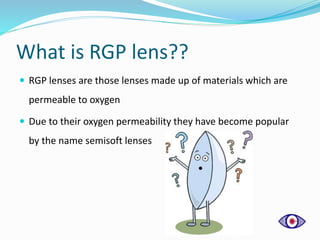
What is RGP lens??
 RGP lenses are those lenses made up of materials which are
permeable to oxygen
 Due to their oxygen permeability they have become popular
by the name semisoft lenses
Are RGP lenses better than soft lens??
 Good vision
 Durability
 Able to correct astigmatism completely most of the cases
 Excellent eye health
 Less tendency of deposit formation
 Ease of care & maintenance
 Cost factor
Choice for RGP/ Indications
 Keratoconus
 High refractive error & high astigmatism
 Trauma or irregular astigmatism
 Post graft
Cont…
 Slow down myopia progression
 Corneal degenerations & dystrophies
 Applied in orthokeratology
Patient selection
Patient Selection
High Motivation
 A highly motivated patient is more likely to be successful
 Motivation is the key factor for the tolerance of initial
adaptation period
Moderate To High Prescription
 Patient with moderate to high prescription tend to be more
motivated than those with low power
 Best corrected vision is poor with spectacle power & soft
contact lens
Corneal toricity
 The quality of vision is superior to soft CL & spectacle
 Patient with significant against rule astigmatism or oblique
corneal toricity often have less success with spherical RGP
RGP FITTING
PATIENT SCREENING
PRELIMINARY EXAMINATION & MEASUREMENTS
TRIAL LENS FITTING
LENS DISPENSING
AFTER CARE
Patient Screening
 Establish why the patient wants CLs
 Is the patient suitable for RGP
 Obtaining baseline information
 Advise patient of their options
Preliminary measures
Corneal radius of curvature
 Corneal topography is essential for selecting the BOZR
 Measurement is usually made with keratometry
 Average k or flat k reading is taken as trial lens BOZR
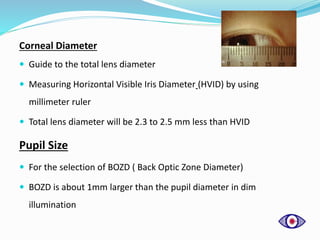
Corneal Diameter
 Guide to the total lens diameter
 Measuring Horizontal Visible Iris Diameter (HVID) by using
millimeter ruler
 Total lens diameter will be 2.3 to 2.5 mm less than HVID
Pupil Size
 For the selection of BOZD ( Back Optic Zone Diameter)
 BOZD is about 1mm larger than the pupil diameter in dim
illumination
Lid Characteristics
 Position of upper & lower lid is important in determining the
lens total dia that is required
 Lid tonus can be assessed when the lid is everted for
examination
 Graded as loose, average & tight
Spectacle Refraction
 Do spectacle refraction before fitting RGP lenses
 Relationship b/w refraction, topography & visual acuity will
indicate the type of lens which will most suit the patient
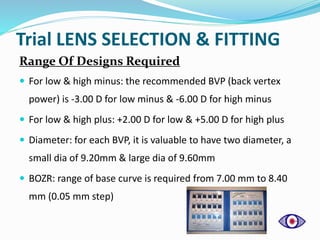
Trial LENS SELECTION & FITTING
Range Of Designs Required
 For low & high minus: the recommended BVP (back vertex
power) is -3.00 D for low minus & -6.00 D for high minus
 For low & high plus: +2.00 D for low & +5.00 D for high plus
 Diameter: for each BVP, it is valuable to have two diameter, a
small dia of 9.20mm & large dia of 9.60mm
 BOZR: range of base curve is required from 7.00 mm to 8.40
mm (0.05 mm step)
Lens Application
Patient Instructions
 Counsel the patient on the sensation they will notice when the
lens is placed on the cornea
 Advise to keep eyes closed for few seconds after the lens
placed on the cornea
Setting time
 An adequate amount of time must be given
 Excessive tearing results in an inaccurate fitting assessment
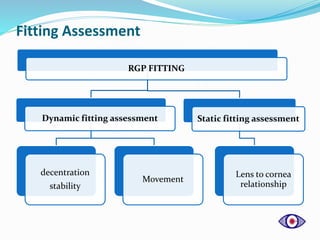
Fitting Assessment
RGP FITTING
Dynamic fitting assessment
decentration
stability
Movement
Static fitting assessment
Lens to cornea
relationship
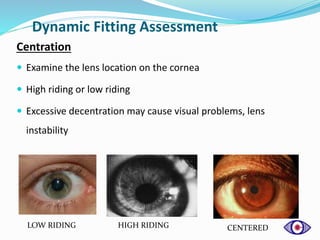
Dynamic Fitting Assessment
Centration
 Examine the lens location on the cornea
 High riding or low riding
 Excessive decentration may cause visual problems, lens
instability
LOW RIDING HIGH RIDING CENTERED
Stability
 Does the lens have consistent movement & position
of rest or decentration
 Assessed after adequate degree of adaptation has
been achieved
Movement
Amount of movement
 Assessed by post blink recentration of the lens
 The post blink movement may be as much as 1 to 1.5 mm
Type of movement
 Smooth vertical movement
 Apical rotation
 Rocky movement
 Two part movement
 lid attachment
Speed of movement
 Rate as slow , average or fast
Static Fitting Assessment
 Determine the relationship b/w the lens back surface & the
anterior surface of cornea
 Assessed with the patient instructed to looking in the primary
gaze position, lens should be centered on the cornea or its
natural resting position
 With the lens centered, the fluorescein pattern is assessed &
recorded
Static Fitting Techniques
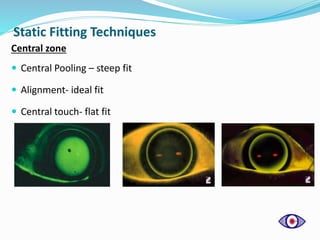
Central zone
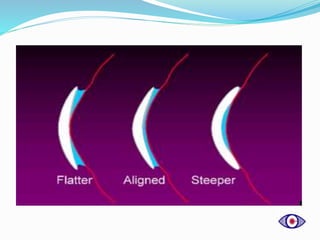
 Central Pooling – steep fit
 Alignment- ideal fit
 Central touch- flat fit
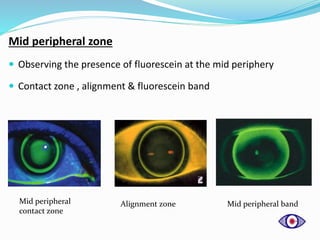
Mid peripheral zone
 Observing the presence of fluorescein at the mid periphery
 Contact zone , alignment & fluorescein band
Mid peripheral
contact zone
Alignment zone Mid peripheral band
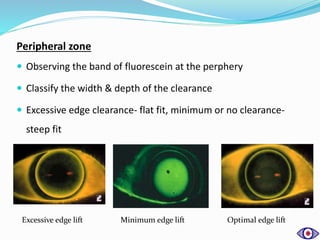
Peripheral zone
 Observing the band of fluorescein at the perphery
 Classify the width & depth of the clearance
 Excessive edge clearance- flat fit, minimum or no clearance-
steep fit
Excessive edge lift Minimum edge lift Optimal edge lift
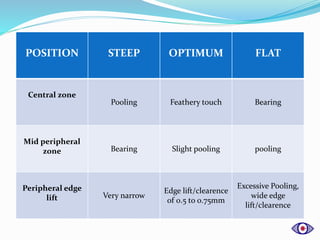
POSITION STEEP OPTIMUM FLAT
Central zone
Pooling Feathery touch Bearing
Mid peripheral
zone Bearing Slight pooling pooling
Peripheral edge
lift Very narrow
Edge lift/clearence
of 0.5 to 0.75mm
Excessive Pooling,
wide edge
lift/clearence
Optimal Dynamic Fitting Characteristics
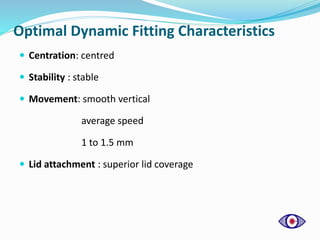
 Centration: centred
 Stability : stable
 Movement: smooth vertical
average speed
1 to 1.5 mm
 Lid attachment : superior lid coverage
Optimal static fitting characteristics
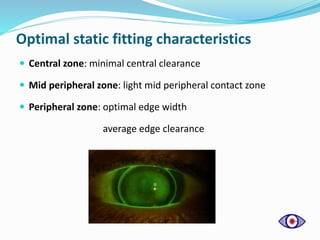
 Central zone: minimal central clearance
 Mid peripheral zone: light mid peripheral contact zone
 Peripheral zone: optimal edge width
average edge clearance
Rule Of Thumb
 Flatten BC by 0.25 D or 0.05mm for every increase in diameter
of 0.5 mm
 Steepen BC by 0.25 D or 0.05mm for every decrease in overall
diameter of 0.5mm
Over Refraction
 Determining the over refraction allows the tear lens to be
calculated
 If the lens is fitted steep, +ve tear lens will result & the power
of the CL will require less plus or more minus
 If the lens is flat, the tear lens will be –ve & power of CL will
require less minus or more plus
 Final CL power is the sum of trial lens power & over refraction
Toric RGP Fitting
 When the amount of corneal astigmatism results in an
unsatisfactory fit from a spherical RGP lens, it is often
necessary to fit a back surface toric lens
 The ideal lens fit should show the same fluorescein pattern as
a spherical lens on a spherical cornea
Care & Maintenance
Purpose of care & maintenance
 Clean lens
 Good vision
 Good comfort
 Safe lens wear
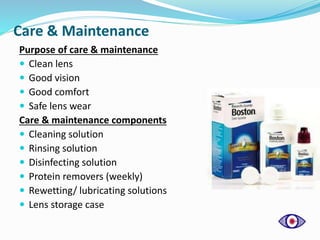
Care & maintenance components
 Cleaning solution
 Rinsing solution
 Disinfecting solution
 Protein removers (weekly)
 Rewetting/ lubricating solutions
 Lens storage case
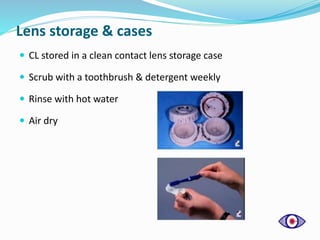
Lens storage & cases
 CL stored in a clean contact lens storage case
 Scrub with a toothbrush & detergent weekly
 Rinse with hot water
 Air dry
Always
 Wash, rinse & dry your hands before handiling your lenses
 Replace the lens at the interval specified by your practitioner
 Have a regular check up with your practitioner as
recommended
 Seek professional advice if you are having problems with your
CL
 Better to have a pair of spectacle for when you need to
remove your lenses
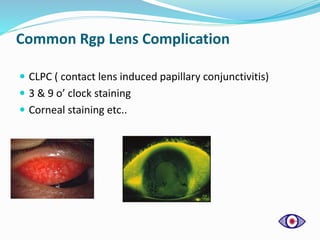
Common Rgp Lens Complication
 CLPC ( contact lens induced papillary conjunctivitis)
 3 & 9 o’ clock staining
 Corneal staining etc..
THANK YOU

RGP Fitting

  • 1.
    Tobin C Eapen MscOptometry EMLC THIRUVALLA
  • 3.
    What is RGPlens??  RGP lenses are those lenses made up of materials which are permeable to oxygen  Due to their oxygen permeability they have become popular by the name semisoft lenses
  • 4.
    Are RGP lensesbetter than soft lens??  Good vision  Durability  Able to correct astigmatism completely most of the cases  Excellent eye health  Less tendency of deposit formation  Ease of care & maintenance  Cost factor
  • 5.
    Choice for RGP/Indications  Keratoconus  High refractive error & high astigmatism  Trauma or irregular astigmatism  Post graft
  • 6.
    Cont…  Slow downmyopia progression  Corneal degenerations & dystrophies  Applied in orthokeratology
  • 7.
  • 8.
    Patient Selection High Motivation A highly motivated patient is more likely to be successful  Motivation is the key factor for the tolerance of initial adaptation period
  • 9.
    Moderate To HighPrescription  Patient with moderate to high prescription tend to be more motivated than those with low power  Best corrected vision is poor with spectacle power & soft contact lens Corneal toricity  The quality of vision is superior to soft CL & spectacle  Patient with significant against rule astigmatism or oblique corneal toricity often have less success with spherical RGP
  • 10.
    RGP FITTING PATIENT SCREENING PRELIMINARYEXAMINATION & MEASUREMENTS TRIAL LENS FITTING LENS DISPENSING AFTER CARE
  • 11.
    Patient Screening  Establishwhy the patient wants CLs  Is the patient suitable for RGP  Obtaining baseline information  Advise patient of their options
  • 12.
    Preliminary measures Corneal radiusof curvature  Corneal topography is essential for selecting the BOZR  Measurement is usually made with keratometry  Average k or flat k reading is taken as trial lens BOZR
  • 13.
    Corneal Diameter  Guideto the total lens diameter  Measuring Horizontal Visible Iris Diameter (HVID) by using millimeter ruler  Total lens diameter will be 2.3 to 2.5 mm less than HVID Pupil Size  For the selection of BOZD ( Back Optic Zone Diameter)  BOZD is about 1mm larger than the pupil diameter in dim illumination
  • 14.
    Lid Characteristics  Positionof upper & lower lid is important in determining the lens total dia that is required  Lid tonus can be assessed when the lid is everted for examination  Graded as loose, average & tight Spectacle Refraction  Do spectacle refraction before fitting RGP lenses  Relationship b/w refraction, topography & visual acuity will indicate the type of lens which will most suit the patient
  • 15.
    Trial LENS SELECTION& FITTING Range Of Designs Required  For low & high minus: the recommended BVP (back vertex power) is -3.00 D for low minus & -6.00 D for high minus  For low & high plus: +2.00 D for low & +5.00 D for high plus  Diameter: for each BVP, it is valuable to have two diameter, a small dia of 9.20mm & large dia of 9.60mm  BOZR: range of base curve is required from 7.00 mm to 8.40 mm (0.05 mm step)
  • 16.
    Lens Application Patient Instructions Counsel the patient on the sensation they will notice when the lens is placed on the cornea  Advise to keep eyes closed for few seconds after the lens placed on the cornea Setting time  An adequate amount of time must be given  Excessive tearing results in an inaccurate fitting assessment
  • 17.
    Fitting Assessment RGP FITTING Dynamicfitting assessment decentration stability Movement Static fitting assessment Lens to cornea relationship
  • 18.
    Dynamic Fitting Assessment Centration Examine the lens location on the cornea  High riding or low riding  Excessive decentration may cause visual problems, lens instability LOW RIDING HIGH RIDING CENTERED
  • 19.
    Stability  Does thelens have consistent movement & position of rest or decentration  Assessed after adequate degree of adaptation has been achieved
  • 20.
    Movement Amount of movement Assessed by post blink recentration of the lens  The post blink movement may be as much as 1 to 1.5 mm Type of movement  Smooth vertical movement  Apical rotation  Rocky movement  Two part movement  lid attachment Speed of movement  Rate as slow , average or fast
  • 21.
    Static Fitting Assessment Determine the relationship b/w the lens back surface & the anterior surface of cornea  Assessed with the patient instructed to looking in the primary gaze position, lens should be centered on the cornea or its natural resting position  With the lens centered, the fluorescein pattern is assessed & recorded
  • 22.
    Static Fitting Techniques Centralzone  Central Pooling – steep fit  Alignment- ideal fit  Central touch- flat fit
  • 23.
    Mid peripheral zone Observing the presence of fluorescein at the mid periphery  Contact zone , alignment & fluorescein band Mid peripheral contact zone Alignment zone Mid peripheral band
  • 24.
    Peripheral zone  Observingthe band of fluorescein at the perphery  Classify the width & depth of the clearance  Excessive edge clearance- flat fit, minimum or no clearance- steep fit Excessive edge lift Minimum edge lift Optimal edge lift
  • 26.
    POSITION STEEP OPTIMUMFLAT Central zone Pooling Feathery touch Bearing Mid peripheral zone Bearing Slight pooling pooling Peripheral edge lift Very narrow Edge lift/clearence of 0.5 to 0.75mm Excessive Pooling, wide edge lift/clearence
  • 27.
    Optimal Dynamic FittingCharacteristics  Centration: centred  Stability : stable  Movement: smooth vertical average speed 1 to 1.5 mm  Lid attachment : superior lid coverage
  • 28.
    Optimal static fittingcharacteristics  Central zone: minimal central clearance  Mid peripheral zone: light mid peripheral contact zone  Peripheral zone: optimal edge width average edge clearance
  • 29.
    Rule Of Thumb Flatten BC by 0.25 D or 0.05mm for every increase in diameter of 0.5 mm  Steepen BC by 0.25 D or 0.05mm for every decrease in overall diameter of 0.5mm
  • 30.
    Over Refraction  Determiningthe over refraction allows the tear lens to be calculated  If the lens is fitted steep, +ve tear lens will result & the power of the CL will require less plus or more minus  If the lens is flat, the tear lens will be –ve & power of CL will require less minus or more plus  Final CL power is the sum of trial lens power & over refraction
  • 31.
    Toric RGP Fitting When the amount of corneal astigmatism results in an unsatisfactory fit from a spherical RGP lens, it is often necessary to fit a back surface toric lens  The ideal lens fit should show the same fluorescein pattern as a spherical lens on a spherical cornea
  • 32.
    Care & Maintenance Purposeof care & maintenance  Clean lens  Good vision  Good comfort  Safe lens wear Care & maintenance components  Cleaning solution  Rinsing solution  Disinfecting solution  Protein removers (weekly)  Rewetting/ lubricating solutions  Lens storage case
  • 33.
    Lens storage &cases  CL stored in a clean contact lens storage case  Scrub with a toothbrush & detergent weekly  Rinse with hot water  Air dry
  • 34.
    Always  Wash, rinse& dry your hands before handiling your lenses  Replace the lens at the interval specified by your practitioner  Have a regular check up with your practitioner as recommended  Seek professional advice if you are having problems with your CL  Better to have a pair of spectacle for when you need to remove your lenses
  • 35.
    Common Rgp LensComplication  CLPC ( contact lens induced papillary conjunctivitis)  3 & 9 o’ clock staining  Corneal staining etc..
  • 36.