







ANIMAL KINGDOM
ASCHELMINTHES
Hello!
I am Swetha
Bachelors in Optometry
You can find me at @
https://unacademy.com/user/swetha.chandran304/courses
Place your screenshot here
Introduction, Other features, Body wall, Body cavity and
skeleton, Digestion, Respiration and circulation, Nervous
system, Excretion, Reproduction
Synopsis
Introduction
INTRODUCTION
◈ Earlier round worms or thread worm were classified
as Achelminthes by Grobben.
◈ Gegenbour established the Phylum Nemathelminthes.
Phylum included round worm.
◈ Nematods are found everywhere in fresh water, sea
water, soil humus - rich soil. Many as a parasite and
cause health problems.
Other features
OTHER FEATURES
◈ Animal of this phylum are cylindrical, tapering at both
end without segmentation.
◈ Symmetry - Bilateral, Germ layer - Triploblastic, Level
of organisation - Organ system level and having tube
within tube plan.
◈ Anterior end does not show distinct head.
◈ No appendage
Body wall
BODY WALL
◈ 1. Cuticle - Firm, non living, resistant to digestive
enzymes of host.
◈ Moulted (changed) many time during growth period
(usually four times).
◈ 2. Epidermis - Without cilia. Syncytial i.e. a continuous
layer of cytoplasm having scattered nuclei.
◈ 3. Muscle layer - Longitudinal fibre divided into four
quadrants.
Body cavity and
skeleton
BODY CAVITY AND SKELETON
◈ Body cavity is there between body wall and digestive
tract. Which is not lined by mesothelium i.e.
Pseudocoel (developed from blastocoel) and contain
Pseudocoelomic fluid.
◈ Skeleton is not mineralized.
◈ High fluid pressure in the pseudocoelom maintains the
body shape. It is called Hydro skeleton.
Digestion
DIGESTION
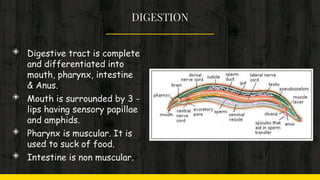
◈ Digestive tract is complete
and differentiated into
mouth, pharynx, intestine
& Anus.
◈ Mouth is surrounded by 3 -
lips having sensory papillae
and amphids.
◈ Pharynx is muscular. It is
used to suck of food.
◈ Intestine is non muscular.
Respiration and
Circulation
RESPIRATION AND CIRCULATION
◈ Respiration is through body surface by diffusion.
◈ Circulatory system is undeveloped
Nervous system
NERVOUS SYSTEM
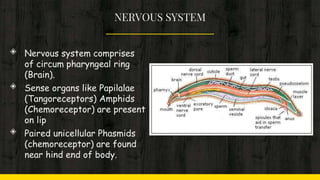
◈ Nervous system comprises
of circum pharyngeal ring
(Brain).
◈ Sense organs like Papilalae
(Tangoreceptors) Amphids
(Chemoreceptor) are present
on lip
◈ Paired unicellular Phasmids
(chemoreceptor) are found
near hind end of body.
Excretion
EXCRETION
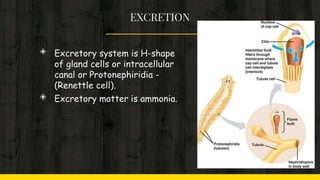
◈ Excretory system is H-shape
of gland cells or intracellular
canal or Protonephiridia -
(Renettle cell).
◈ Excretory matter is ammonia.
Reproduction
REPRODUCTION
◈ Reproduction system is developed as sexes are
generally separate.
◈ Sexual dimorphism is present.
◈ Male is smaller than female and curved from its caudal
end.
◈ Male has penial spiculas for copulation.
◈ Genital tract joins digestive track to form cloaca.
Female is larger than male and straight.
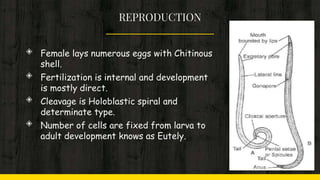
REPRODUCTION
◈ Female lays numerous eggs with Chitinous
shell.
◈ Fertilization is internal and development
is mostly direct.
◈ Cleavage is Holoblastic spiral and
determinate type.
◈ Number of cells are fixed from larva to
adult development knows as Eutely.
Thanks!
Any questions?
You can find me at @
https://unacademy.com/user/swetha.chandran304/courses
Follow me or drop your queries in the comment box

Aschelminthes

  • 1.
  • 2.
    Hello! I am Swetha Bachelorsin Optometry You can find me at @ https://unacademy.com/user/swetha.chandran304/courses
  • 3.
  • 4.
    Introduction, Other features,Body wall, Body cavity and skeleton, Digestion, Respiration and circulation, Nervous system, Excretion, Reproduction Synopsis
  • 5.
  • 6.
    INTRODUCTION ◈ Earlier roundworms or thread worm were classified as Achelminthes by Grobben. ◈ Gegenbour established the Phylum Nemathelminthes. Phylum included round worm. ◈ Nematods are found everywhere in fresh water, sea water, soil humus - rich soil. Many as a parasite and cause health problems.
  • 7.
  • 8.
    OTHER FEATURES ◈ Animalof this phylum are cylindrical, tapering at both end without segmentation. ◈ Symmetry - Bilateral, Germ layer - Triploblastic, Level of organisation - Organ system level and having tube within tube plan. ◈ Anterior end does not show distinct head. ◈ No appendage
  • 9.
  • 10.
    BODY WALL ◈ 1.Cuticle - Firm, non living, resistant to digestive enzymes of host. ◈ Moulted (changed) many time during growth period (usually four times). ◈ 2. Epidermis - Without cilia. Syncytial i.e. a continuous layer of cytoplasm having scattered nuclei. ◈ 3. Muscle layer - Longitudinal fibre divided into four quadrants.
  • 11.
  • 12.
    BODY CAVITY ANDSKELETON ◈ Body cavity is there between body wall and digestive tract. Which is not lined by mesothelium i.e. Pseudocoel (developed from blastocoel) and contain Pseudocoelomic fluid. ◈ Skeleton is not mineralized. ◈ High fluid pressure in the pseudocoelom maintains the body shape. It is called Hydro skeleton.
  • 13.
  • 14.
    DIGESTION ◈ Digestive tractis complete and differentiated into mouth, pharynx, intestine & Anus. ◈ Mouth is surrounded by 3 - lips having sensory papillae and amphids. ◈ Pharynx is muscular. It is used to suck of food. ◈ Intestine is non muscular.
  • 15.
  • 16.
    RESPIRATION AND CIRCULATION ◈Respiration is through body surface by diffusion. ◈ Circulatory system is undeveloped
  • 17.
  • 18.
    NERVOUS SYSTEM ◈ Nervoussystem comprises of circum pharyngeal ring (Brain). ◈ Sense organs like Papilalae (Tangoreceptors) Amphids (Chemoreceptor) are present on lip ◈ Paired unicellular Phasmids (chemoreceptor) are found near hind end of body.
  • 19.
  • 20.
    EXCRETION ◈ Excretory systemis H-shape of gland cells or intracellular canal or Protonephiridia - (Renettle cell). ◈ Excretory matter is ammonia.
  • 21.
  • 22.
    REPRODUCTION ◈ Reproduction systemis developed as sexes are generally separate. ◈ Sexual dimorphism is present. ◈ Male is smaller than female and curved from its caudal end. ◈ Male has penial spiculas for copulation. ◈ Genital tract joins digestive track to form cloaca. Female is larger than male and straight.
  • 23.
    REPRODUCTION ◈ Female laysnumerous eggs with Chitinous shell. ◈ Fertilization is internal and development is mostly direct. ◈ Cleavage is Holoblastic spiral and determinate type. ◈ Number of cells are fixed from larva to adult development knows as Eutely.
  • 24.
    Thanks! Any questions? You canfind me at @ https://unacademy.com/user/swetha.chandran304/courses Follow me or drop your queries in the comment box