Age-Related Macular Degeneration Dr Charlotte Hazel
Introduction Leading cause of blindness in the Western World Common in Caucasian populations Bilateral disease 60% bilateral within 5 years of visual loss in first eye Earliest signs rarely visible before 45 years.
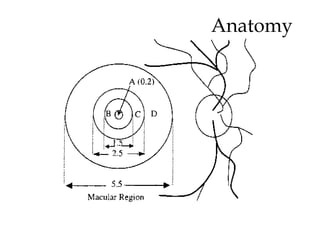
Anatomy Macula Diameter 5 mm 4 mm temporal, 0.8 inferior to optic disc Fovea Depression of ~1 disc diameter (1.5 mm) at centre of macula
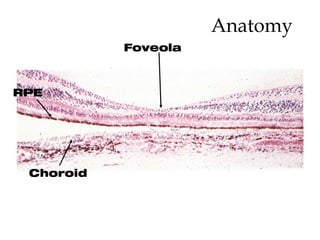
Anatomy Foveola Central point of fovea 0.35 mm in diameter Thinnest part of retina Cones only High levels of visual acuity
Anatomy Choroid RPE Foveola
Anatomy
Definitions Two forms: Non-exudative (dry) Most common (90%)  Geographic atrophy Exudative (wet) Neo-vascularisation Causes more devastating and sudden vision affects
Pathophysiology Progressive thickening of Bruch’s membrane with age Interferes with RPE - photoreceptor metabolism Metabolites from photoreceptors accumulate on Bruch’s membrane Like debris!
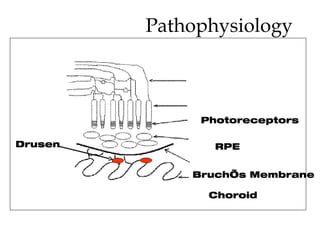
Pathophysiology Drusen (colloid bodies) Earliest clinical sign Lipid or collagen rich deposits (waste) Lie between Bruch’s membrane and RPE Further disruption of RPE/photoreceptor metabolism Cause variable amount of depigmentation and eventually atrophy of overlying RPE
Pathophysiology Drusen Bruch’s Membrane RPE Photoreceptors Choroid
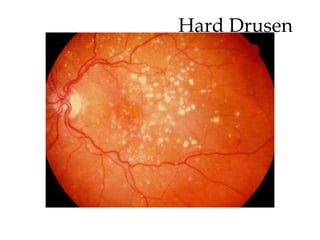
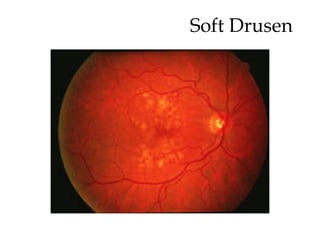
Pathophysiology Hard Drusen Small localised collection of hyaline material within or on Bruch’s membrane Sharp, well demarcated boundaries  Soft Drusen Involve overlying focal RPE detachment Poorly demarcated boundaries Larger/commonly become confluent
Hard Drusen
Soft Drusen
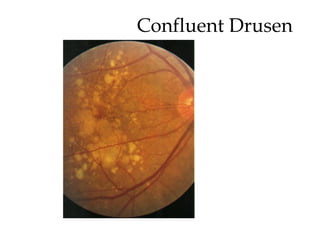
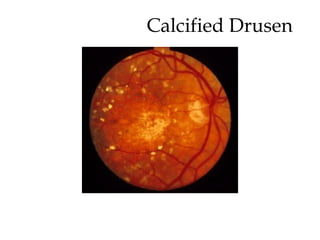
Pathophysiology Drusen Can become calcified (glistening appearance) Can become confluent – representing widespread RPE abnormality Increase risk of vision loss! Can be inherited as a dominant trait Hard Drusen No progression / consequence
Confluent Drusen
Calcified Drusen
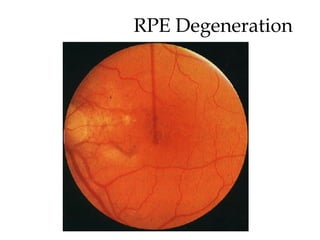
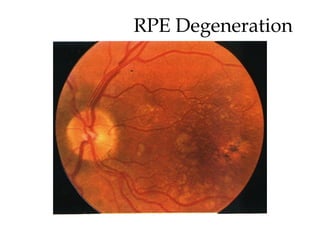
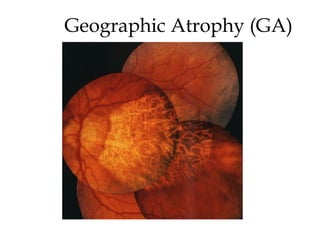
Pathophysiology RPE degeneration, seen as: Focal areas of hypo- and hyper- pigmentation (‘stippling’) Eventually areas of atrophy of the RPE revealing underlying choriocapillaris ‘ Geographic atrophy’ = end stage
RPE Degeneration
RPE Degeneration
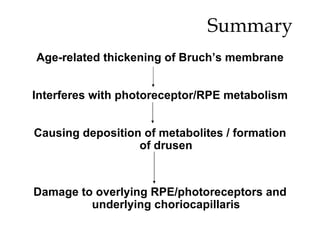
Summary Age-related thickening of Bruch’s membrane Interferes with photoreceptor/RPE metabolism Causing deposition of metabolites / formation of drusen Damage to overlying RPE/photoreceptors and underlying choriocapillaris
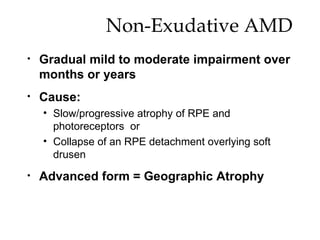
Non-Exudative AMD Gradual mild to moderate impairment over months or years Cause: Slow/progressive atrophy of RPE and photoreceptors  or Collapse of an RPE detachment overlying soft drusen Advanced form = Geographic Atrophy
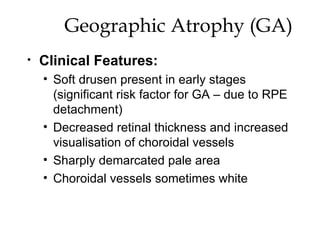
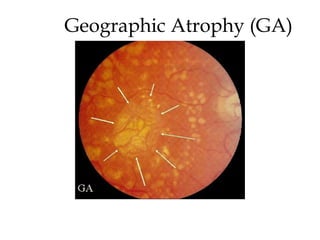
Geographic Atrophy (GA) Clinical Features: Soft drusen present in early stages (significant risk factor for GA – due to RPE detachment) Decreased retinal thickness and increased visualisation of choroidal vessels  Sharply demarcated pale area Choroidal vessels sometimes white
Geographic Atrophy (GA)
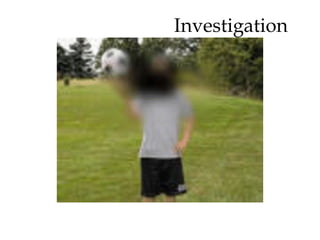
Geographic Atrophy (GA) Signs/Symptoms: Marked decrease VA (unless foveal sparing) Central field loss (positive scotoma) Difficulty recognizing faces Difficulty reading if large scotoma Difficulties in dim light / adapting
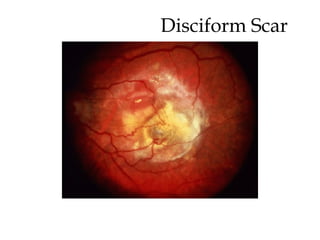
Exudative AMD  Clinical Features: Choroidal neo-vascularisation Exudative detachment of RPE and/or retina Disciform scar
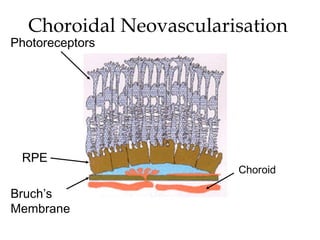
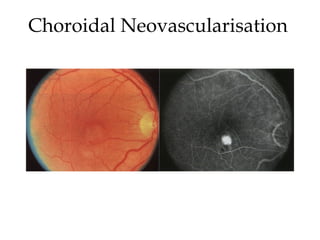
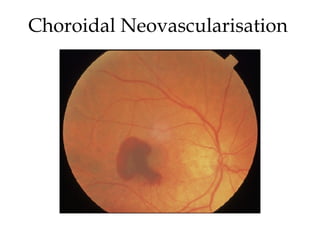
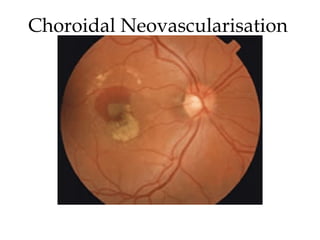
Choroidal Neovascularisation  Proliferations of fibrovascular tissue from choriocapillaris through defects in Bruch’s membrane Sub-RPE or sub-retinal Membranes have a greyish/green or pinkish/yellow hue in late stages
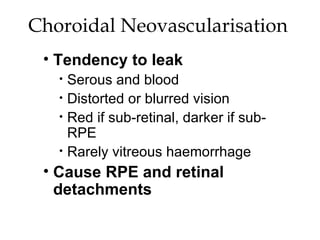
Choroidal Neovascularisation  Tendency to leak Serous and blood Distorted or blurred vision Red if sub-retinal, darker if sub-RPE Rarely vitreous haemorrhage Cause RPE and retinal detachments
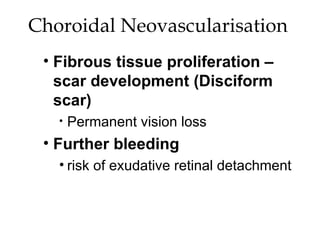
Choroidal Neovascularisation  Fibrous tissue proliferation – scar development (Disciform scar)  Permanent vision loss Further bleeding  risk of exudative retinal detachment
Choroidal Neovascularisation  RPE Bruch’s  Membrane Photoreceptors Choroid
Choroidal Neovascularisation
Disciform Scar
Investigation  History Gradual change = non-exudative Sudden change = exudative Difficulties reading/recognising faces Difficulties with changing light / adapting after bright light (remember when assessing!) Distortion = exudative change!
Investigation
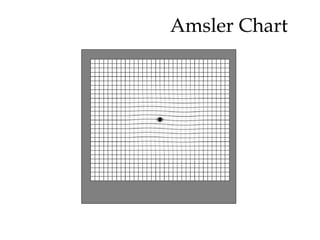
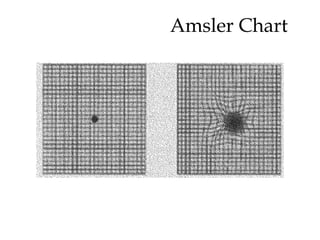
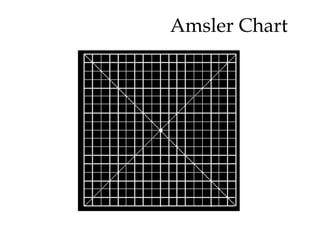
Investigation  Visual acuity Distance and near No improvement (worse?) with pin-hole Amsler-grid Field test for central 20 degrees Show scotoma/distortion Monocular/ correct add for WD! No varifocals/bifocals!!!!
Amsler Chart
Amsler Chart
Amsler Chart
Investigation  Fundus Examination Binocular view – detect elevation VOLK or contact lens
Management  Urgent refer any suspected neovascular membrane or sub-retinal fluid Fluorescein angiography Absence of previous drusen – sub-retinal fluid(?) Non-exudative – no surgical treatment
Mx. Non-exudative  Advice and support Likely to progress Central vision only Advice re. Lighting High add or LVA’s
Mx. Non-exudative  Amsler Chart – self monitoring Low Vision referral Daily living skills LVA’s Eccentric fixation training? Registration Social Service - advice and benefits
Mx. Exudative  Argon laser photocoagulation Extrafoveal/Juxtafoveal CNV Subfoveal? Immediate loss of VA  Slow progression NOT improve Possible recurrence (up to 50%)
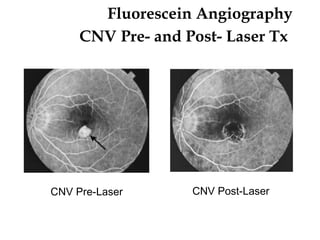
Fluorescein Angiography CNV Pre- and Post- Laser Tx   CNV Pre-Laser CNV Post-Laser
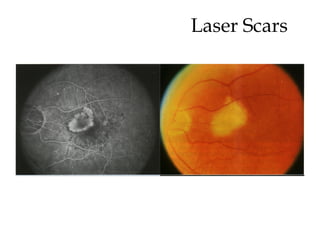
Laser Scars
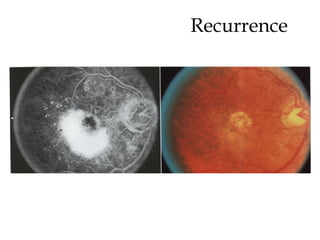
Recurrence
Mx. Exudative  Photodynamic therapy Photosensitizer dye accumulates in proliferating tissues  damaged by appropriate wavelength light More specific than laser – only destroys tissue with photosensitive dye High cost!!
Mx. Exudative  Radiation Therapy Not conclusive Surgical translocation Still experimental Membrane removal Suitable for young not old RPE transplantation?
Risk Factors  Fair skin/blue eyes Female Obesity Hypertension High-fat diet / High cholesterol Long-sighted
Risk Factors  Smoking Accelerate development of ‘wet’ form - twice the risk Sunlight   short wavelengths accelerate degeneration History of out-door life Sunglasses/polaroids?
Prevention  Supplements Carotenoid pigments – green leafy vegetables Zinc – mixed results Anti-oxidants – Vit A and C (particularly combined with Zinc) Selenium Problems with side-effects
Prevention  Age-Related Eye Disease Study (AREDS) 2001 Vit C 500mg Vit E 400 mg Vit A – 15 mg Zinc – 80 mg (Copper – 2mg) Did not help early stages; reduced risk of progression to advanced forms.
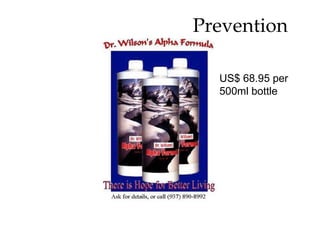
Prevention  US$ 68.95 per 500ml bottle
References  www. rcophth .ac. uk /publications /guidelines/ armd .html Mx, prognosis, aetiology etc Kanski, Clinical Opthalmology Various ophthalmology textbooks or atlases Berger et al. Age-related macular degeneration

Age-Related Macular Degeneration

  • 1.
  • 2.
    Introduction Leading causeof blindness in the Western World Common in Caucasian populations Bilateral disease 60% bilateral within 5 years of visual loss in first eye Earliest signs rarely visible before 45 years.
  • 3.
    Anatomy Macula Diameter5 mm 4 mm temporal, 0.8 inferior to optic disc Fovea Depression of ~1 disc diameter (1.5 mm) at centre of macula
  • 4.
    Anatomy Foveola Centralpoint of fovea 0.35 mm in diameter Thinnest part of retina Cones only High levels of visual acuity
  • 5.
  • 6.
  • 7.
    Definitions Two forms:Non-exudative (dry) Most common (90%) Geographic atrophy Exudative (wet) Neo-vascularisation Causes more devastating and sudden vision affects
  • 8.
    Pathophysiology Progressive thickeningof Bruch’s membrane with age Interferes with RPE - photoreceptor metabolism Metabolites from photoreceptors accumulate on Bruch’s membrane Like debris!
  • 9.
    Pathophysiology Drusen (colloidbodies) Earliest clinical sign Lipid or collagen rich deposits (waste) Lie between Bruch’s membrane and RPE Further disruption of RPE/photoreceptor metabolism Cause variable amount of depigmentation and eventually atrophy of overlying RPE
  • 10.
    Pathophysiology Drusen Bruch’sMembrane RPE Photoreceptors Choroid
  • 11.
    Pathophysiology Hard DrusenSmall localised collection of hyaline material within or on Bruch’s membrane Sharp, well demarcated boundaries Soft Drusen Involve overlying focal RPE detachment Poorly demarcated boundaries Larger/commonly become confluent
  • 12.
  • 13.
  • 14.
    Pathophysiology Drusen Canbecome calcified (glistening appearance) Can become confluent – representing widespread RPE abnormality Increase risk of vision loss! Can be inherited as a dominant trait Hard Drusen No progression / consequence
  • 15.
  • 16.
  • 17.
    Pathophysiology RPE degeneration,seen as: Focal areas of hypo- and hyper- pigmentation (‘stippling’) Eventually areas of atrophy of the RPE revealing underlying choriocapillaris ‘ Geographic atrophy’ = end stage
  • 18.
  • 19.
  • 20.
    Summary Age-related thickeningof Bruch’s membrane Interferes with photoreceptor/RPE metabolism Causing deposition of metabolites / formation of drusen Damage to overlying RPE/photoreceptors and underlying choriocapillaris
  • 21.
    Non-Exudative AMD Gradualmild to moderate impairment over months or years Cause: Slow/progressive atrophy of RPE and photoreceptors or Collapse of an RPE detachment overlying soft drusen Advanced form = Geographic Atrophy
  • 22.
    Geographic Atrophy (GA)Clinical Features: Soft drusen present in early stages (significant risk factor for GA – due to RPE detachment) Decreased retinal thickness and increased visualisation of choroidal vessels Sharply demarcated pale area Choroidal vessels sometimes white
  • 23.
  • 24.
  • 25.
    Geographic Atrophy (GA)Signs/Symptoms: Marked decrease VA (unless foveal sparing) Central field loss (positive scotoma) Difficulty recognizing faces Difficulty reading if large scotoma Difficulties in dim light / adapting
  • 26.
    Exudative AMD Clinical Features: Choroidal neo-vascularisation Exudative detachment of RPE and/or retina Disciform scar
  • 27.
    Choroidal Neovascularisation Proliferations of fibrovascular tissue from choriocapillaris through defects in Bruch’s membrane Sub-RPE or sub-retinal Membranes have a greyish/green or pinkish/yellow hue in late stages
  • 28.
    Choroidal Neovascularisation Tendency to leak Serous and blood Distorted or blurred vision Red if sub-retinal, darker if sub-RPE Rarely vitreous haemorrhage Cause RPE and retinal detachments
  • 29.
    Choroidal Neovascularisation Fibrous tissue proliferation – scar development (Disciform scar) Permanent vision loss Further bleeding risk of exudative retinal detachment
  • 30.
    Choroidal Neovascularisation RPE Bruch’s Membrane Photoreceptors Choroid
  • 31.
  • 32.
  • 33.
  • 34.
  • 35.
    Investigation HistoryGradual change = non-exudative Sudden change = exudative Difficulties reading/recognising faces Difficulties with changing light / adapting after bright light (remember when assessing!) Distortion = exudative change!
  • 36.
  • 37.
    Investigation Visualacuity Distance and near No improvement (worse?) with pin-hole Amsler-grid Field test for central 20 degrees Show scotoma/distortion Monocular/ correct add for WD! No varifocals/bifocals!!!!
  • 38.
  • 39.
  • 40.
  • 41.
    Investigation FundusExamination Binocular view – detect elevation VOLK or contact lens
  • 42.
    Management Urgentrefer any suspected neovascular membrane or sub-retinal fluid Fluorescein angiography Absence of previous drusen – sub-retinal fluid(?) Non-exudative – no surgical treatment
  • 43.
    Mx. Non-exudative Advice and support Likely to progress Central vision only Advice re. Lighting High add or LVA’s
  • 44.
    Mx. Non-exudative Amsler Chart – self monitoring Low Vision referral Daily living skills LVA’s Eccentric fixation training? Registration Social Service - advice and benefits
  • 45.
    Mx. Exudative Argon laser photocoagulation Extrafoveal/Juxtafoveal CNV Subfoveal? Immediate loss of VA Slow progression NOT improve Possible recurrence (up to 50%)
  • 46.
    Fluorescein Angiography CNVPre- and Post- Laser Tx CNV Pre-Laser CNV Post-Laser
  • 47.
  • 48.
  • 49.
    Mx. Exudative Photodynamic therapy Photosensitizer dye accumulates in proliferating tissues damaged by appropriate wavelength light More specific than laser – only destroys tissue with photosensitive dye High cost!!
  • 50.
    Mx. Exudative Radiation Therapy Not conclusive Surgical translocation Still experimental Membrane removal Suitable for young not old RPE transplantation?
  • 51.
    Risk Factors Fair skin/blue eyes Female Obesity Hypertension High-fat diet / High cholesterol Long-sighted
  • 52.
    Risk Factors Smoking Accelerate development of ‘wet’ form - twice the risk Sunlight short wavelengths accelerate degeneration History of out-door life Sunglasses/polaroids?
  • 53.
    Prevention SupplementsCarotenoid pigments – green leafy vegetables Zinc – mixed results Anti-oxidants – Vit A and C (particularly combined with Zinc) Selenium Problems with side-effects
  • 54.
    Prevention Age-RelatedEye Disease Study (AREDS) 2001 Vit C 500mg Vit E 400 mg Vit A – 15 mg Zinc – 80 mg (Copper – 2mg) Did not help early stages; reduced risk of progression to advanced forms.
  • 55.
    Prevention US$68.95 per 500ml bottle
  • 56.
    References www.rcophth .ac. uk /publications /guidelines/ armd .html Mx, prognosis, aetiology etc Kanski, Clinical Opthalmology Various ophthalmology textbooks or atlases Berger et al. Age-related macular degeneration