POWER SUPPLY
Fabrication of Power supply
             &
           SMPS
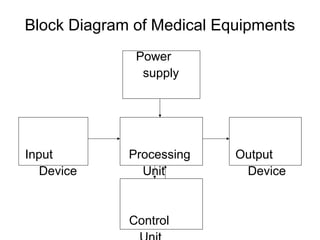
Block Diagram of Medical Equipments
              Power
               supply


Input        Processing    Output
   Device      Unit         Device


             Control
โ€ข The electric power is not normally used in
  the form in which it is produced or
  distributed.
โ€ข Practically all electronic systems require
  some form of Power conversion.
โ€ข A device that transfers electric energy
  from a source to a load using electronic
  circuits is referred to as power supply.
โ€ข A typical application of a power supply is
  to convert utility AC voltage into regulated
  DC voltages required for electronic
  equipment.
Categories of Power Supplies
There are two broad categories of power
  supplies:
โ€ข Linear regulated power supply
โ€ข switched mode power supply (SMPS)
            In some cases one may use a
  combination of switched mode and linear
  power supplies to gain some desired
  advantages of both the types.
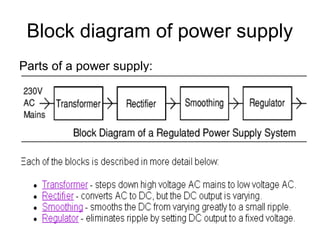
Block diagram of power supply
Parts of a power supply:
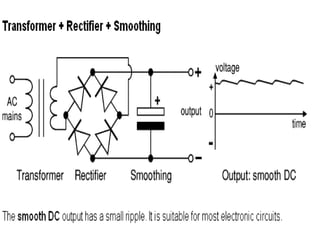
โ€ข The AC voltage is connected to a transformer,
  which steps that ac voltage down to the level for
  the desired dc output.
โ€ข A diode rectifier then provides a full-wave
  rectified voltage.
โ€ข This is initially filtered by a simple capacitor filter
  to produce a dc voltage.
โ€ข This resulting dc voltage usually has some ripple
  or ac voltage regulation.
โ€ข A regulator circuit can use this dc input to
  provide a dc voltage that not only has much less
  ripple voltage but also remains the same dc
  value even if the input dc voltage varies
  somewhat or the load connected to the output
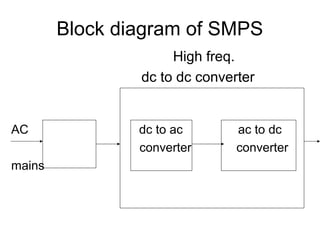
  dc voltage changes.
โ€ข This voltage regulation is usually obtained using
  one of the voltage regulator IC units.
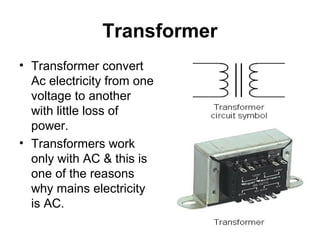
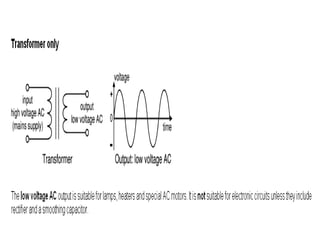
Transformer
โ€ข Transformer convert
  Ac electricity from one
  voltage to another
  with little loss of
  power.
โ€ข Transformers work
  only with AC & this is
  one of the reasons
  why mains electricity
  is AC.
TYPES OF TRANSFORMER
โ€ข Step-up Transformer

โ€ข Step-down Transformer
โ€ข Step-up transformers increase voltage,
  step-down transformers reduce voltage.

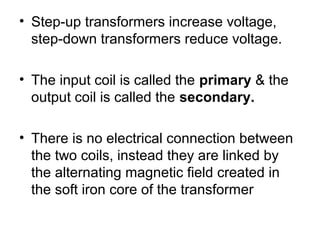
โ€ข The input coil is called the primary & the
  output coil is called the secondary.

โ€ข There is no electrical connection between
  the two coils, instead they are linked by
  the alternating magnetic field created in
  the soft iron core of the transformer
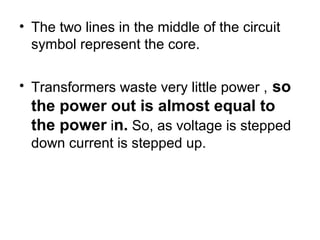
โ€ข The two lines in the middle of the circuit
  symbol represent the core.

โ€ข Transformers waste very little power , so
  the power out is almost equal to
  the power in. So, as voltage is stepped
  down current is stepped up.
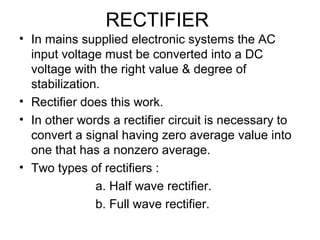
RECTIFIER
โ€ข In mains supplied electronic systems the AC
  input voltage must be converted into a DC
  voltage with the right value & degree of
  stabilization.
โ€ข Rectifier does this work.
โ€ข In other words a rectifier circuit is necessary to
  convert a signal having zero average value into
  one that has a nonzero average.
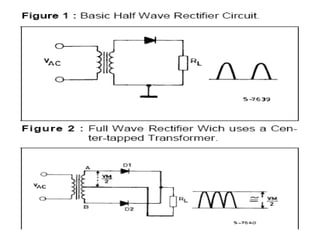
โ€ข Two types of rectifiers :
               a. Half wave rectifier.
               b. Full wave rectifier.
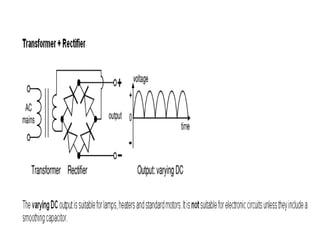
โ€ข Figure above uses a center-tapped
  transformer with two rectifier diodes.
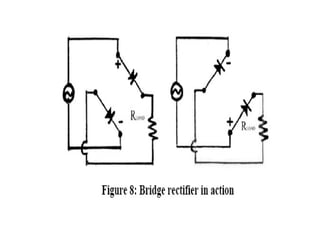
โ€ข Figure below uses a simple transformer &
  four rectifier diodes usually known as a
  bridge rectifier.
SMOOTHING/FILTER
โ€ข We need a way to smooth out the
  pulsations& get a much cleaner dc power
  source for the load circuit.
โ€ข This is done by a filter circuit.
โ€ข In power supply, a filter must remove or
  reduce the ac variations while still making
  the desired dc available to the load
  circuitry.
โ€ข Any given filter involve capacitors,
  inductors,&/resistors in some combination.
Types of filters
โ€ข Capacitor Filter : Used to obtain
 essentially a dc voltage with some ripple.
โ€ข RC Filter : It is possible to reduce the
 amount of ripple across a filter capacitor
 by using an additional RC filter .
โ€ข LC Filter : This reduces Hum & ripple
 (Used where noise should be reduced).
CAPACITOR FILTER
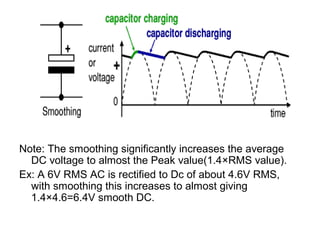
โ€ข Smoothing is performed by a large value
  electrolytic capacitor connected across the DC
  supply to act as a reservoir, supplying current to
  the output when the varying DC voltage from the
  rectifier is falling.
โ€ข The diagram shows the unsmoothed varying DC
  (dotted line) & the smoothed DC (solid line).
โ€ข The capacitor charges quickly near the peak of
  the varying DC, & then discharges as it supplies
  current to the output.
Note: The smoothing significantly increases the average
  DC voltage to almost the Peak value(1.4ร—RMS value).
Ex: A 6V RMS AC is rectified to Dc of about 4.6V RMS,
  with smoothing this increases to almost giving
  1.4ร—4.6=6.4V smooth DC.
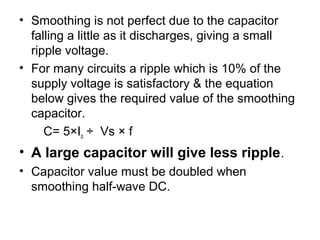
โ€ข Smoothing is not perfect due to the capacitor
  falling a little as it discharges, giving a small
  ripple voltage.
โ€ข For many circuits a ripple which is 10% of the
  supply voltage is satisfactory & the equation
  below gives the required value of the smoothing
  capacitor.
     C= 5ร—Io รท Vs ร— f
โ€ข A large capacitor will give less ripple .
โ€ข Capacitor value must be doubled when
  smoothing half-wave DC.
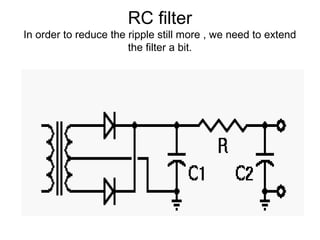
RC filter
In order to reduce the ripple still more , we need to extend
                       the filter a bit.
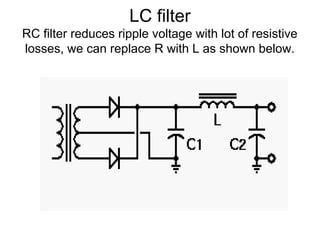
LC filter
RC filter reduces ripple voltage with lot of resistive
losses, we can replace R with L as shown below.
REGULATOR
โ€ข Regulator - eliminates ripple by setting DC
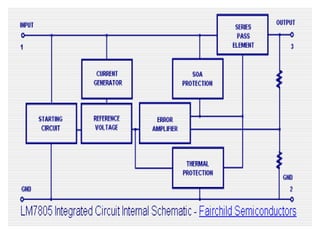
  output to a fixed voltage
โ€ข Voltage regulator ICโ€™s are available with fixed
  (typically 5,12 &15V) or variable output voltages.
โ€ข They are also rated by the maximum current
  they can pass.
โ€ข Negative voltage regulators are available, mainly
  for use in dual supplies.
โ€ข Many regulators include some automatic
  protection from excessive current (overload
  protection) & overheating (thermal protection).
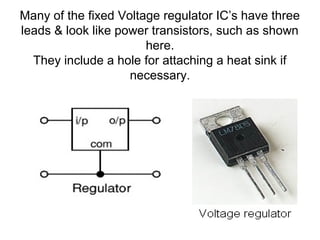
Many of the fixed Voltage regulator ICโ€™s have three
leads & look like power transistors, such as shown
                       here.
  They include a hole for attaching a heat sink if
                    necessary.
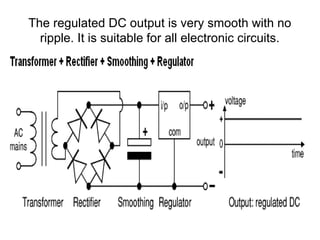
The regulated DC output is very smooth with no
  ripple. It is suitable for all electronic circuits.
Zener diode Regulators
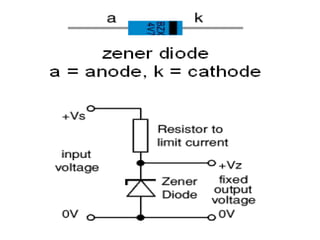
โ€ข For low current power supplies a simple voltage
  regulator can be made with a resistor & a zener
  diode connected in reverse as shown in the
  diagram.
โ€ข Zener diodes are rated by their breakdown voltage
  Vz & maximum power Pz.
โ€ข The resistor limits the current (like an LED resistor).
โ€ข The current through resistor is constant, so when
  there is no output current all the current flows
  through zener diode & its power rating must be
  large enough to withstand this.
โ€ข Choosing a zener diode and resistor:
โ€ข The zener voltage Vz is the output voltage
  required
โ€ข The input voltage Vs must be a few volts
  greater than Vz
  (this is to allow for small fluctuations in Vs
  due to ripple)
โ€ข The maximum current Imax is the output
  current required plus 10%
โ€ข The zener power Pz is determined by the
  maximum current: Pz > Vz ร— Imax
โ€ข The resistor resistance: R = (Vs - Vz) /
  Imax
โ€ข The resistor power rating: P > (Vs - Vz) ร—
  Imax
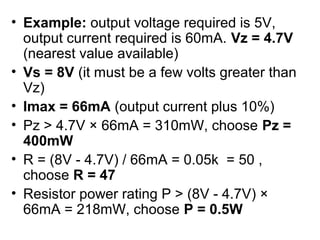
โ€ข Example: output voltage required is 5V,
  output current required is 60mA. Vz = 4.7V
  (nearest value available)
โ€ข Vs = 8V (it must be a few volts greater than
  Vz)
โ€ข Imax = 66mA (output current plus 10%)
โ€ข Pz > 4.7V ร— 66mA = 310mW, choose Pz =
  400mW
โ€ข R = (8V - 4.7V) / 66mA = 0.05k = 50 ,
  choose R = 47
โ€ข Resistor power rating P > (8V - 4.7V) ร—
  66mA = 218mW, choose P = 0.5W
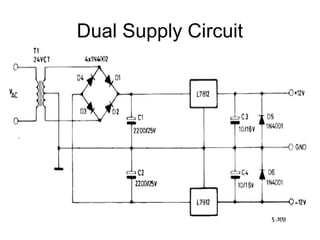
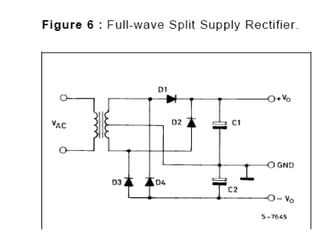
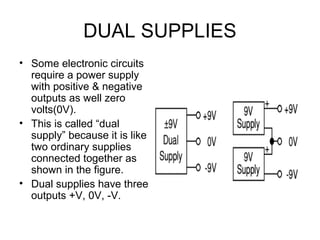
DUAL SUPPLIES
โ€ข Some electronic circuits
  require a power supply
  with positive & negative
  outputs as well zero
  volts(0V).
โ€ข This is called โ€œdual
  supplyโ€ because it is like
  two ordinary supplies
  connected together as
  shown in the figure.
โ€ข Dual supplies have three
  outputs +V, 0V, -V.
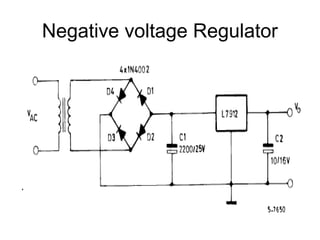
Negative voltage Regulator
Dual Supply Circuit
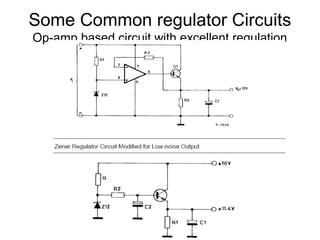
Some Common regulator Circuits
Op-amp based circuit with excellent regulation
Advantages of traditional Power
           supply
โ€ข The linear regulator is the building block of
  nearly every power supply used in
  electronics.
โ€ข The IC linear regulator is so easy to use
  that it is virtually foolproof, & so
  inexpensive that it is usually one of the
  cheapest components in an electronic
  assembly.
โ€ข Power supply discussed till now are also
  known as linear regulators and
  maintains desired output voltage by
  dissipating excess power .
โ€ข Thus for proper operation of these
  supplies heat sinks are a must.
โ€ข The power dissipated by a 15V regulator
  is
Power dissipated=(dropout voltage)
  (current)
    =(18.95-15) (0.5)=1.98W
โ€ข The power dissipated by a 5V regulator is
Power dissipated=(8.91-5) (1.0)= 3.91W
Defects in the Traditional Power Supplies
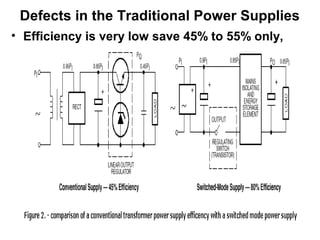
โ€ข Efficiency is very low save 45% to 55% only,
โ€ข A large amount of energy is wasted.
    1. Unstabilized D.C voltage / current should be
  greater than the stabilized voltage / current. So,
  the energy loss is in the form of heat due to the
  power transistor, etc.
    2. Energy loss in the form of heat etc. is in the
  main transformer.
       a. Due to eddy current loss.
       b. Copper loss.

โ€ข The size & weight of the transformer is also
  large for high current.
  In transformer, number of turns is
  inversely proportional to frequency.
  So less frequency means more turns & high
  frequency means less turns.
โ€ข Very large value of capacitor is needed
  for reservoir for high current say 10,000
  mfd to 50,000 mfd.
  Similarly at low frequency, capacitor value
  will be increased( so size will increase). At
  high frequency, capacitor value will
  decrease & hence size will also decrease.
โ€ข The low frequency ripple from the main
  is always difficult to remove completely,
  even large capacitors are used.
โ€ข Get shock from the chassis if
  accidentally touch it.
Answers to many of the problems for
making high current, low
dissipation, light weight, less space
and without low frequency ripple
                  Isโ€ฆ.
Switched Mode power Supply
โ€ข The SMPS owes its name to dc-to-dc
  switching converter for conversion from
  unregulated dc input to regulated dc
  output voltage.


โ€ข Typical frequency range of SMPS is from
  50 kHz to several MHz.
Requirements of SMPS
โ€ข Less bulky Transformers
โ€ข Less Energy loss / Eddy currents
โ€ข Capacitors of small size
Switched-mode power supply
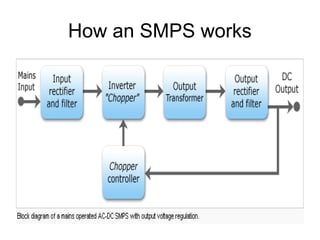
โ€ข The input supply drawn from ac mains is first
  rectified & filtered using a capacitor.
โ€ข The unregulated dc voltage across the
  capacitor is then fed to a high frequency
  dc- to dc converter.
โ€ข Most of the dc-to-dc converters used in
  SMPS circuits have an intermediate high
  frequency ac conversion stage to facilitate
  the use of a high frequency transformer for
  voltage scaling & isolation.
Block diagram of SMPS
                     High freq.
                dc to dc converter


AC              dc to ac       ac to dc
                converter      converter
mains
DC to DC conversion in SMPS
โ€ข One method is to use a High frequency
  transformer for voltage scaling & isolation.
โ€ข Another popular method is to use simplified
  switching circuits that omits the transformer
  action.
        In such SMPS, the unregulated input
  dc voltage is fed to a high frequency
  chopping circuit which switches between
  โ€œONโ€ & โ€œOFFโ€ states.
Types of SMPS
SMPS can be classified into four types according
  to the input & output wave forms as follows:
โ€ข AC in, DC out: rectifier, off-line converter
  input stage.
โ€ข DC in, DC out: Voltage converter or
  current converter, DC to DC converter.
โ€ข AC in, AC out: Frequency changer or
    cyclo converter.
โ€ข   DC in, AC out: Inverter
AC in DC out (Ordinary SMPS)
This type of power supply previously used in
 TV receivers / instruments having used
 the main at full voltage to provide a power
 for an oscillator / inverter whose output is
 in turn is fed to high frequency
 transformer, then to rectifier, switcher,
 stabilizer and then to regulator. The
 correct of the error signal and output
 signal is also done by negative feedback
 loop from output to the input switch.
How an SMPS works
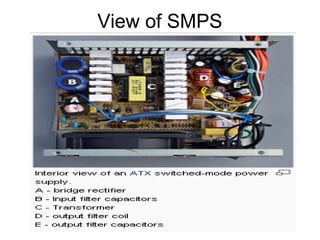
View of SMPS
Input Rectifier
โ€ข The first stage is to convert AC input to
  DC output (Rectification).
โ€ข The rectifier produces an unregulated DC
  voltage which is sent to a large filter
  capacitor.
โ€ข The current drawn from the mains supply
  by this rectifier circuit occurs in short
  pulses around the AC voltage peaks.
โ€ข These pulses have significant high
  frequency energy which reduces the power
  factor.
โ€ข Special control techniques can be
  employed by the following SMPS to force
  the average input current to follow the
  sinusoidal shape of the AC input voltage
  thus the designer should try correcting the
  power factor.
INVERTER
โ€ข This converts DC, Whether directly from
  the input or from the rectifier, to AC by
  running it through a power oscillator,
  whose output transformer is very small
  with few windings at a frequency of tens or
  hundreds of kHz.
โ€ข The frequency is usually chosen to be
  above 20 kHZ, to make it inaudible to
  humans.
OUTPUT TRANSFORMER
โ€ข If the output is required to be isolated from
  input, (as is usually the case in mains
  power supplies) the inverted AC is used to
  drive the primary winding of a high-
  frequency transformer.
โ€ข This converts the voltage up or down to
  the required output level on its secondary
  winding.
Output rectifier & filter
โ€ข If a DC output is required, the AC output from
  the transformer is rectified.
โ€ข For output voltages above ten volts or so,
  ordinary silicon diodes are commonly used.
โ€ข For lower voltages Schottky diodes are
  commonly used as rectifier elements (they have
  faster times than silicon diodes, thus allowing
  low-loss operation at higher frequencies).
โ€ข For even lower output voltages, MOSFETs may
  be used as synchronous rectifiers.
โ€ข The rectified output is then smoothed by a
  filter consisting of inductors & capacitors.
โ€ข For higher switching frequencies,
  components with lower capacitance &
  inductance are needed.
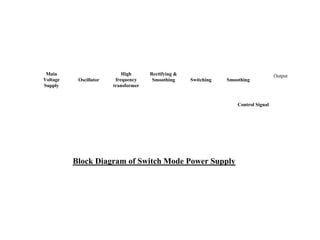
Main                       High      Rectifying &                                    Output
Voltage    Oscillator    frequency     Smoothing     Switching   Smoothing
Supply                  transformer


                                                                     Control Signal


          Block Diagram of Switch Mode Power Supply
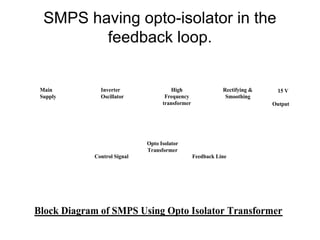
SMPS having opto-isolator in the
         feedback loop.


 Main         Inverter                 High                 Rectifying &    15 V
 Supply       Oscillator            Frequency                Smoothing
                                   transformer                             Output


                             Opto Isolator
                             Transformer
            Control Signal                       Feedback Line


Block Diagram of SMPS Using Opto Isolator Transformer
Features & drawbacks
โ€ข A lamp from output to Optocoupler.
โ€ข When Optocoupler fails, the light will fall on
  the photocell, the mains will flow through
  feedback circuit & reflect in output. Hence a
  shock hazard.
โ€ข So, now SMPS using pulse transformer.
  Feedback will have mark& space
  modulation.
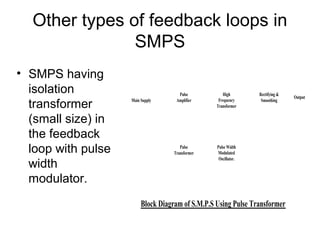
Other types of feedback loops in
               SMPS
โ€ข SMPS having
  isolation                           Pulse          High        Rectifying &
                                                                                Output
  transformer       Main Supply      Amplifier     Frequency
                                                  Transformer
                                                                  Smoothing


  (small size) in
  the feedback
  loop with pulse                      Pulse
                                    Transformer
                                                  Pulse Width
                                                  Modulated
                                                   Oscillator.
  width
  modulator.
                         Block Diagram of S.M.P.S Using Pulse Transformer
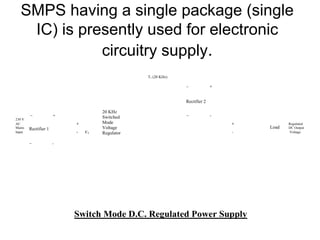
SMPS having a single package (single
   IC) is presently used for electronic
             circuitry supply.
                                               T1 (20 KHz)

                                                             ~             +


                                                             Rectifier 2

                                   20 KHz
        ~             +                                      ~             -
230 V
                                   Switched
AC                        +        Mode                                        +          Regulated
Mains   Rectifier 1                Voltage                                         Load   DC Output
Input                     -   C1   Regulator                                   -          Voltage


        ~             -


                          Switch Mode D.C. Regulated Power Supply
Different Topologies of SMPS
โ€ข   fly-back
โ€ข   forward
โ€ข   push-pull
โ€ข   Cโ€™uk
โ€ข   Sepic
โ€ข   Half bridge
โ€ข   H-bridge circuits.
โ€ข A particular topology may be more
  suitable than others on the basis of one or
  more performance criterions like cost,
  efficiency, overall weight and size, output
  power, output regulation, voltage ripple
  etc.
โ€ข All the topologies listed above are
  capable of providing isolated voltages by
  incorporating a high frequency transformer
  in the circuit.
Popular types of SMPS
 Non Isolated SMPS:
โ€ข Non isolated power supplies contain an inductor
  instead of a transformer. This type includes
               Boost converters
               Buck converters
               Buck-boost converters
โ€ข These belong to the simplest class of single
  input, single output converters which utilize one
  inductor & one active switch (MOSFET).
Buck converter
โ€ข This reduces the input voltage, in direct
  proportion to the ratio of the active switch โ€œonโ€
  time to the total switching period, called the duty
  cycle.
  For ex: An ideal buck converter with a 10V input
  operating at a 50% duty cycle will produce an
  average output voltage of 5V.
โ€ข A feed back control loop is employed to maintain
  (regulate) the output voltage by varying the duty
  cycle to compensate for the variations in the
  input voltage.
Boost & Buck-boost converter
โ€ข The output voltage of a boost converter is
  always greater than the input voltage.
โ€ข The buck-boost output voltage is inverted
  but can be greater than, equal to, or less
  than the magnitude of its input voltage.
โ€ข There are many variations & extensions to
  this class of converters but these three
  form the basics of almost all isolated &
  non isolated DC to Dc converters.
Other types of SMPS
โ€ข By adding a second inductor the Cuk & SEPIC
  converters can be implemented or by adding
  additional active switches various bridge
  converters can be realised.
โ€ข Other types of SMPSs use a capacitor-diode
  voltage multiplier instead of inductors &
  transformers.
โ€ข These are mostly used for generating high
  voltages at low currents.
โ€ข The low voltage variant is called charge pump.
Chopper controller/Regulation
โ€ข A feedback circuit monitors the output voltage &
  compares it with a reference voltage, which is
  set manually or electronically to the desired
  output.
โ€ข If there is an error in the output voltage, the
  feedback circuit compensates by adjusting the
  timing with which the MOSFETs are switched on
  & off.
โ€ข This part of the power supply is called the
  switching regulator.
โ€ข Depending on design/safety requirements, the
  controller may or may not contain an isolation
  mechanism (such as opto-couplers) to
  isolate it from the DC output.
โ€ข Switching supplies in Bio-medical instruments
  have these opto-couplers to tightly control the
  output voltage & isolation of patient .
โ€ข Open regulators do not have a feedback circuit.
  Instead, they rely on feeding a constant voltage
  to the input of the transformer or inductor, &
  assume that the output will be correct.
Advantage & disadvantage of
              SMPS
Advantage:
โ€ข Greater efficiency because the switching
  transistor dissipates little power in the saturated
  state & the off state compared to the
  semiconductor state.
โ€ข Small size & lighter weight ( elimination of low
  frequency transformers)& low heat generation.
Disadvantage:
โ€ข Greater complexity
โ€ข Generation of high amplitude, high frequency
  energy that a low pass filter blocks.
โ€ข Due to large electronic circuitry and
  feedback from output to input it become
  difficult to repair as compare to ordinary
  Power supplies.
โ€ข The Transformer is small in size but it is
  tuned to particular high frequency (20 kc/s โ€“
  50 kc/s). So, whenever the transformer
  gone defective, it must be replaced with the
  original one.
โ€ข The output load current / voltage must not
  be more than 15% up or down the mention
  standard value.
Application of SMPS in Biomedical
              circuits
โ€ข Isolation of patients in diagnostic
  instruments like ECG etc. (using opto-
  couplers in control circuitry)
โ€ข SMPS battery chargers for battery based
  instruments.
โ€ข To avoid shocks, in SMPS the input is isolated from
  the output. This is achieved at two places in SMPS.
  Once at mains & another at feedback using either
  transformer or optocoupler.
โ€ข +ve feedback for oscillation & -ve feedback for
  stabilization.
โ€ข To reduce losses, quality of transformer must be
  better.
โ€ข At high frequency, no iron core will be used. Ferrite
  core is used. Basically small particles of ferrite are
  bound under pressure, so no shock hazard.
โ€ข Now Integrated SMPS are available in LSI & MSI
  packages (1394)
THANK YOU
Comparison of LPS & SMPS
โ€ข Unlike a linear power supply, the pass transistor of
  a switching mode supply switches very quickly
  (typically between 50 kHz and 1 MHz) between
  full-on and full-off states, which minimizes wasted
  energy. Voltage regulation is provided by varying
  the ratio of on to off time. In contrast, a linear
  power supply must dissipate the excess voltage to
  regulate the output. This higher efficiency is the
  chief advantage of a switched-mode power supply.
โ€ข Switching regulators are used as replacements for
  the linear regulators when higher efficiency,
  smaller size or lighter weight are required. They
  are, however, more complicated, their switching
  currents can cause electrical noise problems if not
  carefully suppressed,
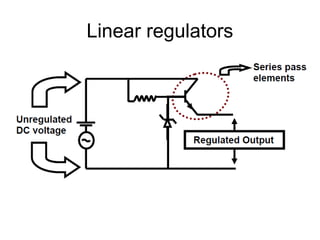
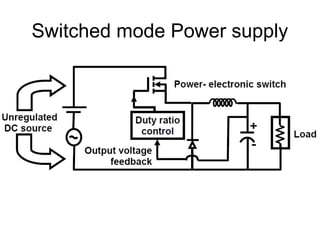
Linear regulators
Switched mode Power supply
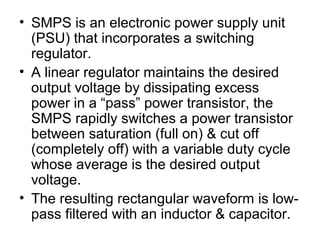
โ€ข SMPS is an electronic power supply unit
  (PSU) that incorporates a switching
  regulator.
โ€ข A linear regulator maintains the desired
  output voltage by dissipating excess
  power in a โ€œpassโ€ power transistor, the
  SMPS rapidly switches a power transistor
  between saturation (full on) & cut off
  (completely off) with a variable duty cycle
  whose average is the desired output
  voltage.
โ€ข The resulting rectangular waveform is low-
  pass filtered with an inductor & capacitor.

Power supply

  • 1.
    POWER SUPPLY Fabrication ofPower supply & SMPS
  • 2.
    Block Diagram ofMedical Equipments Power supply Input Processing Output Device Unit Device Control
  • 3.
    โ€ข The electricpower is not normally used in the form in which it is produced or distributed. โ€ข Practically all electronic systems require some form of Power conversion. โ€ข A device that transfers electric energy from a source to a load using electronic circuits is referred to as power supply. โ€ข A typical application of a power supply is to convert utility AC voltage into regulated DC voltages required for electronic equipment.
  • 4.
    Categories of PowerSupplies There are two broad categories of power supplies: โ€ข Linear regulated power supply โ€ข switched mode power supply (SMPS) In some cases one may use a combination of switched mode and linear power supplies to gain some desired advantages of both the types.
  • 5.
    Block diagram ofpower supply Parts of a power supply:
  • 6.
    โ€ข The ACvoltage is connected to a transformer, which steps that ac voltage down to the level for the desired dc output. โ€ข A diode rectifier then provides a full-wave rectified voltage. โ€ข This is initially filtered by a simple capacitor filter to produce a dc voltage. โ€ข This resulting dc voltage usually has some ripple or ac voltage regulation. โ€ข A regulator circuit can use this dc input to provide a dc voltage that not only has much less ripple voltage but also remains the same dc value even if the input dc voltage varies somewhat or the load connected to the output dc voltage changes. โ€ข This voltage regulation is usually obtained using one of the voltage regulator IC units.
  • 8.
    Transformer โ€ข Transformer convert Ac electricity from one voltage to another with little loss of power. โ€ข Transformers work only with AC & this is one of the reasons why mains electricity is AC.
  • 9.
    TYPES OF TRANSFORMER โ€ขStep-up Transformer โ€ข Step-down Transformer
  • 10.
    โ€ข Step-up transformersincrease voltage, step-down transformers reduce voltage. โ€ข The input coil is called the primary & the output coil is called the secondary. โ€ข There is no electrical connection between the two coils, instead they are linked by the alternating magnetic field created in the soft iron core of the transformer
  • 11.
    โ€ข The twolines in the middle of the circuit symbol represent the core. โ€ข Transformers waste very little power , so the power out is almost equal to the power in. So, as voltage is stepped down current is stepped up.
  • 13.
    RECTIFIER โ€ข In mainssupplied electronic systems the AC input voltage must be converted into a DC voltage with the right value & degree of stabilization. โ€ข Rectifier does this work. โ€ข In other words a rectifier circuit is necessary to convert a signal having zero average value into one that has a nonzero average. โ€ข Two types of rectifiers : a. Half wave rectifier. b. Full wave rectifier.
  • 15.
    โ€ข Figure aboveuses a center-tapped transformer with two rectifier diodes. โ€ข Figure below uses a simple transformer & four rectifier diodes usually known as a bridge rectifier.
  • 18.
    SMOOTHING/FILTER โ€ข We needa way to smooth out the pulsations& get a much cleaner dc power source for the load circuit. โ€ข This is done by a filter circuit. โ€ข In power supply, a filter must remove or reduce the ac variations while still making the desired dc available to the load circuitry. โ€ข Any given filter involve capacitors, inductors,&/resistors in some combination.
  • 19.
    Types of filters โ€ขCapacitor Filter : Used to obtain essentially a dc voltage with some ripple. โ€ข RC Filter : It is possible to reduce the amount of ripple across a filter capacitor by using an additional RC filter . โ€ข LC Filter : This reduces Hum & ripple (Used where noise should be reduced).
  • 20.
    CAPACITOR FILTER โ€ข Smoothingis performed by a large value electrolytic capacitor connected across the DC supply to act as a reservoir, supplying current to the output when the varying DC voltage from the rectifier is falling. โ€ข The diagram shows the unsmoothed varying DC (dotted line) & the smoothed DC (solid line). โ€ข The capacitor charges quickly near the peak of the varying DC, & then discharges as it supplies current to the output.
  • 21.
    Note: The smoothingsignificantly increases the average DC voltage to almost the Peak value(1.4ร—RMS value). Ex: A 6V RMS AC is rectified to Dc of about 4.6V RMS, with smoothing this increases to almost giving 1.4ร—4.6=6.4V smooth DC.
  • 22.
    โ€ข Smoothing isnot perfect due to the capacitor falling a little as it discharges, giving a small ripple voltage. โ€ข For many circuits a ripple which is 10% of the supply voltage is satisfactory & the equation below gives the required value of the smoothing capacitor. C= 5ร—Io รท Vs ร— f โ€ข A large capacitor will give less ripple . โ€ข Capacitor value must be doubled when smoothing half-wave DC.
  • 24.
    RC filter In orderto reduce the ripple still more , we need to extend the filter a bit.
  • 25.
    LC filter RC filterreduces ripple voltage with lot of resistive losses, we can replace R with L as shown below.
  • 26.
    REGULATOR โ€ข Regulator -eliminates ripple by setting DC output to a fixed voltage โ€ข Voltage regulator ICโ€™s are available with fixed (typically 5,12 &15V) or variable output voltages. โ€ข They are also rated by the maximum current they can pass. โ€ข Negative voltage regulators are available, mainly for use in dual supplies. โ€ข Many regulators include some automatic protection from excessive current (overload protection) & overheating (thermal protection).
  • 27.
    Many of thefixed Voltage regulator ICโ€™s have three leads & look like power transistors, such as shown here. They include a hole for attaching a heat sink if necessary.
  • 28.
    The regulated DCoutput is very smooth with no ripple. It is suitable for all electronic circuits.
  • 29.
    Zener diode Regulators โ€ขFor low current power supplies a simple voltage regulator can be made with a resistor & a zener diode connected in reverse as shown in the diagram. โ€ข Zener diodes are rated by their breakdown voltage Vz & maximum power Pz. โ€ข The resistor limits the current (like an LED resistor). โ€ข The current through resistor is constant, so when there is no output current all the current flows through zener diode & its power rating must be large enough to withstand this.
  • 31.
    โ€ข Choosing azener diode and resistor: โ€ข The zener voltage Vz is the output voltage required โ€ข The input voltage Vs must be a few volts greater than Vz (this is to allow for small fluctuations in Vs due to ripple) โ€ข The maximum current Imax is the output current required plus 10% โ€ข The zener power Pz is determined by the maximum current: Pz > Vz ร— Imax โ€ข The resistor resistance: R = (Vs - Vz) / Imax โ€ข The resistor power rating: P > (Vs - Vz) ร— Imax
  • 32.
    โ€ข Example: outputvoltage required is 5V, output current required is 60mA. Vz = 4.7V (nearest value available) โ€ข Vs = 8V (it must be a few volts greater than Vz) โ€ข Imax = 66mA (output current plus 10%) โ€ข Pz > 4.7V ร— 66mA = 310mW, choose Pz = 400mW โ€ข R = (8V - 4.7V) / 66mA = 0.05k = 50 , choose R = 47 โ€ข Resistor power rating P > (8V - 4.7V) ร— 66mA = 218mW, choose P = 0.5W
  • 33.
    DUAL SUPPLIES โ€ข Someelectronic circuits require a power supply with positive & negative outputs as well zero volts(0V). โ€ข This is called โ€œdual supplyโ€ because it is like two ordinary supplies connected together as shown in the figure. โ€ข Dual supplies have three outputs +V, 0V, -V.
  • 34.
  • 35.
  • 37.
    Some Common regulatorCircuits Op-amp based circuit with excellent regulation
  • 39.
    Advantages of traditionalPower supply โ€ข The linear regulator is the building block of nearly every power supply used in electronics. โ€ข The IC linear regulator is so easy to use that it is virtually foolproof, & so inexpensive that it is usually one of the cheapest components in an electronic assembly.
  • 40.
    โ€ข Power supplydiscussed till now are also known as linear regulators and maintains desired output voltage by dissipating excess power . โ€ข Thus for proper operation of these supplies heat sinks are a must. โ€ข The power dissipated by a 15V regulator is Power dissipated=(dropout voltage) (current) =(18.95-15) (0.5)=1.98W โ€ข The power dissipated by a 5V regulator is Power dissipated=(8.91-5) (1.0)= 3.91W
  • 41.
    Defects in theTraditional Power Supplies โ€ข Efficiency is very low save 45% to 55% only,
  • 42.
    โ€ข A largeamount of energy is wasted. 1. Unstabilized D.C voltage / current should be greater than the stabilized voltage / current. So, the energy loss is in the form of heat due to the power transistor, etc. 2. Energy loss in the form of heat etc. is in the main transformer. a. Due to eddy current loss. b. Copper loss. โ€ข The size & weight of the transformer is also large for high current. In transformer, number of turns is inversely proportional to frequency. So less frequency means more turns & high frequency means less turns.
  • 43.
    โ€ข Very largevalue of capacitor is needed for reservoir for high current say 10,000 mfd to 50,000 mfd. Similarly at low frequency, capacitor value will be increased( so size will increase). At high frequency, capacitor value will decrease & hence size will also decrease. โ€ข The low frequency ripple from the main is always difficult to remove completely, even large capacitors are used. โ€ข Get shock from the chassis if accidentally touch it.
  • 44.
    Answers to manyof the problems for making high current, low dissipation, light weight, less space and without low frequency ripple Isโ€ฆ. Switched Mode power Supply
  • 45.
    โ€ข The SMPSowes its name to dc-to-dc switching converter for conversion from unregulated dc input to regulated dc output voltage. โ€ข Typical frequency range of SMPS is from 50 kHz to several MHz.
  • 46.
    Requirements of SMPS โ€ขLess bulky Transformers โ€ข Less Energy loss / Eddy currents โ€ข Capacitors of small size
  • 47.
    Switched-mode power supply โ€ขThe input supply drawn from ac mains is first rectified & filtered using a capacitor. โ€ข The unregulated dc voltage across the capacitor is then fed to a high frequency dc- to dc converter. โ€ข Most of the dc-to-dc converters used in SMPS circuits have an intermediate high frequency ac conversion stage to facilitate the use of a high frequency transformer for voltage scaling & isolation.
  • 48.
    Block diagram ofSMPS High freq. dc to dc converter AC dc to ac ac to dc converter converter mains
  • 49.
    DC to DCconversion in SMPS โ€ข One method is to use a High frequency transformer for voltage scaling & isolation. โ€ข Another popular method is to use simplified switching circuits that omits the transformer action. In such SMPS, the unregulated input dc voltage is fed to a high frequency chopping circuit which switches between โ€œONโ€ & โ€œOFFโ€ states.
  • 50.
    Types of SMPS SMPScan be classified into four types according to the input & output wave forms as follows: โ€ข AC in, DC out: rectifier, off-line converter input stage. โ€ข DC in, DC out: Voltage converter or current converter, DC to DC converter. โ€ข AC in, AC out: Frequency changer or cyclo converter. โ€ข DC in, AC out: Inverter
  • 51.
    AC in DCout (Ordinary SMPS) This type of power supply previously used in TV receivers / instruments having used the main at full voltage to provide a power for an oscillator / inverter whose output is in turn is fed to high frequency transformer, then to rectifier, switcher, stabilizer and then to regulator. The correct of the error signal and output signal is also done by negative feedback loop from output to the input switch.
  • 52.
  • 53.
  • 54.
    Input Rectifier โ€ข Thefirst stage is to convert AC input to DC output (Rectification). โ€ข The rectifier produces an unregulated DC voltage which is sent to a large filter capacitor. โ€ข The current drawn from the mains supply by this rectifier circuit occurs in short pulses around the AC voltage peaks.
  • 55.
    โ€ข These pulseshave significant high frequency energy which reduces the power factor. โ€ข Special control techniques can be employed by the following SMPS to force the average input current to follow the sinusoidal shape of the AC input voltage thus the designer should try correcting the power factor.
  • 56.
    INVERTER โ€ข This convertsDC, Whether directly from the input or from the rectifier, to AC by running it through a power oscillator, whose output transformer is very small with few windings at a frequency of tens or hundreds of kHz. โ€ข The frequency is usually chosen to be above 20 kHZ, to make it inaudible to humans.
  • 57.
    OUTPUT TRANSFORMER โ€ข Ifthe output is required to be isolated from input, (as is usually the case in mains power supplies) the inverted AC is used to drive the primary winding of a high- frequency transformer. โ€ข This converts the voltage up or down to the required output level on its secondary winding.
  • 58.
    Output rectifier &filter โ€ข If a DC output is required, the AC output from the transformer is rectified. โ€ข For output voltages above ten volts or so, ordinary silicon diodes are commonly used. โ€ข For lower voltages Schottky diodes are commonly used as rectifier elements (they have faster times than silicon diodes, thus allowing low-loss operation at higher frequencies). โ€ข For even lower output voltages, MOSFETs may be used as synchronous rectifiers.
  • 59.
    โ€ข The rectifiedoutput is then smoothed by a filter consisting of inductors & capacitors. โ€ข For higher switching frequencies, components with lower capacitance & inductance are needed.
  • 60.
    Main High Rectifying & Output Voltage Oscillator frequency Smoothing Switching Smoothing Supply transformer Control Signal Block Diagram of Switch Mode Power Supply
  • 61.
    SMPS having opto-isolatorin the feedback loop. Main Inverter High Rectifying & 15 V Supply Oscillator Frequency Smoothing transformer Output Opto Isolator Transformer Control Signal Feedback Line Block Diagram of SMPS Using Opto Isolator Transformer
  • 62.
    Features & drawbacks โ€ขA lamp from output to Optocoupler. โ€ข When Optocoupler fails, the light will fall on the photocell, the mains will flow through feedback circuit & reflect in output. Hence a shock hazard. โ€ข So, now SMPS using pulse transformer. Feedback will have mark& space modulation.
  • 63.
    Other types offeedback loops in SMPS โ€ข SMPS having isolation Pulse High Rectifying & Output transformer Main Supply Amplifier Frequency Transformer Smoothing (small size) in the feedback loop with pulse Pulse Transformer Pulse Width Modulated Oscillator. width modulator. Block Diagram of S.M.P.S Using Pulse Transformer
  • 64.
    SMPS having asingle package (single IC) is presently used for electronic circuitry supply. T1 (20 KHz) ~ + Rectifier 2 20 KHz ~ + ~ - 230 V Switched AC + Mode + Regulated Mains Rectifier 1 Voltage Load DC Output Input - C1 Regulator - Voltage ~ - Switch Mode D.C. Regulated Power Supply
  • 65.
    Different Topologies ofSMPS โ€ข fly-back โ€ข forward โ€ข push-pull โ€ข Cโ€™uk โ€ข Sepic โ€ข Half bridge โ€ข H-bridge circuits.
  • 66.
    โ€ข A particulartopology may be more suitable than others on the basis of one or more performance criterions like cost, efficiency, overall weight and size, output power, output regulation, voltage ripple etc. โ€ข All the topologies listed above are capable of providing isolated voltages by incorporating a high frequency transformer in the circuit.
  • 67.
    Popular types ofSMPS Non Isolated SMPS: โ€ข Non isolated power supplies contain an inductor instead of a transformer. This type includes Boost converters Buck converters Buck-boost converters โ€ข These belong to the simplest class of single input, single output converters which utilize one inductor & one active switch (MOSFET).
  • 68.
    Buck converter โ€ข Thisreduces the input voltage, in direct proportion to the ratio of the active switch โ€œonโ€ time to the total switching period, called the duty cycle. For ex: An ideal buck converter with a 10V input operating at a 50% duty cycle will produce an average output voltage of 5V. โ€ข A feed back control loop is employed to maintain (regulate) the output voltage by varying the duty cycle to compensate for the variations in the input voltage.
  • 69.
    Boost & Buck-boostconverter โ€ข The output voltage of a boost converter is always greater than the input voltage. โ€ข The buck-boost output voltage is inverted but can be greater than, equal to, or less than the magnitude of its input voltage. โ€ข There are many variations & extensions to this class of converters but these three form the basics of almost all isolated & non isolated DC to Dc converters.
  • 70.
    Other types ofSMPS โ€ข By adding a second inductor the Cuk & SEPIC converters can be implemented or by adding additional active switches various bridge converters can be realised. โ€ข Other types of SMPSs use a capacitor-diode voltage multiplier instead of inductors & transformers. โ€ข These are mostly used for generating high voltages at low currents. โ€ข The low voltage variant is called charge pump.
  • 71.
    Chopper controller/Regulation โ€ข Afeedback circuit monitors the output voltage & compares it with a reference voltage, which is set manually or electronically to the desired output. โ€ข If there is an error in the output voltage, the feedback circuit compensates by adjusting the timing with which the MOSFETs are switched on & off. โ€ข This part of the power supply is called the switching regulator.
  • 72.
    โ€ข Depending ondesign/safety requirements, the controller may or may not contain an isolation mechanism (such as opto-couplers) to isolate it from the DC output. โ€ข Switching supplies in Bio-medical instruments have these opto-couplers to tightly control the output voltage & isolation of patient . โ€ข Open regulators do not have a feedback circuit. Instead, they rely on feeding a constant voltage to the input of the transformer or inductor, & assume that the output will be correct.
  • 73.
    Advantage & disadvantageof SMPS Advantage: โ€ข Greater efficiency because the switching transistor dissipates little power in the saturated state & the off state compared to the semiconductor state. โ€ข Small size & lighter weight ( elimination of low frequency transformers)& low heat generation. Disadvantage: โ€ข Greater complexity โ€ข Generation of high amplitude, high frequency energy that a low pass filter blocks.
  • 74.
    โ€ข Due tolarge electronic circuitry and feedback from output to input it become difficult to repair as compare to ordinary Power supplies. โ€ข The Transformer is small in size but it is tuned to particular high frequency (20 kc/s โ€“ 50 kc/s). So, whenever the transformer gone defective, it must be replaced with the original one. โ€ข The output load current / voltage must not be more than 15% up or down the mention standard value.
  • 75.
    Application of SMPSin Biomedical circuits โ€ข Isolation of patients in diagnostic instruments like ECG etc. (using opto- couplers in control circuitry) โ€ข SMPS battery chargers for battery based instruments.
  • 76.
    โ€ข To avoidshocks, in SMPS the input is isolated from the output. This is achieved at two places in SMPS. Once at mains & another at feedback using either transformer or optocoupler. โ€ข +ve feedback for oscillation & -ve feedback for stabilization. โ€ข To reduce losses, quality of transformer must be better. โ€ข At high frequency, no iron core will be used. Ferrite core is used. Basically small particles of ferrite are bound under pressure, so no shock hazard. โ€ข Now Integrated SMPS are available in LSI & MSI packages (1394)
  • 77.
  • 78.
    Comparison of LPS& SMPS โ€ข Unlike a linear power supply, the pass transistor of a switching mode supply switches very quickly (typically between 50 kHz and 1 MHz) between full-on and full-off states, which minimizes wasted energy. Voltage regulation is provided by varying the ratio of on to off time. In contrast, a linear power supply must dissipate the excess voltage to regulate the output. This higher efficiency is the chief advantage of a switched-mode power supply. โ€ข Switching regulators are used as replacements for the linear regulators when higher efficiency, smaller size or lighter weight are required. They are, however, more complicated, their switching currents can cause electrical noise problems if not carefully suppressed,
  • 79.
  • 80.
  • 81.
    โ€ข SMPS isan electronic power supply unit (PSU) that incorporates a switching regulator. โ€ข A linear regulator maintains the desired output voltage by dissipating excess power in a โ€œpassโ€ power transistor, the SMPS rapidly switches a power transistor between saturation (full on) & cut off (completely off) with a variable duty cycle whose average is the desired output voltage. โ€ข The resulting rectangular waveform is low- pass filtered with an inductor & capacitor.