Operational
Amplifiers
By Unsa Shakir
What is an Op-Amp
 Low cost integrating circuit consisting of:
• Transistors
• Resistors
• Capacitors
 Able to amplify a signal due to an external
power supply
 Name derives from its use to perform
operations on a signal.
Applications of Op-Amps
 Simple Amplifiers
 Summers
 Comparators
 Integrators
 Differentiators
 Analog to Digital Converters
Circuit Symbol and Pin Identification
 2 Inverting Input
 3 Non-Inverting Input
 6 Output
 7 + Voltage Supply
VCC
 4 – Voltage Supply
VEE
 1 and 5 -- Offset Null
U1
741
3
2
4
7
6
51
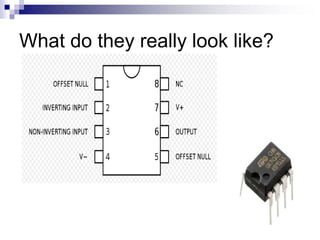
What do they really look like?
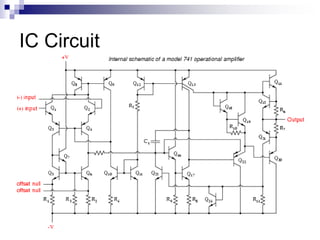
IC Circuit
Op-Amp “Golden Rules”
• When an op-amp is configured in any negative-
feedback arrangement, it will obey the following two
rules:
– The inputs to the op-amp draw or source no
current (true whether negative feedback or not)
– The op-amp output will do whatever it can (within
its limitations) to make the voltage difference
between the two inputs zero
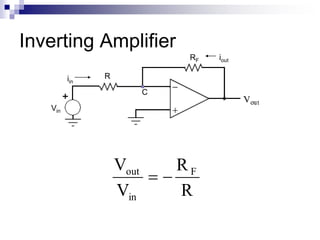
Inverting Amplifier
R
RF
Vin
iin
iout
C
R
R
V
V F
in
out

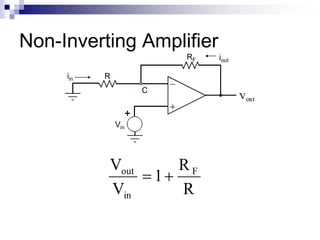
Non-Inverting Amplifier
R
RF
iin
iout
C
Vin
R
R
1
V
V F
in
out

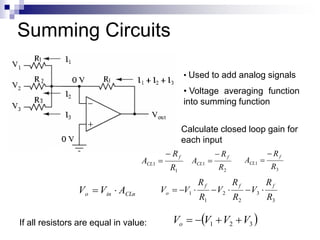
Summing Circuits
• Used to add analog signals
• Voltage averaging function
into summing function
Calculate closed loop gain for
each input
1
1
R
R
A
f
CL


2
1
R
R
A
f
CL


3
1
R
R
A
f
CL


CLnino AVV 
3
3
2
2
1
1
R
R
V
R
R
V
R
R
VV
fff
o 
 321 VVVVo If all resistors are equal in value:
Difference Circuit
• Used to subtract analog
signals
• Output signal is
proportional to difference
between two inputs
12 VVVout If all resistors are equal:
 
1
31
124
4132
)( R
RV
RRR
RRRV
Vout 



Integrating Circuit
• Replace feedback resistor of
inverting op-amp with capacitor
• A constant input signal
generates a certain rate of
change in output voltage
• Smoothes signals over time
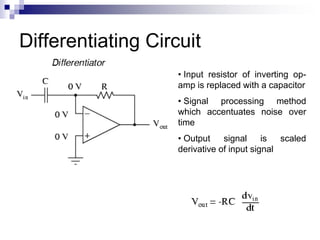
Differentiating Circuit
• Input resistor of inverting op-
amp is replaced with a capacitor
• Signal processing method
which accentuates noise over
time
• Output signal is scaled
derivative of input signal
Comparator Circuit
• Determines if one signal is bigger than another
• No negative feedback, infinite gain and circuit saturates
• Saturation: output is most positive or most negative value
V1 is Vref
V2 is Vin
Analog to Digital Converters
 An electronic integrated circuit which transforms a signal from
analog (continuous) to digital (discrete) form.
 Microprocessors can only perform complex processing on digitized
signals.
 When signals are in digital form they are less susceptible to the
deleterious effects of additive noise.
 ADC Provides a link between the analog world of transducers and
the digital world of signal processing and data handling.
 Some examples of ADC usage are digital volt meters, cell phone,
thermocouples, and digital oscilloscope.
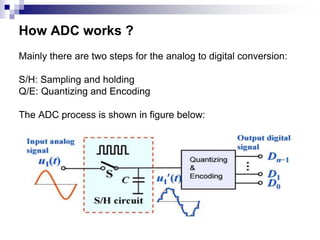
How ADC works ?
Mainly there are two steps for the analog to digital conversion:
S/H: Sampling and holding
Q/E: Quantizing and Encoding
The ADC process is shown in figure below:
Sampling & Holding
• It is used to sample the given input signal and to hold the
sampled value. Once a signal is sampled, it is called a
discrete signal.
• Sample and hold circuit is used to sample an analog signal
for a short interval of time in the range of 1 to 10µS and to
hold on its last sampled value until the input signal is
sampled again.
• The holding period may be from a few milliseconds to
several seconds.
Quantization and Encoding
 The output of a sampler is still continuous in amplitude. To
transmit as a digital signal we must restrict the number of
possible values.
 Quantization is the process of “rounding off” a sampled value
according to some rule.
– E.g. suppose we must round to the nearest tenth, then:
3.752 --> 3.8 0.001 --> 0
 Encoding: After identifying the closest value, a numerical
value is assigned to it and it is encoded in the form of a binary
number.

Operational amplifier

  • 1.
  • 2.
    What is anOp-Amp  Low cost integrating circuit consisting of: • Transistors • Resistors • Capacitors  Able to amplify a signal due to an external power supply  Name derives from its use to perform operations on a signal.
  • 3.
    Applications of Op-Amps Simple Amplifiers  Summers  Comparators  Integrators  Differentiators  Analog to Digital Converters
  • 4.
    Circuit Symbol andPin Identification  2 Inverting Input  3 Non-Inverting Input  6 Output  7 + Voltage Supply VCC  4 – Voltage Supply VEE  1 and 5 -- Offset Null U1 741 3 2 4 7 6 51
  • 5.
    What do theyreally look like?
  • 6.
  • 7.
    Op-Amp “Golden Rules” •When an op-amp is configured in any negative- feedback arrangement, it will obey the following two rules: – The inputs to the op-amp draw or source no current (true whether negative feedback or not) – The op-amp output will do whatever it can (within its limitations) to make the voltage difference between the two inputs zero
  • 8.
  • 9.
  • 10.
    Summing Circuits • Usedto add analog signals • Voltage averaging function into summing function Calculate closed loop gain for each input 1 1 R R A f CL   2 1 R R A f CL   3 1 R R A f CL   CLnino AVV  3 3 2 2 1 1 R R V R R V R R VV fff o   321 VVVVo If all resistors are equal in value:
  • 11.
    Difference Circuit • Usedto subtract analog signals • Output signal is proportional to difference between two inputs 12 VVVout If all resistors are equal:   1 31 124 4132 )( R RV RRR RRRV Vout    
  • 12.
    Integrating Circuit • Replacefeedback resistor of inverting op-amp with capacitor • A constant input signal generates a certain rate of change in output voltage • Smoothes signals over time
  • 13.
    Differentiating Circuit • Inputresistor of inverting op- amp is replaced with a capacitor • Signal processing method which accentuates noise over time • Output signal is scaled derivative of input signal
  • 14.
    Comparator Circuit • Determinesif one signal is bigger than another • No negative feedback, infinite gain and circuit saturates • Saturation: output is most positive or most negative value V1 is Vref V2 is Vin
  • 15.
    Analog to DigitalConverters  An electronic integrated circuit which transforms a signal from analog (continuous) to digital (discrete) form.  Microprocessors can only perform complex processing on digitized signals.  When signals are in digital form they are less susceptible to the deleterious effects of additive noise.  ADC Provides a link between the analog world of transducers and the digital world of signal processing and data handling.  Some examples of ADC usage are digital volt meters, cell phone, thermocouples, and digital oscilloscope.
  • 16.
    How ADC works? Mainly there are two steps for the analog to digital conversion: S/H: Sampling and holding Q/E: Quantizing and Encoding The ADC process is shown in figure below:
  • 17.
    Sampling & Holding •It is used to sample the given input signal and to hold the sampled value. Once a signal is sampled, it is called a discrete signal. • Sample and hold circuit is used to sample an analog signal for a short interval of time in the range of 1 to 10µS and to hold on its last sampled value until the input signal is sampled again. • The holding period may be from a few milliseconds to several seconds.
  • 18.
    Quantization and Encoding The output of a sampler is still continuous in amplitude. To transmit as a digital signal we must restrict the number of possible values.  Quantization is the process of “rounding off” a sampled value according to some rule. – E.g. suppose we must round to the nearest tenth, then: 3.752 --> 3.8 0.001 --> 0  Encoding: After identifying the closest value, a numerical value is assigned to it and it is encoded in the form of a binary number.