Data Infrastructure @ LinkedIn
Sid Anand
QCon London 2012

@r39132


                                 1
About Me
Current Life…
  LinkedIn                        *

      Web / Software Engineering
           Search, Network, and Analytics (SNA)
               Distributed Data Systems (DDS)
                   Me

In a Previous Life…
  Netflix, Cloud Database Architect
  eBay, Web Development, Research Lab, & Search
    Engine                                              ***


And Many Years Prior…
  Studying Distributed Systems at Cornell University


                                       @r39132                2
Our mission
Connect the world’s professionals to make
  them more productive and successful


                  @r39132                   3
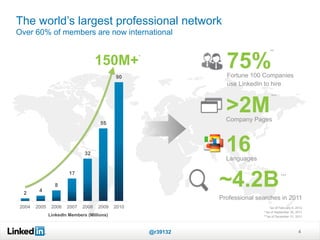
The world’s largest professional network
Over 60% of members are now international


                                                                    75%
                                                                                     **

                                     150M+          *


                                             90                     Fortune 100 Companies
                                                                    use LinkedIn to hire


                                                                    >2M
                                                                                      ***


                                                                    Company Pages
                                      55


                               32
                                                                    16
                                                                    Languages


                                                                  ~4.2B
                        17                                                                   ***

                  8
  2      4
                                                                  Professional searches in 2011
 2004   2005    2006   2007   2008   2009    2010                                    *as of February 9, 2012
                                                                                 **as of September 30, 2011
               LinkedIn Members (Millions)                                       ***as of December 31, 2011


                                                        @r39132                                          4
Other Company Facts

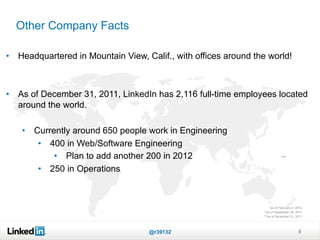
•  Headquartered in Mountain View, Calif., with offices around the world!
                                *


•  As of December 31, 2011, LinkedIn has 2,116 full-time employees located
   around the world.

    •  Currently around 650 people work in Engineering
        •  400 in Web/Software Engineering
            •  Plan to add another 200 in 2012                               ***

        •  250 in Operations


                                                                     *as of February 9, 2012
                                                                 **as of September 30, 2011
                                                                 ***as of December 31, 2011


                                    @r39132                                              5
Agenda

  Company Overview
  Architecture
   –  Data Infrastructure Overview
   –  Technology Spotlight
           Oracle
           Voldemort
           DataBus
           Kafka
  Q & A


                                @r39132   6
LinkedIn : Architecture	


Overview

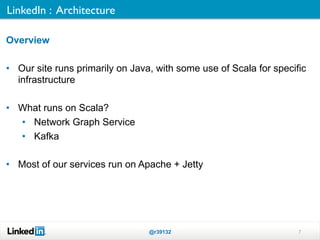
•  Our site runs primarily on Java, with some use of Scala for specific
   infrastructure

•  What runs on Scala?
   •  Network Graph Service
   •  Kafka

•  Most of our services run on Apache + Jetty


                                 @r39132                             7
LinkedIn : Architecture	


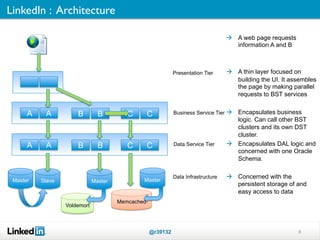
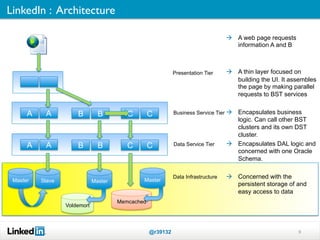
                                                                                     A web page requests
                                                                                      information A and B


                                                             Presentation Tier       A thin layer focused on
                                                                                      building the UI. It assembles
                                                                                      the page by making parallel
                                                                                      requests to BST services


      A    A          B         B         C        C         Business Service Tier   Encapsulates business
                                                                                      logic. Can call other BST
                                                                                      clusters and its own DST
                                                                                      cluster.
      A    A          B         B         C        C         Data Service Tier       Encapsulates DAL logic and
                                                                                      concerned with one Oracle
                                                                                      Schema.

                                                             Data Infrastructure     Concerned with the
 Master   Slave               Master           Master
                                                                                      persistent storage of and
                                                                                      easy access to data
                                       Memcached
                  Voldemort


                                                   @r39132                                                  8
LinkedIn : Architecture	


                                                                                     A web page requests
                                                                                      information A and B


                                                             Presentation Tier       A thin layer focused on
                                                                                      building the UI. It assembles
                                                                                      the page by making parallel
                                                                                      requests to BST services


      A    A          B         B         C        C         Business Service Tier   Encapsulates business
                                                                                      logic. Can call other BST
                                                                                      clusters and its own DST
                                                                                      cluster.
      A    A          B         B         C        C         Data Service Tier       Encapsulates DAL logic and
                                                                                      concerned with one Oracle
                                                                                      Schema.

                                                             Data Infrastructure     Concerned with the
 Master   Slave               Master           Master
                                                                                      persistent storage of and
                                                                                      easy access to data
                                       Memcached
                  Voldemort


                                                   @r39132                                                  9
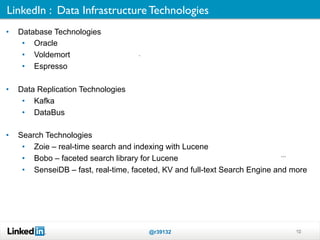
LinkedIn : Data Infrastructure Technologies	

•    Database Technologies
      •  Oracle
      •  Voldemort                    *

      •  Espresso

•    Data Replication Technologies
      •  Kafka
      •  DataBus

•    Search Technologies
      •  Zoie – real-time search and indexing with Lucene
      •  Bobo – faceted search library for Lucene                              ***

      •  SenseiDB – fast, real-time, faceted, KV and full-text Search Engine and more


                                          @r39132                                10
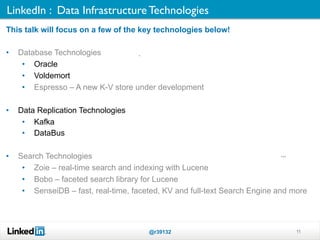
LinkedIn : Data Infrastructure Technologies	

This talk will focus on a few of the key technologies below!

•    Database Technologies           *
      •  Oracle
      •  Voldemort
      •  Espresso – A new K-V store under development

•    Data Replication Technologies
      •  Kafka
      •  DataBus

•    Search Technologies                                                       ***

      •  Zoie – real-time search and indexing with Lucene
      •  Bobo – faceted search library for Lucene
      •  SenseiDB – fast, real-time, faceted, KV and full-text Search Engine and more


                                         @r39132                                  11
LinkedIn Data Infrastructure Technologies

Oracle: Source of Truth for User-Provided Data


                              @r39132            12
Oracle : Overview	

Oracle
•  All user-provided data is stored in Oracle – our current source of truth
•  About 50 Schemas running on tens of physical instances
                                       *

•  With our user base and traffic growing at an accelerating pace, so how do we
   scale Oracle for user-provided data?

Scaling Reads
•  Oracle Slaves (c.f. DSC)
•  Memcached
•  Voldemort – for key-value lookups

                                                                            ***


Scaling Writes
•  Move to more expensive hardware or replace Oracle with something else


                                       @r39132                                    13
Oracle : Overview – Data Service Context	

 Scaling Oracle Reads using DSC


   DSC uses a token (e.g. cookie) to ensure that a reader always
    sees his or her own writes immediately

     –  If I update my own status, it is okay if you don’t see the
        change for a few minutes, but I have to see it immediately


                                @r39132                              14
Oracle : Overview – How DSC Works?	

    When a user writes data to the master, the DSC token (for that
     data domain) is updated with a timestamp

    When the user reads data, we first attempt to read from a
     replica (a.k.a. slave) database

    If the data in the slave is older than the data in the DSC token,
     we read from the Master instead


                                 @r39132                             15
LinkedIn Data Infrastructure Technologies
Voldemort: Highly-Available Distributed Data Store


                              @r39132                16
Voldemort : Overview	

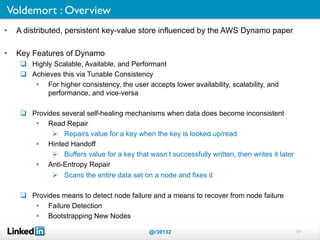
•    A distributed, persistent key-value store influenced by the AWS Dynamo paper

•    Key Features of Dynamo
        Highly Scalable, Available, and Performant
        Achieves this via Tunable Consistency
          •  For higher consistency, the user accepts lower availability, scalability, and
              performance, and vice-versa

        Provides several self-healing mechanisms when data does become inconsistent
          •  Read Repair
                 Repairs value for a key when the key is looked up/read
          •  Hinted Handoff
                 Buffers value for a key that wasn’t successfully written, then writes it later
          •  Anti-Entropy Repair
                 Scans the entire data set on a node and fixes it

        Provides means to detect node failure and a means to recover from node failure
          •  Failure Detection
          •  Bootstrapping New Nodes

                                                @r39132                                            17
Voldemort : Overview	

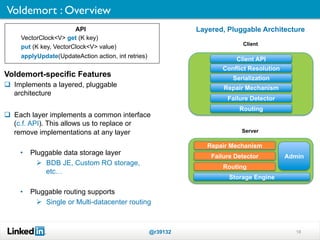
                        API                                    Layered, Pluggable Architecture
     VectorClock<V> get (K key)
                                                                             Client
     put (K key, VectorClock<V> value)
     applyUpdate(UpdateAction action, int retries)                         Client API
                                                                      Conflict Resolution
Voldemort-specific Features                                               Serialization
  Implements a layered, pluggable                                     Repair Mechanism
   architecture
                                                                        Failure Detector
                                                                            Routing
  Each layer implements a common interface
   (c.f. API). This allows us to replace or
   remove implementations at any layer                                       Server

                                                                  Repair Mechanism
    •  Pluggable data storage layer                                Failure Detector         Admin
           BDB JE, Custom RO storage,
                                                                       Routing
            etc…
                                                                         Storage Engine

    •  Pluggable routing supports
           Single or Multi-datacenter routing


                                                     @r39132                                  18
Voldemort : Overview	

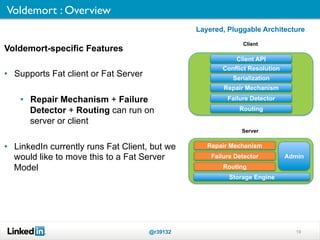
                                                 Layered, Pluggable Architecture
                                                               Client
Voldemort-specific Features
                                                             Client API
                                                        Conflict Resolution
•  Supports Fat client or Fat Server                        Serialization
                                                         Repair Mechanism
    •  Repair Mechanism + Failure                         Failure Detector

       Detector + Routing can run on                          Routing

       server or client
                                                               Server


•  LinkedIn currently runs Fat Client, but we       Repair Mechanism
   would like to move this to a Fat Server           Failure Detector         Admin
   Model                                                 Routing
                                                           Storage Engine


                                       @r39132                                  19
Where Does LinkedIn use
      Voldemort?


          @r39132         20
Voldemort : Usage Patterns @ LinkedIn	


 2 Usage-Patterns

   Read-Write Store
     –  Uses BDB JE for the storage engine
     –  50% of Voldemort Stores (aka Tables) are RW


   Read-only Store
     –  Uses a custom Read-only format
     –  50% of Voldemort Stores (aka Tables) are RO


   Let’s look at the RO Store


                                 @r39132              21
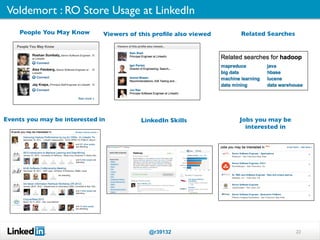
Voldemort : RO Store Usage at LinkedIn	

     People You May Know	

     Viewers of this profile also viewed	

   Related Searches	


Events you may be interested in	

          LinkedIn Skills	

          Jobs you may be
                                                                          interested in	


                                               @r39132                                       22
Voldemort : Usage Patterns @ LinkedIn	

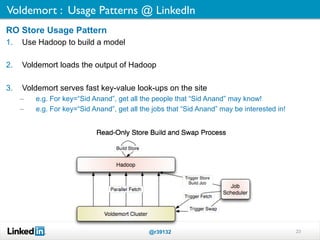
RO Store Usage Pattern
1.    Use Hadoop to build a model

2.    Voldemort loads the output of Hadoop

3.    Voldemort serves fast key-value look-ups on the site
      –    e.g. For key=“Sid Anand”, get all the people that “Sid Anand” may know!
      –    e.g. For key=“Sid Anand”, get all the jobs that “Sid Anand” may be interested in!


                                               @r39132                                         23
How Do The Voldemort RO
     Stores Perform?


          @r39132         24
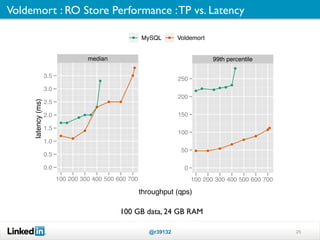
Voldemort : RO Store Performance : TP vs. Latency	


                                                             ●       MySQL ● Voldemort
                                                   ●   MySQL ● Voldemort ● Voldemort
                                                                      ●   MySQL
                                                       median MySQL ● Voldemort 99th percentile
                                                               ●

                                           median            median          ●     99th percentile ●percentile
                                                                                                     99th
                                                       median                                  99th percentile
                                   3.5                           ●          ●    ●
                                                                                250          ●                ●
                                                             ●              ●                            ●
                     3.5                3.5                     ●
                                                                     250 ●      ●                       ●
                                  3.5
                                   3.0          ●                                   250 ●       ●
                                                                                                   ● ●
                                                            ●
                                                                   ●           250     ●
                                                                                           ●               ●
                     3.0                                                      ● 200 ● ●             ● ●
                                                                                                       ● ●
                                        3.0                                ●       ●       ●
                                                                                               ●
                                                                                                  ● ●
                                  3.0                                                    ●
                                latency (ms)


                                   2.5                            ●
                                                                     200
                                                                        ●            ●         ●
                                                           ●                        200
                                                                               200
      latency (ms)


                     2.5
                             latency (ms)


                                        2.5         ●    ●             ●   ●
                            latency (ms)


                                  2.5
                                   2.0        ●
                                                   ●
                                                      ● ●       ●
                                                                 ●
                                                                       ●        150
                                                          ●
                     2.0                2.0● ●
                                         ●●               ● ●        150            150
                                  2.0 ●
                                   1.5            ●
                                                       ●
                                                     ● ●                       150                                  ●
                                                                                                                     ●
                            ●   ●              ● ● ●                            100
                                         ●● ●                                                                    ●
                     1.5                1.5
                                         ●      ●
                                                                                                            ●
                                                                                                           ●●            ●
                                                                                                                          ●
                                  1.5
                                   1.0               ●
                                                          ●          100            100                            ●
                                                                                                                    ●
                            ●
                                   ●
                                               ●
                                                     ●
                                                                               100                    ●●           ●
                     1.0                 ●
                                        1.0 ●                                    50 ● ● ● ● ●              ●
                                                                                                                ●
                                                                                                                ●
                                  1.0
                                   0.5                                               ●                 ●
                                                                                                       ●
                                                                                                           ●
                                                                       50 ●     ●    50 ●  ●      ●
                                                                                                  ●
                     0.5                0.5                                     50 ●
                                  0.5
                                   0.0                                             0
                     0.0           0.0                   0           0
                               0.0 100 200 300 400 500 600 700 0 100 200 300 400 500 600 700
                           100 200 300 400 500 600 700 throughput 300 400 500 600 700 500 600 700
                                                           100 200
                                       100 200 300 400 500 600 700 (qps) 200 300 400
                                                                       100
                                   100 200 300 400 500 600 700     100 200 300 400 500 600 700
                                                     throughput (qps) (qps)
                                                                throughput (qps)
                                                            throughput

                                                       100 GB data, 24 GB RAM 	


                                                                    @r39132                                                   25
LinkedIn Data Infrastructure Solutions
Databus : Timeline-Consistent Change Data Capture


                               @r39132              26
Where Does LinkedIn use
       DataBus?


          @r39132         27
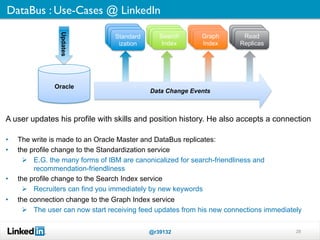
DataBus : Use-Cases @ LinkedIn	


                  Updates
                                   Standard      Search       Graph        Read
                                    ization       Index       Index       Replicas


                Oracle
                                              Data Change Events


A user updates his profile with skills and position history. He also accepts a connection

•    The write is made to an Oracle Master and DataBus replicates:
•    the profile change to the Standardization service
         E.G. the many forms of IBM are canonicalized for search-friendliness and
          recommendation-friendliness
•    the profile change to the Search Index service
         Recruiters can find you immediately by new keywords
•    the connection change to the Graph Index service
         The user can now start receiving feed updates from his new connections immediately


                                              @r39132                                     28
DataBus : Architecture	

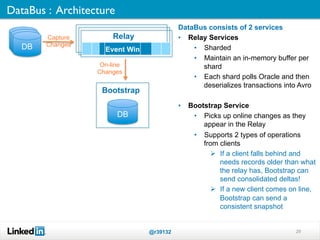
                                            DataBus consists of 2 services
        Capture          Relay              •  Relay Services
   DB   Changes
                      Event Win                 •  Sharded
                                                •  Maintain an in-memory buffer per
                     On-line                       shard
                    Changes
                                                •  Each shard polls Oracle and then
                                                   deserializes transactions into Avro
                     Bootstrap
                                            •  Bootstrap Service
                          DB                    •  Picks up online changes as they
                                                   appear in the Relay
                                                •  Supports 2 types of operations
                                                   from clients
                                                       If a client falls behind and
                                                        needs records older than what
                                                        the relay has, Bootstrap can
                                                        send consolidated deltas!
                                                       If a new client comes on line,
                                                        Bootstrap can send a
                                                        consistent snapshot


                                  @r39132                                        29
DataBus : Architecture	


                                                                   Client
        Capture          Relay                                     Consumer 1


                                                      Client Lib
                                            On-line


                                                      Databus
   DB   Changes                             Changes
                      Event Win                                    Consumer n
                     On-line
                                               ated
                    Changes              solid
                                     Con         eT
                                            Sinc
                                      Delta                        Client
                     Bootstrap
                                                                   Consumer 1


                                                      Client Lib
                                      Consistent


                                                      Databus
                                     Snapshot at U                 Consumer n
                          DB

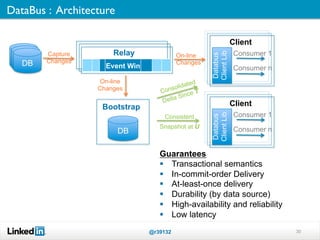
                                     Guarantees
                                       Transactional semantics
                                       In-commit-order Delivery
                                       At-least-once delivery
                                       Durability (by data source)
                                       High-availability and reliability
                                       Low latency
                                  @r39132                                       30
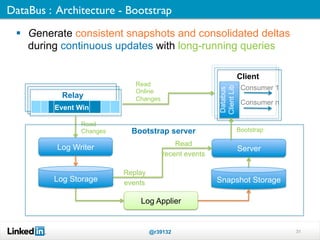
DataBus : Architecture - Bootstrap	

    Generate consistent snapshots and consolidated deltas
     during continuous updates with long-running queries

                                                                     Client
                              Read
                                                                      Consumer 1


                                                        Client Lib
                                                        Databus
                              Online
            Relay             Changes
                                                                      Consumer n
          Event Win

                 Read
                 Changes     Bootstrap server                        Bootstrap

                                            Read
           Log Writer                                                Server
                                        recent events

                           Replay
          Log Storage      events                       Snapshot Storage

                               Log Applier


                                    @r39132                                        31
LinkedIn Data Infrastructure Solutions
Kafka: High-Volume Low-Latency Messaging System


                               @r39132            32
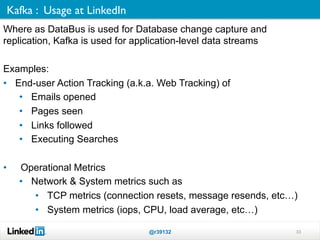
Kafka : Usage at LinkedIn	

Where as DataBus is used for Database change capture and
replication, Kafka is used for application-level data streams

Examples:
•  End-user Action Tracking (a.k.a. Web Tracking) of
    •  Emails opened
    •  Pages seen
    •  Links followed
    •  Executing Searches

•    Operational Metrics
     •  Network & System metrics such as
         •  TCP metrics (connection resets, message resends, etc…)
         •  System metrics (iops, CPU, load average, etc…)

                                 @r39132                         33
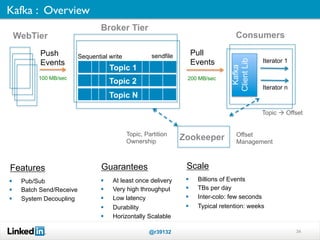
Kafka : Overview	

                                   Broker Tier
     WebTier                                                                          Consumers

            Push           Sequential write            sendfile         Pull
            Events                                                      Events                   Iterator 1


                                                                                    Client Lib
                                        Topic 1


                                                                                     Kafka
           100 MB/sec                                               200 MB/sec
                                        Topic 2
                                                                                                 Iterator n
                                        Topic N

                                                                                                 Topic  Offset


                                              Topic, Partition                        Offset
                                              Ownership
                                                                  Zookeeper           Management


Features                           Guarantees                      Scale
     Pub/Sub                          At least once delivery          Billions of Events
     Batch Send/Receive               Very high throughput            TBs per day
     System Decoupling                Low latency                     Inter-colo: few seconds
                                       Durability                      Typical retention: weeks
                                       Horizontally Scalable

                                                      @r39132                                                 34
Kafka : Overview	

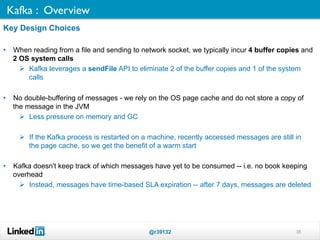
Key Design Choices

•  When reading from a file and sending to network socket, we typically incur 4 buffer copies and
   2 OS system calls
       Kafka leverages a sendFile API to eliminate 2 of the buffer copies and 1 of the system
        calls

•  No double-buffering of messages - we rely on the OS page cache and do not store a copy of
   the message in the JVM
       Less pressure on memory and GC

       If the Kafka process is restarted on a machine, recently accessed messages are still in
        the page cache, so we get the benefit of a warm start

•  Kafka doesn't keep track of which messages have yet to be consumed -- i.e. no book keeping
   overhead
       Instead, messages have time-based SLA expiration -- after 7 days, messages are deleted


                                              @r39132                                        35
How Does Kafka Perform?


          @r39132         36
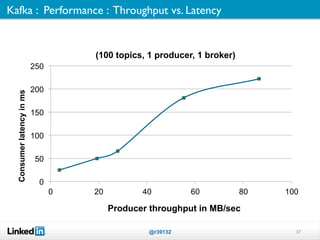
Kafka : Performance : Throughput vs. Latency	


                                     (100 topics, 1 producer, 1 broker)
                           250

                           200
  Consumer latency in ms


                           150

                           100

                            50

                             0
                                 0   20          40          60           80   100

                                          Producer throughput in MB/sec

                                                   @r39132                       37
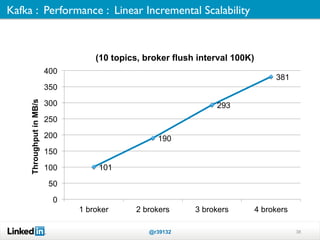
Kafka : Performance : Linear Incremental Scalability	


                                    (10 topics, broker flush interval 100K)
                          400
                                                                                   381
                          350

                          300
     Throughput in MB/s


                                                                 293
                          250

                          200                      190
                          150

                          100        101

                           50

                            0
                                1 broker     2 brokers      3 brokers         4 brokers

                                                 @r39132                                  38
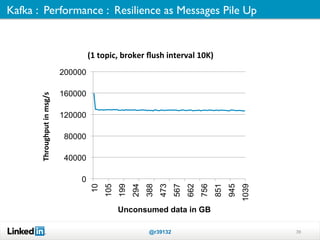
Kafka : Performance : Resilience as Messages Pile Up 	


                                                (1	
  topic,	
  broker	
  flush	
  interval	
  10K)	
  
                                       200000

                                       160000
       Throughput	
  in	
  msg/s	


                                       120000

                                       80000

                                       40000

                                           0
                                                 10
                                                      105
                                                            199
                                                                  294
                                                                        388
                                                                              473
                                                                                    567
                                                                                          662
                                                                                                756
                                                                                                      851
                                                                                                            945
                                                                                                                  1039
                                                            Unconsumed data in GB

                                                                         @r39132                                         39
Acknowledgments	

 Presentation & Content
   Chavdar Botev (DataBus)       @cbotev
   Roshan Sumbaly (Voldemort)    @rsumbaly
   Neha Narkhede (Kafka)         @nehanarkhede


 Development Team
     Aditya Auradkar, Chavdar Botev, Shirshanka Das, Dave DeMaagd, Alex
     Feinberg, Phanindra Ganti, Lei Gao, Bhaskar Ghosh, Kishore
     Gopalakrishna, Brendan Harris, Joel Koshy, Kevin Krawez, Jay Kreps, Shi
     Lu, Sunil Nagaraj, Neha Narkhede, Sasha Pachev, Igor Perisic, Lin Qiao,
     Tom Quiggle, Jun Rao, Bob Schulman, Abraham Sebastian, Oliver Seeliger,
     Adam Silberstein, Boris Skolnick, Chinmay Soman, Roshan Sumbaly, Kapil
     Surlaker, Sajid Topiwala, Balaji Varadarajan, Jemiah Westerman, Zach
     White, David Zhang, and Jason Zhang


                                   @r39132                                40
y Questions?


   @r39132     41