Presentation on - Active & Passive component
BY
Suneel Kumar
Passive ComponentsPassive CPASSIVE COMPONENTnts
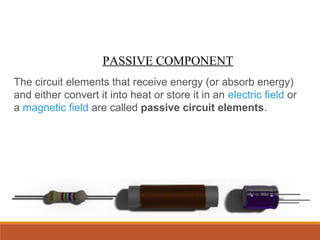
The circuit elements that receive energy (or absorb energy)
and either convert it into heat or store it in an electric field or
a magnetic field are called passive circuit elements.
Passive Components
Mica
Foil
Foil
Mica
Foil
Foil
Mica
Foil
Tantalum electrolytic
capacitor (polarized)
Mica capacitor_
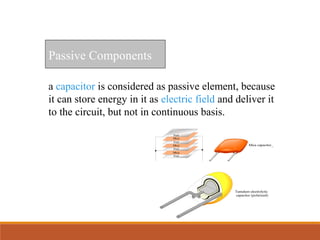
a capacitor is considered as passive element, because
it can store energy in it as electric field and deliver it
to the circuit, but not in continuous basis.
•Inductors
Passive Components
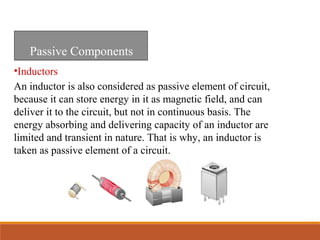
An inductor is also considered as passive element of circuit,
because it can store energy in it as magnetic field, and can
deliver it to the circuit, but not in continuous basis. The
energy absorbing and delivering capacity of an inductor are
limited and transient in nature. That is why, an inductor is
taken as passive element of a circuit.
Passive Components
•Transformers
A transistor is an active circuit element, because, it can
amplify the power of a signal. On the other
hand,transformer is not an active circuit element because it
does not amplify power and the power remains same both
in primary and secondary side. Although, a transistor is an
example of active circuit elements, but the transformer is an
example of passive circuit elements.
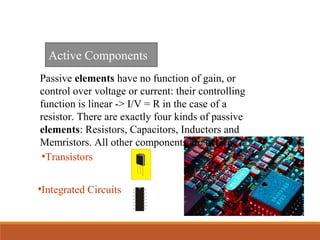
•Transistors
Active Components
•Integrated Circuits
Passive elements have no function of gain, or
control over voltage or current: their controlling
function is linear -> I/V = R in the case of a
resistor. There are exactly four kinds of passive
elements: Resistors, Capacitors, Inductors and
Memristors. All other components are active.
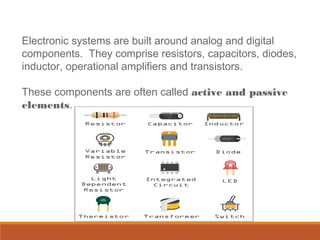
Electronic systems are built around analog and digital
components.  They comprise resistors, capacitors, diodes,
inductor, operational amplifiers and transistors.
These components are often called active and passive
elements.
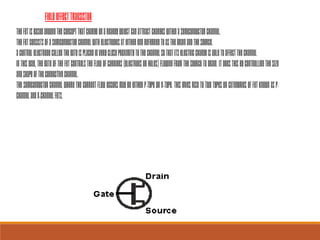
TheFETisbasedaroundtheconceptthatchargeonanearbyobjectcanattractchargeswithinasemiconductorchannel.
TheFETconsistsofasemiconductorchannelwithelectrodesateitherendreferredtoasthedrainandthesource.
Acontrolelectrodecalledthegateisplacedinverycloseproximitytothechannelsothatitselectricchargeisabletoaffectthechannel
Inthisway,thegateoftheFETcontrolstheflowofcarriers(electronsorholes)flowingfromthesourcetodrain.Itdoesthisbycontrollingthesize
andshapeoftheconductivechannel.
ThesemiconductorchannelwherethecurrentflowoccursmaybeeitherP-typeorN-type.ThisgivesrisetotwotypesorcategoriesofFETknownasP-
ChannelandN-ChannelFETs.
FieldEffectTransistor
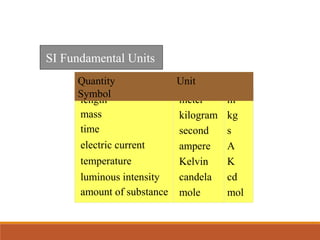
SI Fundamental Units
length
mass
time
electric current
temperature
luminous intensity
amount of substance
meter
kilogram
second
ampere
Kelvin
candela
mole
m
kg
s
A
K
cd
mol
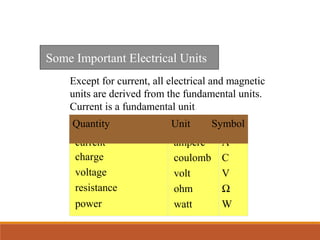
Quantity Unit
Symbol
Some Important Electrical Units
current
charge
voltage
resistance
power
ampere
coulomb
volt
ohm
watt
A
C
V
Ω
W
Except for current, all electrical and magnetic
units are derived from the fundamental units.
Current is a fundamental unit.
Quantity Unit Symbol
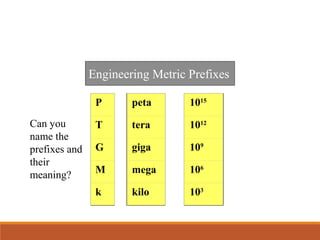
Engineering Metric Prefixes
peta
tera
giga
mega
kilo
1015
1012
109
106
103
P
T
G
M
k
Can you
name the
prefixes and
their
meaning?
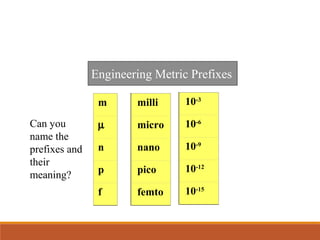
Engineering Metric Prefixes
10-3
10-6
10-9
10-12
10-15
milli
micro
nano
pico
femto
m
µ
n
p
f
Can you
name the
prefixes and
their
meaning?
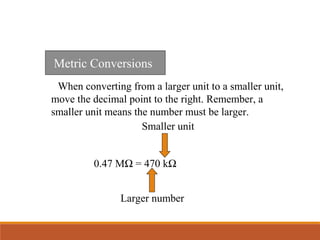
When converting from a larger unit to a smaller unit,
move the decimal point to the right. Remember, a
smaller unit means the number must be larger.
Metric Conversions
0.47 MΩ = 470 kΩ
Larger number
Smaller unit
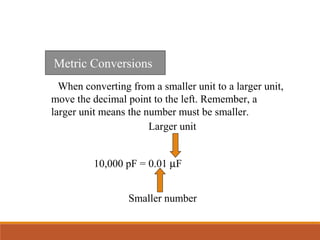
When converting from a smaller unit to a larger unit,
move the decimal point to the left. Remember, a
larger unit means the number must be smaller.
Metric Conversions
10,000 pF = 0.01 µF
Smaller number
Larger unit
THANK YOU

Active and passive