Presented By:
Deepjyoti Mahanta
3/26/2020 1
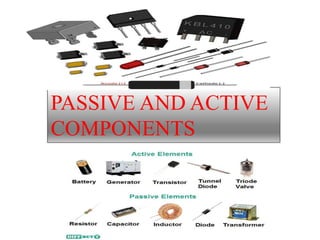
PASSIVE AND ACTIVE
COMPONENTS
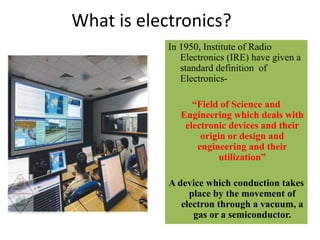
What is electronics?
In 1950, Institute of Radio
Electronics (IRE) have given a
standard definition of
Electronics-
“Field of Science and
Engineering which deals with
electronic devices and their
origin or design and
engineering and their
utilization”
A device which conduction takes
place by the movement of
electron through a vacuum, a
gas or a semiconductor.
Electronic devices and components
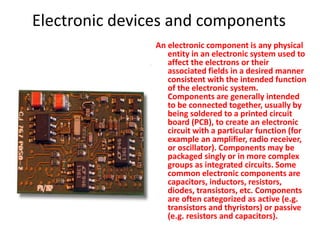
An electronic component is any physical
entity in an electronic system used to
affect the electrons or their
associated fields in a desired manner
consistent with the intended function
of the electronic system.
Components are generally intended
to be connected together, usually by
being soldered to a printed circuit
board (PCB), to create an electronic
circuit with a particular function (for
example an amplifier, radio receiver,
or oscillator). Components may be
packaged singly or in more complex
groups as integrated circuits. Some
common electronic components are
capacitors, inductors, resistors,
diodes, transistors, etc. Components
are often categorized as active (e.g.
transistors and thyristors) or passive
(e.g. resistors and capacitors).
Early electronic components
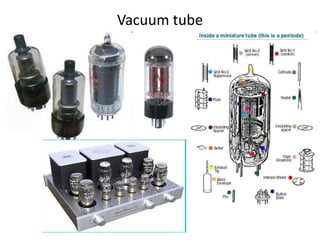
Vacuum tubes were one of the earliest
electronic components. They dominated
electronics until the 1950s. Since that time,
solid state devices have all but completely
taken over. Vacuum tubes are still used in
some specialist applications such as high
power RF amplifiers, cathode ray tubes, and
some microwave devices.
Vacuum tube
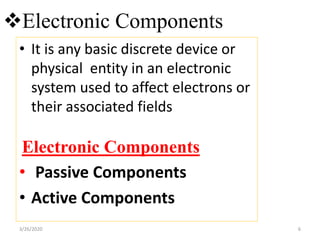
Electronic Components
3/26/2020 6
• It is any basic discrete device or
physical entity in an electronic
system used to affect electrons or
their associated fields
Electronic Components
• Passive Components
• Active Components
3/26/2020 7
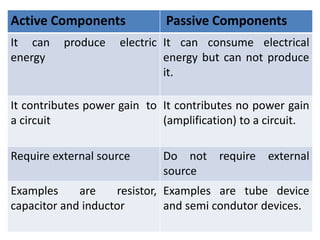
Active Components Passive Components
It can produce electric
energy
It can consume electrical
energy but can not produce
it.
It contributes power gain to
a circuit
It contributes no power gain
(amplification) to a circuit.
Require external source Do not require external
source
Examples are resistor,
capacitor and inductor
Examples are tube device
and semi condutor devices.
RESISTORS
A resistor is used to reduce the flow of
electricity in an electric circuit. Resistors
come in fixed or variable types.
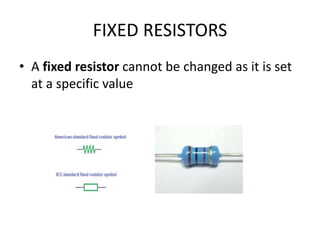
FIXED RESISTORS
• A fixed resistor cannot be changed as it is set
at a specific value
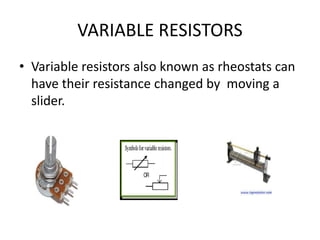
VARIABLE RESISTORS
• Variable resistors also known as rheostats can
have their resistance changed by moving a
slider.
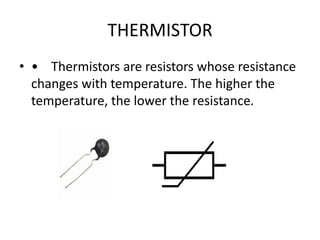
THERMISTOR
• • Thermistors are resistors whose resistance
changes with temperature. The higher the
temperature, the lower the resistance.
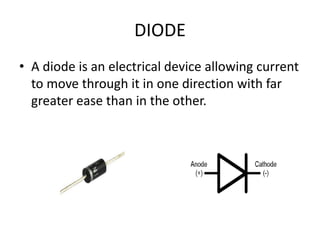
DIODE
• A diode is an electrical device allowing current
to move through it in one direction with far
greater ease than in the other.
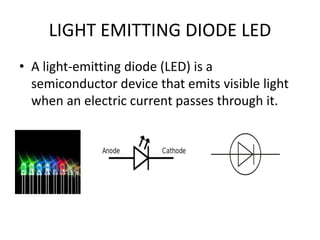
LIGHT EMITTING DIODE LED
• A light-emitting diode (LED) is a
semiconductor device that emits visible light
when an electric current passes through it.

Electronic components ppt

  • 1.
    Presented By: Deepjyoti Mahanta 3/26/20201 PASSIVE AND ACTIVE COMPONENTS
  • 2.
    What is electronics? In1950, Institute of Radio Electronics (IRE) have given a standard definition of Electronics- “Field of Science and Engineering which deals with electronic devices and their origin or design and engineering and their utilization” A device which conduction takes place by the movement of electron through a vacuum, a gas or a semiconductor.
  • 3.
    Electronic devices andcomponents An electronic component is any physical entity in an electronic system used to affect the electrons or their associated fields in a desired manner consistent with the intended function of the electronic system. Components are generally intended to be connected together, usually by being soldered to a printed circuit board (PCB), to create an electronic circuit with a particular function (for example an amplifier, radio receiver, or oscillator). Components may be packaged singly or in more complex groups as integrated circuits. Some common electronic components are capacitors, inductors, resistors, diodes, transistors, etc. Components are often categorized as active (e.g. transistors and thyristors) or passive (e.g. resistors and capacitors).
  • 4.
    Early electronic components Vacuumtubes were one of the earliest electronic components. They dominated electronics until the 1950s. Since that time, solid state devices have all but completely taken over. Vacuum tubes are still used in some specialist applications such as high power RF amplifiers, cathode ray tubes, and some microwave devices.
  • 5.
  • 6.
    Electronic Components 3/26/2020 6 •It is any basic discrete device or physical entity in an electronic system used to affect electrons or their associated fields Electronic Components • Passive Components • Active Components
  • 7.
    3/26/2020 7 Active ComponentsPassive Components It can produce electric energy It can consume electrical energy but can not produce it. It contributes power gain to a circuit It contributes no power gain (amplification) to a circuit. Require external source Do not require external source Examples are resistor, capacitor and inductor Examples are tube device and semi condutor devices.
  • 8.
    RESISTORS A resistor isused to reduce the flow of electricity in an electric circuit. Resistors come in fixed or variable types.
  • 9.
    FIXED RESISTORS • Afixed resistor cannot be changed as it is set at a specific value
  • 10.
    VARIABLE RESISTORS • Variableresistors also known as rheostats can have their resistance changed by moving a slider.
  • 11.
    THERMISTOR • • Thermistorsare resistors whose resistance changes with temperature. The higher the temperature, the lower the resistance.
  • 12.
    DIODE • A diodeis an electrical device allowing current to move through it in one direction with far greater ease than in the other.
  • 13.
    LIGHT EMITTING DIODELED • A light-emitting diode (LED) is a semiconductor device that emits visible light when an electric current passes through it.