Post Extubation Stridor Critical Care Grand Rounds April 7, 2008 Janice D Chisholm, BSc, MD, FRCPC
Post Extubation Stridor Definition Epidemiology The Cuff Leak Use of Steroids Prophylaxis Treatment How do I use this info clinically? Conclusions
the development of upper airway obstruction after extubation Minor Audible high pitched inspiratory wheeze with respiratory distress Major Severe respiratory distress needing tracheal reintubation secondary to upper airway obstruction Definition
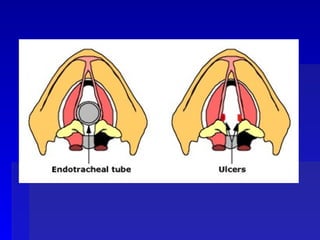
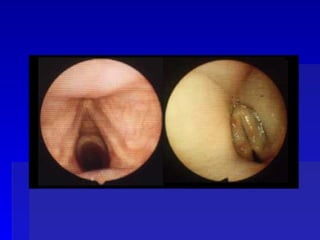
Prolonged intubation can lead to edema, inflammation, and ulceration Level of cords and cuff site At autopsy, 54% had ulcers on posterior cords and 93% had mucosal inflammation and/or edema
 
 
Incidence 2-22% of patients intubated  > 24 hrs Increased mortality and prolonged ICU stay Occurs after 36hrs of intubation Occurs shortly after extubation Reintubation rate is 1-10%
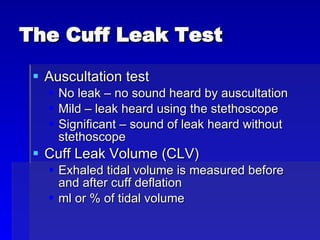
The Cuff Leak Test Auscultation test No leak – no sound heard by auscultation Mild – leak heard using the stethoscope Significant – sound of leak heard without stethoscope Cuff Leak Volume (CLV) Exhaled tidal volume is measured before and after cuff deflation ml or % of tidal volume
Early studies suggested that a failed cuff leak test did not preclude uneventful extubation Problems Small studies Observational or prospective cohort Study populations – surgical, short duration of intubation
Miller,RL, Cole, RP.  Association between reduced cuff leak volume and postextubation stridor.  Chest 1996; 110:1035   100 intubations on 88 patients Cuff leak measured 24 hrs prior to extubation Post extubation stridor 6%  17% reintubation rate 50% when stridor present CLV 180 ml vs 360 ml (stridor vs normal) CLV 110 ml – PPV 80%, NPV 98% No risk factors identified
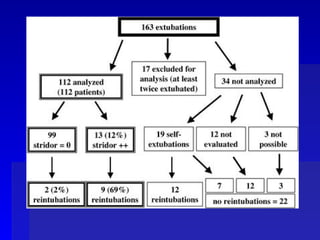
Jaber, S, Chanques, G, Matecki, S, et al.  Post-extubation stridor in intensive care unit patients.  Risk factors, evaluation and importance of the cuff-leak test.  Intensive Care Med 2003; 29:69. 112 intubated patients MSICU Cuff-leak test 24 hrs prior to extubation Evaluated for stridor and need for reintubation over 48 hrs
Results 12% incidence of post extubation stridor Avg time to stridor 3.2+/- 3.3 hrs Extubation failure 10% overall 69% of stridulous patients 2% non-stridulous CLV 130 ml or 12% - sensitivity 85%, specificity 95%
 
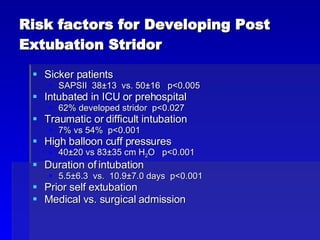
Risk factors for Developing Post Extubation Stridor Sicker patients SAPSII  38 ±13  vs. 50±16  p<0.005 Intubated in ICU or prehospital 62% developed stridor  p<0.027 Traumatic or difficult intubation 7% vs 54%  p<0.001 High balloon cuff pressures 40±20 vs 83±35 cm H 2 O  p<0.001 Duration of intubation 5.5±6.3  vs.  10.9±7.0 days  p<0.001 Prior self extubation Medical vs. surgical admission
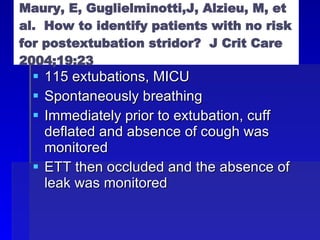
Maury, E, Guglielminotti,J, Alzieu, M, et al.  How to identify patients with no risk for postextubation stridor?  J Crit Care 2004;19:23 115 extubations, MICU Spontaneously breathing Immediately prior to extubation, cuff deflated and absence of cough was monitored ETT then occluded and the absence of leak was monitored
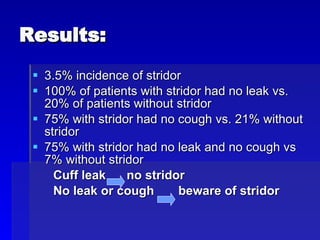
Results: 3.5% incidence of stridor 100% of patients with stridor had no leak vs. 20% of patients without stridor 75% with stridor had no cough vs. 21% without stridor  75% with stridor had no leak and no cough vs  7% without stridor Cuff leak  no stridor No leak or cough  beware of stridor
Steroid Prophylaxis Why steroids? Predicted to suppress mucosal inflammation and tissue swelling In children, steroids decrease post extubation stridor by 40% Unclear, if steroids change the reintubation rate in children Multiple positive and negative studies in adults Timing and dose are important
Ho, LI, Harn, HJ, Lien, TC, et al.  Postextubation laryngeal edema in adults.  Risk factor evaluation and prevention by hydrocortisone.  Intensive Care Medicine 1996; 22:933 Prospective, randomized, double blind study 77 patients in MSICU Randomly assigned to receive 100 mg hydrocortisone or placebo 1 hr prior to extubation Examined immediately after extubation and q6h X 24hrs
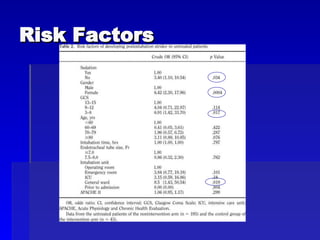
Results 77 patients randomized 22% developed stridor 1 / 77 reintubated because of stridor Steroids did not decrease incidence of stridor Risk factors to develop stridor: Female  RR 2.29
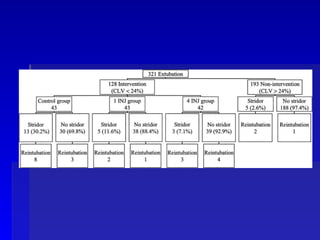
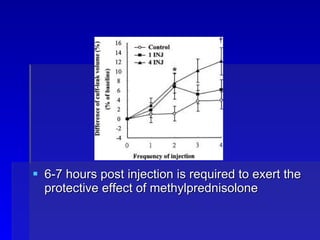
Cheng, KC, Hou, CC, Huang, HC, et al.  Intravenous injection of methylprednisolone reduces the incidence of postextubation stridor in intensive care unit patients.  Crit Care Med 2006; 34:1345 Randomized, double blind, placebo controlled 321 patients extubated 128 of these had CLV <24% and were randomized to 1 of 3 groups No intervention (control) 40 mg methylprednisolone q6h X 24hrs (4 inj) 40 mg methylprednisolone 24hrs pre-extubation (1 inj) Patients were extubated 1 hr post last dose
 
6-7 hours post injection is required to exert the protective effect of methylprednisolone
Risk Factors
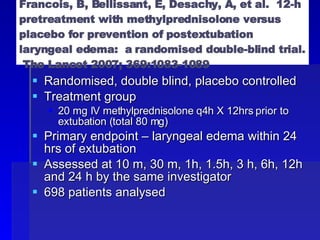
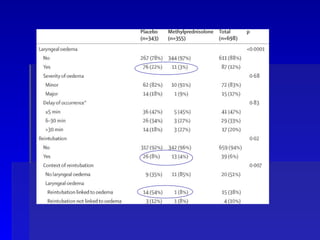
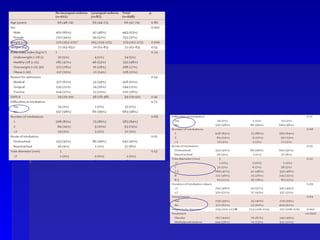
Francois, B, Bellissant, E, Desachy, A, et al.  12-h pretreatment with methylprednisolone versus placebo for prevention of postextubation laryngeal edema:  a randomised double-blind trial.  The Lancet 2007; 369:1083-1089 Randomised, double blind, placebo controlled Treatment group 20 mg IV methylprednisolone q4h X 12hrs prior to extubation (total 80 mg) Primary endpoint – laryngeal edema within 24 hrs of extubation Assessed at 10 m, 30 m, 1h, 1.5h, 3 h, 6h, 12h and 24 h by the same investigator 698 patients analysed
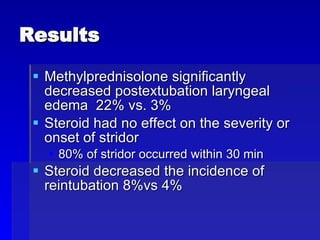
Results Methylprednisolone significantly decreased postextubation laryngeal edema  22% vs. 3% Steroid had no effect on the severity or onset of stridor 80% of stridor occurred within 30 min  Steroid decreased the incidence of reintubation 8%vs 4%
 
 
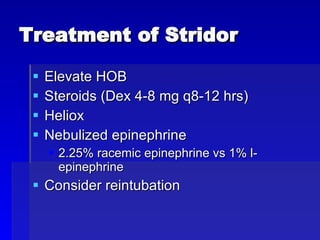
Treatment of Stridor Elevate HOB Steroids (Dex 4-8 mg q8-12 hrs) Heliox Nebulized epinephrine 2.25% racemic epinephrine vs 1% l-epinephrine Consider reintubation
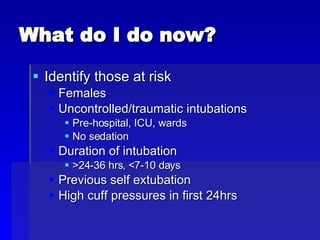
What do I do now? Identify those at risk Females Uncontrolled/traumatic intubations Pre-hospital, ICU, wards No sedation  Duration of intubation >24-36 hrs, <7-10 days Previous self extubation High cuff pressures in first 24hrs
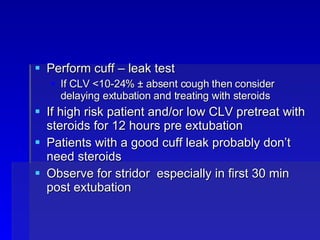
Perform cuff – leak test If CLV <10-24%  ±  absent cough then consider delaying extubation and treating with steroids If high risk patient and/or low CLV pretreat with steroids for 12 hours pre extubation Patients with a good cuff leak probably don’t need steroids Observe for stridor  especially in first 30 min post extubation
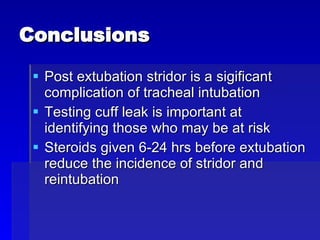
Conclusions Post extubation stridor is a sigificant complication of tracheal intubation Testing cuff leak is important at identifying those who may be at risk Steroids given 6-24 hrs before extubation reduce the incidence of stridor and reintubation
 

Post extubation stridor

  • 1.
    Post Extubation StridorCritical Care Grand Rounds April 7, 2008 Janice D Chisholm, BSc, MD, FRCPC
  • 2.
    Post Extubation StridorDefinition Epidemiology The Cuff Leak Use of Steroids Prophylaxis Treatment How do I use this info clinically? Conclusions
  • 3.
    the development ofupper airway obstruction after extubation Minor Audible high pitched inspiratory wheeze with respiratory distress Major Severe respiratory distress needing tracheal reintubation secondary to upper airway obstruction Definition
  • 4.
    Prolonged intubation canlead to edema, inflammation, and ulceration Level of cords and cuff site At autopsy, 54% had ulcers on posterior cords and 93% had mucosal inflammation and/or edema
  • 5.
  • 6.
  • 7.
    Incidence 2-22% ofpatients intubated > 24 hrs Increased mortality and prolonged ICU stay Occurs after 36hrs of intubation Occurs shortly after extubation Reintubation rate is 1-10%
  • 8.
    The Cuff LeakTest Auscultation test No leak – no sound heard by auscultation Mild – leak heard using the stethoscope Significant – sound of leak heard without stethoscope Cuff Leak Volume (CLV) Exhaled tidal volume is measured before and after cuff deflation ml or % of tidal volume
  • 9.
    Early studies suggestedthat a failed cuff leak test did not preclude uneventful extubation Problems Small studies Observational or prospective cohort Study populations – surgical, short duration of intubation
  • 10.
    Miller,RL, Cole, RP. Association between reduced cuff leak volume and postextubation stridor. Chest 1996; 110:1035 100 intubations on 88 patients Cuff leak measured 24 hrs prior to extubation Post extubation stridor 6% 17% reintubation rate 50% when stridor present CLV 180 ml vs 360 ml (stridor vs normal) CLV 110 ml – PPV 80%, NPV 98% No risk factors identified
  • 11.
    Jaber, S, Chanques,G, Matecki, S, et al. Post-extubation stridor in intensive care unit patients. Risk factors, evaluation and importance of the cuff-leak test. Intensive Care Med 2003; 29:69. 112 intubated patients MSICU Cuff-leak test 24 hrs prior to extubation Evaluated for stridor and need for reintubation over 48 hrs
  • 12.
    Results 12% incidenceof post extubation stridor Avg time to stridor 3.2+/- 3.3 hrs Extubation failure 10% overall 69% of stridulous patients 2% non-stridulous CLV 130 ml or 12% - sensitivity 85%, specificity 95%
  • 13.
  • 14.
    Risk factors forDeveloping Post Extubation Stridor Sicker patients SAPSII 38 ±13 vs. 50±16 p<0.005 Intubated in ICU or prehospital 62% developed stridor p<0.027 Traumatic or difficult intubation 7% vs 54% p<0.001 High balloon cuff pressures 40±20 vs 83±35 cm H 2 O p<0.001 Duration of intubation 5.5±6.3 vs. 10.9±7.0 days p<0.001 Prior self extubation Medical vs. surgical admission
  • 15.
    Maury, E, Guglielminotti,J,Alzieu, M, et al. How to identify patients with no risk for postextubation stridor? J Crit Care 2004;19:23 115 extubations, MICU Spontaneously breathing Immediately prior to extubation, cuff deflated and absence of cough was monitored ETT then occluded and the absence of leak was monitored
  • 16.
    Results: 3.5% incidenceof stridor 100% of patients with stridor had no leak vs. 20% of patients without stridor 75% with stridor had no cough vs. 21% without stridor 75% with stridor had no leak and no cough vs 7% without stridor Cuff leak no stridor No leak or cough beware of stridor
  • 17.
    Steroid Prophylaxis Whysteroids? Predicted to suppress mucosal inflammation and tissue swelling In children, steroids decrease post extubation stridor by 40% Unclear, if steroids change the reintubation rate in children Multiple positive and negative studies in adults Timing and dose are important
  • 18.
    Ho, LI, Harn,HJ, Lien, TC, et al. Postextubation laryngeal edema in adults. Risk factor evaluation and prevention by hydrocortisone. Intensive Care Medicine 1996; 22:933 Prospective, randomized, double blind study 77 patients in MSICU Randomly assigned to receive 100 mg hydrocortisone or placebo 1 hr prior to extubation Examined immediately after extubation and q6h X 24hrs
  • 19.
    Results 77 patientsrandomized 22% developed stridor 1 / 77 reintubated because of stridor Steroids did not decrease incidence of stridor Risk factors to develop stridor: Female RR 2.29
  • 20.
    Cheng, KC, Hou,CC, Huang, HC, et al. Intravenous injection of methylprednisolone reduces the incidence of postextubation stridor in intensive care unit patients. Crit Care Med 2006; 34:1345 Randomized, double blind, placebo controlled 321 patients extubated 128 of these had CLV <24% and were randomized to 1 of 3 groups No intervention (control) 40 mg methylprednisolone q6h X 24hrs (4 inj) 40 mg methylprednisolone 24hrs pre-extubation (1 inj) Patients were extubated 1 hr post last dose
  • 21.
  • 22.
    6-7 hours postinjection is required to exert the protective effect of methylprednisolone
  • 23.
  • 24.
    Francois, B, Bellissant,E, Desachy, A, et al. 12-h pretreatment with methylprednisolone versus placebo for prevention of postextubation laryngeal edema: a randomised double-blind trial. The Lancet 2007; 369:1083-1089 Randomised, double blind, placebo controlled Treatment group 20 mg IV methylprednisolone q4h X 12hrs prior to extubation (total 80 mg) Primary endpoint – laryngeal edema within 24 hrs of extubation Assessed at 10 m, 30 m, 1h, 1.5h, 3 h, 6h, 12h and 24 h by the same investigator 698 patients analysed
  • 25.
    Results Methylprednisolone significantlydecreased postextubation laryngeal edema 22% vs. 3% Steroid had no effect on the severity or onset of stridor 80% of stridor occurred within 30 min Steroid decreased the incidence of reintubation 8%vs 4%
  • 26.
  • 27.
  • 28.
    Treatment of StridorElevate HOB Steroids (Dex 4-8 mg q8-12 hrs) Heliox Nebulized epinephrine 2.25% racemic epinephrine vs 1% l-epinephrine Consider reintubation
  • 29.
    What do Ido now? Identify those at risk Females Uncontrolled/traumatic intubations Pre-hospital, ICU, wards No sedation Duration of intubation >24-36 hrs, <7-10 days Previous self extubation High cuff pressures in first 24hrs
  • 30.
    Perform cuff –leak test If CLV <10-24% ± absent cough then consider delaying extubation and treating with steroids If high risk patient and/or low CLV pretreat with steroids for 12 hours pre extubation Patients with a good cuff leak probably don’t need steroids Observe for stridor especially in first 30 min post extubation
  • 31.
    Conclusions Post extubationstridor is a sigificant complication of tracheal intubation Testing cuff leak is important at identifying those who may be at risk Steroids given 6-24 hrs before extubation reduce the incidence of stridor and reintubation
  • 32.