STRIDOR
Dr. Yusuf Imran
Department Of Pediatrics
J.N Medical College, AMU- Aligarh
INDIA
STRIDOR
Harsh, high-pitched, musical sound produced by
turbulent airflow through a partially obstructed airway
May be inspiratory, expiratory, or biphasic depending
on its timing in the respiratory cycle
Inspiratory stridor suggests an extrathoracic lesion (eg,
laryngeal, nasal, pharyngeal)
Expiratory stridor implies an intrathoracic lesion (eg,
tracheal, bronchial)
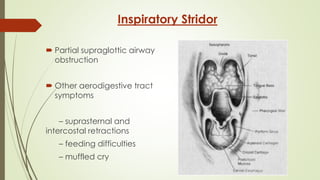
Inspiratory Stridor
 Partial supraglottic airway
obstruction
 Other aerodigestive tract
symptoms
– suprasternal and
intercostal retractions
– feeding difficulties
– muffled cry
Biphasic Stridor
 Partial obstruction at the
level of the glottis
 Primarily inspiratory stridor
 Other aerodigestive tract
symptoms
– hoarseness
– aphonia
– nasal flaring
– retractions
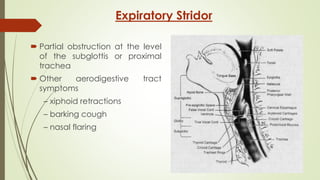
Expiratory Stridor
 Partial obstruction at the level
of the subglottis or proximal
trachea
 Other aerodigestive tract
symptoms
– xiphoid retractions
– barking cough
– nasal flaring
STRIDOR: Diagnosis
 History & Examination
 Flexible fiberoptic laryngoscopy
 Direct laryngoscopy with rigid bronchoscopy
 Barium esophagram
 CT neck and chest
STRIDOR: History
 Age of onset, duration, severity, and progression; precipitating
events (eg, crying, feeding); positioning (eg, prone, supine, sitting);
quality and nature of crying; presence of aphonia; and other
associated symptoms (eg, paroxysms of cough, aspiration,
difficulty feeding, drooling, sleep disordered breathing).
 Perinatal history - maternal condylomata, endotracheal intubation
use and duration, and presence of congenital anomalies .
 Feeding and growth history, developmental history.
STRIDOR : Examination
 Heart and respiratory rates, cyanosis, use of accessory muscles
of respiration, nasal flaring, level of consciousness, and
responsiveness.
 Note the presence of infection in the oral cavity; crepitations
or masses in the soft tissues of the face, neck, or chest; and
deviation of the trachea
 Use care when examining (especially palpating) the oral
cavity or pharynx because sudden dislodgement of a foreign
body or rupture of an abscess can cause further airway
compromise.
STRIDOR : Examination
 Drooling from the mouth - suggests poor handling of secretions,
Dysphagia.
 Observe the character of the cough, cry, and voice.
 Careful auscultation of the nose, oropharynx, neck, and chest
helps to discern the location of the stridor.
 Special attention to craniofacial morphology, patency of the
nares, and cutaneous hemangiomas.
CAUSES: Acute Onset Stridor
1. Laryngotracheobronchitis (croup)
 the most common cause of acute stridor in children
 6 months to 2 years
 barking cough that is worst at night
 low-grade fever
2. Aspiration of foreign body
 1-2 years
 food such as nuts, hot dogs, popcorn, and hard candy
 history of coughing and choking that precedes development of
respiratory symptoms
3. Bacterial tracheitis
 uncommon
 younger than 3 years
 secondary infection (most commonly due to Staphylococcus aureus)
following a viral process (commonly croup or influenza)
CAUSES: Acute Onset Stridor
4. Retropharyngeal abscess
 complication of bacterial pharyngitis
 younger than 6 years
 abrupt onset of high fevers, difficulty swallowing, refusal to feed, sore
throat, hyperextension of the neck, and respiratory distress
5. Peritonsillar abscess
 infection in the potential space between the superior constrictor muscles
and the tonsil
 common in adolescents and preadolescents.
 patient develops severe throat pain and trouble swallowing or speaking
CAUSES: Acute Onset Stridor
6. Spasmodic croup (acute spasmodic laryngitis)
 most commonly in children aged 1-3 years
 presentation may be identical to croup
7. Allergic reaction (ie, anaphylaxis)
 hoarseness and inspiratory stridor may be accompanied by symptoms (eg,
dysphagia, nasal congestion, itching eyes, sneezing, wheezing) that
indicate the involvement of other organs
8. Epiglottitis
 medical emergency
 most commonly in children aged 2-7 years
 Clinically, the patient experiences an abrupt onset of high-grade fever,
sore throat, dysphagia, and drooling
CAUSES: Chronic Stridor
1. Laryngomalacia
The most common cause of
inspiratory stridor in the neonatal
period and early infancy
Accounts for up to 75% of all cases
of stridor
Stridor may be exacerbated by
crying or feeding
CAUSES: Chronic Stridor
Laryngomalacia cont…
Placing the patient in a prone position with the head up improves the
stridor
Supine position worsens the stridor
Usually benign and self-limiting and improves as the child reaches age 1
year.
[Supraglottoplasty]
CAUSES: Chronic Stridor
2. Subglottic stenosis
 inspiratory or biphasic stridor
 congenital - incomplete canalization of the subglottis and cricoid rings.
 Acquired - is most commonly caused by prolonged intubation.
3. Vocal cord dysfunction
 unilateral vocal cord paralysis - congenital or secondary to trauma at birth
or time of cardiac or intrathoracic surgery
 bilateral vocal cord paralysis
Pt present with aphonia and a high-pitched stridor that may progress to
severe respiratory distress.
It is usually associated with CNS abnormalities, such as Arnold-Chiari
malformation or increased intracranial pressure
CAUSES: Chronic Stridor
4. Laryngeal dyskinesia, exercise-induced laryngomalacia, and
paradoxical vocal fold motion are other neuromuscular
disorders
5. Laryngeal webs
6. Laryngeal cysts
7. Laryngeal hemangiomas (glottic or subglottic)
half are accompanied by cutaneous hemangiomas in the
head and neck
usually regress by age 12-18 months
CAUSES : Chronic Stridor
8. Laryngeal papillomas
secondary to vertical transmission of the human papilloma
virus in maternal condylomata or infected vaginal cells to
the pharynx or larynx of the infant during the birth
9. Tracheomalacia
most common cause of expiratory stridor
10.Tracheal stenosis secondary to extrinsic compression
MANAGEMENT
 Maintain Airway
 Positioning of neck and body
 Supplemental Oxygen as needed
 Stridor has varied etiology hence specific management
depends on the cause.

Stridor In Children

  • 1.
    STRIDOR Dr. Yusuf Imran DepartmentOf Pediatrics J.N Medical College, AMU- Aligarh INDIA
  • 2.
    STRIDOR Harsh, high-pitched, musicalsound produced by turbulent airflow through a partially obstructed airway May be inspiratory, expiratory, or biphasic depending on its timing in the respiratory cycle Inspiratory stridor suggests an extrathoracic lesion (eg, laryngeal, nasal, pharyngeal) Expiratory stridor implies an intrathoracic lesion (eg, tracheal, bronchial)
  • 3.
    Inspiratory Stridor  Partialsupraglottic airway obstruction  Other aerodigestive tract symptoms – suprasternal and intercostal retractions – feeding difficulties – muffled cry
  • 4.
    Biphasic Stridor  Partialobstruction at the level of the glottis  Primarily inspiratory stridor  Other aerodigestive tract symptoms – hoarseness – aphonia – nasal flaring – retractions
  • 5.
    Expiratory Stridor  Partialobstruction at the level of the subglottis or proximal trachea  Other aerodigestive tract symptoms – xiphoid retractions – barking cough – nasal flaring
  • 6.
    STRIDOR: Diagnosis  History& Examination  Flexible fiberoptic laryngoscopy  Direct laryngoscopy with rigid bronchoscopy  Barium esophagram  CT neck and chest
  • 7.
    STRIDOR: History  Ageof onset, duration, severity, and progression; precipitating events (eg, crying, feeding); positioning (eg, prone, supine, sitting); quality and nature of crying; presence of aphonia; and other associated symptoms (eg, paroxysms of cough, aspiration, difficulty feeding, drooling, sleep disordered breathing).  Perinatal history - maternal condylomata, endotracheal intubation use and duration, and presence of congenital anomalies .  Feeding and growth history, developmental history.
  • 8.
    STRIDOR : Examination Heart and respiratory rates, cyanosis, use of accessory muscles of respiration, nasal flaring, level of consciousness, and responsiveness.  Note the presence of infection in the oral cavity; crepitations or masses in the soft tissues of the face, neck, or chest; and deviation of the trachea  Use care when examining (especially palpating) the oral cavity or pharynx because sudden dislodgement of a foreign body or rupture of an abscess can cause further airway compromise.
  • 9.
    STRIDOR : Examination Drooling from the mouth - suggests poor handling of secretions, Dysphagia.  Observe the character of the cough, cry, and voice.  Careful auscultation of the nose, oropharynx, neck, and chest helps to discern the location of the stridor.  Special attention to craniofacial morphology, patency of the nares, and cutaneous hemangiomas.
  • 10.
    CAUSES: Acute OnsetStridor 1. Laryngotracheobronchitis (croup)  the most common cause of acute stridor in children  6 months to 2 years  barking cough that is worst at night  low-grade fever 2. Aspiration of foreign body  1-2 years  food such as nuts, hot dogs, popcorn, and hard candy  history of coughing and choking that precedes development of respiratory symptoms 3. Bacterial tracheitis  uncommon  younger than 3 years  secondary infection (most commonly due to Staphylococcus aureus) following a viral process (commonly croup or influenza)
  • 11.
    CAUSES: Acute OnsetStridor 4. Retropharyngeal abscess  complication of bacterial pharyngitis  younger than 6 years  abrupt onset of high fevers, difficulty swallowing, refusal to feed, sore throat, hyperextension of the neck, and respiratory distress 5. Peritonsillar abscess  infection in the potential space between the superior constrictor muscles and the tonsil  common in adolescents and preadolescents.  patient develops severe throat pain and trouble swallowing or speaking
  • 12.
    CAUSES: Acute OnsetStridor 6. Spasmodic croup (acute spasmodic laryngitis)  most commonly in children aged 1-3 years  presentation may be identical to croup 7. Allergic reaction (ie, anaphylaxis)  hoarseness and inspiratory stridor may be accompanied by symptoms (eg, dysphagia, nasal congestion, itching eyes, sneezing, wheezing) that indicate the involvement of other organs 8. Epiglottitis  medical emergency  most commonly in children aged 2-7 years  Clinically, the patient experiences an abrupt onset of high-grade fever, sore throat, dysphagia, and drooling
  • 13.
    CAUSES: Chronic Stridor 1.Laryngomalacia The most common cause of inspiratory stridor in the neonatal period and early infancy Accounts for up to 75% of all cases of stridor Stridor may be exacerbated by crying or feeding
  • 14.
    CAUSES: Chronic Stridor Laryngomalaciacont… Placing the patient in a prone position with the head up improves the stridor Supine position worsens the stridor Usually benign and self-limiting and improves as the child reaches age 1 year. [Supraglottoplasty]
  • 15.
    CAUSES: Chronic Stridor 2.Subglottic stenosis  inspiratory or biphasic stridor  congenital - incomplete canalization of the subglottis and cricoid rings.  Acquired - is most commonly caused by prolonged intubation. 3. Vocal cord dysfunction  unilateral vocal cord paralysis - congenital or secondary to trauma at birth or time of cardiac or intrathoracic surgery  bilateral vocal cord paralysis Pt present with aphonia and a high-pitched stridor that may progress to severe respiratory distress. It is usually associated with CNS abnormalities, such as Arnold-Chiari malformation or increased intracranial pressure
  • 16.
    CAUSES: Chronic Stridor 4.Laryngeal dyskinesia, exercise-induced laryngomalacia, and paradoxical vocal fold motion are other neuromuscular disorders 5. Laryngeal webs 6. Laryngeal cysts 7. Laryngeal hemangiomas (glottic or subglottic) half are accompanied by cutaneous hemangiomas in the head and neck usually regress by age 12-18 months
  • 17.
    CAUSES : ChronicStridor 8. Laryngeal papillomas secondary to vertical transmission of the human papilloma virus in maternal condylomata or infected vaginal cells to the pharynx or larynx of the infant during the birth 9. Tracheomalacia most common cause of expiratory stridor 10.Tracheal stenosis secondary to extrinsic compression
  • 18.
    MANAGEMENT  Maintain Airway Positioning of neck and body  Supplemental Oxygen as needed  Stridor has varied etiology hence specific management depends on the cause.