EXTUBATION OF A DIFFICULT AIRWAY
DR ADERONKE ADESIYAN MBBS. PGDA(WACS), FWACS, PGDIP MEDED
LEARNING OUTCOMES
 Enumerate the risk factors of extubation after a difficult airway
 Describe the techniques for extubating a difficult airway
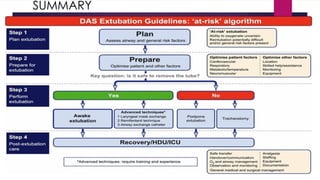
 Explain the 4Ps of extubation - DAS extubation guidelines (‘at risk’ algorithm)
INTRODUCTION
 Based on recent literature, including large-scale audits and closed claims analysis- extubation after a difficult
airway is a scenario at risk of severe adverse events
 Extubation is always an elective procedure – principles, planning and performance under optimal conditions.
Scenarios differ in OR, PACU, ER, ICU, prehospital settings or in transit.
 Extubation failure in adults in the OR and PACU- 0.1 and 0.45%, ICU (2-25%)
 Unplanned extubation- incidence in ICU- 0.3 and 35.8%, in OR (unknown)
 The principles also apply to extubation in normal scenarios.
Definitions
Extubation failure
 when the patient cannot maintain oxygenation, alveolar ventilation, airway patency, pulmonary toileting,
secretion management, and airway protection, or any combination of these issues.
 need for reintubation within 24–72 h after extubation (failure usually occurs within 2 hours)
a clear consensus on a precise definition or time frame does not exist at present
Unplanned extubation
 unintentional and uncontrolled removal of the endotracheal tube due to either actions of the patients or
during nursing care or movement of the patient
 e.g., during prone positioning
Complications of extubation- Minor
Minor
 Transient hypertension
 Tachycardia
 Coughing / bucking
 Agitation.
-Usually transient and reintubation not required
-Potentially serious in patients with:
 significant cardiac or cerebrovascular disease
 pre-existing elevated intracranial or intraocular
pressure
 patients who have undergone neck surgery,
neurosurgery, and some plastic surgical procedures
Complications of extubation- Major
 Extubation failure-upper airway obst. due to the inability to breathe without a tracheal tube
 Pulmonary aspiration- 33% occur after extubation
 Hypoxaemia – due to atelectasis, resp. Depressive medication
 Prolonged hypoxia
 Cardiac arrest- consequent brain damage and/or death.
Complications of extubation-Major
Unplanned extubation
 Aspiration pneumonia
 Hypoxemia
 Arrhythmias
 Vocal cord injury,
 Brain damage
 Death.
Indications for early reintubation
 Respiratory insufficiency
 Airway obstruction
 Bronchospasm
 Inadequate reversal of neuromuscular blockade
 Drug-induced respiratory depression
4Ps of extubation after a difficult ET intubation
 Plan extubation – assess airway and general risk factors
 Prepare for extubation – optimise patient and other factors
 Perform extubation – techniques of extubation
 Post Extubation care
PLAN
 In cases reported in the 2000–2012 closed claimed analysis, there was no back-up plan for emergent reintubation
(ASA)
 Extubation may be challenging due to the predicted difficulty with reintubation should this be required.
 Reintubation may be difficult when pre-existing difficulty with airway management exists and changes to the airway
have occurred due to trauma, positioning, or prolonged mechanical ventilation
 Patient and other factors -the location where reintubation occurs, the availability of expert help and essential team
members, and patient’s clinical conditions such as rapid desaturation and hypotension
Risk factors for extubation failure after DA- patient factors
 Laryngospasm
 Obesity
 Obstructive sleep apnea
 Chronic obstructive pulmonary disease
(COPD)
 Neuromuscular diseases
 Head and neck radiation history
 Parkinson’s disease
 Rheumatoid arthritis
 Paradoxical vocal fold motion
 Female gender
 Advanced age (> 70 years)
 Anatomically difficult airway- easy intubation under
controlled elective conditions does not equate to
optimal conditions should an emergent reintubation
be required
 Physiological difficulty- hypoxemia, hypercapnia,
acidosis, and cardiovascular instability at the time of
emergent reintubation may render patients less
tolerant of delays and persistent or prolonged
intubation attempts.
Risk factors for extubation failure after DA- surgical factors
 Head and neck surgical procedures- responsible for 34.2% of all airway events during
emergence or recovery
 Neurologic injuries affecting vocal cord motion, dynamic airway collapse, or airway
compression above, below, or at the level of the larynx
 Restricted airway access, e.g., Halo fixation, cervical collar, jaws wired shut
 Prolonged duration of mechanical ventilation
 Airway edema due to positioning, airway trauma during initial airway management or fluid
overload
Risk factors for extubation failure-contextual challenges
The emergent nature of a reintubation may result in:
 Insufficient information, medication, equipment, qualified personnel, suitable
positioning, or access to the airway.
 Other human factors such as operator fatigue, situational awareness, stress.
 Interference with an organized, appropriate, and well-executed approach to
managing the airway
Risk factors for unplanned extubation
 Inadequately securing the endotracheal tube
 Prone or lateral positioning, position changes
 Patient transport (for example, ambulance transport or in-hospital transfer to magnetic resonance imaging
or computerized tomography scans)
 Delirium, and agitation -lack of physical restraints where indicated for patient protection
 Risk factors for post-extubation stridor- traumatic intubation, intubation > 6 days, large ET, female gender,
and reintubation after unplanned extubation
Prepare- optimisation of risk factors prior to extubation
Contextual Assessment- do not perform extubation until:
 Patient’s medical condition is stable,
 The airway is patent,
 Potential difficulties in the event of reintubation have been identified,
 A plan that includes back-up options has been developed and shared among the team members involved.
 The required expertise and additional expert help should be present at the bedside or their immediate
availability should be confirmed.
 The availability of the necessary equipment should be checked and confirmed.
Prepare- optimisation of risk factors prior to extubation
Clinical assessment:
 Respiratory: spontaneous tidal volume > 6 ml/kg, vital capacity > 15 ml/kg, respiratory rate < 30
breaths/min, maximum inspiratory pressure < − 20 cmH2O, adequate gas exchange
 Cardiovascular: hemodynamic stability, without significant inotropic support or with stable, moderate
support
 Adequate reversal of neuromuscular block reversal, which should be monitored with a quantitative
neuromuscular monitor
 Risk of airway edema: Cuff leak test— used to assess the adequacy of airflow around the cuff-deflated
tracheal tube and is used for patients who are at risk for airway edema
Cuff leak test
 Patients with significantly positive fluid balance, prolonged Trendelenburg or prone positioning, maxillofacial
or neck surgery.
 Can be performed qualitatively or quantitatively, after suctioning the pharynx, the cuff is slowly deflated.
 In the qualitative assessment-the tracheal tube is progressively occluded. A spontaneously breathing patient
should be able to breathe in and out around the tube.
 In the quantitative assessment- in a volume-cycled ventilation mode, the difference between the inspired and
expired tidal volume is measured.
Cuff leak test.
 Cuff leak volumes less than 110 ml or less than 12 to 24% of the delivered tidal volume are thresholds for
determining diminished airway patency and risk for post-extubation stridor from laryngeal edema.
 presence of a leak does not rule out the possibility of subsequent airway obstruction or extubation failure of
a nonobstructive cause.
 This test has been reported to have sensitivity and specificity of 56 and 92 %, respectively
 In patients with an absent or reduced cuff leak, administration of a corticosteroid at least 4 h before extubation
is advised. A repeat cuff leak test is not required after the administration of systemic steroids
Perform extubation- techniques
1.Deep Extubation- no evidence, ?deep VS awake extubation, more in infants(higher risk of larygospasm)
 Advantages
• potential for earlier transport to the recovery room
• reduced airway and hemodynamic stimulation during extubation
 Disadvantages
• increased risk of aspiration and airway obstruction
Expert opinion advises against deep extubation of the patient with a higher risk airway
Perform extubation- techniques
2. Medications to Reduce Coughing – suppress airway and circulatory reflexes.
Low dose Infusions, 10-15mins before end of surgery and extubation.
 Dexmedetomidine- 0.5-0.75ug/kg, anxiolytic, sedative and analgesic qualities , no respiratory depressant
effects
 Remifentanil- 0.03ug/kg, ultrashort duration of analgesia and risk of respiratory depression, analgesic,
antitussive
 Fentanyl- 1ug/kg, comparable to dexmedetomidine, respiratory depressant effects
 Lidocaine via intracuff, tracheal/topical, and IV routes.
Dexmedetomidine may be the most effective drug in these regards
Perform extubation- techniques
3. Airway Exchange Catheters (AEC)- Different international guidelines, ASA, DAS, Canadian Airway focus.
 recommend considering the placement of an AEC when extubating a patient with a difficult airway.
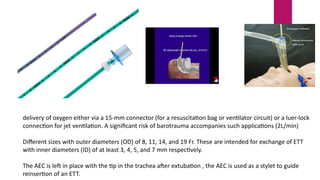
 long, hollow semirigid catheters designed and approved for endotracheal tube (ETT) exchange
 The principle of using AECs in the setting of difficult intubation is to insert them through the ETT at a
predefined depth.
 Distance marks on the AEC allow alignment with those on the ETT, to avoid the tip of the AEC protruding
beyond that of the ETT, causing trauma or irritation to the trachea, carina, or bronchi.
delivery of oxygen either via a 15-mm connector (for a resuscitation bag or ventilator circuit) or a luer-lock
connection for jet ventilation. A significant risk of barotrauma accompanies such applications (2L/min)
Different sizes with outer diameters (OD) of 8, 11, 14, and 19 Fr. These are intended for exchange of ETT
with inner diameters (ID) of at least 3, 4, 5, and 7 mm respectively.
The AEC is left in place with the tip in the trachea after extubation , the AEC is used as a stylet to guide
reinsertion of an ETT.
Perform extubation- techniques (AEC)
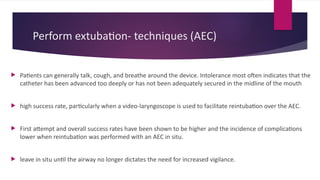
 Patients can generally talk, cough, and breathe around the device. Intolerance most often indicates that the
catheter has been advanced too deeply or has not been adequately secured in the midline of the mouth
 high success rate, particularly when a video-laryngoscope is used to facilitate reintubation over the AEC.
 First attempt and overall success rates have been shown to be higher and the incidence of complications
lower when reintubation was performed with an AEC in situ.
 leave in situ until the airway no longer dictates the need for increased vigilance.
Perform extubation- techniques
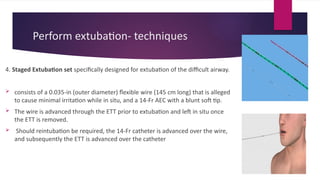
4. Staged Extubation set specifically designed for extubation of the difficult airway.
 consists of a 0.035-in (outer diameter) flexible wire (145 cm long) that is alleged
to cause minimal irritation while in situ, and a 14-Fr AEC with a blunt soft tip.
 The wire is advanced through the ETT prior to extubation and left in situ once
the ETT is removed.
 Should reintubation be required, the 14-Fr catheter is advanced over the wire,
and subsequently the ETT is advanced over the catheter
Perform extubation- techniques (SGAs)
5. Extubation with a Supraglottic Airway (SGA)
 facilitating extubation under general anesthesia in at-risk patients
 not advised for use in patients with anatomically difficult airways.
 regarded as a bridge to successful and uneventful emergence from anesthesia, an advanced manoeuver
 reduce hemodynamic stress and coughing- minimises the risk of bleeding and hematoma formation
after head and neck surgery
 useful in settings where the evaluation of vocal cord function prior to awakening is desirable, as a
flexible scope can be inserted via the supraglottic airway to perform such assessment.
Perform extubation- techniques (Tracheostomy)
6. Elective surgical tracheostomy- when it is unsafe to remove a tracheal tube even when postponed for
hours or days.
 extensive intraoral flaps, an obstructed airway, significant swelling (either currently present or
predictable in the next few hours as a result of surgical interventions),
 bleeding in or around the airway
 following evaluation by a multidisciplinary team including anesthesiologists, intensivists, and surgeons.
 Evaluation must include consideration of patient factors as well as an assessment of the resources and
skills required to secure a compromised airway on an emergent basis.
Post extubation care- ICU, HDU, Recovery
Strategies to prevent failure after extubation
 Head-up positioning (unless contraindicated) and administration of supplemental oxygen.
 Noninvasive ventilation
 High-flow nasal therapies
 Patients who have received mechanical ventilation for longer than 24 h and have hypercapnia
 Chronic obstructive pulmonary disease (COPD)
 Congestive heart failure (CHF), or other serious comorbidities.
Post extubation care- ICU, HDU, Recovery
If stridor occurs-
 Nebulized racemic epinephrine,
 Diuretics
 Administration of inhaled O2/helium mixture may have a role, depending on the underlying
etiology
 In such circumstances, close monitoring is mandatory and planning for failure and potential
difficult reintubation should be undertaken.
SUMMARY
References
 Parotto, M., Cooper, R. M., & Behringer, E. C. (2020). Extubation of the Challenging or Difficult Airway. Current anesthesiology
reports, 10(4), 334–340. Available from: https://doi.org/10.1007/s40140-020-00416-3 (Accessed 08 May 2024)
 Cavallone, L.F. & Vannucci, A. (2013) Extubation of the difficult airway and extubation failure. Anesthesia & Analgesia, 116(2),
368-383. Available from: https://www.ncbi.nlm.nih.gov/pmc/articles/PMC7471579/ ( Accessed 08 May 2024)
 Cooper, RM. Extubation following anesthesia. In: UpToDate, Hagberg CA and Crowley M (Eds), UpToDate 2020. Excellent
overview of extubation, regularly updated.
 Joffe, A.M., Aziz, M.F., Posner, K.L., Duggan, L.V., Mincer, S.L. and Domino, K.B. (2019) Management of difficult tracheal
intubation: a closed claims analysis. Anesthesiology, 131(4), 818-82
 Cook, TM., Woodall, N., Frerk, C. (2011) Fourth National Audit Project of the Royal College of Anaesthetists and Difficult
Airway Society. Major complications of airway management in the United Kingdom. Report and Findings. London Accessed
from: http://www.rcoa.ac.uk/nap4 (Accessed 09 May 2024)
 Popat, M., Mitchell, V., Dravid, R., Pate,l A., Swampillai, C., Higgs, A. (2012) Difficult Airway Society Guidelines for the
management of tracheal extubation. Anaesthesia, 67:318–340. doi: 10.1111/j.1365-2044.2012.07253.x.

EXTUBATION AFTER A DIFFICULT AIRWAY .pptx

  • 1.
    EXTUBATION OF ADIFFICULT AIRWAY DR ADERONKE ADESIYAN MBBS. PGDA(WACS), FWACS, PGDIP MEDED
  • 2.
    LEARNING OUTCOMES  Enumeratethe risk factors of extubation after a difficult airway  Describe the techniques for extubating a difficult airway  Explain the 4Ps of extubation - DAS extubation guidelines (‘at risk’ algorithm)
  • 3.
    INTRODUCTION  Based onrecent literature, including large-scale audits and closed claims analysis- extubation after a difficult airway is a scenario at risk of severe adverse events  Extubation is always an elective procedure – principles, planning and performance under optimal conditions. Scenarios differ in OR, PACU, ER, ICU, prehospital settings or in transit.  Extubation failure in adults in the OR and PACU- 0.1 and 0.45%, ICU (2-25%)  Unplanned extubation- incidence in ICU- 0.3 and 35.8%, in OR (unknown)  The principles also apply to extubation in normal scenarios.
  • 4.
    Definitions Extubation failure  whenthe patient cannot maintain oxygenation, alveolar ventilation, airway patency, pulmonary toileting, secretion management, and airway protection, or any combination of these issues.  need for reintubation within 24–72 h after extubation (failure usually occurs within 2 hours) a clear consensus on a precise definition or time frame does not exist at present Unplanned extubation  unintentional and uncontrolled removal of the endotracheal tube due to either actions of the patients or during nursing care or movement of the patient  e.g., during prone positioning
  • 5.
    Complications of extubation-Minor Minor  Transient hypertension  Tachycardia  Coughing / bucking  Agitation. -Usually transient and reintubation not required -Potentially serious in patients with:  significant cardiac or cerebrovascular disease  pre-existing elevated intracranial or intraocular pressure  patients who have undergone neck surgery, neurosurgery, and some plastic surgical procedures
  • 6.
    Complications of extubation-Major  Extubation failure-upper airway obst. due to the inability to breathe without a tracheal tube  Pulmonary aspiration- 33% occur after extubation  Hypoxaemia – due to atelectasis, resp. Depressive medication  Prolonged hypoxia  Cardiac arrest- consequent brain damage and/or death.
  • 7.
    Complications of extubation-Major Unplannedextubation  Aspiration pneumonia  Hypoxemia  Arrhythmias  Vocal cord injury,  Brain damage  Death.
  • 8.
    Indications for earlyreintubation  Respiratory insufficiency  Airway obstruction  Bronchospasm  Inadequate reversal of neuromuscular blockade  Drug-induced respiratory depression
  • 9.
    4Ps of extubationafter a difficult ET intubation  Plan extubation – assess airway and general risk factors  Prepare for extubation – optimise patient and other factors  Perform extubation – techniques of extubation  Post Extubation care
  • 10.
    PLAN  In casesreported in the 2000–2012 closed claimed analysis, there was no back-up plan for emergent reintubation (ASA)  Extubation may be challenging due to the predicted difficulty with reintubation should this be required.  Reintubation may be difficult when pre-existing difficulty with airway management exists and changes to the airway have occurred due to trauma, positioning, or prolonged mechanical ventilation  Patient and other factors -the location where reintubation occurs, the availability of expert help and essential team members, and patient’s clinical conditions such as rapid desaturation and hypotension
  • 11.
    Risk factors forextubation failure after DA- patient factors  Laryngospasm  Obesity  Obstructive sleep apnea  Chronic obstructive pulmonary disease (COPD)  Neuromuscular diseases  Head and neck radiation history  Parkinson’s disease  Rheumatoid arthritis  Paradoxical vocal fold motion  Female gender  Advanced age (> 70 years)  Anatomically difficult airway- easy intubation under controlled elective conditions does not equate to optimal conditions should an emergent reintubation be required  Physiological difficulty- hypoxemia, hypercapnia, acidosis, and cardiovascular instability at the time of emergent reintubation may render patients less tolerant of delays and persistent or prolonged intubation attempts.
  • 12.
    Risk factors forextubation failure after DA- surgical factors  Head and neck surgical procedures- responsible for 34.2% of all airway events during emergence or recovery  Neurologic injuries affecting vocal cord motion, dynamic airway collapse, or airway compression above, below, or at the level of the larynx  Restricted airway access, e.g., Halo fixation, cervical collar, jaws wired shut  Prolonged duration of mechanical ventilation  Airway edema due to positioning, airway trauma during initial airway management or fluid overload
  • 13.
    Risk factors forextubation failure-contextual challenges The emergent nature of a reintubation may result in:  Insufficient information, medication, equipment, qualified personnel, suitable positioning, or access to the airway.  Other human factors such as operator fatigue, situational awareness, stress.  Interference with an organized, appropriate, and well-executed approach to managing the airway
  • 14.
    Risk factors forunplanned extubation  Inadequately securing the endotracheal tube  Prone or lateral positioning, position changes  Patient transport (for example, ambulance transport or in-hospital transfer to magnetic resonance imaging or computerized tomography scans)  Delirium, and agitation -lack of physical restraints where indicated for patient protection  Risk factors for post-extubation stridor- traumatic intubation, intubation > 6 days, large ET, female gender, and reintubation after unplanned extubation
  • 15.
    Prepare- optimisation ofrisk factors prior to extubation Contextual Assessment- do not perform extubation until:  Patient’s medical condition is stable,  The airway is patent,  Potential difficulties in the event of reintubation have been identified,  A plan that includes back-up options has been developed and shared among the team members involved.  The required expertise and additional expert help should be present at the bedside or their immediate availability should be confirmed.  The availability of the necessary equipment should be checked and confirmed.
  • 16.
    Prepare- optimisation ofrisk factors prior to extubation Clinical assessment:  Respiratory: spontaneous tidal volume > 6 ml/kg, vital capacity > 15 ml/kg, respiratory rate < 30 breaths/min, maximum inspiratory pressure < − 20 cmH2O, adequate gas exchange  Cardiovascular: hemodynamic stability, without significant inotropic support or with stable, moderate support  Adequate reversal of neuromuscular block reversal, which should be monitored with a quantitative neuromuscular monitor  Risk of airway edema: Cuff leak test— used to assess the adequacy of airflow around the cuff-deflated tracheal tube and is used for patients who are at risk for airway edema
  • 17.
    Cuff leak test Patients with significantly positive fluid balance, prolonged Trendelenburg or prone positioning, maxillofacial or neck surgery.  Can be performed qualitatively or quantitatively, after suctioning the pharynx, the cuff is slowly deflated.  In the qualitative assessment-the tracheal tube is progressively occluded. A spontaneously breathing patient should be able to breathe in and out around the tube.  In the quantitative assessment- in a volume-cycled ventilation mode, the difference between the inspired and expired tidal volume is measured.
  • 18.
    Cuff leak test. Cuff leak volumes less than 110 ml or less than 12 to 24% of the delivered tidal volume are thresholds for determining diminished airway patency and risk for post-extubation stridor from laryngeal edema.  presence of a leak does not rule out the possibility of subsequent airway obstruction or extubation failure of a nonobstructive cause.  This test has been reported to have sensitivity and specificity of 56 and 92 %, respectively  In patients with an absent or reduced cuff leak, administration of a corticosteroid at least 4 h before extubation is advised. A repeat cuff leak test is not required after the administration of systemic steroids
  • 19.
    Perform extubation- techniques 1.DeepExtubation- no evidence, ?deep VS awake extubation, more in infants(higher risk of larygospasm)  Advantages • potential for earlier transport to the recovery room • reduced airway and hemodynamic stimulation during extubation  Disadvantages • increased risk of aspiration and airway obstruction Expert opinion advises against deep extubation of the patient with a higher risk airway
  • 20.
    Perform extubation- techniques 2.Medications to Reduce Coughing – suppress airway and circulatory reflexes. Low dose Infusions, 10-15mins before end of surgery and extubation.  Dexmedetomidine- 0.5-0.75ug/kg, anxiolytic, sedative and analgesic qualities , no respiratory depressant effects  Remifentanil- 0.03ug/kg, ultrashort duration of analgesia and risk of respiratory depression, analgesic, antitussive  Fentanyl- 1ug/kg, comparable to dexmedetomidine, respiratory depressant effects  Lidocaine via intracuff, tracheal/topical, and IV routes. Dexmedetomidine may be the most effective drug in these regards
  • 21.
    Perform extubation- techniques 3.Airway Exchange Catheters (AEC)- Different international guidelines, ASA, DAS, Canadian Airway focus.  recommend considering the placement of an AEC when extubating a patient with a difficult airway.  long, hollow semirigid catheters designed and approved for endotracheal tube (ETT) exchange  The principle of using AECs in the setting of difficult intubation is to insert them through the ETT at a predefined depth.  Distance marks on the AEC allow alignment with those on the ETT, to avoid the tip of the AEC protruding beyond that of the ETT, causing trauma or irritation to the trachea, carina, or bronchi.
  • 22.
    delivery of oxygeneither via a 15-mm connector (for a resuscitation bag or ventilator circuit) or a luer-lock connection for jet ventilation. A significant risk of barotrauma accompanies such applications (2L/min) Different sizes with outer diameters (OD) of 8, 11, 14, and 19 Fr. These are intended for exchange of ETT with inner diameters (ID) of at least 3, 4, 5, and 7 mm respectively. The AEC is left in place with the tip in the trachea after extubation , the AEC is used as a stylet to guide reinsertion of an ETT.
  • 23.
    Perform extubation- techniques(AEC)  Patients can generally talk, cough, and breathe around the device. Intolerance most often indicates that the catheter has been advanced too deeply or has not been adequately secured in the midline of the mouth  high success rate, particularly when a video-laryngoscope is used to facilitate reintubation over the AEC.  First attempt and overall success rates have been shown to be higher and the incidence of complications lower when reintubation was performed with an AEC in situ.  leave in situ until the airway no longer dictates the need for increased vigilance.
  • 24.
    Perform extubation- techniques 4.Staged Extubation set specifically designed for extubation of the difficult airway.  consists of a 0.035-in (outer diameter) flexible wire (145 cm long) that is alleged to cause minimal irritation while in situ, and a 14-Fr AEC with a blunt soft tip.  The wire is advanced through the ETT prior to extubation and left in situ once the ETT is removed.  Should reintubation be required, the 14-Fr catheter is advanced over the wire, and subsequently the ETT is advanced over the catheter
  • 25.
    Perform extubation- techniques(SGAs) 5. Extubation with a Supraglottic Airway (SGA)  facilitating extubation under general anesthesia in at-risk patients  not advised for use in patients with anatomically difficult airways.  regarded as a bridge to successful and uneventful emergence from anesthesia, an advanced manoeuver  reduce hemodynamic stress and coughing- minimises the risk of bleeding and hematoma formation after head and neck surgery  useful in settings where the evaluation of vocal cord function prior to awakening is desirable, as a flexible scope can be inserted via the supraglottic airway to perform such assessment.
  • 26.
    Perform extubation- techniques(Tracheostomy) 6. Elective surgical tracheostomy- when it is unsafe to remove a tracheal tube even when postponed for hours or days.  extensive intraoral flaps, an obstructed airway, significant swelling (either currently present or predictable in the next few hours as a result of surgical interventions),  bleeding in or around the airway  following evaluation by a multidisciplinary team including anesthesiologists, intensivists, and surgeons.  Evaluation must include consideration of patient factors as well as an assessment of the resources and skills required to secure a compromised airway on an emergent basis.
  • 27.
    Post extubation care-ICU, HDU, Recovery Strategies to prevent failure after extubation  Head-up positioning (unless contraindicated) and administration of supplemental oxygen.  Noninvasive ventilation  High-flow nasal therapies  Patients who have received mechanical ventilation for longer than 24 h and have hypercapnia  Chronic obstructive pulmonary disease (COPD)  Congestive heart failure (CHF), or other serious comorbidities.
  • 28.
    Post extubation care-ICU, HDU, Recovery If stridor occurs-  Nebulized racemic epinephrine,  Diuretics  Administration of inhaled O2/helium mixture may have a role, depending on the underlying etiology  In such circumstances, close monitoring is mandatory and planning for failure and potential difficult reintubation should be undertaken.
  • 29.
  • 30.
    References  Parotto, M.,Cooper, R. M., & Behringer, E. C. (2020). Extubation of the Challenging or Difficult Airway. Current anesthesiology reports, 10(4), 334–340. Available from: https://doi.org/10.1007/s40140-020-00416-3 (Accessed 08 May 2024)  Cavallone, L.F. & Vannucci, A. (2013) Extubation of the difficult airway and extubation failure. Anesthesia & Analgesia, 116(2), 368-383. Available from: https://www.ncbi.nlm.nih.gov/pmc/articles/PMC7471579/ ( Accessed 08 May 2024)  Cooper, RM. Extubation following anesthesia. In: UpToDate, Hagberg CA and Crowley M (Eds), UpToDate 2020. Excellent overview of extubation, regularly updated.  Joffe, A.M., Aziz, M.F., Posner, K.L., Duggan, L.V., Mincer, S.L. and Domino, K.B. (2019) Management of difficult tracheal intubation: a closed claims analysis. Anesthesiology, 131(4), 818-82  Cook, TM., Woodall, N., Frerk, C. (2011) Fourth National Audit Project of the Royal College of Anaesthetists and Difficult Airway Society. Major complications of airway management in the United Kingdom. Report and Findings. London Accessed from: http://www.rcoa.ac.uk/nap4 (Accessed 09 May 2024)  Popat, M., Mitchell, V., Dravid, R., Pate,l A., Swampillai, C., Higgs, A. (2012) Difficult Airway Society Guidelines for the management of tracheal extubation. Anaesthesia, 67:318–340. doi: 10.1111/j.1365-2044.2012.07253.x.