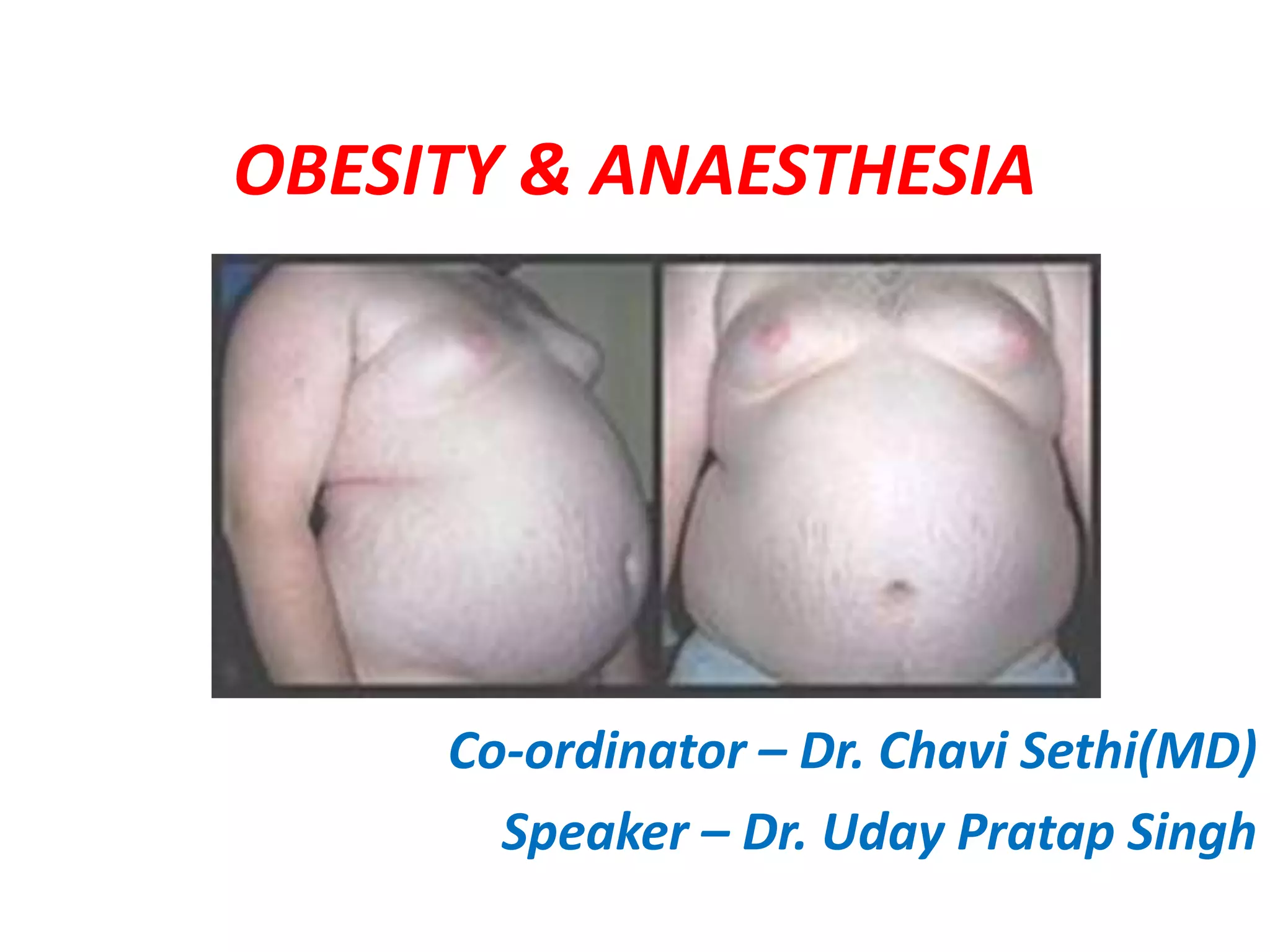
OBESITY & ANAESTHESIA

Co-ordinator – Dr. Chavi Sethi(MD)
Speaker – Dr. Uday Pratap Singh
OBESITY
LATIN WORD OBESUS, WHICH
MEANS FATTENED BY EATING
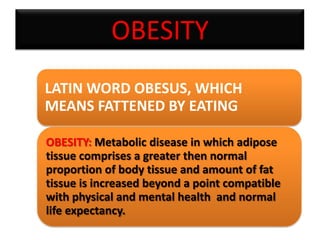
OBESITY: Metabolic disease in which adipose
tissue comprises a greater then normal
proportion of body tissue and amount of fat
tissue is increased beyond a point compatible
with physical and mental health and normal
life expectancy.
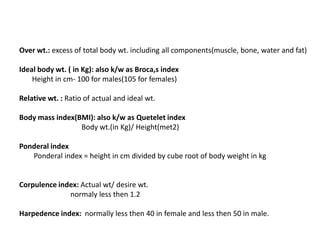
Over wt.: excess of total body wt. including all components(muscle, bone, water and fat)
Ideal body wt. ( in Kg): also k/w as Broca,s index
Height in cm- 100 for males(105 for females)
Relative wt. : Ratio of actual and ideal wt.
Body mass index(BMI): also k/w as Quetelet index
Body wt.(in Kg)/ Height(met2)
Ponderal index
Ponderal index = height in cm divided by cube root of body weight in kg

Corpulence index: Actual wt/ desire wt.
normaly less then 1.2
Harpedence index: normally less then 40 in female and less then 50 in male.
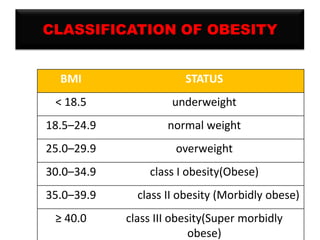
CLASSIFICATION OF OBESITY

BMI

STATUS

< 18.5

underweight

18.5–24.9

normal weight

25.0–29.9

overweight

30.0–34.9

class I obesity(Obese)

35.0–39.9
≥ 40.0

class II obesity (Morbidly obese)
class III obesity(Super morbidly
obese)
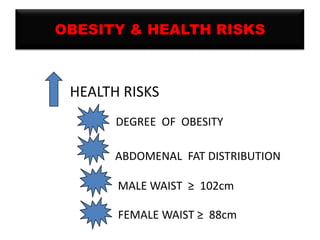
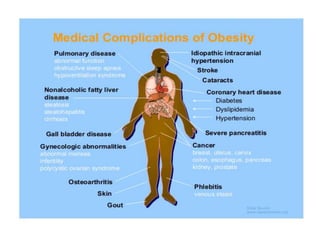
OBESITY & HEALTH RISKS

HEALTH RISKS
DEGREE OF OBESITY
ABDOMENAL FAT DISTRIBUTION
MALE WAIST ≥ 102cm
FEMALE WAIST ≥ 88cm
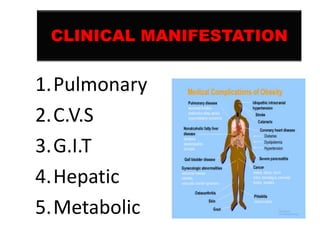
CLINICAL MANIFESTATION

1.Pulmonary
2.C.V.S
3.G.I.T
4.Hepatic
5.Metabolic
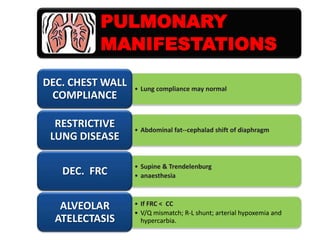
PULMONARY
MANIFESTATIONS
DEC. CHEST WALL
COMPLIANCE
RESTRICTIVE
LUNG DISEASE

DEC. FRC
ALVEOLAR
ATELECTASIS

• Lung compliance may normal

• Abdominal fat--cephalad shift of diaphragm

• Supine & Trendelenburg
• anaesthesia

• If FRC < CC
• V/Q mismatch; R-L shunt; arterial hypoxemia and
hypercarbia.
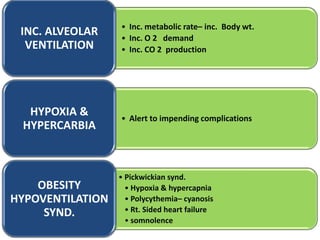
INC. ALVEOLAR
VENTILATION

• Inc. metabolic rate– inc. Body wt.
• Inc. O 2 demand
• Inc. CO 2 production

HYPOXIA &
HYPERCARBIA

• Alert to impending complications

OBESITY
HYPOVENTILATION
SYND.

• Pickwickian synd.
• Hypoxia & hypercapnia
• Polycythemia– cyanosis
• Rt. Sided heart failure
• somnolence
OBSTRSUCTIVE SLEEP APNEA
SYNDROME
• Frequent episodes of apnea or hypopnea during sleep
Total cessation of airflow for = 10 sec.
Hypoapnea is 50% reduction in airflow
5 or more episode per hr. or 30 per night are counted as
clinically significant
• Day time somnolence associated with memory problem ,
impaired conc. and accident
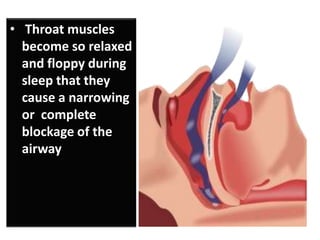
• Throat muscles
become so relaxed
and floppy during
sleep that they
cause a narrowing
or complete
blockage of the
airway
Daytime sleepiness or fatigue
Dry mouth or sore throat upon awakening
Headaches in the morning
Trouble concentrating, forgetfulness,
depression, or irritability
Night sweats
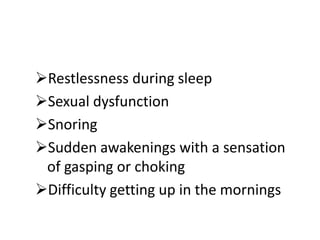
Restlessness during sleep
Sexual dysfunction
Snoring
Sudden awakenings with a sensation
of gasping or choking
Difficulty getting up in the mornings
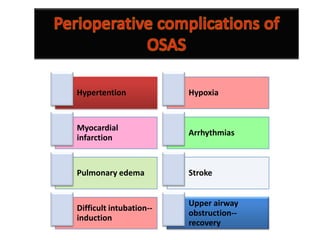
Hypertention

Hypoxia

Myocardial
infarction

Arrhythmias

Pulmonary edema

Stroke

Difficult intubation-induction

Upper airway
obstruction-recovery
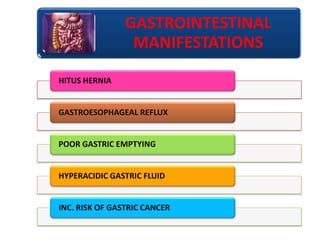
GASTROINTESTINAL
MANIFESTATIONS
HITUS HERNIA

GASTROESOPHAGEAL REFLUX

POOR GASTRIC EMPTYING

HYPERACIDIC GASTRIC FLUID

INC. RISK OF GASTRIC CANCER
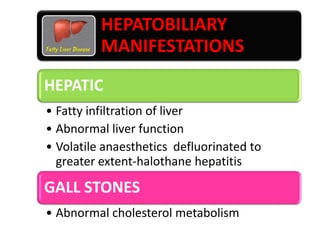
HEPATOBILIARY
MANIFESTATIONS
HEPATIC
• Fatty infiltration of liver
• Abnormal liver function
• Volatile anaesthetics defluorinated to
greater extent-halothane hepatitis

GALL STONES
• Abnormal cholesterol metabolism
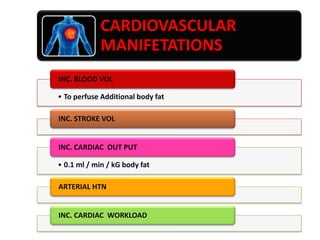
CARDIOVASCULAR
MANIFETATIONS
INC. BLOOD VOL
• To perfuse Additional body fat
INC. STROKE VOL

INC. CARDIAC OUT PUT
• 0.1 ml / min / kG body fat
ARTERIAL HTN

INC. CARDIAC WORKLOAD
LT VENTRICULAR HYPERTROPHY

PULMONARY HTN & COR
PULMONALE
• INC. Pulmonary blood flow
• Pulmonary vasoconstriction
• Persistent hypoxia
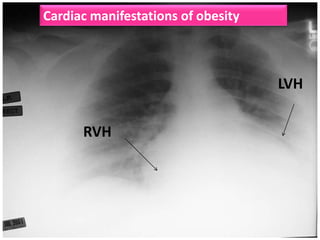
Cardiac manifestations of obesity

LVH
RVH
THROMBO-EMBOLIC DISEASE:
• Inc risk of DVT
•
•
•
•

Inc. intra-abdominal pressure
Polycythemia
Inc. pressure in deep veins
Immobilization-venous stasis
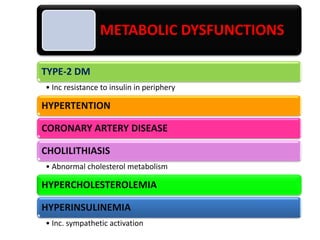
METABOLIC DYSFUNCTIONS
TYPE-2 DM
• Inc resistance to insulin in periphery

HYPERTENTION

CORONARY ARTERY DISEASE
CHOLILITHIASIS
• Abnormal cholesterol metabolism

HYPERCHOLESTEROLEMIA
HYPERINSULINEMIA
• Inc. sympathetic activation
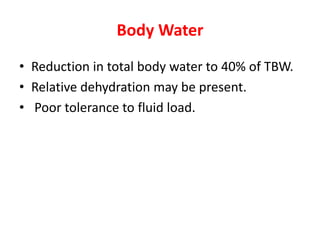
Body Water
• Reduction in total body water to 40% of TBW.
• Relative dehydration may be present.
• Poor tolerance to fluid load.
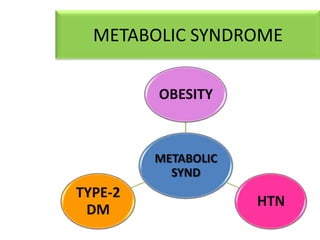
METABOLIC SYNDROME
OBESITY

METABOLIC
SYND

TYPE-2
DM

HTN
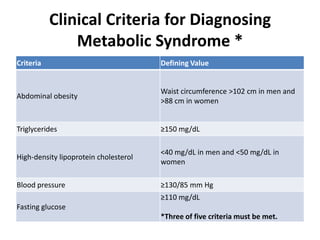
Clinical Criteria for Diagnosing
Metabolic Syndrome *
Criteria

Defining Value

Abdominal obesity

Waist circumference >102 cm in men and
>88 cm in women

Triglycerides

≥150 mg/dL

High-density lipoprotein cholesterol

<40 mg/dL in men and <50 mg/dL in
women

Blood pressure

≥130/85 mm Hg
≥110 mg/dL

Fasting glucose
*Three of five criteria must be met.
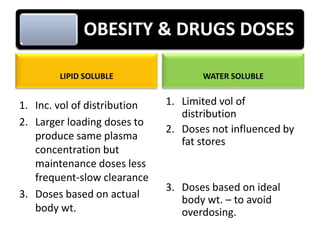
OBESITY & DRUGS DOSES
LIPID SOLUBLE

1. Inc. vol of distribution
2. Larger loading doses to
produce same plasma
concentration but
maintenance doses less
frequent-slow clearance
3. Doses based on actual
body wt.

WATER SOLUBLE

1. Limited vol of
distribution
2. Doses not influenced by
fat stores

3. Doses based on ideal
body wt. – to avoid
overdosing.
•

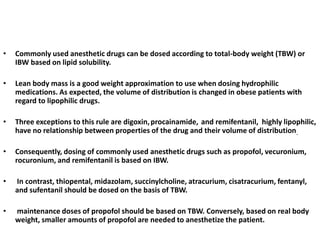
Commonly used anesthetic drugs can be dosed according to total-body weight (TBW) or
IBW based on lipid solubility.

•

Lean body mass is a good weight approximation to use when dosing hydrophilic
medications. As expected, the volume of distribution is changed in obese patients with
regard to lipophilic drugs.

•

Three exceptions to this rule are digoxin, procainamide, and remifentanil, highly lipophilic,
have no relationship between properties of the drug and their volume of distribution.

•

Consequently, dosing of commonly used anesthetic drugs such as propofol, vecuronium,
rocuronium, and remifentanil is based on IBW.

•

In contrast, thiopental, midazolam, succinylcholine, atracurium, cisatracurium, fentanyl,
and sufentanil should be dosed on the basis of TBW.

•

maintenance doses of propofol should be based on TBW. Conversely, based on real body
weight, smaller amounts of propofol are needed to anesthetize the patient.
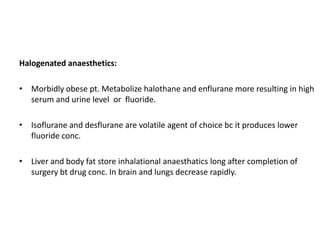
Halogenated anaesthetics:
• Morbidly obese pt. Metabolize halothane and enflurane more resulting in high
serum and urine level or fluoride.
• Isoflurane and desflurane are volatile agent of choice bc it produces lower
fluoride conc.
• Liver and body fat store inhalational anaesthatics long after completion of
surgery bt drug conc. In brain and lungs decrease rapidly.
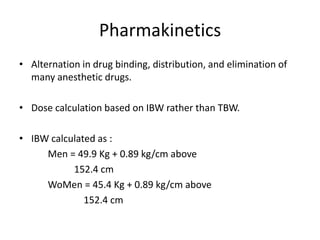
Pharmakinetics
• Alternation in drug binding, distribution, and elimination of
many anesthetic drugs.
• Dose calculation based on IBW rather than TBW.

• IBW calculated as :
Men = 49.9 Kg + 0.89 kg/cm above
152.4 cm
WoMen = 45.4 Kg + 0.89 kg/cm above
152.4 cm
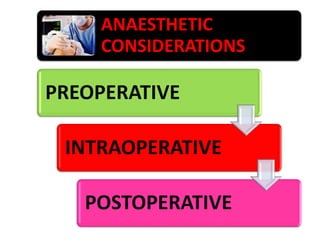
ANAESTHETIC
CONSIDERATIONS

PREOPERATIVE
INTRAOPERATIVE

POSTOPERATIVE
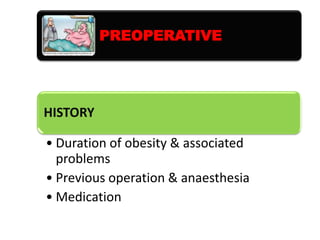
PREOPERATIVE

HISTORY
• Duration of obesity & associated
problems
• Previous operation & anaesthesia
• Medication
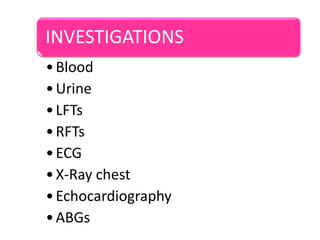
INVESTIGATIONS
• Blood
• Urine
• LFTs
• RFTs
• ECG
• X-Ray chest
• Echocardiography
• ABGs
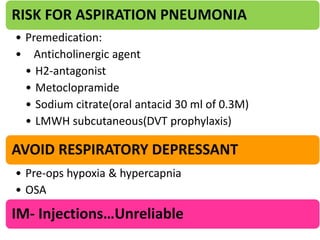
RISK FOR ASPIRATION PNEUMONIA
• Premedication:
• Anticholinergic agent
• H2-antagonist
• Metoclopramide
• Sodium citrate(oral antacid 30 ml of 0.3M)
• LMWH subcutaneous(DVT prophylaxis)

AVOID RESPIRATORY DEPRESSANT
• Pre-ops hypoxia & hypercapnia
• OSA

IM- Injections…Unreliable
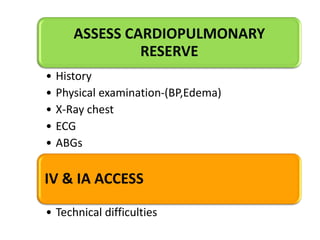
ASSESS CARDIOPULMONARY
RESERVE
•
•
•
•
•

History
Physical examination-(BP,Edema)
X-Ray chest
ECG
ABGs

IV & IA ACCESS
• Technical difficulties
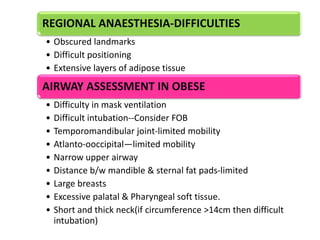
REGIONAL ANAESTHESIA-DIFFICULTIES
• Obscured landmarks
• Difficult positioning
• Extensive layers of adipose tissue

AIRWAY ASSESSMENT IN OBESE
•
•
•
•
•
•
•
•
•

Difficulty in mask ventilation
Difficult intubation--Consider FOB
Temporomandibular joint-limited mobility
Atlanto-ooccipital—limited mobility
Narrow upper airway
Distance b/w mandible & sternal fat pads-limited
Large breasts
Excessive palatal & Pharyngeal soft tissue.
Short and thick neck(if circumference >14cm then difficult
intubation)
INTRAOPERATIVE
GA
• PRE-OXYGENATION
• POSITIONING
• INDUCTION & INTUBATION
• MAINTAINACE

REGIONAL ANAESTHESIA
• Technical difficulties
• Doses of LA
• Complications
• Advantages
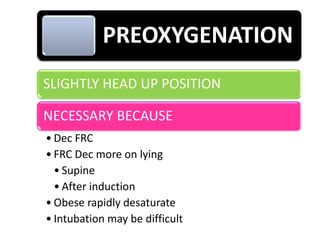
PREOXYGENATION
SLIGHTLY HEAD UP POSITION
NECESSARY BECAUSE
• Dec FRC
• FRC Dec more on lying
• Supine
• After induction
• Obese rapidly desaturate
• Intubation may be difficult
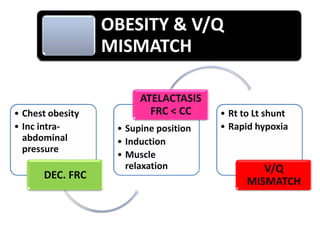
OBESITY & V/Q
MISMATCH

• Chest obesity
• Inc intraabdominal
pressure

DEC. FRC

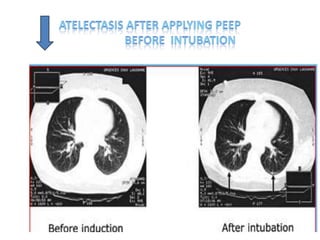
ATELACTASIS
FRC < CC
• Supine position
• Induction
• Muscle
relaxation

• Rt to Lt shunt
• Rapid hypoxia

V/Q
MISMATCH
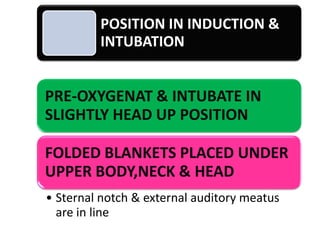
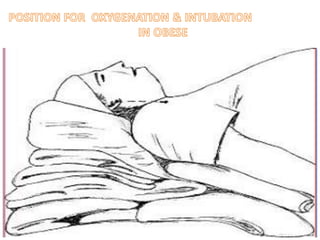
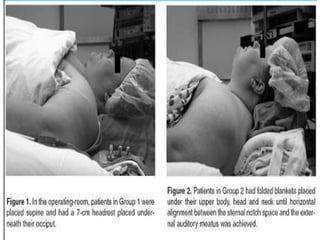
POSITION IN INDUCTION &
INTUBATION

PRE-OXYGENAT & INTUBATE IN
SLIGHTLY HEAD UP POSITION
FOLDED BLANKETS PLACED UNDER
UPPER BODY,NECK & HEAD
• Sternal notch & external auditory meatus
are in line
INDUCTION &
INTUBATION
DIFFICULT TO VENTILATE WITH MASK
RAPID SEQUENCE INTUBATION
• Risk for aspiration

VAREITY OF SCOPES
• Long blade & short handle

AWAKE INTUBATION-IF DIFFICULT
• FOB
PEEP DURING
INDUCTION
Application of positive endexpiratory pressure during the
induction of general anesthesia:
• prevents atelectasis formation.
• improves oxygenation and probably
increases the margin of safety before
intubation.
CONFIRMATION OF
INTUBATION

DIFFICULT TO CONFIRM
BY AUSCULTATIONCLINICALLY
CONFIRMED BY END
TIDAL CO2
MAINTAINACE OF
ANAESTHESIA
HIGH INSPIRED O2 CONCENTRATION
• LITHOTOMY,TRENDELENBURG & PRONE

CONTROLLED VENTILATION – HIGH TIDAL
VOLUMES

PEEP-WORSEN PULMONARY HTN IN
EXTREME OBESE
POSTOPERATIVE
COSIDERATIONS
EXTUBATION
• Delayed until effects of NMBAs completely
reversed
• Fully awake
• Adequate airway maintenance
• Adequate tidal volume
• Supplemental oxygenation
• Modified sitting position
POSTOPERATIVE COMPLICATIONS
RESPIRATORY FAILURE
• Major complication
• Inc risk• Pre-ops hypoxia
• Thoracic & upper abdominal Surgery

DEEP VENOUS THOROMBOSIS
PULMONARY EMBOLISM
WOUND INFECTION
THANK YOU
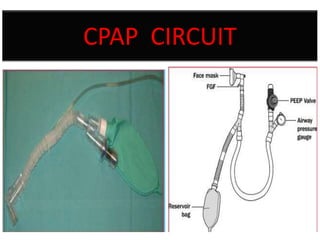
CPAP CIRCUIT
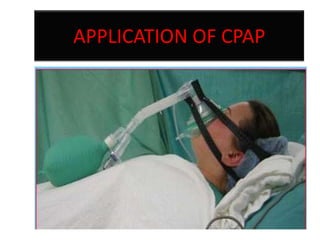
APPLICATION OF CPAP
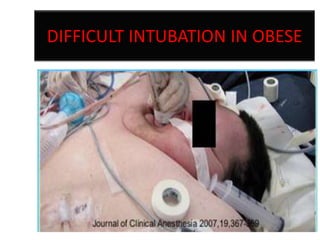
DIFFICULT INTUBATION IN OBESE
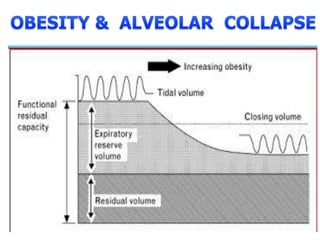
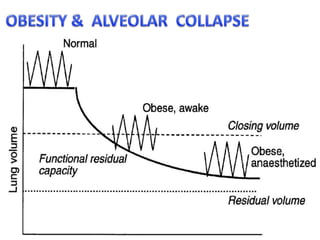
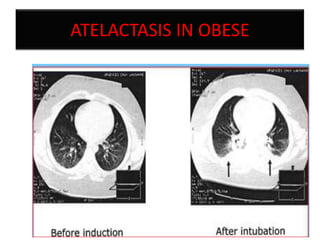
ATELACTASIS IN OBESE
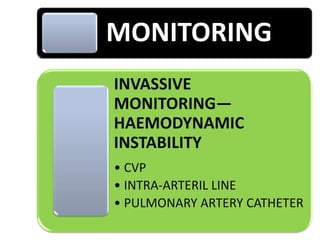
MONITORING
INVASSIVE
MONITORING—
HAEMODYNAMIC
INSTABILITY
• CVP
• INTRA-ARTERIL LINE
• PULMONARY ARTERY CATHETER

Obesity & anaesthesia

  • 1.
    OBESITY & ANAESTHESIA Co-ordinator– Dr. Chavi Sethi(MD) Speaker – Dr. Uday Pratap Singh
  • 2.
    OBESITY LATIN WORD OBESUS,WHICH MEANS FATTENED BY EATING OBESITY: Metabolic disease in which adipose tissue comprises a greater then normal proportion of body tissue and amount of fat tissue is increased beyond a point compatible with physical and mental health and normal life expectancy.
  • 3.
    Over wt.: excessof total body wt. including all components(muscle, bone, water and fat) Ideal body wt. ( in Kg): also k/w as Broca,s index Height in cm- 100 for males(105 for females) Relative wt. : Ratio of actual and ideal wt. Body mass index(BMI): also k/w as Quetelet index Body wt.(in Kg)/ Height(met2) Ponderal index Ponderal index = height in cm divided by cube root of body weight in kg Corpulence index: Actual wt/ desire wt. normaly less then 1.2 Harpedence index: normally less then 40 in female and less then 50 in male.
  • 4.
    CLASSIFICATION OF OBESITY BMI STATUS <18.5 underweight 18.5–24.9 normal weight 25.0–29.9 overweight 30.0–34.9 class I obesity(Obese) 35.0–39.9 ≥ 40.0 class II obesity (Morbidly obese) class III obesity(Super morbidly obese)
  • 5.
    OBESITY & HEALTHRISKS HEALTH RISKS DEGREE OF OBESITY ABDOMENAL FAT DISTRIBUTION MALE WAIST ≥ 102cm FEMALE WAIST ≥ 88cm
  • 6.
  • 9.
    PULMONARY MANIFESTATIONS DEC. CHEST WALL COMPLIANCE RESTRICTIVE LUNGDISEASE DEC. FRC ALVEOLAR ATELECTASIS • Lung compliance may normal • Abdominal fat--cephalad shift of diaphragm • Supine & Trendelenburg • anaesthesia • If FRC < CC • V/Q mismatch; R-L shunt; arterial hypoxemia and hypercarbia.
  • 12.
    INC. ALVEOLAR VENTILATION • Inc.metabolic rate– inc. Body wt. • Inc. O 2 demand • Inc. CO 2 production HYPOXIA & HYPERCARBIA • Alert to impending complications OBESITY HYPOVENTILATION SYND. • Pickwickian synd. • Hypoxia & hypercapnia • Polycythemia– cyanosis • Rt. Sided heart failure • somnolence
  • 13.
    OBSTRSUCTIVE SLEEP APNEA SYNDROME •Frequent episodes of apnea or hypopnea during sleep Total cessation of airflow for = 10 sec. Hypoapnea is 50% reduction in airflow 5 or more episode per hr. or 30 per night are counted as clinically significant • Day time somnolence associated with memory problem , impaired conc. and accident
  • 14.
    • Throat muscles becomeso relaxed and floppy during sleep that they cause a narrowing or complete blockage of the airway
  • 15.
    Daytime sleepiness orfatigue Dry mouth or sore throat upon awakening Headaches in the morning Trouble concentrating, forgetfulness, depression, or irritability Night sweats
  • 16.
    Restlessness during sleep Sexualdysfunction Snoring Sudden awakenings with a sensation of gasping or choking Difficulty getting up in the mornings
  • 17.
  • 18.
    GASTROINTESTINAL MANIFESTATIONS HITUS HERNIA GASTROESOPHAGEAL REFLUX POORGASTRIC EMPTYING HYPERACIDIC GASTRIC FLUID INC. RISK OF GASTRIC CANCER
  • 19.
    HEPATOBILIARY MANIFESTATIONS HEPATIC • Fatty infiltrationof liver • Abnormal liver function • Volatile anaesthetics defluorinated to greater extent-halothane hepatitis GALL STONES • Abnormal cholesterol metabolism
  • 20.
    CARDIOVASCULAR MANIFETATIONS INC. BLOOD VOL •To perfuse Additional body fat INC. STROKE VOL INC. CARDIAC OUT PUT • 0.1 ml / min / kG body fat ARTERIAL HTN INC. CARDIAC WORKLOAD
  • 21.
    LT VENTRICULAR HYPERTROPHY PULMONARYHTN & COR PULMONALE • INC. Pulmonary blood flow • Pulmonary vasoconstriction • Persistent hypoxia
  • 22.
  • 23.
    THROMBO-EMBOLIC DISEASE: • Incrisk of DVT • • • • Inc. intra-abdominal pressure Polycythemia Inc. pressure in deep veins Immobilization-venous stasis
  • 24.
    METABOLIC DYSFUNCTIONS TYPE-2 DM •Inc resistance to insulin in periphery HYPERTENTION CORONARY ARTERY DISEASE CHOLILITHIASIS • Abnormal cholesterol metabolism HYPERCHOLESTEROLEMIA HYPERINSULINEMIA • Inc. sympathetic activation
  • 25.
    Body Water • Reductionin total body water to 40% of TBW. • Relative dehydration may be present. • Poor tolerance to fluid load.
  • 26.
  • 27.
    Clinical Criteria forDiagnosing Metabolic Syndrome * Criteria Defining Value Abdominal obesity Waist circumference >102 cm in men and >88 cm in women Triglycerides ≥150 mg/dL High-density lipoprotein cholesterol <40 mg/dL in men and <50 mg/dL in women Blood pressure ≥130/85 mm Hg ≥110 mg/dL Fasting glucose *Three of five criteria must be met.
  • 28.
    OBESITY & DRUGSDOSES LIPID SOLUBLE 1. Inc. vol of distribution 2. Larger loading doses to produce same plasma concentration but maintenance doses less frequent-slow clearance 3. Doses based on actual body wt. WATER SOLUBLE 1. Limited vol of distribution 2. Doses not influenced by fat stores 3. Doses based on ideal body wt. – to avoid overdosing.
  • 29.
    • Commonly used anestheticdrugs can be dosed according to total-body weight (TBW) or IBW based on lipid solubility. • Lean body mass is a good weight approximation to use when dosing hydrophilic medications. As expected, the volume of distribution is changed in obese patients with regard to lipophilic drugs. • Three exceptions to this rule are digoxin, procainamide, and remifentanil, highly lipophilic, have no relationship between properties of the drug and their volume of distribution. • Consequently, dosing of commonly used anesthetic drugs such as propofol, vecuronium, rocuronium, and remifentanil is based on IBW. • In contrast, thiopental, midazolam, succinylcholine, atracurium, cisatracurium, fentanyl, and sufentanil should be dosed on the basis of TBW. • maintenance doses of propofol should be based on TBW. Conversely, based on real body weight, smaller amounts of propofol are needed to anesthetize the patient.
  • 30.
    Halogenated anaesthetics: • Morbidlyobese pt. Metabolize halothane and enflurane more resulting in high serum and urine level or fluoride. • Isoflurane and desflurane are volatile agent of choice bc it produces lower fluoride conc. • Liver and body fat store inhalational anaesthatics long after completion of surgery bt drug conc. In brain and lungs decrease rapidly.
  • 31.
    Pharmakinetics • Alternation indrug binding, distribution, and elimination of many anesthetic drugs. • Dose calculation based on IBW rather than TBW. • IBW calculated as : Men = 49.9 Kg + 0.89 kg/cm above 152.4 cm WoMen = 45.4 Kg + 0.89 kg/cm above 152.4 cm
  • 32.
  • 33.
    PREOPERATIVE HISTORY • Duration ofobesity & associated problems • Previous operation & anaesthesia • Medication
  • 34.
    INVESTIGATIONS • Blood • Urine •LFTs • RFTs • ECG • X-Ray chest • Echocardiography • ABGs
  • 35.
    RISK FOR ASPIRATIONPNEUMONIA • Premedication: • Anticholinergic agent • H2-antagonist • Metoclopramide • Sodium citrate(oral antacid 30 ml of 0.3M) • LMWH subcutaneous(DVT prophylaxis) AVOID RESPIRATORY DEPRESSANT • Pre-ops hypoxia & hypercapnia • OSA IM- Injections…Unreliable
  • 36.
  • 37.
    REGIONAL ANAESTHESIA-DIFFICULTIES • Obscuredlandmarks • Difficult positioning • Extensive layers of adipose tissue AIRWAY ASSESSMENT IN OBESE • • • • • • • • • Difficulty in mask ventilation Difficult intubation--Consider FOB Temporomandibular joint-limited mobility Atlanto-ooccipital—limited mobility Narrow upper airway Distance b/w mandible & sternal fat pads-limited Large breasts Excessive palatal & Pharyngeal soft tissue. Short and thick neck(if circumference >14cm then difficult intubation)
  • 38.
    INTRAOPERATIVE GA • PRE-OXYGENATION • POSITIONING •INDUCTION & INTUBATION • MAINTAINACE REGIONAL ANAESTHESIA • Technical difficulties • Doses of LA • Complications • Advantages
  • 39.
    PREOXYGENATION SLIGHTLY HEAD UPPOSITION NECESSARY BECAUSE • Dec FRC • FRC Dec more on lying • Supine • After induction • Obese rapidly desaturate • Intubation may be difficult
  • 40.
    OBESITY & V/Q MISMATCH •Chest obesity • Inc intraabdominal pressure DEC. FRC ATELACTASIS FRC < CC • Supine position • Induction • Muscle relaxation • Rt to Lt shunt • Rapid hypoxia V/Q MISMATCH
  • 41.
    POSITION IN INDUCTION& INTUBATION PRE-OXYGENAT & INTUBATE IN SLIGHTLY HEAD UP POSITION FOLDED BLANKETS PLACED UNDER UPPER BODY,NECK & HEAD • Sternal notch & external auditory meatus are in line
  • 44.
    INDUCTION & INTUBATION DIFFICULT TOVENTILATE WITH MASK RAPID SEQUENCE INTUBATION • Risk for aspiration VAREITY OF SCOPES • Long blade & short handle AWAKE INTUBATION-IF DIFFICULT • FOB
  • 45.
    PEEP DURING INDUCTION Application ofpositive endexpiratory pressure during the induction of general anesthesia: • prevents atelectasis formation. • improves oxygenation and probably increases the margin of safety before intubation.
  • 46.
    CONFIRMATION OF INTUBATION DIFFICULT TOCONFIRM BY AUSCULTATIONCLINICALLY CONFIRMED BY END TIDAL CO2
  • 47.
    MAINTAINACE OF ANAESTHESIA HIGH INSPIREDO2 CONCENTRATION • LITHOTOMY,TRENDELENBURG & PRONE CONTROLLED VENTILATION – HIGH TIDAL VOLUMES PEEP-WORSEN PULMONARY HTN IN EXTREME OBESE
  • 48.
    POSTOPERATIVE COSIDERATIONS EXTUBATION • Delayed untileffects of NMBAs completely reversed • Fully awake • Adequate airway maintenance • Adequate tidal volume • Supplemental oxygenation • Modified sitting position
  • 49.
    POSTOPERATIVE COMPLICATIONS RESPIRATORY FAILURE •Major complication • Inc risk• Pre-ops hypoxia • Thoracic & upper abdominal Surgery DEEP VENOUS THOROMBOSIS PULMONARY EMBOLISM WOUND INFECTION
  • 50.
  • 51.
  • 52.
  • 53.
  • 54.
  • 56.