Double lumen tube
indications for one-lung ventilation
OPTIONS FOR LUNG ISOLATION
DOUBLE-LUMEN ENDOTRACHEAL
TUBES
• Essentially two single lumen tubes bonded
together and designated either as right or left
sided.
• History: Thedevelopment of double lumen tubes
between 1950sand1960swasaresponseto fast
growing capabilities in thoracicsurgery.
• Carlens DLT for lung surgery in 1950 was a
landmark in the development of thoracic
anesthesia.
• In the 1960s, Robertshaw introduced design
modifications for separate left- and rightsided
DLTs, removing the carinal hook and using
larger lumina.
• In the 1980s, manufacturers introduced
disposable DLTs made of polyvinyl chloride
based on the design of the Robertshaw DLT.
Specific DLT
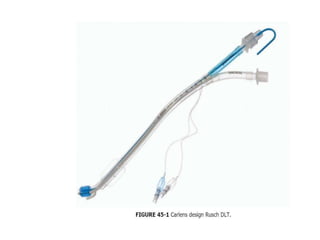
• CARLENS DOUBLE LUMEN TUBE: 1950
left sided; with carinal hook; cross sectional
shape oval in horizontal plane.
• Bryce smith DLT: 1959
Modification of carlens catheter with no
carinal hook.
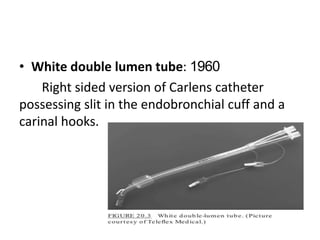
• White double lumen tube: 1960
Right sided version of Carlens catheter
possessing slit in the endobronchial cuff and a
carinal hooks.
• Robert shaw double lumen tube: 1962
Right and left DLT
larger lumen, slotted right endobronchial cuff,
no carinal hook,
cross sectional D shaped in horizontal plane.
• Silbroncho double lumen tube:
made of silicone
bronchial segment is wire reinforced distal to
the tracheal cuff. It increases the flexibility and
prevent kinking; also makes tube position easy
to determine on x-ray.
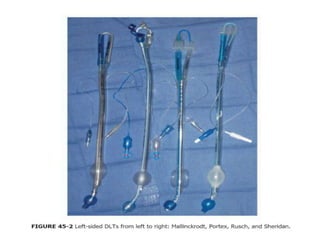
DIFFERENTTYPESOFDLT
Anatomy of the Tracheobronchial Tree
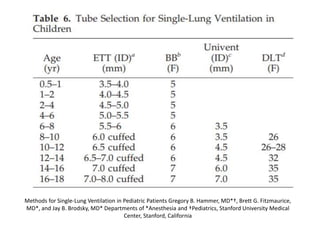
Methods for Single-Lung Ventilation in Pediatric Patients Gregory B. Hammer, MD*†, Brett G. Fitzmaurice,
MD*, and Jay B. Brodsky, MD* Departments of *Anesthesia and †Pediatrics, Stanford University Medical
Center, Stanford, California
• LENGTH OF TUBE:
Height(cm)/10 + 12
For 170 cm height, tube depth of 29cm
For every 10 cm height change , 1 cm depth
change
Methods of Insertion
Positioning of Double-Lumen Tubes
• Auscultation alone is unreliable for confirmation of proper
DLT placement. Auscultation and bronchoscopy should
both be used each time a DLT is placed.
• Fiberoptic bronchoscopy is performed first through the
tracheal lumen to ensure that the endobronchial portion of
the DLT is in the left bronchus and that there is no bronchial
cuff herniation over the carina after inflation. Through the
tracheal view, the blue endobronchial cuff ideally should
be seen approximately 5 mm below the tracheal carina in
the left bronchus. It is crucial to identify the takeoff of the
right upper lobe bronchus through the tracheal view. Going
inside this right upper lobe with the bronchoscope should
reveal three orifices (apical, anterior, posterior). This is the
only structure in the tracheobronchial tree that has three
orifices
• malpositioning
• airway trauma
Advantages of Double Lumen Tubes
• Easier to position
• Can be positioned without bronchoscopy
• Less time is required to position as compared with EBB
• More rapid lung collapse as compared with EBB
• Less likely to be displaced as compared with EBB
• Allows either lung to be ventilated, collapsed, and re-
expanded
• Each lung can be suctioned adequately
• Each lung can be inspected with a bronchoscope
• Continuous positive airway pressure (CPAP) can be
easily applied to operated lung
• Enables independent lung ventilation in ICU.
Disadvantages of Double Lumen Tubes
• It may be impossible to place a DLT in a patient with a difficult
airway
• The large size and design of DLTs can cause airway damage during
insertion, prolonged use, and removal
• There can be a problem in proper placement especially if the
tracheal or bronchial anatomy is severely distorted
• Lesions within the trachea, like tumors, are relative
contraindications to DLT placement
• If patient’s condition necessitates mechanical ventilation
postoperatively, changing a DLT to a single-lumen ETT at the end of
surgery can be hazardous
• Intubated patient from ICU coming for a surgery requiring lung
isolation would require change of single-lumen ETT to a DLT, which
can be dangerous in patients who are fluid resuscitated and have
airway edema, those with cervical spine injuries, difficult airways,
and in those that cannot tolerate periods of apnea
• DLTs are manufactured in limited sizes 28, 35, 37, 39, and 41 French
and are often too big for the majority of pediatric patients
• Lumens of DLTs are narrow as compared to single lumen tube.
BRONCHIAL BLOCKERS
• In 1935, Archibald used a rubber bronchial blocker to
facilitate lung surgeries first time in history.
EZ bronchial blocker
Advantages of Blockers
• Unlike double lumen tubes, EBB adds no further complexity to intubation
• Offers a distinct advantage in the intubation of difficult upper airways
• Useful in pediatric patients in whom the tracheobronchial size may not
accommodate even the smallest double lumen tube
• Lung isolation in distorted neck (e.g. burns contracture, postradiation) and
tracheobronchial anatomy (by extraluminal tumors or thoracic aortic
aneurysm etc.), where positioning of DLT is difficult or impossible
• EBB can be inserted through DLT intraoperatively as a rescue method in
case of failed lung isolation using DLT
• Repositioning is possible in lateral decubitus, if the blocker is
malpositioned after giving position for thoracotomy
• Rupture of the tracheal cuff during intubation is not an uncommon
problem when using DLTs, which, on occasion, requires the use of multiple
DLT tubes. This problem is not seen with the use of EBB
• EBB can be used when ETT is already in place (oral, nasal, tracheostomy)
• Not necessary to change ETT if postoperative ventilation required
• Allows selective lobar blockade
• Useful for patients requiring nasotracheal intubation.
Disadvantages of Blockers
• Tedious final placement after intubation • Final placement to achieve adequate lung
isolation takes little longer than DLT insertion and requires bronchoscopic guidance
• Difficult to place when bronchoscopic visualization is limited by massive hemoptysis
• EBBs cannot be used when the side of the bleeding is unknown in case of
intrapulmonary hemorrhage
• Dislodgement is more common with bronchial blockers than in DLTs during positioning
and surgical manipulation of lung
• By blocking up the pathological side, it is difficult to monitor continued bleeding or
secretions
• Lung collapse is slower though final quality of surgical exposure is similar with both DLTs
and EBBs
• Inclusion of bronchial blocker or distal wire loop of Arndt blocker in stapler during lung
surgery has been reported and requires good communication between the surgeon and
anesthetist
• Inflated balloon may slip in trachea causing blockade of ETT and obstruction to
ventilation
• Due to very narrow suction channel suctioning of blood or thick secretions is difficult
• Bronchial blockers present the potential risk of perforating a bronchus or lung
parenchyma
• Sizes not available for children less than 1 year.
Endobronchial tube
Double lumen tubes

Double lumen tubes

  • 1.
  • 2.
  • 4.
  • 5.
    DOUBLE-LUMEN ENDOTRACHEAL TUBES • Essentiallytwo single lumen tubes bonded together and designated either as right or left sided. • History: Thedevelopment of double lumen tubes between 1950sand1960swasaresponseto fast growing capabilities in thoracicsurgery. • Carlens DLT for lung surgery in 1950 was a landmark in the development of thoracic anesthesia.
  • 6.
    • In the1960s, Robertshaw introduced design modifications for separate left- and rightsided DLTs, removing the carinal hook and using larger lumina. • In the 1980s, manufacturers introduced disposable DLTs made of polyvinyl chloride based on the design of the Robertshaw DLT.
  • 7.
    Specific DLT • CARLENSDOUBLE LUMEN TUBE: 1950 left sided; with carinal hook; cross sectional shape oval in horizontal plane.
  • 9.
    • Bryce smithDLT: 1959 Modification of carlens catheter with no carinal hook.
  • 10.
    • White doublelumen tube: 1960 Right sided version of Carlens catheter possessing slit in the endobronchial cuff and a carinal hooks.
  • 12.
    • Robert shawdouble lumen tube: 1962 Right and left DLT larger lumen, slotted right endobronchial cuff, no carinal hook, cross sectional D shaped in horizontal plane.
  • 15.
    • Silbroncho doublelumen tube: made of silicone bronchial segment is wire reinforced distal to the tracheal cuff. It increases the flexibility and prevent kinking; also makes tube position easy to determine on x-ray.
  • 17.
  • 19.
    Anatomy of theTracheobronchial Tree
  • 21.
    Methods for Single-LungVentilation in Pediatric Patients Gregory B. Hammer, MD*†, Brett G. Fitzmaurice, MD*, and Jay B. Brodsky, MD* Departments of *Anesthesia and †Pediatrics, Stanford University Medical Center, Stanford, California
  • 22.
    • LENGTH OFTUBE: Height(cm)/10 + 12 For 170 cm height, tube depth of 29cm For every 10 cm height change , 1 cm depth change
  • 23.
  • 25.
    Positioning of Double-LumenTubes • Auscultation alone is unreliable for confirmation of proper DLT placement. Auscultation and bronchoscopy should both be used each time a DLT is placed. • Fiberoptic bronchoscopy is performed first through the tracheal lumen to ensure that the endobronchial portion of the DLT is in the left bronchus and that there is no bronchial cuff herniation over the carina after inflation. Through the tracheal view, the blue endobronchial cuff ideally should be seen approximately 5 mm below the tracheal carina in the left bronchus. It is crucial to identify the takeoff of the right upper lobe bronchus through the tracheal view. Going inside this right upper lobe with the bronchoscope should reveal three orifices (apical, anterior, posterior). This is the only structure in the tracheobronchial tree that has three orifices
  • 30.
  • 31.
    Advantages of DoubleLumen Tubes • Easier to position • Can be positioned without bronchoscopy • Less time is required to position as compared with EBB • More rapid lung collapse as compared with EBB • Less likely to be displaced as compared with EBB • Allows either lung to be ventilated, collapsed, and re- expanded • Each lung can be suctioned adequately • Each lung can be inspected with a bronchoscope • Continuous positive airway pressure (CPAP) can be easily applied to operated lung • Enables independent lung ventilation in ICU.
  • 32.
    Disadvantages of DoubleLumen Tubes • It may be impossible to place a DLT in a patient with a difficult airway • The large size and design of DLTs can cause airway damage during insertion, prolonged use, and removal • There can be a problem in proper placement especially if the tracheal or bronchial anatomy is severely distorted • Lesions within the trachea, like tumors, are relative contraindications to DLT placement • If patient’s condition necessitates mechanical ventilation postoperatively, changing a DLT to a single-lumen ETT at the end of surgery can be hazardous • Intubated patient from ICU coming for a surgery requiring lung isolation would require change of single-lumen ETT to a DLT, which can be dangerous in patients who are fluid resuscitated and have airway edema, those with cervical spine injuries, difficult airways, and in those that cannot tolerate periods of apnea • DLTs are manufactured in limited sizes 28, 35, 37, 39, and 41 French and are often too big for the majority of pediatric patients • Lumens of DLTs are narrow as compared to single lumen tube.
  • 33.
    BRONCHIAL BLOCKERS • In1935, Archibald used a rubber bronchial blocker to facilitate lung surgeries first time in history.
  • 36.
  • 38.
    Advantages of Blockers •Unlike double lumen tubes, EBB adds no further complexity to intubation • Offers a distinct advantage in the intubation of difficult upper airways • Useful in pediatric patients in whom the tracheobronchial size may not accommodate even the smallest double lumen tube • Lung isolation in distorted neck (e.g. burns contracture, postradiation) and tracheobronchial anatomy (by extraluminal tumors or thoracic aortic aneurysm etc.), where positioning of DLT is difficult or impossible • EBB can be inserted through DLT intraoperatively as a rescue method in case of failed lung isolation using DLT • Repositioning is possible in lateral decubitus, if the blocker is malpositioned after giving position for thoracotomy • Rupture of the tracheal cuff during intubation is not an uncommon problem when using DLTs, which, on occasion, requires the use of multiple DLT tubes. This problem is not seen with the use of EBB • EBB can be used when ETT is already in place (oral, nasal, tracheostomy) • Not necessary to change ETT if postoperative ventilation required • Allows selective lobar blockade • Useful for patients requiring nasotracheal intubation.
  • 39.
    Disadvantages of Blockers •Tedious final placement after intubation • Final placement to achieve adequate lung isolation takes little longer than DLT insertion and requires bronchoscopic guidance • Difficult to place when bronchoscopic visualization is limited by massive hemoptysis • EBBs cannot be used when the side of the bleeding is unknown in case of intrapulmonary hemorrhage • Dislodgement is more common with bronchial blockers than in DLTs during positioning and surgical manipulation of lung • By blocking up the pathological side, it is difficult to monitor continued bleeding or secretions • Lung collapse is slower though final quality of surgical exposure is similar with both DLTs and EBBs • Inclusion of bronchial blocker or distal wire loop of Arndt blocker in stapler during lung surgery has been reported and requires good communication between the surgeon and anesthetist • Inflated balloon may slip in trachea causing blockade of ETT and obstruction to ventilation • Due to very narrow suction channel suctioning of blood or thick secretions is difficult • Bronchial blockers present the potential risk of perforating a bronchus or lung parenchyma • Sizes not available for children less than 1 year.
  • 40.