Endotracheal Intubation/Extubation
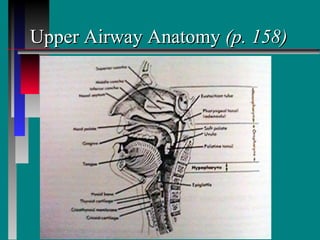
Upper Airway Anatomy  (p. 158)
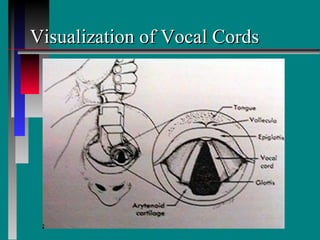
Visualization of Vocal Cords
Indications for Intubation In conditions of, or leading to resp. failure, such as; - trauma to the chest or airway - neurologic involvement from drugs  myasthenia gravis, poisons, etc. -CV involvement leading to CNS  impairment from strokes, tumors,  infection,  pulmonary emboli -CP arrest
Indications (cont’d) Relief of airway obstruction Protection of airway (I.e. seizures) Evacuation of secretions by tracheal aspiration Prevention of aspiration Facilitation of positive press. ventilation
Relieving Airway Obstruction Obstruction classified as  upper  ( above the glottis and includes the areas of the nasopharynx, oropharynx, and larynx) or  lower  (below the vocal cords) Can also be classified as partial or complete obstruction Causes include trauma, edema, tumors, changes in muscle tone or tissue support
Hazards of tracheal tubes & cuffs Infection Trauma Dehydration Obstruction Trauma
Hazards (cont’d) Accidental intubation of the esophagus or right mainstem bronchus Bronchospasm, laryngospasm Cardiac arrhythmias resulting from stimulation of the vagus nerve Aspiration pneumonia Broken or loosened teeth
Later Complications of Intubation Paralysis of the tongue Ulcerations of the mouth Paralysis of the vocal cords Tissue stenosis and necrosis of the trachea
Routes for Intubation Orotracheal Nasotracheal Tracheotomy
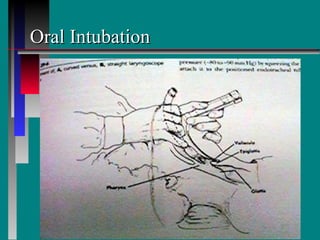
Oral Intubation
Advantages of Oral Intubation Larger tube can be inserted Tube can be inserted usually with more speed and ease with less trauma Easier suctioning Less airflow resistance Reduced risk of tube kinking
Disadvantages of Oral Intubation Gagging, coughing, salivation, and irritation can be induced with intact airway reflexes Tube fixation is difficult, self-extubation Gastric distention from frequent  swallowing of air Mucosal irritation and ulcerations of mouth (change tube position)
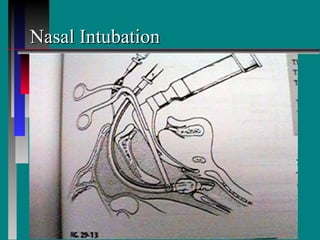
Nasal Intubation
Advantages of Nasal Intubation More comfort long term Decreased gagging Less salivation, easier to swallow Improved mouth care Better tube fixation Improved communication
Disadvantages of Nasal Intub. Pain and discomfort Nasal and paranasal complications, I.e., epistaxis, sinusitis, otits More difficult procedure Smaller tube needed Increased airflow resistance Difficult suctioning Bacteremia
Intubation Equipment Endotracheal Tube and stylet Laryngoscope Sterile water-soluble jelly Syringe to inflate cuff Adhesive tape or tube fixation device Bite block to prevent biting oral ET tube Suction Equipment, bag- mask, O2 Local anesthetic Stethoscope
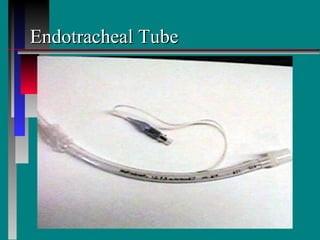
Endotracheal Tube
Endotracheal Tube ET tube size and depth of insertion (see p. 594) For children older than 2 years - tube size = age/4 + 4 - depth = age/2 + 12 Adult  - tube size female = 8.0, male = 9.0 - depth female = 19-21  and 24-26   male = 21-23 and 26-28
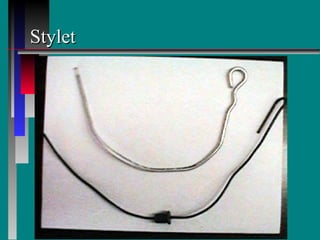
Stylet
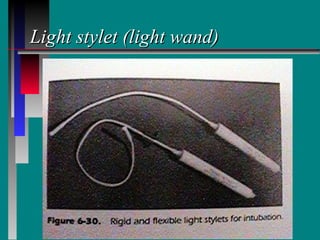
Light stylet (light wand)
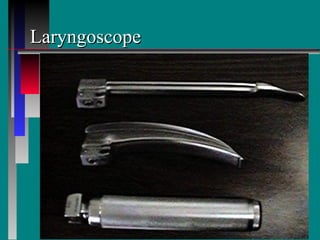
Laryngoscope
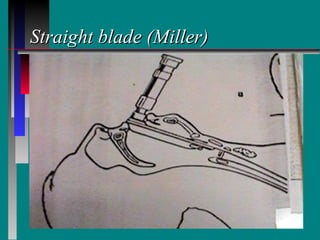
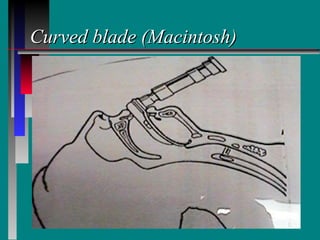
Laryngoscope Blade and handle Blade  - has a flange, spatula, light, and tip - curved blade (Macintosh) - straight blade (Miller, Wisconsin) Fiber optic vs. traditional laryngoscope Blade size:  0 - 1  infant,  2  from 2-8 years  3  from age 10 - adult,  4  large adult
Straight blade (Miller)
Curved blade (Macintosh)
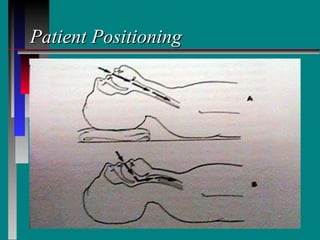
Oral Intubation Procedure Assemble and check equipment - suction equipment - laryngoscope - select proper size tube, check tube Position patient - align mouth, pharynx, larynx - “sniffing” position
Patient Positioning
Oral Intubation Proced. (cont’d.) Preoxygenate the patient - bag-valve mask - *intubation attempt should take no  longer than 30 sec, if unsuccessful,  then  ventilate again with bag and  mask for 3-5 minutes Insert laryngoscope - hold laryngoscope in  left  hand &  insert in right side of mouth, displace  tongue toward center
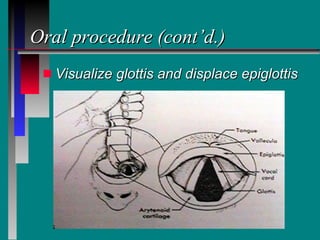
Oral procedure (cont’d.) Visualize glottis and displace epiglottis
Oral proced. (cont’d.) Insert ET tube - do not use laryngoscope blade to  guide tube - once you  see  the tube pass the  glottis, advance the cuff passed the  cords by 2 -3 cm Hold tube with right hand and  remove  laryngoscope & stylet - inflate cuff with 5 - 10 cc of air - ventilate with bag
Oral proced. (cont’d) Inflate cuff with 5 - 10 cc of air Ventilate with “bag” Assess tube position - auscultation of chest & epigastric - cm mark at teeth - capnometry/colorimetry - light “wand” Stabilize tube/Confirm placement - chest x-ray
Extubation Guidelines for extubation (see table, p. 613) Cuff-leak test
Extubation Procedure Assemble Equipment - intubation equipment - in addition to intubation equipment,  O2 device and humidity, SVN with  racemic epi Suction ET tube Oxygenate patient Unsecure tube, deflate cuff
Extubation proced. (cont’d.) Place suction catheter down tube and remove ET tube as you suction Apply appropriate O2 and humidity Assess/Reassess the patient

Endotracheal intubation extubation

  • 1.
  • 2.
  • 3.
  • 4.
    Indications for IntubationIn conditions of, or leading to resp. failure, such as; - trauma to the chest or airway - neurologic involvement from drugs myasthenia gravis, poisons, etc. -CV involvement leading to CNS impairment from strokes, tumors, infection, pulmonary emboli -CP arrest
  • 5.
    Indications (cont’d) Reliefof airway obstruction Protection of airway (I.e. seizures) Evacuation of secretions by tracheal aspiration Prevention of aspiration Facilitation of positive press. ventilation
  • 6.
    Relieving Airway ObstructionObstruction classified as upper ( above the glottis and includes the areas of the nasopharynx, oropharynx, and larynx) or lower (below the vocal cords) Can also be classified as partial or complete obstruction Causes include trauma, edema, tumors, changes in muscle tone or tissue support
  • 7.
    Hazards of trachealtubes & cuffs Infection Trauma Dehydration Obstruction Trauma
  • 8.
    Hazards (cont’d) Accidentalintubation of the esophagus or right mainstem bronchus Bronchospasm, laryngospasm Cardiac arrhythmias resulting from stimulation of the vagus nerve Aspiration pneumonia Broken or loosened teeth
  • 9.
    Later Complications ofIntubation Paralysis of the tongue Ulcerations of the mouth Paralysis of the vocal cords Tissue stenosis and necrosis of the trachea
  • 10.
    Routes for IntubationOrotracheal Nasotracheal Tracheotomy
  • 11.
  • 12.
    Advantages of OralIntubation Larger tube can be inserted Tube can be inserted usually with more speed and ease with less trauma Easier suctioning Less airflow resistance Reduced risk of tube kinking
  • 13.
    Disadvantages of OralIntubation Gagging, coughing, salivation, and irritation can be induced with intact airway reflexes Tube fixation is difficult, self-extubation Gastric distention from frequent swallowing of air Mucosal irritation and ulcerations of mouth (change tube position)
  • 14.
  • 15.
    Advantages of NasalIntubation More comfort long term Decreased gagging Less salivation, easier to swallow Improved mouth care Better tube fixation Improved communication
  • 16.
    Disadvantages of NasalIntub. Pain and discomfort Nasal and paranasal complications, I.e., epistaxis, sinusitis, otits More difficult procedure Smaller tube needed Increased airflow resistance Difficult suctioning Bacteremia
  • 17.
    Intubation Equipment EndotrachealTube and stylet Laryngoscope Sterile water-soluble jelly Syringe to inflate cuff Adhesive tape or tube fixation device Bite block to prevent biting oral ET tube Suction Equipment, bag- mask, O2 Local anesthetic Stethoscope
  • 18.
  • 19.
    Endotracheal Tube ETtube size and depth of insertion (see p. 594) For children older than 2 years - tube size = age/4 + 4 - depth = age/2 + 12 Adult - tube size female = 8.0, male = 9.0 - depth female = 19-21 and 24-26 male = 21-23 and 26-28
  • 20.
  • 21.
  • 22.
  • 23.
    Laryngoscope Blade andhandle Blade - has a flange, spatula, light, and tip - curved blade (Macintosh) - straight blade (Miller, Wisconsin) Fiber optic vs. traditional laryngoscope Blade size: 0 - 1 infant, 2 from 2-8 years 3 from age 10 - adult, 4 large adult
  • 24.
  • 25.
  • 26.
    Oral Intubation ProcedureAssemble and check equipment - suction equipment - laryngoscope - select proper size tube, check tube Position patient - align mouth, pharynx, larynx - “sniffing” position
  • 27.
  • 28.
    Oral Intubation Proced.(cont’d.) Preoxygenate the patient - bag-valve mask - *intubation attempt should take no longer than 30 sec, if unsuccessful, then ventilate again with bag and mask for 3-5 minutes Insert laryngoscope - hold laryngoscope in left hand & insert in right side of mouth, displace tongue toward center
  • 29.
    Oral procedure (cont’d.)Visualize glottis and displace epiglottis
  • 30.
    Oral proced. (cont’d.)Insert ET tube - do not use laryngoscope blade to guide tube - once you see the tube pass the glottis, advance the cuff passed the cords by 2 -3 cm Hold tube with right hand and remove laryngoscope & stylet - inflate cuff with 5 - 10 cc of air - ventilate with bag
  • 31.
    Oral proced. (cont’d)Inflate cuff with 5 - 10 cc of air Ventilate with “bag” Assess tube position - auscultation of chest & epigastric - cm mark at teeth - capnometry/colorimetry - light “wand” Stabilize tube/Confirm placement - chest x-ray
  • 32.
    Extubation Guidelines forextubation (see table, p. 613) Cuff-leak test
  • 33.
    Extubation Procedure AssembleEquipment - intubation equipment - in addition to intubation equipment, O2 device and humidity, SVN with racemic epi Suction ET tube Oxygenate patient Unsecure tube, deflate cuff
  • 34.
    Extubation proced. (cont’d.)Place suction catheter down tube and remove ET tube as you suction Apply appropriate O2 and humidity Assess/Reassess the patient