POSITRON
EMISSIONS
TOMOGRAPHY
PET SCAN
DONE BY : MUSTAFA KHALIL IBRAHIM
TBILISI STATE MEDICAL UNIVERSITY
4th year, 1st semester, 2nd group
What is a Pet Scan?
• Nuclear 3-D imaging test that
uses a radioactive substance
called a tracer to look for
disease in the body.
• Shows how organs and tissues
are working at a molecular and
cellular level. Scan is non-
invasive, but does involve
exposure to ionizing radiation.
• Best known for its role in
detecting cancer imaging.
How Do Pet
Scans work?
• A small amount of a radioactive
sugar molecule, 18 fluoro-2-
deoxyglucose (FDG), is injected
into the bloodstream (can also be
inhaled as gas or swallowed in
pill form).
• A PET Scan is used to detect and
generate images that indicate
areas of high FDG uptake.
• Many cancers require more
energy than normal cells, and the
FDG tracer accumulates in these
cells.
• This allows cancers to be seen on
the Pet images as hot spots.
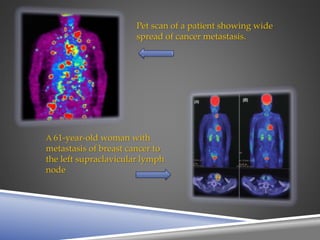
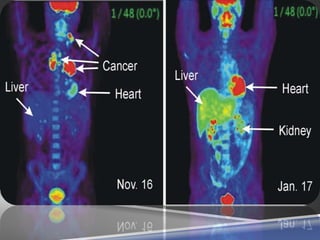
Pet scan of a patient showing wide
spread of cancer metastasis.
A 61-year-old woman with
metastasis of breast cancer to
the left supraclavicular lymph
node
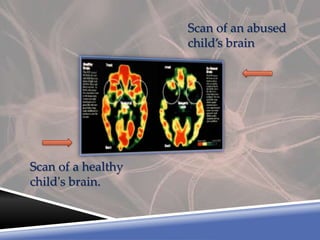
Scan of a healthy
child's brain.
Scan of an abused
child’s brain
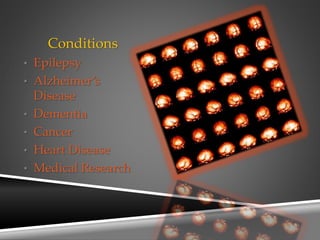
Conditions
• Epilepsy
• Alzheimer’s
Disease
• Dementia
• Cancer
• Heart Disease
• Medical Research
PET SCAN ADVANTAGES
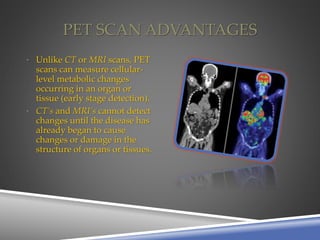
• Unlike CT or MRI scans, PET
scans can measure cellular-
level metabolic changes
occurring in an organ or
tissue (early stage detection).
• CT’s and MRI’s cannot detect
changes until the disease has
already began to cause
changes or damage in the
structure of organs or tissues.
PATIENT COST & TIME
$3,000 to
$6,000
per scan
Takes 2
to 4
hours
RISK FACTORS
ļ‚„Cause a major allergic reaction, in rare
instances
ļ‚„Expose your unborn baby to radiation if you
are pregnant
ļ‚„Expose your child to radiation if you are
breast-feeding
CONSIDERATIONS
ļ‚„It is possible to have
false results on a
PET scan. Blood
sugar or insulin
levels may affect the
test results in people
with diabetes.
ļ‚„Most PET scans are
now performed
along with a CT
scan. This
combination scan is
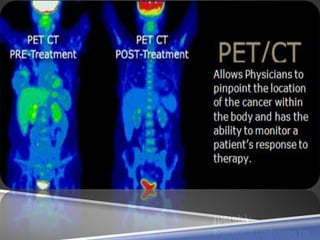
called a PET/CT.
This helps find the
exact location of the
tumor.
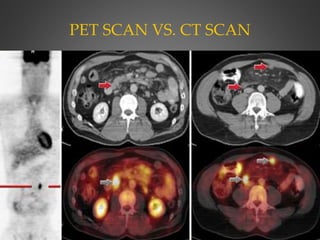
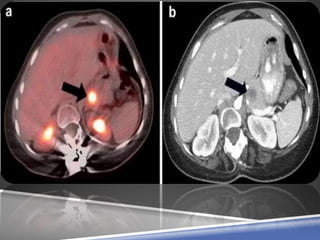
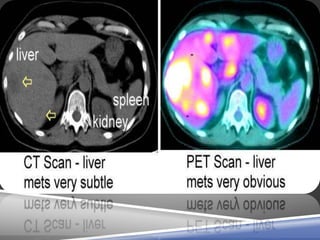
PET SCAN VS. CT SCAN
REFERENCES
Joseph, U. A. (June 01, 2012). Positron Emission Tomography. Journal
of Nuclear Medicine, 53, 6, 1002-1003.
Kumar, R., Halanaik, D., & Malhotra, A. (January 01, 2010). Clinical
applications of positron emission tomography-computed
tomography in oncology. Indian Journal of Cancer, 47, 2.)
Politis, M., & Piccini, P. (January 01, 2012). Positron emission
tomography imaging in neurological disorders. Journal of
Neurology, 259, 9, 1769-80.
Society of Nuclear Medicine and Molecular Imaging. (2014). Pet
scans: Get the facts. Retrieved from:
http://interactive.snm.org/index.cfm?PageID=7988
Positron Emissions Tomography (PET SCAN)

Positron Emissions Tomography (PET SCAN)

  • 1.
    POSITRON EMISSIONS TOMOGRAPHY PET SCAN DONE BY: MUSTAFA KHALIL IBRAHIM TBILISI STATE MEDICAL UNIVERSITY 4th year, 1st semester, 2nd group
  • 2.
    What is aPet Scan? • Nuclear 3-D imaging test that uses a radioactive substance called a tracer to look for disease in the body. • Shows how organs and tissues are working at a molecular and cellular level. Scan is non- invasive, but does involve exposure to ionizing radiation. • Best known for its role in detecting cancer imaging.
  • 3.
    How Do Pet Scanswork? • A small amount of a radioactive sugar molecule, 18 fluoro-2- deoxyglucose (FDG), is injected into the bloodstream (can also be inhaled as gas or swallowed in pill form). • A PET Scan is used to detect and generate images that indicate areas of high FDG uptake. • Many cancers require more energy than normal cells, and the FDG tracer accumulates in these cells. • This allows cancers to be seen on the Pet images as hot spots.
  • 5.
    Pet scan ofa patient showing wide spread of cancer metastasis. A 61-year-old woman with metastasis of breast cancer to the left supraclavicular lymph node
  • 6.
    Scan of ahealthy child's brain. Scan of an abused child’s brain
  • 7.
    Conditions • Epilepsy • Alzheimer’s Disease •Dementia • Cancer • Heart Disease • Medical Research
  • 8.
    PET SCAN ADVANTAGES •Unlike CT or MRI scans, PET scans can measure cellular- level metabolic changes occurring in an organ or tissue (early stage detection). • CT’s and MRI’s cannot detect changes until the disease has already began to cause changes or damage in the structure of organs or tissues.
  • 9.
    PATIENT COST &TIME $3,000 to $6,000 per scan Takes 2 to 4 hours
  • 10.
    RISK FACTORS ļ‚„Cause amajor allergic reaction, in rare instances ļ‚„Expose your unborn baby to radiation if you are pregnant ļ‚„Expose your child to radiation if you are breast-feeding
  • 11.
    CONSIDERATIONS ļ‚„It is possibleto have false results on a PET scan. Blood sugar or insulin levels may affect the test results in people with diabetes. ļ‚„Most PET scans are now performed along with a CT scan. This combination scan is called a PET/CT. This helps find the exact location of the tumor.
  • 14.
    PET SCAN VS.CT SCAN
  • 17.
    REFERENCES Joseph, U. A.(June 01, 2012). Positron Emission Tomography. Journal of Nuclear Medicine, 53, 6, 1002-1003. Kumar, R., Halanaik, D., & Malhotra, A. (January 01, 2010). Clinical applications of positron emission tomography-computed tomography in oncology. Indian Journal of Cancer, 47, 2.) Politis, M., & Piccini, P. (January 01, 2012). Positron emission tomography imaging in neurological disorders. Journal of Neurology, 259, 9, 1769-80. Society of Nuclear Medicine and Molecular Imaging. (2014). Pet scans: Get the facts. Retrieved from: http://interactive.snm.org/index.cfm?PageID=7988

Editor's Notes

  • #3Ā A positron emission tomography (PET) scan is used to produce a detailed, three-dimensional picture of the inside of the body. The images clearly show the part of the body that is being investigated and can also highlight how effectively certain functions of the body are working. Pet scans are most commonly used to help diagnose a range of different diseases and/or disorders to work out the best possible course of treatments for a patient.
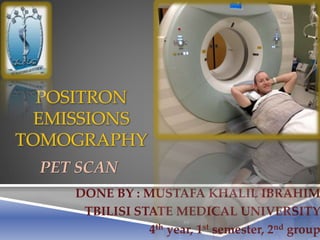
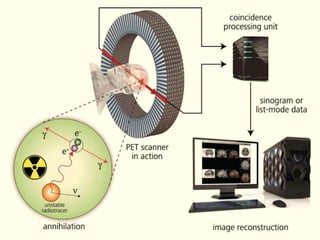
  • #4Ā The scanner contains an array of detectors that receive signals emitted by the radiotracer. Using these signals, the Pet scanner measures metabolic activity while a computer reassembles the signals into images. The Pet scan itself should not be painful, but for some people, being inside the scan tends to cause claustrophobia.
  • #8Ā PET scans are occasionally used to help plan complex heart surgery, such as a heart transplant. They are also used to help diagnose a number of conditions that affect the normal workings of the brain (neurological conditions), such as dementia and Alzheimer’s disease. It can accurately assess the location and stage of a malignant condition. It also helps by replacing multiple medical testing procedures with a single exam and reducing or eliminating any ineffective or unnecessary treatment. Pet scans can eliminate the need for surgical biopsy because PET can detect whether lesions are benign or malignant. PET is currently the most effective way to check for cancer recurrence.
  • #10Ā PET scanners are expensive (price ranging between $ 2.5 and $ 6.5 million), so they are usually only found at larger hospitals and some specialized research centers such as Moffitt Cancer Research Center in Tampa, Florida. Due to the lack of availability, PET scans are often only recommended for people with complex health problems (ex. Hodgkin's Lymphoma). They are not routinely used to diagnose cancer, but they are often used in confirmed cancer cases to check how far the cancer has spread and whether treatment has been effective. Due to the equipment high cost and limited availability, the cost of having the procedure performed on a patient can be pricey as well.