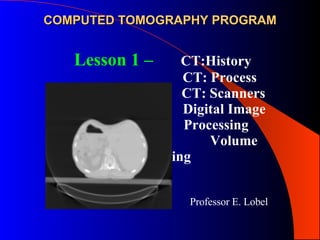
COMPUTED TOMOGRAPHY PROGRAM Professor E. Lobel Lesson 1 –     CT:History   CT: Process CT: Scanners Digital Image    Processing   Volume Scanning
Contributors to TOMOGRAPHY Stratigraphy Planigraphy Z. des Plantes Laminography Zonography
History NOBEL PRIZES Roentgen (1901) Hounsfield & Cormack (1979) Computed Tomography
Hounsfield Sir Godfrey N.  Hounsfield , DSc, the father of computed tomography, died on August 12, 2004 at the age of 84. He was awarded the  Nobel Prize in Physiology or Medicine for 1979  along with Allan M.  Cormack , a South African-born naturalized American physicist, for the “development of computer assisted tomography, a revolutionary radiological method, particularly for the investigation of diseases of the nervous system.” Hounsfield’s name is immortalised in the  Hounsfield units , a quantitative scale used to describe the brightness of tomograms ( radiodensity ). He left his money to fund engineering research and scholarships. He died in August 2004 at the age of 84 from a chronic and progressive lung disease, spending his last years in a nursing home. He was unmarried and unattached, and had no children.
CONSTRUCTION OF FIRST CT RADIATION SOURCE – AMERICUM GAMMA SOURCE SCAN—9 DAYS COMPUTER PROCESSING—2.5 HOURS PICTURE PRODUCTION 1 DAY http://en.wikipedia.org/wiki/Godfrey_Hounsfield
Prototype CT Scanner Hounsfield built a prototype head scanner and tested it first on a preserved  human brain , then on a fresh cow  brain  from a butcher shop, and later on himself. In September  1971 , CT scanning was introduced into  medical practice  with a successful scan on a cerebral  cyst  patient at Atkinson Morley's Hospital in  Wimbledon, London ,  United Kingdom . In  1975 , Hounsfield built a whole-body scanner.
EARLY EXPERIMENTS In his initial experiments, Hounsfield used a gamma source rather than an x-ray tube, because the energy distribution of gamma radiation was more uniform It took nine days to acquire image data and 2 and a half hours to reconstruct the image.  Once he replaced the gamma ray with an x-ray tube the scan time was reduced to 9 hours.
ALLAN M. CORMACK 1979 – NOBEL PRIZE SHARED WITH DR. HOUNSFIELD. DEVELOPED SOLUTIONS TO MATHEMATICAL PROBLEMS IN CT.
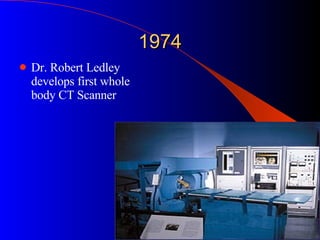
1974 Dr. Robert Ledley develops first whole body CT Scanner
SCANNING DEVELOPMENT 5 MIN. –1972 1 SEC – 1993  (now we are sub second) 3 Lp/cm 1972 15 Lp/cm 1993
Tomography Tomography otherwise known as body section radiography, planigraphy, laminography or stratigraphy, is the process of using motion of the X-ray focal spot and image receptor (e.g. film) in generating radiographic images where object detail from only one plane or region remains in sharp focus
TOMOGRAPHY
Tomo Variations
ZONOGRAPHY –ANGLE <10 DEG Zonography  -  a form of tomography where the tomographic angle is small, on the order of 10, resulting in a thick plane of focus. The technique is sometimes used to better delineate suspected pathology.
PANTOMOGRAPHY- Panorex Panoramic radiography for obtaining radiographs of the maxillary and mandibular dental arches and their associated structures.
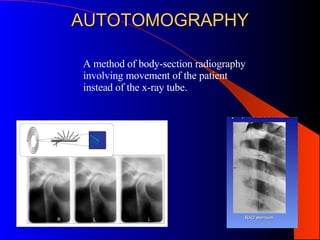
AUTOTOMOGRAPHY A method of body-section radiography involving movement of the patient instead of the x-ray tube.
CT Defined Computed tomography or CT is a diagnostic imaging modality which uses x-rays to image individual cross-sectional slices through the body. AKA COMPUTERIZED TRANSVERSE AXIAL TOMOGRAPHY COMPUTER ASSISTED TOMOGRAPHY COMPUTERIZED AXIAL TOMOGRAPHY COMPUTED TOMOGRAPHY
CT Setup X-RAY EMMISSION
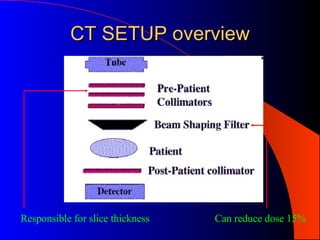
CT SETUP overview Responsible for slice thickness Can reduce dose 15%
Full System
CT
IMAGE FORMATION DATA AQUSITION IMAGE RECONSTRUCTION IMAGE: DISPLAY, MANIPULATION, STORAGE COMMUNICATIONS & RECORDING
Instructional commands initiated by the technologist about pt. Specific imaging parameters, post processing & Archiving.  Image Reconstruction Commands translated into machine language Timing/operation of table, gantry, high volt. Generator.These are electrical signals Digital to Analog (continuous, wave form) Attenuation Information In the form of tiny little electrical signals Amplified signals are sampled and then digitized by the analog-to-digital converter Image Creation
Image Reconstruction Has   Volume  Thickness
Data Acquisition System (DAS)
Reconstruction  of What?
Image Reconstruction 2D views (projections) at angles all the way around the patient
Types of Image Reconstruction BACK-PROJECTION ITERATIVE ALGORITHM ( not  used ) ANALYTIC RECONSTRUCTION ALGORITHM FILTERED BACK PROJECTION FOURIER RECONSTRUCTION The raw data collected from measured attenuation information must be further processed (reconstructed) in the scanners array processor. Most CT systems today use a reconstruction method called filtered back projection .
Back Projection BACK PROJECTION
Filtered Back Projection Steps Projection profiles are obtained Logarithm of data is obtained Logarithmic values are multiplied by digital filter or convolution filter to generate filtered profiles Filtered profiles are now back-projected Filtered projections are summed and the negative and positive components are therefore canceled providing an image free of blurring
 
ITERATIVE ALGORITHM In  mathematics ,  computing ,  linguistics , and related disciplines, an  algorithm  is a finite list of well-defined instructions for accomplishing some task that, given an initial state, will proceed through a well-defined series of successive states, eventually terminating in an end-state.
ITERATIVE ALGORITHM Iterative  algorithms use repetitive constructs like  loops  and sometimes additional data structures like  stacks  to solve the given problems.
Filtered Back Projection
FBB
FBB diag
FBB
Fourier Reconstruction This reconstruction process is used in MRI but not in modern CT scanners because it requires more complicated mathematics than the filtered back projection algorithm.
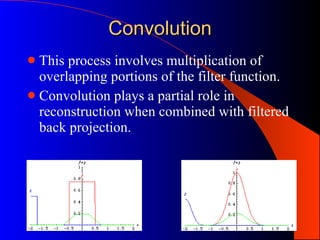
Convolution This process involves multiplication of overlapping portions of the filter function. Convolution plays a partial role in reconstruction when combined with filtered back projection.
Image Display Specifications: •  3D volume rendering, real-time interactive performance (VP) •  Real-time interactive MPR, Slab MIP, and curved MPR views •  Independent masks with powerful cutting, editing, and segmentation tools •  Cutplane and user defined slab thickness inspection
Communication
Communications
Image Storage With the multitude of studies and images a great deal of storage is necessary and can come in several forms. Images are stored in 2D pixel arrays with each point representing a number of bits determining a gray level. Typically floppy disks do not have enough memory for CT MOD
http://youtube.com/watch?v=3SFUzLBV9aA&feature=related
Scanner Types Conventional High Speed (cardiovascular CT) Spiral/Helical Scanners Mobile Scanners CT Fluoroscopy
Conventional Scanner Also known as Step by Step.  Or Step and Shoot.
High  Speed  CT (cardiovascular CT) Speed 50, 100 ms Thickness 1.5, 3, 6, 10 mm ECG trigger Cardiac Images EBCT
EBCT To achieve shorter image acquisition times than conventional mechanical CT, especially for cardiac and pediatric imaging, Electron Beam CT (EBCT) was introduced in  1984 . EBCT provides image acquisition times down to 100msec that become possible with a non-mechanical   movement of the X-ray source and a stationary detector array. For cardiac scanning, the heart is covered with prospectively ECG-triggered sequential scans. As EBCT is also restricted to single-slice acquisition for ECG-triggered scans examination times may still be beyond a single breath-hold. Typical scan times are 30 to 40 seconds for a 12cm volume.
EBCT ( SIEMENS)
MOBILE CT USE:
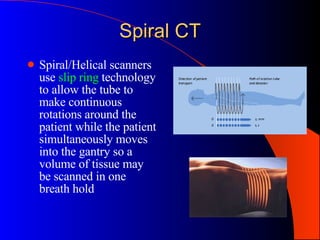
Spiral CT Spiral/Helical scanners use  slip ring  technology to allow the tube to make continuous rotations around the patient while the patient simultaneously moves into the gantry so a volume of tissue may be scanned in one breath hold                                                                                 
CT Fluoroscopy (CTF) Display of constantly updated images produced by continuous rotation of CT tube Couch position controlled by operator Generally performed at same KV, but lower mA than conventional CT Scanning 120KV, 50mA for CT Fluro 120KV, 200-300mA conventional Picker 5000 Venue Helical CT scanner with C-arm fluoroscopy with integrated biopsy arm, 3-4D image reconstruction capability, as well as a radiation therapy planning package (VOXEL Q software).
CT Fluro Guidance in interventional procedures Tissue Biopsies Drainage of fluid from lesions Spinal nerve blocks Timing Optimizing start of helical CT run in contrast agent studies.  Important in CTA where cardiac output can be variable
CT Angio (CTA) Computerized tomographic angiography, also called CT angiography or CTA, is a test that combines the technology of a conventional CT scan with that of traditional angiography to create detailed images of the blood vessels in the body.
CT ENDOSCOPY (CTE) Based on a combination of spiral CT images and 3-D reconstruction techniques, virtual colonoscopy can detect most polyps of clinically significant size and differentiate between polyps and complex folds.
CTE
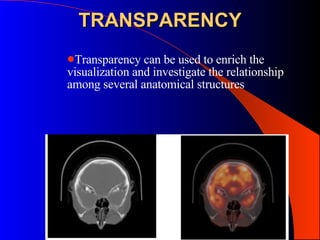
TRANSPARENCY Transparency can be used to enrich the visualization and investigate the relationship among several anatomical structures
PET/CT fusion A dual-purpose imaging device,  PET/CT  is literally the combination of PET (positron emission tomography) and CT (computed tomography) imaging techniques within a single machine. The individual scans, which are taken virtually simultaneously, can be presented separately or as a single, overlapping, or &quot;fused&quot; image. The two techniques present different types of information about the human body:  PET shows metabolic or chemical activity in the body; CT shows the body's anatomical structures.  For example, a PET scan would highlight a tumor's increased glucose consumption, while a CT scan would reveal its physical mass.                                                                                                                                   
ANIMAL SCANNING                                                                                                                                                                                             
Multi-Slice CT Scanners
A multislice scanner allows for less contrast and faster acquisition times. More slices per tube rotation.
First Generation Single detector with parallel beam Translate - rotate acquisition  Translates across patient  Rotates around patient  Very slow  minutes per slice  180 degree Rotation
Second Generation Narrow fan beam (10°)  Multiple detectors  Multiple angle acquisition at each position  Larger angle rotate  Translate still required  Slow  20s per slice
Third Generation Fan beam   Multiple (500 - 1000) detectors  Rotation only  no translation required  Much faster  as fast as 0.5 s per rotation  Most common modern scanner design  Spiral Scanning is now possible
 
Fourth Generation Cone Style Beam   Static detectors all round gantry (up to 4800 on a single ring) Only tube rotates  Avoids ring artifact problems of 3rd generation scanners
Comparison Schematic illustration of different generations of X-ray CT scan geometries. Solid arrows indicate movements during data collection, dashed arrows indicate movement between sequences of data collection. The solid lines passing from the sources to the detectors are ray paths, and each set of solid lines from a single angular orientation constitutes a view. These illustrations show the source and detectors moving around a stationary object, as is the case with medical scanners. The motion is relative, however, and in many industrial scanners the object moves while the source and detectors are stationary. In all cases, the axis of rotation is the center of the circle.  A . First-generation, translate-rotate pencil beam geometry.  B . Second-generation, translate-rotate fan beam geometry.  C . Third-generation, rotate-only geometry.  D . Third-generation offset-mode geometry.
Dose Reduction In CT PRE-PATIENT FILTERING—15% REDUCTION ULTRAFAST CERAMIC DETECTORS-25% REDUCTION DOSE ADAPTION –40% REDUCTION
Dose C.A.R.E ADAPTION Combined Applications to Reduce Exposure Fluro   System
QC
QC
Other Uses - Archeology
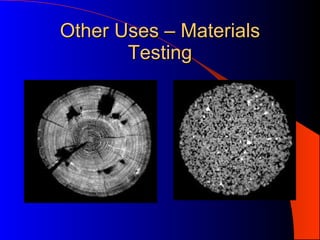
Other Uses – Materials Testing
IN PALEONTOLOGY
TESTING ELECTRONIC DEVICES
3D Scanning
Thanks……

CT History

  • 1.
    COMPUTED TOMOGRAPHY PROGRAMProfessor E. Lobel Lesson 1 – CT:History CT: Process CT: Scanners Digital Image Processing Volume Scanning
  • 2.
    Contributors to TOMOGRAPHYStratigraphy Planigraphy Z. des Plantes Laminography Zonography
  • 3.
    History NOBEL PRIZESRoentgen (1901) Hounsfield & Cormack (1979) Computed Tomography
  • 4.
    Hounsfield Sir GodfreyN. Hounsfield , DSc, the father of computed tomography, died on August 12, 2004 at the age of 84. He was awarded the Nobel Prize in Physiology or Medicine for 1979 along with Allan M. Cormack , a South African-born naturalized American physicist, for the “development of computer assisted tomography, a revolutionary radiological method, particularly for the investigation of diseases of the nervous system.” Hounsfield’s name is immortalised in the Hounsfield units , a quantitative scale used to describe the brightness of tomograms ( radiodensity ). He left his money to fund engineering research and scholarships. He died in August 2004 at the age of 84 from a chronic and progressive lung disease, spending his last years in a nursing home. He was unmarried and unattached, and had no children.
  • 5.
    CONSTRUCTION OF FIRSTCT RADIATION SOURCE – AMERICUM GAMMA SOURCE SCAN—9 DAYS COMPUTER PROCESSING—2.5 HOURS PICTURE PRODUCTION 1 DAY http://en.wikipedia.org/wiki/Godfrey_Hounsfield
  • 6.
    Prototype CT ScannerHounsfield built a prototype head scanner and tested it first on a preserved human brain , then on a fresh cow brain from a butcher shop, and later on himself. In September 1971 , CT scanning was introduced into medical practice with a successful scan on a cerebral cyst patient at Atkinson Morley's Hospital in Wimbledon, London , United Kingdom . In 1975 , Hounsfield built a whole-body scanner.
  • 7.
    EARLY EXPERIMENTS Inhis initial experiments, Hounsfield used a gamma source rather than an x-ray tube, because the energy distribution of gamma radiation was more uniform It took nine days to acquire image data and 2 and a half hours to reconstruct the image. Once he replaced the gamma ray with an x-ray tube the scan time was reduced to 9 hours.
  • 8.
    ALLAN M. CORMACK1979 – NOBEL PRIZE SHARED WITH DR. HOUNSFIELD. DEVELOPED SOLUTIONS TO MATHEMATICAL PROBLEMS IN CT.
  • 9.
    1974 Dr. RobertLedley develops first whole body CT Scanner
  • 10.
    SCANNING DEVELOPMENT 5MIN. –1972 1 SEC – 1993 (now we are sub second) 3 Lp/cm 1972 15 Lp/cm 1993
  • 11.
    Tomography Tomography otherwiseknown as body section radiography, planigraphy, laminography or stratigraphy, is the process of using motion of the X-ray focal spot and image receptor (e.g. film) in generating radiographic images where object detail from only one plane or region remains in sharp focus
  • 12.
  • 13.
  • 14.
    ZONOGRAPHY –ANGLE <10DEG Zonography - a form of tomography where the tomographic angle is small, on the order of 10, resulting in a thick plane of focus. The technique is sometimes used to better delineate suspected pathology.
  • 15.
    PANTOMOGRAPHY- Panorex Panoramicradiography for obtaining radiographs of the maxillary and mandibular dental arches and their associated structures.
  • 16.
    AUTOTOMOGRAPHY A methodof body-section radiography involving movement of the patient instead of the x-ray tube.
  • 17.
    CT Defined Computedtomography or CT is a diagnostic imaging modality which uses x-rays to image individual cross-sectional slices through the body. AKA COMPUTERIZED TRANSVERSE AXIAL TOMOGRAPHY COMPUTER ASSISTED TOMOGRAPHY COMPUTERIZED AXIAL TOMOGRAPHY COMPUTED TOMOGRAPHY
  • 18.
    CT Setup X-RAYEMMISSION
  • 19.
    CT SETUP overviewResponsible for slice thickness Can reduce dose 15%
  • 20.
  • 21.
  • 22.
    IMAGE FORMATION DATAAQUSITION IMAGE RECONSTRUCTION IMAGE: DISPLAY, MANIPULATION, STORAGE COMMUNICATIONS & RECORDING
  • 23.
    Instructional commands initiatedby the technologist about pt. Specific imaging parameters, post processing & Archiving. Image Reconstruction Commands translated into machine language Timing/operation of table, gantry, high volt. Generator.These are electrical signals Digital to Analog (continuous, wave form) Attenuation Information In the form of tiny little electrical signals Amplified signals are sampled and then digitized by the analog-to-digital converter Image Creation
  • 24.
    Image Reconstruction Has Volume Thickness
  • 25.
  • 26.
  • 27.
    Image Reconstruction 2Dviews (projections) at angles all the way around the patient
  • 28.
    Types of ImageReconstruction BACK-PROJECTION ITERATIVE ALGORITHM ( not used ) ANALYTIC RECONSTRUCTION ALGORITHM FILTERED BACK PROJECTION FOURIER RECONSTRUCTION The raw data collected from measured attenuation information must be further processed (reconstructed) in the scanners array processor. Most CT systems today use a reconstruction method called filtered back projection .
  • 29.
  • 30.
    Filtered Back ProjectionSteps Projection profiles are obtained Logarithm of data is obtained Logarithmic values are multiplied by digital filter or convolution filter to generate filtered profiles Filtered profiles are now back-projected Filtered projections are summed and the negative and positive components are therefore canceled providing an image free of blurring
  • 31.
  • 32.
    ITERATIVE ALGORITHM In mathematics , computing , linguistics , and related disciplines, an algorithm is a finite list of well-defined instructions for accomplishing some task that, given an initial state, will proceed through a well-defined series of successive states, eventually terminating in an end-state.
  • 33.
    ITERATIVE ALGORITHM Iterative algorithms use repetitive constructs like loops and sometimes additional data structures like stacks to solve the given problems.
  • 34.
  • 35.
  • 36.
  • 37.
  • 38.
    Fourier Reconstruction Thisreconstruction process is used in MRI but not in modern CT scanners because it requires more complicated mathematics than the filtered back projection algorithm.
  • 39.
    Convolution This processinvolves multiplication of overlapping portions of the filter function. Convolution plays a partial role in reconstruction when combined with filtered back projection.
  • 40.
    Image Display Specifications:• 3D volume rendering, real-time interactive performance (VP) • Real-time interactive MPR, Slab MIP, and curved MPR views • Independent masks with powerful cutting, editing, and segmentation tools • Cutplane and user defined slab thickness inspection
  • 41.
  • 42.
  • 43.
    Image Storage Withthe multitude of studies and images a great deal of storage is necessary and can come in several forms. Images are stored in 2D pixel arrays with each point representing a number of bits determining a gray level. Typically floppy disks do not have enough memory for CT MOD
  • 44.
  • 45.
    Scanner Types ConventionalHigh Speed (cardiovascular CT) Spiral/Helical Scanners Mobile Scanners CT Fluoroscopy
  • 46.
    Conventional Scanner Alsoknown as Step by Step. Or Step and Shoot.
  • 47.
    High Speed CT (cardiovascular CT) Speed 50, 100 ms Thickness 1.5, 3, 6, 10 mm ECG trigger Cardiac Images EBCT
  • 48.
    EBCT To achieveshorter image acquisition times than conventional mechanical CT, especially for cardiac and pediatric imaging, Electron Beam CT (EBCT) was introduced in 1984 . EBCT provides image acquisition times down to 100msec that become possible with a non-mechanical movement of the X-ray source and a stationary detector array. For cardiac scanning, the heart is covered with prospectively ECG-triggered sequential scans. As EBCT is also restricted to single-slice acquisition for ECG-triggered scans examination times may still be beyond a single breath-hold. Typical scan times are 30 to 40 seconds for a 12cm volume.
  • 49.
  • 50.
  • 51.
    Spiral CT Spiral/Helicalscanners use slip ring technology to allow the tube to make continuous rotations around the patient while the patient simultaneously moves into the gantry so a volume of tissue may be scanned in one breath hold                                                                                 
  • 52.
    CT Fluoroscopy (CTF)Display of constantly updated images produced by continuous rotation of CT tube Couch position controlled by operator Generally performed at same KV, but lower mA than conventional CT Scanning 120KV, 50mA for CT Fluro 120KV, 200-300mA conventional Picker 5000 Venue Helical CT scanner with C-arm fluoroscopy with integrated biopsy arm, 3-4D image reconstruction capability, as well as a radiation therapy planning package (VOXEL Q software).
  • 53.
    CT Fluro Guidancein interventional procedures Tissue Biopsies Drainage of fluid from lesions Spinal nerve blocks Timing Optimizing start of helical CT run in contrast agent studies. Important in CTA where cardiac output can be variable
  • 54.
    CT Angio (CTA)Computerized tomographic angiography, also called CT angiography or CTA, is a test that combines the technology of a conventional CT scan with that of traditional angiography to create detailed images of the blood vessels in the body.
  • 55.
    CT ENDOSCOPY (CTE)Based on a combination of spiral CT images and 3-D reconstruction techniques, virtual colonoscopy can detect most polyps of clinically significant size and differentiate between polyps and complex folds.
  • 56.
  • 57.
    TRANSPARENCY Transparency canbe used to enrich the visualization and investigate the relationship among several anatomical structures
  • 58.
    PET/CT fusion Adual-purpose imaging device, PET/CT is literally the combination of PET (positron emission tomography) and CT (computed tomography) imaging techniques within a single machine. The individual scans, which are taken virtually simultaneously, can be presented separately or as a single, overlapping, or &quot;fused&quot; image. The two techniques present different types of information about the human body: PET shows metabolic or chemical activity in the body; CT shows the body's anatomical structures. For example, a PET scan would highlight a tumor's increased glucose consumption, while a CT scan would reveal its physical mass.                                                                                                                                   
  • 59.
    ANIMAL SCANNING                                                                                                                                                                                            
  • 60.
  • 61.
    A multislice scannerallows for less contrast and faster acquisition times. More slices per tube rotation.
  • 62.
    First Generation Singledetector with parallel beam Translate - rotate acquisition Translates across patient Rotates around patient Very slow minutes per slice 180 degree Rotation
  • 63.
    Second Generation Narrowfan beam (10°) Multiple detectors Multiple angle acquisition at each position Larger angle rotate Translate still required Slow 20s per slice
  • 64.
    Third Generation Fanbeam Multiple (500 - 1000) detectors Rotation only no translation required Much faster as fast as 0.5 s per rotation Most common modern scanner design Spiral Scanning is now possible
  • 65.
  • 66.
    Fourth Generation ConeStyle Beam Static detectors all round gantry (up to 4800 on a single ring) Only tube rotates Avoids ring artifact problems of 3rd generation scanners
  • 67.
    Comparison Schematic illustrationof different generations of X-ray CT scan geometries. Solid arrows indicate movements during data collection, dashed arrows indicate movement between sequences of data collection. The solid lines passing from the sources to the detectors are ray paths, and each set of solid lines from a single angular orientation constitutes a view. These illustrations show the source and detectors moving around a stationary object, as is the case with medical scanners. The motion is relative, however, and in many industrial scanners the object moves while the source and detectors are stationary. In all cases, the axis of rotation is the center of the circle. A . First-generation, translate-rotate pencil beam geometry. B . Second-generation, translate-rotate fan beam geometry. C . Third-generation, rotate-only geometry. D . Third-generation offset-mode geometry.
  • 68.
    Dose Reduction InCT PRE-PATIENT FILTERING—15% REDUCTION ULTRAFAST CERAMIC DETECTORS-25% REDUCTION DOSE ADAPTION –40% REDUCTION
  • 69.
    Dose C.A.R.E ADAPTIONCombined Applications to Reduce Exposure Fluro System
  • 70.
  • 71.
  • 72.
    Other Uses -Archeology
  • 73.
    Other Uses –Materials Testing
  • 74.
  • 75.
  • 76.
  • 77.