https://www.youtube.com/chann
el/UCAiarMZDNhe1A3Rnpr_WkzA
Saba Parvin Haque
MSc in Neuroscience
from “Sophia College For
Women”, Mumbai.
Saba Parvin Haque
MSc Part 2
P20013
Positron Emission Tomography
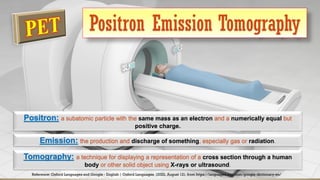
Positron: a subatomic particle with the same mass as an electron and a numerically equal but
positive charge.
Emission: the production and discharge of something, especially gas or radiation.
Reference: Oxford Languages and Google - English | Oxford Languages. (2022, August 12). from https://languages.oup.com/google-dictionary-en/
Tomography: a technique for displaying a representation of a cross section through a human
body or other solid object using X-rays or ultrasound.
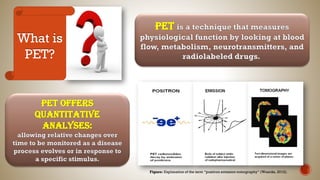
PET
What is
PET?
PET offers
Quantitative
Analyses:
Figure: Explanation of the term “positron emission tomography” (Waarde, 2012).
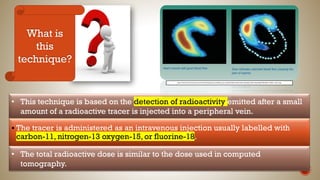
• This technique is based on the detection of radioactivity emitted after a small
amount of a radioactive tracer is injected into a peripheral vein.
What is
this
technique?
▪ The tracer is administered as an intravenous injection usually labelled with
carbon-11, nitrogen-13 oxygen-15, or fluorine-18.
• The total radioactive dose is similar to the dose used in computed
tomography.
https://www.ncbi.nlm.nih.gov/core/lw/2.0/html/tileshop_pmc/tileshop_pmc_inline.html?title=Click%20on%20image%20to%20zoom&p=PMC3&id=1126321_1449_f1.jpg
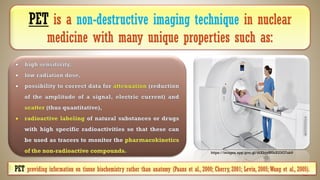
PET is a non-destructive imaging technique in nuclear
medicine with many unique properties such as:
https://images.app.goo.gl/diXbjyBNkXU3G7ak9
PET providing information on tissue biochemistry rather than anatomy (Paans et al., 2000; Cherry, 2001; Levin, 2005;Wang et al., 2005).
• The radiopharmaceutical is transported
throughout the body by the circulation and
taken up by target organs resulting in the
emission of externally detectable radiation.
• The emitted radiation is measured by a PET
camera and used for imaging.
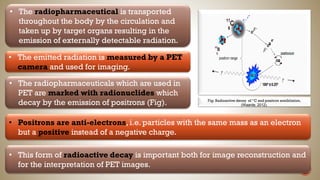
Fig: Radioactive decay of “C and positron annihilation,
(Waarde, 2012).
• The radiopharmaceuticals which are used in
PET are marked with radionuclides which
decay by the emission of positrons (Fig).
• Positrons are anti-electrons, i.e. particles with the same mass as an electron
but a positive instead of a negative charge.
• This form of radioactive decay is important both for image reconstruction and
for the interpretation of PET images.
• A PET camera does not detect the positrons
themselves for their range of travel within tissue is
too short (less than 2.5 mm).
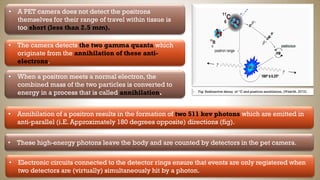
Fig: Radioactive decay of “C and positron annihilation, (Waarde, 2012).
• The camera detects the two gamma quanta which
originate from the annihilation of these anti-
electrons.
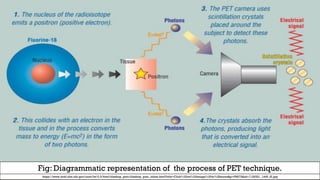
• When a positron meets a normal electron, the
combined mass of the two particles is converted to
energy in a process that is called annihilation.
• Annihilation of a positron results in the formation of two 511 kev photons which are emitted in
anti-parallel (i.E. Approximately 180 degrees opposite) directions (fig).
• These high-energy photons leave the body and are counted by detectors in the pet camera.
• Electronic circuits connected to the detector rings ensure that events are only registered when
two detectors are (virtually) simultaneously hit by a photon.
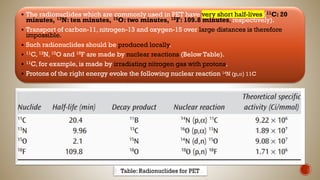
Table: Radionuclides for PET
▪ The radionuclides which are commonly used in PET have very short half-lives (11C: 20
minutes, 13N: ten minutes, 15O: two minutes, 18F: 109.8 minutes, respectively).
▪ Transport of carbon-11, nitrogen-13 and oxygen-15 over large distances is therefore
impossible.
▪ Such radionuclides should be produced locally.
▪ 11C, 13N, 15O and 18F are made by nuclear reactions (Below Table).
▪ 11C, for example, is made by irradiating nitrogen gas with protons.
▪ Protons of the right energy evoke the following nuclear reaction 14N (p,α) 11C
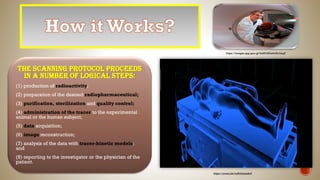
The scanning protocol proceeds
in a number of logical steps:
(1) production of radioactivity;
(2) preparation of the desired radiopharmaceutical;
(3) purification, sterilization and quality control;
(4) administration of the tracer to the experimental
animal or the human subject;
(5) data acquisition;
(6) image reconstruction;
(7) analysis of the data with tracer-kinetic models;
and
(8) reporting to the investigator or the physician of the
patient.
https://images.app.goo.gl/hnEFrHGe6cHz1Lzq6
https://youtu.be/oySvkmezdo0
https://www.ncbi.nlm.nih.gov/core/lw/2.0/html/tileshop_pmc/tileshop_pmc_inline.html?title=Click%20on%20image%20to%20zoom&p=PMC3&id=1126321_1449_f2.jpg
Fig: Diagrammatic representation of the process of PET technique.
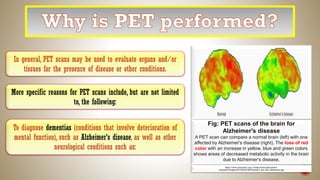
In general, PET scans may be used to evaluate organs and/or
tissues for the presence of disease or other conditions.
To diagnose dementias (conditions that involve deterioration of
mental function), such as Alzheimer's disease, as well as other
neurological conditions such as:
More specific reasons for PET scans include, but are not limited
to, the following:
https://www.mayoclinic.org/-/media/kcms/gbs/patient-
consumer/images/2014/05/04/08/38/mcdc7_pet_scan_alzheimers.jpg
Fig: PET scans of the brain for
Alzheimer's disease
A PET scan can compare a normal brain (left) with one
affected by Alzheimer's disease (right). The loss of red
color with an increase in yellow, blue and green colors
shows areas of decreased metabolic activity in the brain
due to Alzheimer's disease.
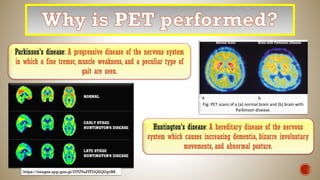
Parkinson's disease: A progressive disease of the nervous system
in which a fine tremor, muscle weakness, and a peculiar type of
gait are seen.
Fig: PET scans of a (a) normal brain and (b) brain with
Parkinson disease.
Huntington's disease: A hereditary disease of the nervous
system which causes increasing dementia, bizarre involuntary
movements, and abnormal posture.
https://images.app.goo.gl/DTUTa2TFDQEQUgvB8
https://images.app.goo.gl/cxRorBnziNANT6vW6
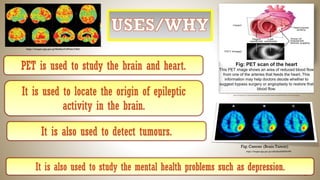
Fig: Cancer (Brain Tumor)
It is also used to detect tumours.
It is also used to study the mental health problems such as depression.
It is used to locate the origin of epileptic
activity in the brain.
https://images.app.goo.gl/MsA8acVuW3nk1C8s6
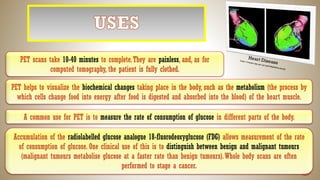
PET is used to study the brain and heart. Fig: PET scan of the heart
This PET image shows an area of reduced blood flow
from one of the arteries that feeds the heart. This
information may help doctors decide whether to
suggest bypass surgery or angioplasty to restore that
blood flow.
https://www.mayoclinic.org/-/media/kcms/gbs/patient-consumer/images/2013/08/26/10/03/my00238_im03976_mcdc_pet_heartthu_jpg.jpg
PET scans take 10-40 minutes to complete.They are painless, and, as for
computed tomography, the patient is fully clothed.
A common use for PET is to measure the rate of consumption of glucose in different parts of the body.
Accumulation of the radiolabelled glucose analogue 18-fluorodeoxyglucose (FDG) allows measurement of the rate
of consumption of glucose. One clinical use of this is to distinguish between benign and malignant tumours
(malignant tumours metabolise glucose at a faster rate than benign tumours).Whole body scans are often
performed to stage a cancer.
PET helps to visualize the biochemical changes taking place in the body, such as the metabolism (the process by
which cells change food into energy after food is digested and absorbed into the blood) of the heart muscle.
(Source:Waarde,2012)
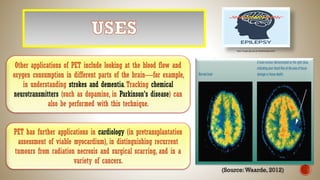
Other applications of PET include looking at the blood flow and
oxygen consumption in different parts of the brain—for example,
in understanding strokes and dementia.Tracking chemical
neurotransmitters (such as dopamine, in Parkinson's disease) can
also be performed with this technique.
PET has further applications in cardiology (in pretransplantation
assessment of viable myocardium), in distinguishing recurrent
tumours from radiation necrosis and surgical scarring, and in a
variety of cancers.
https://images.app.goo.gl/3azZ2Rx9wRppmow27
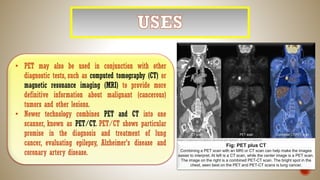
• PET may also be used in conjunction with other
diagnostic tests, such as computed tomography (CT) or
magnetic resonance imaging (MRI) to provide more
definitive information about malignant (cancerous)
tumors and other lesions.
• Newer technology combines PET and CT into one
scanner, known as PET/CT. PET/CT shows particular
promise in the diagnosis and treatment of lung
cancer, evaluating epilepsy, Alzheimer's disease and
coronary artery disease.
Fig: PET plus CT
Combining a PET scan with an MRI or CT scan can help make the images
easier to interpret. At left is a CT scan, while the center image is a PET scan.
The image on the right is a combined PET-CT scan. The bright spot in the
chest, seen best on the PET and PET-CT scans is lung cancer.
Q: What is non-destructive imaging?
Ans:
Q: Pharmacokinetics meaning?
Ans:
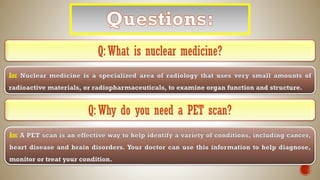
Q: What is nuclear medicine?
Ans:
Q: Why do you need a PET scan?
Ans:
❑ Information for Patients - | University of Utah. (2020, October 22).
https://uofuhealth.utah.edu/huntsman/cqci/clinical-patient-imaging/information-for-patients.php
❑ PET Center | Radiology | Michigan Medicine. (2018, March 30). Radiology.
https://medicine.umich.edu/dept/radiology/research/pet-center
❑ https://www.ncbi.nlm.nih.gov/pmc/articles/PMC1126321/
❑ PET scan. (n.d.). https://medlineplus.gov/ency/article/003827.htm
❑ Waarde, A.V. (2012). Introduction on PET: Description of Basics and Principles.Trends on the Role of PET in Drug
Development, 1–13. https://doi.org/10.1142/9789814317740_0001
❑ https://depts.washington.edu/imreslab/education/Physics%20of%20PET.pdf
❑ Berger A. (2003). How does it work? Positron emission tomography. BMJ (Clinical research ed.), 326(7404), 1449.
https://doi.org/10.1136/bmj.326.7404.1449
❑ Positron Emission Tomography (PET). (2021, August 20). Johns Hopkins Medicine, from
https://www.hopkinsmedicine.org/health/treatment-tests-and-therapies/positron-emission-tomography-pet

Positron Emission Tomography (PET).pdf

  • 1.
    https://www.youtube.com/chann el/UCAiarMZDNhe1A3Rnpr_WkzA Saba Parvin Haque MScin Neuroscience from “Sophia College For Women”, Mumbai.
  • 2.
    Saba Parvin Haque MScPart 2 P20013 Positron Emission Tomography Positron: a subatomic particle with the same mass as an electron and a numerically equal but positive charge. Emission: the production and discharge of something, especially gas or radiation. Reference: Oxford Languages and Google - English | Oxford Languages. (2022, August 12). from https://languages.oup.com/google-dictionary-en/ Tomography: a technique for displaying a representation of a cross section through a human body or other solid object using X-rays or ultrasound.
  • 3.
    PET What is PET? PET offers Quantitative Analyses: Figure:Explanation of the term “positron emission tomography” (Waarde, 2012).
  • 4.
    • This techniqueis based on the detection of radioactivity emitted after a small amount of a radioactive tracer is injected into a peripheral vein. What is this technique? ▪ The tracer is administered as an intravenous injection usually labelled with carbon-11, nitrogen-13 oxygen-15, or fluorine-18. • The total radioactive dose is similar to the dose used in computed tomography. https://www.ncbi.nlm.nih.gov/core/lw/2.0/html/tileshop_pmc/tileshop_pmc_inline.html?title=Click%20on%20image%20to%20zoom&p=PMC3&id=1126321_1449_f1.jpg
  • 5.
    PET is anon-destructive imaging technique in nuclear medicine with many unique properties such as: https://images.app.goo.gl/diXbjyBNkXU3G7ak9 PET providing information on tissue biochemistry rather than anatomy (Paans et al., 2000; Cherry, 2001; Levin, 2005;Wang et al., 2005).
  • 6.
    • The radiopharmaceuticalis transported throughout the body by the circulation and taken up by target organs resulting in the emission of externally detectable radiation. • The emitted radiation is measured by a PET camera and used for imaging. Fig: Radioactive decay of “C and positron annihilation, (Waarde, 2012). • The radiopharmaceuticals which are used in PET are marked with radionuclides which decay by the emission of positrons (Fig). • Positrons are anti-electrons, i.e. particles with the same mass as an electron but a positive instead of a negative charge. • This form of radioactive decay is important both for image reconstruction and for the interpretation of PET images.
  • 7.
    • A PETcamera does not detect the positrons themselves for their range of travel within tissue is too short (less than 2.5 mm). Fig: Radioactive decay of “C and positron annihilation, (Waarde, 2012). • The camera detects the two gamma quanta which originate from the annihilation of these anti- electrons. • When a positron meets a normal electron, the combined mass of the two particles is converted to energy in a process that is called annihilation. • Annihilation of a positron results in the formation of two 511 kev photons which are emitted in anti-parallel (i.E. Approximately 180 degrees opposite) directions (fig). • These high-energy photons leave the body and are counted by detectors in the pet camera. • Electronic circuits connected to the detector rings ensure that events are only registered when two detectors are (virtually) simultaneously hit by a photon.
  • 8.
    Table: Radionuclides forPET ▪ The radionuclides which are commonly used in PET have very short half-lives (11C: 20 minutes, 13N: ten minutes, 15O: two minutes, 18F: 109.8 minutes, respectively). ▪ Transport of carbon-11, nitrogen-13 and oxygen-15 over large distances is therefore impossible. ▪ Such radionuclides should be produced locally. ▪ 11C, 13N, 15O and 18F are made by nuclear reactions (Below Table). ▪ 11C, for example, is made by irradiating nitrogen gas with protons. ▪ Protons of the right energy evoke the following nuclear reaction 14N (p,α) 11C
  • 9.
    The scanning protocolproceeds in a number of logical steps: (1) production of radioactivity; (2) preparation of the desired radiopharmaceutical; (3) purification, sterilization and quality control; (4) administration of the tracer to the experimental animal or the human subject; (5) data acquisition; (6) image reconstruction; (7) analysis of the data with tracer-kinetic models; and (8) reporting to the investigator or the physician of the patient. https://images.app.goo.gl/hnEFrHGe6cHz1Lzq6 https://youtu.be/oySvkmezdo0
  • 10.
  • 11.
    In general, PETscans may be used to evaluate organs and/or tissues for the presence of disease or other conditions. To diagnose dementias (conditions that involve deterioration of mental function), such as Alzheimer's disease, as well as other neurological conditions such as: More specific reasons for PET scans include, but are not limited to, the following: https://www.mayoclinic.org/-/media/kcms/gbs/patient- consumer/images/2014/05/04/08/38/mcdc7_pet_scan_alzheimers.jpg Fig: PET scans of the brain for Alzheimer's disease A PET scan can compare a normal brain (left) with one affected by Alzheimer's disease (right). The loss of red color with an increase in yellow, blue and green colors shows areas of decreased metabolic activity in the brain due to Alzheimer's disease.
  • 12.
    Parkinson's disease: Aprogressive disease of the nervous system in which a fine tremor, muscle weakness, and a peculiar type of gait are seen. Fig: PET scans of a (a) normal brain and (b) brain with Parkinson disease. Huntington's disease: A hereditary disease of the nervous system which causes increasing dementia, bizarre involuntary movements, and abnormal posture. https://images.app.goo.gl/DTUTa2TFDQEQUgvB8
  • 13.
    https://images.app.goo.gl/cxRorBnziNANT6vW6 Fig: Cancer (BrainTumor) It is also used to detect tumours. It is also used to study the mental health problems such as depression. It is used to locate the origin of epileptic activity in the brain. https://images.app.goo.gl/MsA8acVuW3nk1C8s6 PET is used to study the brain and heart. Fig: PET scan of the heart This PET image shows an area of reduced blood flow from one of the arteries that feeds the heart. This information may help doctors decide whether to suggest bypass surgery or angioplasty to restore that blood flow. https://www.mayoclinic.org/-/media/kcms/gbs/patient-consumer/images/2013/08/26/10/03/my00238_im03976_mcdc_pet_heartthu_jpg.jpg
  • 14.
    PET scans take10-40 minutes to complete.They are painless, and, as for computed tomography, the patient is fully clothed. A common use for PET is to measure the rate of consumption of glucose in different parts of the body. Accumulation of the radiolabelled glucose analogue 18-fluorodeoxyglucose (FDG) allows measurement of the rate of consumption of glucose. One clinical use of this is to distinguish between benign and malignant tumours (malignant tumours metabolise glucose at a faster rate than benign tumours).Whole body scans are often performed to stage a cancer. PET helps to visualize the biochemical changes taking place in the body, such as the metabolism (the process by which cells change food into energy after food is digested and absorbed into the blood) of the heart muscle.
  • 15.
    (Source:Waarde,2012) Other applications ofPET include looking at the blood flow and oxygen consumption in different parts of the brain—for example, in understanding strokes and dementia.Tracking chemical neurotransmitters (such as dopamine, in Parkinson's disease) can also be performed with this technique. PET has further applications in cardiology (in pretransplantation assessment of viable myocardium), in distinguishing recurrent tumours from radiation necrosis and surgical scarring, and in a variety of cancers. https://images.app.goo.gl/3azZ2Rx9wRppmow27
  • 16.
    • PET mayalso be used in conjunction with other diagnostic tests, such as computed tomography (CT) or magnetic resonance imaging (MRI) to provide more definitive information about malignant (cancerous) tumors and other lesions. • Newer technology combines PET and CT into one scanner, known as PET/CT. PET/CT shows particular promise in the diagnosis and treatment of lung cancer, evaluating epilepsy, Alzheimer's disease and coronary artery disease. Fig: PET plus CT Combining a PET scan with an MRI or CT scan can help make the images easier to interpret. At left is a CT scan, while the center image is a PET scan. The image on the right is a combined PET-CT scan. The bright spot in the chest, seen best on the PET and PET-CT scans is lung cancer.
  • 17.
    Q: What isnon-destructive imaging? Ans: Q: Pharmacokinetics meaning? Ans:
  • 18.
    Q: What isnuclear medicine? Ans: Q: Why do you need a PET scan? Ans:
  • 19.
    ❑ Information forPatients - | University of Utah. (2020, October 22). https://uofuhealth.utah.edu/huntsman/cqci/clinical-patient-imaging/information-for-patients.php ❑ PET Center | Radiology | Michigan Medicine. (2018, March 30). Radiology. https://medicine.umich.edu/dept/radiology/research/pet-center ❑ https://www.ncbi.nlm.nih.gov/pmc/articles/PMC1126321/ ❑ PET scan. (n.d.). https://medlineplus.gov/ency/article/003827.htm ❑ Waarde, A.V. (2012). Introduction on PET: Description of Basics and Principles.Trends on the Role of PET in Drug Development, 1–13. https://doi.org/10.1142/9789814317740_0001 ❑ https://depts.washington.edu/imreslab/education/Physics%20of%20PET.pdf ❑ Berger A. (2003). How does it work? Positron emission tomography. BMJ (Clinical research ed.), 326(7404), 1449. https://doi.org/10.1136/bmj.326.7404.1449 ❑ Positron Emission Tomography (PET). (2021, August 20). Johns Hopkins Medicine, from https://www.hopkinsmedicine.org/health/treatment-tests-and-therapies/positron-emission-tomography-pet