PET CT AND ITS
BENEFIT VS RISK
NAME- VIBHA JOSHI
REGN NO.- 200513015
COURSE- MRIT 2ND SEM
PET
• PET stands for positron emission tomography
• PET is a nuclear medical imaging technique which
uses small amounts of radioactive
compounds(tracers) to help in the diagnosis of
diseases.
• The tracers are introduced into the body by either
injection or inhalation so that distribution of the
tracer in the body can visible on image which is
produced by PET Scanner.
HISTORY OF PET SCANNER
• Late 1950’s David E. Kuhl, Luke
Chapman and Roy Edward ,
they introduced the concept
of emission and transmission
tomography and first PET Scan
was done for detection of
Brain Tumour using Sodium
Iodide(NaI)
• In 1970’s and 80’s PET was
mainly used for research
purpose.
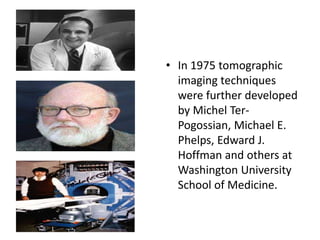
• In 1975 tomographic
imaging techniques
were further developed
by Michel Ter-
Pogossian, Michael E.
Phelps, Edward J.
Hoffman and others at
Washington University
School of Medicine.
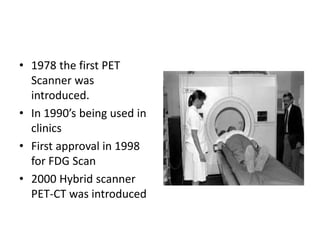
• 1978 the first PET
Scanner was
introduced.
• In 1990’s being used in
clinics
• First approval in 1998
for FDG Scan
• 2000 Hybrid scanner
PET-CT was introduced
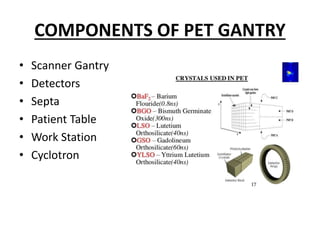
COMPONENTS OF PET GANTRY
• Scanner Gantry
• Detectors
• Septa
• Patient Table
• Work Station
• Cyclotron
OVERVIEW ABOUT COMPONENTS
• Scanner Gantry – Round Donut shape
Diameter size is approx 70-80cm
• Detectors – Comprised by 8X8 scintillation crystals which
emits photons after the interaction of photons.
• Septa – Lie b/w detector and ring and limits the scattered
radiation
• Patient Table – The table is capable of moving in and out
direction of scanner to detect tracers throughout the body
and can be adjust to very low position.
• Work Station – It consist of computer setups which analyzes
the gamma rays and uses to create image.
• Cyclotron – A machine used to produce the radioisotopes
which synthesis the radiopharmaceuticals.
• The most frequently radioisotopes used in PET are :
Carbon-11 , Nitrogen-13
Oxygen-15 , Fluorine-18
• Interpretation of Images -PET provides images
of quantitative uptake of the radionuclide
injected that can give the concentration of
radiotracer activity in KILOBECQUERELS PER
MILILITER.
• Methods for assessment of radiotracer uptake
Visual Inspection
Standardized Uptake Value(SUV)
Glucose metabolic rate
SUV
• Standardized uptake value
• Assessment of radiotracer
• Malignant tumors have an SUV of greater than
2.5-3.0
• Normal tissues such as the liver, lung and
marrow have SUVs ranging from 0.5-2.5
• If the value increased from 2.5-3.0 , then the
lesion assess as malignant.
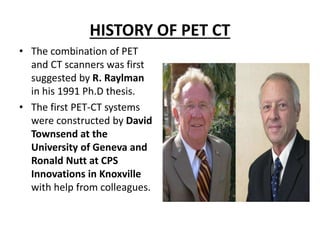
HISTORY OF PET CT
• The combination of PET
and CT scanners was first
suggested by R. Raylman
in his 1991 Ph.D thesis.
• The first PET-CT systems
were constructed by David
Townsend at the
University of Geneva and
Ronald Nutt at CPS
Innovations in Knoxville
with help from colleagues.
• The first PET-CT prototype
for clinical evaluation was
funded by the NCI and
installed at the University
of Pittsburgh Medical
Center in 1998.
• The first commercial
system reached the market
by 2001, and by 2004, over
400 systems had been
installed worldwide.
INTRODUCTON
• Cancer is one of the leading cause of mortality
and morbidity in developed countries.
• Most of advance radiological procedures map
the anatomy and morphology of tumors with
less or no information about their
metabolism.
• PET is a combination of Physics, chemistry,
physiology and medicine in an effort to
measures physiologic parameters non
invasively.
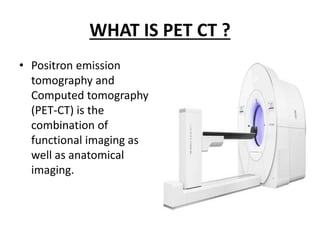
WHAT IS PET CT ?
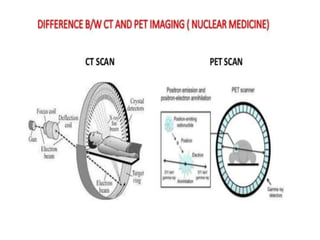
• Positron emission
tomography and
Computed tomography
(PET-CT) is the
combination of
functional imaging as
well as anatomical
imaging.
WHY USING CT WITH PET?
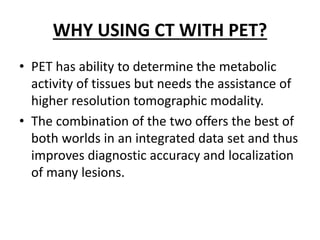
• PET has ability to determine the metabolic
activity of tissues but needs the assistance of
higher resolution tomographic modality.
• The combination of the two offers the best of
both worlds in an integrated data set and thus
improves diagnostic accuracy and localization
of many lesions.
PRINCIPLE
• The concept of PET is to inject
radiopharmaceuticals into patient body.
• All PET compounds are radiolabeled with positron
emitting radionuclides.
• These radionuclides have decay properties that
enable localization in the body.
• A positron is emitted from the nucleus, travels a
short distance an annihilates with its
antiparticle(electron) which results in two
511keVphotons travelling in opposite direction.
• After both photons are detected the activity is
localized somewhere along the line defined by the
two detectors.
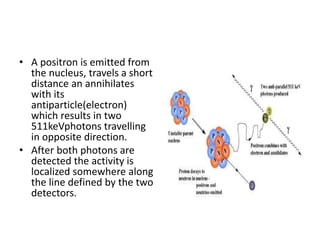
• A positron is emitted from
the nucleus, travels a short
distance an annihilates
with its
antiparticle(electron)
which results in two
511keVphotons travelling
in opposite direction.
• After both photons are
detected the activity is
localized somewhere along
the line defined by the two
detectors.
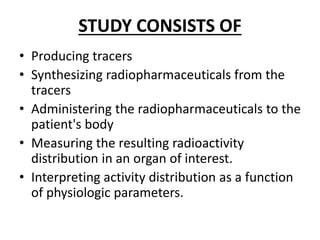
STUDY CONSISTS OF
• Producing tracers
• Synthesizing radiopharmaceuticals from the
tracers
• Administering the radiopharmaceuticals to the
patient's body
• Measuring the resulting radioactivity
distribution in an organ of interest.
• Interpreting activity distribution as a function
of physiologic parameters.
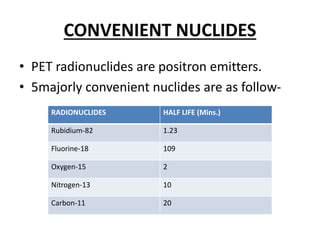
CONVENIENT NUCLIDES
• PET radionuclides are positron emitters.
• 5majorly convenient nuclides are as follow-
RADIONUCLIDES HALF LIFE (Mins.)
Rubidium-82 1.23
Fluorine-18 109
Oxygen-15 2
Nitrogen-13 10
Carbon-11 20
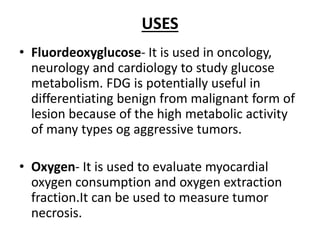
USES
• Fluordeoxyglucose- It is used in oncology,
neurology and cardiology to study glucose
metabolism. FDG is potentially useful in
differentiating benign from malignant form of
lesion because of the high metabolic activity
of many types og aggressive tumors.
• Oxygen- It is used to evaluate myocardial
oxygen consumption and oxygen extraction
fraction.It can be used to measure tumor
necrosis.
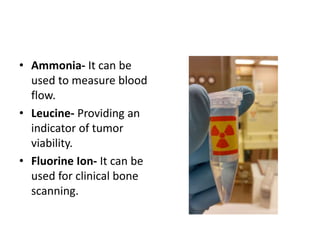
• Ammonia- It can be
used to measure blood
flow.
• Leucine- Providing an
indicator of tumor
viability.
• Fluorine Ion- It can be
used for clinical bone
scanning.
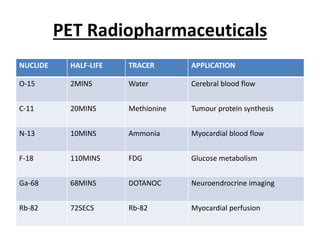
PET Radiopharmaceuticals
NUCLIDE HALF-LIFE TRACER APPLICATION
O-15 2MINS Water Cerebral blood flow
C-11 20MINS Methionine Tumour protein synthesis
N-13 10MINS Ammonia Myocardial blood flow
F-18 110MINS FDG Glucose metabolism
Ga-68 68MINS DOTANOC Neuroendrocrine imaging
Rb-82 72SECS Rb-82 Myocardial perfusion
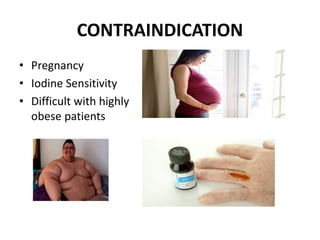
CONTRAINDICATION
• Pregnancy
• Iodine Sensitivity
• Difficult with highly
obese patients
PATIENT'S PREPARATION:
• Patients should be come with fasting of 6-8
hours.
• If patient is diabetic, only intake of plain water
or black tea is permisible.
• No intake of any kind of sugar or sugar free
products.
• If diabetic patient is on medication intake of
medicine with plain water is allowed.
• Patients are ask to drink upto 1.5L of oral
contrast solution during the 18F-FDG uptake
phase.
• The injected dose of tracer may vary,
depending upon patient's weight and scan
part.
SCANNING PROCEDURE
• 60-90mins after the FDG has been introduced in
patients body.
• The patient is placed supine on the imaging table.
• Same as with diagnostic CT, the CT tube and
detector are used to obtain a tomogram.
• Scout image is used to outline the require region of
the body to be scanned.
• The scanner software then automatically realigns
the table and spiral CT is performed on the ROI.
• It generates 100s of transaxial images through the
body
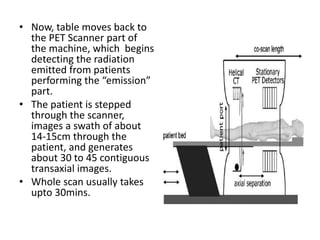
• Now, table moves back to
the PET Scanner part of
the machine, which begins
detecting the radiation
emitted from patients
performing the “emission”
part.
• The patient is stepped
through the scanner,
images a swath of about
14-15cm through the
patient, and generates
about 30 to 45 contiguous
transaxial images.
• Whole scan usually takes
upto 30mins.
IMAGE GENERATION
• The data generated is
enormous.
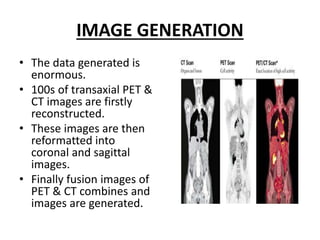
• 100s of transaxial PET &
CT images are firstly
reconstructed.
• These images are then
reformatted into
coronal and sagittal
images.
• Finally fusion images of
PET & CT combines and
images are generated.
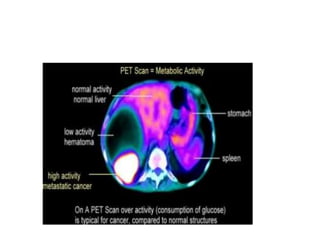
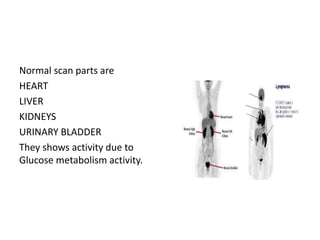
Normal scan parts are
HEART
LIVER
KIDNEYS
URINARY BLADDER
They shows activity due to
Glucose metabolism activity.
BENEFITS OF PET CT
• Better identification of inflammatory lesions.
• Confirmation of abnormal sites.
• Improved localization for biopsy or
radiotherapy.
• Tumor stages can be defined more exactly.
RISK OF PET-CT
• May be claustrophobic for some patients.
• Radiations are there in use.
• Time taking scan
• Cost is not pocket friendly
• Hyperactivity of tracers can cause
inflammation or infection.
Pet ct and its benefit vs risk

Pet ct and its benefit vs risk

  • 1.
    PET CT ANDITS BENEFIT VS RISK NAME- VIBHA JOSHI REGN NO.- 200513015 COURSE- MRIT 2ND SEM
  • 2.
    PET • PET standsfor positron emission tomography • PET is a nuclear medical imaging technique which uses small amounts of radioactive compounds(tracers) to help in the diagnosis of diseases. • The tracers are introduced into the body by either injection or inhalation so that distribution of the tracer in the body can visible on image which is produced by PET Scanner.
  • 3.
    HISTORY OF PETSCANNER • Late 1950’s David E. Kuhl, Luke Chapman and Roy Edward , they introduced the concept of emission and transmission tomography and first PET Scan was done for detection of Brain Tumour using Sodium Iodide(NaI) • In 1970’s and 80’s PET was mainly used for research purpose.
  • 4.
    • In 1975tomographic imaging techniques were further developed by Michel Ter- Pogossian, Michael E. Phelps, Edward J. Hoffman and others at Washington University School of Medicine.
  • 5.
    • 1978 thefirst PET Scanner was introduced. • In 1990’s being used in clinics • First approval in 1998 for FDG Scan • 2000 Hybrid scanner PET-CT was introduced
  • 6.
    COMPONENTS OF PETGANTRY • Scanner Gantry • Detectors • Septa • Patient Table • Work Station • Cyclotron
  • 7.
    OVERVIEW ABOUT COMPONENTS •Scanner Gantry – Round Donut shape Diameter size is approx 70-80cm • Detectors – Comprised by 8X8 scintillation crystals which emits photons after the interaction of photons. • Septa – Lie b/w detector and ring and limits the scattered radiation • Patient Table – The table is capable of moving in and out direction of scanner to detect tracers throughout the body and can be adjust to very low position. • Work Station – It consist of computer setups which analyzes the gamma rays and uses to create image. • Cyclotron – A machine used to produce the radioisotopes which synthesis the radiopharmaceuticals. • The most frequently radioisotopes used in PET are : Carbon-11 , Nitrogen-13 Oxygen-15 , Fluorine-18
  • 8.
    • Interpretation ofImages -PET provides images of quantitative uptake of the radionuclide injected that can give the concentration of radiotracer activity in KILOBECQUERELS PER MILILITER. • Methods for assessment of radiotracer uptake Visual Inspection Standardized Uptake Value(SUV) Glucose metabolic rate
  • 9.
    SUV • Standardized uptakevalue • Assessment of radiotracer • Malignant tumors have an SUV of greater than 2.5-3.0 • Normal tissues such as the liver, lung and marrow have SUVs ranging from 0.5-2.5 • If the value increased from 2.5-3.0 , then the lesion assess as malignant.
  • 10.
    HISTORY OF PETCT • The combination of PET and CT scanners was first suggested by R. Raylman in his 1991 Ph.D thesis. • The first PET-CT systems were constructed by David Townsend at the University of Geneva and Ronald Nutt at CPS Innovations in Knoxville with help from colleagues.
  • 11.
    • The firstPET-CT prototype for clinical evaluation was funded by the NCI and installed at the University of Pittsburgh Medical Center in 1998. • The first commercial system reached the market by 2001, and by 2004, over 400 systems had been installed worldwide.
  • 12.
    INTRODUCTON • Cancer isone of the leading cause of mortality and morbidity in developed countries. • Most of advance radiological procedures map the anatomy and morphology of tumors with less or no information about their metabolism. • PET is a combination of Physics, chemistry, physiology and medicine in an effort to measures physiologic parameters non invasively.
  • 13.
    WHAT IS PETCT ? • Positron emission tomography and Computed tomography (PET-CT) is the combination of functional imaging as well as anatomical imaging.
  • 14.
    WHY USING CTWITH PET? • PET has ability to determine the metabolic activity of tissues but needs the assistance of higher resolution tomographic modality. • The combination of the two offers the best of both worlds in an integrated data set and thus improves diagnostic accuracy and localization of many lesions.
  • 16.
    PRINCIPLE • The conceptof PET is to inject radiopharmaceuticals into patient body. • All PET compounds are radiolabeled with positron emitting radionuclides. • These radionuclides have decay properties that enable localization in the body. • A positron is emitted from the nucleus, travels a short distance an annihilates with its antiparticle(electron) which results in two 511keVphotons travelling in opposite direction. • After both photons are detected the activity is localized somewhere along the line defined by the two detectors.
  • 17.
    • A positronis emitted from the nucleus, travels a short distance an annihilates with its antiparticle(electron) which results in two 511keVphotons travelling in opposite direction. • After both photons are detected the activity is localized somewhere along the line defined by the two detectors.
  • 18.
    STUDY CONSISTS OF •Producing tracers • Synthesizing radiopharmaceuticals from the tracers • Administering the radiopharmaceuticals to the patient's body • Measuring the resulting radioactivity distribution in an organ of interest. • Interpreting activity distribution as a function of physiologic parameters.
  • 19.
    CONVENIENT NUCLIDES • PETradionuclides are positron emitters. • 5majorly convenient nuclides are as follow- RADIONUCLIDES HALF LIFE (Mins.) Rubidium-82 1.23 Fluorine-18 109 Oxygen-15 2 Nitrogen-13 10 Carbon-11 20
  • 20.
    USES • Fluordeoxyglucose- Itis used in oncology, neurology and cardiology to study glucose metabolism. FDG is potentially useful in differentiating benign from malignant form of lesion because of the high metabolic activity of many types og aggressive tumors. • Oxygen- It is used to evaluate myocardial oxygen consumption and oxygen extraction fraction.It can be used to measure tumor necrosis.
  • 21.
    • Ammonia- Itcan be used to measure blood flow. • Leucine- Providing an indicator of tumor viability. • Fluorine Ion- It can be used for clinical bone scanning.
  • 22.
    PET Radiopharmaceuticals NUCLIDE HALF-LIFETRACER APPLICATION O-15 2MINS Water Cerebral blood flow C-11 20MINS Methionine Tumour protein synthesis N-13 10MINS Ammonia Myocardial blood flow F-18 110MINS FDG Glucose metabolism Ga-68 68MINS DOTANOC Neuroendrocrine imaging Rb-82 72SECS Rb-82 Myocardial perfusion
  • 24.
    CONTRAINDICATION • Pregnancy • IodineSensitivity • Difficult with highly obese patients
  • 25.
    PATIENT'S PREPARATION: • Patientsshould be come with fasting of 6-8 hours. • If patient is diabetic, only intake of plain water or black tea is permisible. • No intake of any kind of sugar or sugar free products. • If diabetic patient is on medication intake of medicine with plain water is allowed.
  • 26.
    • Patients areask to drink upto 1.5L of oral contrast solution during the 18F-FDG uptake phase. • The injected dose of tracer may vary, depending upon patient's weight and scan part.
  • 27.
    SCANNING PROCEDURE • 60-90minsafter the FDG has been introduced in patients body. • The patient is placed supine on the imaging table. • Same as with diagnostic CT, the CT tube and detector are used to obtain a tomogram. • Scout image is used to outline the require region of the body to be scanned. • The scanner software then automatically realigns the table and spiral CT is performed on the ROI. • It generates 100s of transaxial images through the body
  • 28.
    • Now, tablemoves back to the PET Scanner part of the machine, which begins detecting the radiation emitted from patients performing the “emission” part. • The patient is stepped through the scanner, images a swath of about 14-15cm through the patient, and generates about 30 to 45 contiguous transaxial images. • Whole scan usually takes upto 30mins.
  • 29.
    IMAGE GENERATION • Thedata generated is enormous. • 100s of transaxial PET & CT images are firstly reconstructed. • These images are then reformatted into coronal and sagittal images. • Finally fusion images of PET & CT combines and images are generated.
  • 31.
    Normal scan partsare HEART LIVER KIDNEYS URINARY BLADDER They shows activity due to Glucose metabolism activity.
  • 32.
    BENEFITS OF PETCT • Better identification of inflammatory lesions. • Confirmation of abnormal sites. • Improved localization for biopsy or radiotherapy. • Tumor stages can be defined more exactly.
  • 33.
    RISK OF PET-CT •May be claustrophobic for some patients. • Radiations are there in use. • Time taking scan • Cost is not pocket friendly • Hyperactivity of tracers can cause inflammation or infection.