 DONE BY : MUSTAFA KHALIL IBRAHIM
 TBILISI STATE MEDICAL UNIVERSITY
 4th year, 1st semester, 2nd group
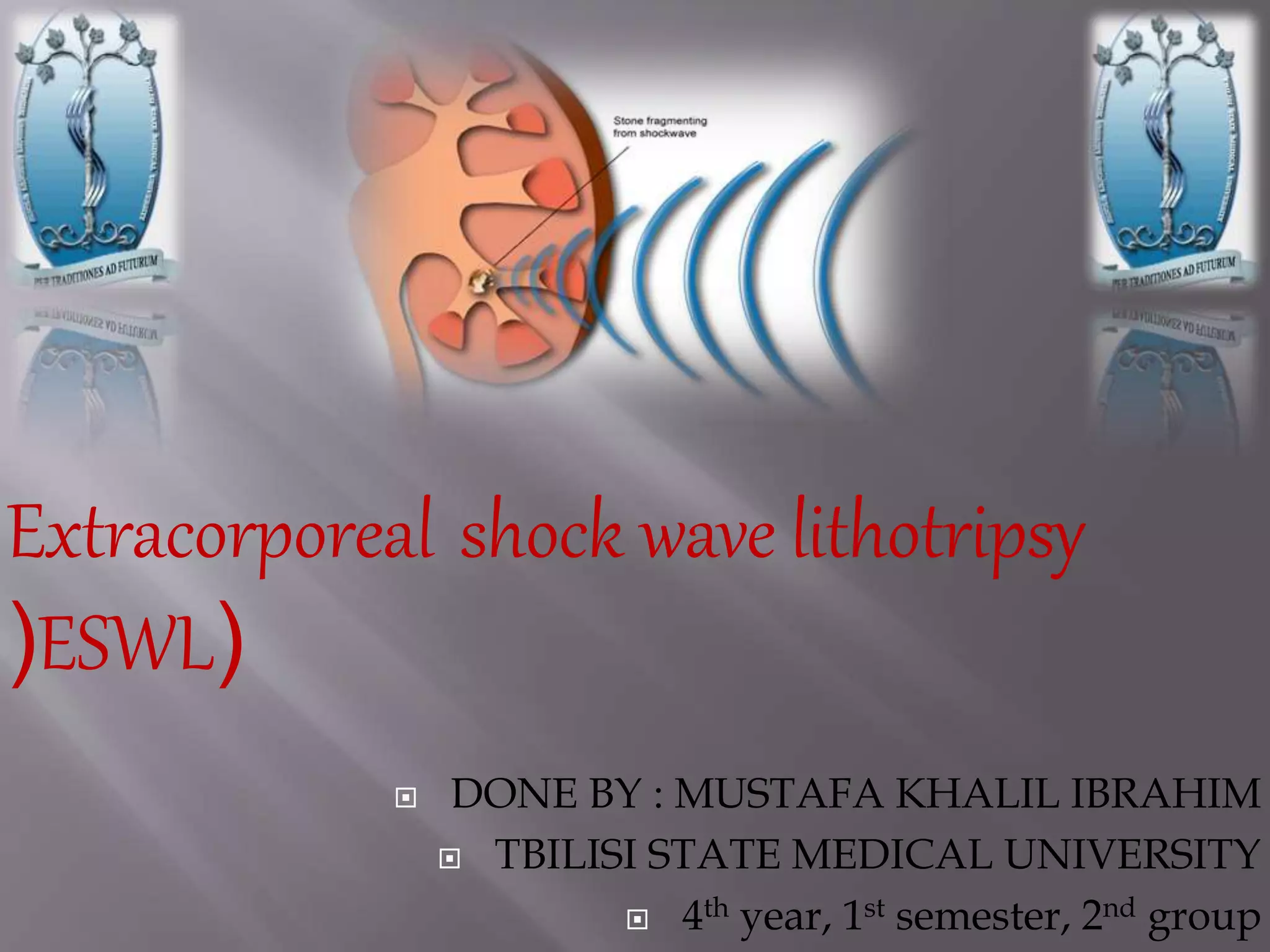
Extracorporeal shock wave lithotripsy
(ESWL(
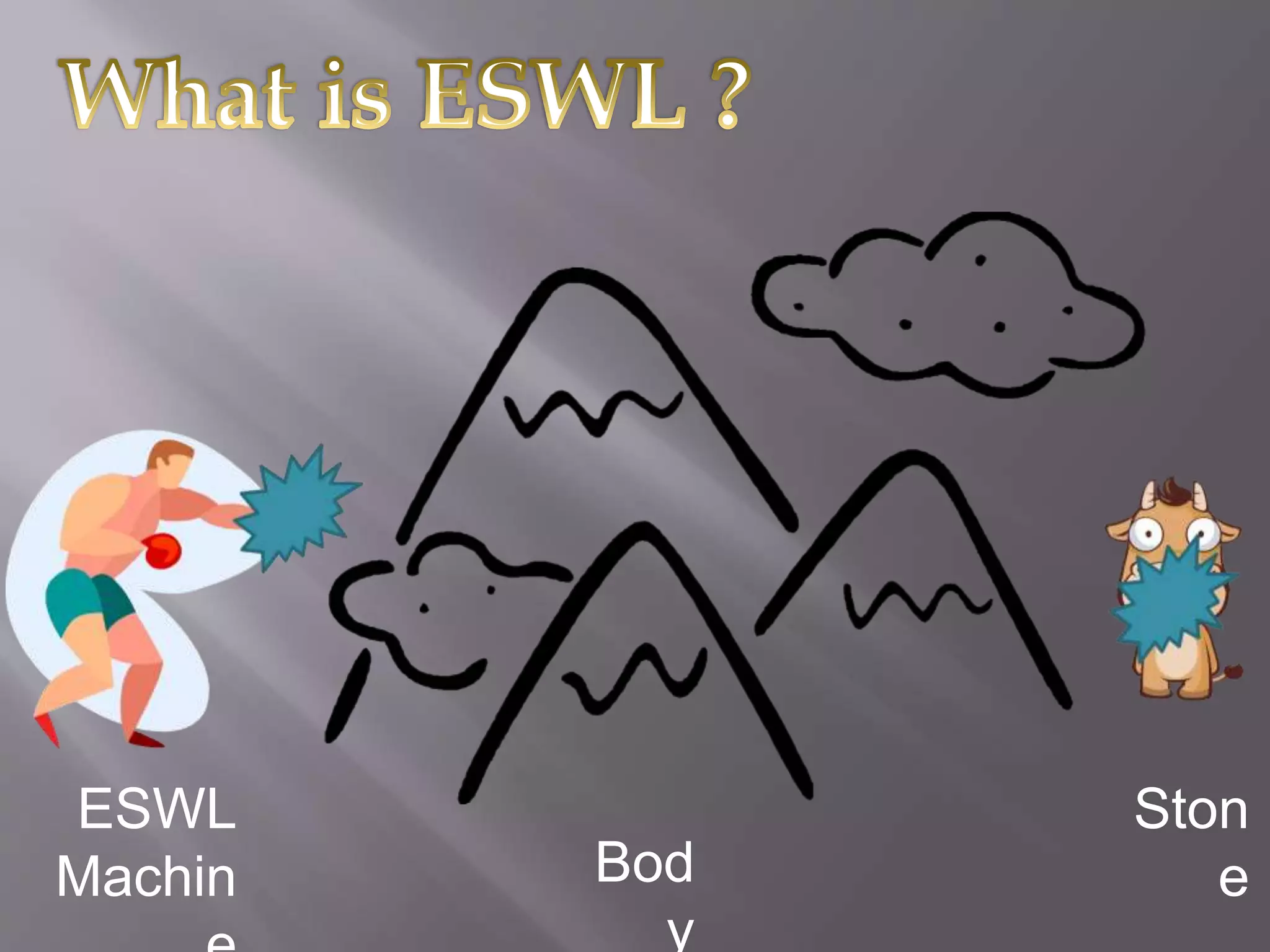
ESWL
Machin Bod
y
Ston
e
 Crystallization of
minerals inside urine,
which act as the nidus
for more
sedimentation and
finally the formation of
a stone within the
kidney.
 Calcium-containing stone
 Calcium Oxalate
 Calcium Phosphate
 Uric acid stone
 Cysteine stones
 NO symptom
 Pain: sudden or severe pain
 nausea, vomiting
 Renal colic
 Frequent and painful urination,
hematuria
 Urinary tract infection: Block the
urinary tract
Plain X-ray
CTUltrasound
 Intravenous
Urogram
 ESWL
 Percutaneous nephrolithotomy
 Ureteroscopy
 Open surgery
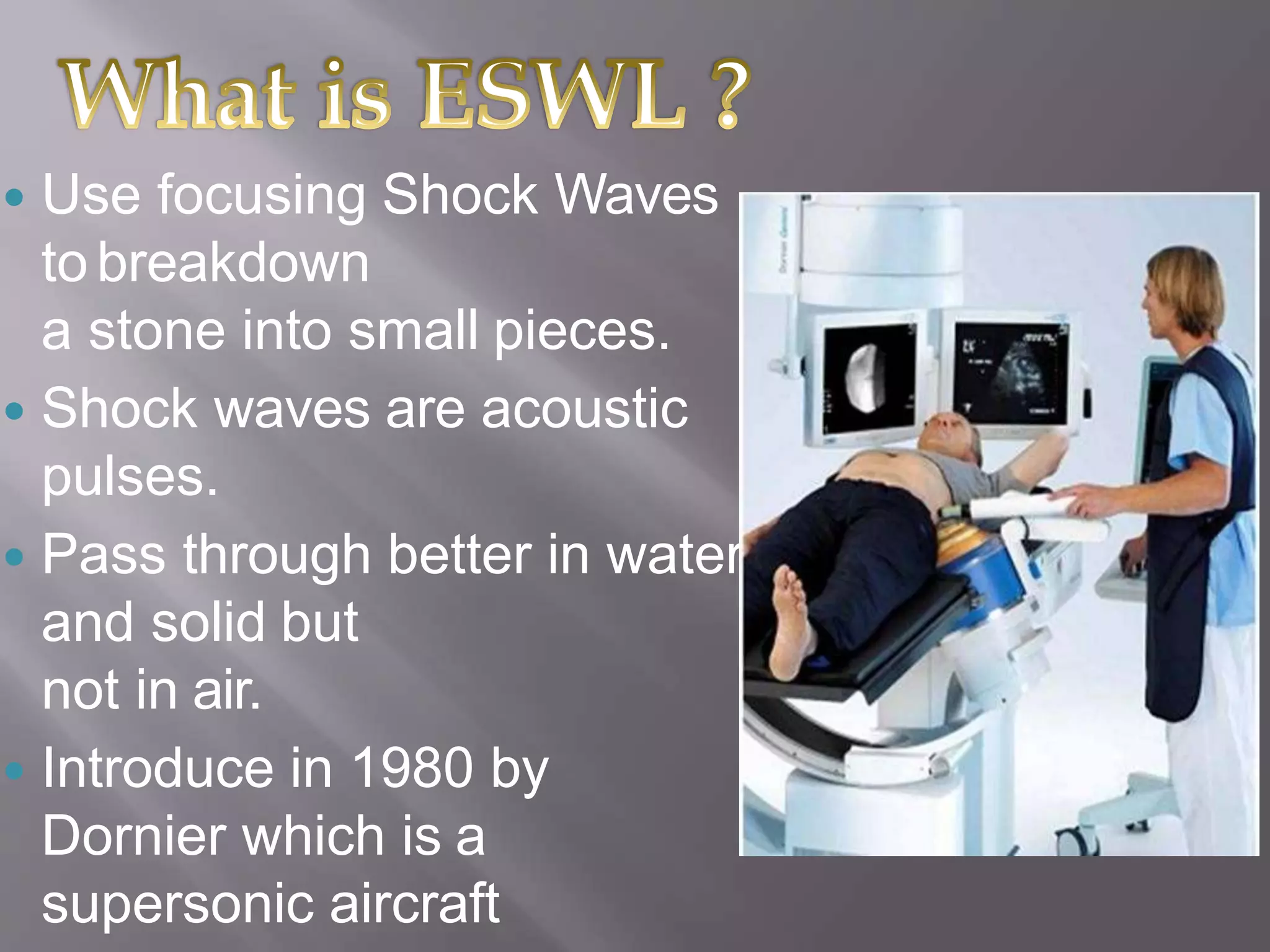
 Use focusing Shock Waves
to breakdown
a stone into small pieces.
 Shock waves are acoustic
pulses.
 Pass through better in water
and solid but
not in air.
 Introduce in 1980 by
Dornier which is a
supersonic aircraft
Contra-indicationIndication
 Relevant coagulation problems
 Lung tissue in shock wave path
 Tumors in shock wave area
 Aneurysms
 Polyarthritis (difficult to positioning)
 Active pyelonephritis
 Pregnancy
• Stones of less than 2 cm in the kidney
• Or
• less than 1 cm in the ureter.
1) A shockwave generator (electromagnetic
generator)
2) A focusing system
3) A coupling system
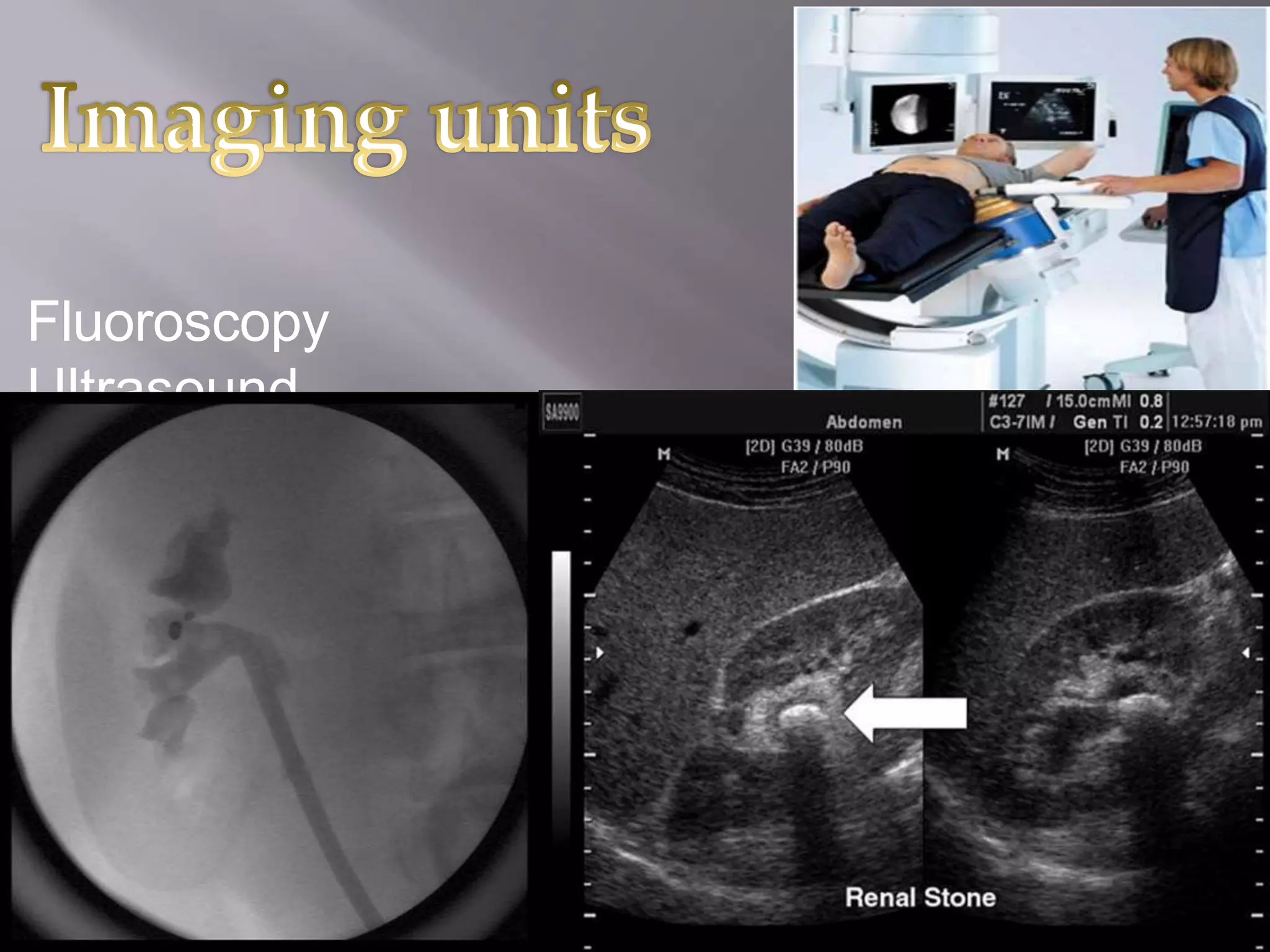
4) An imaging/localization units
 Provide a air-free contact
 In the propagation and transmission
of a wave, energy is lost at
interfaces with differing densities.
 A coupling system is needed to
minimize the dissipation of energy of
a shockwave as it traverses the skin
surface
Transcranial magnetic stimulation Dornier
Fluoroscopy
Ultrasound
1) find out the location of stone
2) Fasting
3) Take the blood pressure
4) Check the cardiac physical exam
5) Pre-medication (pain relief)
6) Check LMP for female patients
7) Brief the details of the treatment to the
patient
Lie the patient on the table
(Supine
oblique or prone(
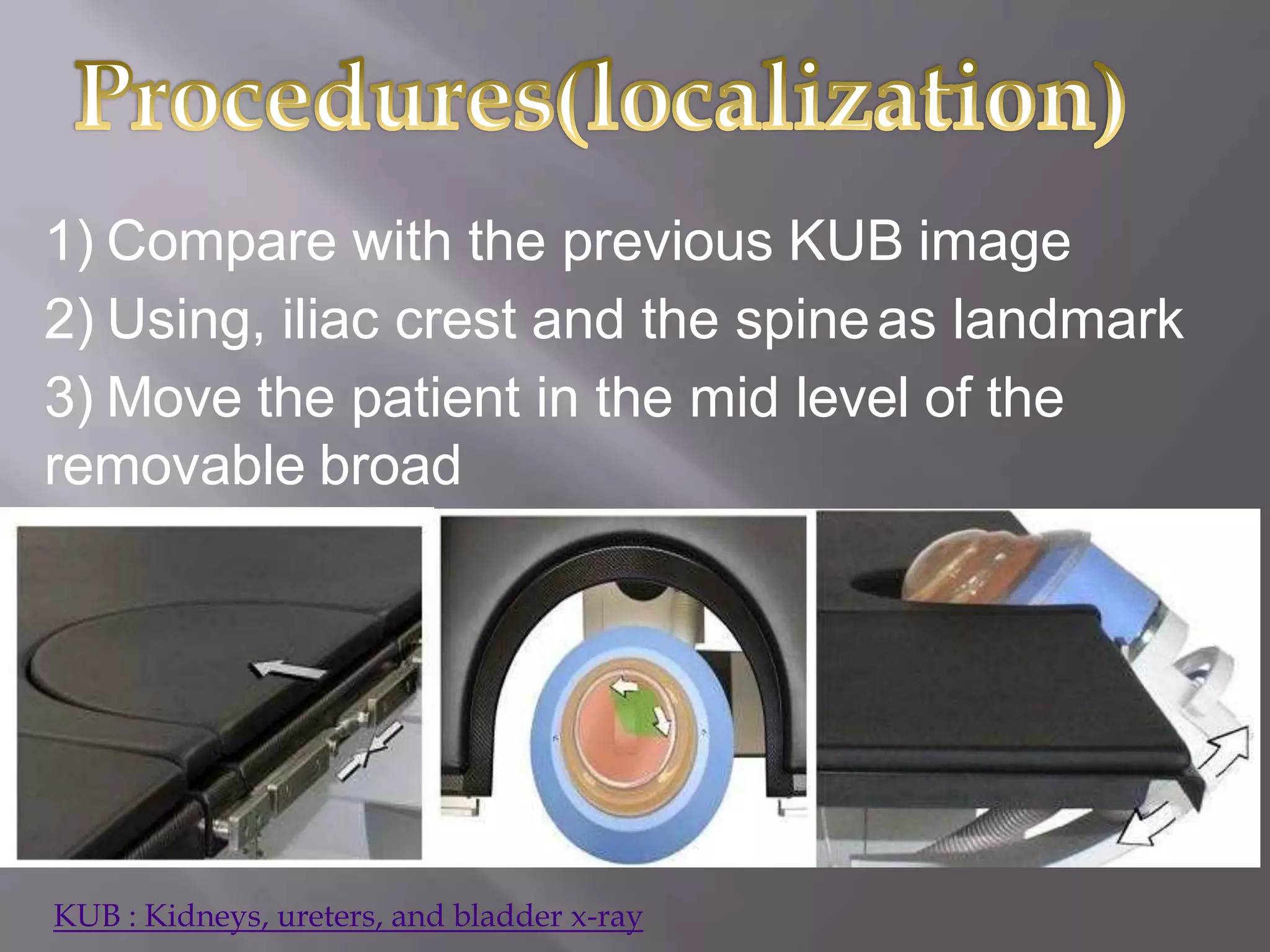
1) Compare with the previous KUB image
2) Using, iliac crest and the spineas landmark
3) Move the patient in the mid level of the
removable broad
KUB : Kidneys, ureters, and bladder x-ray
4)Remove the broad
5)Apply gel to the coupling cushion
6)Move the coupling cushion to treatment
position
7) Increase the coupling pressure and
touch
the patient skin
8) Apply soft pad or sand bag on the
opposite side of the
patient (immobilize the patient)
10)Screening in PA view
11)Move the table to locate the stone in the
center
12)Screening in CC view
13)Adjust the height of the table to
locate the stone in center
14) Instruct to the patient
15) Call doctor to confirm the position and
start the treatment
 Select the suitable parameters
1)Power of shockwave (start from low energy
level to high energy level)
2)The frequency of shockwave (ECG gated for
patients with cardiac pacemakers or those with
arrhythmias who regularly take anti-arrythmic
drugs
3) Total energy of shockwave
(Renal stone < Ureteric stone(
High energy level + high frequency = shorter treatment time
Low energy level + low frequency =longer treatment time
 Monitor the patient condition
e.g. Blood pressure,heart rate, pain
Any abnormality => Stop shock wave!
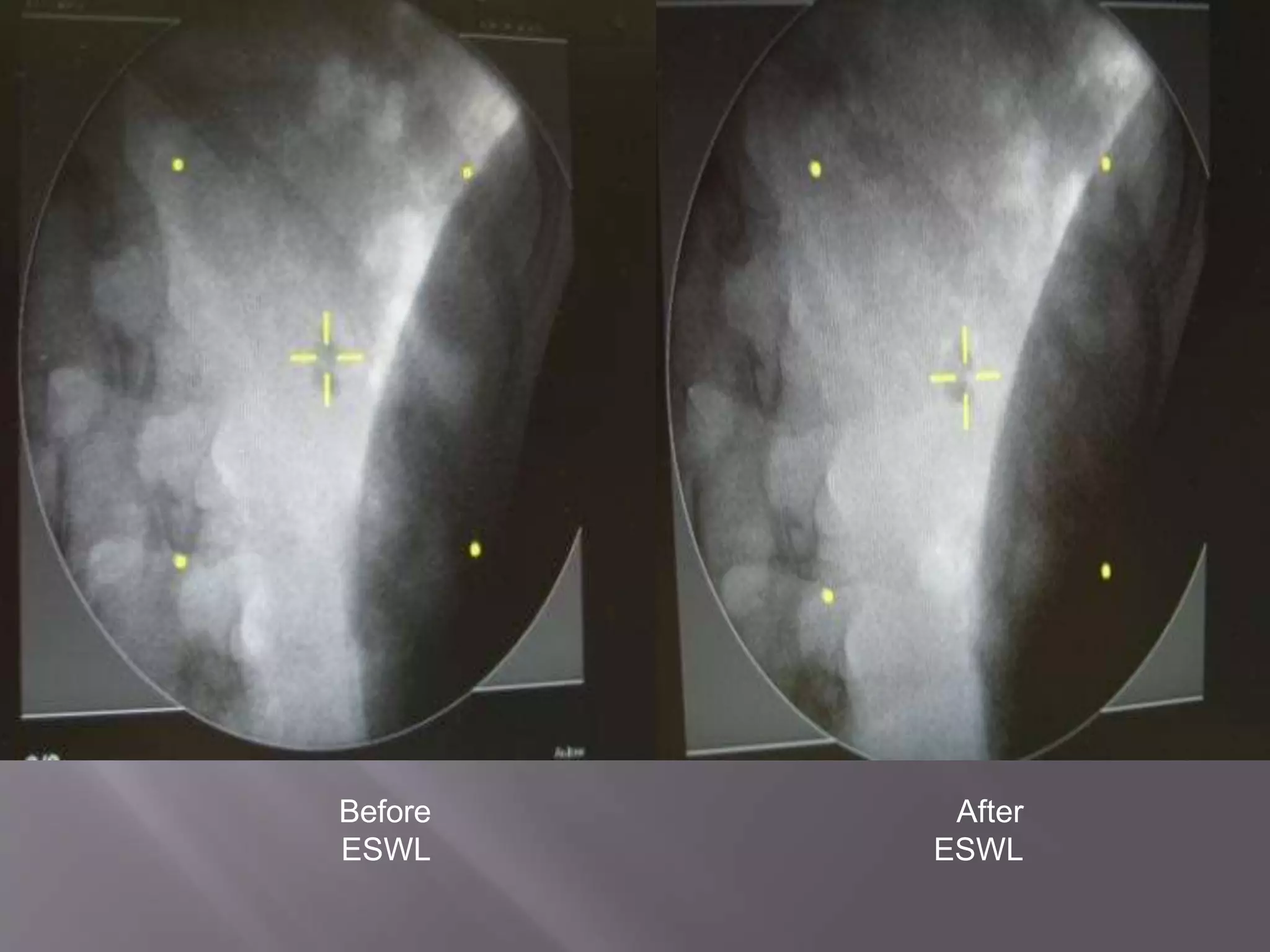
 Monitor the position and the progress
of
stone
Move far away from the center =>
Stop
shock wave and make adjustment!
Before
ESWL
After
ESWL
 Patient is being observed for at least an
hour in Day ward.
 Follow up 2 weeks later with X-ray (KUB)
 Remaining Stone => ESWL again
 Other treatment
 Hematomas
 Risk of hemorrhage
 Hyperventilation
tetany
 Blockage of urinary
tract
The higher the total
energy, the higher
risk
DisadvantagesAdvantages
 May require repeat
procedures
 Not suitable for all
types of stones
 Cause complications
 Painful
 Non-invasive
 Safe
 No General
anesthesia
 Short treatment time
 Convenience
1) Presentation powerpoint by Beatrice Pang and Connie Li,2011
2) Dornier Medtech. Operating Manual of Dornier Gemini. 2012
3) JS Rodman et al. No more kidney stones. 2007
4) SWH Chan et al.A report on randomly sampled questionnaire
survey about renal stone disease in Hong Kong. HK Med J.
2008
5) B Sturtevant et al. Fracture mechanics model of stone
comminutionin ESWL and implications for tissue damage. Phys
Med Biol. 2000
6) W Eisenmenger.The mechanisms of stone fragmentation in
ESWL.
Ultrasound in Med. & Biol. 2001
7) http://zh.wikipedia.org/w/index.php?title=Image:KUB_stone.j
pg&variant=zh-tw
8) http://www.medison.ru/uzi/img/p287.jpg
9) http://www.mwstone.com/STONES/equipment.htm
10) http://www.tms-uro.com/eng/physicians/swl/1a_vision_device.htm
11) http://www.dornier.com/EMEA/clinical-
solutions/urology/kidney-stones/
12) http://emedicine.medscape.com/article/444554-overview
Extracorporeal shock wave lithotripsy (eswl)

Extracorporeal shock wave lithotripsy (eswl)

  • 1.
     DONE BY: MUSTAFA KHALIL IBRAHIM  TBILISI STATE MEDICAL UNIVERSITY  4th year, 1st semester, 2nd group Extracorporeal shock wave lithotripsy (ESWL(
  • 2.
  • 3.
     Crystallization of mineralsinside urine, which act as the nidus for more sedimentation and finally the formation of a stone within the kidney.
  • 4.
     Calcium-containing stone Calcium Oxalate  Calcium Phosphate  Uric acid stone  Cysteine stones
  • 5.
     NO symptom Pain: sudden or severe pain  nausea, vomiting  Renal colic  Frequent and painful urination, hematuria  Urinary tract infection: Block the urinary tract
  • 6.
  • 7.
     ESWL  Percutaneousnephrolithotomy  Ureteroscopy  Open surgery
  • 8.
     Use focusingShock Waves to breakdown a stone into small pieces.  Shock waves are acoustic pulses.  Pass through better in water and solid but not in air.  Introduce in 1980 by Dornier which is a supersonic aircraft
  • 9.
    Contra-indicationIndication  Relevant coagulationproblems  Lung tissue in shock wave path  Tumors in shock wave area  Aneurysms  Polyarthritis (difficult to positioning)  Active pyelonephritis  Pregnancy • Stones of less than 2 cm in the kidney • Or • less than 1 cm in the ureter.
  • 10.
    1) A shockwavegenerator (electromagnetic generator) 2) A focusing system 3) A coupling system 4) An imaging/localization units
  • 12.
     Provide aair-free contact  In the propagation and transmission of a wave, energy is lost at interfaces with differing densities.  A coupling system is needed to minimize the dissipation of energy of a shockwave as it traverses the skin surface
  • 13.
  • 14.
  • 16.
    1) find outthe location of stone 2) Fasting 3) Take the blood pressure 4) Check the cardiac physical exam 5) Pre-medication (pain relief) 6) Check LMP for female patients 7) Brief the details of the treatment to the patient
  • 17.
    Lie the patienton the table (Supine oblique or prone(
  • 18.
    1) Compare withthe previous KUB image 2) Using, iliac crest and the spineas landmark 3) Move the patient in the mid level of the removable broad KUB : Kidneys, ureters, and bladder x-ray
  • 19.
    4)Remove the broad 5)Applygel to the coupling cushion 6)Move the coupling cushion to treatment position 7) Increase the coupling pressure and touch the patient skin 8) Apply soft pad or sand bag on the opposite side of the patient (immobilize the patient)
  • 20.
    10)Screening in PAview 11)Move the table to locate the stone in the center 12)Screening in CC view 13)Adjust the height of the table to locate the stone in center 14) Instruct to the patient 15) Call doctor to confirm the position and start the treatment
  • 22.
     Select thesuitable parameters 1)Power of shockwave (start from low energy level to high energy level) 2)The frequency of shockwave (ECG gated for patients with cardiac pacemakers or those with arrhythmias who regularly take anti-arrythmic drugs 3) Total energy of shockwave (Renal stone < Ureteric stone( High energy level + high frequency = shorter treatment time Low energy level + low frequency =longer treatment time
  • 23.
     Monitor thepatient condition e.g. Blood pressure,heart rate, pain Any abnormality => Stop shock wave!  Monitor the position and the progress of stone Move far away from the center => Stop shock wave and make adjustment!
  • 24.
  • 26.
     Patient isbeing observed for at least an hour in Day ward.  Follow up 2 weeks later with X-ray (KUB)  Remaining Stone => ESWL again  Other treatment
  • 27.
     Hematomas  Riskof hemorrhage  Hyperventilation tetany  Blockage of urinary tract The higher the total energy, the higher risk
  • 28.
    DisadvantagesAdvantages  May requirerepeat procedures  Not suitable for all types of stones  Cause complications  Painful  Non-invasive  Safe  No General anesthesia  Short treatment time  Convenience
  • 29.
    1) Presentation powerpointby Beatrice Pang and Connie Li,2011 2) Dornier Medtech. Operating Manual of Dornier Gemini. 2012 3) JS Rodman et al. No more kidney stones. 2007 4) SWH Chan et al.A report on randomly sampled questionnaire survey about renal stone disease in Hong Kong. HK Med J. 2008 5) B Sturtevant et al. Fracture mechanics model of stone comminutionin ESWL and implications for tissue damage. Phys Med Biol. 2000 6) W Eisenmenger.The mechanisms of stone fragmentation in ESWL. Ultrasound in Med. & Biol. 2001 7) http://zh.wikipedia.org/w/index.php?title=Image:KUB_stone.j pg&variant=zh-tw 8) http://www.medison.ru/uzi/img/p287.jpg 9) http://www.mwstone.com/STONES/equipment.htm 10) http://www.tms-uro.com/eng/physicians/swl/1a_vision_device.htm 11) http://www.dornier.com/EMEA/clinical- solutions/urology/kidney-stones/ 12) http://emedicine.medscape.com/article/444554-overview