Positron Emission
Tomography…
_ Ramzee Small
Outline
Positron Emission Tomography
 Definition
 Clinical Application
 Main System Components
 Principle of PET
 Image Acquisition
 Image Reconstruction
 Pros and Cons
 Basic Configuration of PET Facility
 References
What is PET??..
Positron Emission Tomography is an imaging technique
which uses small amounts of radiolabeled biologically
active compounds to help in the diagnosis of disease.
The tracers are introduced into the body, by either injection
or inhalation of a gas.
PET scanner is used to produce an image showing the
distribution of the tracer in the body.
Clinical Applications of PET
 Oncology
Role in lesion detection, lesion characterization, staging of malignant lesions
and assessment of the therapeutic response
 Brain
PET Study the brain's blood flow and metabolic activity. It aid in discovery of
nervous system problems, such as Alzheimer's disease, Parkinson's disease etc.
 Heart
PET can help find damaged heart tissue especially after a heart attack and can
help choose the best treatment such as coronary bypass heart surgery for a
person with heart disease.
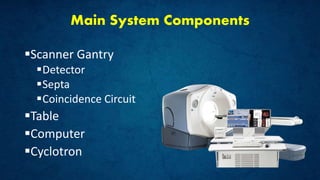
Main System Components
Scanner Gantry
Detector
Septa
Coincidence Circuit
Table
Computer
Cyclotron
Main System Component…
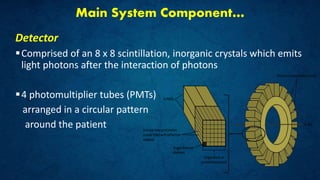
Detector
Comprised of an 8 x 8 scintillation, inorganic crystals which emits
light photons after the interaction of photons
4 photomultiplier tubes (PMTs)
arranged in a circular pattern
around the patient
Main System Components…
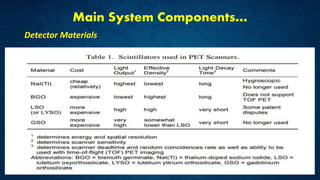
Detector Materials
Main System Component
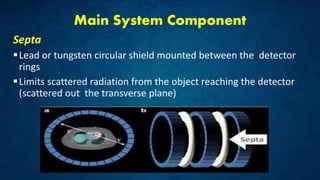
Septa
Lead or tungsten circular shield mounted between the detector
rings
Limits scattered radiation from the object reaching the detector
(scattered out the transverse plane)
Main System Component
Coincidence circuit
Specific electronic circuits "coincidence" circuits pick up gamma
pairs due to the two gamma rays emitted during the positron
annihilation almost simultaneously.
This coincidence is a very strong signature that distinguishes
them from other photons.
On the image it is requested that the signals coming from the
scintillators A and B coincide within 12 billionths of a second
(nanosecond).
Main System Component
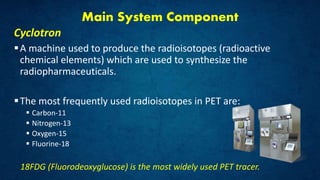
Cyclotron
A machine used to produce the radioisotopes (radioactive
chemical elements) which are used to synthesize the
radiopharmaceuticals.
The most frequently used radioisotopes in PET are:
 Carbon-11
 Nitrogen-13
 Oxygen-15
 Fluorine-18
18FDG (Fluorodeoxyglucose) is the most widely used PET tracer.
Main System Component
Table
The bed is capable of moving in and out of the scanner to measure
the distribution of PET radiopharmaceuticals throughout the body,
and it adjusts to a very low position for easy patient access
Computer
A computer analyzes the gamma rays and uses the information to
create an image map of the organ or tissue being studied.
Principle of PET
Positron Emission
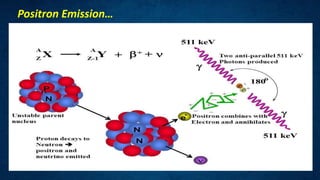
Positron Emission occurs when the isotope decays and a proton
decays to a Neutron, a Positron and a Neutrino.
After traveling a short distance (3-5mm), the positron emitted
encounters an electron from the surrounding environment.
The two particles combine and "annihilate" each other, resulting
in the emission of two gamma rays in opposite directions of 0.511
MeV each.
Positron Emission…
Principle of PET
Emission Detection
As positron annihilation occurs, the detector detects the isotope's
location and concentration
The resultant light photons are converted to electrical signals that
are registered by the system electronics almost instantly
 The reconstruction software then takes the coincidence events
measured at all angular and linear positions to reconstruct an
image
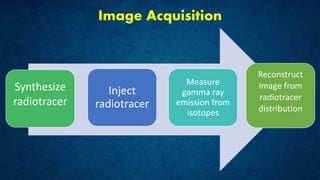
Image Acquisition
Inject
radiotracer
Measure
gamma ray
emission from
isotopes
Synthesize
radiotracer
Reconstruct
image from
radiotracer
distribution
Image Acquisition…
Image Acquisition…
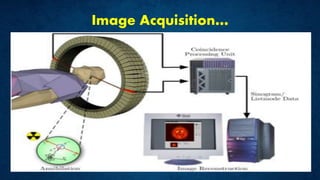
• The image acquisition is based on the external detection in
coincidence of the emitted Gamma rays.
• Valid annihilation event requires a coincidence within 12
nanoseconds between two detectors on opposite sides of the
scanner.
• For accepted coincidences, lines of response connecting the
coincidence detectors are drawn through the object and used in
the image reconstruction.
Image Reconstruction
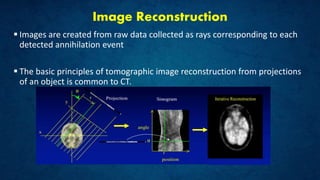
 Images are created from raw data collected as rays corresponding to each
detected annihilation event
 The basic principles of tomographic image reconstruction from projections
of an object is common to CT.
Image Reconstruction…
Process…
 The detectors collect a series of lines of responses LORs,
 A profile of counts versus distance is produced for each angle of LORs
 Each profile maps the location of the source in the direction parallel to the
scan profile (however, the source can lie at any depth along the line
perpendicular to that profile)
 The source distribution can be obtained by projecting the data from each
scan profile back across the entire image grid. [backprojection]
Image Reconstruction…
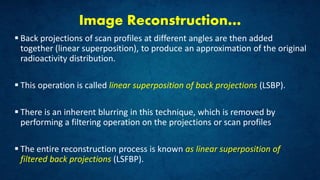
 Back projections of scan profiles at different angles are then added
together (linear superposition), to produce an approximation of the original
radioactivity distribution.
 This operation is called linear superposition of back projections (LSBP).
 There is an inherent blurring in this technique, which is removed by
performing a filtering operation on the projections or scan profiles
 The entire reconstruction process is known as linear superposition of
filtered back projections (LSFBP).
Image Reconstruction
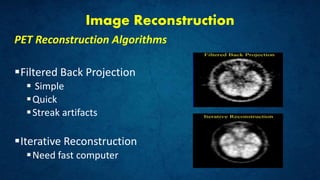
PET Reconstruction Algorithms
Filtered Back Projection
 Simple
Quick
Streak artifacts
Iterative Reconstruction
Need fast computer
Pros and Cons
Advantages
 Uniquely shows the chemical functioning
of organs and tissues
 Detect functional changes
 Study metabolic functions- may be an
alternative to biopsy.
 Distinguish between benign and malignant
tumors- reducing unnecessary surgeries
due to misdiagnosis
 Determine the spread of disease (cancer)
and function of the heart.
 Diagnose early stages of neurological
illness, e.g. Epilepsy, Alzheimer's disease.
Disadvantages
 Ionizing radiation
 Radioactive compound is short lived.
 Radioisotope must be produced in a
laboratory near the PET scanner.
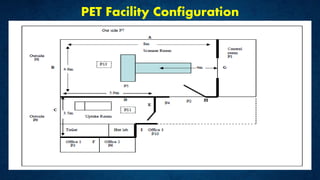
PET Facility Configuration
Finally!!! A Scan that is available for all PETs…
and not just CAT…
References
 Alessio AM, Kinahan PE, Cheng PM, Vesselle H, Karp JS. PET/CT scanner instrumentation,
challenges, and solutions. Radiol Clin N Am. 2004;42(6):1017-32.
 Phelps ME, HotTman EJ, Mullani NA, Ter-Pogossian MM. Applications of annihilation
coincidence to transaxial reconstruction tomography. J Nucl Med 1975;16:210-224.
 Valk PE, Bailey DE, Townsend DW, Maisey MN. Positron Emission Tomography: Basic
Science and Clinical Practice. London: Springer-Verlag; 2003.
 Fahey H. F. Data Acquisition in PET Imaging, Journal of Nuclear Medical Technology; June
2002;30(2):39-49
 Daghighian F., Sumida. R, Phelps E. M. PET imaging: An overview and instrumentation. J.
Nucl. Med. Technol. 1990;18:5-13.
 ShuklaK. A, Kumar U. Positron emission tomography Scan; an overview J Med Phys. 2006
Jan-Mar; 31(1): 13–21. doi: 10.4103/0971-6203.25665
 Ranger NT, Thompson CJ, Evans AC. The Application of a masked orbiting transmission
source for attenuation correction in PET. J Nucl Med. 1989;30:1056–68.

Positron Emission Tomography

  • 1.
  • 2.
    Outline Positron Emission Tomography Definition  Clinical Application  Main System Components  Principle of PET  Image Acquisition  Image Reconstruction  Pros and Cons  Basic Configuration of PET Facility  References
  • 3.
    What is PET??.. PositronEmission Tomography is an imaging technique which uses small amounts of radiolabeled biologically active compounds to help in the diagnosis of disease. The tracers are introduced into the body, by either injection or inhalation of a gas. PET scanner is used to produce an image showing the distribution of the tracer in the body.
  • 4.
    Clinical Applications ofPET  Oncology Role in lesion detection, lesion characterization, staging of malignant lesions and assessment of the therapeutic response  Brain PET Study the brain's blood flow and metabolic activity. It aid in discovery of nervous system problems, such as Alzheimer's disease, Parkinson's disease etc.  Heart PET can help find damaged heart tissue especially after a heart attack and can help choose the best treatment such as coronary bypass heart surgery for a person with heart disease.
  • 5.
    Main System Components ScannerGantry Detector Septa Coincidence Circuit Table Computer Cyclotron
  • 6.
    Main System Component… Detector Comprisedof an 8 x 8 scintillation, inorganic crystals which emits light photons after the interaction of photons 4 photomultiplier tubes (PMTs) arranged in a circular pattern around the patient
  • 7.
  • 8.
    Main System Component Septa Leador tungsten circular shield mounted between the detector rings Limits scattered radiation from the object reaching the detector (scattered out the transverse plane)
  • 9.
    Main System Component Coincidencecircuit Specific electronic circuits "coincidence" circuits pick up gamma pairs due to the two gamma rays emitted during the positron annihilation almost simultaneously. This coincidence is a very strong signature that distinguishes them from other photons. On the image it is requested that the signals coming from the scintillators A and B coincide within 12 billionths of a second (nanosecond).
  • 10.
    Main System Component Cyclotron Amachine used to produce the radioisotopes (radioactive chemical elements) which are used to synthesize the radiopharmaceuticals. The most frequently used radioisotopes in PET are:  Carbon-11  Nitrogen-13  Oxygen-15  Fluorine-18 18FDG (Fluorodeoxyglucose) is the most widely used PET tracer.
  • 11.
    Main System Component Table Thebed is capable of moving in and out of the scanner to measure the distribution of PET radiopharmaceuticals throughout the body, and it adjusts to a very low position for easy patient access Computer A computer analyzes the gamma rays and uses the information to create an image map of the organ or tissue being studied.
  • 12.
    Principle of PET PositronEmission Positron Emission occurs when the isotope decays and a proton decays to a Neutron, a Positron and a Neutrino. After traveling a short distance (3-5mm), the positron emitted encounters an electron from the surrounding environment. The two particles combine and "annihilate" each other, resulting in the emission of two gamma rays in opposite directions of 0.511 MeV each.
  • 13.
  • 14.
    Principle of PET EmissionDetection As positron annihilation occurs, the detector detects the isotope's location and concentration The resultant light photons are converted to electrical signals that are registered by the system electronics almost instantly  The reconstruction software then takes the coincidence events measured at all angular and linear positions to reconstruct an image
  • 15.
    Image Acquisition Inject radiotracer Measure gamma ray emissionfrom isotopes Synthesize radiotracer Reconstruct image from radiotracer distribution
  • 16.
  • 17.
    Image Acquisition… • Theimage acquisition is based on the external detection in coincidence of the emitted Gamma rays. • Valid annihilation event requires a coincidence within 12 nanoseconds between two detectors on opposite sides of the scanner. • For accepted coincidences, lines of response connecting the coincidence detectors are drawn through the object and used in the image reconstruction.
  • 18.
    Image Reconstruction  Imagesare created from raw data collected as rays corresponding to each detected annihilation event  The basic principles of tomographic image reconstruction from projections of an object is common to CT.
  • 19.
    Image Reconstruction… Process…  Thedetectors collect a series of lines of responses LORs,  A profile of counts versus distance is produced for each angle of LORs  Each profile maps the location of the source in the direction parallel to the scan profile (however, the source can lie at any depth along the line perpendicular to that profile)  The source distribution can be obtained by projecting the data from each scan profile back across the entire image grid. [backprojection]
  • 20.
    Image Reconstruction…  Backprojections of scan profiles at different angles are then added together (linear superposition), to produce an approximation of the original radioactivity distribution.  This operation is called linear superposition of back projections (LSBP).  There is an inherent blurring in this technique, which is removed by performing a filtering operation on the projections or scan profiles  The entire reconstruction process is known as linear superposition of filtered back projections (LSFBP).
  • 21.
    Image Reconstruction PET ReconstructionAlgorithms Filtered Back Projection  Simple Quick Streak artifacts Iterative Reconstruction Need fast computer
  • 22.
    Pros and Cons Advantages Uniquely shows the chemical functioning of organs and tissues  Detect functional changes  Study metabolic functions- may be an alternative to biopsy.  Distinguish between benign and malignant tumors- reducing unnecessary surgeries due to misdiagnosis  Determine the spread of disease (cancer) and function of the heart.  Diagnose early stages of neurological illness, e.g. Epilepsy, Alzheimer's disease. Disadvantages  Ionizing radiation  Radioactive compound is short lived.  Radioisotope must be produced in a laboratory near the PET scanner.
  • 23.
  • 24.
    Finally!!! A Scanthat is available for all PETs… and not just CAT…
  • 25.
    References  Alessio AM,Kinahan PE, Cheng PM, Vesselle H, Karp JS. PET/CT scanner instrumentation, challenges, and solutions. Radiol Clin N Am. 2004;42(6):1017-32.  Phelps ME, HotTman EJ, Mullani NA, Ter-Pogossian MM. Applications of annihilation coincidence to transaxial reconstruction tomography. J Nucl Med 1975;16:210-224.  Valk PE, Bailey DE, Townsend DW, Maisey MN. Positron Emission Tomography: Basic Science and Clinical Practice. London: Springer-Verlag; 2003.  Fahey H. F. Data Acquisition in PET Imaging, Journal of Nuclear Medical Technology; June 2002;30(2):39-49  Daghighian F., Sumida. R, Phelps E. M. PET imaging: An overview and instrumentation. J. Nucl. Med. Technol. 1990;18:5-13.  ShuklaK. A, Kumar U. Positron emission tomography Scan; an overview J Med Phys. 2006 Jan-Mar; 31(1): 13–21. doi: 10.4103/0971-6203.25665  Ranger NT, Thompson CJ, Evans AC. The Application of a masked orbiting transmission source for attenuation correction in PET. J Nucl Med. 1989;30:1056–68.