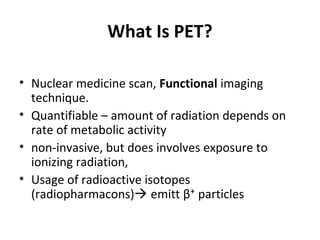
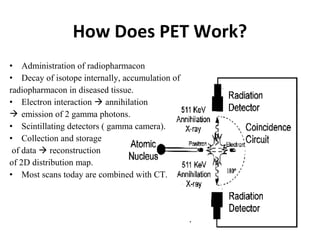
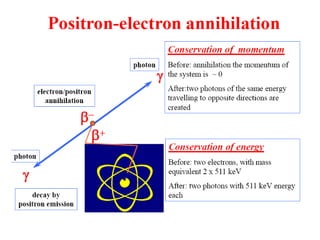
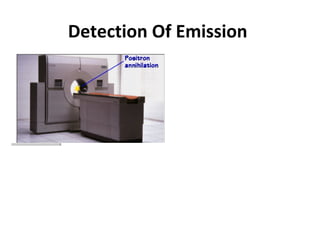
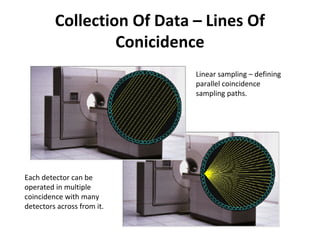
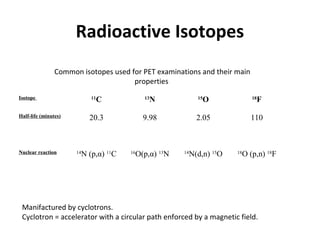
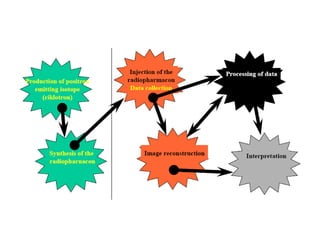
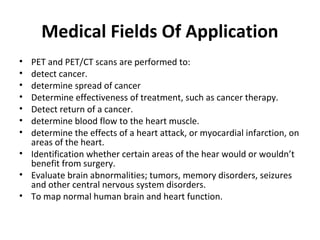
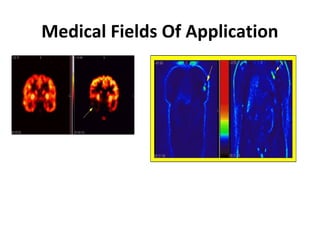
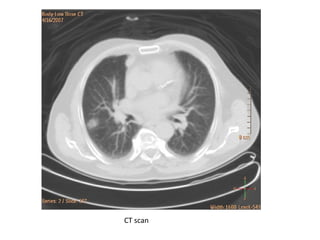
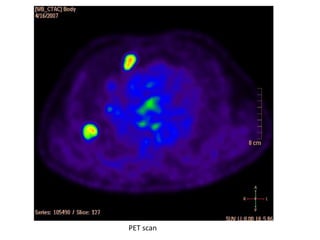
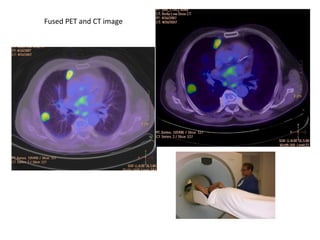
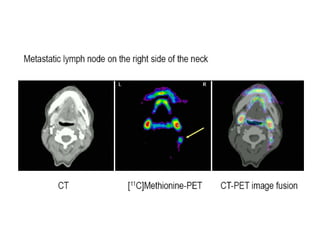
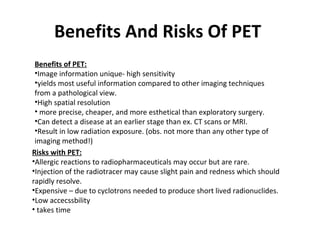
PET is a nuclear medicine scan that uses radioactive tracers to visualize metabolic processes in the body. It works by administering a radioactive tracer that accumulates in tissues and organs, emitting gamma rays that are detected by a ring of scintillation detectors. This allows reconstruction of 2D images showing tracer concentration. Common tracers include carbon-11, nitrogen-13, oxygen-15 and fluorine-18, which are produced by a cyclotron. PET scans are used to detect and monitor cancer, heart disease, and brain disorders. The scans provide functional information that can be fused with anatomical CT or MRI images. While exposing patients to radiation, PET offers high sensitivity for disease detection at early stages.


![Pet appilcation[1]](https://cdn.slidesharecdn.com/ss_thumbnails/petappilcation1-191002015502-thumbnail.jpg?width=640&height=640&fit=bounds)


![PET - Production of [18F] PET tracers: Beyond [18F]FDG](https://cdn.slidesharecdn.com/ss_thumbnails/jq5oqe2qnkyw3vzn1pyb-signature-e2021a44809bb314ac99609dc68de0b69b8ecda2aded008bfe49c080b80c183b-poli-180221142953-thumbnail.jpg?width=640&height=640&fit=bounds)


