RADIOACTIVE WASTE 
DISPOSAL METHODS 
MSc. Pt 1 Environmental Science 
K. J. Somaiya College of Sci and Comm. 
Dhananjay Patil 
Bruno Fernandes 
Milind Joshi 
Chirag Patel
Content 
1. Motivation 
2. Learning objective 
3. Introduction 
4. Methods of waste disposal 
5. Conclusion 
6. Facts 
7. Take away message 
8. References
Motivation 
 The current trends say that nuclear power is a huge source of energy. On the 
contrary the byproducts obtained after production of energy are hazardous and 
have a very great impact on the environment as well as on human health. 
 The well known incident of Hiroshima and Nagasaki and also the Fukushima 
disaster is deeply rooted in the minds of every individual and the effects are 
faced by the people till date.
Learning objective 
 Since nuclear power being used on a large scale today our main objective is to 
learn and understand the harmful after effects of these nuclear toxicants and 
understand the way in which their disposal takes place without causing much 
harm to the environment. 
 Advantages and disadvantages of radioactive materials.
Introduction 
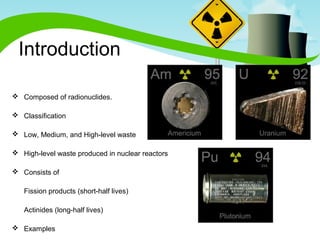
 Composed of radionuclides. 
 Classification 
 Low, Medium, and High-level waste 
 High-level waste produced in nuclear reactors 
 Consists of 
Fission products (short-half lives) 
Actinides (long-half lives) 
 Examples
Methods of waste 
disposal 
1. Decay in Storage (DIS) 
2. Dump to Sanitary Sewer 
3. Dispose as if not radioactive 
4. Vitrification 
5. Geological disposal 
6. Reprocessing 
7. Transmutation 
8. Space disposal 
9. Deep boreholes
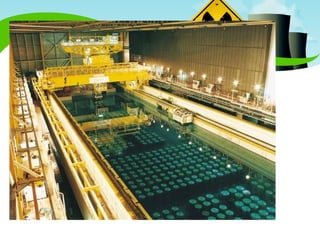
Decay in Storage (DIS) 
 Store waste in the laboratory if the half-life is no more than 120 days. 
 “DIS” Isotopes must be held for decay for at least 10 half-lives. 
 Survey monitoring of material must read close to background. 
 All radioactive labeling must be defaced. 
 Document in log
Dump to Sanitary Sewer 
 Must be water soluble or readily dispersible biological material in water. 
 Concentration per month is limited by the regulations, check with the 
Radiation Safety Officer. 
 May obtain permission from the Radiation Safety Office prior to dumping - 
Only way to know if other people are dumping.
Dump to Sanitary Sewer 
Contd. 
 Annual Limit per Facility 
H-3 - 5 curies 
C-14 - 1 curie 
 All other radionuclides combined - 1 curie
Dispose as if not Radioactive 
 Scintillation medium containing no more than 0.05 microcuries per ml of H-3, or 
C-14 may be discarded as if it was not radioactive. If chemical solvent is 
disposed of properly the radioactivity will not pose a problem. 
 A record shall be kept of each such disposal for the life of the license; it may be 
sent to the RSO
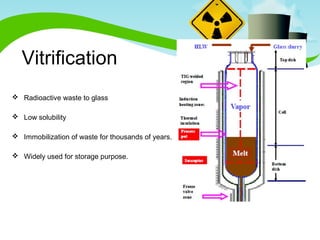
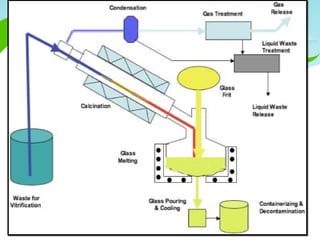
Vitrification 
 Radioactive waste to glass 
 Low solubility 
 Immobilization of waste for thousands of years. 
 Widely used for storage purpose.
Vitrification
Geological 
Disposal 
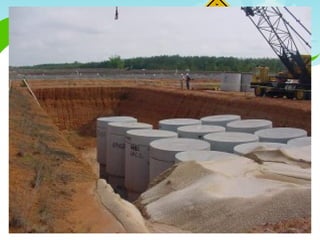
 Burrowing nuclear waste into the ground 
to the point where it is out of human reach 
 Large variety of geological environments 
suitable for disposal 
 Depth of burial is very high 
 Waste can be recovered 
 Most widely used method 
 Practically feasible with current 
technology
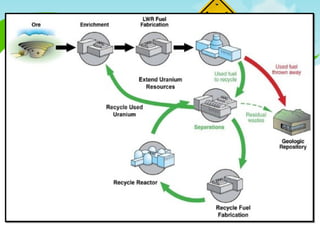
Reprocessing 
 Long term method 
 Separating useful components from non useful 
 Fissionable material out from irradiated nuclear fuel
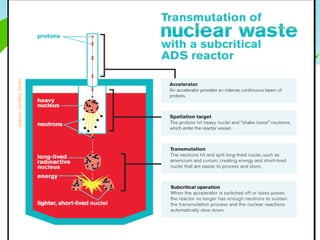
Transmutation 
 Long term disposal. 
 Converting a chemical into non harmful one. 
 Example: Cl to Ar, K to Ar 
 Outside stimulus like proton hitting reaction materials 
 Natural transmutation
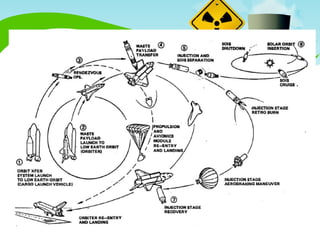
Space Disposal 
 Near infinite storage space 
 Completely removes waste from biosphere Technical risks and problems 
 High risk of space vehicle failure 
 Relatively limited volume per launch 
 High energy cost of space launch o The current cost to launch an object into orbit around 
the earth is about $20,000 per kilogram. 
 Beamed energy technology (BEP)
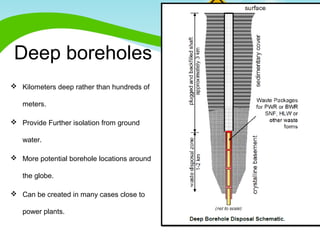
Deep boreholes 
 Kilometers deep rather than hundreds of 
meters. 
 Provide Further isolation from ground 
water. 
 More potential borehole locations around 
the globe. 
 Can be created in many cases close to 
power plants.
Conclusion 
 Proper disposal of nuclear waste is still a challenging issue that constrains the growth of 
nuclear power. The most currently-used method for nuclear waste disposal is storage, 
either using steel cylinders as radioactive shield or using deep and stable geologic 
formations.
References 
1. Bhabha Atomic Research Centre (BARC). (n.d.) Radioactive waste management 
[online]. Available from: http://www.barc.gov.in/ [Accessed 10th October 2014]. 
2. Organisation for Economic Co-operation and Development (OECD). (1989) NEA Issue 
Brief: An analysis of principal nuclear issues [online]. Available from https://www.oecd-nea. 
org [Accessed 9th October 2014]. 
3. Th. Briggs, P. L. Kunsch and B. Mareschal. (1990) "Nuclear Waste Management: An 
Application of the Multicriteria PROMETHEE Methods“ Eur. J. Oper. Res. 44, 1 
4. World Nuclear Association. (2014) Radioactive Waste Management [online]. Available 
from: http://www.world-nuclear.org [Accessed 9th October 2014]. 
5. U.S. Nuclear Regulatory Commission.(n.d.) “Radioactive waste." Available from: 
http://www.nrc.gov/waste.html. [Accessed 9th October 2014].
Facts 
 It still contains 95% of its energy. That's like taking a couple tablespoons out of a liter of 
pop and throwing the rest away if we don't make use of it! 
 Nuclear fuel is around 20,00,000 times more energy dense than coal, oil, and biomass. 
This means the quantity of nuclear waste is super tiny for the super huge amount of 
energy it produces. 20,00,000 times is like the difference between the diameter of the 
moon compared to the height of an adult person 
 It can be recycled, and actually produces energy while being recycled, instead of 
requiring energy to recycle! 
 Even including the worst accidents in worldwide nuclear history, nuclear has the best 
safety record (deaths/yr) of any type of energy source, including wind, solar, natural gas, 
and coal. There have been no deaths in the history of U.S. commercial nuclear power 
due to exposure to nuclear waste.
Take away message 
 Money and radioactivity go hand in hand, both have a large half life and both of 
them when used in excess harms the nature
Thank You!

Radioactive Waste disposal methods

  • 1.
    RADIOACTIVE WASTE DISPOSALMETHODS MSc. Pt 1 Environmental Science K. J. Somaiya College of Sci and Comm. Dhananjay Patil Bruno Fernandes Milind Joshi Chirag Patel
  • 2.
    Content 1. Motivation 2. Learning objective 3. Introduction 4. Methods of waste disposal 5. Conclusion 6. Facts 7. Take away message 8. References
  • 3.
    Motivation  Thecurrent trends say that nuclear power is a huge source of energy. On the contrary the byproducts obtained after production of energy are hazardous and have a very great impact on the environment as well as on human health.  The well known incident of Hiroshima and Nagasaki and also the Fukushima disaster is deeply rooted in the minds of every individual and the effects are faced by the people till date.
  • 4.
    Learning objective Since nuclear power being used on a large scale today our main objective is to learn and understand the harmful after effects of these nuclear toxicants and understand the way in which their disposal takes place without causing much harm to the environment.  Advantages and disadvantages of radioactive materials.
  • 5.
    Introduction  Composedof radionuclides.  Classification  Low, Medium, and High-level waste  High-level waste produced in nuclear reactors  Consists of Fission products (short-half lives) Actinides (long-half lives)  Examples
  • 6.
    Methods of waste disposal 1. Decay in Storage (DIS) 2. Dump to Sanitary Sewer 3. Dispose as if not radioactive 4. Vitrification 5. Geological disposal 6. Reprocessing 7. Transmutation 8. Space disposal 9. Deep boreholes
  • 7.
    Decay in Storage(DIS)  Store waste in the laboratory if the half-life is no more than 120 days.  “DIS” Isotopes must be held for decay for at least 10 half-lives.  Survey monitoring of material must read close to background.  All radioactive labeling must be defaced.  Document in log
  • 8.
    Dump to SanitarySewer  Must be water soluble or readily dispersible biological material in water.  Concentration per month is limited by the regulations, check with the Radiation Safety Officer.  May obtain permission from the Radiation Safety Office prior to dumping - Only way to know if other people are dumping.
  • 9.
    Dump to SanitarySewer Contd.  Annual Limit per Facility H-3 - 5 curies C-14 - 1 curie  All other radionuclides combined - 1 curie
  • 10.
    Dispose as ifnot Radioactive  Scintillation medium containing no more than 0.05 microcuries per ml of H-3, or C-14 may be discarded as if it was not radioactive. If chemical solvent is disposed of properly the radioactivity will not pose a problem.  A record shall be kept of each such disposal for the life of the license; it may be sent to the RSO
  • 11.
    Vitrification  Radioactivewaste to glass  Low solubility  Immobilization of waste for thousands of years.  Widely used for storage purpose.
  • 12.
  • 13.
    Geological Disposal Burrowing nuclear waste into the ground to the point where it is out of human reach  Large variety of geological environments suitable for disposal  Depth of burial is very high  Waste can be recovered  Most widely used method  Practically feasible with current technology
  • 14.
    Reprocessing  Longterm method  Separating useful components from non useful  Fissionable material out from irradiated nuclear fuel
  • 16.
    Transmutation  Longterm disposal.  Converting a chemical into non harmful one.  Example: Cl to Ar, K to Ar  Outside stimulus like proton hitting reaction materials  Natural transmutation
  • 17.
    Space Disposal Near infinite storage space  Completely removes waste from biosphere Technical risks and problems  High risk of space vehicle failure  Relatively limited volume per launch  High energy cost of space launch o The current cost to launch an object into orbit around the earth is about $20,000 per kilogram.  Beamed energy technology (BEP)
  • 18.
    Deep boreholes Kilometers deep rather than hundreds of meters.  Provide Further isolation from ground water.  More potential borehole locations around the globe.  Can be created in many cases close to power plants.
  • 19.
    Conclusion  Properdisposal of nuclear waste is still a challenging issue that constrains the growth of nuclear power. The most currently-used method for nuclear waste disposal is storage, either using steel cylinders as radioactive shield or using deep and stable geologic formations.
  • 20.
    References 1. BhabhaAtomic Research Centre (BARC). (n.d.) Radioactive waste management [online]. Available from: http://www.barc.gov.in/ [Accessed 10th October 2014]. 2. Organisation for Economic Co-operation and Development (OECD). (1989) NEA Issue Brief: An analysis of principal nuclear issues [online]. Available from https://www.oecd-nea. org [Accessed 9th October 2014]. 3. Th. Briggs, P. L. Kunsch and B. Mareschal. (1990) "Nuclear Waste Management: An Application of the Multicriteria PROMETHEE Methods“ Eur. J. Oper. Res. 44, 1 4. World Nuclear Association. (2014) Radioactive Waste Management [online]. Available from: http://www.world-nuclear.org [Accessed 9th October 2014]. 5. U.S. Nuclear Regulatory Commission.(n.d.) “Radioactive waste." Available from: http://www.nrc.gov/waste.html. [Accessed 9th October 2014].
  • 21.
    Facts  Itstill contains 95% of its energy. That's like taking a couple tablespoons out of a liter of pop and throwing the rest away if we don't make use of it!  Nuclear fuel is around 20,00,000 times more energy dense than coal, oil, and biomass. This means the quantity of nuclear waste is super tiny for the super huge amount of energy it produces. 20,00,000 times is like the difference between the diameter of the moon compared to the height of an adult person  It can be recycled, and actually produces energy while being recycled, instead of requiring energy to recycle!  Even including the worst accidents in worldwide nuclear history, nuclear has the best safety record (deaths/yr) of any type of energy source, including wind, solar, natural gas, and coal. There have been no deaths in the history of U.S. commercial nuclear power due to exposure to nuclear waste.
  • 22.
    Take away message  Money and radioactivity go hand in hand, both have a large half life and both of them when used in excess harms the nature
  • 23.