DONE BY :
MUSTAFA KHALIL IBRAHIM
TBILISI STATE MEDICAL
UNIVERSITY
4th year, 2st semester, 1nd group
The death of one
twins fetus in the
uterus occurs in 2.2
to 6.8 of twins .
1. Spontaneous Abortion:
 Miscarriage is more likely with multiple fetuses.
 The spontaneous abortion rate per live birth in singleton
pregnancies was 0.9 percent compared with 7.3 percent in
multiple pregnancies.
Furthermore, they found that monochorial placentation
was more common in multiple gestations ending in
miscarriage than in those resulting in a livebirth.
Twin pregnancies achieved through Assisted reproductive
technology are at increased risk for abortion compared
with those conceived spontaneously (Szymusik, 2012).
2. Congenital Malformations:
The incidence of congenital malformations is
appreciably increased in multifetal gestations compared
with singletons.
the rate of congenital malformations was 406 per 10,000
twins versus 238 per 10,000 singletons.
the malformation rate in monochorionic twins was
almost twice that of dichorionic twin gestations.
This increase has been attributed to the high incidence
of structural defects in monozygotic twins.
But from a 30-year European registry of multifetal births
found a steady increase in structural anomalies from
1987 (2.16 percent) to 2007 (3.26 percent). During this
time, the proportion of dizygotic twins increased by 30
percent, while the proportion of monozygotic twins
remained stable.
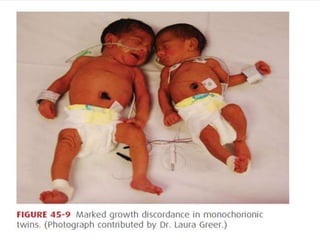
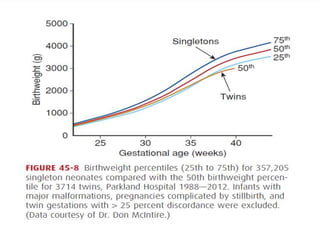
3. Low Birthweight:
 the degree of growth restriction increases with fetal number.
 abnormal growth should be diagnosed only when fetal size is less
than expected for multifetal gestation.
 The degree of growth restriction in monozygotic twins is likely to
be greater than that in dizygotic pairs.
 With monochorionic embryos, allocation of blastomeres may not
be equal, vascular anastomoses within the placenta may cause
unequal distribution of nutrients and oxygen, and discordant
structural anomalies resulting from the twinning event itself may
affect growth.
 In dizygotic pregnancies, marked size discordancy usually results
from unequal placentation, with one placental site receiving more
perfusion than the other. Size differences may also reflect different
genetic fetal-growth potentials. Discordancy can also result from
fetal malformations, genetic syndromes, infection, or umbilical
cord abnormalities such as velamentous insertion, marginal
insertion, or vasa previa
4.Hypertension: usually begins after 20 weeks of
pregnancy
 Hypertensive disorders due to pregnancy are more likely to
develop with multiple fetuses.
 because twin pregnancies are more likely to deliver preterm
before preeclampsia can develop and because women with
twin pregnancies are often older and multiparous.
 Case-control analyses suggest that prepregnancy body mass
index (BMI) ≥ 30 kg/m2 and egg donation are additional
independent risk factors for preeclampsia.
 These researchers found a twofold increased risk of
preeclampsia in women diagnosed with gestational diabetes.
 hypertension significantly increased for triplets and
quadruplets (11 and 12 percent, respectively) compared with
that for twins (8 percent).
 With multifetal gestation, hypertension not only develops
more often but also tends to develop earlier and be more
severe.
5.Preterm Birth:
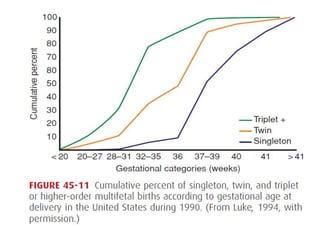
 Delivery before term is a major reason for increased
neonatal morbidity and mortality rates in multifetal
pregnancy.
 Prematurity is increased sixfold and tenfold in twins
and triplets,
 Although the causes of preterm delivery in twins and
singletons may be different, neonatal
6.Prolonged Pregnancy:
 More than 40 years ago, Bennett and Dunn (1969)
suggested that a twin pregnancy of 40 weeks or more
should be considered postterm.
 Twin stillborn neonates delivered at 40 weeks or
beyond commonly had features similar to those of
postmature singletons at and beyond 39 weeks,
 the risk of subsequent stillbirth was greater than the
risk of neonatal mortality.
7.Long-Term Infant Development :
 twins have been considered cognitively delayed compared
with singletons
 In contrast, among normal-birthweight infants, the cerebral
palsy risk is higher
 among twins and higher-order multiples. For example, the
cerebral palsy rate has been reported to be 2.3 per 1000 in
singletons, 12.6 per 1000 in twins, and 44.8 per 1000 in
triplets (Giuffre, 2012).
 Much of this excess risk is thought to be related to an
increased risk of fetal-growth
 restriction, congenital anomalies, twin-twin transfusion
syndrome, and fetal demise of a cotwin (Lorenz, 2012).
1.Monoamnionic Twins:
 Only about 1 percent of all monozygotic twins will share an
amnionic sac (Hall, 2003). Said another way, approximately 1 in
20 monochorionic twins are monoamnionic (Lewi, 2013).
 (2001) reported that monoamnionic twins diagnosed antenatally
and alive at 20 weeks have approximately a 10-percent risk of
subsequent fetal demise. In a Dutch report of 98 monoamnionic
twin pregnancies, the perinatal mortality rate was 17 percent
(Hack, 2009).
 Umbilical cord entanglement, a frequent cause of death, is
estimated to complicate at least half of cases .
 Diamnionic twins can become monoamnionic if the dividing
membrane ruptures and therefore have similar associated
morbidity and mortality rates.
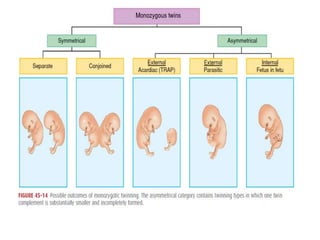
 Aberrant Twinning Mechanisms:
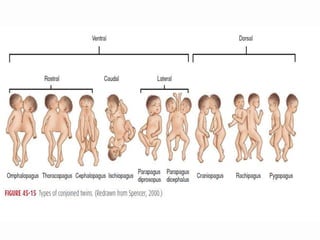
 Several aberrations in the twinning process result in a
spectrum
 of fetal malformations. These are traditionally ascribed
 to incomplete splitting of an embryo into two separate
twins.
 However, it is possible that they may result from early
secondary
 fusion of two separate embryos. These separated embryos
 are either symmetrical or asymmetrical, and the spectrum
 of anomalies is shown in Figure 45-14
2.Monochorionic Twins and
Vascular Anastomoses:
 Another group of fascinating fetal syndromes can arise when
monozygotic twinning results in two amnionic sacs and a common
surrounding chorion.
 This leads to anatomical sharing of the two fetal circulations through
anastomoses of placental arteries and veins.
 Artery-to-artery anastomoses are most common and are identified on
the chorionic surface of the placenta in up to 75 percent of
monochorionic twin placentas.
 Vein-to-vein and artery-to-vein communications are each found in
approximately
 half. One vessel may have several connections, sometimes to both
arteries and veins. In contrast to these superficial vascular connections
on the surface of the chorion, deep artery-tovein communications can
extend through the capillary bed of given villus.
 These deep arteriovenous anastomoses create a common villous
compartment or third circulation that has been identified in
approximately half of monochorionic twin placentas.
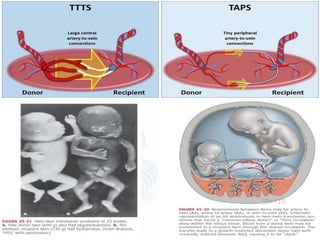
3.Twin-Twin Transfusion Syndrome
(TTTS):
The prevalence of this condition is approximately 1 to 3 per
 10,000 births (Simpson, 2013).
 In this syndrome, blood is transfused from a donor twin to its
recipient sibling such that the donor may eventually become
anemic and its growth may
be restricted.
 In contrast, the recipient becomes polycythemic and may
develop circulatory overload manifest as hydrops.
 The recipient neonate may have circulatory overload from
 heart failure and severe hypervolemia and hyperviscosity.
 Occlusive thrombosis is another concern.
 Finally, polycythemia in the recipient twin may lead to severe
hyperbilirubinemia and kernicterus .
 Williams Obstetrics 24th Ed
Twins complications
Twins complications

Twins complications

  • 1.
    DONE BY : MUSTAFAKHALIL IBRAHIM TBILISI STATE MEDICAL UNIVERSITY 4th year, 2st semester, 1nd group
  • 3.
    The death ofone twins fetus in the uterus occurs in 2.2 to 6.8 of twins .
  • 7.
    1. Spontaneous Abortion: Miscarriage is more likely with multiple fetuses.  The spontaneous abortion rate per live birth in singleton pregnancies was 0.9 percent compared with 7.3 percent in multiple pregnancies. Furthermore, they found that monochorial placentation was more common in multiple gestations ending in miscarriage than in those resulting in a livebirth. Twin pregnancies achieved through Assisted reproductive technology are at increased risk for abortion compared with those conceived spontaneously (Szymusik, 2012).
  • 8.
    2. Congenital Malformations: Theincidence of congenital malformations is appreciably increased in multifetal gestations compared with singletons. the rate of congenital malformations was 406 per 10,000 twins versus 238 per 10,000 singletons. the malformation rate in monochorionic twins was almost twice that of dichorionic twin gestations. This increase has been attributed to the high incidence of structural defects in monozygotic twins. But from a 30-year European registry of multifetal births found a steady increase in structural anomalies from 1987 (2.16 percent) to 2007 (3.26 percent). During this time, the proportion of dizygotic twins increased by 30 percent, while the proportion of monozygotic twins remained stable.
  • 9.
    3. Low Birthweight: the degree of growth restriction increases with fetal number.  abnormal growth should be diagnosed only when fetal size is less than expected for multifetal gestation.  The degree of growth restriction in monozygotic twins is likely to be greater than that in dizygotic pairs.  With monochorionic embryos, allocation of blastomeres may not be equal, vascular anastomoses within the placenta may cause unequal distribution of nutrients and oxygen, and discordant structural anomalies resulting from the twinning event itself may affect growth.  In dizygotic pregnancies, marked size discordancy usually results from unequal placentation, with one placental site receiving more perfusion than the other. Size differences may also reflect different genetic fetal-growth potentials. Discordancy can also result from fetal malformations, genetic syndromes, infection, or umbilical cord abnormalities such as velamentous insertion, marginal insertion, or vasa previa
  • 12.
    4.Hypertension: usually beginsafter 20 weeks of pregnancy  Hypertensive disorders due to pregnancy are more likely to develop with multiple fetuses.  because twin pregnancies are more likely to deliver preterm before preeclampsia can develop and because women with twin pregnancies are often older and multiparous.  Case-control analyses suggest that prepregnancy body mass index (BMI) ≥ 30 kg/m2 and egg donation are additional independent risk factors for preeclampsia.  These researchers found a twofold increased risk of preeclampsia in women diagnosed with gestational diabetes.  hypertension significantly increased for triplets and quadruplets (11 and 12 percent, respectively) compared with that for twins (8 percent).  With multifetal gestation, hypertension not only develops more often but also tends to develop earlier and be more severe.
  • 13.
    5.Preterm Birth:  Deliverybefore term is a major reason for increased neonatal morbidity and mortality rates in multifetal pregnancy.  Prematurity is increased sixfold and tenfold in twins and triplets,  Although the causes of preterm delivery in twins and singletons may be different, neonatal
  • 15.
    6.Prolonged Pregnancy:  Morethan 40 years ago, Bennett and Dunn (1969) suggested that a twin pregnancy of 40 weeks or more should be considered postterm.  Twin stillborn neonates delivered at 40 weeks or beyond commonly had features similar to those of postmature singletons at and beyond 39 weeks,  the risk of subsequent stillbirth was greater than the risk of neonatal mortality.
  • 16.
    7.Long-Term Infant Development:  twins have been considered cognitively delayed compared with singletons  In contrast, among normal-birthweight infants, the cerebral palsy risk is higher  among twins and higher-order multiples. For example, the cerebral palsy rate has been reported to be 2.3 per 1000 in singletons, 12.6 per 1000 in twins, and 44.8 per 1000 in triplets (Giuffre, 2012).  Much of this excess risk is thought to be related to an increased risk of fetal-growth  restriction, congenital anomalies, twin-twin transfusion syndrome, and fetal demise of a cotwin (Lorenz, 2012).
  • 17.
    1.Monoamnionic Twins:  Onlyabout 1 percent of all monozygotic twins will share an amnionic sac (Hall, 2003). Said another way, approximately 1 in 20 monochorionic twins are monoamnionic (Lewi, 2013).  (2001) reported that monoamnionic twins diagnosed antenatally and alive at 20 weeks have approximately a 10-percent risk of subsequent fetal demise. In a Dutch report of 98 monoamnionic twin pregnancies, the perinatal mortality rate was 17 percent (Hack, 2009).  Umbilical cord entanglement, a frequent cause of death, is estimated to complicate at least half of cases .  Diamnionic twins can become monoamnionic if the dividing membrane ruptures and therefore have similar associated morbidity and mortality rates.
  • 18.
     Aberrant TwinningMechanisms:  Several aberrations in the twinning process result in a spectrum  of fetal malformations. These are traditionally ascribed  to incomplete splitting of an embryo into two separate twins.  However, it is possible that they may result from early secondary  fusion of two separate embryos. These separated embryos  are either symmetrical or asymmetrical, and the spectrum  of anomalies is shown in Figure 45-14
  • 21.
    2.Monochorionic Twins and VascularAnastomoses:  Another group of fascinating fetal syndromes can arise when monozygotic twinning results in two amnionic sacs and a common surrounding chorion.  This leads to anatomical sharing of the two fetal circulations through anastomoses of placental arteries and veins.  Artery-to-artery anastomoses are most common and are identified on the chorionic surface of the placenta in up to 75 percent of monochorionic twin placentas.  Vein-to-vein and artery-to-vein communications are each found in approximately  half. One vessel may have several connections, sometimes to both arteries and veins. In contrast to these superficial vascular connections on the surface of the chorion, deep artery-tovein communications can extend through the capillary bed of given villus.  These deep arteriovenous anastomoses create a common villous compartment or third circulation that has been identified in approximately half of monochorionic twin placentas.
  • 22.
    3.Twin-Twin Transfusion Syndrome (TTTS): Theprevalence of this condition is approximately 1 to 3 per  10,000 births (Simpson, 2013).  In this syndrome, blood is transfused from a donor twin to its recipient sibling such that the donor may eventually become anemic and its growth may be restricted.  In contrast, the recipient becomes polycythemic and may develop circulatory overload manifest as hydrops.  The recipient neonate may have circulatory overload from  heart failure and severe hypervolemia and hyperviscosity.  Occlusive thrombosis is another concern.  Finally, polycythemia in the recipient twin may lead to severe hyperbilirubinemia and kernicterus .
  • 25.