DONE BY :
MUSTAFA KHALIL IBRAHIM
TBILISI STATE MEDICAL
UNIVERSITY
4th year, 2st semester, 1nd group
 Epidemiology
 Introduction
 Pathophysiology
 Risk factors
 Etiology
 Signs and symptoms
 Complications
 Diagnosis
 Treatments
 Prevention
 Rehabilitation
 Prognosis
 References
 Stroke is the 5th leading cause of death in the US and is a major
cause of disability.
 Annually, 15 million worldwide suffer a stroke-5 million die and 5
million are permanently disabled .
 WHO estimates a stroke occurs every 5 seconds.
 adult ~ 800,000 people in the US have a stroke each year.
 One American dies from a stroke every 4 minutes, on average
 killing nearly 130,000 Americans each year, that’s 1 of every 20
deaths.
 About 87% of all strokes are ischemic stroke , when blood flow to
the brain is blocked.
 Stroke costs the United States an estimated 34 -40$ billion each
year
 Total cost of stroke has been estimated at $65.5 billion in 2008.
highest death rates from
stroke are in the
southeastern United States
 Stroke is a syndrome
consisting of rapidly
developing (usually
seconds or minutes)
symptoms and/or signs of
loss of focal (or sometimes
global) CNS function. The
symptoms last more than
24 hours or lead to death.
 Although the brain makes
up only 2% of our body
weight, it uses 20% of the
oxygen you breathe.
12%
 A transient ischemic attack (TIA)
is sometimes called a "mini-
stroke." It is different from the
major types of stroke because
blood flow to the brain is blocked
for only a short time.
 lasting less than 24 hours - usually
no more than 5 minutes
 caused by embolic, thrombotic or
hemodynamic vascular
mechanisms.
 Some transient episodes last
longer than 24 hours, yet patients
recover completely – reversible
ischaemic neurological deficits.
 Is characterized by the sudden loss of blood circulation to an
area of the brain, resulting in a corresponding loss of
neurologic function. Acute ischemic stroke is caused by
thrombotic or embolic occlusion of a cerebral artery and is
more common than hemorrhagic stroke.
 It can occur
in the carotid
artery of the
neck as well as
other arteries.
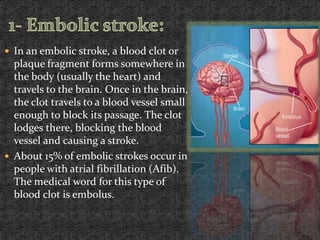
 In an embolic stroke, a blood clot or
plaque fragment forms somewhere in
the body (usually the heart) and
travels to the brain. Once in the brain,
the clot travels to a blood vessel small
enough to block its passage. The clot
lodges there, blocking the blood
vessel and causing a stroke.
 About 15% of embolic strokes occur in
people with atrial fibrillation (Afib).
The medical word for this type of
blood clot is embolus.
 A thrombotic stroke is caused by a blood clot
that forms inside one of the arteries supplying
blood to the brain.
 This type of stroke is usually seen in people with
and
 Two types of blood clots can cause thrombotic stroke:
and
The most common form of thrombotic stroke (large vessel
thrombosis) occurs in the brain’s larger arteries. In most cases it is
caused by long-term atherosclerosis in combination with rapid blood
clot formation. High cholesterol is a common risk factor for this type
of stroke.
Another form of thrombotic stroke happens when blood flow is
blocked to a very small arterial vessel (small vessel disease or lacunar
infarction). Little is known about the causes of this type of stroke, but
it is closely linked to high blood pressure.
When an artery is acutely occluded by thrombus or embolus, the
area of the CNS supplied by it will undergo infarction if there is no
adequate collateral blood supply.
Surrounding a central necrotic zone, an ‘ischemic penumbra’
remains viable for a time, i.e. it may recover function if blood flow is
restored.
CNS ischemia may be accompanied by swelling for two reasons:
● cytotoxic oedema – accumulation of water in damaged glial cells
and neurones,
● vasogenic oedema – extracellular fluid accumulation as a result
of breakdown of the blood–brain barrier.
In the brain, this swelling may be sufficient to produce clinical
deterioration in the days following a major stroke, as a result of a rise
in intracranial pressure and compression of adjacent structures.
Atherosclerosis: decades-long process; progression favored
by hypercholesterolemia, HTN, cigarette smoking
•Fatty streak: yellowish discoloration on intimal surface of
blood
•Focal plaques: eccentric thickening at bifurcations;
addition of massive extracellular lipids that displaced normal
cells and matrix
•Complicated fibrous plaques: central a cellular area of
lipid covered by a cap of smooth muscle cells and collagen
 Functional alteration of
endothelial cell layer
 Denuding of endothelium
 Superficial intimal injury
 Deep intimal & media
damage with marked
platelet aggregation and
mural thrombosis
 Cardiogenic emboli
lodge in the middle
cerebral artery or its
branches in 80% of
cases,
 in the posterior cerebral
artery or its branches
10% of the time,
 and in the vertebral
artery or its branches in
the remaining 10% of
cases.
• Geographic location-
southeastern US >
other areas. so-called
"stroke belt" states.
• Socioeconomic
factors- some evidence
strokes among low-
income people >
people with high-
income .
• Alcohol abuse.
• Drug abuse.
• Acute infection*
• High blood pressure.
• Cigarette smoking.
• Diabetes mellitus —Many
people with DM have high BP,
dyslipidemia and overweight.
• Carotid or other artery
disease.
• Peripheral artery disease.
• Atrial fibrillation ~ 15% of
embolic strokes occur in people
with Afib.
• Other heart disease- CAD or
HF …etc
• Transient ischemic attacks
(TIA).
• Sickle cell disease.
• High blood cholesterol .
• Poor diet.
• Physical inactivity and
obesity
• Increased age .
• Being male .
• Race (e.g., African-
Americans) .
• Diabetes mellitus .
• Prior stroke/transient.
ischemic attacks .
• Family history of stroke
• Asymptomatic carotid
bruit.
• Genetic disorders .
• Hypercoagulable disorders
• Protein C deficiency
• Protein S deficiency
• Antithrombin III deficiency
• Antiphospholipid syndrome
• Factor V Leiden mutation a
• Prothrombin G20210
• Mutation a
• Systemic malignancy
• Sickle cell anemia
• β-Thalassemia
• Polycythemia vera
• Systemic lupus erythematosus
• Homocysteinemia
• Thrombotic thrombocytopenic
• purpura
• Disseminated intravascular
• coagulation
• Dysproteinemias
• Nephrotic syndrome
• Inflammatory bowel disease
• Oral contraceptives
• Venous sinus thrombosis b
• Fibromuscular dysplasia
• Vasculitis
Lacunar stroke (small vessel)
Large vessel thrombosis
Dehydration
Artery-to-artery
Carotid bifurcation
Aortic arch
Arterial dissection
Cardioembolic
Atrial fibrillation
Mural thrombus
Myocardial infarction
Dilated cardiomyopathy
Valvular lesions
Mitral stenosis
Mechanical valve
Bacterial endocarditis
Paradoxical embolus
Atrial septal defect
Patent foramen ovale
Atrial septal aneurysm
Spontaneous echo contrast
 Contralateral paresis and
sensory loss in the leg.
 Cognitive or personality
changes.
The symptoms last more than 24 hours
or lead to death.
Symptoms and signs of arterial
infarcts depend on the vascular
territory affected .
 Pneumonic: “CHANGes”
ontralateral paresis and
sensory loss in the face and
the arm.
omonymous
emianopsia.
phasia.
eglect.
aze preference toward the
side of the lesion.
POSTERIOR CEREBRAL ARTERY
 Pneumonic: The 4 ’s
iplopia
izziness
ysphagia
ysarthria
 Pure motor or sensory
stroke.
 Dysarthria-clumsy hand
syndrome, ataxic
hemiparesis.
 Coma
 “Locked-In” Syndrome
 Cranial Nerve Palsies
 Apnea
 Visual Symptoms
 Drop Attacks
 Dysphagia
 Dysarthria
 Vertigo
 “Crossed” weakness and sensory loss
affecting the ipsilateral face and
contralateral body.
occurs as a result of not being able to move as a result
of the stroke.
- can occur as a result of having a
foley catheter .
common in larger strokes.
very common after stroke or may be
worsened in someone who had depression before the stroke.
 Heart rate .
 Blood pressure.
 Breathing.
 Temperature.
 BMI.
 O2 saturation
 Patient history
 Absent pulses (inferior extremity, radial, or carotid) - favors
atherosclerosis with thrombosis
 Sudden onset of cold, blue limb- favors embolism.
 Occlusion of common carotid artery in the neck neck with bruit -
occlusive extracranial disease
 Temporal arteritis- temporal arteries irregular and with dilatation,
tender, pulseless
 Cardiac findings(especially atrial fibrillation, murmurs,cardiac
enlargement) - favor cardiac-origin embolism.
 Carotid artery occlusion –iris speckled, ipsilateral pupil dilated
and poorly reactive, retinal ischemia
 Fundus - cholesterol crystal, white platelet-fibrin, or red clot
emboli. Subhyaloid hemorrhage in brain or subarachnoid
hemorrhage.
 levels of cholesterol and sugar in your blood.
 electrocardiogram (ECG) .
 Electrocardiogram
 Complete blood count including platelets & ESR
 Cardiac enzymes and troponin
 Electrolytes, urea nitrogen, creatinine
 Prothrombin time and international normalized ratio (INR),
Partial thromboplastin time
 Oxygen saturation
 Coagulation studies: May reveal a coagulopathy and are useful when
fibrinolytics or anticoagulants are to be used
Middle cerebral artery infarct Posterior cerebral artery infarct
Strokes <6 hours old are usually NOT
visible on CT scan.
acute middle carotid artery (MCA) stroke
CT SCAN MRI
MRA (Magnetic Resonance Angiography)
CT Angiography
 Liver function tests
 Toxicology screen
 Blood alcohol level
 Pregnancy test in women of child-bearing potential
 Arterial blood gas if hypoxia is suspected
 Electroencephalogram if seizures are suspected
Craniocerebral / cervical trauma
Meningitis/encephalitis
Intracranial mass
 Tumor
 Subdural hematoma
Seizure with persistent neurological signs
Migraine with persistent neurological signs
Metabolic
 Hyperglycemia
 Hypoglycemia
 Post-cardiac arrest ischemia
 Drug/narcotic overdose
● Admission to a stroke unit .
-Aspirin 300mg daily or Clopidogrel , modest benefit
when given within 48 hours of onset,
Alteplase ( tissue plasminogen activator (tPA))
-IV Alteplase : within 3 hours of stroke symptom onset
-IA Alteplase : within 6 hours.
(SBP<185 and SBP <110mmHg.)
Warfarin, or Heparin
Also :
 Endotracheal intubation
 Nasogastric tube
 Iv fluid to prevent dehydrated
*Brain edema peaks at 3-5 days
1. IV Mannitol (0.25 mg/kg over 20 minutes).
2.hyperventilation (lower PCO2).
3. osmotic diuretics.
4. drainage of CSF (ventriculostomy).
5. surgery (lobectomy).
 Reduce fever.
 Regulate blood pressure.
- if severe hypertension IV Labetalol or Nicardipine infusion.
 Correct hypoxia.
 Regulate blood glucose.
 Manage cardiac arrhythmias.
 Manage myocardial ischemia.
Pneumonic: SAMPLE
STAGES
 Stroke or head trauma
within the last 3 months.
 Anticoagulation with
INR>1.7 or prolonged PTT.
 MI (recent).
 Prior Intracranial
Haemorrhage.
 Low Platelet Count
(<100,000/mm3 )
 Elevated BP: Systolic>185
or Diastolic >110mmHg
 Surgery in the past 14 days.
 TIA (mild symptoms or
rapid improvement of
symptoms).
 Age<18
 GI or urinary bleeding in
the past 21 days
 Elevated (>400mg/dl) or
Decreased (<50mg/dl)
Blood glucose.
 Seizures present at the
onset of stroke.
 Carotid Endarterectomy to
remove blood clots and fatty
deposits from one of the carotid
arteries (but isn’t suitable for
everyone).
 If stenosis is >70% in
symptomatic patients or
>60% in asymptomatic
patients
(Contraindicated on
100% occlusion).
 Stopping smoking.
 Healthy diet (low animal fat, low salt, avoiding excess alcohol) and
prescribing cholesterol-lowering agents, i.e. statins. In the long term,
control of blood pressure is also important.
 For the first 2 weeks after an ischaemic stroke, however, patients
should not receive antihypertensive therapy beyond their pre-existing
treatment unless there is evidence of malignant hypertension.
 This is because too rapid lowering of blood pressure may worsen
ischaemia in a region where the cerebral circulation is already
compromised.
 Lifelong antiplatelet treatment is indicated, commencing as soon as
possible after a cerebral infarct. The initial dose of aspirin (300mg
daily) can be reduced to 75mg daily after 4 weeks.
 Anticoagulation with warfarin is effective prophylaxis in the presence
of atrial fibrillation and other cardiac sources of embolism.
 Anticoagulants (Heparin, Warfarin)
 Antiplatelets (aspirin, clopidogrel
dipyridamole/ASA combination, ticlopidine)
 Statin
 ARB (-sartan), or ACE inhibitor + HCTZ
 Carotid endarterectomy if indicated
 Carotid or intracranial stent.
 Risk factor control!!!
 A multidisciplinary team of
health professionals will work
out a rehabilitation
programme for you that’s
designed around your
particular needs.
 Rehabilitation aims to help
you stay as independent as
possible and get back to your
usual activities, or adapt to
new ways of doing things.
 You may make most of your
recovery in the early weeks
and months afterwards but
you may continue to improve
for years.
 Hypotension
 Hyperglycemia
 Hyperthermia
 Infection
 Cerebral hypoperfusion
BOOKS :
 Harrisons Neurology in Clinical Medicine, 3rd Ed
 Ginsberg lecture notes neurology
INTERNET :
 http://www.cdc.gov/stroke/index.htm
 http://www.who.int/topics/cerebrovascular_accident/en/
 http://www.stroke.org/understand-stroke/what-
stroke/ischemic-stroke
 http://www.strokecenter.org/patients/about-
stroke/ischemic-stroke/
 http://www.strokeassociation.org/STROKEORG/AboutStr
oke/TypesofStroke/Types-of-
Stroke_UCM_308531_SubHomePage.jsp
stroke ( ischemic stroke )

stroke ( ischemic stroke )

  • 1.
    DONE BY : MUSTAFAKHALIL IBRAHIM TBILISI STATE MEDICAL UNIVERSITY 4th year, 2st semester, 1nd group
  • 2.
     Epidemiology  Introduction Pathophysiology  Risk factors  Etiology  Signs and symptoms  Complications  Diagnosis  Treatments  Prevention  Rehabilitation  Prognosis  References
  • 4.
     Stroke isthe 5th leading cause of death in the US and is a major cause of disability.  Annually, 15 million worldwide suffer a stroke-5 million die and 5 million are permanently disabled .  WHO estimates a stroke occurs every 5 seconds.  adult ~ 800,000 people in the US have a stroke each year.  One American dies from a stroke every 4 minutes, on average  killing nearly 130,000 Americans each year, that’s 1 of every 20 deaths.  About 87% of all strokes are ischemic stroke , when blood flow to the brain is blocked.  Stroke costs the United States an estimated 34 -40$ billion each year  Total cost of stroke has been estimated at $65.5 billion in 2008.
  • 5.
    highest death ratesfrom stroke are in the southeastern United States
  • 7.
     Stroke isa syndrome consisting of rapidly developing (usually seconds or minutes) symptoms and/or signs of loss of focal (or sometimes global) CNS function. The symptoms last more than 24 hours or lead to death.  Although the brain makes up only 2% of our body weight, it uses 20% of the oxygen you breathe.
  • 9.
  • 11.
     A transientischemic attack (TIA) is sometimes called a "mini- stroke." It is different from the major types of stroke because blood flow to the brain is blocked for only a short time.  lasting less than 24 hours - usually no more than 5 minutes  caused by embolic, thrombotic or hemodynamic vascular mechanisms.  Some transient episodes last longer than 24 hours, yet patients recover completely – reversible ischaemic neurological deficits.
  • 12.
     Is characterizedby the sudden loss of blood circulation to an area of the brain, resulting in a corresponding loss of neurologic function. Acute ischemic stroke is caused by thrombotic or embolic occlusion of a cerebral artery and is more common than hemorrhagic stroke.  It can occur in the carotid artery of the neck as well as other arteries.
  • 13.
     In anembolic stroke, a blood clot or plaque fragment forms somewhere in the body (usually the heart) and travels to the brain. Once in the brain, the clot travels to a blood vessel small enough to block its passage. The clot lodges there, blocking the blood vessel and causing a stroke.  About 15% of embolic strokes occur in people with atrial fibrillation (Afib). The medical word for this type of blood clot is embolus.
  • 14.
     A thromboticstroke is caused by a blood clot that forms inside one of the arteries supplying blood to the brain.  This type of stroke is usually seen in people with and  Two types of blood clots can cause thrombotic stroke: and The most common form of thrombotic stroke (large vessel thrombosis) occurs in the brain’s larger arteries. In most cases it is caused by long-term atherosclerosis in combination with rapid blood clot formation. High cholesterol is a common risk factor for this type of stroke. Another form of thrombotic stroke happens when blood flow is blocked to a very small arterial vessel (small vessel disease or lacunar infarction). Little is known about the causes of this type of stroke, but it is closely linked to high blood pressure.
  • 15.
    When an arteryis acutely occluded by thrombus or embolus, the area of the CNS supplied by it will undergo infarction if there is no adequate collateral blood supply. Surrounding a central necrotic zone, an ‘ischemic penumbra’ remains viable for a time, i.e. it may recover function if blood flow is restored. CNS ischemia may be accompanied by swelling for two reasons: ● cytotoxic oedema – accumulation of water in damaged glial cells and neurones, ● vasogenic oedema – extracellular fluid accumulation as a result of breakdown of the blood–brain barrier. In the brain, this swelling may be sufficient to produce clinical deterioration in the days following a major stroke, as a result of a rise in intracranial pressure and compression of adjacent structures.
  • 16.
    Atherosclerosis: decades-long process;progression favored by hypercholesterolemia, HTN, cigarette smoking •Fatty streak: yellowish discoloration on intimal surface of blood •Focal plaques: eccentric thickening at bifurcations; addition of massive extracellular lipids that displaced normal cells and matrix •Complicated fibrous plaques: central a cellular area of lipid covered by a cap of smooth muscle cells and collagen
  • 17.
     Functional alterationof endothelial cell layer  Denuding of endothelium  Superficial intimal injury  Deep intimal & media damage with marked platelet aggregation and mural thrombosis
  • 19.
     Cardiogenic emboli lodgein the middle cerebral artery or its branches in 80% of cases,  in the posterior cerebral artery or its branches 10% of the time,  and in the vertebral artery or its branches in the remaining 10% of cases.
  • 21.
    • Geographic location- southeasternUS > other areas. so-called "stroke belt" states. • Socioeconomic factors- some evidence strokes among low- income people > people with high- income . • Alcohol abuse. • Drug abuse. • Acute infection* • High blood pressure. • Cigarette smoking. • Diabetes mellitus —Many people with DM have high BP, dyslipidemia and overweight. • Carotid or other artery disease. • Peripheral artery disease. • Atrial fibrillation ~ 15% of embolic strokes occur in people with Afib. • Other heart disease- CAD or HF …etc • Transient ischemic attacks (TIA). • Sickle cell disease. • High blood cholesterol . • Poor diet. • Physical inactivity and obesity • Increased age . • Being male . • Race (e.g., African- Americans) . • Diabetes mellitus . • Prior stroke/transient. ischemic attacks . • Family history of stroke • Asymptomatic carotid bruit. • Genetic disorders .
  • 22.
    • Hypercoagulable disorders •Protein C deficiency • Protein S deficiency • Antithrombin III deficiency • Antiphospholipid syndrome • Factor V Leiden mutation a • Prothrombin G20210 • Mutation a • Systemic malignancy • Sickle cell anemia • β-Thalassemia • Polycythemia vera • Systemic lupus erythematosus • Homocysteinemia • Thrombotic thrombocytopenic • purpura • Disseminated intravascular • coagulation • Dysproteinemias • Nephrotic syndrome • Inflammatory bowel disease • Oral contraceptives • Venous sinus thrombosis b • Fibromuscular dysplasia • Vasculitis Lacunar stroke (small vessel) Large vessel thrombosis Dehydration Artery-to-artery Carotid bifurcation Aortic arch Arterial dissection Cardioembolic Atrial fibrillation Mural thrombus Myocardial infarction Dilated cardiomyopathy Valvular lesions Mitral stenosis Mechanical valve Bacterial endocarditis Paradoxical embolus Atrial septal defect Patent foramen ovale Atrial septal aneurysm Spontaneous echo contrast
  • 24.
     Contralateral paresisand sensory loss in the leg.  Cognitive or personality changes. The symptoms last more than 24 hours or lead to death. Symptoms and signs of arterial infarcts depend on the vascular territory affected .
  • 25.
     Pneumonic: “CHANGes” ontralateralparesis and sensory loss in the face and the arm. omonymous emianopsia. phasia. eglect. aze preference toward the side of the lesion.
  • 26.
    POSTERIOR CEREBRAL ARTERY Pneumonic: The 4 ’s iplopia izziness ysphagia ysarthria
  • 27.
     Pure motoror sensory stroke.  Dysarthria-clumsy hand syndrome, ataxic hemiparesis.
  • 28.
     Coma  “Locked-In”Syndrome  Cranial Nerve Palsies  Apnea  Visual Symptoms  Drop Attacks  Dysphagia  Dysarthria  Vertigo  “Crossed” weakness and sensory loss affecting the ipsilateral face and contralateral body.
  • 32.
    occurs as aresult of not being able to move as a result of the stroke. - can occur as a result of having a foley catheter . common in larger strokes. very common after stroke or may be worsened in someone who had depression before the stroke.
  • 33.
     Heart rate.  Blood pressure.  Breathing.  Temperature.  BMI.  O2 saturation  Patient history  Absent pulses (inferior extremity, radial, or carotid) - favors atherosclerosis with thrombosis  Sudden onset of cold, blue limb- favors embolism.  Occlusion of common carotid artery in the neck neck with bruit - occlusive extracranial disease  Temporal arteritis- temporal arteries irregular and with dilatation, tender, pulseless  Cardiac findings(especially atrial fibrillation, murmurs,cardiac enlargement) - favor cardiac-origin embolism.  Carotid artery occlusion –iris speckled, ipsilateral pupil dilated and poorly reactive, retinal ischemia  Fundus - cholesterol crystal, white platelet-fibrin, or red clot emboli. Subhyaloid hemorrhage in brain or subarachnoid hemorrhage.
  • 34.
     levels ofcholesterol and sugar in your blood.  electrocardiogram (ECG) .  Electrocardiogram  Complete blood count including platelets & ESR  Cardiac enzymes and troponin  Electrolytes, urea nitrogen, creatinine  Prothrombin time and international normalized ratio (INR), Partial thromboplastin time  Oxygen saturation  Coagulation studies: May reveal a coagulopathy and are useful when fibrinolytics or anticoagulants are to be used
  • 35.
    Middle cerebral arteryinfarct Posterior cerebral artery infarct Strokes <6 hours old are usually NOT visible on CT scan.
  • 36.
    acute middle carotidartery (MCA) stroke
  • 38.
  • 41.
    MRA (Magnetic ResonanceAngiography) CT Angiography
  • 42.
     Liver functiontests  Toxicology screen  Blood alcohol level  Pregnancy test in women of child-bearing potential  Arterial blood gas if hypoxia is suspected  Electroencephalogram if seizures are suspected
  • 43.
    Craniocerebral / cervicaltrauma Meningitis/encephalitis Intracranial mass  Tumor  Subdural hematoma Seizure with persistent neurological signs Migraine with persistent neurological signs Metabolic  Hyperglycemia  Hypoglycemia  Post-cardiac arrest ischemia  Drug/narcotic overdose
  • 45.
    ● Admission toa stroke unit . -Aspirin 300mg daily or Clopidogrel , modest benefit when given within 48 hours of onset, Alteplase ( tissue plasminogen activator (tPA)) -IV Alteplase : within 3 hours of stroke symptom onset -IA Alteplase : within 6 hours. (SBP<185 and SBP <110mmHg.) Warfarin, or Heparin Also :  Endotracheal intubation  Nasogastric tube  Iv fluid to prevent dehydrated
  • 46.
    *Brain edema peaksat 3-5 days 1. IV Mannitol (0.25 mg/kg over 20 minutes). 2.hyperventilation (lower PCO2). 3. osmotic diuretics. 4. drainage of CSF (ventriculostomy). 5. surgery (lobectomy).
  • 47.
     Reduce fever. Regulate blood pressure. - if severe hypertension IV Labetalol or Nicardipine infusion.  Correct hypoxia.  Regulate blood glucose.  Manage cardiac arrhythmias.  Manage myocardial ischemia.
  • 48.
    Pneumonic: SAMPLE STAGES  Strokeor head trauma within the last 3 months.  Anticoagulation with INR>1.7 or prolonged PTT.  MI (recent).  Prior Intracranial Haemorrhage.  Low Platelet Count (<100,000/mm3 )  Elevated BP: Systolic>185 or Diastolic >110mmHg  Surgery in the past 14 days.  TIA (mild symptoms or rapid improvement of symptoms).  Age<18  GI or urinary bleeding in the past 21 days  Elevated (>400mg/dl) or Decreased (<50mg/dl) Blood glucose.  Seizures present at the onset of stroke.
  • 49.
     Carotid Endarterectomyto remove blood clots and fatty deposits from one of the carotid arteries (but isn’t suitable for everyone).
  • 50.
     If stenosisis >70% in symptomatic patients or >60% in asymptomatic patients (Contraindicated on 100% occlusion).
  • 52.
     Stopping smoking. Healthy diet (low animal fat, low salt, avoiding excess alcohol) and prescribing cholesterol-lowering agents, i.e. statins. In the long term, control of blood pressure is also important.  For the first 2 weeks after an ischaemic stroke, however, patients should not receive antihypertensive therapy beyond their pre-existing treatment unless there is evidence of malignant hypertension.  This is because too rapid lowering of blood pressure may worsen ischaemia in a region where the cerebral circulation is already compromised.  Lifelong antiplatelet treatment is indicated, commencing as soon as possible after a cerebral infarct. The initial dose of aspirin (300mg daily) can be reduced to 75mg daily after 4 weeks.  Anticoagulation with warfarin is effective prophylaxis in the presence of atrial fibrillation and other cardiac sources of embolism.
  • 53.
     Anticoagulants (Heparin,Warfarin)  Antiplatelets (aspirin, clopidogrel dipyridamole/ASA combination, ticlopidine)  Statin  ARB (-sartan), or ACE inhibitor + HCTZ  Carotid endarterectomy if indicated  Carotid or intracranial stent.  Risk factor control!!!
  • 54.
     A multidisciplinaryteam of health professionals will work out a rehabilitation programme for you that’s designed around your particular needs.  Rehabilitation aims to help you stay as independent as possible and get back to your usual activities, or adapt to new ways of doing things.  You may make most of your recovery in the early weeks and months afterwards but you may continue to improve for years.
  • 56.
     Hypotension  Hyperglycemia Hyperthermia  Infection  Cerebral hypoperfusion
  • 57.
    BOOKS :  HarrisonsNeurology in Clinical Medicine, 3rd Ed  Ginsberg lecture notes neurology INTERNET :  http://www.cdc.gov/stroke/index.htm  http://www.who.int/topics/cerebrovascular_accident/en/  http://www.stroke.org/understand-stroke/what- stroke/ischemic-stroke  http://www.strokecenter.org/patients/about- stroke/ischemic-stroke/  http://www.strokeassociation.org/STROKEORG/AboutStr oke/TypesofStroke/Types-of- Stroke_UCM_308531_SubHomePage.jsp