


Polynomials
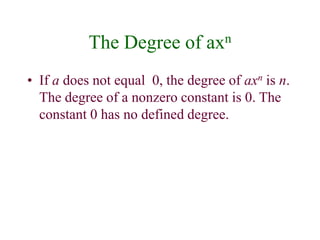
The Degree of axn 
• If a does not equal 0, the degree of axn is n. 
The degree of a nonzero constant is 0. The 
constant 0 has no defined degree.
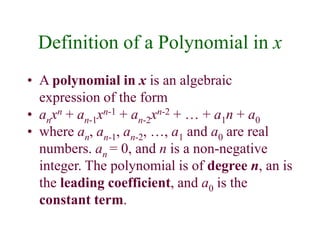
Definition of a Polynomial in x 
• A polynomial in x is an algebraic 
expression of the form 
• anxn + an-1xn-1 + an-2xn-2 + … + a1n + a0 
• where an, an-1, an-2, …, a1 and a0 are real 
numbers. an = 0, and n is a non-negative 
integer. The polynomial is of degree n, an is 
the leading coefficient, and a0 is the 
constant term.
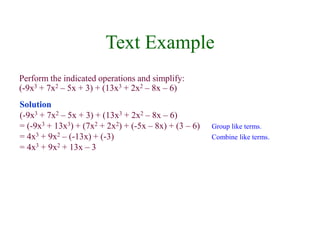
Text Example 
Perform the indicated operations and simplify: 
(-9x3 + 7x2 – 5x + 3) + (13x3 + 2x2 – 8x – 6) 
Solution 
(-9x3 + 7x2 – 5x + 3) + (13x3 + 2x2 – 8x – 6) 
= (-9x3 + 13x3) + (7x2 + 2x2) + (-5x – 8x) + (3 – 6) Group like terms. 
= 4x3 + 9x2 – (-13x) + (-3) Combine like terms. 
= 4x3 + 9x2 + 13x – 3
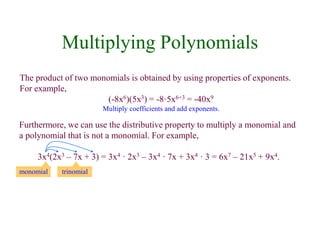
Multiplying Polynomials 
The product of two monomials is obtained by using properties of exponents. 
For example, 
(-8x6)(5x3) = -8·5x6+3 = -40x9 
Multiply coefficients and add exponents. 
Furthermore, we can use the distributive property to multiply a monomial and 
a polynomial that is not a monomial. For example, 
3x4(2x3 – 7x + 3) = 3x4 · 2x3 – 3x4 · 7x + 3x4 · 3 = 6x7 – 21x5 + 9x4. 
monomial trinomial
Multiplying Polynomials when 
Neither is a Monomial 
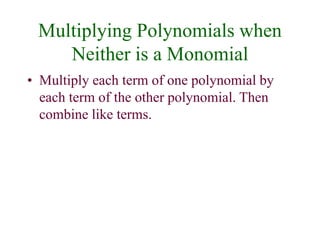
• Multiply each term of one polynomial by 
each term of the other polynomial. Then 
combine like terms.
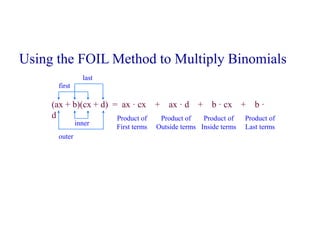
Using the FOIL Method to Multiply Binomials 
(ax + b)(cx + d) = ax · cx + ax · d + b · cx + b · 
d Product of 
First terms 
Product of 
Outside terms 
Product of 
Inside terms 
Product of 
Last terms 
first 
last 
inner 
outer
Text Example 
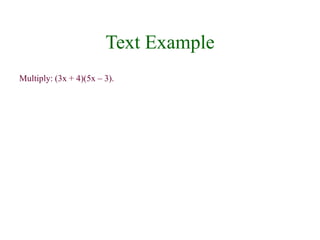
Multiply: (3x + 4)(5x – 3).
Text Example 
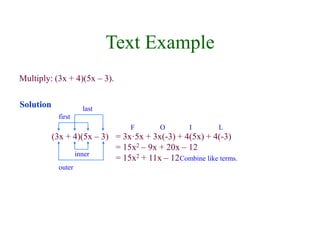
Multiply: (3x + 4)(5x – 3). 
Solution 
(3x + 4)(5x – 3) = 3x·5x + 3x(-3) + 4(5x) + 4(-3) 
= 15x2 – 9x + 20x – 12 
= 15x2 + 11x – 12Combine like terms. 
first 
last 
inner 
outer 
F O I L
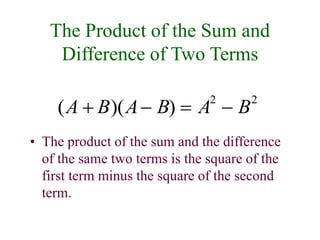
The Product of the Sum and 
Difference of Two Terms 
(A  B)(A B)  A2  B2 
• The product of the sum and the difference 
of the same two terms is the square of the 
first term minus the square of the second 
term.
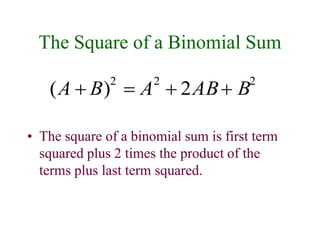
The Square of a Binomial Sum 
(A  B)2  A2  2AB B2 
• The square of a binomial sum is first term 
squared plus 2 times the product of the 
terms plus last term squared.
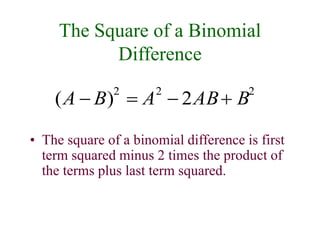
The Square of a Binomial 
Difference 
(A  B)2  A2  2AB B2 
• The square of a binomial difference is first 
term squared minus 2 times the product of 
the terms plus last term squared.
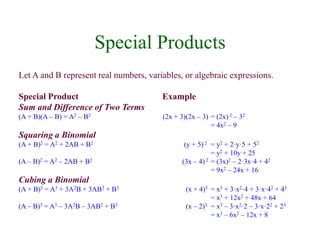
Special Products 
Let A and B represent real numbers, variables, or algebraic expressions. 
Special Product Example 
Sum and Difference of Two Terms 
(A + B)(A – B) = A2 – B2 (2x + 3)(2x – 3) = (2x) 2 – 32 
= 4x2 – 9 
Squaring a Binomial 
(A + B)2 = A2 + 2AB + B2 (y + 5) 2 = y2 + 2·y·5 + 52 
= y2 + 10y + 25 
(A – B)2 = A2 – 2AB + B2 (3x – 4) 2 = (3x)2 – 2·3x·4 + 42 
= 9x2 – 24x + 16 
Cubing a Binomial 
(A + B)3 = A3 + 3A2B + 3AB2 + B3 (x + 4)3 = x3 + 3·x2·4 + 3·x·42 + 43 
= x3 + 12x2 + 48x + 64 
(A – B)3 = A3 – 3A2B – 3AB2 + B3 (x – 2)3 = x3 – 3·x2·2 – 3·x·22 + 23 
= x3 – 6x2 – 12x + 8
Text Example 
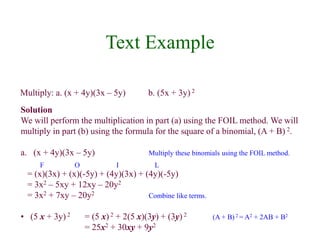
Multiply: a. (x + 4y)(3x – 5y) b. (5x + 3y) 2 
Solution 
We will perform the multiplication in part (a) using the FOIL method. We will 
multiply in part (b) using the formula for the square of a binomial, (A + B) 2. 
a. (x + 4y)(3x – 5y) Multiply these binomials using the FOIL method. 
F O I L 
= (x)(3x) + (x)(-5y) + (4y)(3x) + (4y)(-5y) 
= 3x2 – 5xy + 12xy – 20y2 
= 3x2 + 7xy – 20y2 Combine like terms. 
• (5 x + 3y) 2 = (5 x) 2 + 2(5 x)(3y) + (3y) 2 (A + B) 2 = A2 + 2AB + B2 
= 25x2 + 30xy + 9y2
Example 
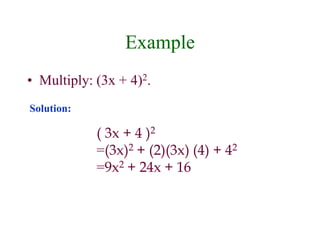
• Multiply: (3x + 4)2. 
( 3x + 4 )2 
=(3x)2 + (2)(3x) (4) + 42 
=9x2 + 24x + 16 
Solution:
Polynomials

Polynomials

  • 1.
  • 2.
    The Degree ofaxn • If a does not equal 0, the degree of axn is n. The degree of a nonzero constant is 0. The constant 0 has no defined degree.
  • 3.
    Definition of aPolynomial in x • A polynomial in x is an algebraic expression of the form • anxn + an-1xn-1 + an-2xn-2 + … + a1n + a0 • where an, an-1, an-2, …, a1 and a0 are real numbers. an = 0, and n is a non-negative integer. The polynomial is of degree n, an is the leading coefficient, and a0 is the constant term.
  • 4.
    Text Example Performthe indicated operations and simplify: (-9x3 + 7x2 – 5x + 3) + (13x3 + 2x2 – 8x – 6) Solution (-9x3 + 7x2 – 5x + 3) + (13x3 + 2x2 – 8x – 6) = (-9x3 + 13x3) + (7x2 + 2x2) + (-5x – 8x) + (3 – 6) Group like terms. = 4x3 + 9x2 – (-13x) + (-3) Combine like terms. = 4x3 + 9x2 + 13x – 3
  • 5.
    Multiplying Polynomials Theproduct of two monomials is obtained by using properties of exponents. For example, (-8x6)(5x3) = -8·5x6+3 = -40x9 Multiply coefficients and add exponents. Furthermore, we can use the distributive property to multiply a monomial and a polynomial that is not a monomial. For example, 3x4(2x3 – 7x + 3) = 3x4 · 2x3 – 3x4 · 7x + 3x4 · 3 = 6x7 – 21x5 + 9x4. monomial trinomial
  • 6.
    Multiplying Polynomials when Neither is a Monomial • Multiply each term of one polynomial by each term of the other polynomial. Then combine like terms.
  • 7.
    Using the FOILMethod to Multiply Binomials (ax + b)(cx + d) = ax · cx + ax · d + b · cx + b · d Product of First terms Product of Outside terms Product of Inside terms Product of Last terms first last inner outer
  • 8.
    Text Example Multiply:(3x + 4)(5x – 3).
  • 9.
    Text Example Multiply:(3x + 4)(5x – 3). Solution (3x + 4)(5x – 3) = 3x·5x + 3x(-3) + 4(5x) + 4(-3) = 15x2 – 9x + 20x – 12 = 15x2 + 11x – 12Combine like terms. first last inner outer F O I L
  • 10.
    The Product ofthe Sum and Difference of Two Terms (A  B)(A B)  A2  B2 • The product of the sum and the difference of the same two terms is the square of the first term minus the square of the second term.
  • 11.
    The Square ofa Binomial Sum (A  B)2  A2  2AB B2 • The square of a binomial sum is first term squared plus 2 times the product of the terms plus last term squared.
  • 12.
    The Square ofa Binomial Difference (A  B)2  A2  2AB B2 • The square of a binomial difference is first term squared minus 2 times the product of the terms plus last term squared.
  • 13.
    Special Products LetA and B represent real numbers, variables, or algebraic expressions. Special Product Example Sum and Difference of Two Terms (A + B)(A – B) = A2 – B2 (2x + 3)(2x – 3) = (2x) 2 – 32 = 4x2 – 9 Squaring a Binomial (A + B)2 = A2 + 2AB + B2 (y + 5) 2 = y2 + 2·y·5 + 52 = y2 + 10y + 25 (A – B)2 = A2 – 2AB + B2 (3x – 4) 2 = (3x)2 – 2·3x·4 + 42 = 9x2 – 24x + 16 Cubing a Binomial (A + B)3 = A3 + 3A2B + 3AB2 + B3 (x + 4)3 = x3 + 3·x2·4 + 3·x·42 + 43 = x3 + 12x2 + 48x + 64 (A – B)3 = A3 – 3A2B – 3AB2 + B3 (x – 2)3 = x3 – 3·x2·2 – 3·x·22 + 23 = x3 – 6x2 – 12x + 8
  • 14.
    Text Example Multiply:a. (x + 4y)(3x – 5y) b. (5x + 3y) 2 Solution We will perform the multiplication in part (a) using the FOIL method. We will multiply in part (b) using the formula for the square of a binomial, (A + B) 2. a. (x + 4y)(3x – 5y) Multiply these binomials using the FOIL method. F O I L = (x)(3x) + (x)(-5y) + (4y)(3x) + (4y)(-5y) = 3x2 – 5xy + 12xy – 20y2 = 3x2 + 7xy – 20y2 Combine like terms. • (5 x + 3y) 2 = (5 x) 2 + 2(5 x)(3y) + (3y) 2 (A + B) 2 = A2 + 2AB + B2 = 25x2 + 30xy + 9y2
  • 15.
    Example • Multiply:(3x + 4)2. ( 3x + 4 )2 =(3x)2 + (2)(3x) (4) + 42 =9x2 + 24x + 16 Solution:
  • 16.