Factoring 
Polynomials
Factoring 
Factoring is the process of writing a polynomial as the product of 
two or more polynomials. The factors of 6x2 – x – 2 are 2x + 1 and 3x – 2. 
In this section, we will be factoring over the integers. Polynomials that 
cannot be factored using integer coefficients are called irreducible over the 
integers or prime. 
The goal in factoring a polynomial is to use one or more factoring 
techniques until each of the polynomial’s factors is prime or irreducible. In 
this situation, the polynomial is said to be factored completely.
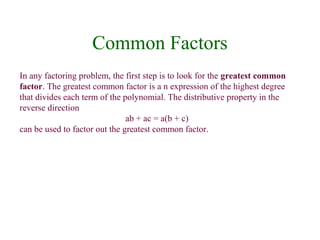
Common Factors 
In any factoring problem, the first step is to look for the greatest common 
factor. The greatest common factor is a n expression of the highest degree 
that divides each term of the polynomial. The distributive property in the 
reverse direction 
ab + ac = a(b + c) 
can be used to factor out the greatest common factor.
Text Example 
Factor: a. 18x3 + 27x2 b. x2(x + 3) + 5(x + 3) 
Solution 
a. We begin by determining the greatest common factor. 9 is the greatest 
integer that divides 18 and 27. Furthermore, x2 is the greatest expression that 
divides x3 and x2. Thus, the greatest common factor of the two terms in the 
polynomial is 9x2. 
18x3 + 27x2 
= 9x2(2x) + 9x2(3) Express each term with the greatest common factor as a factor. 
= 9x2(2 x + 3) Factor out the greatest common factor. 
b. In this situation, the greatest common factor is the common binomial factor 
(x + 3). We factor out this common factor as follows. 
x2(x + 3) + 5(x + 3) = (x + 3)(x2 + 5) Factor out the common binomial factor.
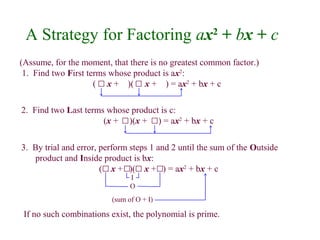
A Strategy for Factoring ax2 + bx + c 
(Assume, for the moment, that there is no greatest common factor.) 
1. Find two First terms whose product is ax2: 
( x + )( x + ) = ax2 + bx + c 
2. Find two Last terms whose product is c: 
(x + )(x + ) = ax2 + bx + c 
3. By trial and error, perform steps 1 and 2 until the sum of the Outside 
product and Inside product is bx: 
( x + )( x + ) = ax2 + bx + c 
I 
O 
(sum of O + I) 
If no such combinations exist, the polynomial is prime.
Text Example 
Factor: a. x2 + 6x + 8 b. x2 + 3x – 18 
Solution 
a. The factors of the first term are x and x: (x )( x ) 
To find the second term of each factor, we must find two numbers whose 
product is 8 and whose sum is 6. 
Factors of 8 8, 1 4, 2 -8, -1 -4, -2 
Sum of Factors 9 6 -9 -6 
This is the 
desired sum. 
From the table above, we see that 4 and 2 are the required integers. Thus, 
x2 + 6x + 8 = (x + 4)( x + 2) or (x + 2)( x + 4).
Text Example cont. 
Factor: a. x2 + 6x + 8 b. x2 + 3x – 18 
Solution 
b. We begin with x2 + 3x – 18 = (x )( x ). 
To find the second term of each factor, we must find two numbers whose 
product is –18 and whose sum is 3. 
Factors of -8 18, -1 -18, 1 9, -2 -9, 2 6, -3 -6, 3 
Sum of Factors 17 -17 7 -7 3 -3 
This is the 
desired sum. 
From the table above, we see that 6 and –3 are the required integers. Thus, 
x2 + 3x – 18 = (x + 6)(x – 3) or (x – 3)(x + 6).
Factor: 8x2 – 10x – 3. 
Text Example 
Solution 
Step 1 Find two First terms whose product is 8x2. 
Õ 
Õ 
8x2 – 10x – 3 (8x )(x ) 
8x2 – 10x – 3 (4x )(2x ) 
Step 2 Find two Last terms whose product is –3. The possible factors are 
1(-3) and –1(3). 
Step 3 Try various combinations of these factors. The correct factorization 
of 8x2 – 10x – 3 is the one in which the sum of the Outside and Inside products 
is equal to –10x. Here is a list of possible factors.
Sum of Outside and Inside 
Products (Should Equal –10x) 
Possible Factors of 
8x2 – 10x – 3 
(8x + 1)(x – 3) -24x + x = -23x 
(8x – 3)(x + 1) 8x – 3x = 5x 
(8x – 1)(x +3) 24x – x = 23x 
(8x + 3)(x – 1) -8x + 3x = -5x 
(4x + 1)(2x – 3) -12x + 2x = -10x 
(4x – 3)(2x + 1) 4x – 6x = -2x 
(4x – 1)(2x + 3) 12x – 2x = 10x 
(4x + 3)(2x – 1) -4x + 6x = 2x 
Thus, 8x2 – 10x – 3 = (4x + 1)(2x – 3) or (2x – 3)(4x + 1). 
This is the required 
middle term. 
Text Example cont.
The Difference of Two Squares 
• If A and B are real numbers, variables, or 
algebraic expressions, then 
• A2 – B2 = (A + B)(A – B). 
• In words: The difference of the squares of 
two terms factors as the product of a sum 
and the difference of those terms.
Text Example 
• Factor: 81x2 - 49 
Solution: 
81x2 – 49 = (9x)2 – 72 = (9x + 7)(9x – 7).
Factoring Perfect Square Trinomials 
Let A and B be real numbers, variables, or 
algebraic expressions, 
1. A2 + 2AB + B2 = (A + B)2 
2. A2 – 2AB + B2 = (A – B)2
Text Example 
• Factor: x2 + 6x + 9. 
Solution: 
x2 + 6x + 9 = x2 + 2 · x · 3 + 32 = (x + 3)2
Text Example 
• Factor: 25x2 – 60x + 36 . 
Solution: 
25x2 – 60x + 36 = (5x)2 – 2 · 5x · 6 + 62 = (x + 3)2.
Factoring the Sum and 
Difference of 2 Cubes 
Type Example 
64x3 – 125 = (4x)3 – 53 
= (4x – 5)(4x)2 + (4x)(5) + 52) 
= (4x – 5)(16x2 + 20x + 25) 
A3 – B3 
= (A – B)(A2 + 2AB + B2) 
x3 + 8 = x3 + 23 
= (x + 2)( x2 – x·2 + 22) 
= (x + 2)( x2 – 2x + 4) 
A3 + B3 
= (A + B)(A2 – 2AB + B2)
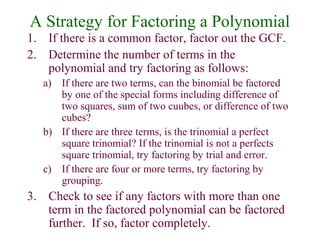
A Strategy for Factoring a Polynomial 
1. If there is a common factor, factor out the GCF. 
2. Determine the number of terms in the 
polynomial and try factoring as follows: 
a) If there are two terms, can the binomial be factored 
by one of the special forms including difference of 
two squares, sum of two cuubes, or difference of two 
cubes? 
b) If there are three terms, is the trinomial a perfect 
square trinomial? If the trinomial is not a perfects 
square trinomial, try factoring by trial and error. 
c) If there are four or more terms, try factoring by 
grouping. 
3. Check to see if any factors with more than one 
term in the factored polynomial can be factored 
further. If so, factor completely.
Example 
Factor: x3 – 5x2 – 4x + 20 
Solution 
x3 – 5x2 – 4x + 20 
= (x3 – 5x2) + (-4x + 20) Group the terms with common factors. 
= x2(x – 5) – 4(x – 5) Factor from each group. 
= (x – 5)(x2 – 4) Factor out the common binomial factor, (x – 5). 
= (x – 5)(x + 2)(x – 2) Factor completely by factoring x2 – 4 as the difference of two 
squares.
Factoring 
Polynomials

Factoring polynomials

  • 1.
  • 2.
    Factoring Factoring isthe process of writing a polynomial as the product of two or more polynomials. The factors of 6x2 – x – 2 are 2x + 1 and 3x – 2. In this section, we will be factoring over the integers. Polynomials that cannot be factored using integer coefficients are called irreducible over the integers or prime. The goal in factoring a polynomial is to use one or more factoring techniques until each of the polynomial’s factors is prime or irreducible. In this situation, the polynomial is said to be factored completely.
  • 3.
    Common Factors Inany factoring problem, the first step is to look for the greatest common factor. The greatest common factor is a n expression of the highest degree that divides each term of the polynomial. The distributive property in the reverse direction ab + ac = a(b + c) can be used to factor out the greatest common factor.
  • 4.
    Text Example Factor:a. 18x3 + 27x2 b. x2(x + 3) + 5(x + 3) Solution a. We begin by determining the greatest common factor. 9 is the greatest integer that divides 18 and 27. Furthermore, x2 is the greatest expression that divides x3 and x2. Thus, the greatest common factor of the two terms in the polynomial is 9x2. 18x3 + 27x2 = 9x2(2x) + 9x2(3) Express each term with the greatest common factor as a factor. = 9x2(2 x + 3) Factor out the greatest common factor. b. In this situation, the greatest common factor is the common binomial factor (x + 3). We factor out this common factor as follows. x2(x + 3) + 5(x + 3) = (x + 3)(x2 + 5) Factor out the common binomial factor.
  • 5.
    A Strategy forFactoring ax2 + bx + c (Assume, for the moment, that there is no greatest common factor.) 1. Find two First terms whose product is ax2: ( x + )( x + ) = ax2 + bx + c 2. Find two Last terms whose product is c: (x + )(x + ) = ax2 + bx + c 3. By trial and error, perform steps 1 and 2 until the sum of the Outside product and Inside product is bx: ( x + )( x + ) = ax2 + bx + c I O (sum of O + I) If no such combinations exist, the polynomial is prime.
  • 6.
    Text Example Factor:a. x2 + 6x + 8 b. x2 + 3x – 18 Solution a. The factors of the first term are x and x: (x )( x ) To find the second term of each factor, we must find two numbers whose product is 8 and whose sum is 6. Factors of 8 8, 1 4, 2 -8, -1 -4, -2 Sum of Factors 9 6 -9 -6 This is the desired sum. From the table above, we see that 4 and 2 are the required integers. Thus, x2 + 6x + 8 = (x + 4)( x + 2) or (x + 2)( x + 4).
  • 7.
    Text Example cont. Factor: a. x2 + 6x + 8 b. x2 + 3x – 18 Solution b. We begin with x2 + 3x – 18 = (x )( x ). To find the second term of each factor, we must find two numbers whose product is –18 and whose sum is 3. Factors of -8 18, -1 -18, 1 9, -2 -9, 2 6, -3 -6, 3 Sum of Factors 17 -17 7 -7 3 -3 This is the desired sum. From the table above, we see that 6 and –3 are the required integers. Thus, x2 + 3x – 18 = (x + 6)(x – 3) or (x – 3)(x + 6).
  • 8.
    Factor: 8x2 –10x – 3. Text Example Solution Step 1 Find two First terms whose product is 8x2. Õ Õ 8x2 – 10x – 3 (8x )(x ) 8x2 – 10x – 3 (4x )(2x ) Step 2 Find two Last terms whose product is –3. The possible factors are 1(-3) and –1(3). Step 3 Try various combinations of these factors. The correct factorization of 8x2 – 10x – 3 is the one in which the sum of the Outside and Inside products is equal to –10x. Here is a list of possible factors.
  • 9.
    Sum of Outsideand Inside Products (Should Equal –10x) Possible Factors of 8x2 – 10x – 3 (8x + 1)(x – 3) -24x + x = -23x (8x – 3)(x + 1) 8x – 3x = 5x (8x – 1)(x +3) 24x – x = 23x (8x + 3)(x – 1) -8x + 3x = -5x (4x + 1)(2x – 3) -12x + 2x = -10x (4x – 3)(2x + 1) 4x – 6x = -2x (4x – 1)(2x + 3) 12x – 2x = 10x (4x + 3)(2x – 1) -4x + 6x = 2x Thus, 8x2 – 10x – 3 = (4x + 1)(2x – 3) or (2x – 3)(4x + 1). This is the required middle term. Text Example cont.
  • 10.
    The Difference ofTwo Squares • If A and B are real numbers, variables, or algebraic expressions, then • A2 – B2 = (A + B)(A – B). • In words: The difference of the squares of two terms factors as the product of a sum and the difference of those terms.
  • 11.
    Text Example •Factor: 81x2 - 49 Solution: 81x2 – 49 = (9x)2 – 72 = (9x + 7)(9x – 7).
  • 12.
    Factoring Perfect SquareTrinomials Let A and B be real numbers, variables, or algebraic expressions, 1. A2 + 2AB + B2 = (A + B)2 2. A2 – 2AB + B2 = (A – B)2
  • 13.
    Text Example •Factor: x2 + 6x + 9. Solution: x2 + 6x + 9 = x2 + 2 · x · 3 + 32 = (x + 3)2
  • 14.
    Text Example •Factor: 25x2 – 60x + 36 . Solution: 25x2 – 60x + 36 = (5x)2 – 2 · 5x · 6 + 62 = (x + 3)2.
  • 15.
    Factoring the Sumand Difference of 2 Cubes Type Example 64x3 – 125 = (4x)3 – 53 = (4x – 5)(4x)2 + (4x)(5) + 52) = (4x – 5)(16x2 + 20x + 25) A3 – B3 = (A – B)(A2 + 2AB + B2) x3 + 8 = x3 + 23 = (x + 2)( x2 – x·2 + 22) = (x + 2)( x2 – 2x + 4) A3 + B3 = (A + B)(A2 – 2AB + B2)
  • 16.
    A Strategy forFactoring a Polynomial 1. If there is a common factor, factor out the GCF. 2. Determine the number of terms in the polynomial and try factoring as follows: a) If there are two terms, can the binomial be factored by one of the special forms including difference of two squares, sum of two cuubes, or difference of two cubes? b) If there are three terms, is the trinomial a perfect square trinomial? If the trinomial is not a perfects square trinomial, try factoring by trial and error. c) If there are four or more terms, try factoring by grouping. 3. Check to see if any factors with more than one term in the factored polynomial can be factored further. If so, factor completely.
  • 17.
    Example Factor: x3– 5x2 – 4x + 20 Solution x3 – 5x2 – 4x + 20 = (x3 – 5x2) + (-4x + 20) Group the terms with common factors. = x2(x – 5) – 4(x – 5) Factor from each group. = (x – 5)(x2 – 4) Factor out the common binomial factor, (x – 5). = (x – 5)(x + 2)(x – 2) Factor completely by factoring x2 – 4 as the difference of two squares.
  • 18.