Multiplying Polynomials I Learning how to multiply a binomial with a monomial
Rules of Exponents - Review Before we begin multiplying polynomials let’s review Rules of Exponents
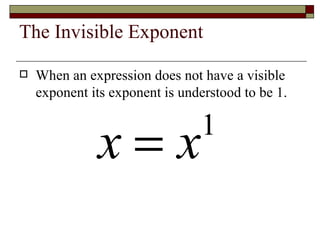
The Invisible Exponent When an expression does not have a visible exponent its exponent is understood to be 1.
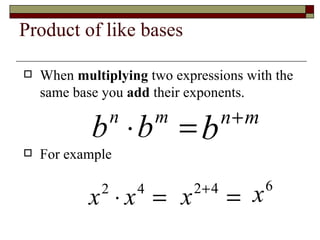
Product of like bases When  multiplying  two expressions with the same base you  add  their exponents. For example
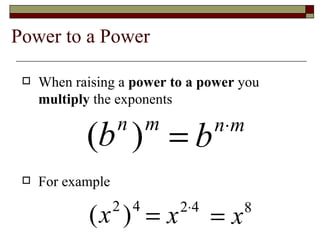
Power to a Power When raising a  power to a power  you  multiply  the exponents For example
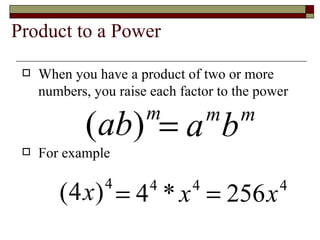
Product to a Power When you have a product of two or more numbers, you raise each factor to the power For example
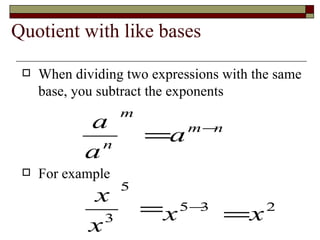
Quotient with like bases When dividing two expressions with the same base, you subtract the exponents For example
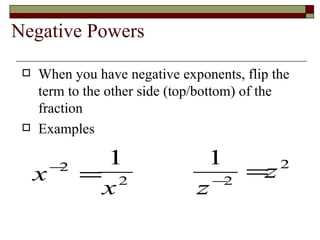
Negative Powers When you have negative exponents, flip the term to the other side (top/bottom) of the fraction Examples
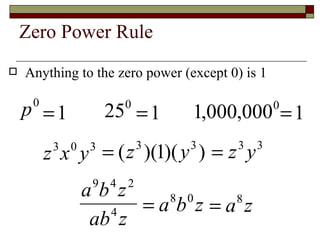
Zero Power Rule Anything to the zero power (except 0) is 1
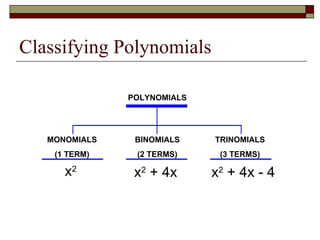
Classifying Polynomials POLYNOMIALS MONOMIALS (1 TERM) BINOMIALS (2 TERMS) TRINOMIALS (3 TERMS) x 2  + 4x x 2 x 2  + 4x - 4
The Distributive Property  - Back with a Vengeance We will be applying the Distributive Property to multiply polynomials You will learn the box method for distribution
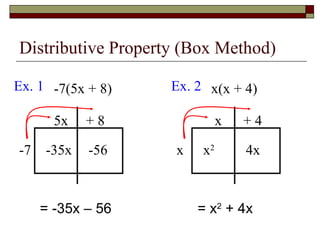
Distributive Property (Box Method) -7(5x + 8) = -35x – 56 Ex. 1 5x  + 8 -7 -35x -56 x(x + 4) = x 2  + 4x Ex. 2 x  + 4 x x 2 4x
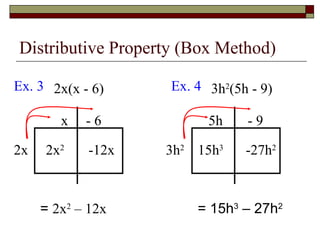
Distributive Property (Box Method) 2x(x - 6) =  2x 2  – 12x Ex. 3 x  - 6 2x 2x 2 -12x 3h 2 (5h - 9) = 15h 3  – 27h 2 Ex. 4 5h  - 9 3h 2 15h 3 -27h 2
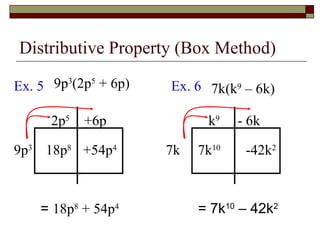
Distributive Property (Box Method) 9p 3 (2p 5  + 6p) =  18p 8  + 54p 4 Ex. 5 2p 5  +6p 9p 3 18p 8 +54p 4 7k(k 9  – 6k) = 7k 10  – 42k 2 Ex. 6 k 9   - 6k 7k 7k 10 -42k 2
Questions

Multiplying Polynomials I

  • 1.
    Multiplying Polynomials ILearning how to multiply a binomial with a monomial
  • 2.
    Rules of Exponents- Review Before we begin multiplying polynomials let’s review Rules of Exponents
  • 3.
    The Invisible ExponentWhen an expression does not have a visible exponent its exponent is understood to be 1.
  • 4.
    Product of likebases When multiplying two expressions with the same base you add their exponents. For example
  • 5.
    Power to aPower When raising a power to a power you multiply the exponents For example
  • 6.
    Product to aPower When you have a product of two or more numbers, you raise each factor to the power For example
  • 7.
    Quotient with likebases When dividing two expressions with the same base, you subtract the exponents For example
  • 8.
    Negative Powers Whenyou have negative exponents, flip the term to the other side (top/bottom) of the fraction Examples
  • 9.
    Zero Power RuleAnything to the zero power (except 0) is 1
  • 10.
    Classifying Polynomials POLYNOMIALSMONOMIALS (1 TERM) BINOMIALS (2 TERMS) TRINOMIALS (3 TERMS) x 2 + 4x x 2 x 2 + 4x - 4
  • 11.
    The Distributive Property - Back with a Vengeance We will be applying the Distributive Property to multiply polynomials You will learn the box method for distribution
  • 12.
    Distributive Property (BoxMethod) -7(5x + 8) = -35x – 56 Ex. 1 5x + 8 -7 -35x -56 x(x + 4) = x 2 + 4x Ex. 2 x + 4 x x 2 4x
  • 13.
    Distributive Property (BoxMethod) 2x(x - 6) = 2x 2 – 12x Ex. 3 x - 6 2x 2x 2 -12x 3h 2 (5h - 9) = 15h 3 – 27h 2 Ex. 4 5h - 9 3h 2 15h 3 -27h 2
  • 14.
    Distributive Property (BoxMethod) 9p 3 (2p 5 + 6p) = 18p 8 + 54p 4 Ex. 5 2p 5 +6p 9p 3 18p 8 +54p 4 7k(k 9 – 6k) = 7k 10 – 42k 2 Ex. 6 k 9 - 6k 7k 7k 10 -42k 2
  • 15.