GRAPHING QUADRATIC EQUATIONS
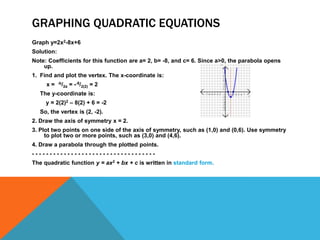
Graph y=2x2-8x+6
Solution:
Note: Coefficients for this function are a= 2, b= -8, and c= 6. Since a>0, the parabola opens
    up.
1. Find and plot the vertex. The x-coordinate is:
     x=     -b/     = --8/2(2) = 2
               2a

  The y-coordinate is:
     y = 2(2)2 – 8(2) + 6 = -2
  So, the vertex is (2, -2).
2. Draw the axis of symmetry x = 2.
3. Plot two points on one side of the axis of symmetry, such as (1,0) and (0,6). Use symmetry
     to plot two or more points, such as (3,0) and (4,6).
4. Draw a parabola through the plotted points.
-----------------------------------
The quadratic function y = ax2 + bx + c is written in standard form.
GRAPHING A QUADRATIC FUNCTION IN VERTEX FORM
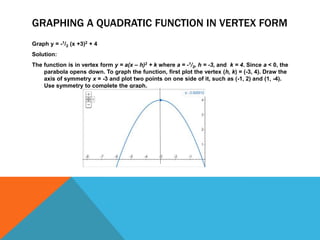
Graph y = -1/2 (x +3)2 + 4
Solution:
The function is in vertex form y = a(x – h)2 + k where a = -1/2, h = -3, and k = 4. Since a < 0, the
    parabola opens down. To graph the function, first plot the vertex (h, k) = (-3, 4). Draw the
    axis of symmetry x = -3 and plot two points on one side of it, such as (-1, 2) and (1, -4).
    Use symmetry to complete the graph.
GRAPHING A QUADRATIC FUNCTION IN INTERCEPT FORM
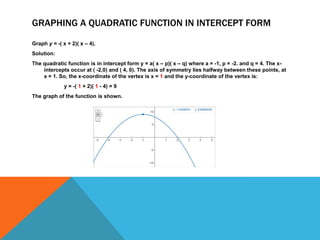
Graph y = -( x + 2)( x – 4).
Solution:
The quadratic function is in intercept form y = a( x – p)( x – q) where a = -1, p = -2. and q = 4. The x-
    intercepts occur at ( -2,0) and ( 4, 0). The axis of symmetry lies halfway between these points, at
    x = 1. So, the x-coordinate of the vertex is x = 1 and the y-coordinate of the vertex is:
              y = -( 1 + 2)( 1 - 4) = 9
The graph of the function is shown.
WRITING QUADRATIC FUNCTIONS IN STANDARD FORM
Write the quadratic function in standard form.
a.     Y = -( x+4)( x – 9)                   b. y = 3( x – 1)2 +8
Solution:
     a. y = -( x +4)( x – 9)       Write original function.
         = -( x2 – 9x +4x – 36) Multiply by using FOIL.
         = -( x2 – 5x – 36)        Combine like terms.
         = -x2 + 5x +36            Use distributive property.
     b. y = 3( x – 1)2 +8          Write original function.
         = 3( x – 1)( x – 1) + 8    Rewrite ( x - 1)2.
         = 3(x2 - x – x + 1) + 8    Multiply using FOIL.
         = 3( x2 – 2x + 1) +8       Combine like terms.
         = 3x2 – 6x + 3 + 8        Use distributive property.
         = 3x2 – 6x + 11            Combine like terms.
SOLVING QUADRATIC EQUATIONS WITH FACTORING
( X + 3)( X + 5) can be written as x2 + 8x + 15. The expressions x + 3 and x + 5 are
     binominals because they have two terms. The expression x2 + 8x + 15 is a
     trinomial because it has three terms. You can use factoring to write a trinomial as
     a product of binominals. To factor x2 + bx + c, find integers m and n such that:
         x2 + bx + c = ( x + m)( x + n)
                     = x2 + ( m + n)x + mn
So, the sum of m and n must equal b and the product of m and n must equal c.
Factoring Shortcuts:
    Difference of Two Squares:      a2 – b2 = (a + b)(a – b), Example: x2 – 9 = ( x + 3)( x –
    3)
    Perfect Square Trinomial:       a2 + 2ab + b2 = ( a + b)2, Example: x2 +12x + 36 = ( x
    +6)2
                           a2 - 2ab + b2 = ( a - b)2, Example: x2 – 8x + 16 = ( x – 4)2
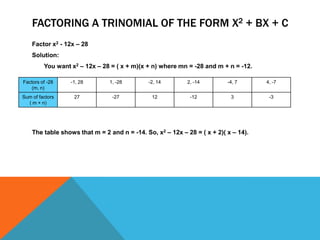
FACTORING A TRINOMIAL OF THE FORM X2 + BX + C
    Factor x2 - 12x – 28
    Solution:
         You want x2 – 12x – 28 = ( x + m)(x + n) where mn = -28 and m + n = -12.

Factors of -28    -1, 28       1, -28        -2, 14        2, -14         -4, 7      4, -7
   (m, n)
Sum of factors     27           -27            12           -12            3          -3
  ( m + n)


    The table shows that m = 2 and n = -14. So, x2 – 12x – 28 = ( x + 2)( x – 14).
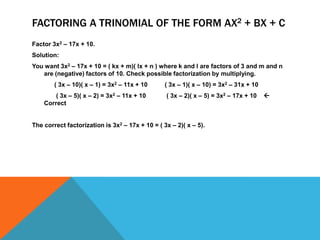
FACTORING A TRINOMIAL OF THE FORM AX2 + BX + C
Factor 3x2 – 17x + 10.
Solution:
You want 3x2 – 17x + 10 = ( kx + m)( lx + n ) where k and l are factors of 3 and m and n
   are (negative) factors of 10. Check possible factorization by multiplying.
        ( 3x – 10)( x – 1) = 3x2 – 11x + 10      ( 3x – 1)( x – 10) = 3x2 – 31x + 10
        ( 3x – 5)( x – 2) = 3x2 – 11x + 10       ( 3x – 2)( x – 5) = 3x2 – 17x + 10    
    Correct


The correct factorization is 3x2 – 17x + 10 = ( 3x – 2)( x – 5).
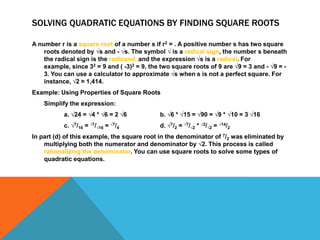
SOLVING QUADRATIC EQUATIONS BY FINDING SQUARE ROOTS

A number r is a square root of a number s if r2 = . A positive number s has two square
    roots denoted by √s and - √s. The symbol √ is a radical sign, the number s beneath
    the radical sign is the radicand, and the expression √s is a radical. For
    example, since 32 = 9 and ( -3)2 = 9, the two square roots of 9 are √9 = 3 and - √9 = -
    3. You can use a calculator to approximate √s when s is not a perfect square. For
    instance, √2 ≈ 1,414.
Example: Using Properties of Square Roots
    Simplify the expression:
           a. √24 = √4 * √6 = 2 √6           b. √6 * √15 = √90 = √9 * √10 = 3 √16
           c. √7/16 = √7/√16 = √7/4          d. √7/2 = √7/√2 * √2/√2 = √14/2
In part (d) of this example, the square root in the denominator of 7/2 was eliminated by
    multiplying both the numerator and denominator by √2. This process is called
    rationalizing the denominator. You can use square roots to solve some types of
    quadratic equations.
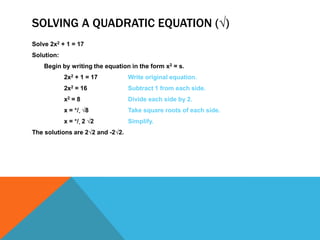
SOLVING A QUADRATIC EQUATION (√)
Solve 2x2 + 1 = 17
Solution:
    Begin by writing the equation in the form x2 = s.
            2x2 + 1 = 17          Write original equation.
            2x2 = 16              Subtract 1 from each side.
            x2 = 8                Divide each side by 2.
            x = +/- √8            Take square roots of each side.
            x = +/- 2 √2          Simplify.
The solutions are 2√2 and -2√2.
SOLVING A QUADRATIC EQUATION (√)
Solve 1/3( x + 5)2 = 7
Solution:
     1/        x + 5)2 = 7
          3(                     Write original equation.
    ( x + 5)2 = 21               Multiply each side by 3
    x + 5 = +/- √21              Take square roots of each side.
    x = -5 +/- √21               Subtract 5 from each side.
The solutions are -5 + √21 and -5 - √21.
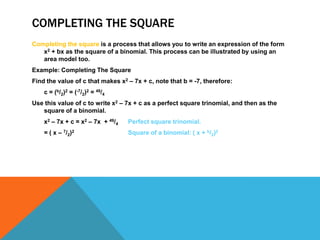
COMPLETING THE SQUARE
Completing the square is a process that allows you to write an expression of the form
   x2 + bx as the square of a binomial. This process can be illustrated by using an
   area model too.
Example: Completing The Square
Find the value of c that makes x2 – 7x + c, note that b = -7, therefore:
    c = (b/2)2 = (-7/2)2 = 49/4
Use this value of c to write x2 – 7x + c as a perfect square trinomial, and then as the
   square of a binomial.
    x2 – 7x + c = x2 – 7x + 49/4   Perfect square trinomial.
    = ( x – 7/2)2                  Square of a binomial: ( x + b/2)2
SOLVING A QUADRATIC EQUATION IF THE COEFFICIENT OF X2 IS NOT 1

Solve 3x2 – 6x + 12 = 0 by completing the square.
Solution:
     3x2 – 6x + 12 = 0                   Write original equation.
     x2 – 2x + 4 = 0                     Divide each side by the coefficient of x2.
     x2 – 2x = -4                        Write the left side in the form of x2 + bx.
     x2 – 2x + (-1)2 = -4 + 1                          Add (-2/2)2 = (-1)2 = 1 to each side.
     ( x – 1)2 = -3                      Write the left side as a binomial squared.
     x – 1 = +/- √-3                     Take square roots of each side.
     x = 1 +/- √-3                       Solve for x
     x = 1 +/- i√3                       Write in terms of imaginary unit i.
The solutions are 1 + i√3 and 1 - i√3.
Because these solutions are imaginary, you cannot check them graphically. However, you can check
    the solutions algebraically by substituting them back into the original equation.
SOLVING A QUADRATIC EQUATION IF THE COEFFICIENT OF X2 IS 1

Solve x2 + 10x – 3 = 0 by completing the square.
Solution:
    x2 + 10x – 3 = 0              Write original equation.
    x2 + 10x = 3                  Write the left side in the form x2 + bx.
    x2 + 10x +52 = 3 + 25                     Add (10/2)2 = 52 = 25 to each side.
    ( x + 5)2 = 28                Write the left side as a binomial squared.
    x + 5 = +/- √28               Take square roots of each side.
    x = -5 +/- √28                Solve for x.
    x = -5 +/- 2 √7               Simplify.
The solutions are -5 + 2 √7 and -5 - 2 √7.
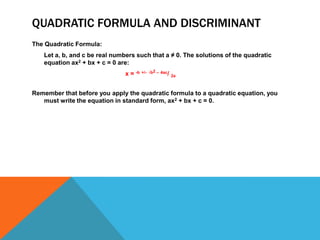
QUADRATIC FORMULA AND DISCRIMINANT
The Quadratic Formula:
   Let a, b, and c be real numbers such that a ≠ 0. The solutions of the quadratic
   equation ax2 + bx + c = 0 are:
                               x = -b +/- √b2 – 4ac/ 2a


Remember that before you apply the quadratic formula to a quadratic equation, you
   must write the equation in standard form, ax2 + bx + c = 0.
SOLVING A QUADRATIC EQUATION WITH TWO REAL SOLUTIONS

Solve 2x2 + x = 5
Solution:
     2x2 + x = 5                               Write original equation.
     2x2 + x – 5 = 0                           Write in standard form.
                   2 – 4ac
     x = -b +/- √b         /   2a              Quadratic formula
     x = -1 +/- √12 – 4(2)(-5)/     2(2)       a = 2, b = 1, c = -5
     x = -1 +/- √41/4                          Simplify.


     The solutions are x = -1 +/- √41/4 ≈ 1.35, and x = -1 +/- √41/4 ≈ 1.85

Algebra slideshow

  • 2.
    GRAPHING QUADRATIC EQUATIONS Graphy=2x2-8x+6 Solution: Note: Coefficients for this function are a= 2, b= -8, and c= 6. Since a>0, the parabola opens up. 1. Find and plot the vertex. The x-coordinate is: x= -b/ = --8/2(2) = 2 2a The y-coordinate is: y = 2(2)2 – 8(2) + 6 = -2 So, the vertex is (2, -2). 2. Draw the axis of symmetry x = 2. 3. Plot two points on one side of the axis of symmetry, such as (1,0) and (0,6). Use symmetry to plot two or more points, such as (3,0) and (4,6). 4. Draw a parabola through the plotted points. ----------------------------------- The quadratic function y = ax2 + bx + c is written in standard form.
  • 3.
    GRAPHING A QUADRATICFUNCTION IN VERTEX FORM Graph y = -1/2 (x +3)2 + 4 Solution: The function is in vertex form y = a(x – h)2 + k where a = -1/2, h = -3, and k = 4. Since a < 0, the parabola opens down. To graph the function, first plot the vertex (h, k) = (-3, 4). Draw the axis of symmetry x = -3 and plot two points on one side of it, such as (-1, 2) and (1, -4). Use symmetry to complete the graph.
  • 4.
    GRAPHING A QUADRATICFUNCTION IN INTERCEPT FORM Graph y = -( x + 2)( x – 4). Solution: The quadratic function is in intercept form y = a( x – p)( x – q) where a = -1, p = -2. and q = 4. The x- intercepts occur at ( -2,0) and ( 4, 0). The axis of symmetry lies halfway between these points, at x = 1. So, the x-coordinate of the vertex is x = 1 and the y-coordinate of the vertex is: y = -( 1 + 2)( 1 - 4) = 9 The graph of the function is shown.
  • 5.
    WRITING QUADRATIC FUNCTIONSIN STANDARD FORM Write the quadratic function in standard form. a. Y = -( x+4)( x – 9) b. y = 3( x – 1)2 +8 Solution: a. y = -( x +4)( x – 9) Write original function. = -( x2 – 9x +4x – 36) Multiply by using FOIL. = -( x2 – 5x – 36) Combine like terms. = -x2 + 5x +36 Use distributive property. b. y = 3( x – 1)2 +8 Write original function. = 3( x – 1)( x – 1) + 8 Rewrite ( x - 1)2. = 3(x2 - x – x + 1) + 8 Multiply using FOIL. = 3( x2 – 2x + 1) +8 Combine like terms. = 3x2 – 6x + 3 + 8 Use distributive property. = 3x2 – 6x + 11 Combine like terms.
  • 6.
    SOLVING QUADRATIC EQUATIONSWITH FACTORING ( X + 3)( X + 5) can be written as x2 + 8x + 15. The expressions x + 3 and x + 5 are binominals because they have two terms. The expression x2 + 8x + 15 is a trinomial because it has three terms. You can use factoring to write a trinomial as a product of binominals. To factor x2 + bx + c, find integers m and n such that: x2 + bx + c = ( x + m)( x + n) = x2 + ( m + n)x + mn So, the sum of m and n must equal b and the product of m and n must equal c. Factoring Shortcuts: Difference of Two Squares: a2 – b2 = (a + b)(a – b), Example: x2 – 9 = ( x + 3)( x – 3) Perfect Square Trinomial: a2 + 2ab + b2 = ( a + b)2, Example: x2 +12x + 36 = ( x +6)2 a2 - 2ab + b2 = ( a - b)2, Example: x2 – 8x + 16 = ( x – 4)2
  • 7.
    FACTORING A TRINOMIALOF THE FORM X2 + BX + C Factor x2 - 12x – 28 Solution: You want x2 – 12x – 28 = ( x + m)(x + n) where mn = -28 and m + n = -12. Factors of -28 -1, 28 1, -28 -2, 14 2, -14 -4, 7 4, -7 (m, n) Sum of factors 27 -27 12 -12 3 -3 ( m + n) The table shows that m = 2 and n = -14. So, x2 – 12x – 28 = ( x + 2)( x – 14).
  • 8.
    FACTORING A TRINOMIALOF THE FORM AX2 + BX + C Factor 3x2 – 17x + 10. Solution: You want 3x2 – 17x + 10 = ( kx + m)( lx + n ) where k and l are factors of 3 and m and n are (negative) factors of 10. Check possible factorization by multiplying. ( 3x – 10)( x – 1) = 3x2 – 11x + 10 ( 3x – 1)( x – 10) = 3x2 – 31x + 10 ( 3x – 5)( x – 2) = 3x2 – 11x + 10 ( 3x – 2)( x – 5) = 3x2 – 17x + 10  Correct The correct factorization is 3x2 – 17x + 10 = ( 3x – 2)( x – 5).
  • 9.
    SOLVING QUADRATIC EQUATIONSBY FINDING SQUARE ROOTS A number r is a square root of a number s if r2 = . A positive number s has two square roots denoted by √s and - √s. The symbol √ is a radical sign, the number s beneath the radical sign is the radicand, and the expression √s is a radical. For example, since 32 = 9 and ( -3)2 = 9, the two square roots of 9 are √9 = 3 and - √9 = - 3. You can use a calculator to approximate √s when s is not a perfect square. For instance, √2 ≈ 1,414. Example: Using Properties of Square Roots Simplify the expression: a. √24 = √4 * √6 = 2 √6 b. √6 * √15 = √90 = √9 * √10 = 3 √16 c. √7/16 = √7/√16 = √7/4 d. √7/2 = √7/√2 * √2/√2 = √14/2 In part (d) of this example, the square root in the denominator of 7/2 was eliminated by multiplying both the numerator and denominator by √2. This process is called rationalizing the denominator. You can use square roots to solve some types of quadratic equations.
  • 10.
    SOLVING A QUADRATICEQUATION (√) Solve 2x2 + 1 = 17 Solution: Begin by writing the equation in the form x2 = s. 2x2 + 1 = 17 Write original equation. 2x2 = 16 Subtract 1 from each side. x2 = 8 Divide each side by 2. x = +/- √8 Take square roots of each side. x = +/- 2 √2 Simplify. The solutions are 2√2 and -2√2.
  • 11.
    SOLVING A QUADRATICEQUATION (√) Solve 1/3( x + 5)2 = 7 Solution: 1/ x + 5)2 = 7 3( Write original equation. ( x + 5)2 = 21 Multiply each side by 3 x + 5 = +/- √21 Take square roots of each side. x = -5 +/- √21 Subtract 5 from each side. The solutions are -5 + √21 and -5 - √21.
  • 12.
    COMPLETING THE SQUARE Completingthe square is a process that allows you to write an expression of the form x2 + bx as the square of a binomial. This process can be illustrated by using an area model too. Example: Completing The Square Find the value of c that makes x2 – 7x + c, note that b = -7, therefore: c = (b/2)2 = (-7/2)2 = 49/4 Use this value of c to write x2 – 7x + c as a perfect square trinomial, and then as the square of a binomial. x2 – 7x + c = x2 – 7x + 49/4 Perfect square trinomial. = ( x – 7/2)2 Square of a binomial: ( x + b/2)2
  • 13.
    SOLVING A QUADRATICEQUATION IF THE COEFFICIENT OF X2 IS NOT 1 Solve 3x2 – 6x + 12 = 0 by completing the square. Solution: 3x2 – 6x + 12 = 0 Write original equation. x2 – 2x + 4 = 0 Divide each side by the coefficient of x2. x2 – 2x = -4 Write the left side in the form of x2 + bx. x2 – 2x + (-1)2 = -4 + 1 Add (-2/2)2 = (-1)2 = 1 to each side. ( x – 1)2 = -3 Write the left side as a binomial squared. x – 1 = +/- √-3 Take square roots of each side. x = 1 +/- √-3 Solve for x x = 1 +/- i√3 Write in terms of imaginary unit i. The solutions are 1 + i√3 and 1 - i√3. Because these solutions are imaginary, you cannot check them graphically. However, you can check the solutions algebraically by substituting them back into the original equation.
  • 14.
    SOLVING A QUADRATICEQUATION IF THE COEFFICIENT OF X2 IS 1 Solve x2 + 10x – 3 = 0 by completing the square. Solution: x2 + 10x – 3 = 0 Write original equation. x2 + 10x = 3 Write the left side in the form x2 + bx. x2 + 10x +52 = 3 + 25 Add (10/2)2 = 52 = 25 to each side. ( x + 5)2 = 28 Write the left side as a binomial squared. x + 5 = +/- √28 Take square roots of each side. x = -5 +/- √28 Solve for x. x = -5 +/- 2 √7 Simplify. The solutions are -5 + 2 √7 and -5 - 2 √7.
  • 15.
    QUADRATIC FORMULA ANDDISCRIMINANT The Quadratic Formula: Let a, b, and c be real numbers such that a ≠ 0. The solutions of the quadratic equation ax2 + bx + c = 0 are: x = -b +/- √b2 – 4ac/ 2a Remember that before you apply the quadratic formula to a quadratic equation, you must write the equation in standard form, ax2 + bx + c = 0.
  • 16.
    SOLVING A QUADRATICEQUATION WITH TWO REAL SOLUTIONS Solve 2x2 + x = 5 Solution: 2x2 + x = 5 Write original equation. 2x2 + x – 5 = 0 Write in standard form. 2 – 4ac x = -b +/- √b / 2a Quadratic formula x = -1 +/- √12 – 4(2)(-5)/ 2(2) a = 2, b = 1, c = -5 x = -1 +/- √41/4 Simplify. The solutions are x = -1 +/- √41/4 ≈ 1.35, and x = -1 +/- √41/4 ≈ 1.85