Holt Algebra 2
6-4 Factoring Polynomials6-4 Factoring Polynomials
Holt Algebra 2
Warm Up
Lesson Presentation
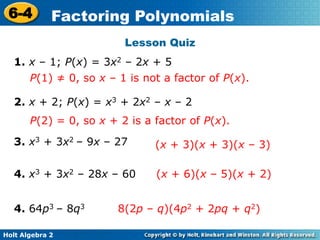
Lesson Quiz
Holt Algebra 2
6-4 Factoring Polynomials
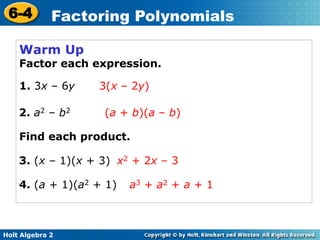
Warm Up
Factor each expression.
1. 3x – 6y
2. a2 – b2
3. (x – 1)(x + 3)
4. (a + 1)(a2 + 1)
x2 + 2x – 3
3(x – 2y)
(a + b)(a – b)
a3 + a2 + a + 1
Find each product.
Holt Algebra 2
6-4 Factoring Polynomials
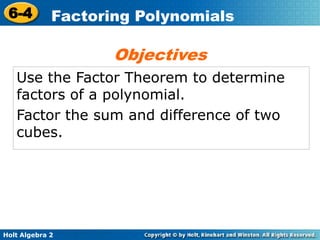
Use the Factor Theorem to determine
factors of a polynomial.
Factor the sum and difference of two
cubes.
Objectives
Holt Algebra 2
6-4 Factoring Polynomials
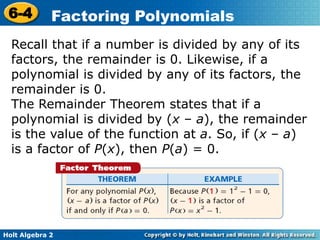
Recall that if a number is divided by any of its
factors, the remainder is 0. Likewise, if a
polynomial is divided by any of its factors, the
remainder is 0.
The Remainder Theorem states that if a
polynomial is divided by (x – a), the remainder
is the value of the function at a. So, if (x – a)
is a factor of P(x), then P(a) = 0.
Holt Algebra 2
6-4 Factoring Polynomials
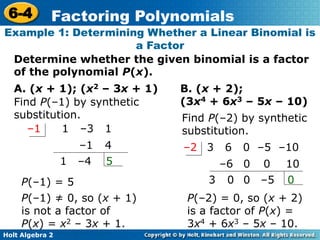
Determine whether the given binomial is a factor
of the polynomial P(x).
Example 1: Determining Whether a Linear Binomial is
a Factor
A. (x + 1); (x2 – 3x + 1)
Find P(–1) by synthetic
substitution.
1 –3 1–1
–1
1 5–4
4
P(–1) = 5
P(–1) ≠ 0, so (x + 1)
is not a factor of
P(x) = x2 – 3x + 1.
B. (x + 2);
(3x4 + 6x3 – 5x – 10)
Find P(–2) by synthetic
substitution.
3 6 0 –5 –10–2
–6
3 0
1000
–500
P(–2) = 0, so (x + 2)
is a factor of P(x) =
3x4 + 6x3 – 5x – 10.
Holt Algebra 2
6-4 Factoring Polynomials
Check It Out! Example 1
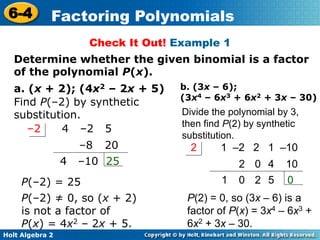
Determine whether the given binomial is a factor
of the polynomial P(x).
a. (x + 2); (4x2 – 2x + 5)
Find P(–2) by synthetic
substitution.
4 –2 5–2
–8
4 25–10
20
P(–2) = 25
P(–2) ≠ 0, so (x + 2)
is not a factor of
P(x) = 4x2 – 2x + 5.
b. (3x – 6);
(3x4 – 6x3 + 6x2 + 3x – 30)
1 –2 2 1 –102
2
1 0
1040
520
P(2) = 0, so (3x – 6) is a
factor of P(x) = 3x4 – 6x3 +
6x2 + 3x – 30.
Divide the polynomial by 3,
then find P(2) by synthetic
substitution.
Holt Algebra 2
6-4 Factoring Polynomials
You are already familiar with methods for
factoring quadratic expressions. You can factor
polynomials of higher degrees using many of the
same methods you learned in Lesson 5-3.
Holt Algebra 2
6-4 Factoring Polynomials
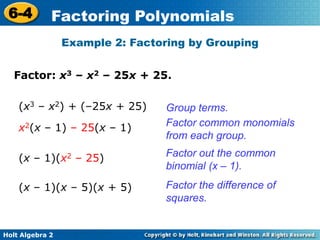
Factor: x3 – x2 – 25x + 25.
Example 2: Factoring by Grouping
Group terms.(x3 – x2) + (–25x + 25)
Factor common monomials
from each group.
x2(x – 1) – 25(x – 1)
Factor out the common
binomial (x – 1).
(x – 1)(x2 – 25)
Factor the difference of
squares.
(x – 1)(x – 5)(x + 5)
Holt Algebra 2
6-4 Factoring Polynomials
Example 2 Continued
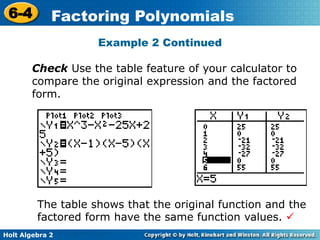
Check Use the table feature of your calculator to
compare the original expression and the factored
form.
The table shows that the original function and the
factored form have the same function values. 
Holt Algebra 2
6-4 Factoring Polynomials
Check It Out! Example 2a
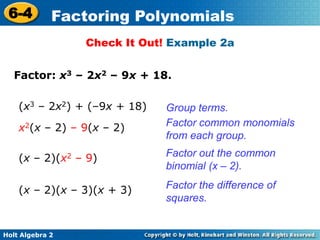
Factor: x3 – 2x2 – 9x + 18.
Group terms.(x3 – 2x2) + (–9x + 18)
Factor common monomials
from each group.
x2(x – 2) – 9(x – 2)
Factor out the common
binomial (x – 2).
(x – 2)(x2 – 9)
Factor the difference of
squares.
(x – 2)(x – 3)(x + 3)
Holt Algebra 2
6-4 Factoring Polynomials
Check It Out! Example 2a Continued
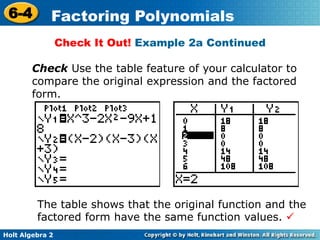
Check Use the table feature of your calculator to
compare the original expression and the factored
form.
The table shows that the original function and the
factored form have the same function values. 
Holt Algebra 2
6-4 Factoring Polynomials
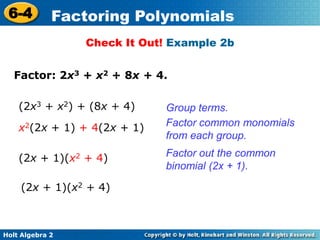
Check It Out! Example 2b
Factor: 2x3 + x2 + 8x + 4.
Group terms.(2x3 + x2) + (8x + 4)
Factor common monomials
from each group.
x2(2x + 1) + 4(2x + 1)
Factor out the common
binomial (2x + 1).
(2x + 1)(x2 + 4)
(2x + 1)(x2 + 4)
Holt Algebra 2
6-4 Factoring Polynomials
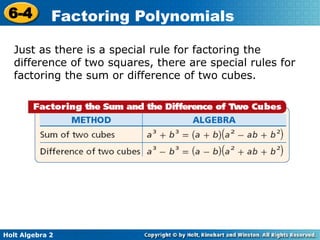
Just as there is a special rule for factoring the
difference of two squares, there are special rules for
factoring the sum or difference of two cubes.
Holt Algebra 2
6-4 Factoring Polynomials
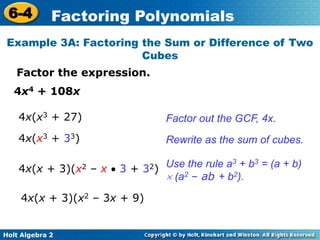
Example 3A: Factoring the Sum or Difference of Two
Cubes
Factor the expression.
4x4 + 108x
Factor out the GCF, 4x.4x(x3 + 27)
Rewrite as the sum of cubes.4x(x3 + 33)
Use the rule a3 + b3 = (a + b)
 (a2 – ab + b2).
4x(x + 3)(x2 – x  3 + 32)
4x(x + 3)(x2 – 3x + 9)
Holt Algebra 2
6-4 Factoring Polynomials
Example 3B: Factoring the Sum or Difference of Two
Cubes
Factor the expression.
125d3 – 8
Rewrite as the difference
of cubes.
(5d)3 – 23
(5d – 2)[(5d)2 + 5d  2 + 22] Use the rule a3 – b3 =
(a – b)  (a2 + ab + b2).
(5d – 2)(25d2 + 10d + 4)
Holt Algebra 2
6-4 Factoring Polynomials
Check It Out! Example 3a
Factor the expression.
8 + z6
Rewrite as the difference
of cubes.
(2)3 + (z2)3
(2 + z2)[(2)2 – 2  z + (z2)2] Use the rule a3 + b3 =
(a + b)  (a2 – ab + b2).
(2 + z2)(4 – 2z + z4)
Holt Algebra 2
6-4 Factoring Polynomials
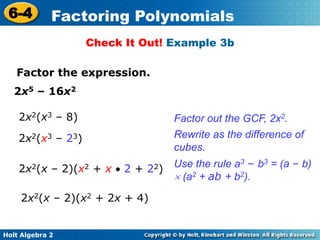
Check It Out! Example 3b
Factor the expression.
2x5 – 16x2
Factor out the GCF, 2x2.2x2(x3 – 8)
Rewrite as the difference of
cubes.
2x2(x3 – 23)
Use the rule a3 – b3 = (a – b)
 (a2 + ab + b2).
2x2(x – 2)(x2 + x  2 + 22)
2x2(x – 2)(x2 + 2x + 4)
Holt Algebra 2
6-4 Factoring Polynomials
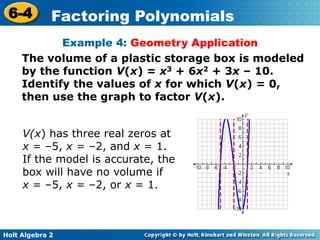
Example 4: Geometry Application
The volume of a plastic storage box is modeled
by the function V(x) = x3 + 6x2 + 3x – 10.
Identify the values of x for which V(x) = 0,
then use the graph to factor V(x).
V(x) has three real zeros at
x = –5, x = –2, and x = 1.
If the model is accurate, the
box will have no volume if
x = –5, x = –2, or x = 1.
Holt Algebra 2
6-4 Factoring Polynomials
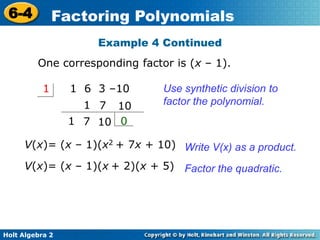
Use synthetic division to
factor the polynomial.
1 6 3 –101
1
1 0
V(x)= (x – 1)(x2 + 7x + 10)
107
107
Write V(x) as a product.
V(x)= (x – 1)(x + 2)(x + 5) Factor the quadratic.
Example 4 Continued
One corresponding factor is (x – 1).
Holt Algebra 2
6-4 Factoring Polynomials
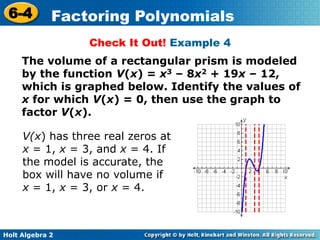
Check It Out! Example 4
The volume of a rectangular prism is modeled
by the function V(x) = x3 – 8x2 + 19x – 12,
which is graphed below. Identify the values of
x for which V(x) = 0, then use the graph to
factor V(x).
V(x) has three real zeros at
x = 1, x = 3, and x = 4. If
the model is accurate, the
box will have no volume if
x = 1, x = 3, or x = 4.
Holt Algebra 2
6-4 Factoring Polynomials
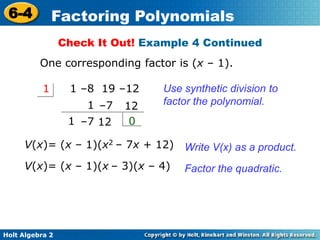
Use synthetic division to
factor the polynomial.
1 –8 19 –121
1
1 0
V(x)= (x – 1)(x2 – 7x + 12)
12–7
12–7
Write V(x) as a product.
V(x)= (x – 1)(x – 3)(x – 4) Factor the quadratic.
Check It Out! Example 4 Continued
One corresponding factor is (x – 1).
Holt Algebra 2
6-4 Factoring Polynomials
4. x3 + 3x2 – 28x – 60
Lesson Quiz
2. x + 2; P(x) = x3 + 2x2 – x – 2
1. x – 1; P(x) = 3x2 – 2x + 5
8(2p – q)(4p2 + 2pq + q2)
(x + 3)(x + 3)(x – 3)3. x3 + 3x2 – 9x – 27
P(1) ≠ 0, so x – 1 is not a factor of P(x).
P(2) = 0, so x + 2 is a factor of P(x).
4. 64p3 – 8q3
(x + 6)(x – 5)(x + 2)

3.2 factoring polynomials

  • 1.
    Holt Algebra 2 6-4Factoring Polynomials6-4 Factoring Polynomials Holt Algebra 2 Warm Up Lesson Presentation Lesson Quiz
  • 2.
    Holt Algebra 2 6-4Factoring Polynomials Warm Up Factor each expression. 1. 3x – 6y 2. a2 – b2 3. (x – 1)(x + 3) 4. (a + 1)(a2 + 1) x2 + 2x – 3 3(x – 2y) (a + b)(a – b) a3 + a2 + a + 1 Find each product.
  • 3.
    Holt Algebra 2 6-4Factoring Polynomials Use the Factor Theorem to determine factors of a polynomial. Factor the sum and difference of two cubes. Objectives
  • 4.
    Holt Algebra 2 6-4Factoring Polynomials Recall that if a number is divided by any of its factors, the remainder is 0. Likewise, if a polynomial is divided by any of its factors, the remainder is 0. The Remainder Theorem states that if a polynomial is divided by (x – a), the remainder is the value of the function at a. So, if (x – a) is a factor of P(x), then P(a) = 0.
  • 5.
    Holt Algebra 2 6-4Factoring Polynomials Determine whether the given binomial is a factor of the polynomial P(x). Example 1: Determining Whether a Linear Binomial is a Factor A. (x + 1); (x2 – 3x + 1) Find P(–1) by synthetic substitution. 1 –3 1–1 –1 1 5–4 4 P(–1) = 5 P(–1) ≠ 0, so (x + 1) is not a factor of P(x) = x2 – 3x + 1. B. (x + 2); (3x4 + 6x3 – 5x – 10) Find P(–2) by synthetic substitution. 3 6 0 –5 –10–2 –6 3 0 1000 –500 P(–2) = 0, so (x + 2) is a factor of P(x) = 3x4 + 6x3 – 5x – 10.
  • 6.
    Holt Algebra 2 6-4Factoring Polynomials Check It Out! Example 1 Determine whether the given binomial is a factor of the polynomial P(x). a. (x + 2); (4x2 – 2x + 5) Find P(–2) by synthetic substitution. 4 –2 5–2 –8 4 25–10 20 P(–2) = 25 P(–2) ≠ 0, so (x + 2) is not a factor of P(x) = 4x2 – 2x + 5. b. (3x – 6); (3x4 – 6x3 + 6x2 + 3x – 30) 1 –2 2 1 –102 2 1 0 1040 520 P(2) = 0, so (3x – 6) is a factor of P(x) = 3x4 – 6x3 + 6x2 + 3x – 30. Divide the polynomial by 3, then find P(2) by synthetic substitution.
  • 7.
    Holt Algebra 2 6-4Factoring Polynomials You are already familiar with methods for factoring quadratic expressions. You can factor polynomials of higher degrees using many of the same methods you learned in Lesson 5-3.
  • 8.
    Holt Algebra 2 6-4Factoring Polynomials Factor: x3 – x2 – 25x + 25. Example 2: Factoring by Grouping Group terms.(x3 – x2) + (–25x + 25) Factor common monomials from each group. x2(x – 1) – 25(x – 1) Factor out the common binomial (x – 1). (x – 1)(x2 – 25) Factor the difference of squares. (x – 1)(x – 5)(x + 5)
  • 9.
    Holt Algebra 2 6-4Factoring Polynomials Example 2 Continued Check Use the table feature of your calculator to compare the original expression and the factored form. The table shows that the original function and the factored form have the same function values. 
  • 10.
    Holt Algebra 2 6-4Factoring Polynomials Check It Out! Example 2a Factor: x3 – 2x2 – 9x + 18. Group terms.(x3 – 2x2) + (–9x + 18) Factor common monomials from each group. x2(x – 2) – 9(x – 2) Factor out the common binomial (x – 2). (x – 2)(x2 – 9) Factor the difference of squares. (x – 2)(x – 3)(x + 3)
  • 11.
    Holt Algebra 2 6-4Factoring Polynomials Check It Out! Example 2a Continued Check Use the table feature of your calculator to compare the original expression and the factored form. The table shows that the original function and the factored form have the same function values. 
  • 12.
    Holt Algebra 2 6-4Factoring Polynomials Check It Out! Example 2b Factor: 2x3 + x2 + 8x + 4. Group terms.(2x3 + x2) + (8x + 4) Factor common monomials from each group. x2(2x + 1) + 4(2x + 1) Factor out the common binomial (2x + 1). (2x + 1)(x2 + 4) (2x + 1)(x2 + 4)
  • 13.
    Holt Algebra 2 6-4Factoring Polynomials Just as there is a special rule for factoring the difference of two squares, there are special rules for factoring the sum or difference of two cubes.
  • 14.
    Holt Algebra 2 6-4Factoring Polynomials Example 3A: Factoring the Sum or Difference of Two Cubes Factor the expression. 4x4 + 108x Factor out the GCF, 4x.4x(x3 + 27) Rewrite as the sum of cubes.4x(x3 + 33) Use the rule a3 + b3 = (a + b)  (a2 – ab + b2). 4x(x + 3)(x2 – x  3 + 32) 4x(x + 3)(x2 – 3x + 9)
  • 15.
    Holt Algebra 2 6-4Factoring Polynomials Example 3B: Factoring the Sum or Difference of Two Cubes Factor the expression. 125d3 – 8 Rewrite as the difference of cubes. (5d)3 – 23 (5d – 2)[(5d)2 + 5d  2 + 22] Use the rule a3 – b3 = (a – b)  (a2 + ab + b2). (5d – 2)(25d2 + 10d + 4)
  • 16.
    Holt Algebra 2 6-4Factoring Polynomials Check It Out! Example 3a Factor the expression. 8 + z6 Rewrite as the difference of cubes. (2)3 + (z2)3 (2 + z2)[(2)2 – 2  z + (z2)2] Use the rule a3 + b3 = (a + b)  (a2 – ab + b2). (2 + z2)(4 – 2z + z4)
  • 17.
    Holt Algebra 2 6-4Factoring Polynomials Check It Out! Example 3b Factor the expression. 2x5 – 16x2 Factor out the GCF, 2x2.2x2(x3 – 8) Rewrite as the difference of cubes. 2x2(x3 – 23) Use the rule a3 – b3 = (a – b)  (a2 + ab + b2). 2x2(x – 2)(x2 + x  2 + 22) 2x2(x – 2)(x2 + 2x + 4)
  • 18.
    Holt Algebra 2 6-4Factoring Polynomials Example 4: Geometry Application The volume of a plastic storage box is modeled by the function V(x) = x3 + 6x2 + 3x – 10. Identify the values of x for which V(x) = 0, then use the graph to factor V(x). V(x) has three real zeros at x = –5, x = –2, and x = 1. If the model is accurate, the box will have no volume if x = –5, x = –2, or x = 1.
  • 19.
    Holt Algebra 2 6-4Factoring Polynomials Use synthetic division to factor the polynomial. 1 6 3 –101 1 1 0 V(x)= (x – 1)(x2 + 7x + 10) 107 107 Write V(x) as a product. V(x)= (x – 1)(x + 2)(x + 5) Factor the quadratic. Example 4 Continued One corresponding factor is (x – 1).
  • 20.
    Holt Algebra 2 6-4Factoring Polynomials Check It Out! Example 4 The volume of a rectangular prism is modeled by the function V(x) = x3 – 8x2 + 19x – 12, which is graphed below. Identify the values of x for which V(x) = 0, then use the graph to factor V(x). V(x) has three real zeros at x = 1, x = 3, and x = 4. If the model is accurate, the box will have no volume if x = 1, x = 3, or x = 4.
  • 21.
    Holt Algebra 2 6-4Factoring Polynomials Use synthetic division to factor the polynomial. 1 –8 19 –121 1 1 0 V(x)= (x – 1)(x2 – 7x + 12) 12–7 12–7 Write V(x) as a product. V(x)= (x – 1)(x – 3)(x – 4) Factor the quadratic. Check It Out! Example 4 Continued One corresponding factor is (x – 1).
  • 22.
    Holt Algebra 2 6-4Factoring Polynomials 4. x3 + 3x2 – 28x – 60 Lesson Quiz 2. x + 2; P(x) = x3 + 2x2 – x – 2 1. x – 1; P(x) = 3x2 – 2x + 5 8(2p – q)(4p2 + 2pq + q2) (x + 3)(x + 3)(x – 3)3. x3 + 3x2 – 9x – 27 P(1) ≠ 0, so x – 1 is not a factor of P(x). P(2) = 0, so x + 2 is a factor of P(x). 4. 64p3 – 8q3 (x + 6)(x – 5)(x + 2)