College Algebra
Fifth Edition
James Stewart  Lothar Redlin  Saleem Watson
PrerequisitesP
FactoringP.7
Factoring
We use the Distributive Property to expand
algebraic expressions.
We sometimes need to reverse this process
(again using the Distributive Property) by:
• Factoring an expression as a product
of simpler ones.
Factoring
For example, we can write:
• We say that x – 2 and x + 2 are factors
of x2
– 4.
2
4 ( 2)( 2)
Factoring
Expanding
x x x
→
− = − +
¬ 
Common Factors
Factoring
The easiest type of factoring
occurs when:
• The terms have a common factor.
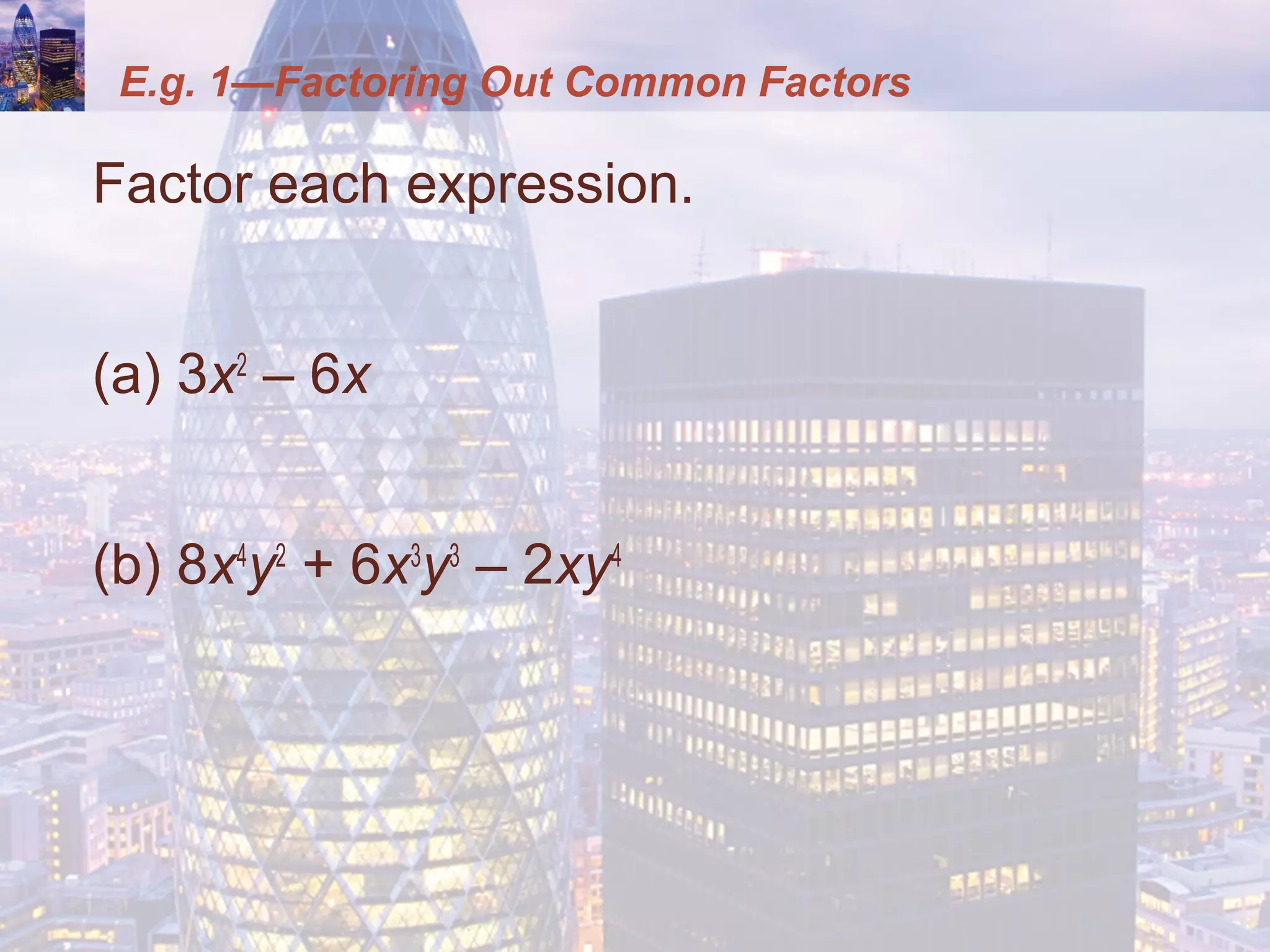
E.g. 1—Factoring Out Common Factors
Factor each expression.
(a) 3x2
– 6x
(b) 8x4
y2
+ 6x3
y3
– 2xy4
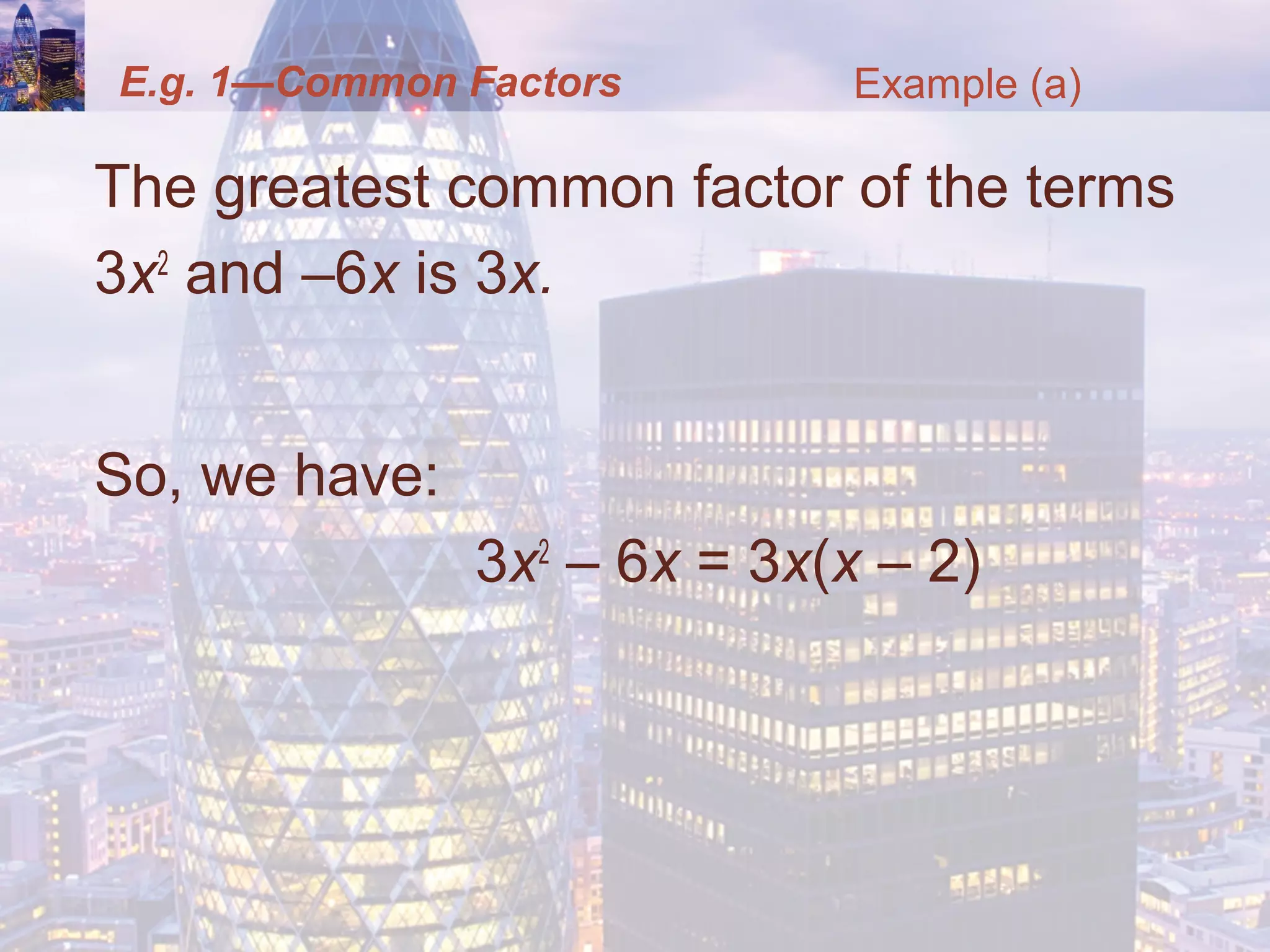
E.g. 1—Common Factors
The greatest common factor of the terms
3x2
and –6x is 3x.
So, we have:
3x2
– 6x = 3x(x – 2)
Example (a)
E.g. 1—Common Factors
We note that:
• 8, 6, and –2 have the greatest common
factor 2.
• x4
, x3
, and x have the greatest common
factor x.
• y2
, y3
, and y4
have the greatest common
factor y2
.
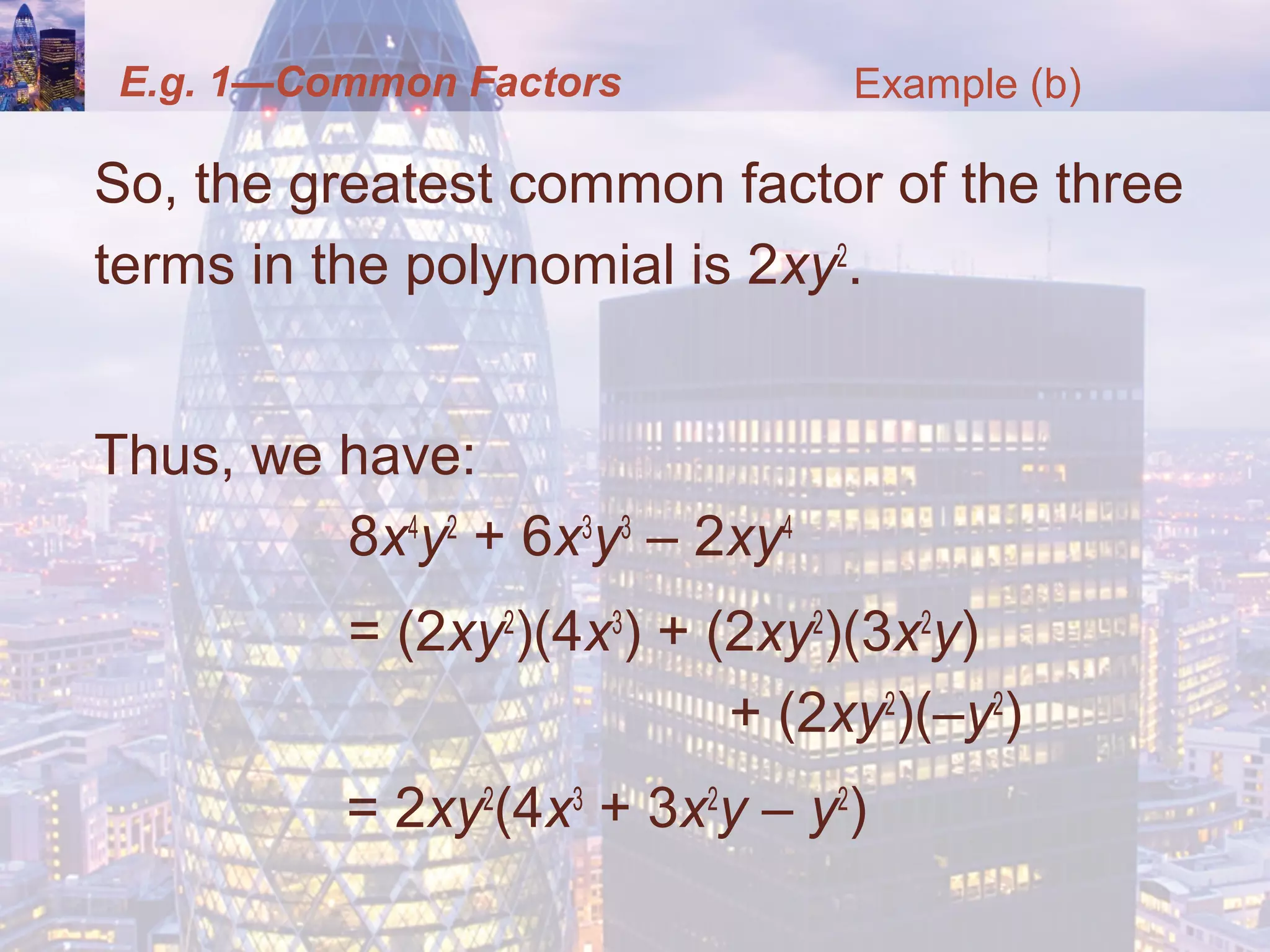
Example (b)
E.g. 1—Common Factors
So, the greatest common factor of the three
terms in the polynomial is 2xy2
.
Thus, we have:
8x4
y2
+ 6x3
y3
– 2xy4
= (2xy2
)(4x3
) + (2xy2
)(3x2
y)
+ (2xy2
)(–y2
)
= 2xy2
(4x3
+ 3x2
y – y2
)
Example (b)
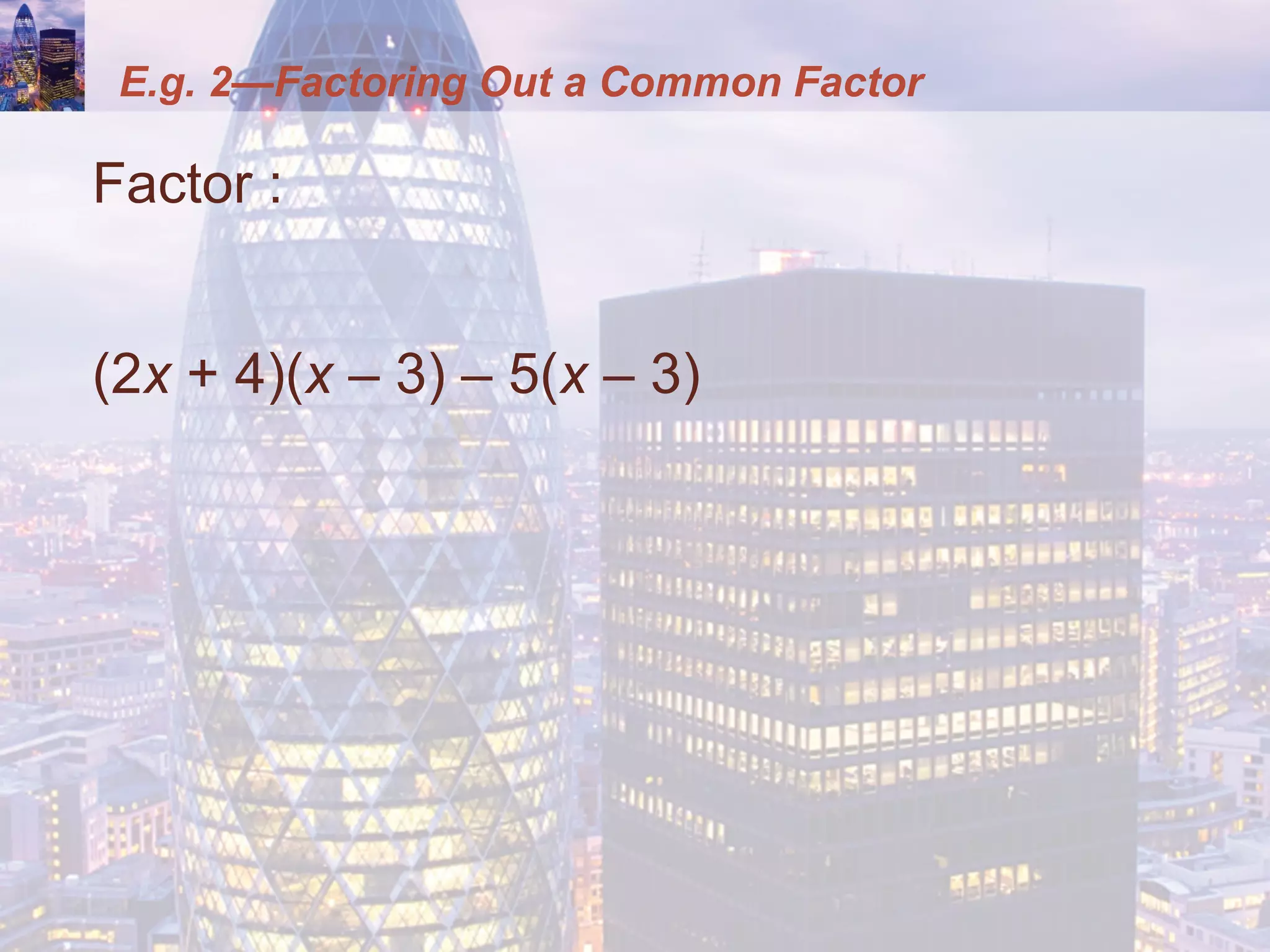
E.g. 2—Factoring Out a Common Factor
Factor :
(2x + 4)(x – 3) – 5(x – 3)
E.g. 2—Factoring Out a Common Factor
The two terms have the common factor x – 3.
(2x + 4)(x – 3) – 5(x – 3)
= [(2x + 4) – 5](x – 3) (Distributive Property)
= (2x – 1)(x – 3) (Simplify)
Factoring Trinomials
Factoring x2
+ bx + c
In order to factor a trinomial of the form
x2
+ bx + c, we note that:
(x + r)(x + s) = x2
+ (r + s)x + rs
• So, we need to choose numbers r and s
so that r + s = b and rs = c.
E.g. 3—Factoring x2
+ bx + c by Trial and Error
Factor: x2
+ 7x + 12
• We need to find two integers whose product is 12
and whose sum is 7.
• By trial and error, we find that they are 3 and 4.
• Thus, the factorization is:
x2
+ 7x + 12 = (x + 3)(x + 4)
Factoring ax2
+ bx + c
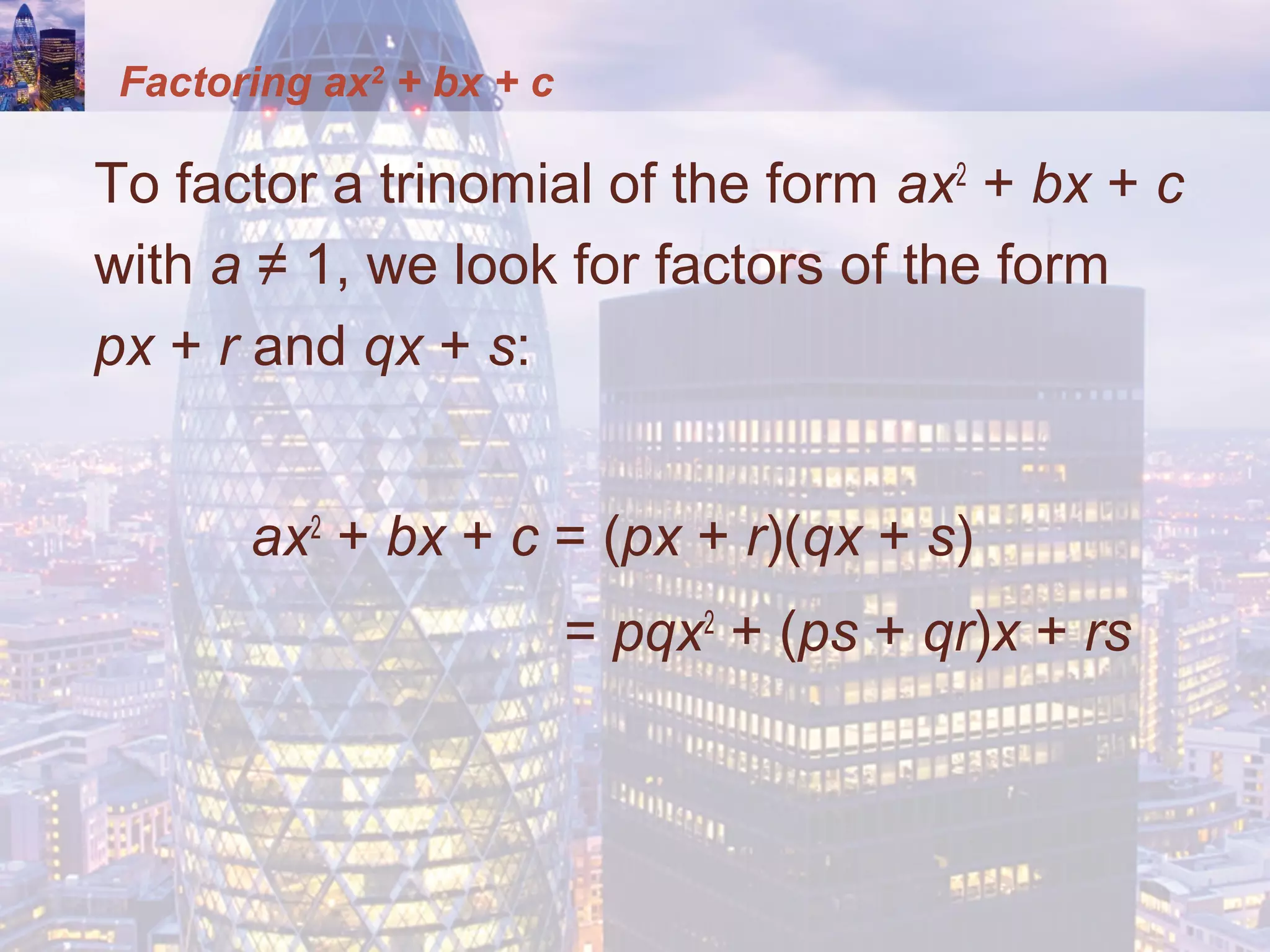
To factor a trinomial of the form ax2
+ bx + c
with a ≠ 1, we look for factors of the form
px + r and qx + s:
ax2
+ bx + c = (px + r)(qx + s)
= pqx2
+ (ps + qr)x + rs
Factoring ax2
+ bx + c
Thus, we try to find numbers p, q, r, and s
such that:
pq = a rs = c ps + qr = b
• If these numbers are all integers, then we will
have a limited number of possibilities to try for
p, q, r, and s.
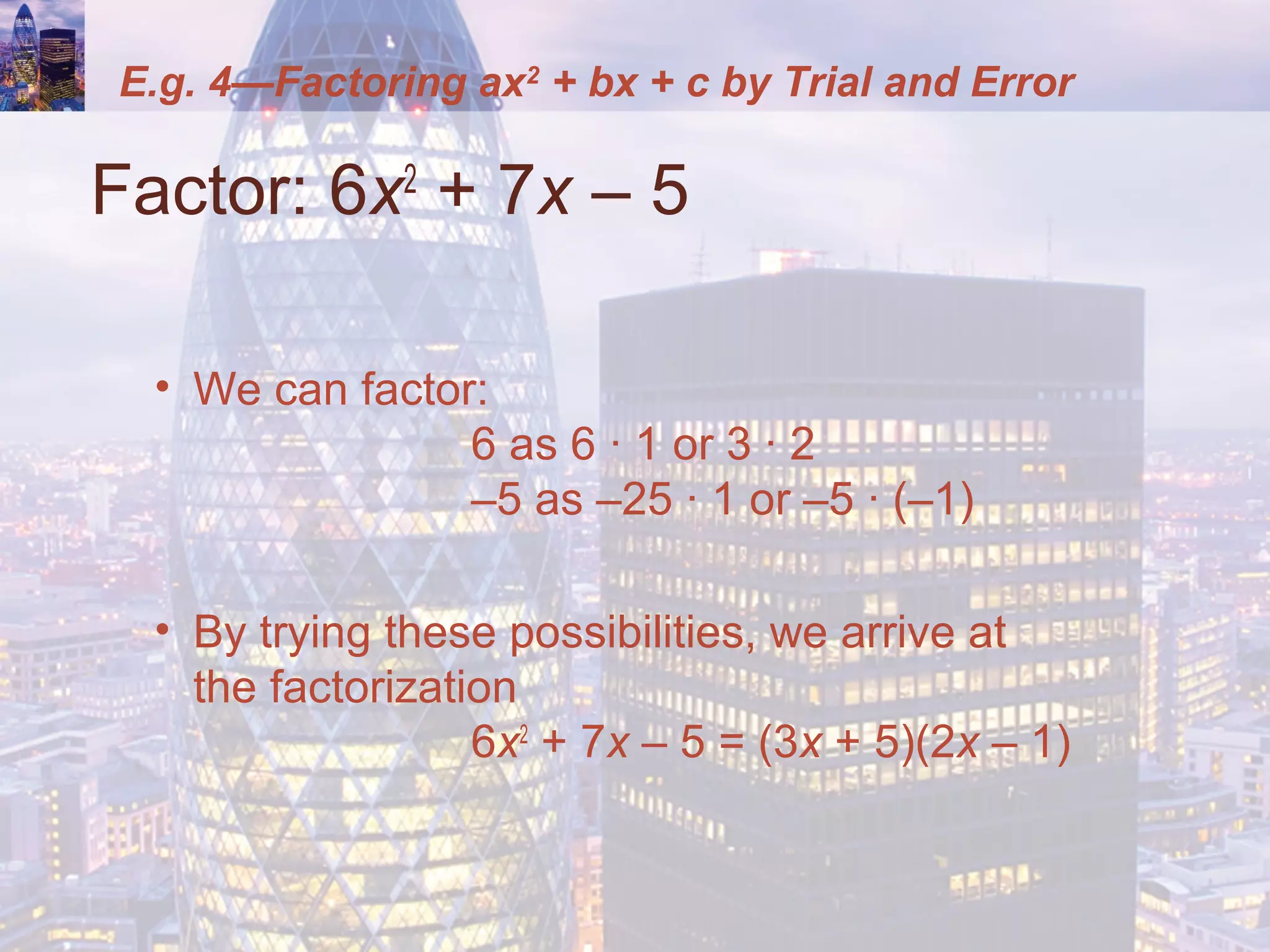
E.g. 4—Factoring ax2
+ bx + c by Trial and Error
Factor: 6x2
+ 7x – 5
• We can factor:
6 as 6 ∙ 1 or 3 ∙ 2
–5 as –25 ∙ 1 or –5 ∙ (–1)
• By trying these possibilities, we arrive at
the factorization
6x2
+ 7x – 5 = (3x + 5)(2x – 1)
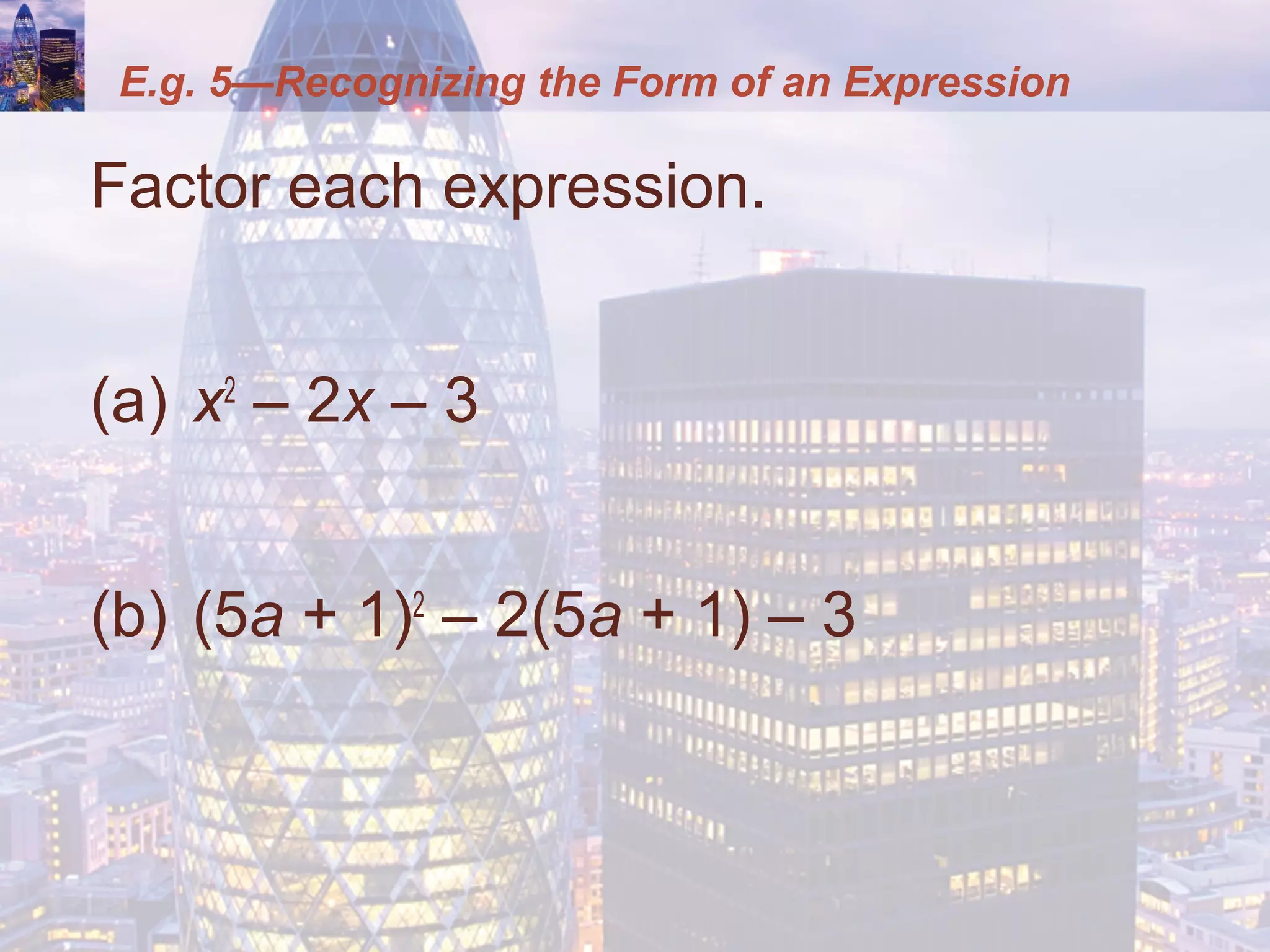
E.g. 5—Recognizing the Form of an Expression
Factor each expression.
(a) x2
– 2x – 3
(b) (5a + 1)2
– 2(5a + 1) – 3
E.g. 5—Recognizing the Form
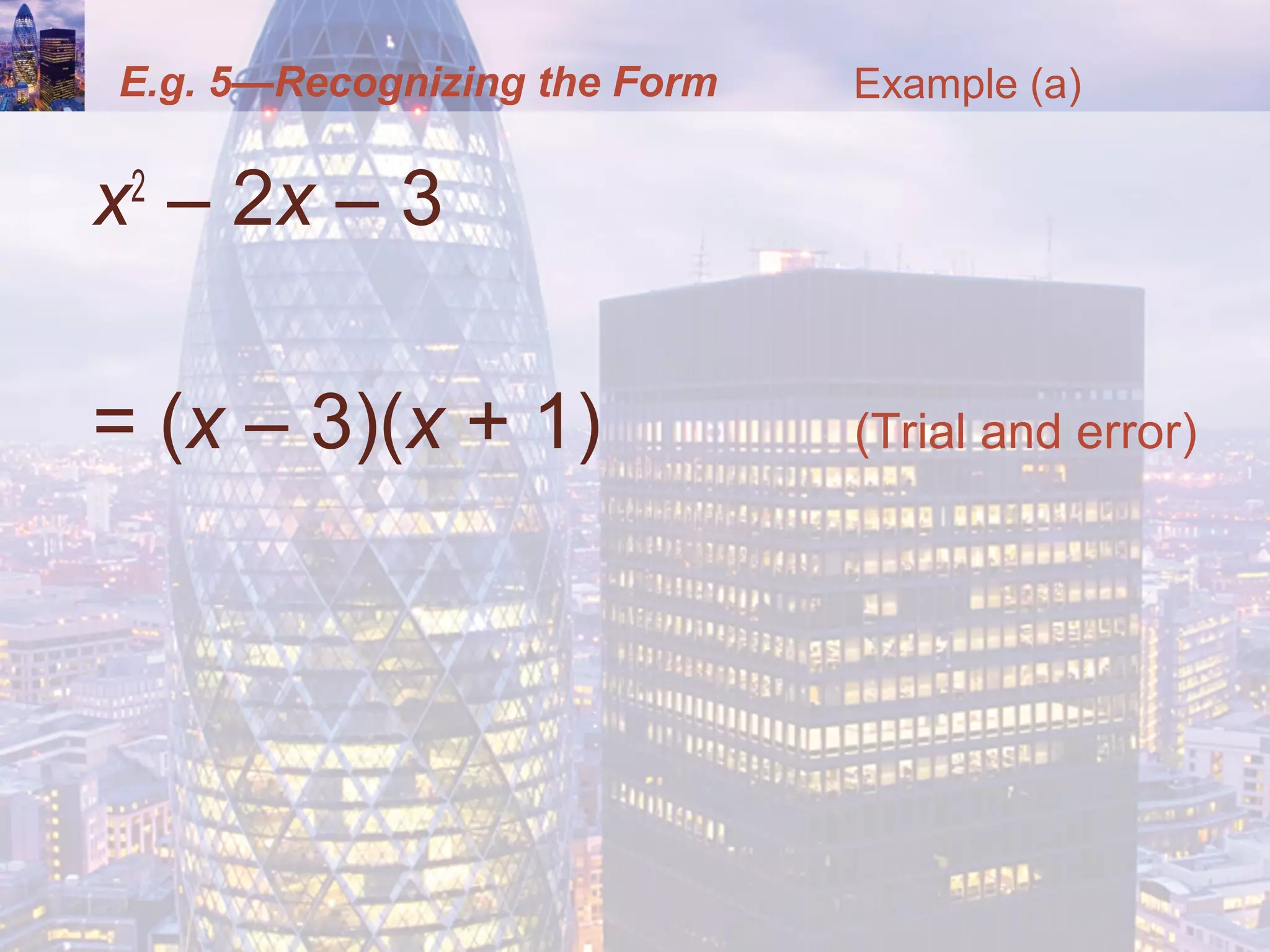
x2
– 2x – 3
= (x – 3)(x + 1) (Trial and error)
Example (a)
E.g. 5—Recognizing the Form
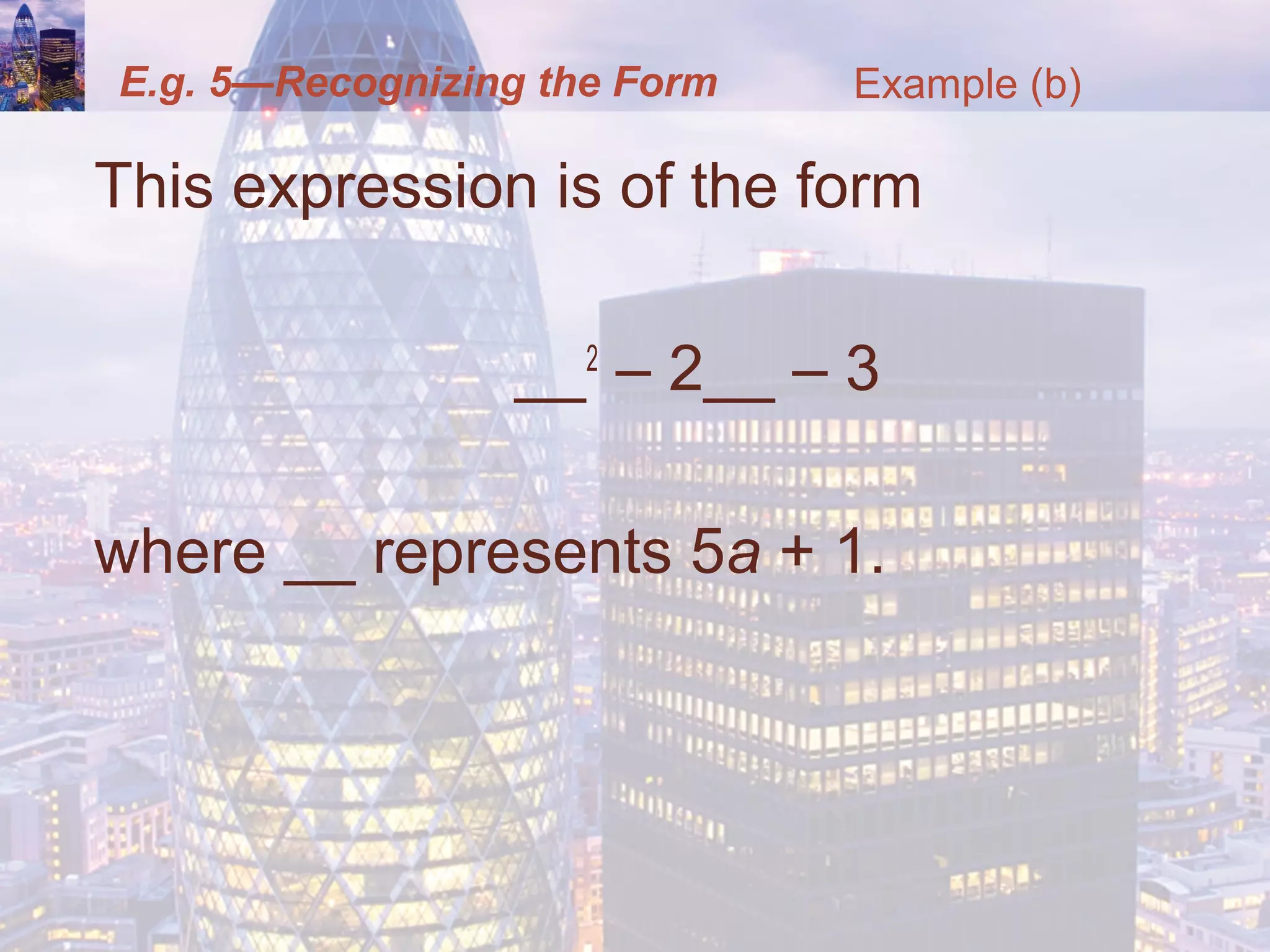
This expression is of the form
__2
– 2__ – 3
where __ represents 5a + 1.
Example (b)
E.g. 5—Recognizing the Form
This is the same form as the expression
in part (a).
So, it will factor as ( __ – 3)( __ + 1).
• (5a + 1)2
– 2(5a + 1) – 3
= [(5a + 1) – 3][(5a + 1) + 1]
= (5a – 2)(5a + 2)
Example (b)
Special Factoring Formulas
Some special algebraic expressions can
be factored using the following formulas.
• The first three are simply Special Product
Formulas written backward.
E.g. 6—Factoring Differences of Squares
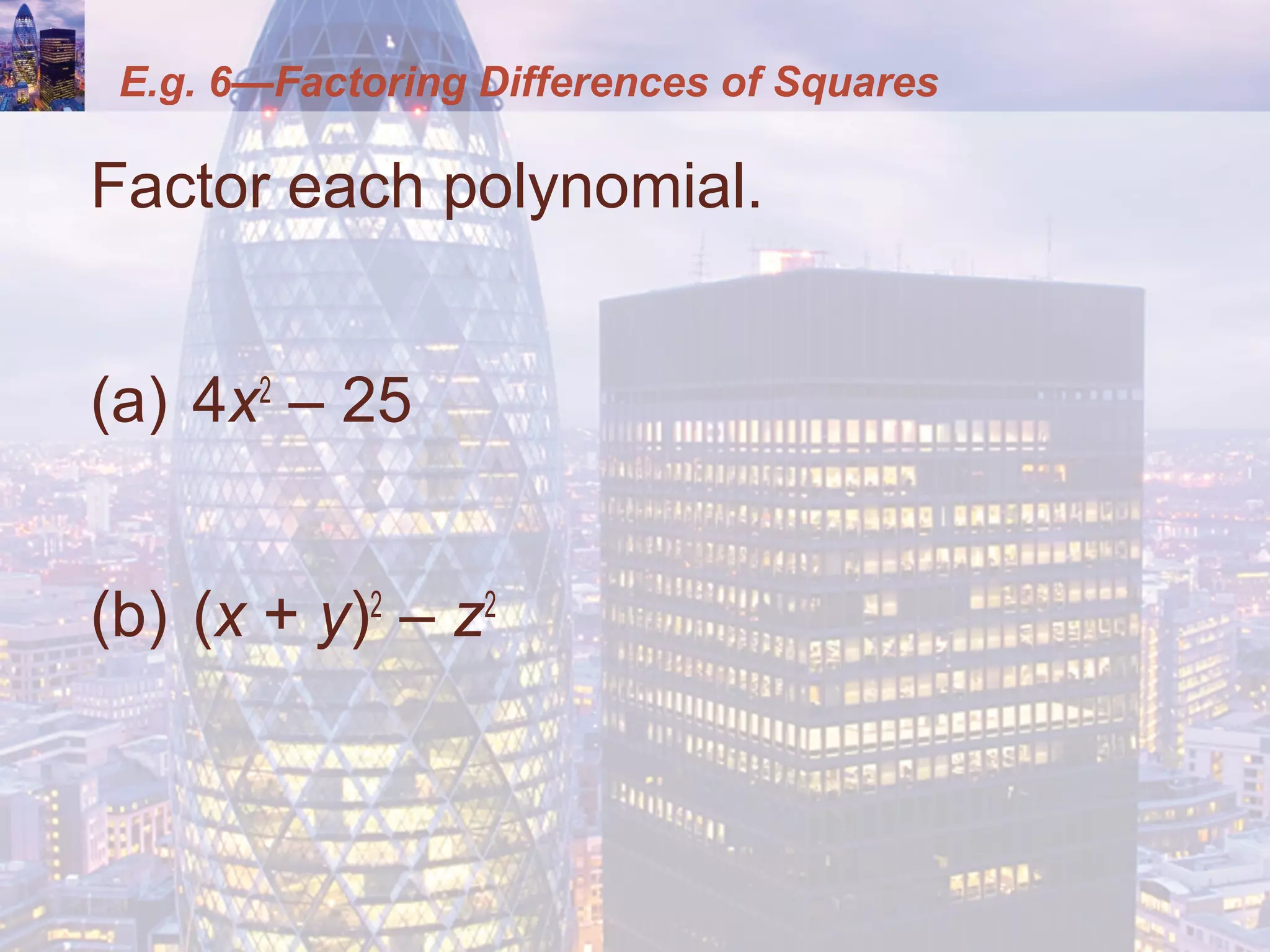
Factor each polynomial.
(a) 4x2
– 25
(b) (x + y)2
– z2
E.g. 6—Differences of Squares
Using the Difference of Squares Formula
with A = 2x and B = 5, we have:
4x2
– 25 = (2x)2
– 52
= (2x – 5)(2x + 5)
Example (a)
E.g. 6—Differences of Squares
We use the Difference of Squares Formula
with A = x + y and B = z.
(x + y)2
– z2
= (x + y – z)(x + y + z)
Example (b)
E.g. 7—Factoring Differences and Sums of Cubes
Factor each polynomial.
(a) 27x3
– 1
(b) x6
+ 8
E.g. 7—Difference of Cubes
Using the Difference of Cubes Formula
with A = 3x and B = 1, we get:
27x3
– 1 = (3x)3
– 13
= (3x – 1)[ (3x)2
+ (3x)(1) + 12
]
= (3x – 1)(9x2
+ 3x + 1)
Example (a)
E.g. 7—Sum of Cubes
Using the Sum of Cubes Formula with
A = x2
and B = 2, we have:
x6
+ 8 = (x2
)3
+ 23
= (x2
+ 2)(x4
– 2x2
+ 4)
Example (b)
Perfect Square
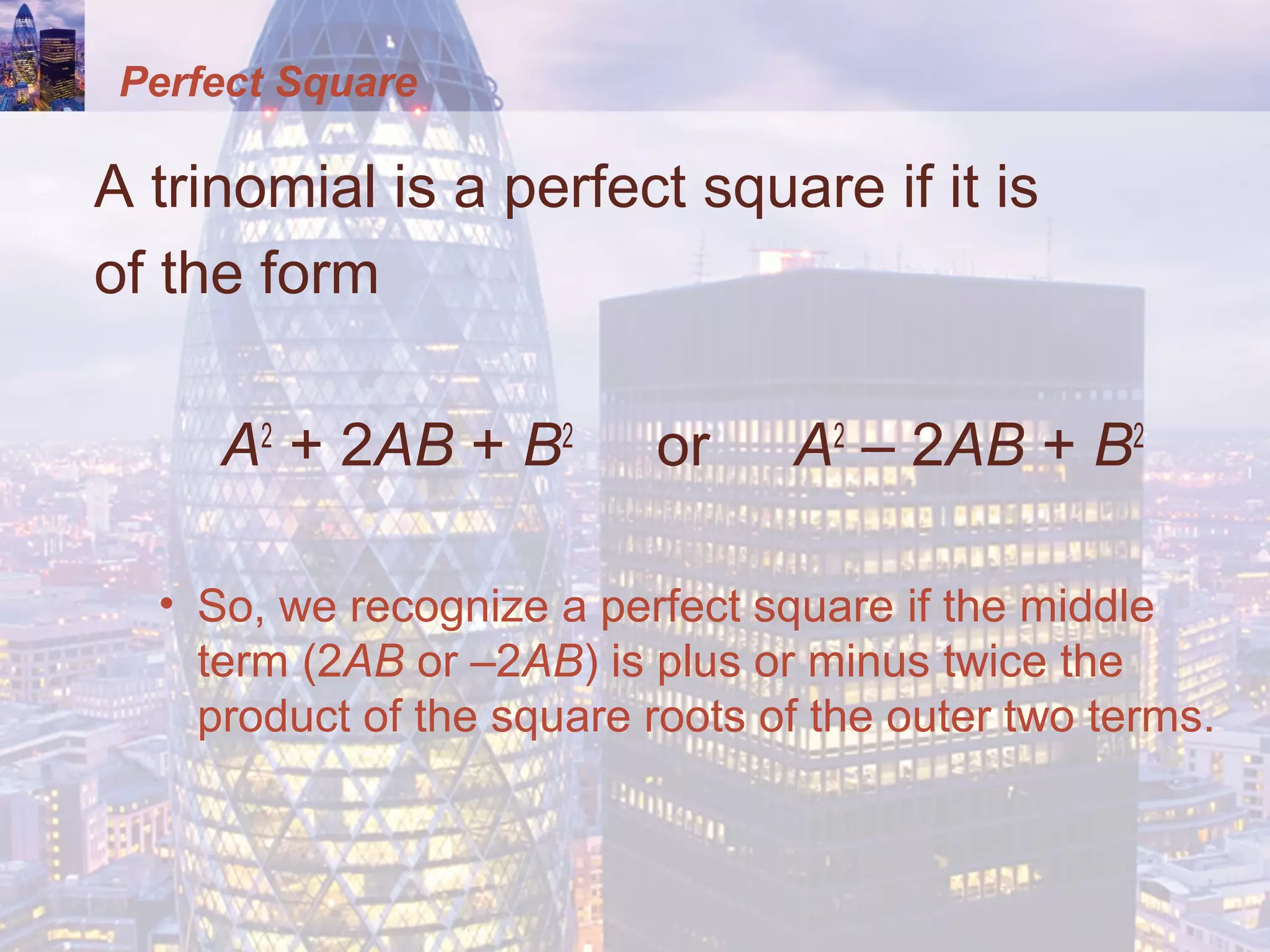
A trinomial is a perfect square if it is
of the form
A2
+ 2AB + B2
or A2
– 2AB + B2
• So, we recognize a perfect square if the middle
term (2AB or –2AB) is plus or minus twice the
product of the square roots of the outer two terms.
E.g. 8—Recognizing Perfect Squares
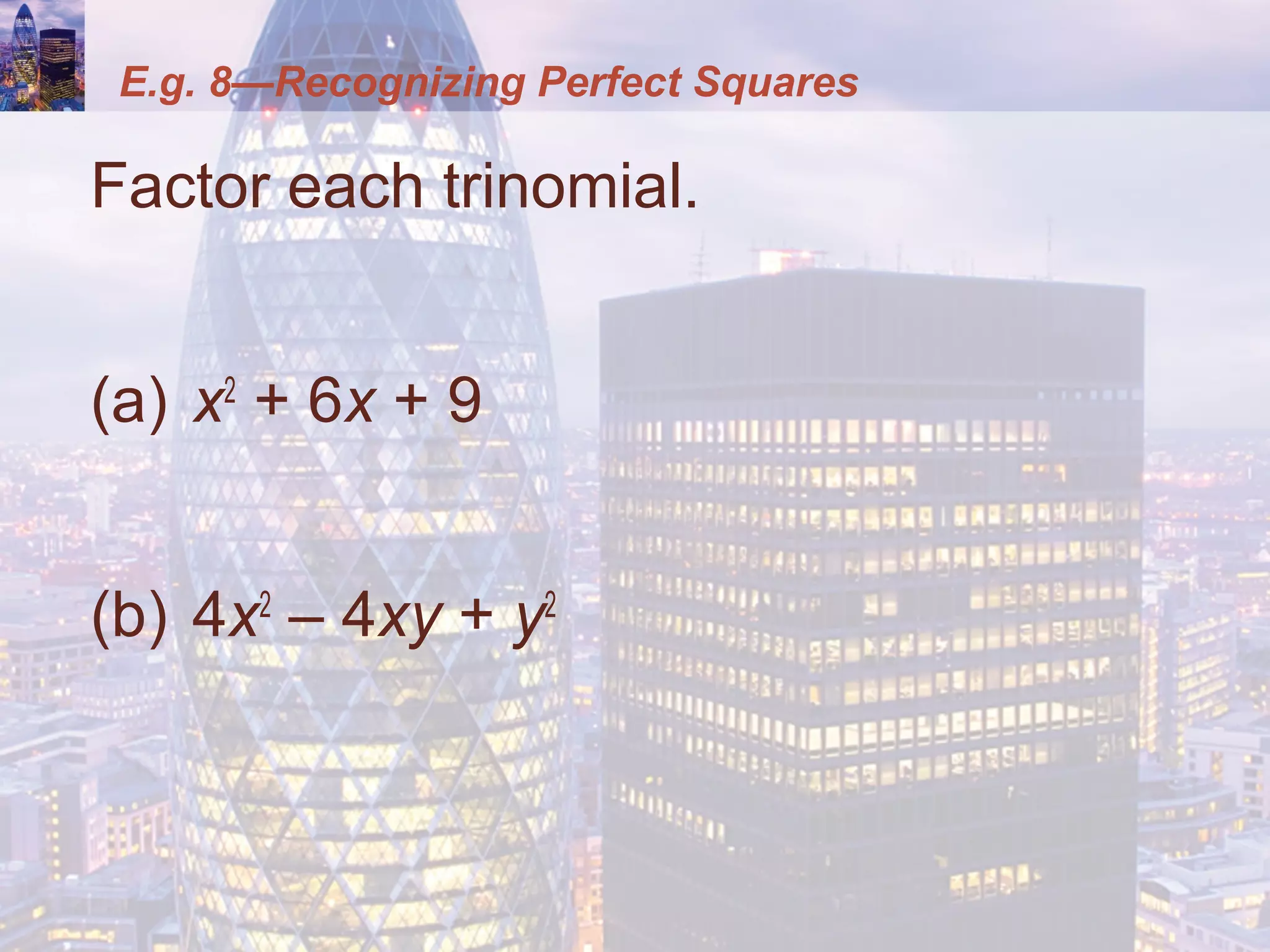
Factor each trinomial.
(a) x2
+ 6x + 9
(b) 4x2
– 4xy + y2
E.g. 8—Perfect Squares
Here, A = x and B = 3.
So, 2AB = 2 .
x .
3 = 6x.
• Since the middle term is 6x, the trinomial is
a perfect square.
• By the Perfect Square Formula, we have:
x2
+ 6x + 9 = (x + 3)2
Example (a)
E.g. 8—Perfect Squares
Here, A = 2x and B = y.
So, 2AB = 2 .
2x .
y = 4xy.
• Since the middle term is –4xy, the trinomial is
a perfect square.
• By the Perfect Square Formula, we have:
4x2
– 4xy + y2
= (2x – y)2
Example (b)
Factoring an Expression
Completely
Factoring an Expression Completely
When we factor an expression, the result
can sometimes be factored further.
In general,
• We first factor out common factors.
• Then, we inspect the result to see if it can be factored
by any of the other methods of this section.
• We repeat this process until we have factored
the expression completely.
E.g. 9—Factoring an Expression Completely
Factor each expression completely.
(a) 2x4
– 8x2
(b) x5
y2
– xy6
E.g. 9—Factoring Completely
We first factor out the power of x with
the smallest exponent.
2x4
– 8x2
= 2x2
(x2
– 4) (Common factor is 2x2
)
= 2x2
(x – 2)(x + 2) (Factor x2
– 4 as a difference
of squares)
Example (a)
E.g. 9—Factoring Completely
We first factor out the powers of x and y
with the smallest exponents.
x5
y2
– xy6
= xy2
(x4
– y4
) (Common factor is xy2
)
= xy2
(x2
+ y2
)(x2
– y2
) (Factor x4
– y4
as
a difference of squares)
= xy2
(x2
+ y2
)(x + y)(x – y) (Factor x2
– y2
as
a difference of squares)
Example (b)
Factoring Expressions with Fractional Exponents
In the next example, we factor out
variables with fractional exponents.
• This type of factoring occurs in calculus.
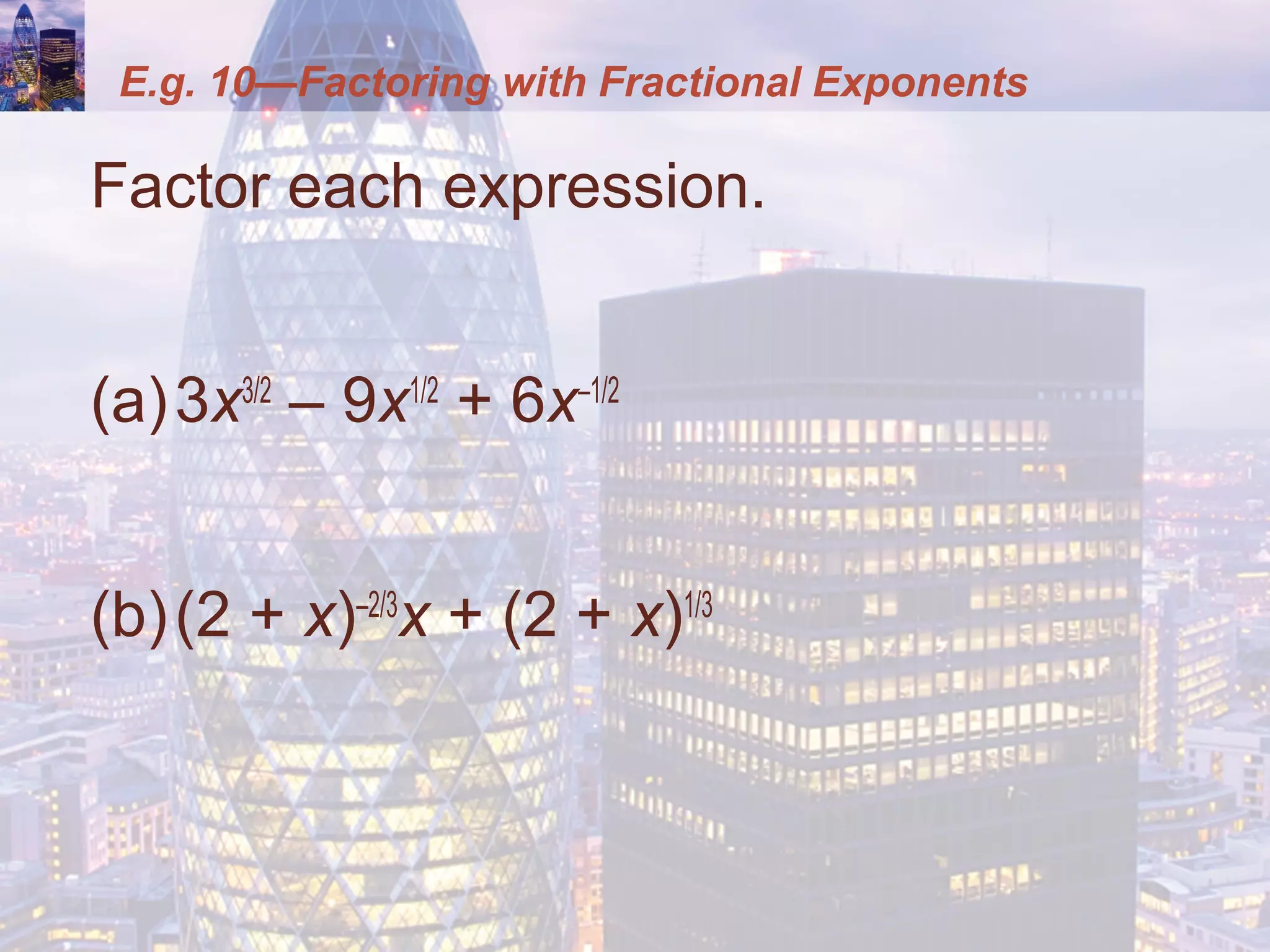
E.g. 10—Factoring with Fractional Exponents
Factor each expression.
(a)3x3/2
– 9x1/2
+ 6x–1/2
(b)(2 + x)–2/3
x + (2 + x)1/3
E.g. 10—Fractional Exponents
Factor out the power of x with the smallest
exponent—that is, x–1/2
.
3x3/2
– 9x1/2
+ 6x–1/2
= 3x–1/2
(x2
– 3x + 2) (Factor out 3x–1/2
)
= 3x–1/2
(x – 1)(x – 2) (Factor the quadratic
x2
– 3x + 2)
Example (a)
E.g. 10—Fractional Exponents
Factor out the power of 2 + x with
the smallest exponent—that is, (2 + x)–2/3
.
(2 + x)–2/3
x + (2 + x)1/3
= (2 + x)–2/3
[x + (2 + x)] (Factor out (2 + x)–2/3
)
= (2 + x)–2/3
(2 + 2x) (Simplify)
= 2(2 + x)–2/3
(1 + x) (Factor out 2)
Example (b)
Factoring by Grouping Terms
Factoring by Grouping
Polynomials with at least four terms
can sometimes be factored by grouping
terms.
• The following example illustrates the idea.
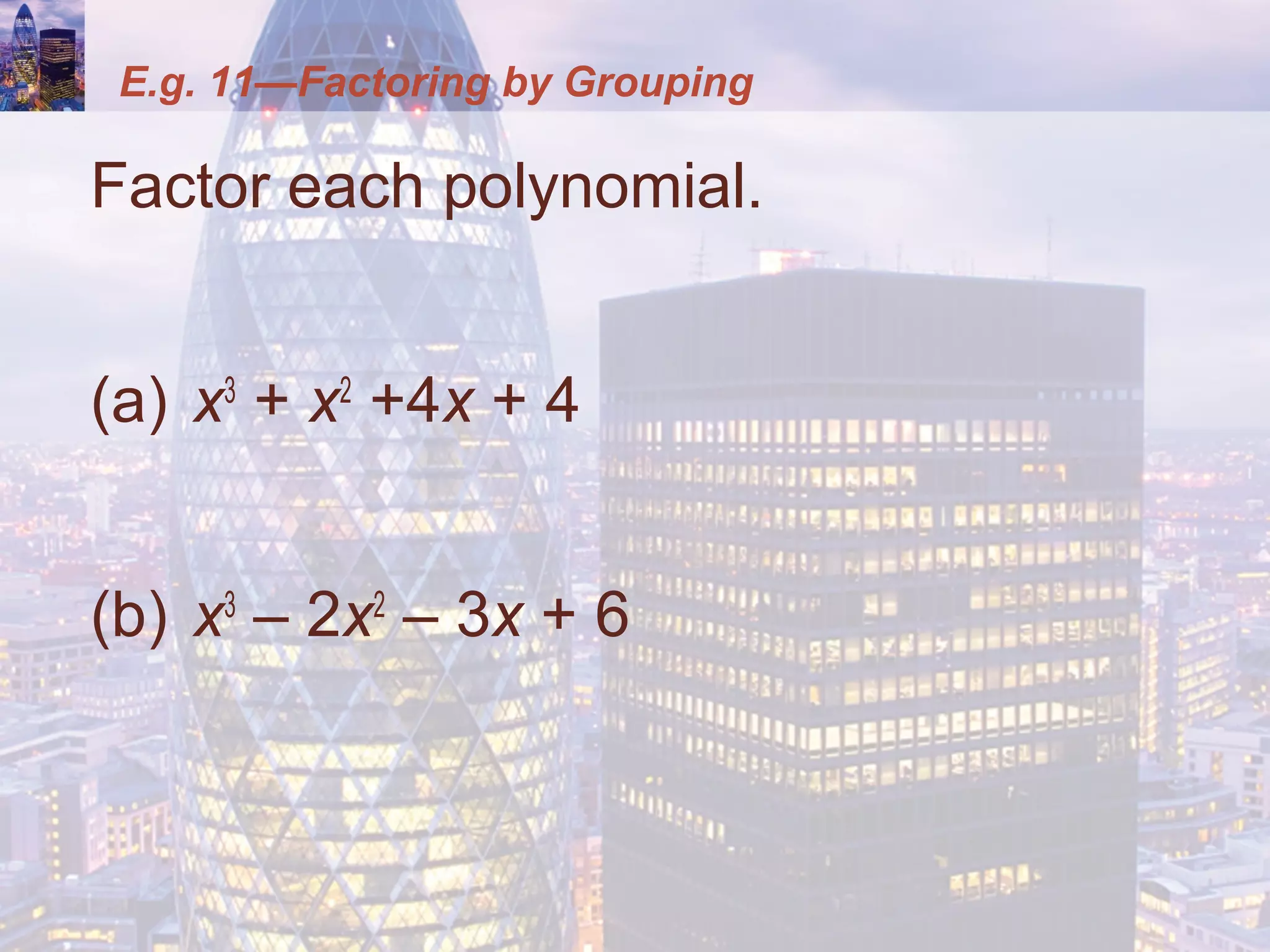
E.g. 11—Factoring by Grouping
Factor each polynomial.
(a) x3
+ x2
+4x + 4
(b) x3
– 2x2
– 3x + 6
E.g. 11—Factoring by Grouping
x3
+ x2
+4x + 4
= (x3
+ x2
) + (4x + 4) (Group terms)
= x2
(x + 1) + 4(x + 1)(Factor out common
factors)
= (x2
+ 4)(x + 1) (Factor out x + 1 from
each term)
Example (a)
E.g. 11—Factoring by Grouping
x3
– 2x2
– 3x + 6
= (x3
– 2x2
) – (3x – 6) (Group terms)
= x2
(x – 2) – 3(x – 2)(Factor out common
factors)
= (x2
– 3)(x – 2) (Factor out x – 2 from
each term)
Example (b)

P6 factoring

  • 1.
    College Algebra Fifth Edition JamesStewart  Lothar Redlin  Saleem Watson
  • 2.
  • 3.
  • 4.
    Factoring We use theDistributive Property to expand algebraic expressions. We sometimes need to reverse this process (again using the Distributive Property) by: • Factoring an expression as a product of simpler ones.
  • 5.
    Factoring For example, wecan write: • We say that x – 2 and x + 2 are factors of x2 – 4. 2 4 ( 2)( 2) Factoring Expanding x x x → − = − + ¬ 
  • 6.
  • 7.
    Factoring The easiest typeof factoring occurs when: • The terms have a common factor.
  • 8.
    E.g. 1—Factoring OutCommon Factors Factor each expression. (a) 3x2 – 6x (b) 8x4 y2 + 6x3 y3 – 2xy4
  • 9.
    E.g. 1—Common Factors Thegreatest common factor of the terms 3x2 and –6x is 3x. So, we have: 3x2 – 6x = 3x(x – 2) Example (a)
  • 10.
    E.g. 1—Common Factors Wenote that: • 8, 6, and –2 have the greatest common factor 2. • x4 , x3 , and x have the greatest common factor x. • y2 , y3 , and y4 have the greatest common factor y2 . Example (b)
  • 11.
    E.g. 1—Common Factors So,the greatest common factor of the three terms in the polynomial is 2xy2 . Thus, we have: 8x4 y2 + 6x3 y3 – 2xy4 = (2xy2 )(4x3 ) + (2xy2 )(3x2 y) + (2xy2 )(–y2 ) = 2xy2 (4x3 + 3x2 y – y2 ) Example (b)
  • 12.
    E.g. 2—Factoring Outa Common Factor Factor : (2x + 4)(x – 3) – 5(x – 3)
  • 13.
    E.g. 2—Factoring Outa Common Factor The two terms have the common factor x – 3. (2x + 4)(x – 3) – 5(x – 3) = [(2x + 4) – 5](x – 3) (Distributive Property) = (2x – 1)(x – 3) (Simplify)
  • 14.
  • 15.
    Factoring x2 + bx+ c In order to factor a trinomial of the form x2 + bx + c, we note that: (x + r)(x + s) = x2 + (r + s)x + rs • So, we need to choose numbers r and s so that r + s = b and rs = c.
  • 16.
    E.g. 3—Factoring x2 +bx + c by Trial and Error Factor: x2 + 7x + 12 • We need to find two integers whose product is 12 and whose sum is 7. • By trial and error, we find that they are 3 and 4. • Thus, the factorization is: x2 + 7x + 12 = (x + 3)(x + 4)
  • 17.
    Factoring ax2 + bx+ c To factor a trinomial of the form ax2 + bx + c with a ≠ 1, we look for factors of the form px + r and qx + s: ax2 + bx + c = (px + r)(qx + s) = pqx2 + (ps + qr)x + rs
  • 18.
    Factoring ax2 + bx+ c Thus, we try to find numbers p, q, r, and s such that: pq = a rs = c ps + qr = b • If these numbers are all integers, then we will have a limited number of possibilities to try for p, q, r, and s.
  • 19.
    E.g. 4—Factoring ax2 +bx + c by Trial and Error Factor: 6x2 + 7x – 5 • We can factor: 6 as 6 ∙ 1 or 3 ∙ 2 –5 as –25 ∙ 1 or –5 ∙ (–1) • By trying these possibilities, we arrive at the factorization 6x2 + 7x – 5 = (3x + 5)(2x – 1)
  • 20.
    E.g. 5—Recognizing theForm of an Expression Factor each expression. (a) x2 – 2x – 3 (b) (5a + 1)2 – 2(5a + 1) – 3
  • 21.
    E.g. 5—Recognizing theForm x2 – 2x – 3 = (x – 3)(x + 1) (Trial and error) Example (a)
  • 22.
    E.g. 5—Recognizing theForm This expression is of the form __2 – 2__ – 3 where __ represents 5a + 1. Example (b)
  • 23.
    E.g. 5—Recognizing theForm This is the same form as the expression in part (a). So, it will factor as ( __ – 3)( __ + 1). • (5a + 1)2 – 2(5a + 1) – 3 = [(5a + 1) – 3][(5a + 1) + 1] = (5a – 2)(5a + 2) Example (b)
  • 24.
  • 25.
    Special Factoring Formulas Somespecial algebraic expressions can be factored using the following formulas. • The first three are simply Special Product Formulas written backward.
  • 26.
    E.g. 6—Factoring Differencesof Squares Factor each polynomial. (a) 4x2 – 25 (b) (x + y)2 – z2
  • 27.
    E.g. 6—Differences ofSquares Using the Difference of Squares Formula with A = 2x and B = 5, we have: 4x2 – 25 = (2x)2 – 52 = (2x – 5)(2x + 5) Example (a)
  • 28.
    E.g. 6—Differences ofSquares We use the Difference of Squares Formula with A = x + y and B = z. (x + y)2 – z2 = (x + y – z)(x + y + z) Example (b)
  • 29.
    E.g. 7—Factoring Differencesand Sums of Cubes Factor each polynomial. (a) 27x3 – 1 (b) x6 + 8
  • 30.
    E.g. 7—Difference ofCubes Using the Difference of Cubes Formula with A = 3x and B = 1, we get: 27x3 – 1 = (3x)3 – 13 = (3x – 1)[ (3x)2 + (3x)(1) + 12 ] = (3x – 1)(9x2 + 3x + 1) Example (a)
  • 31.
    E.g. 7—Sum ofCubes Using the Sum of Cubes Formula with A = x2 and B = 2, we have: x6 + 8 = (x2 )3 + 23 = (x2 + 2)(x4 – 2x2 + 4) Example (b)
  • 32.
    Perfect Square A trinomialis a perfect square if it is of the form A2 + 2AB + B2 or A2 – 2AB + B2 • So, we recognize a perfect square if the middle term (2AB or –2AB) is plus or minus twice the product of the square roots of the outer two terms.
  • 33.
    E.g. 8—Recognizing PerfectSquares Factor each trinomial. (a) x2 + 6x + 9 (b) 4x2 – 4xy + y2
  • 34.
    E.g. 8—Perfect Squares Here,A = x and B = 3. So, 2AB = 2 . x . 3 = 6x. • Since the middle term is 6x, the trinomial is a perfect square. • By the Perfect Square Formula, we have: x2 + 6x + 9 = (x + 3)2 Example (a)
  • 35.
    E.g. 8—Perfect Squares Here,A = 2x and B = y. So, 2AB = 2 . 2x . y = 4xy. • Since the middle term is –4xy, the trinomial is a perfect square. • By the Perfect Square Formula, we have: 4x2 – 4xy + y2 = (2x – y)2 Example (b)
  • 36.
  • 37.
    Factoring an ExpressionCompletely When we factor an expression, the result can sometimes be factored further. In general, • We first factor out common factors. • Then, we inspect the result to see if it can be factored by any of the other methods of this section. • We repeat this process until we have factored the expression completely.
  • 38.
    E.g. 9—Factoring anExpression Completely Factor each expression completely. (a) 2x4 – 8x2 (b) x5 y2 – xy6
  • 39.
    E.g. 9—Factoring Completely Wefirst factor out the power of x with the smallest exponent. 2x4 – 8x2 = 2x2 (x2 – 4) (Common factor is 2x2 ) = 2x2 (x – 2)(x + 2) (Factor x2 – 4 as a difference of squares) Example (a)
  • 40.
    E.g. 9—Factoring Completely Wefirst factor out the powers of x and y with the smallest exponents. x5 y2 – xy6 = xy2 (x4 – y4 ) (Common factor is xy2 ) = xy2 (x2 + y2 )(x2 – y2 ) (Factor x4 – y4 as a difference of squares) = xy2 (x2 + y2 )(x + y)(x – y) (Factor x2 – y2 as a difference of squares) Example (b)
  • 41.
    Factoring Expressions withFractional Exponents In the next example, we factor out variables with fractional exponents. • This type of factoring occurs in calculus.
  • 42.
    E.g. 10—Factoring withFractional Exponents Factor each expression. (a)3x3/2 – 9x1/2 + 6x–1/2 (b)(2 + x)–2/3 x + (2 + x)1/3
  • 43.
    E.g. 10—Fractional Exponents Factorout the power of x with the smallest exponent—that is, x–1/2 . 3x3/2 – 9x1/2 + 6x–1/2 = 3x–1/2 (x2 – 3x + 2) (Factor out 3x–1/2 ) = 3x–1/2 (x – 1)(x – 2) (Factor the quadratic x2 – 3x + 2) Example (a)
  • 44.
    E.g. 10—Fractional Exponents Factorout the power of 2 + x with the smallest exponent—that is, (2 + x)–2/3 . (2 + x)–2/3 x + (2 + x)1/3 = (2 + x)–2/3 [x + (2 + x)] (Factor out (2 + x)–2/3 ) = (2 + x)–2/3 (2 + 2x) (Simplify) = 2(2 + x)–2/3 (1 + x) (Factor out 2) Example (b)
  • 45.
  • 46.
    Factoring by Grouping Polynomialswith at least four terms can sometimes be factored by grouping terms. • The following example illustrates the idea.
  • 47.
    E.g. 11—Factoring byGrouping Factor each polynomial. (a) x3 + x2 +4x + 4 (b) x3 – 2x2 – 3x + 6
  • 48.
    E.g. 11—Factoring byGrouping x3 + x2 +4x + 4 = (x3 + x2 ) + (4x + 4) (Group terms) = x2 (x + 1) + 4(x + 1)(Factor out common factors) = (x2 + 4)(x + 1) (Factor out x + 1 from each term) Example (a)
  • 49.
    E.g. 11—Factoring byGrouping x3 – 2x2 – 3x + 6 = (x3 – 2x2 ) – (3x – 6) (Group terms) = x2 (x – 2) – 3(x – 2)(Factor out common factors) = (x2 – 3)(x – 2) (Factor out x – 2 from each term) Example (b)