Factoring : Sum and Difference
of Two Cubes
Lorie Jane L. Letada
Module 1
Objectives
At the end of this lesson, you are expected to:
• identify which expression is sum
and difference of two cubes;
• factor the sum and difference
of two squares completely.
Review
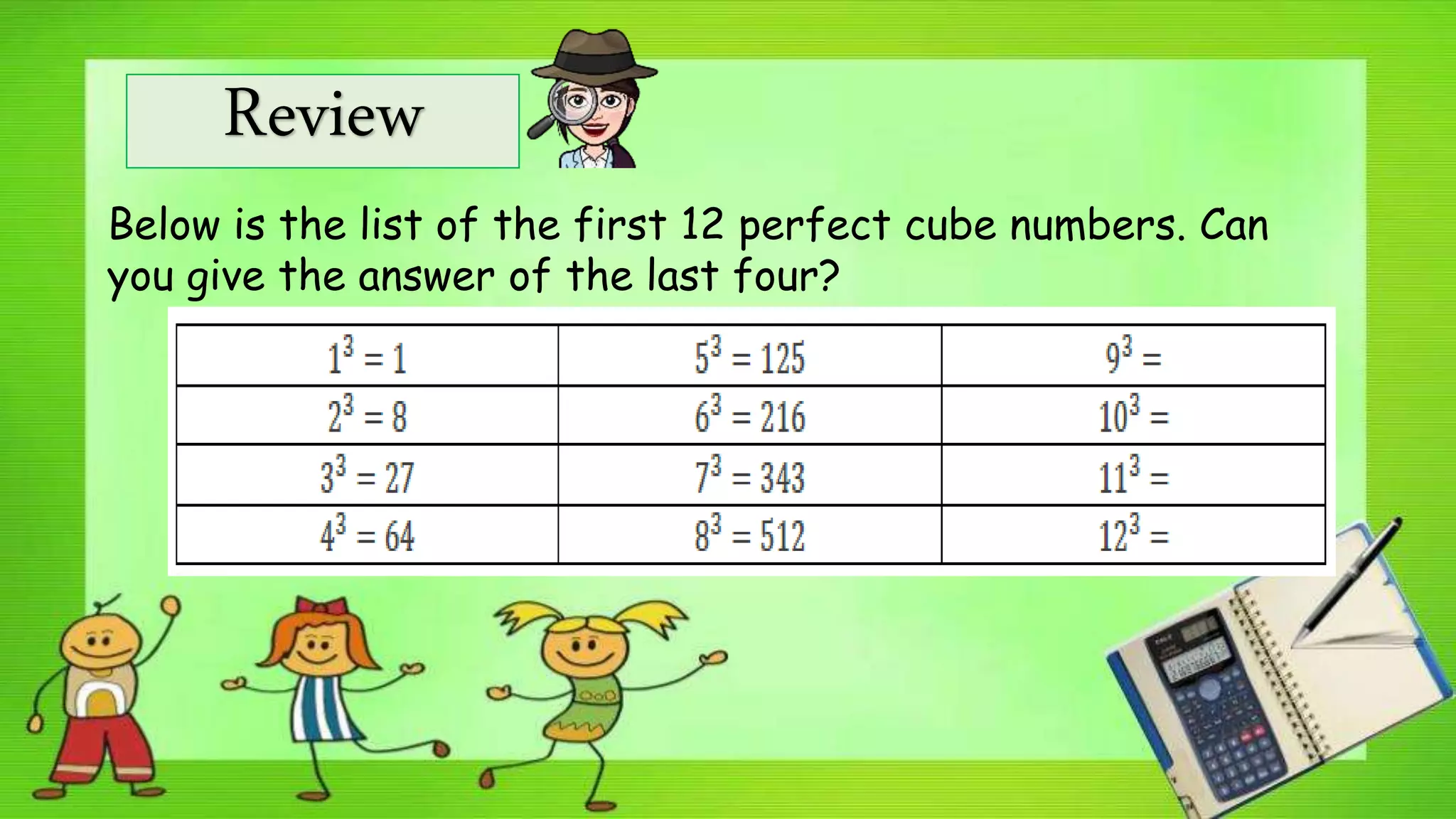
Below is the list of the first 12 perfect cube numbers. Can
you give the answer of the last four?
What’s New
What is it
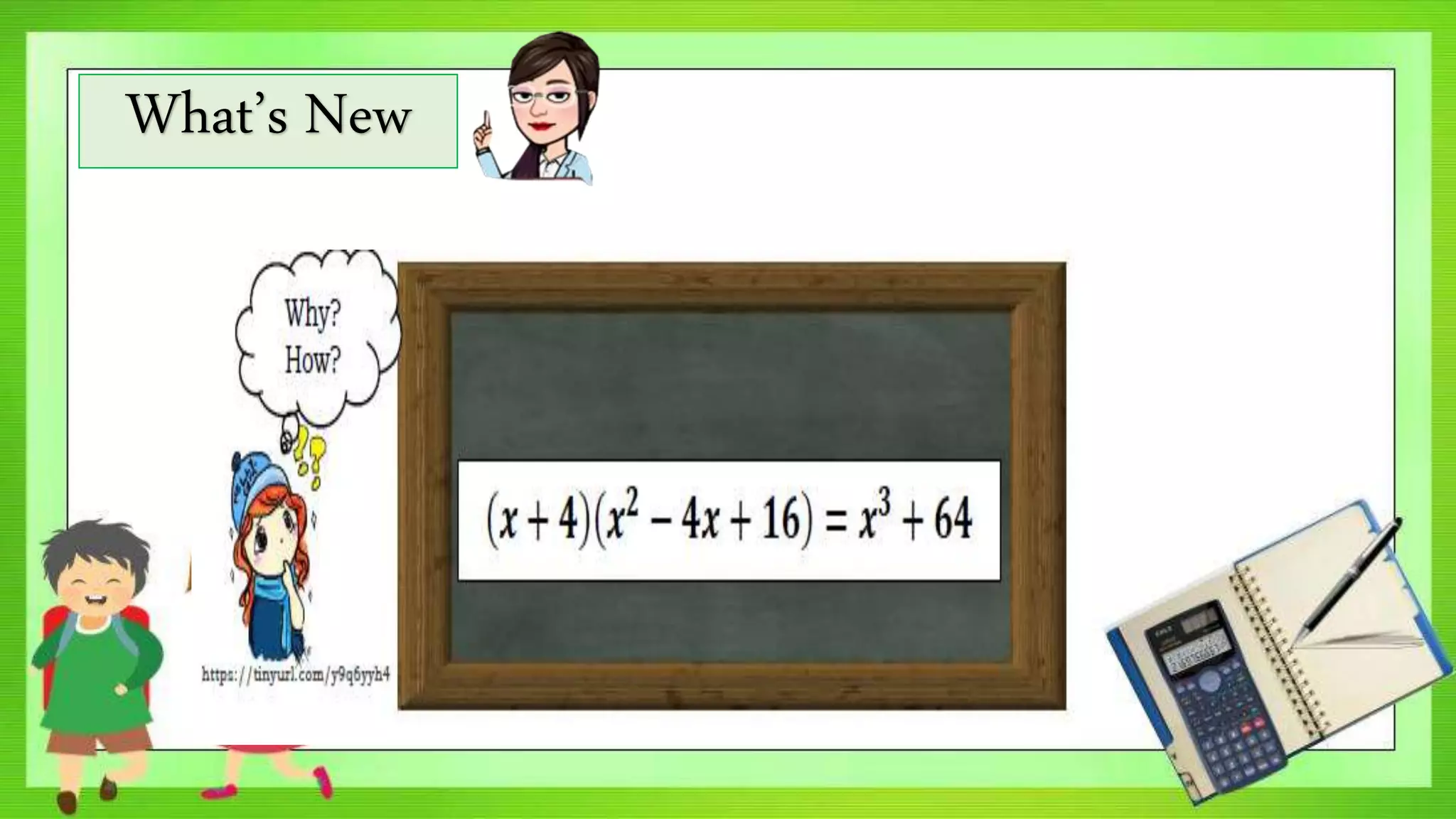
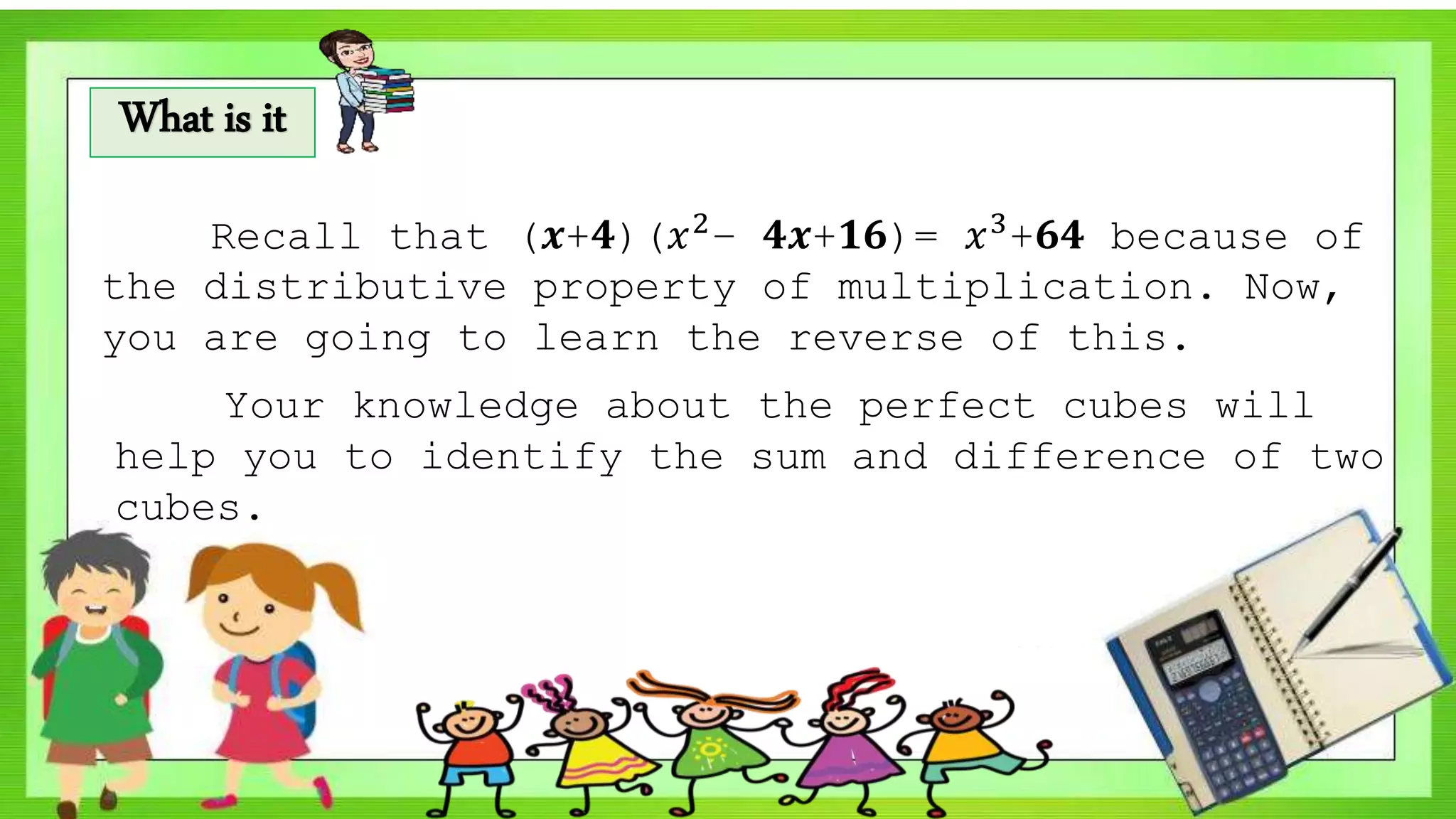
Recall that (𝒙+𝟒)(𝑥2− 𝟒𝒙+𝟏𝟔)= 𝑥3+𝟔𝟒 because of
the distributive property of multiplication. Now,
you are going to learn the reverse of this.
Your knowledge about the perfect cubes will
help you to identify the sum and difference of two
cubes.
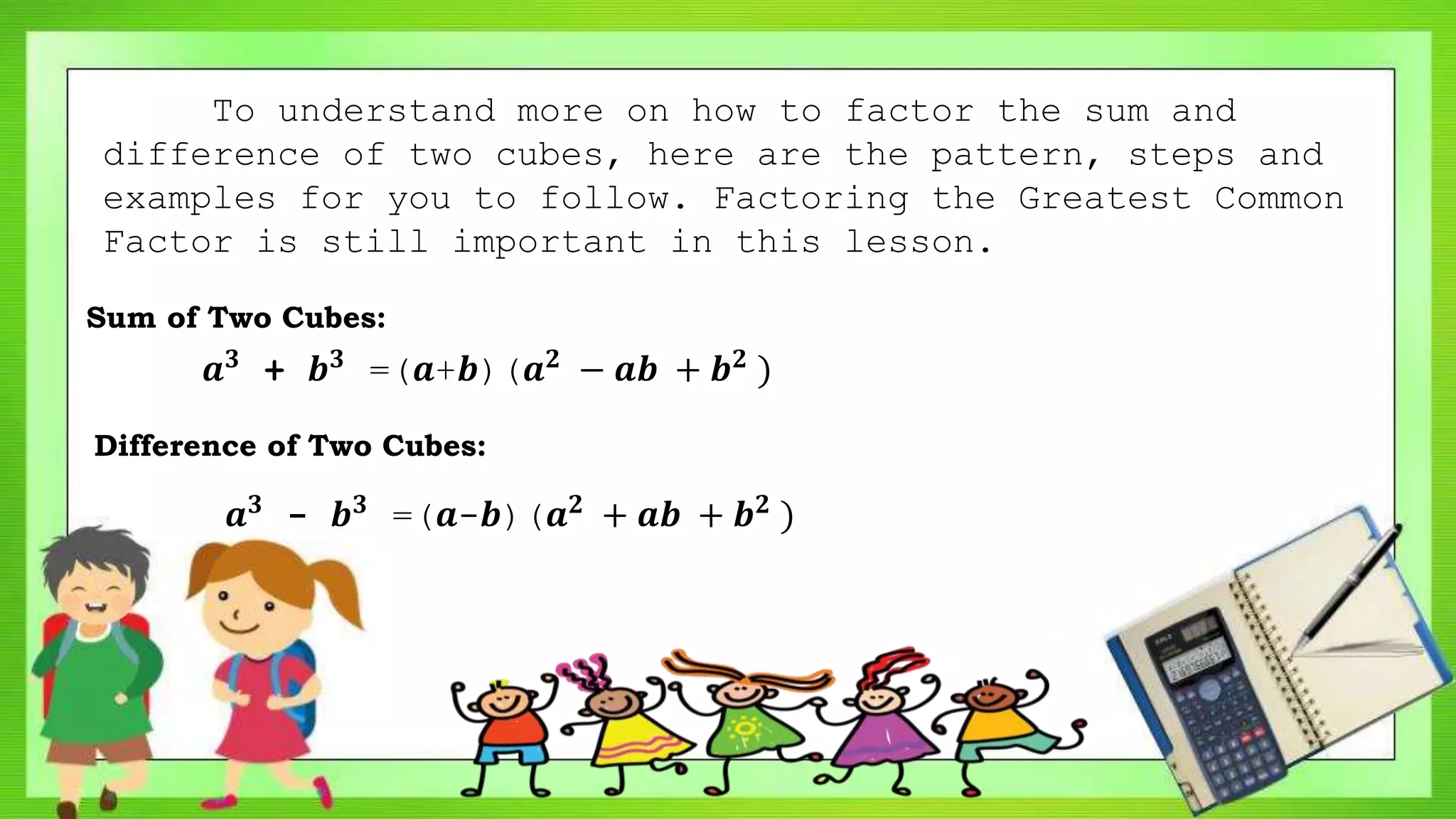
To understand more on how to factor the sum and
difference of two cubes, here are the pattern, steps and
examples for you to follow. Factoring the Greatest Common
Factor is still important in this lesson.
Sum of Two Cubes:
𝒂 𝟑 + 𝒃 𝟑 =(𝒂+𝒃)(𝒂 𝟐 − 𝒂𝒃 + 𝒃 𝟐 )
Difference of Two Cubes:
𝒂 𝟑 - 𝒃 𝟑 =(𝒂-𝒃)(𝒂 𝟐 + 𝒂𝒃 + 𝒃 𝟐 )
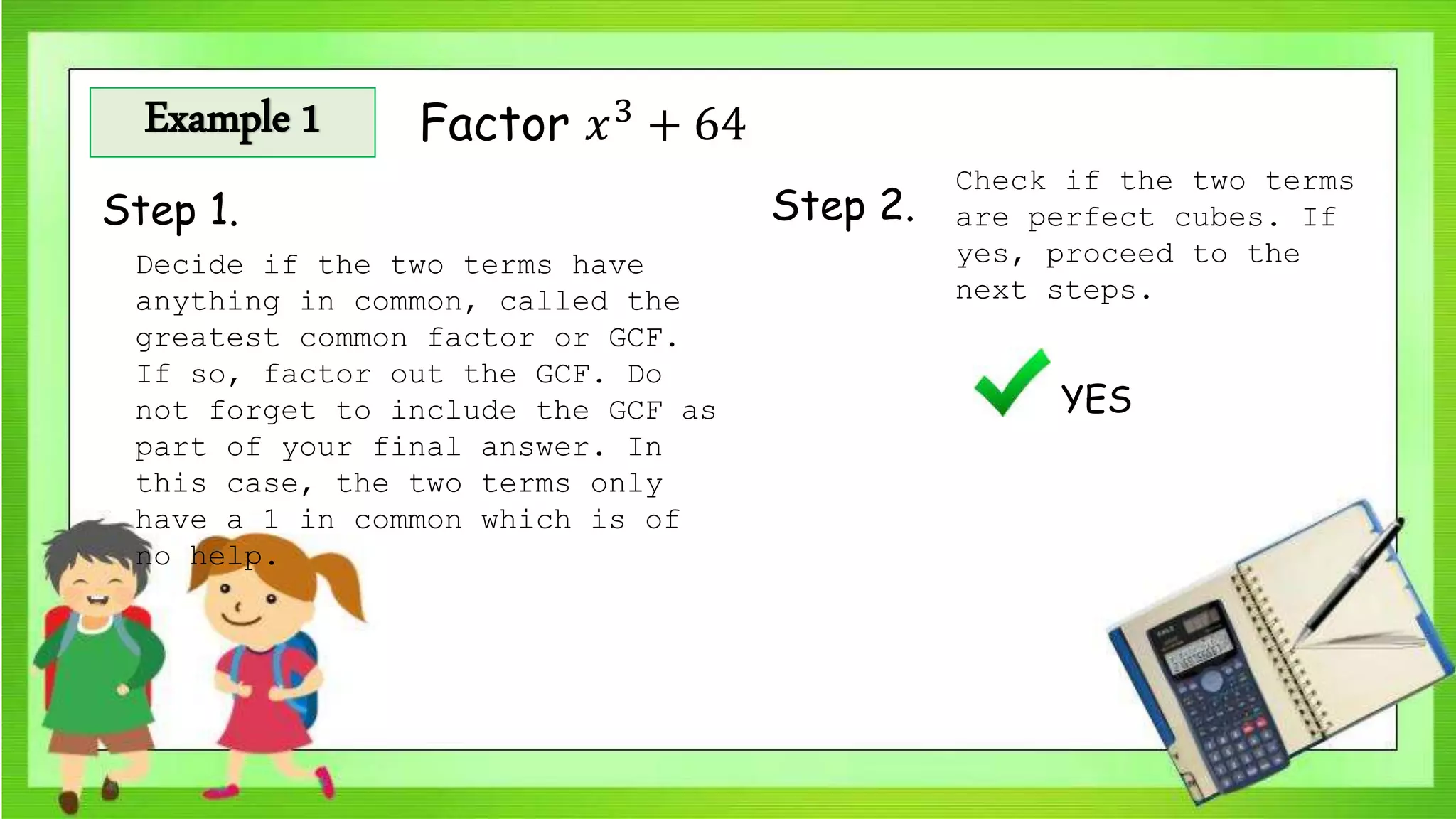
Example 1 Factor 𝑥3
+ 64
Step 1. Step 2.
Check if the two terms
are perfect cubes. If
yes, proceed to the
next steps.
YES
Decide if the two terms have
anything in common, called the
greatest common factor or GCF.
If so, factor out the GCF. Do
not forget to include the GCF as
part of your final answer. In
this case, the two terms only
have a 1 in common which is of
no help.
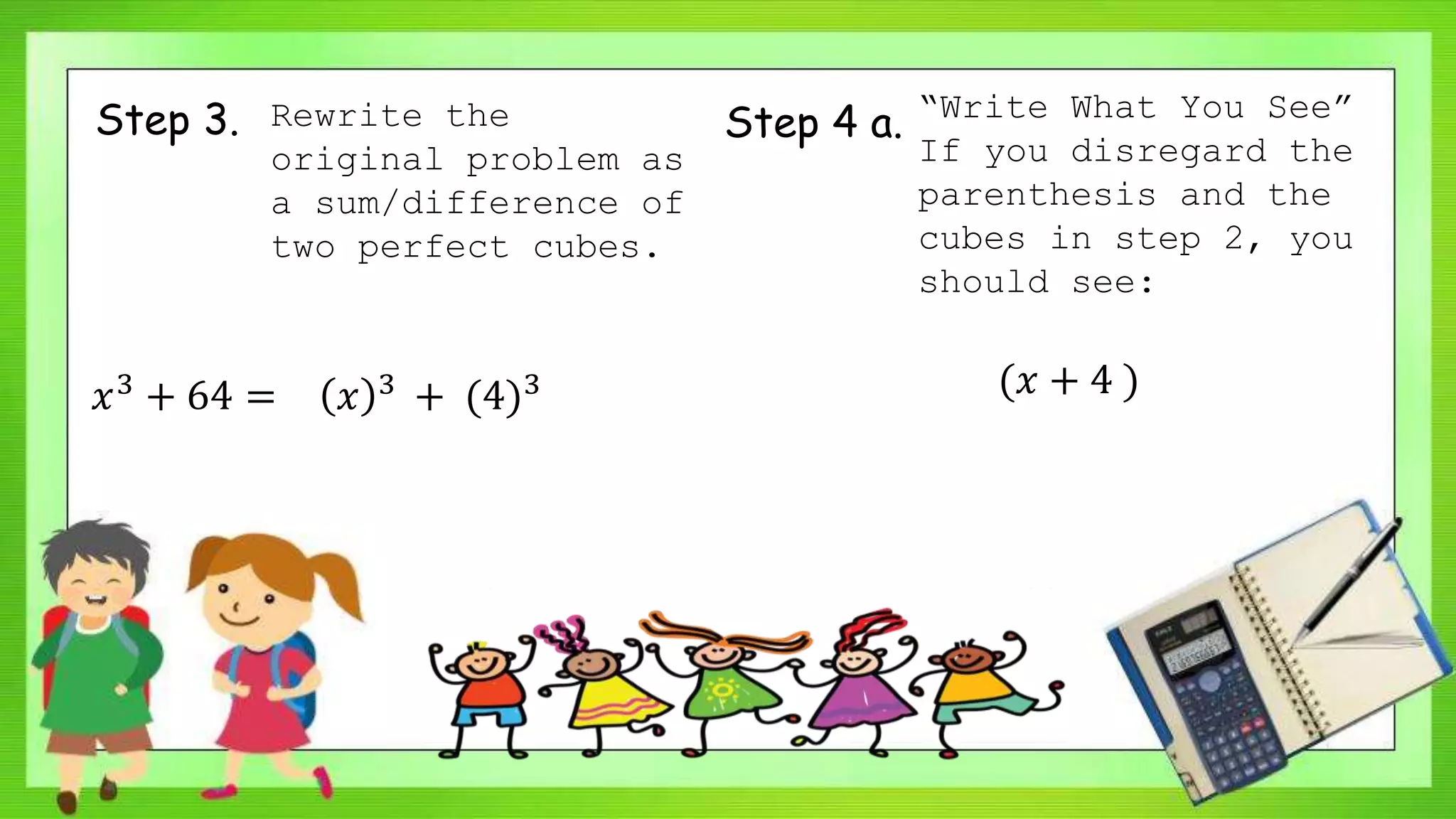
Step 3. Rewrite the
original problem as
a sum/difference of
two perfect cubes.
𝑥3 + 64 = 𝑥 3 + (4)3
Step 4 a. “Write What You See”
If you disregard the
parenthesis and the
cubes in step 2, you
should see:
(𝑥 + 4 )
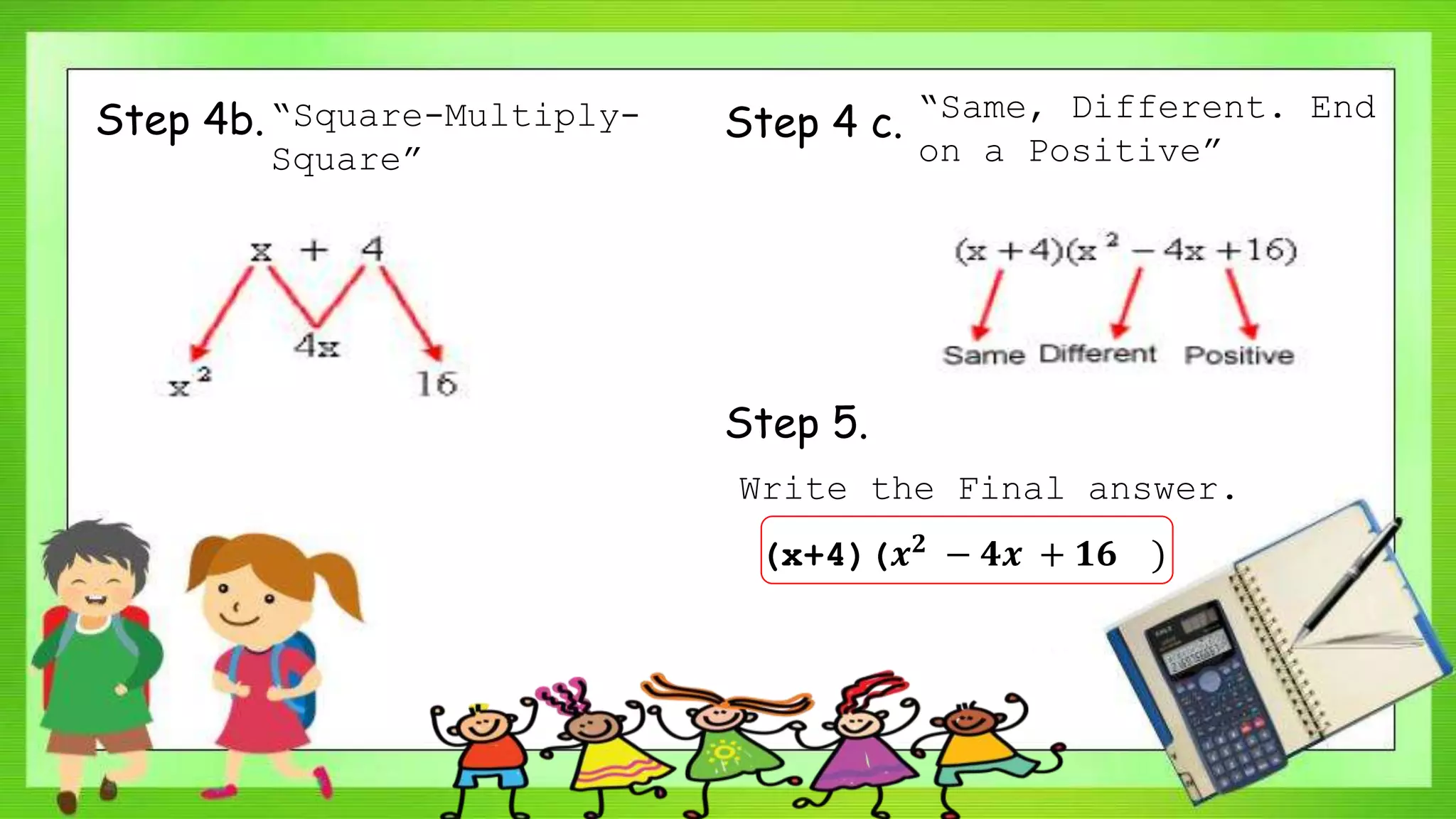
Step 4b.“Square-Multiply-
Square”
Step 4 c. “Same, Different. End
on a Positive”
Step 5.
Write the Final answer.
(x+4)(𝒙 𝟐 − 𝟒𝒙 + 𝟏𝟔 )
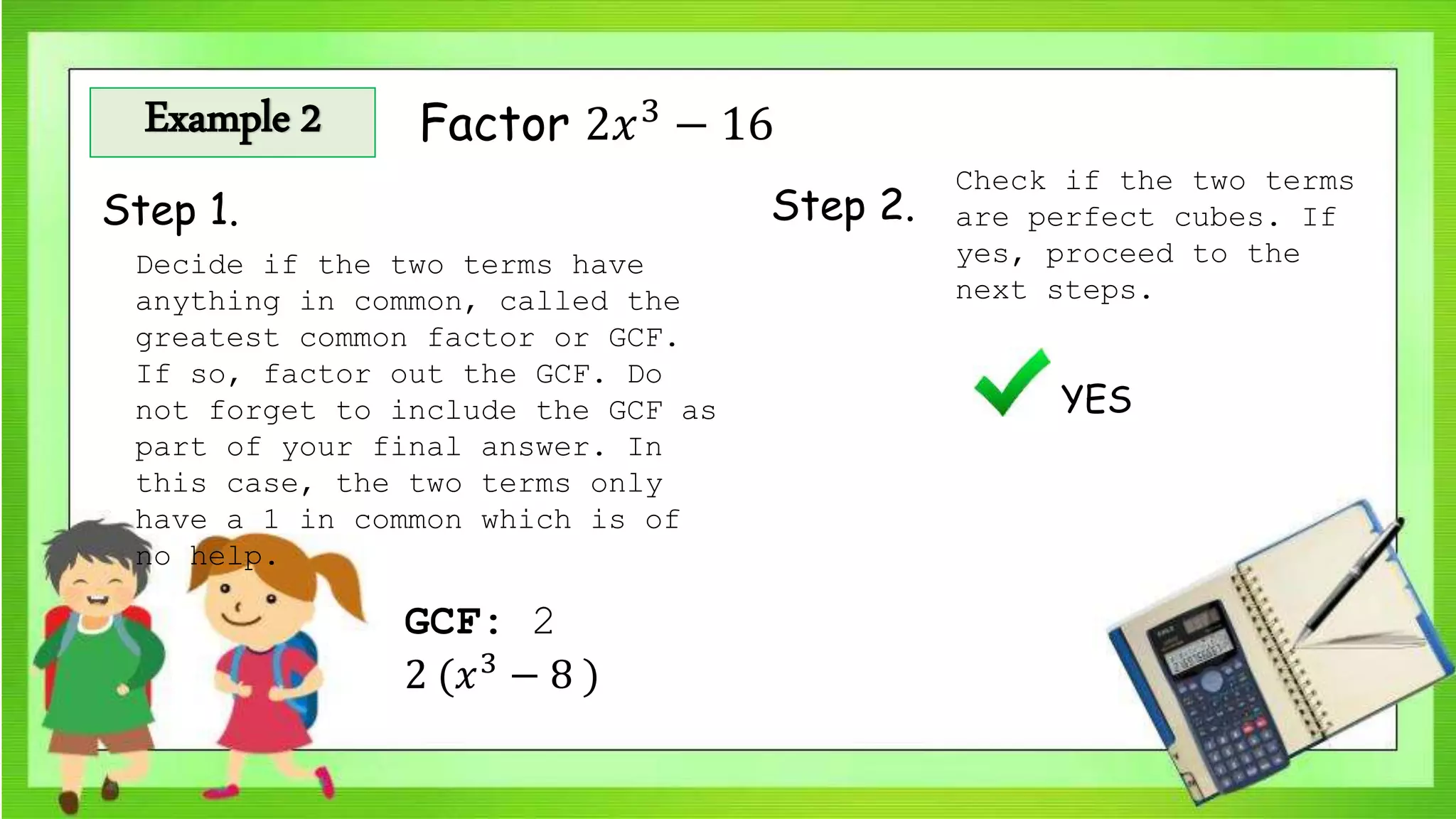
Example 2 Factor 2𝑥3
− 16
Step 1. Step 2.
Check if the two terms
are perfect cubes. If
yes, proceed to the
next steps.
YES
Decide if the two terms have
anything in common, called the
greatest common factor or GCF.
If so, factor out the GCF. Do
not forget to include the GCF as
part of your final answer. In
this case, the two terms only
have a 1 in common which is of
no help.
GCF: 2
2 (𝑥3
− 8 )
Step 3. Rewrite the
original problem as
a sum/difference of
two perfect cubes.
2𝑥3 − 16 = 2 [ 𝑥 3 − 2 3 ]
Step 4 a. “Write What You See”
If you disregard the
parenthesis and the
cubes in step 2, you
should see:
2 (𝑥 − 2 )
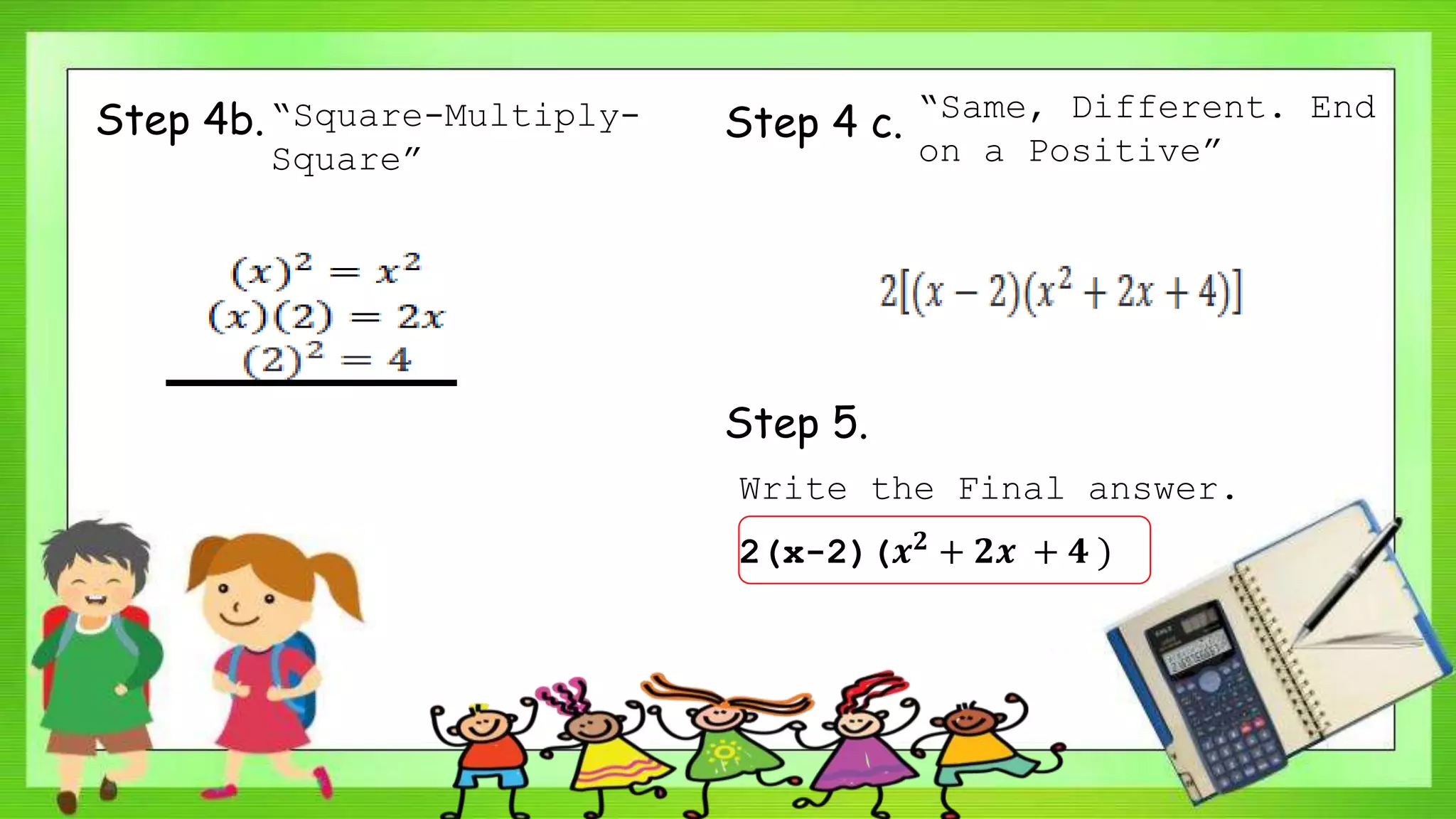
Step 4b.“Square-Multiply-
Square”
Step 4 c. “Same, Different. End
on a Positive”
Step 5.
Write the Final answer.
2(x-2)(𝒙 𝟐 + 𝟐𝒙 + 𝟒 )
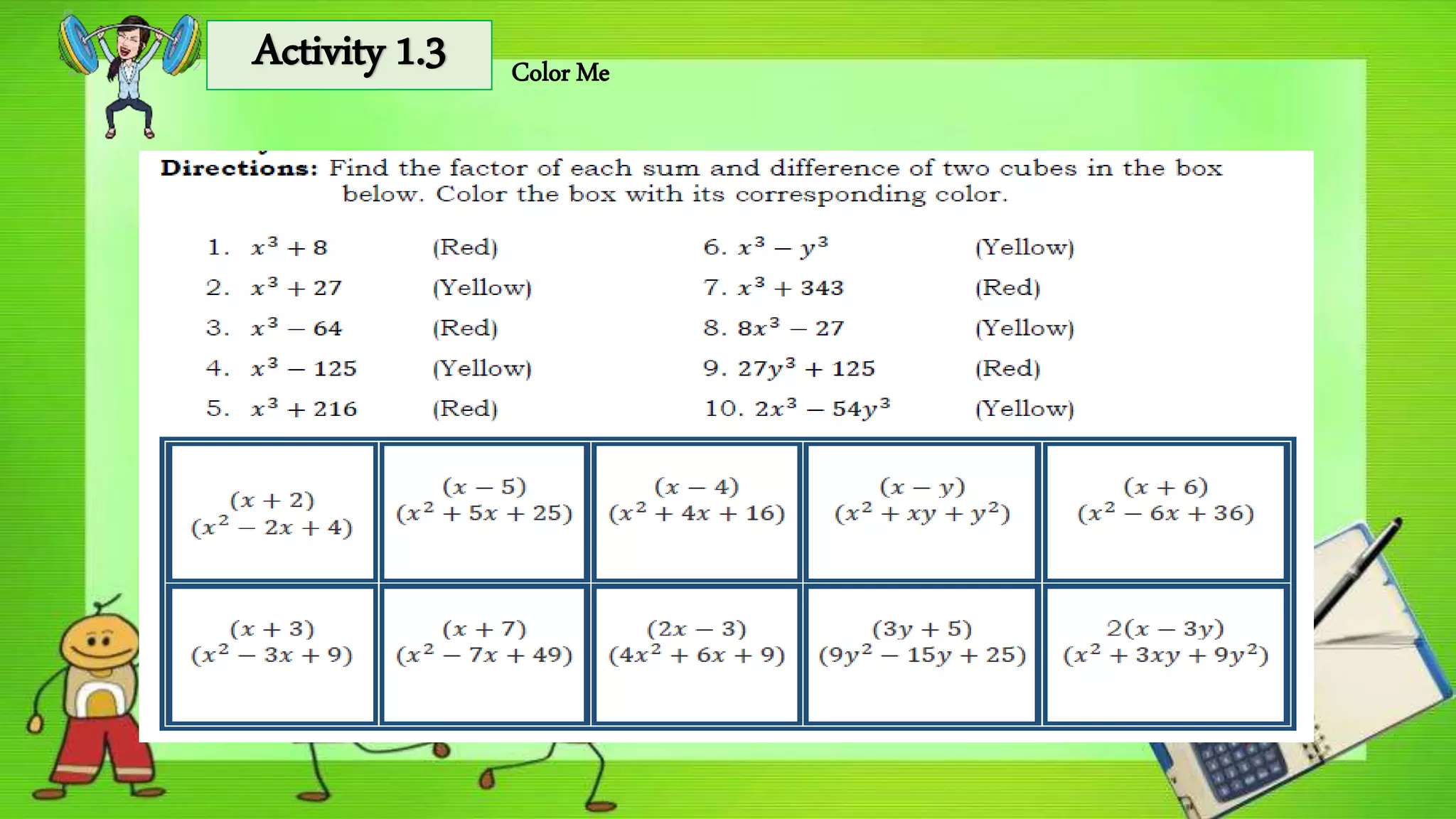
Activity 1.3 Color Me
What I need to remember
The sum and difference of two cubes can only be
factored if the given expression is a binomial and
the two terms have perfect cubes.
Mathematics is not about
numbers, equations,
computations, or
algorithms: it is about
understanding. –William
Paul Thurston

Sum and Difference of Two Cubes

  • 1.
    Factoring : Sumand Difference of Two Cubes Lorie Jane L. Letada Module 1
  • 2.
    Objectives At the endof this lesson, you are expected to: • identify which expression is sum and difference of two cubes; • factor the sum and difference of two squares completely.
  • 3.
    Review Below is thelist of the first 12 perfect cube numbers. Can you give the answer of the last four?
  • 4.
  • 5.
    What is it Recallthat (𝒙+𝟒)(𝑥2− 𝟒𝒙+𝟏𝟔)= 𝑥3+𝟔𝟒 because of the distributive property of multiplication. Now, you are going to learn the reverse of this. Your knowledge about the perfect cubes will help you to identify the sum and difference of two cubes.
  • 6.
    To understand moreon how to factor the sum and difference of two cubes, here are the pattern, steps and examples for you to follow. Factoring the Greatest Common Factor is still important in this lesson. Sum of Two Cubes: 𝒂 𝟑 + 𝒃 𝟑 =(𝒂+𝒃)(𝒂 𝟐 − 𝒂𝒃 + 𝒃 𝟐 ) Difference of Two Cubes: 𝒂 𝟑 - 𝒃 𝟑 =(𝒂-𝒃)(𝒂 𝟐 + 𝒂𝒃 + 𝒃 𝟐 )
  • 7.
    Example 1 Factor𝑥3 + 64 Step 1. Step 2. Check if the two terms are perfect cubes. If yes, proceed to the next steps. YES Decide if the two terms have anything in common, called the greatest common factor or GCF. If so, factor out the GCF. Do not forget to include the GCF as part of your final answer. In this case, the two terms only have a 1 in common which is of no help.
  • 8.
    Step 3. Rewritethe original problem as a sum/difference of two perfect cubes. 𝑥3 + 64 = 𝑥 3 + (4)3 Step 4 a. “Write What You See” If you disregard the parenthesis and the cubes in step 2, you should see: (𝑥 + 4 )
  • 9.
    Step 4b.“Square-Multiply- Square” Step 4c. “Same, Different. End on a Positive” Step 5. Write the Final answer. (x+4)(𝒙 𝟐 − 𝟒𝒙 + 𝟏𝟔 )
  • 10.
    Example 2 Factor2𝑥3 − 16 Step 1. Step 2. Check if the two terms are perfect cubes. If yes, proceed to the next steps. YES Decide if the two terms have anything in common, called the greatest common factor or GCF. If so, factor out the GCF. Do not forget to include the GCF as part of your final answer. In this case, the two terms only have a 1 in common which is of no help. GCF: 2 2 (𝑥3 − 8 )
  • 11.
    Step 3. Rewritethe original problem as a sum/difference of two perfect cubes. 2𝑥3 − 16 = 2 [ 𝑥 3 − 2 3 ] Step 4 a. “Write What You See” If you disregard the parenthesis and the cubes in step 2, you should see: 2 (𝑥 − 2 )
  • 12.
    Step 4b.“Square-Multiply- Square” Step 4c. “Same, Different. End on a Positive” Step 5. Write the Final answer. 2(x-2)(𝒙 𝟐 + 𝟐𝒙 + 𝟒 )
  • 13.
  • 14.
    What I needto remember The sum and difference of two cubes can only be factored if the given expression is a binomial and the two terms have perfect cubes.
  • 15.
    Mathematics is notabout numbers, equations, computations, or algorithms: it is about understanding. –William Paul Thurston