PREPARED BY :- Urvesh Prajapati (140453119029).
Aakash Rana (140453119030).
Keval Rana (140453119031).
Pinakin Rana (140453119032).
SEMESTER :- 5th Sem.
DEPARTMENT :- Mechanical Department
GUIDED BY :- Dhaval Patel
Topic:-
Pneumatic control system and it’s
components
Content
1. Basics of Pneumatics
2. Advantages & dis-advantages
3. Pneumatic Components
Pneumatic Compressor
Air Conditioners
Air pressure regulator
Air lubricator
Air service unit
Pneumatic Silencer
4. Pneumatic Valves
Pneumatic Actuators
Directional control valve
Shuttle valve
1. Basics of Pneumatics
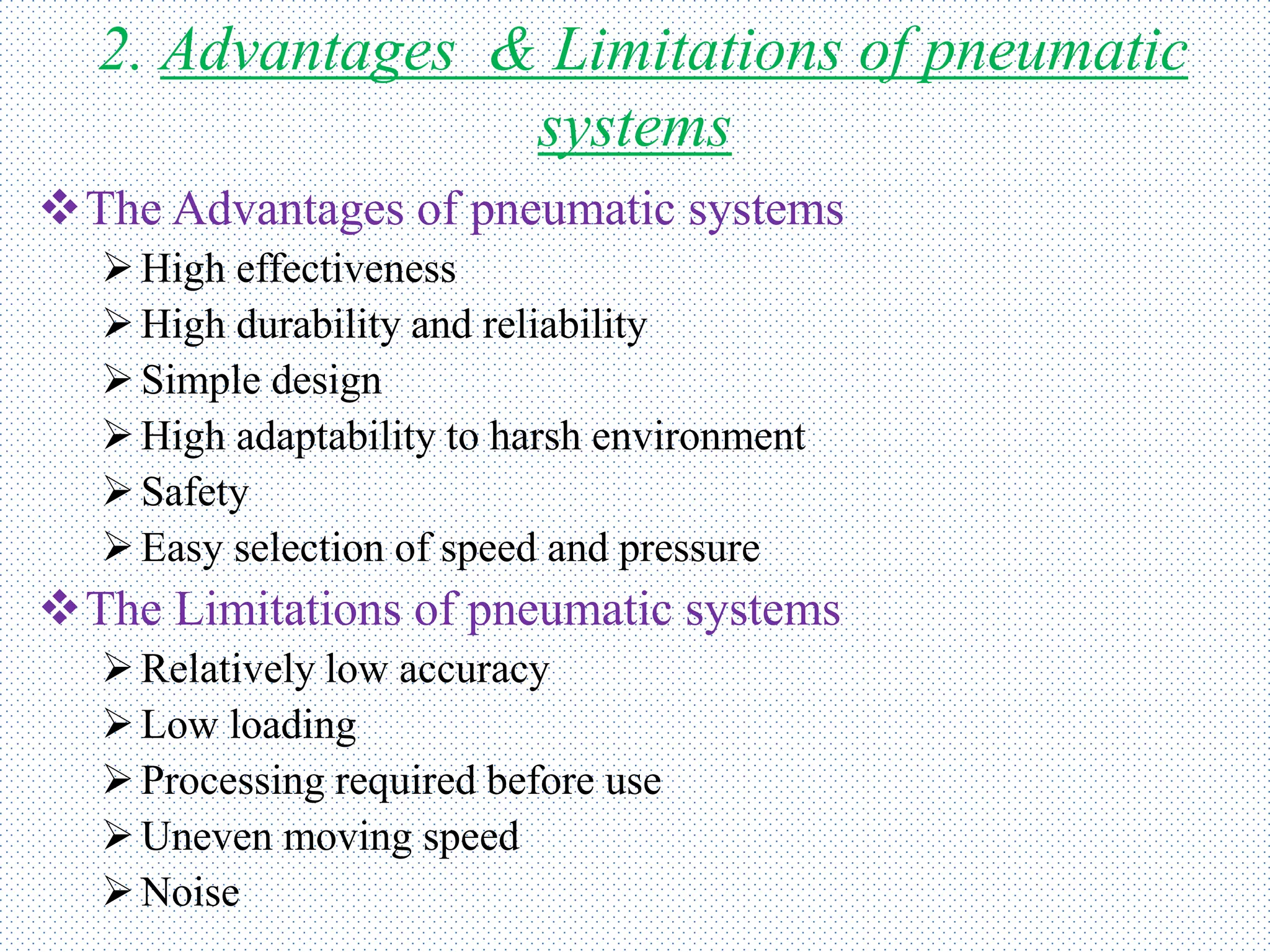
 A pneumatic system is a system that uses compressed air to
transmit and control energy. Pneumatic systems are used in
controlling train doors, automatic production lines, mechanical
clamps.
2. Advantages & Limitations of pneumatic
systems
The Advantages of pneumatic systems
High effectiveness
High durability and reliability
Simple design
High adaptability to harsh environment
Safety
Easy selection of speed and pressure
The Limitations of pneumatic systems
Relatively low accuracy
Low loading
Processing required before use
Uneven moving speed
Noise
3. Pneumatics Components
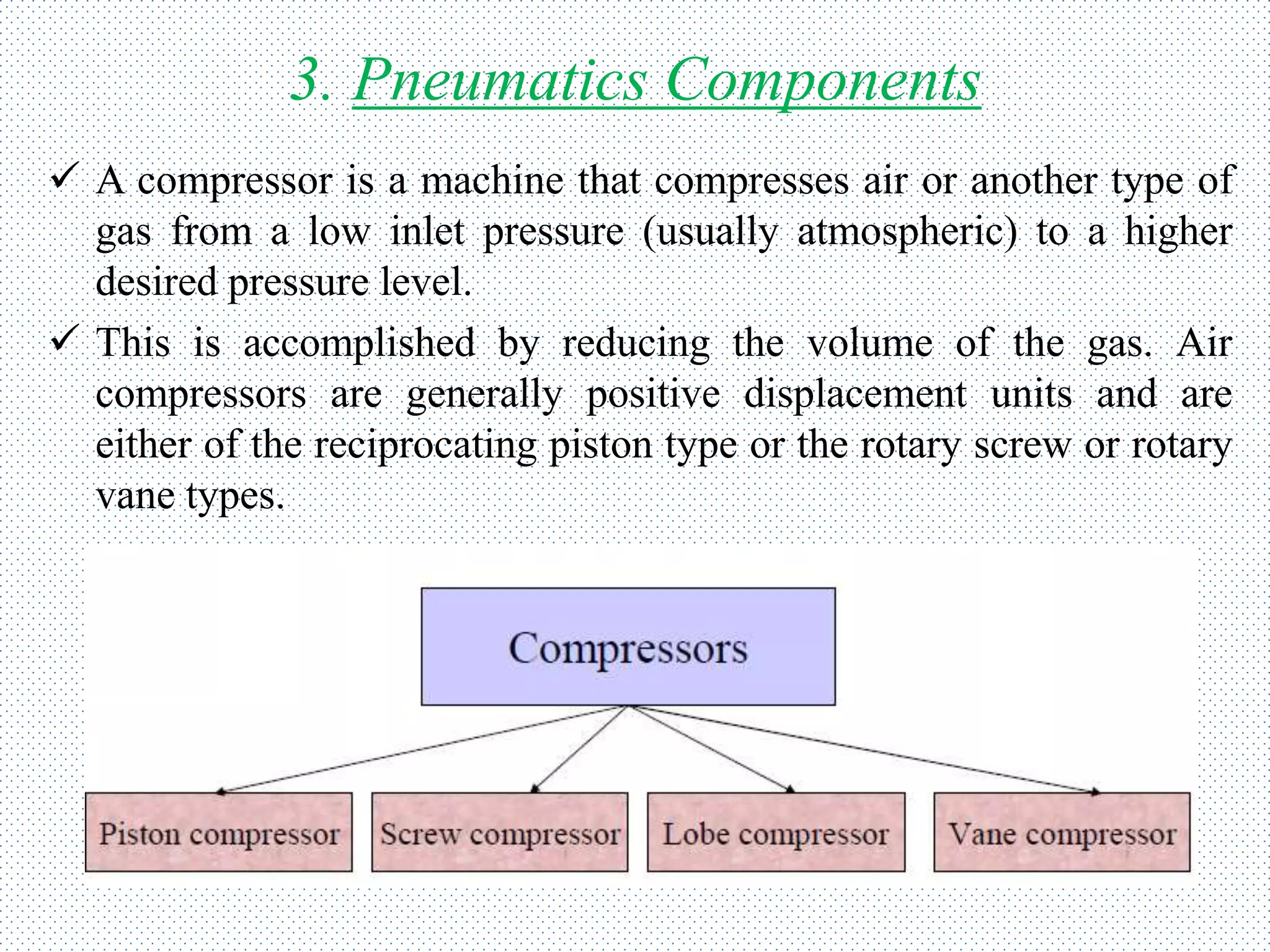
 A compressor is a machine that compresses air or another type of
gas from a low inlet pressure (usually atmospheric) to a higher
desired pressure level.
 This is accomplished by reducing the volume of the gas. Air
compressors are generally positive displacement units and are
either of the reciprocating piston type or the rotary screw or rotary
vane types.
 Piston compressor
 In this type of compressor a cylinder bore encloses a moving
piston. As the crankshaft of the compressor rotate, the piston
moves within the cylinder, similar to the piston in a car engine. As
the piston is pulled down, the volume increases, creating a lower
atmospheric pressure in the piston chamber.
 Vane compressor
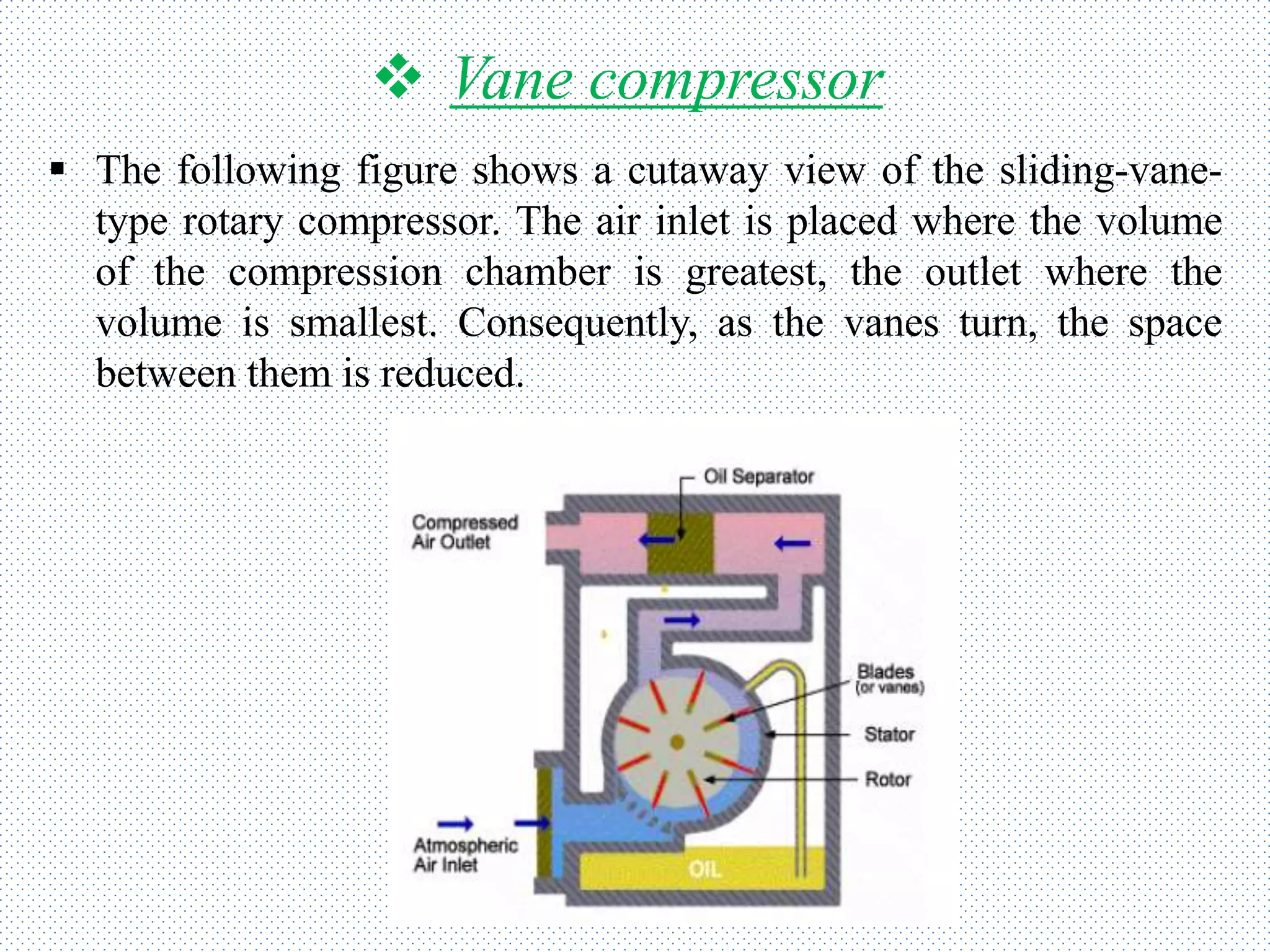
 The following figure shows a cutaway view of the sliding-vane-
type rotary compressor. The air inlet is placed where the volume
of the compression chamber is greatest, the outlet where the
volume is smallest. Consequently, as the vanes turn, the space
between them is reduced.
 Screw compressor
 There is a current toward increased use of the rotary-type
compressor due to technological advances, which have produced
stronger materials and better manufacturing process.
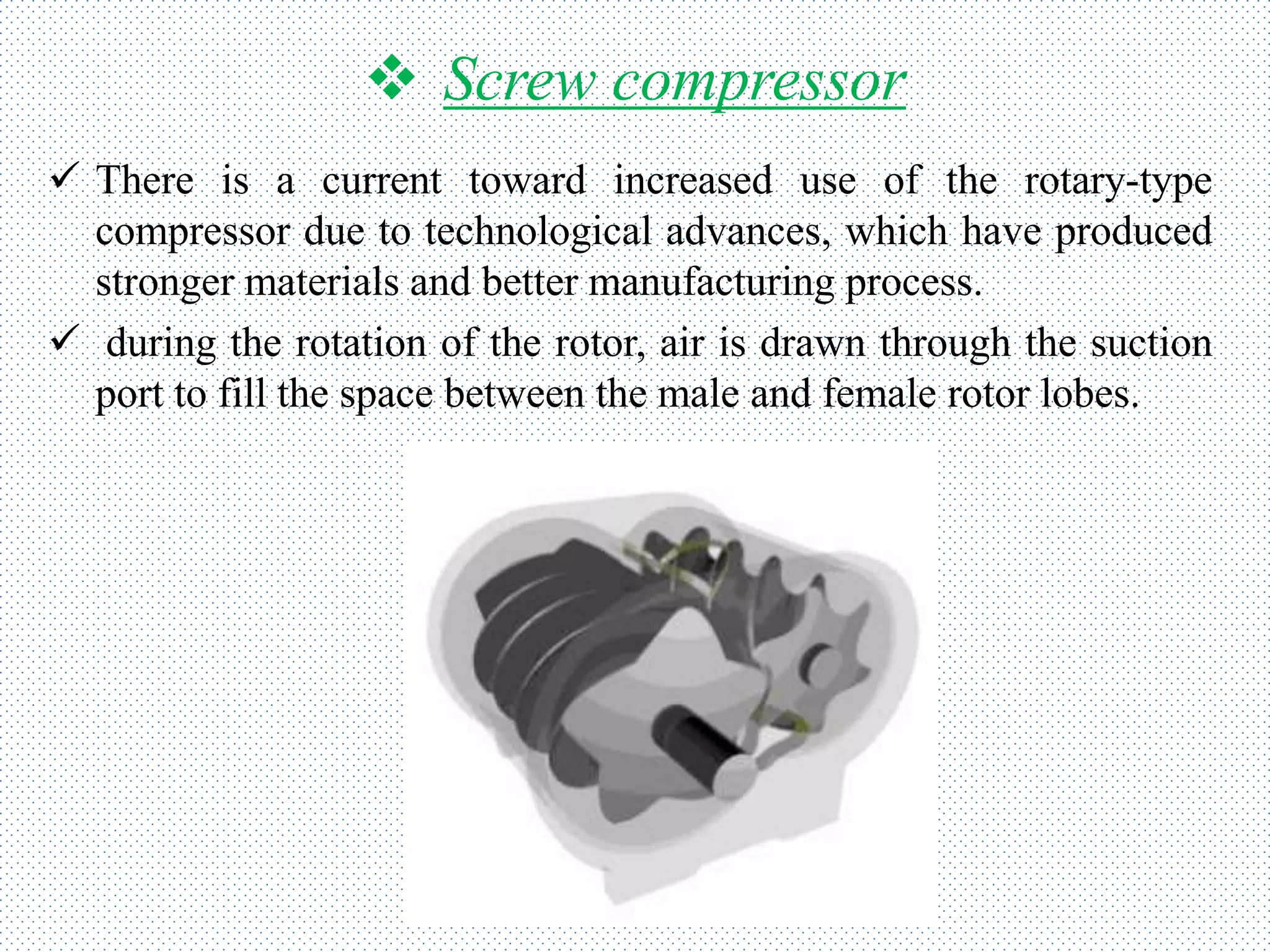
 during the rotation of the rotor, air is drawn through the suction
port to fill the space between the male and female rotor lobes.
 Lobe compressor
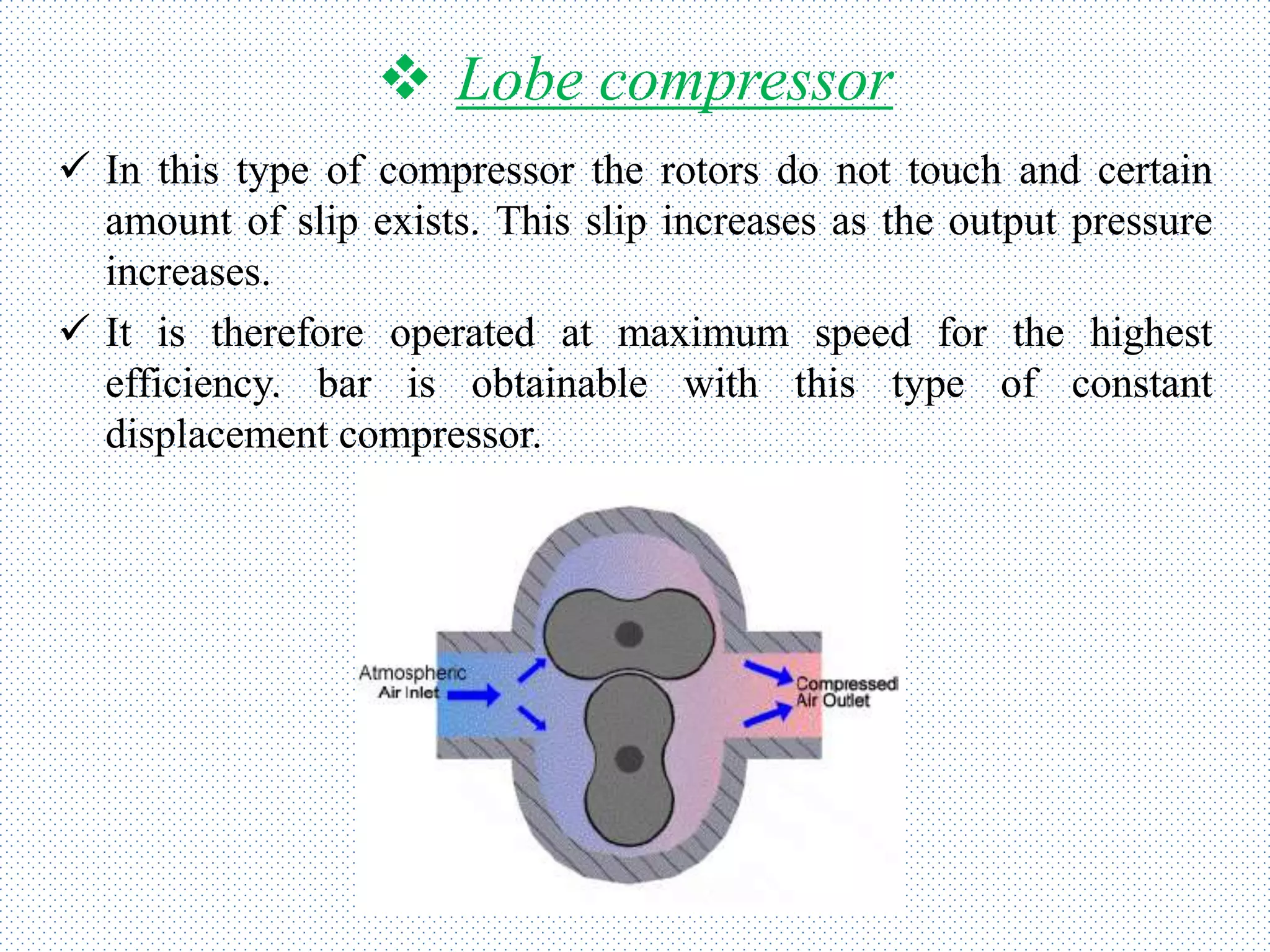
 In this type of compressor the rotors do not touch and certain
amount of slip exists. This slip increases as the output pressure
increases.
 It is therefore operated at maximum speed for the highest
efficiency. bar is obtainable with this type of constant
displacement compressor.
 Air Conditioners
Air filters:-
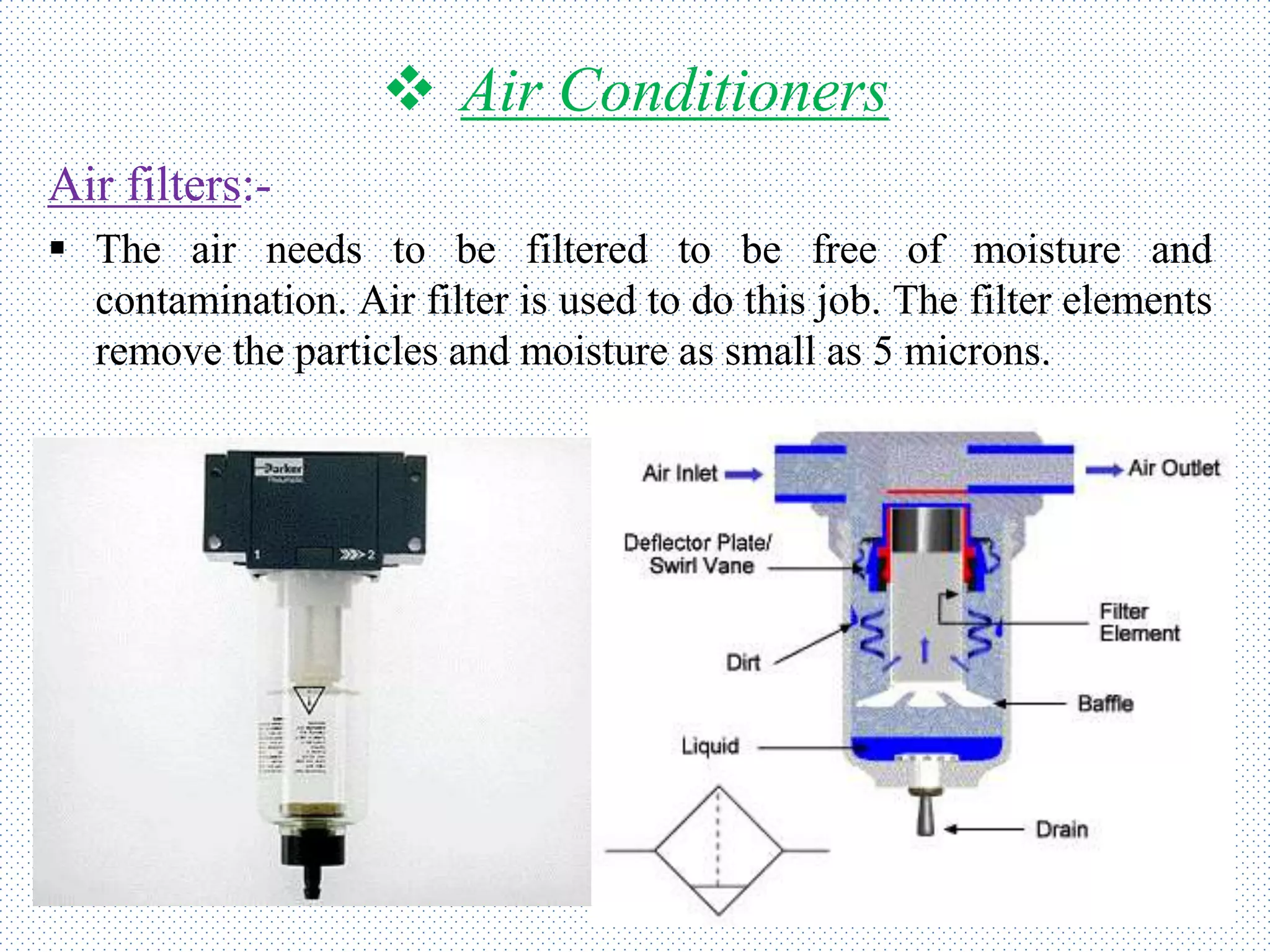
 The air needs to be filtered to be free of moisture and
contamination. Air filter is used to do this job. The filter elements
remove the particles and moisture as small as 5 microns.
 Air pressure regulator
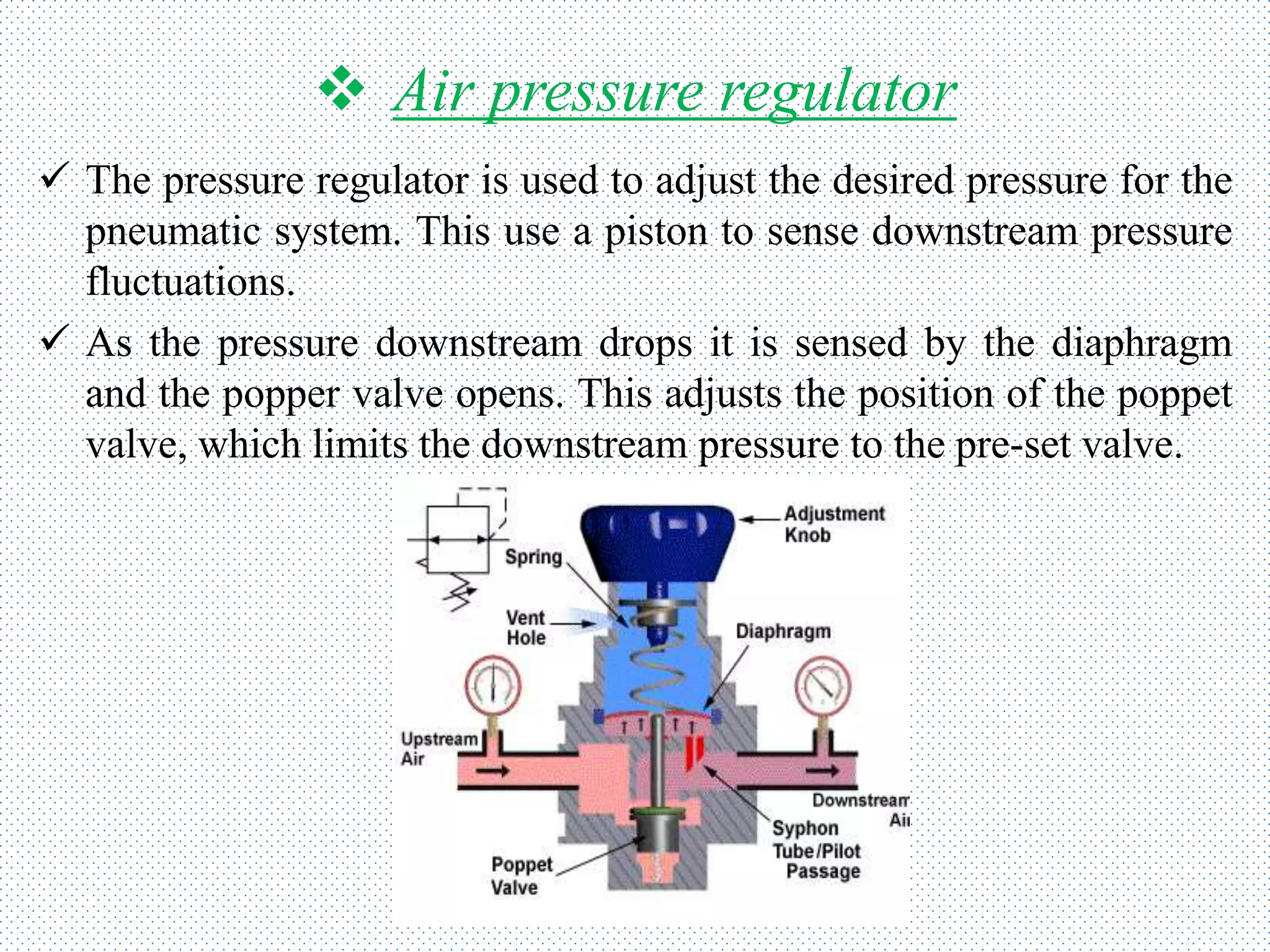
 The pressure regulator is used to adjust the desired pressure for the
pneumatic system. This use a piston to sense downstream pressure
fluctuations.
 As the pressure downstream drops it is sensed by the diaphragm
and the popper valve opens. This adjusts the position of the poppet
valve, which limits the downstream pressure to the pre-set valve.
 Air lubricator
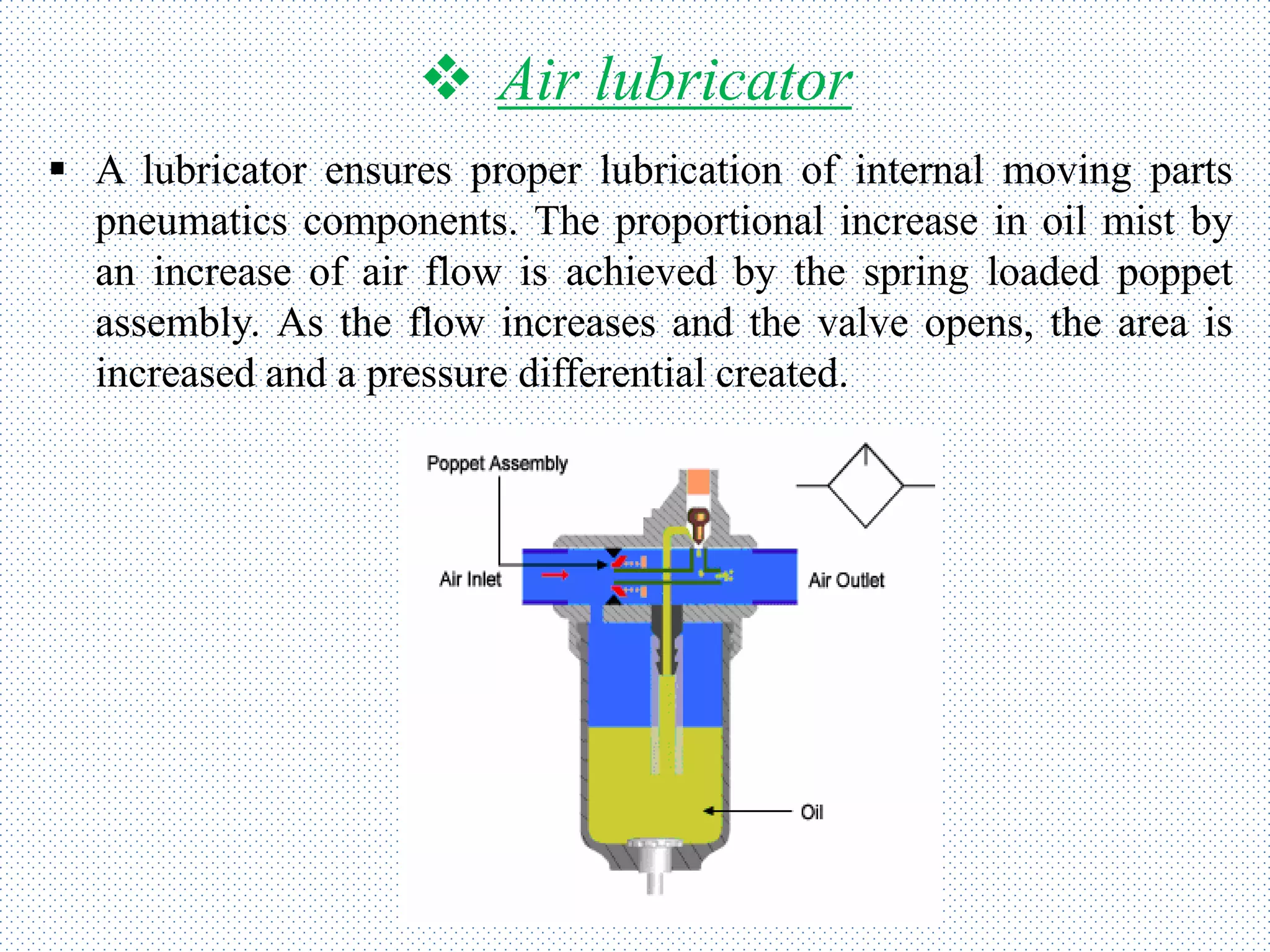
 A lubricator ensures proper lubrication of internal moving parts
pneumatics components. The proportional increase in oil mist by
an increase of air flow is achieved by the spring loaded poppet
assembly. As the flow increases and the valve opens, the area is
increased and a pressure differential created.
 Air service unit
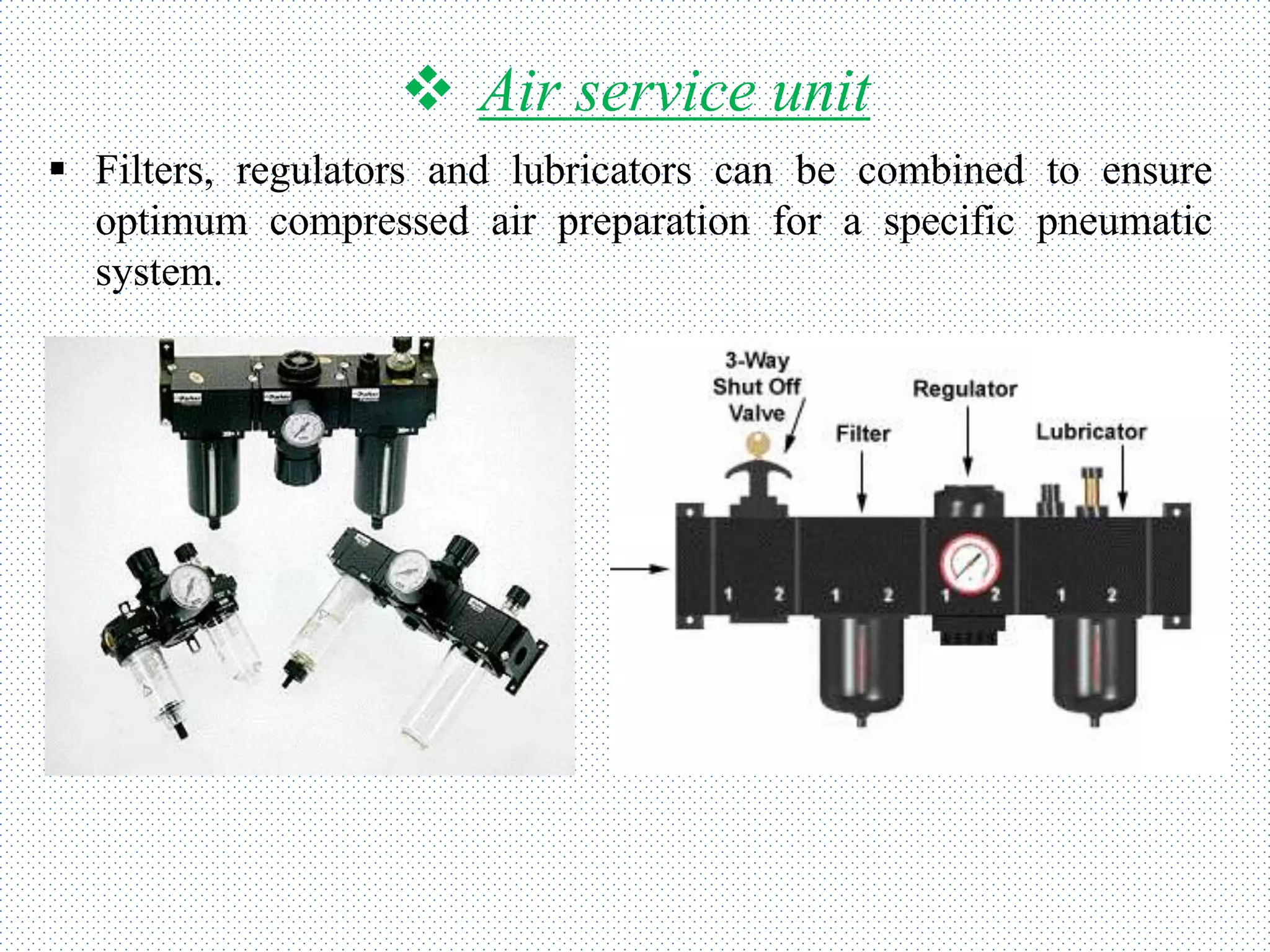
 Filters, regulators and lubricators can be combined to ensure
optimum compressed air preparation for a specific pneumatic
system.
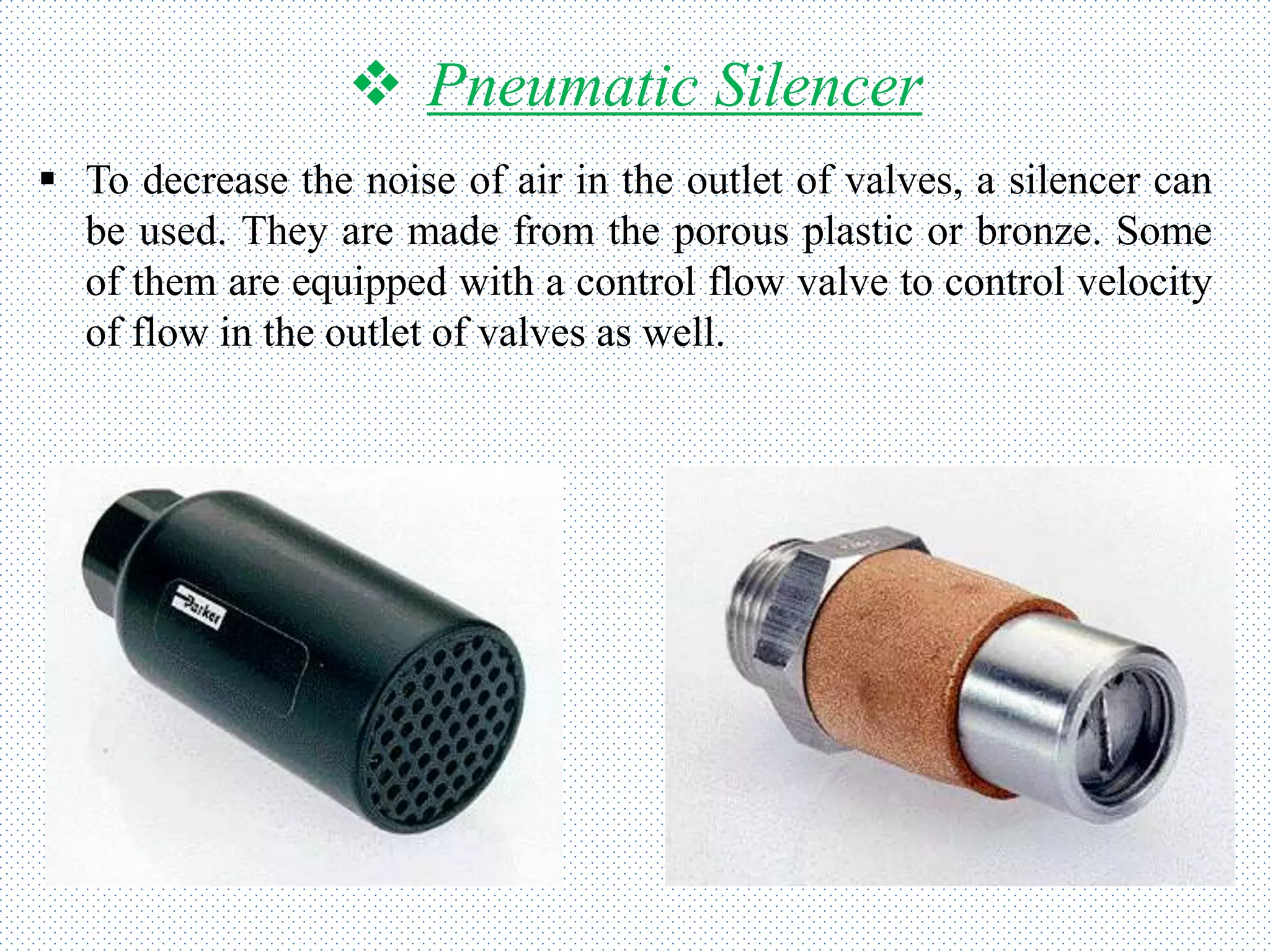
 Pneumatic Silencer
 To decrease the noise of air in the outlet of valves, a silencer can
be used. They are made from the porous plastic or bronze. Some
of them are equipped with a control flow valve to control velocity
of flow in the outlet of valves as well.
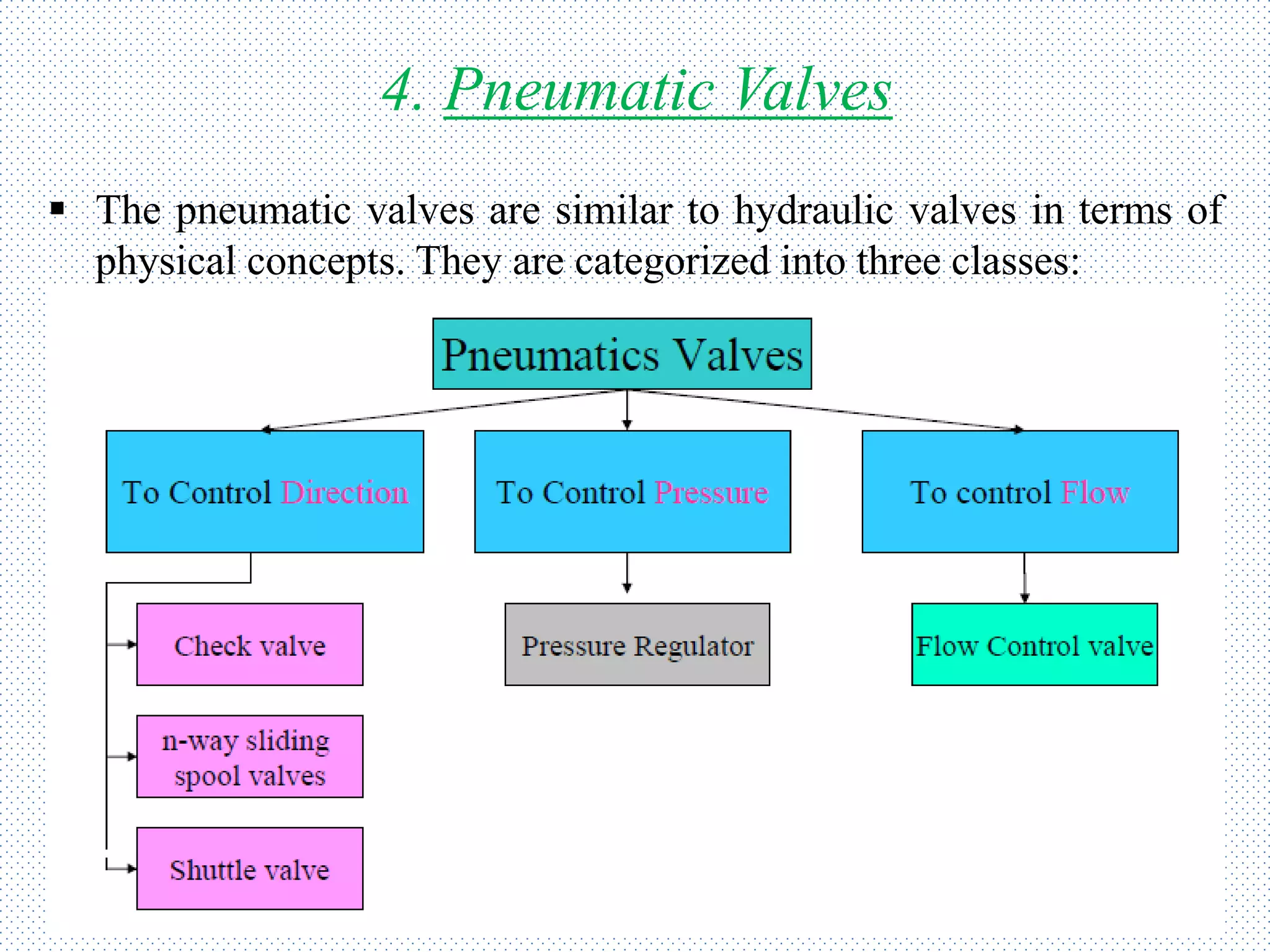
4. Pneumatic Valves
 The pneumatic valves are similar to hydraulic valves in terms of
physical concepts. They are categorized into three classes:
Pneumatic Actuators
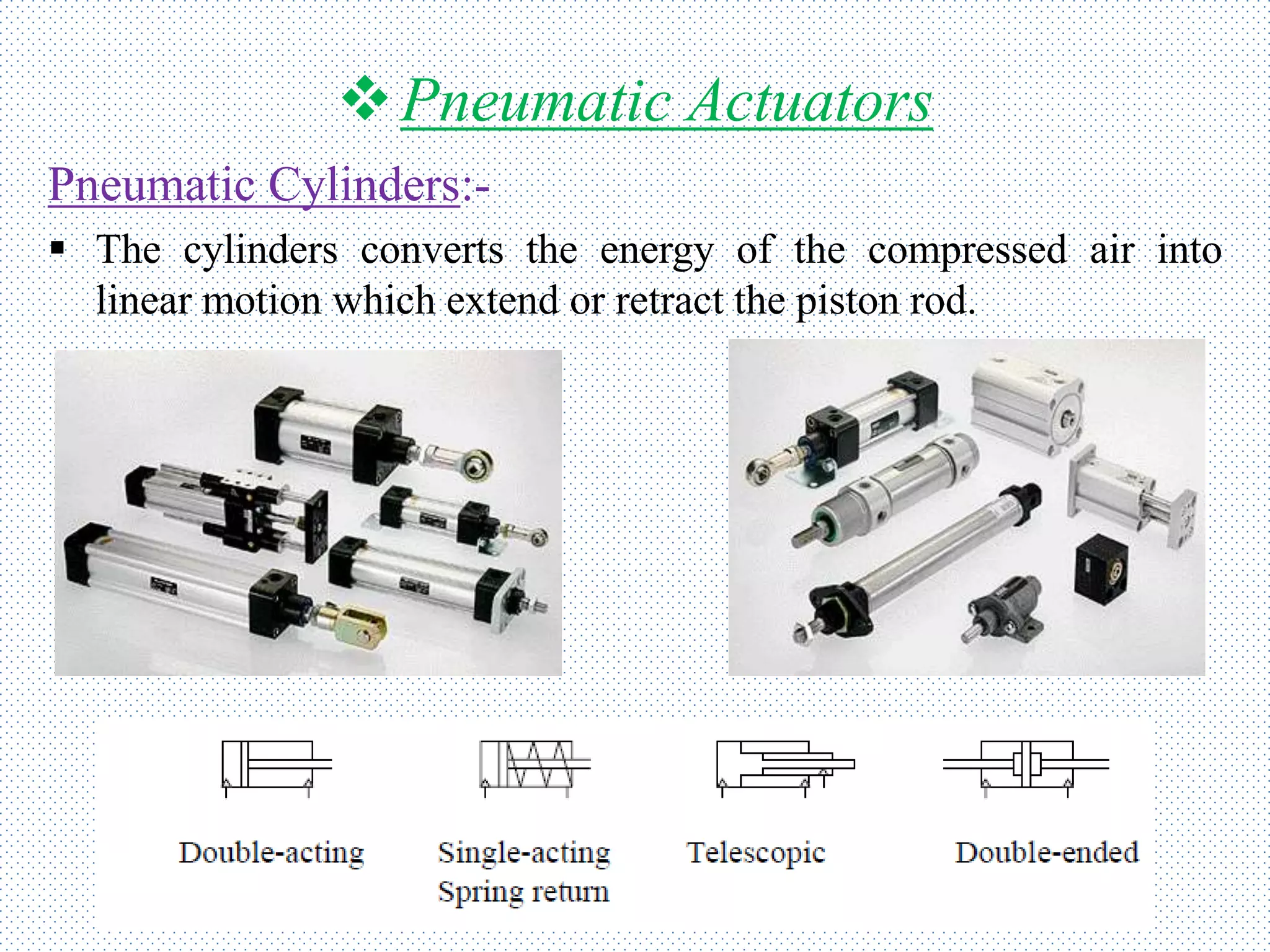
Pneumatic Cylinders:-
 The cylinders converts the energy of the compressed air into
linear motion which extend or retract the piston rod.
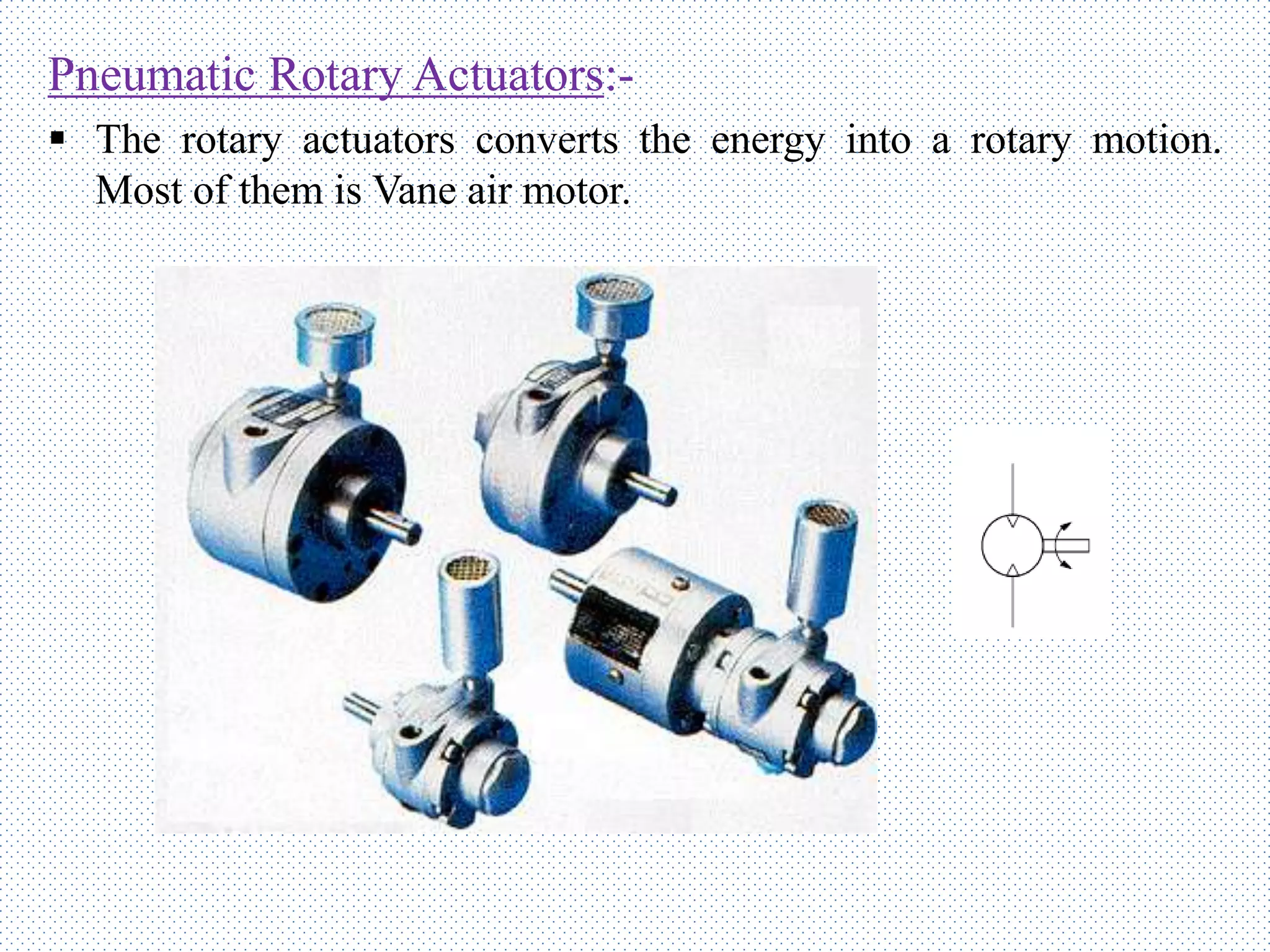
Pneumatic Rotary Actuators:-
 The rotary actuators converts the energy into a rotary motion.
Most of them is Vane air motor.
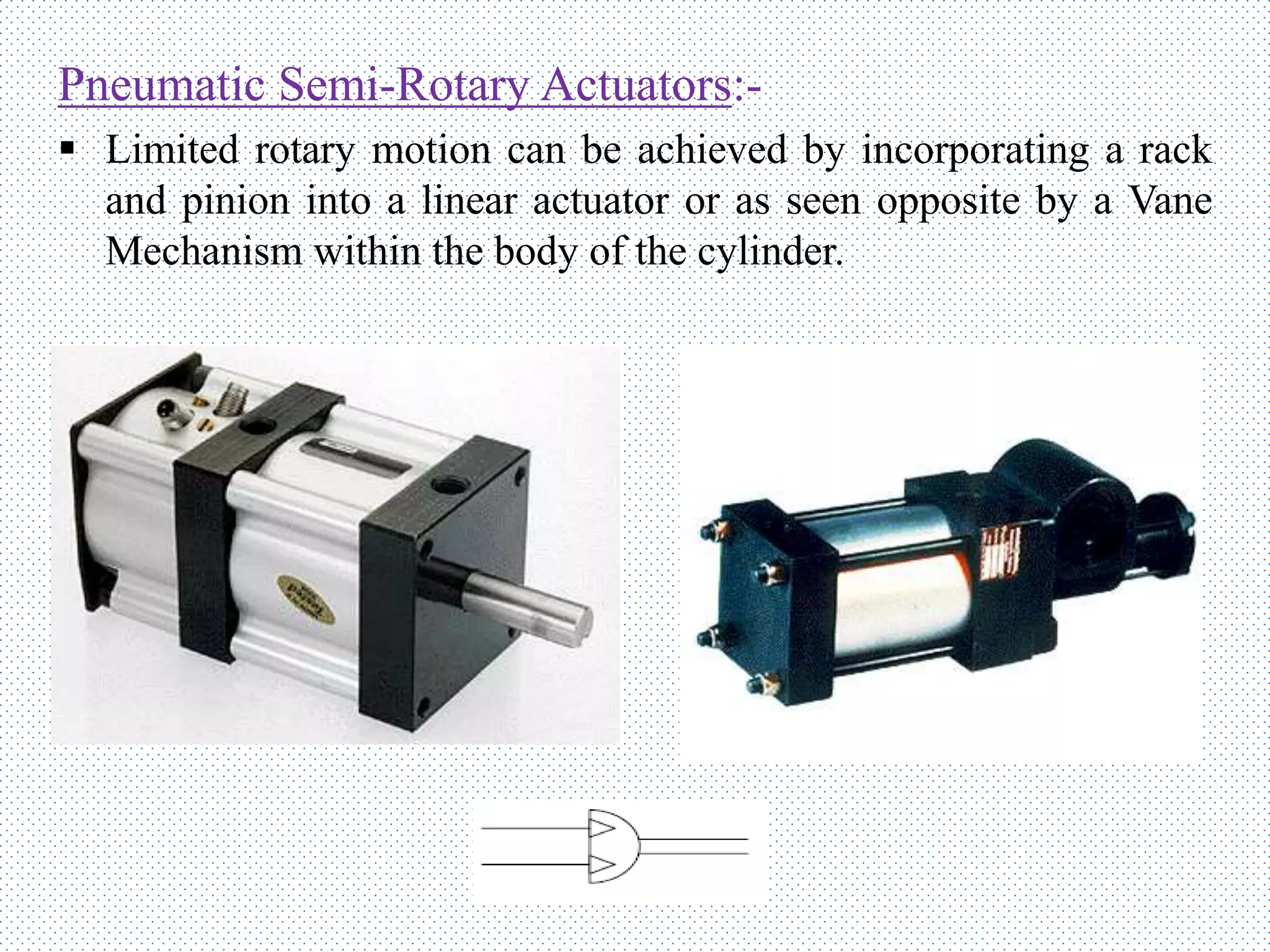
Pneumatic Semi-Rotary Actuators:-
 Limited rotary motion can be achieved by incorporating a rack
and pinion into a linear actuator or as seen opposite by a Vane
Mechanism within the body of the cylinder.
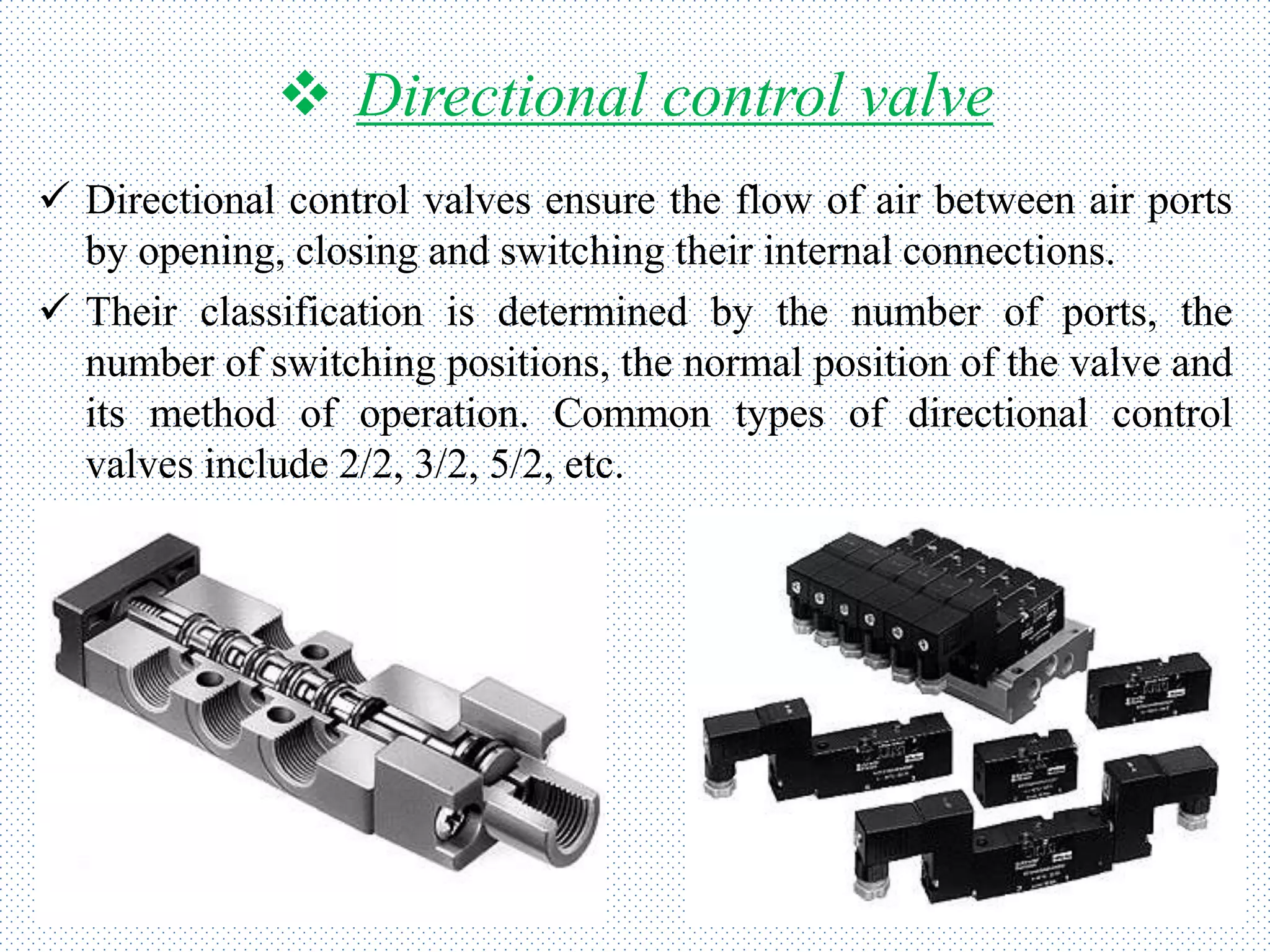
 Directional control valve
 Directional control valves ensure the flow of air between air ports
by opening, closing and switching their internal connections.
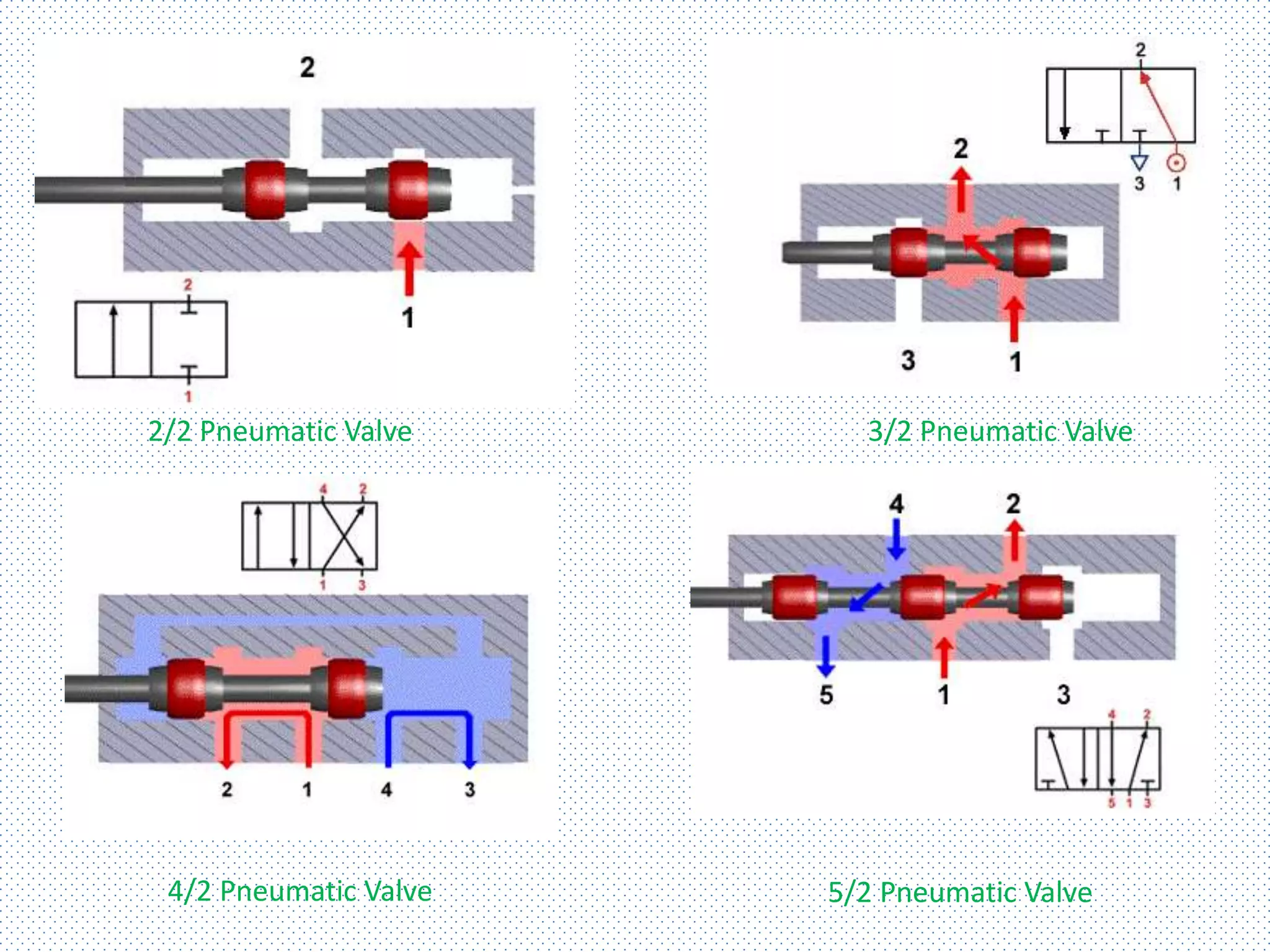
 Their classification is determined by the number of ports, the
number of switching positions, the normal position of the valve and
its method of operation. Common types of directional control
valves include 2/2, 3/2, 5/2, etc.
2/2 Pneumatic Valve 3/2 Pneumatic Valve
4/2 Pneumatic Valve 5/2 Pneumatic Valve
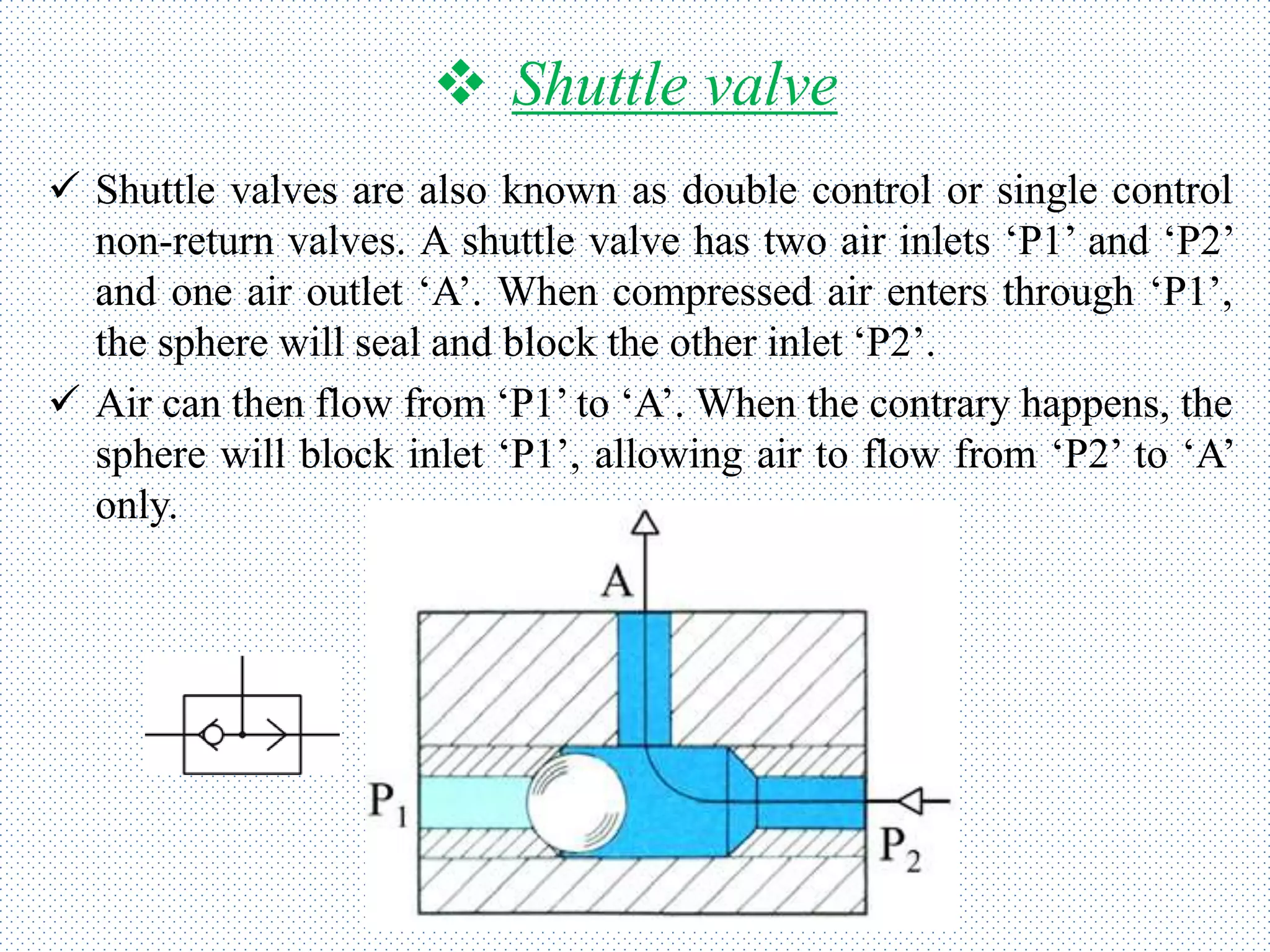
 Shuttle valve
 Shuttle valves are also known as double control or single control
non-return valves. A shuttle valve has two air inlets ‘P1’ and ‘P2’
and one air outlet ‘A’. When compressed air enters through ‘P1’,
the sphere will seal and block the other inlet ‘P2’.
 Air can then flow from ‘P1’ to ‘A’. When the contrary happens, the
sphere will block inlet ‘P1’, allowing air to flow from ‘P2’ to ‘A’
only.
 Pressure control valve
 Pressure is controlled based on the outlet pressure. A feedback
is given from the outlet to the control mechanism which is
normally open type.
 The exit pressure acts on the controlling diaphragm. the outlet
pressure is to be maintained constant.
 When the outlet pressure increase, the valve gets closed more
and the flow of air is reduced.
 When there is a change in outlet pressure, this is communicated
to the diaphragm. the diaphragm will move upwards or
downwards depending on the outlet pressure.
 In case of the outlet pressure reduced, then the valve will get
lifted up and the opening of valve will increase the flow rate of
air.
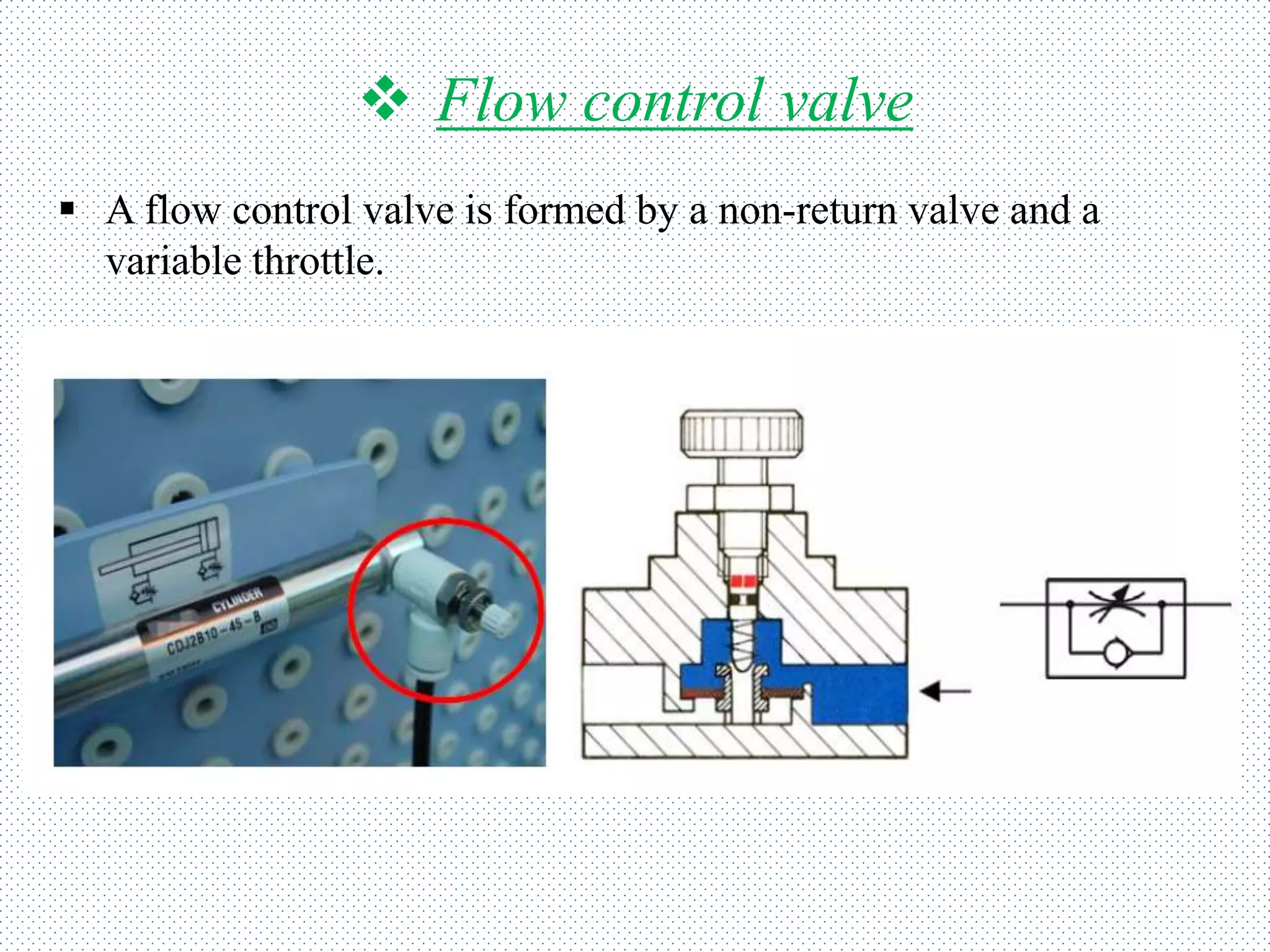
 Flow control valve
 A flow control valve is formed by a non-return valve and a
variable throttle.
24

Pneumatic Control System & ITS Components

  • 1.
    PREPARED BY :-Urvesh Prajapati (140453119029). Aakash Rana (140453119030). Keval Rana (140453119031). Pinakin Rana (140453119032). SEMESTER :- 5th Sem. DEPARTMENT :- Mechanical Department GUIDED BY :- Dhaval Patel Topic:- Pneumatic control system and it’s components
  • 2.
    Content 1. Basics ofPneumatics 2. Advantages & dis-advantages 3. Pneumatic Components Pneumatic Compressor Air Conditioners Air pressure regulator Air lubricator Air service unit Pneumatic Silencer 4. Pneumatic Valves Pneumatic Actuators Directional control valve Shuttle valve
  • 3.
    1. Basics ofPneumatics  A pneumatic system is a system that uses compressed air to transmit and control energy. Pneumatic systems are used in controlling train doors, automatic production lines, mechanical clamps.
  • 4.
    2. Advantages &Limitations of pneumatic systems The Advantages of pneumatic systems High effectiveness High durability and reliability Simple design High adaptability to harsh environment Safety Easy selection of speed and pressure The Limitations of pneumatic systems Relatively low accuracy Low loading Processing required before use Uneven moving speed Noise
  • 5.
    3. Pneumatics Components A compressor is a machine that compresses air or another type of gas from a low inlet pressure (usually atmospheric) to a higher desired pressure level.  This is accomplished by reducing the volume of the gas. Air compressors are generally positive displacement units and are either of the reciprocating piston type or the rotary screw or rotary vane types.
  • 6.
     Piston compressor In this type of compressor a cylinder bore encloses a moving piston. As the crankshaft of the compressor rotate, the piston moves within the cylinder, similar to the piston in a car engine. As the piston is pulled down, the volume increases, creating a lower atmospheric pressure in the piston chamber.
  • 7.
     Vane compressor The following figure shows a cutaway view of the sliding-vane- type rotary compressor. The air inlet is placed where the volume of the compression chamber is greatest, the outlet where the volume is smallest. Consequently, as the vanes turn, the space between them is reduced.
  • 8.
     Screw compressor There is a current toward increased use of the rotary-type compressor due to technological advances, which have produced stronger materials and better manufacturing process.  during the rotation of the rotor, air is drawn through the suction port to fill the space between the male and female rotor lobes.
  • 9.
     Lobe compressor In this type of compressor the rotors do not touch and certain amount of slip exists. This slip increases as the output pressure increases.  It is therefore operated at maximum speed for the highest efficiency. bar is obtainable with this type of constant displacement compressor.
  • 10.
     Air Conditioners Airfilters:-  The air needs to be filtered to be free of moisture and contamination. Air filter is used to do this job. The filter elements remove the particles and moisture as small as 5 microns.
  • 11.
     Air pressureregulator  The pressure regulator is used to adjust the desired pressure for the pneumatic system. This use a piston to sense downstream pressure fluctuations.  As the pressure downstream drops it is sensed by the diaphragm and the popper valve opens. This adjusts the position of the poppet valve, which limits the downstream pressure to the pre-set valve.
  • 12.
     Air lubricator A lubricator ensures proper lubrication of internal moving parts pneumatics components. The proportional increase in oil mist by an increase of air flow is achieved by the spring loaded poppet assembly. As the flow increases and the valve opens, the area is increased and a pressure differential created.
  • 13.
     Air serviceunit  Filters, regulators and lubricators can be combined to ensure optimum compressed air preparation for a specific pneumatic system.
  • 14.
     Pneumatic Silencer To decrease the noise of air in the outlet of valves, a silencer can be used. They are made from the porous plastic or bronze. Some of them are equipped with a control flow valve to control velocity of flow in the outlet of valves as well.
  • 15.
    4. Pneumatic Valves The pneumatic valves are similar to hydraulic valves in terms of physical concepts. They are categorized into three classes:
  • 16.
    Pneumatic Actuators Pneumatic Cylinders:- The cylinders converts the energy of the compressed air into linear motion which extend or retract the piston rod.
  • 17.
    Pneumatic Rotary Actuators:- The rotary actuators converts the energy into a rotary motion. Most of them is Vane air motor.
  • 18.
    Pneumatic Semi-Rotary Actuators:- Limited rotary motion can be achieved by incorporating a rack and pinion into a linear actuator or as seen opposite by a Vane Mechanism within the body of the cylinder.
  • 19.
     Directional controlvalve  Directional control valves ensure the flow of air between air ports by opening, closing and switching their internal connections.  Their classification is determined by the number of ports, the number of switching positions, the normal position of the valve and its method of operation. Common types of directional control valves include 2/2, 3/2, 5/2, etc.
  • 20.
    2/2 Pneumatic Valve3/2 Pneumatic Valve 4/2 Pneumatic Valve 5/2 Pneumatic Valve
  • 21.
     Shuttle valve Shuttle valves are also known as double control or single control non-return valves. A shuttle valve has two air inlets ‘P1’ and ‘P2’ and one air outlet ‘A’. When compressed air enters through ‘P1’, the sphere will seal and block the other inlet ‘P2’.  Air can then flow from ‘P1’ to ‘A’. When the contrary happens, the sphere will block inlet ‘P1’, allowing air to flow from ‘P2’ to ‘A’ only.
  • 22.
     Pressure controlvalve  Pressure is controlled based on the outlet pressure. A feedback is given from the outlet to the control mechanism which is normally open type.  The exit pressure acts on the controlling diaphragm. the outlet pressure is to be maintained constant.  When the outlet pressure increase, the valve gets closed more and the flow of air is reduced.  When there is a change in outlet pressure, this is communicated to the diaphragm. the diaphragm will move upwards or downwards depending on the outlet pressure.  In case of the outlet pressure reduced, then the valve will get lifted up and the opening of valve will increase the flow rate of air.
  • 23.
     Flow controlvalve  A flow control valve is formed by a non-return valve and a variable throttle.
  • 24.