For control and automation 
J.Majumder C.Engg M.I.E
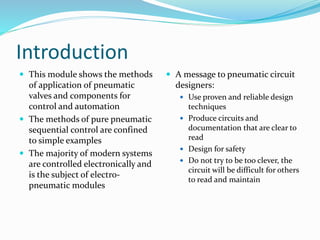
Contents 
 Symbols 
 Circuit layout 
 Actuator control 2/2 Valve 
 Actuator control 3/2 Valve 
 Actuator control 5/2 Valve 
 Sequential control 
 Sequence solution 
 5/3 Valves 
 Poppet/spool logic 
 Balanced spool logic 
 Feedback 
 Introduction
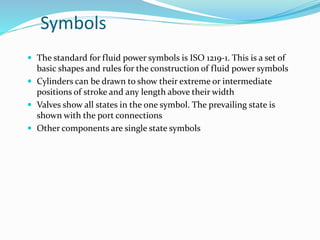
Introduction 
 This module shows the methods 
of application of pneumatic 
valves and components for 
control and automation 
 The methods of pure pneumatic 
sequential control are confined 
to simple examples 
 The majority of modern systems 
are controlled electronically and 
is the subject of electro-pneumatic 
modules 
 A message to pneumatic circuit 
designers: 
 Use proven and reliable design 
techniques 
 Produce circuits and 
documentation that are clear to 
read 
 Design for safety 
 Do not try to be too clever, the 
circuit will be difficult for others 
to read and maintain
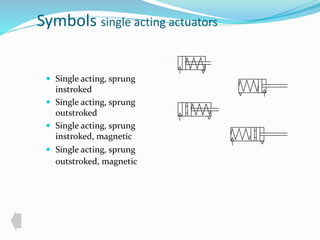
Symbols 
 The standard for fluid power symbols is ISO 1219-1. This is a set of 
basic shapes and rules for the construction of fluid power symbols 
 Cylinders can be drawn to show their extreme or intermediate 
positions of stroke and any length above their width 
 Valves show all states in the one symbol. The prevailing state is 
shown with the port connections 
 Other components are single state symbols
Symbols single acting actuators 
 Single acting, sprung 
instroked 
 Single acting, sprung 
outstroked 
 Single acting, sprung 
instroked, magnetic 
 Single acting, sprung 
outstroked, magnetic
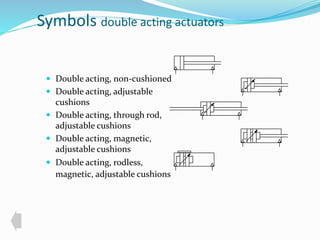
Symbols double acting actuators 
 Double acting, non-cushioned 
 Double acting, adjustable 
cushions 
 Double acting, through rod, 
adjustable cushions 
 Double acting, magnetic, 
adjustable cushions 
 Double acting, rodless, 
magnetic, adjustable cushions
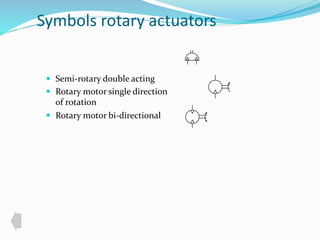
Symbols rotary actuators 
 Semi-rotary double acting 
 Rotary motor single direction 
of rotation 
 Rotary motor bi-directional
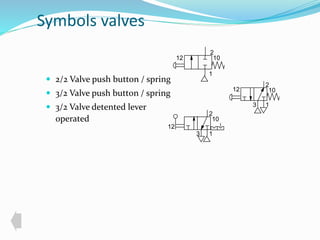
Symbols valves 
 2/2 Valve push button / spring 
 3/2 Valve push button / spring 
 3/2 Valve detented lever 
operated 
2 
12 10 
3 1 
2 
12 10 
1 
2 
1 
3 
12 
10
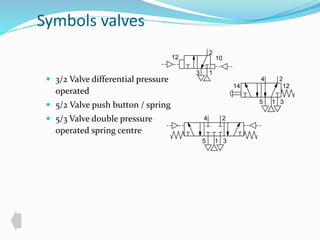
Symbols valves 
 3/2 Valve differential pressure 
operated 
 5/2 Valve push button / spring 
 5/3 Valve double pressure 
operated spring centre 
4 2 
14 12 
5 1 
3 
2 
12 10 
4 2 
5 1 
3 
1 
3
Symbols valves 
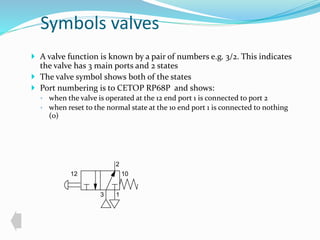
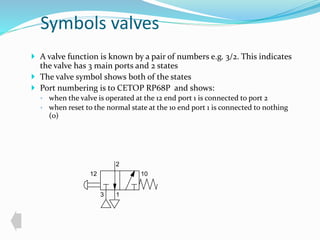
 A valve function is known by a pair of numbers e.g. 3/2. This indicates 
the valve has 3 main ports and 2 states 
 The valve symbol shows both of the states 
 Port numbering is to CETOP RP68P and shows: 
◦ when the valve is operated at the 12 end port 1 is connected to port 2 
◦ when reset to the normal state at the 10 end port 1 is connected to nothing 
(0) 
2 
12 10 
3 1
Symbols valves 
 A valve function is known by a pair of numbers e.g. 3/2. This indicates 
the valve has 3 main ports and 2 states 
 The valve symbol shows both of the states 
 Port numbering is to CETOP RP68P and shows: 
◦ when the valve is operated at the 12 end port 1 is connected to port 2 
◦ when reset to the normal state at the 10 end port 1 is connected to nothing 
(0) 
2 
12 10 
3 1
Symbols valves 
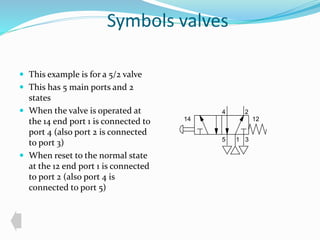
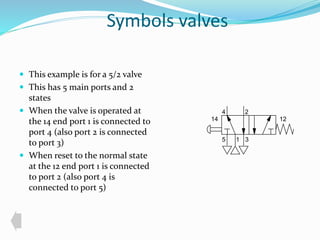
 This example is for a 5/2 valve 
 This has 5 main ports and 2 
states 
 When the valve is operated at 
the 14 end port 1 is connected to 
port 4 (also port 2 is connected 
to port 3) 
 When reset to the normal state 
at the 12 end port 1 is connected 
to port 2 (also port 4 is 
connected to port 5) 
4 2 
14 12 
5 1 
3
Symbols valves 
 This example is for a 5/2 valve 
 This has 5 main ports and 2 
states 
 When the valve is operated at 
the 14 end port 1 is connected to 
port 4 (also port 2 is connected 
to port 3) 
 When reset to the normal state 
at the 12 end port 1 is connected 
to port 2 (also port 4 is 
connected to port 5) 
4 2 
14 12 
5 1 
3
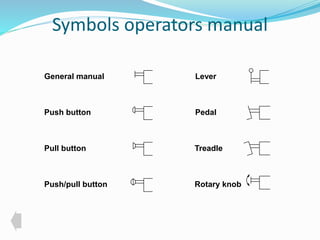
Symbols operators manual 
General manual 
Push button 
Pull button 
Push/pull button 
Lever 
Pedal 
Treadle 
Rotary knob
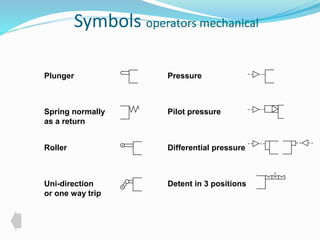
Symbols operators mechanical 
Plunger 
Spring normally 
as a return 
Roller 
Uni-direction 
or one way trip 
Pressure 
Pilot pressure 
Differential pressure 
Detent in 3 positions
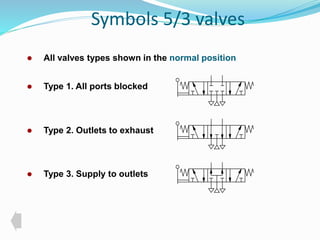
Symbols 5/3 valves 
 All valves types shown in the normal position 
 Type 1. All ports blocked 
 Type 2. Outlets to exhaust 
 Type 3. Supply to outlets
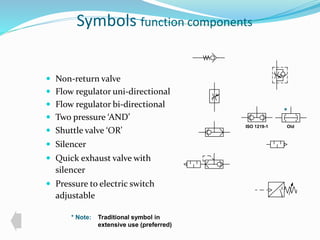
Symbols function components 
 Non-return valve 
 Flow regulator uni-directional 
 Flow regulator bi-directional 
 Two pressure ‘AND’ 
 Shuttle valve ‘OR’ 
 Silencer 
 Quick exhaust valve with 
silencer 
 Pressure to electric switch 
adjustable 
* Note: Traditional symbol in 
extensive use (preferred) 
* 
ISO 1219-1 Old
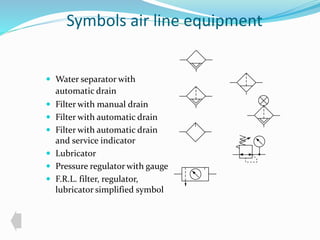
Symbols air line equipment 
 Water separator with 
automatic drain 
 Filter with manual drain 
 Filter with automatic drain 
and service indicator 
 Lubricator 
 Pressure regulator with gauge 
 F.R.L. filter, regulator, 
lubricator simplified symbol
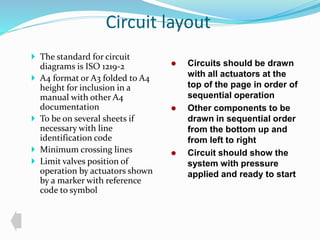
Circuit layout 
 The standard for circuit 
diagrams is ISO 1219-2 
 A4 format or A3 folded to A4 
height for inclusion in a 
manual with other A4 
documentation 
 To be on several sheets if 
necessary with line 
identification code 
 Minimum crossing lines 
 Limit valves position of 
operation by actuators shown 
by a marker with reference 
code to symbol 
 Circuits should be drawn 
with all actuators at the 
top of the page in order of 
sequential operation 
 Other components to be 
drawn in sequential order 
from the bottom up and 
from left to right 
 Circuit should show the 
system with pressure 
applied and ready to start
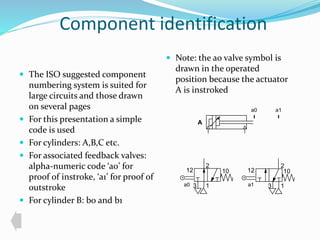
Component identification 
 The ISO suggested component 
numbering system is suited for 
large circuits and those drawn 
on several pages 
 For this presentation a simple 
code is used 
 For cylinders: A,B,C etc. 
 For associated feedback valves: 
alpha-numeric code ‘a0’ for 
proof of instroke, ‘a1’ for proof of 
outstroke 
 For cylinder B: b0 and b1 
 Note: the a0 valve symbol is 
drawn in the operated 
position because the actuator 
A is instroked 
A 
a0 a1 
2 
12 10 
1 
3 
a0 
2 
12 10 
3 1 
a1
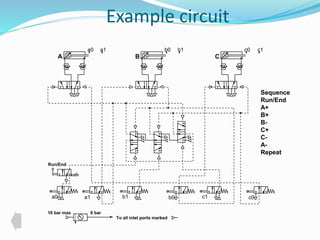
Example circuit 
A 
Run/End 
a0 a1 
B 
b0 b1 
C 
c0 c1 
a0 a1 b1 b0 c1 c0 
10 bar max 6 bar 
To all inlet ports marked 
Sequence 
Run/End 
A+ 
B+ 
B-C+ 
C-A-Repeat
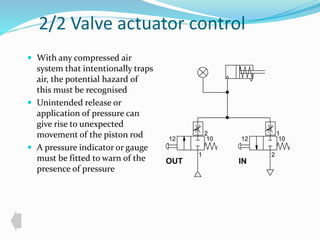
2/2 Valve actuator control 
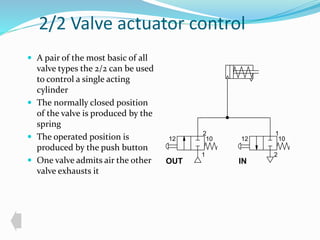
 A pair of the most basic of all 
valve types the 2/2 can be used 
to control a single acting 
cylinder 
 The normally closed position 
of the valve is produced by the 
spring 
 The operated position is 
produced by the push button 
 One valve admits air the other 
valve exhausts it 
2 
12 10 
1 
1 
12 10 
2 
OUT IN
2/2 Valve actuator control 
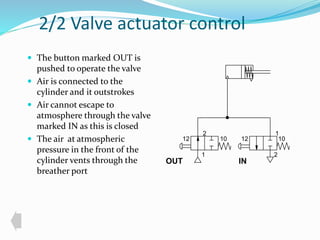
 The button marked OUT is 
pushed to operate the valve 
 Air is connected to the 
cylinder and it outstrokes 
 Air cannot escape to 
atmosphere through the valve 
marked IN as this is closed 
 The air at atmospheric 
pressure in the front of the 
cylinder vents through the 
breather port 
2 
10 
1 
12 
1 
12 10 
2 
OUT IN
2/2 Valve actuator control 
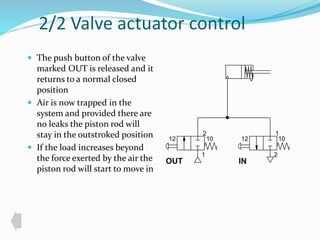
 The push button of the valve 
marked OUT is released and it 
returns to a normal closed 
position 
 Air is now trapped in the 
system and provided there are 
no leaks the piston rod will 
stay in the outstroked position 
 If the load increases beyond 
the force exerted by the air the 
piston rod will start to move in 
2 
10 
1 
12 
1 
12 10 
2 
OUT IN
2/2 Valve actuator control 
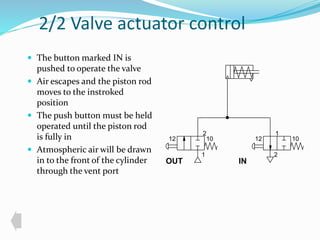
 The button marked IN is 
pushed to operate the valve 
 Air escapes and the piston rod 
moves to the instroked 
position 
 The push button must be held 
operated until the piston rod 
is fully in 
 Atmospheric air will be drawn 
in to the front of the cylinder 
through the vent port 
2 
10 
1 
12 
1 
12 10 
2 
OUT IN
2/2 Valve actuator control 
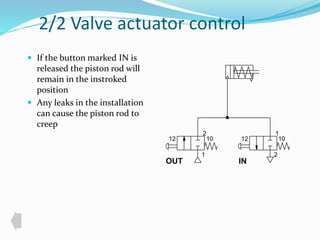
 If the button marked IN is 
released the piston rod will 
remain in the instroked 
position 
 Any leaks in the installation 
can cause the piston rod to 
creep 
2 
10 
1 
12 
1 
12 10 
2 
OUT IN
2/2 Valve actuator control 
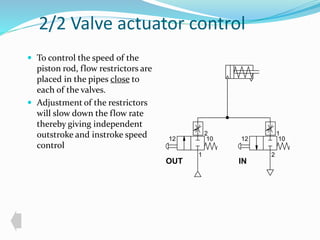
 To control the speed of the 
piston rod, flow restrictors are 
placed in the pipes close to 
each of the valves. 
 Adjustment of the restrictors 
will slow down the flow rate 
thereby giving independent 
outstroke and instroke speed 
control 
2 
12 10 12 10 
1 
OUT IN 
1 
2
2/2 Valve actuator control 
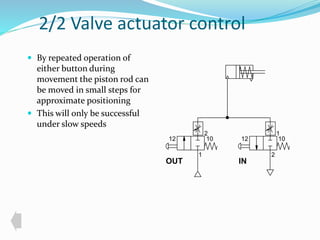
 By repeated operation of 
either button during 
movement the piston rod can 
be moved in small steps for 
approximate positioning 
 This will only be successful 
under slow speeds 
2 
12 10 12 10 
1 
OUT IN 
1 
2
2/2 Valve actuator control 
 With any compressed air 
system that intentionally traps 
air, the potential hazard of 
this must be recognised 
 Unintended release or 
application of pressure can 
give rise to unexpected 
movement of the piston rod 
 A pressure indicator or gauge 
must be fitted to warn of the 
presence of pressure 
2 
10 
1 
12 
1 
12 10 
2 
OUT IN
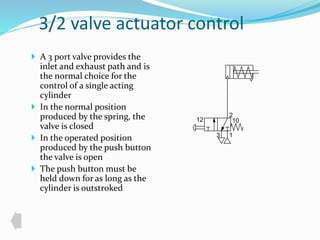
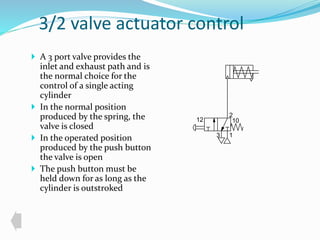
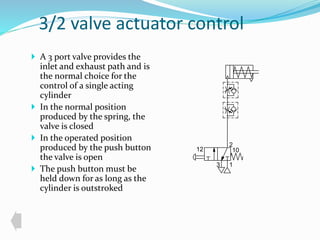
3/2 valve actuator control 
 A 3 port valve provides the 
inlet and exhaust path and is 
the normal choice for the 
control of a single acting 
cylinder 
 In the normal position 
produced by the spring, the 
valve is closed 
 In the operated position 
produced by the push button 
the valve is open 
 The push button must be 
held down for as long as the 
cylinder is outstroked 
2 
12 10 
1 
3
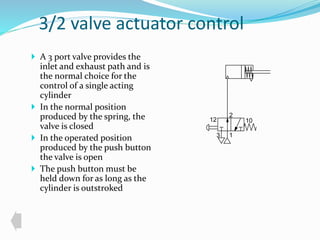
3/2 valve actuator control 
 A 3 port valve provides the 
inlet and exhaust path and is 
the normal choice for the 
control of a single acting 
cylinder 
 In the normal position 
produced by the spring, the 
valve is closed 
 In the operated position 
produced by the push button 
the valve is open 
 The push button must be 
held down for as long as the 
cylinder is outstroked 
2 
12 10 
1 
3
3/2 valve actuator control 
 A 3 port valve provides the 
inlet and exhaust path and is 
the normal choice for the 
control of a single acting 
cylinder 
 In the normal position 
produced by the spring, the 
valve is closed 
 In the operated position 
produced by the push button 
the valve is open 
 The push button must be 
held down for as long as the 
cylinder is outstroked 
2 
12 10 
1 
3
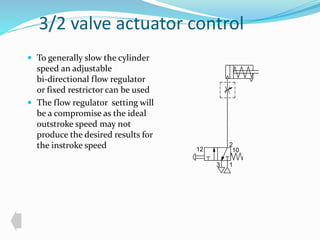
3/2 valve actuator control 
 To generally slow the cylinder 
speed an adjustable 
bi-directional flow regulator 
or fixed restrictor can be used 
 The flow regulator setting will 
be a compromise as the ideal 
outstroke speed may not 
produce the desired results for 
the instroke speed 
2 
12 10 
1 
3
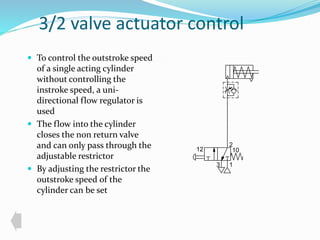
3/2 valve actuator control 
 To control the outstroke speed 
of a single acting cylinder 
without controlling the 
instroke speed, a uni-directional 
flow regulator is 
used 
 The flow into the cylinder 
closes the non return valve 
and can only pass through the 
adjustable restrictor 
 By adjusting the restrictor the 
outstroke speed of the 
cylinder can be set 
2 
12 10 
1 
3
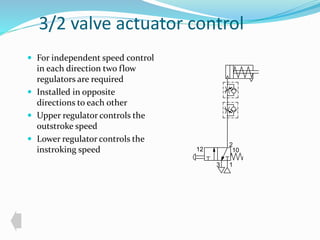
3/2 valve actuator control 
 For independent speed control 
in each direction two flow 
regulators are required 
 Installed in opposite 
directions to each other 
 Upper regulator controls the 
outstroke speed 
 Lower regulator controls the 
instroking speed 
2 
12 10 
1 
3
3/2 valve actuator control 
 A 3 port valve provides the 
inlet and exhaust path and is 
the normal choice for the 
control of a single acting 
cylinder 
 In the normal position 
produced by the spring, the 
valve is closed 
 In the operated position 
produced by the push button 
the valve is open 
 The push button must be 
held down for as long as the 
cylinder is outstroked 
2 
12 10 
1 
3
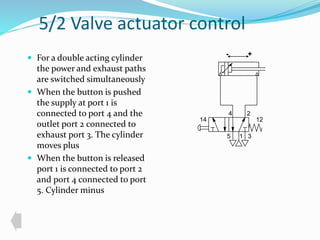
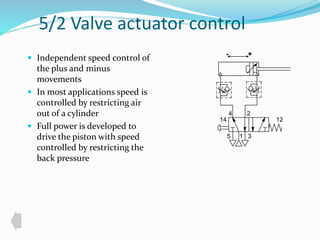
5/2 Valve actuator control 
 For a double acting cylinder 
the power and exhaust paths 
are switched simultaneously 
 When the button is pushed 
the supply at port 1 is 
connected to port 4 and the 
outlet port 2 connected to 
exhaust port 3. The cylinder 
moves plus 
 When the button is released 
port 1 is connected to port 2 
and port 4 connected to port 
5. Cylinder minus 
- + 
4 2 
14 12 
5 1 
3
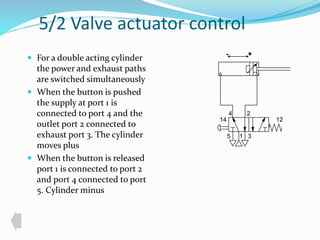
5/2 Valve actuator control 
 For a double acting cylinder 
the power and exhaust paths 
are switched simultaneously 
 When the button is pushed 
the supply at port 1 is 
connected to port 4 and the 
outlet port 2 connected to 
exhaust port 3. The cylinder 
moves plus 
 When the button is released 
port 1 is connected to port 2 
and port 4 connected to port 
5. Cylinder minus 
- + 
4 2 
14 12 
5 1 
3
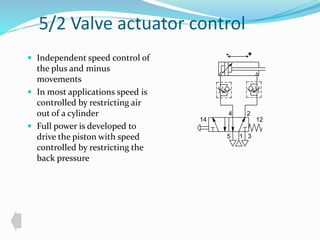
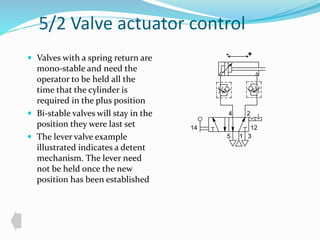
5/2 Valve actuator control 
 Independent speed control of 
the plus and minus 
movements 
 In most applications speed is 
controlled by restricting air 
out of a cylinder 
 Full power is developed to 
drive the piston with speed 
controlled by restricting the 
back pressure 
- + 
4 2 
14 12 
5 1 
3
5/2 Valve actuator control 
 Independent speed control of 
the plus and minus 
movements 
 In most applications speed is 
controlled by restricting air 
out of a cylinder 
 Full power is developed to 
drive the piston with speed 
controlled by restricting the 
back pressure 
- + 
4 2 
14 12 
5 1 
3
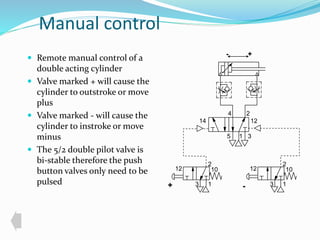
5/2 Valve actuator control 
 Valves with a spring return are 
mono-stable and need the 
operator to be held all the 
time that the cylinder is 
required in the plus position 
 Bi-stable valves will stay in the 
position they were last set 
 The lever valve example 
illustrated indicates a detent 
mechanism. The lever need 
not be held once the new 
position has been established 
- + 
4 2 
14 12 
5 1 
3
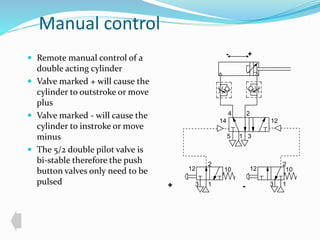
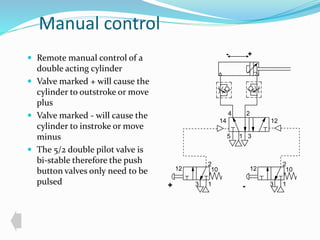
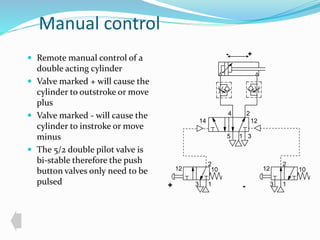
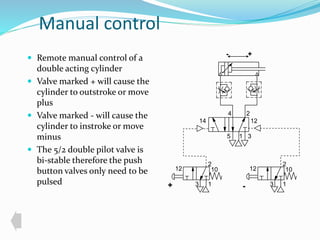
Manual control 
 Remote manual control of a 
double acting cylinder 
 Valve marked + will cause the 
cylinder to outstroke or move 
plus 
 Valve marked - will cause the 
cylinder to instroke or move 
minus 
 The 5/2 double pilot valve is 
bi-stable therefore the push 
button valves only need to be 
pulsed 
- + 
4 2 
14 12 
5 1 
3 
2 
12 10 
1 
3 
2 
12 10 
1 
3 
+ -
Manual control 
 Remote manual control of a 
double acting cylinder 
 Valve marked + will cause the 
cylinder to outstroke or move 
plus 
 Valve marked - will cause the 
cylinder to instroke or move 
minus 
 The 5/2 double pilot valve is 
bi-stable therefore the push 
button valves only need to be 
pulsed 
- + 
4 2 
14 12 
5 1 
3 
2 
12 10 
1 
3 
2 
12 10 
1 
3 
+ -
Manual control 
 Remote manual control of a 
double acting cylinder 
 Valve marked + will cause the 
cylinder to outstroke or move 
plus 
 Valve marked - will cause the 
cylinder to instroke or move 
minus 
 The 5/2 double pilot valve is 
bi-stable therefore the push 
button valves only need to be 
pulsed 
- + 
4 2 
14 12 
5 1 
3 
2 
12 10 
1 
3 
2 
12 10 
1 
3 
+ -
Manual control 
 Remote manual control of a 
double acting cylinder 
 Valve marked + will cause the 
cylinder to outstroke or move 
plus 
 Valve marked - will cause the 
cylinder to instroke or move 
minus 
 The 5/2 double pilot valve is 
bi-stable therefore the push 
button valves only need to be 
pulsed 
- + 
4 2 
14 12 
5 1 
3 
2 
12 10 
1 
3 
2 
12 10 
1 
3 
+ -
Manual control 
 Remote manual control of a 
double acting cylinder 
 Valve marked + will cause the 
cylinder to outstroke or move 
plus 
 Valve marked - will cause the 
cylinder to instroke or move 
minus 
 The 5/2 double pilot valve is 
bi-stable therefore the push 
button valves only need to be 
pulsed 
- + 
4 2 
14 12 
5 1 
3 
2 
12 10 
1 
3 
2 
12 10 
1 
3 
+ -
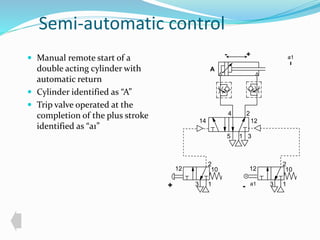
Semi-automatic control 
 Manual remote start of a 
double acting cylinder with 
automatic return 
 Cylinder identified as “A” 
 Trip valve operated at the 
completion of the plus stroke 
identified as “a1” 
- + 
4 2 
A 
14 12 
5 1 
3 
2 
12 10 
1 
3 
2 
12 10 
1 
3 
+ - 
a1 
a1
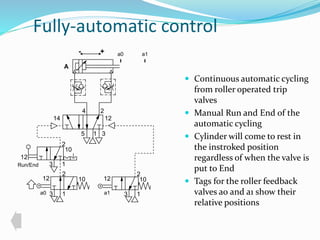
Fully-automatic control 
 Continuous automatic cycling 
from roller operated trip 
valves 
 Manual Run and End of the 
automatic cycling 
 Cylinder will come to rest in 
the instroked position 
regardless of when the valve is 
put to End 
 Tags for the roller feedback 
valves a0 and a1 show their 
relative positions 
4 2 
14 12 
5 1 
3 
2 
12 10 
3 1 
2 
2 
12 10 
1 
3 
1 
3 
12 
10 
Run/End 
- + 
A 
a0 a1 
a0 a1
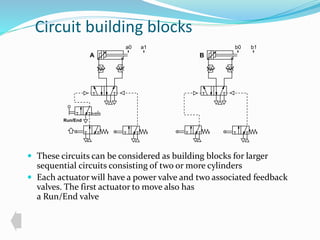
Circuit building blocks 
Run/End 
a0 a1 b0 b1 
A B 
 These circuits can be considered as building blocks for larger 
sequential circuits consisting of two or more cylinders 
 Each actuator will have a power valve and two associated feedback 
valves. The first actuator to move also has 
a Run/End valve
Repeat pattern sequence 
 A repeat pattern sequence is one 
where the order of the 
movements in the first half of 
the sequence is repeated in the 
second half 
 Each actuator may have one Out 
and In stroke only in the 
sequence 
 There may be any number of 
actuators in the sequence 
 The signal starting the first 
movement must pass through 
the Run/End valve 
 Needs only the basic building 
blocks to solve 
 Examples of repeat pattern 
sequences: 
 A+ B+ C+ D+ A- B- C- D- 
 A- B+ C- A+ B- C+ 
 C+ A+ B- C- A- B+
Repeat pattern sequence 
Run/End 
A B 
b0 b1 a1 a0 
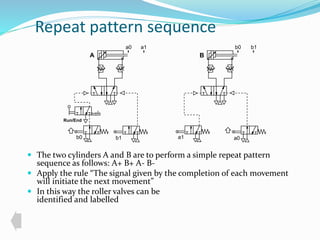
 The two cylinders A and B are to perform a simple repeat pattern 
sequence as follows: A+ B+ A- B- 
 Apply the rule “The signal given by the completion of each movement 
will initiate the next movement” 
 In this way the roller valves can be 
identified and labelled 
a0 a1 b0 b1
Repeat pattern sequence 
Run/End 
A 
c0 c1 
a0 a1 
B 
b0 b1 
a1 a0 
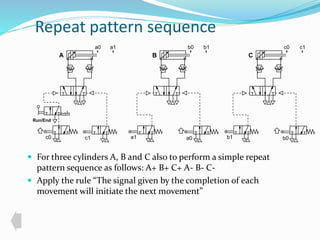
 For three cylinders A, B and C also to perform a simple repeat 
pattern sequence as follows: A+ B+ C+ A- B- C- 
 Apply the rule “The signal given by the completion of each 
movement will initiate the next movement” 
C 
c0 c1 
b1 b0
Non-repeat pattern sequence 
End 
a0 a1 b0 b1 
A B 
a0 b0 a1 b1 
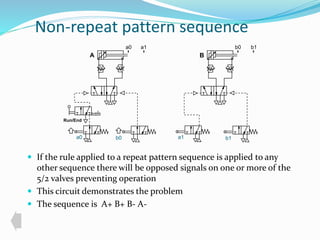
 If the rule applied to a repeat pattern sequence is applied to any 
other sequence there will be opposed signals on one or more of the 
5/2 valves preventing operation 
 This circuit demonstrates the problem 
 The sequence is A+ B+ B- A-Run/
Opposed signals 
End 
a0 a1 b0 b1 
A B 
a0 b0 a1 b1 
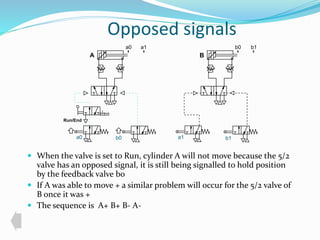
 When the valve is set to Run, cylinder A will not move because the 5/2 
valve has an opposed signal, it is still being signalled to hold position 
by the feedback valve b0 
 If A was able to move + a similar problem will occur for the 5/2 valve of 
B once it was + 
 The sequence is A+ B+ B- A-Run/
Mechanical solution 
Run/End 
a0 a1 b0 b1 
A B 
a0 b0 
a1 b1 
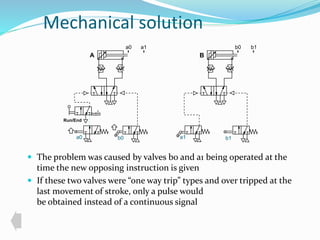
 The problem was caused by valves b0 and a1 being operated at the 
time the new opposing instruction is given 
 If these two valves were “one way trip” types and over tripped at the 
last movement of stroke, only a pulse would 
be obtained instead of a continuous signal
Sequence solution methods 
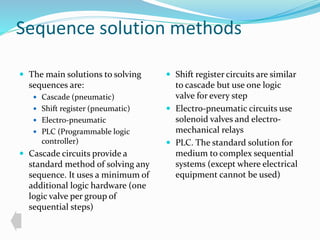
 The main solutions to solving 
sequences are: 
 Cascade (pneumatic) 
 Shift register (pneumatic) 
 Electro-pneumatic 
 PLC (Programmable logic 
controller) 
 Cascade circuits provide a 
standard method of solving any 
sequence. It uses a minimum of 
additional logic hardware (one 
logic valve per group of 
sequential steps) 
 Shift register circuits are similar 
to cascade but use one logic 
valve for every step 
 Electro-pneumatic circuits use 
solenoid valves and electro-mechanical 
relays 
 PLC. The standard solution for 
medium to complex sequential 
systems (except where electrical 
equipment cannot be used)
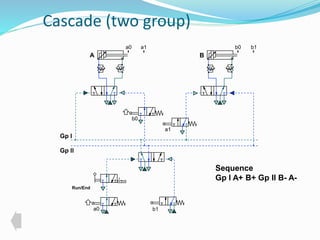
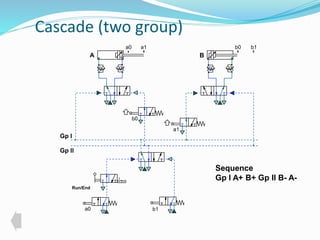
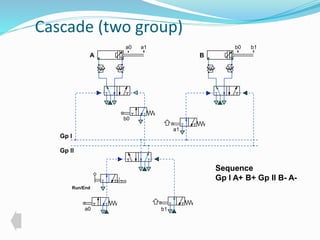
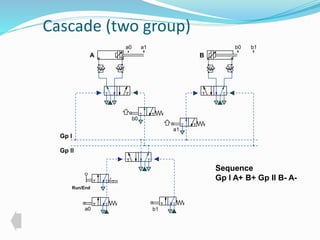
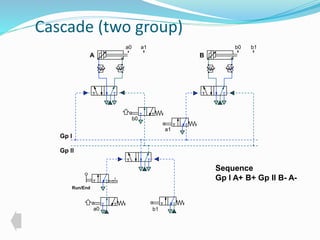
Cascade two group 
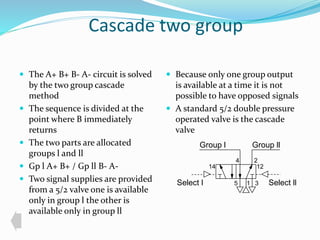
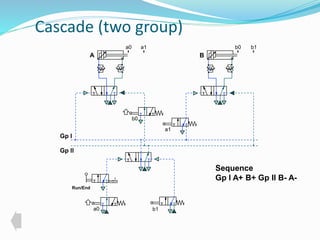
 The A+ B+ B- A- circuit is solved 
by the two group cascade 
method 
 The sequence is divided at the 
point where B immediately 
returns 
 The two parts are allocated 
groups l and ll 
 Gp l A+ B+ / Gp ll B- A- 
 Two signal supplies are provided 
from a 5/2 valve one is available 
only in group l the other is 
available only in group ll 
 Because only one group output 
is available at a time it is not 
possible to have opposed signals 
 A standard 5/2 double pressure 
operated valve is the cascade 
valve 
Group l Group ll 
4 2 
14 12 
Select l 5 1 
3 
Select ll
Cascade (two group) 
a0 a1 b0 b1 
A B 
a1 
b0 
Run/End 
a0 b1 
Sequence 
Gp l A+ B+ Gp ll B- A-Gp 
l 
Gp ll
Cascade (two group) 
a0 a1 b0 b1 
A B 
a1 
b0 
Run/End 
a0 b1 
Sequence 
Gp l A+ B+ Gp ll B- A-Gp 
l 
Gp ll
Cascade (two group) 
a0 a1 b0 b1 
A B 
b0 
Run/End 
a1 
a0 b1 
Sequence 
Gp l A+ B+ Gp ll B- A-Gp 
l 
Gp ll
Cascade (two group) 
a0 a1 b0 b1 
A B 
b0 
Run/End 
a1 
a0 b1 
Sequence 
Gp l A+ B+ Gp ll B- A-Gp 
l 
Gp ll
Cascade (two group) 
a0 a1 b0 b1 
A B 
Run/End 
a1 
a0 
Sequence 
Gp l A+ B+ Gp ll B- A-Gp 
l 
Gp ll 
b0 
b1
Cascade (two group) 
a0 a1 b0 b1 
A B 
Run/End 
Sequence 
Gp l A+ B+ Gp ll B- A-Gp 
l 
Gp ll 
b0 
b1 
a1 
a0
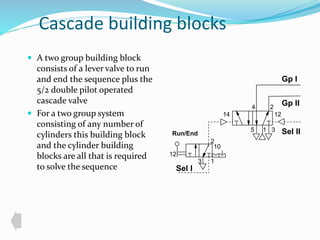
Cascade building blocks 
 A two group building block 
consists of a lever valve to run 
and end the sequence plus the 
5/2 double pilot operated 
cascade valve 
 For a two group system 
consisting of any number of 
cylinders this building block 
and the cylinder building 
blocks are all that is required 
to solve the sequence 
4 2 
14 12 
5 1 
3 
Run/End Sel ll 
2 
1 
3 
12 
10 
Gp l 
Gp ll 
Sel l
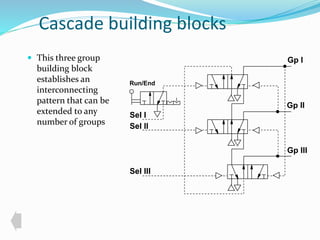
Cascade building blocks 
 This three group 
building block 
establishes an 
interconnecting 
pattern that can be 
extended to any 
number of groups 
Gp l 
Gp ll 
Run/End 
Sel l 
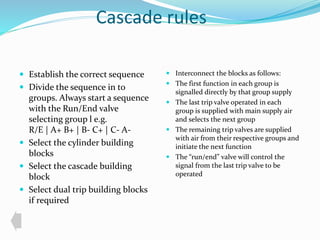
Sel ll 
Gp lll 
Sel lll
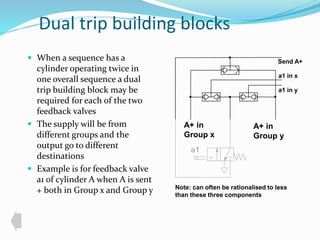
Dual trip building blocks 
 When a sequence has a 
cylinder operating twice in 
one overall sequence a dual 
trip building block may be 
required for each of the two 
feedback valves 
 The supply will be from 
different groups and the 
output go to different 
destinations 
 Example is for feedback valve 
a1 of cylinder A when A is sent 
+ both in Group x and Group y 
Send A+ 
A+ in 
Group x 
A+ in 
Group y 
a1 
a1 in x 
a1 in y 
Note: can often be rationalised to less 
than these three components
Cascade rules 
 Establish the correct sequence 
 Divide the sequence in to 
groups. Always start a sequence 
with the Run/End valve 
selecting group l e.g. 
R/E | A+ B+ | B- C+ | C- A- 
 Select the cylinder building 
blocks 
 Select the cascade building 
block 
 Select dual trip building blocks 
if required 
 Interconnect the blocks as follows: 
 The first function in each group is 
signalled directly by that group supply 
 The last trip valve operated in each 
group is supplied with main supply air 
and selects the next group 
 The remaining trip valves are supplied 
with air from their respective groups and 
initiate the next function 
 The “run/end” valve will control the 
signal from the last trip valve to be 
operated
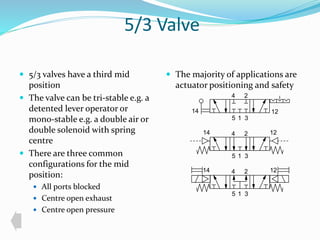
5/3 Valve 
 5/3 valves have a third mid 
position 
 The valve can be tri-stable e.g. a 
detented lever operator or 
mono-stable e.g. a double air or 
double solenoid with spring 
centre 
 There are three common 
configurations for the mid 
position: 
 All ports blocked 
 Centre open exhaust 
 Centre open pressure 
 The majority of applications are 
actuator positioning and safety 
4 2 
14 12 
5 1 3 
14 4 2 12 
5 1 3 
14 4 2 12 
5 1 3
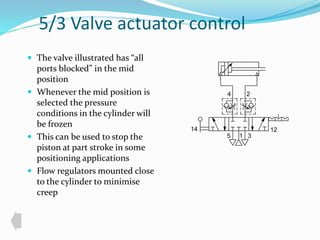
5/3 Valve actuator control 
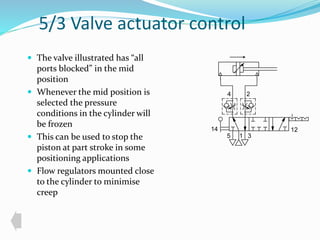
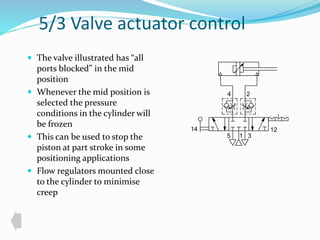
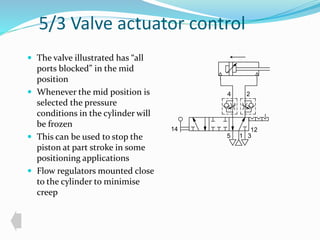
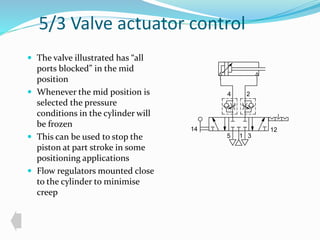
 The valve illustrated has “all 
ports blocked” in the mid 
position 
 Whenever the mid position is 
selected the pressure 
conditions in the cylinder will 
be frozen 
 This can be used to stop the 
piston at part stroke in some 
positioning applications 
 Flow regulators mounted close 
to the cylinder to minimise 
creep 
4 2 
14 12 
5 1 3
5/3 Valve actuator control 
 The valve illustrated has “all 
ports blocked” in the mid 
position 
 Whenever the mid position is 
selected the pressure 
conditions in the cylinder will 
be frozen 
 This can be used to stop the 
piston at part stroke in some 
positioning applications 
 Flow regulators mounted close 
to the cylinder to minimise 
creep 
4 2 
14 12 
5 1 3
5/3 Valve actuator control 
 The valve illustrated has “all 
ports blocked” in the mid 
position 
 Whenever the mid position is 
selected the pressure 
conditions in the cylinder will 
be frozen 
 This can be used to stop the 
piston at part stroke in some 
positioning applications 
 Flow regulators mounted close 
to the cylinder to minimise 
creep 
4 2 
14 12 
5 1 3
5/3 Valve actuator control 
 The valve illustrated has “all 
ports blocked” in the mid 
position 
 Whenever the mid position is 
selected the pressure 
conditions in the cylinder will 
be frozen 
 This can be used to stop the 
piston at part stroke in some 
positioning applications 
 Flow regulators mounted close 
to the cylinder to minimise 
creep 
4 2 
14 12 
5 1 3
5/3 Valve actuator control 
 The valve illustrated has “all 
ports blocked” in the mid 
position 
 Whenever the mid position is 
selected the pressure 
conditions in the cylinder will 
be frozen 
 This can be used to stop the 
piston at part stroke in some 
positioning applications 
 Flow regulators mounted close 
to the cylinder to minimise 
creep 
4 2 
14 12 
5 1 3
5/3 Valve actuator control 
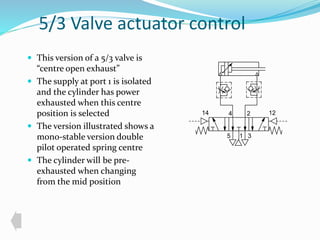
 This version of a 5/3 valve is 
“centre open exhaust” 
 The supply at port 1 is isolated 
and the cylinder has power 
exhausted when this centre 
position is selected 
 The version illustrated shows a 
mono-stable version double 
pilot operated spring centre 
 The cylinder will be pre-exhausted 
when changing 
from the mid position 
14 12 
4 2 
5 1 3
5/3 Valve actuator control 
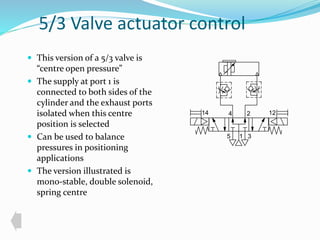
 This version of a 5/3 valve is 
“centre open pressure” 
 The supply at port 1 is 
connected to both sides of the 
cylinder and the exhaust ports 
isolated when this centre 
position is selected 
 Can be used to balance 
pressures in positioning 
applications 
 The version illustrated is 
mono-stable, double solenoid, 
spring centre 
14 12 
4 2 
5 1 
3
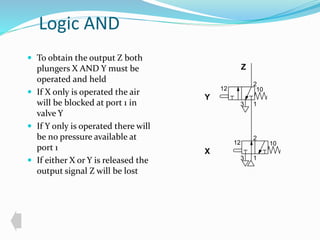
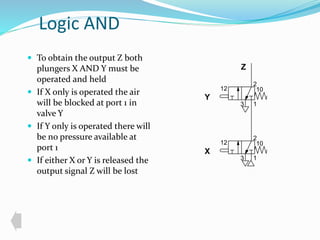
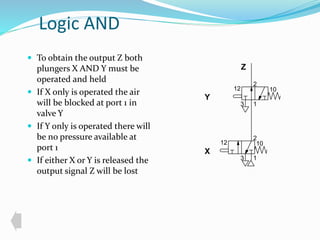
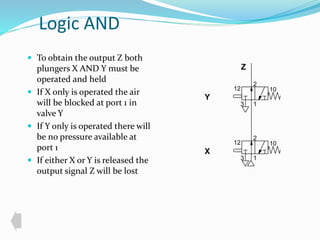
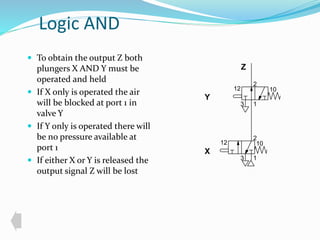
Logic AND 
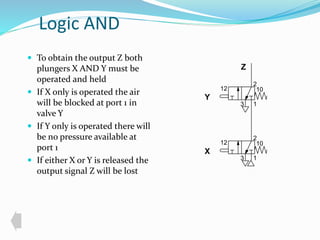
 To obtain the output Z both 
plungers X AND Y must be 
operated and held 
 If X only is operated the air 
will be blocked at port 1 in 
valve Y 
 If Y only is operated there will 
be no pressure available at 
port 1 
 If either X or Y is released the 
output signal Z will be lost 
2 
12 10 
1 
3 
2 
12 10 
1 
3 
Y 
X 
Z
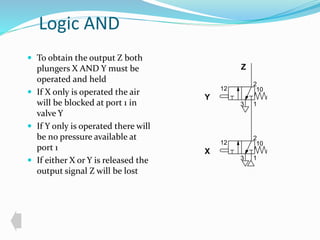
Logic AND 
 To obtain the output Z both 
plungers X AND Y must be 
operated and held 
 If X only is operated the air 
will be blocked at port 1 in 
valve Y 
 If Y only is operated there will 
be no pressure available at 
port 1 
 If either X or Y is released the 
output signal Z will be lost 
2 
12 10 
1 
3 
2 
1 
3 
Y 
X 
Z 
12 10
Logic AND 
 To obtain the output Z both 
plungers X AND Y must be 
operated and held 
 If X only is operated the air 
will be blocked at port 1 in 
valve Y 
 If Y only is operated there will 
be no pressure available at 
port 1 
 If either X or Y is released the 
output signal Z will be lost 
2 
12 10 
1 
3 
2 
12 10 
1 
3 
Y 
X 
Z
Logic AND 
 To obtain the output Z both 
plungers X AND Y must be 
operated and held 
 If X only is operated the air 
will be blocked at port 1 in 
valve Y 
 If Y only is operated there will 
be no pressure available at 
port 1 
 If either X or Y is released the 
output signal Z will be lost 
2 
1 
3 
2 
12 10 
1 
3 
Y 
X 
Z 
12 10
Logic AND 
 To obtain the output Z both 
plungers X AND Y must be 
operated and held 
 If X only is operated the air 
will be blocked at port 1 in 
valve Y 
 If Y only is operated there will 
be no pressure available at 
port 1 
 If either X or Y is released the 
output signal Z will be lost 
2 
12 10 
1 
3 
2 
1 
3 
Y 
X 
Z 
12 10
Logic AND 
 To obtain the output Z both 
plungers X AND Y must be 
operated and held 
 If X only is operated the air 
will be blocked at port 1 in 
valve Y 
 If Y only is operated there will 
be no pressure available at 
port 1 
 If either X or Y is released the 
output signal Z will be lost 
2 
1 
3 
2 
12 10 
1 
3 
Y 
X 
Z 
12 10
Logic AND 
 To obtain the output Z both 
plungers X AND Y must be 
operated and held 
 If X only is operated the air 
will be blocked at port 1 in 
valve Y 
 If Y only is operated there will 
be no pressure available at 
port 1 
 If either X or Y is released the 
output signal Z will be lost 
2 
12 10 
1 
3 
2 
12 10 
1 
3 
Y 
X 
Z
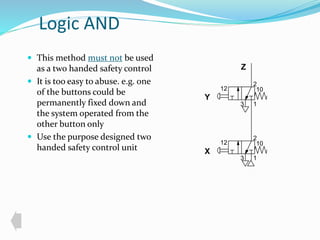
Logic AND 
 This method must not be used 
as a two handed safety control 
 It is too easy to abuse. e.g. one 
of the buttons could be 
permanently fixed down and 
the system operated from the 
other button only 
 Use the purpose designed two 
handed safety control unit 
2 
12 10 
1 
3 
2 
12 10 
1 
3 
Y 
X 
Z
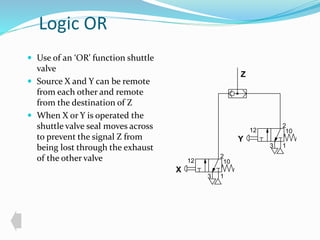
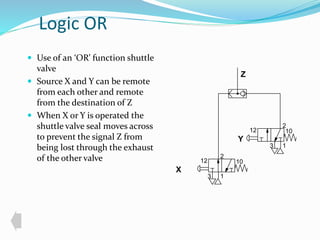
Logic OR 
 Use of an ‘OR’ function shuttle 
valve 
 Source X and Y can be remote 
from each other and remote 
from the destination of Z 
 When X or Y is operated the 
shuttle valve seal moves across 
to prevent the signal Z from 
being lost through the exhaust 
of the other valve 
X 
Z 
Y 
2 
12 10 
1 
3 
2 
12 10 
1 
3
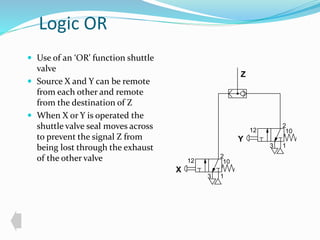
Logic OR 
 Use of an ‘OR’ function shuttle 
valve 
 Source X and Y can be remote 
from each other and remote 
from the destination of Z 
 When X or Y is operated the 
shuttle valve seal moves across 
to prevent the signal Z from 
being lost through the exhaust 
of the other valve 
X 
Z 
Y 
2 
12 10 
1 
3 
2 
12 10 
1 
3
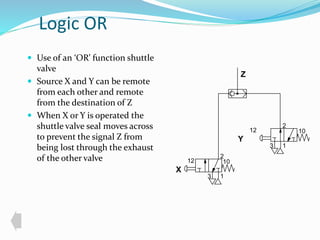
Logic OR 
 Use of an ‘OR’ function shuttle 
valve 
 Source X and Y can be remote 
from each other and remote 
from the destination of Z 
 When X or Y is operated the 
shuttle valve seal moves across 
to prevent the signal Z from 
being lost through the exhaust 
of the other valve 
X 
Z 
Y 
2 
12 10 
1 
3 
2 
12 10 
1 
3
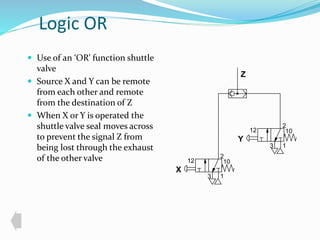
Logic OR 
 Use of an ‘OR’ function shuttle 
valve 
 Source X and Y can be remote 
from each other and remote 
from the destination of Z 
 When X or Y is operated the 
shuttle valve seal moves across 
to prevent the signal Z from 
being lost through the exhaust 
of the other valve 
X 
Z 
Y 
2 
12 10 
1 
3 
2 
12 10 
1 
3
Logic OR 
 Use of an ‘OR’ function shuttle 
valve 
 Source X and Y can be remote 
from each other and remote 
from the destination of Z 
 When X or Y is operated the 
shuttle valve seal moves across 
to prevent the signal Z from 
being lost through the exhaust 
of the other valve 
X 
Z 
Y 
2 
12 10 
1 
3 
2 
12 10 
1 
3
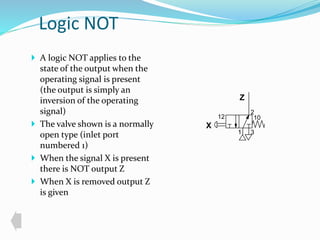
Logic NOT 
 A logic NOT applies to the 
state of the output when the 
operating signal is present 
(the output is simply an 
inversion of the operating 
signal) 
 The valve shown is a normally 
open type (inlet port 
numbered 1) 
 When the signal X is present 
there is NOT output Z 
 When X is removed output Z 
is given 
2 
Z 
12 10 
1 3 
X
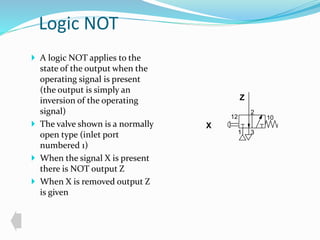
Logic NOT 
 A logic NOT applies to the 
state of the output when the 
operating signal is present 
(the output is simply an 
inversion of the operating 
signal) 
 The valve shown is a normally 
open type (inlet port 
numbered 1) 
 When the signal X is present 
there is NOT output Z 
 When X is removed output Z 
is given 
2 
Z 
12 10 
1 3 
X
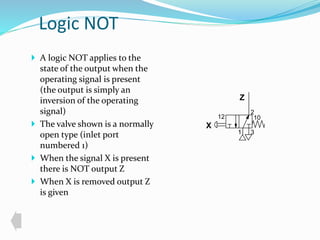
Logic NOT 
 A logic NOT applies to the 
state of the output when the 
operating signal is present 
(the output is simply an 
inversion of the operating 
signal) 
 The valve shown is a normally 
open type (inlet port 
numbered 1) 
 When the signal X is present 
there is NOT output Z 
 When X is removed output Z 
is given 
2 
Z 
12 10 
1 3 
X
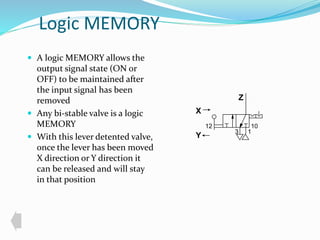
Logic MEMORY 
 A logic MEMORY allows the 
output signal state (ON or 
OFF) to be maintained after 
the input signal has been 
removed 
 Any bi-stable valve is a logic 
MEMORY 
 With this lever detented valve, 
once the lever has been moved 
X direction or Y direction it 
can be released and will stay 
in that position 
Z 
X 
10 
3 1 
Y 
12
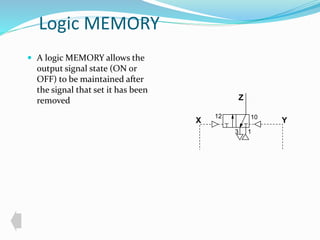
Logic MEMORY 
 A logic MEMORY allows the 
output signal state (ON or 
OFF) to be maintained after 
the signal that set it has been 
removed Z 
X 
12 10 Y 
3 1
Logic MEMORY 
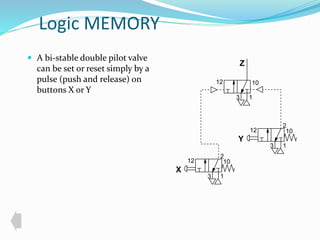
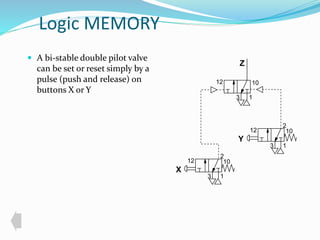
 A bi-stable double pilot valve 
can be set or reset simply by a 
pulse (push and release) on 
buttons X or Y 
Z 
3 1 
X 
Y 
2 
12 10 
1 
3 
2 
12 10 
1 
3 
12 10
Logic MEMORY 
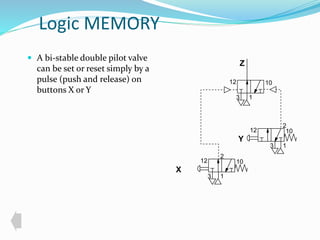
 A bi-stable double pilot valve 
can be set or reset simply by a 
pulse (push and release) on 
buttons X or Y 
Z 
3 1 
X 
Y 
2 
12 10 
1 
3 
2 
12 10 
1 
3 
12 10
Logic MEMORY 
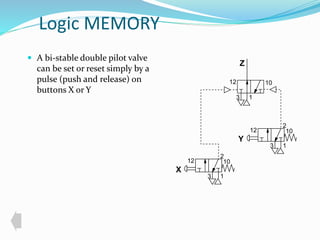
 A bi-stable double pilot valve 
can be set or reset simply by a 
pulse (push and release) on 
buttons X or Y 
Z 
3 1 
X 
Y 
2 
12 10 
1 
3 
2 
12 10 
1 
3 
12 10
Logic MEMORY 
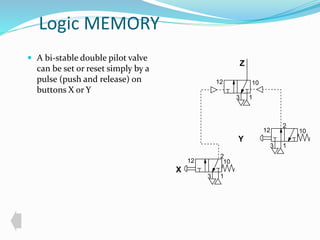
 A bi-stable double pilot valve 
can be set or reset simply by a 
pulse (push and release) on 
buttons X or Y 
Z 
3 1 
X 
Y 
2 
12 10 
1 
3 
2 
12 10 
1 
3 
12 10
Logic MEMORY 
 A bi-stable double pilot valve 
can be set or reset simply by a 
pulse (push and release) on 
buttons X or Y 
Z 
3 1 
X 
Y 
2 
12 10 
1 
3 
2 
12 10 
1 
3 
12 10
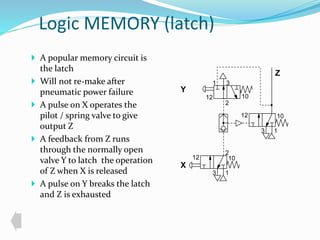
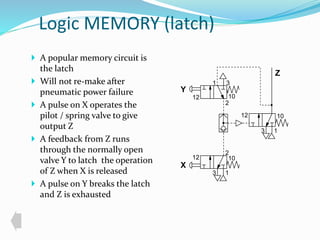
Logic MEMORY (latch) 
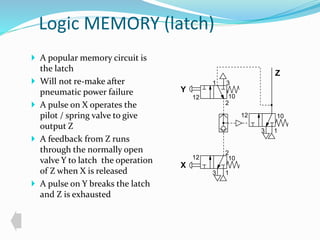
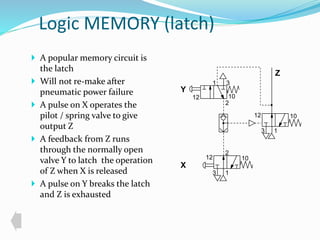
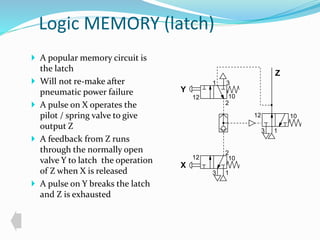
 A popular memory circuit is 
the latch 
 Will not re-make after 
pneumatic power failure 
 A pulse on X operates the 
pilot / spring valve to give 
output Z 
 A feedback from Z runs 
through the normally open 
valve Y to latch the operation 
of Z when X is released 
 A pulse on Y breaks the latch 
and Z is exhausted 
Y 
X 
Z 
3 1 
2 
12 10 
1 
3 
12 10 
3 
2 
1 
12 10
Logic MEMORY (latch) 
 A popular memory circuit is 
the latch 
 Will not re-make after 
pneumatic power failure 
 A pulse on X operates the 
pilot / spring valve to give 
output Z 
 A feedback from Z runs 
through the normally open 
valve Y to latch the operation 
of Z when X is released 
 A pulse on Y breaks the latch 
and Z is exhausted 
Y 
X 
Z 
3 1 
2 
12 10 
1 
3 
12 10 
3 
2 
1 
12 10
Logic MEMORY (latch) 
 A popular memory circuit is 
the latch 
 Will not re-make after 
pneumatic power failure 
 A pulse on X operates the 
pilot / spring valve to give 
output Z 
 A feedback from Z runs 
through the normally open 
valve Y to latch the operation 
of Z when X is released 
 A pulse on Y breaks the latch 
and Z is exhausted 
Y 
X 
Z 
3 1 
2 
12 10 
1 
3 
12 10 
3 
2 
1 
12 10
Logic MEMORY (latch) 
 A popular memory circuit is 
the latch 
 Will not re-make after 
pneumatic power failure 
 A pulse on X operates the 
pilot / spring valve to give 
output Z 
 A feedback from Z runs 
through the normally open 
valve Y to latch the operation 
of Z when X is released 
 A pulse on Y breaks the latch 
and Z is exhausted 
Y 
X 
Z 
3 1 
2 
12 10 
1 
3 
3 
2 
1 
12 10 
12 10
Logic MEMORY (latch) 
 A popular memory circuit is 
the latch 
 Will not re-make after 
pneumatic power failure 
 A pulse on X operates the 
pilot / spring valve to give 
output Z 
 A feedback from Z runs 
through the normally open 
valve Y to latch the operation 
of Z when X is released 
 A pulse on Y breaks the latch 
and Z is exhausted 
Y 
X 
Z 
3 1 
2 
12 10 
1 
3 
3 
2 
1 
12 10 
12 10
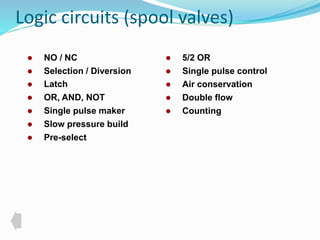
Logic circuits (spool valves) 
 NO / NC  5/2 OR 
 Selection / Diversion 
 Latch 
 OR, AND, NOT 
 Single pulse maker 
 Slow pressure build 
 Pre-select 
 Single pulse control 
 Air conservation 
 Double flow 
 Counting
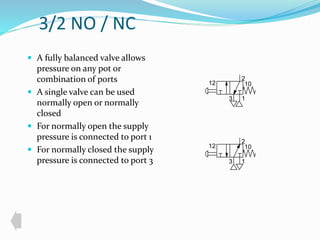
3/2 NO / NC 
 A fully balanced valve allows 
pressure on any pot or 
combination of ports 
 A single valve can be used 
normally open or normally 
closed 
 For normally open the supply 
pressure is connected to port 1 
 For normally closed the supply 
pressure is connected to port 3 
2 
12 10 
1 
3 
2 
12 10 
3 1
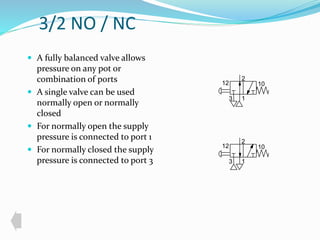
3/2 NO / NC 
 A fully balanced valve allows 
pressure on any pot or 
combination of ports 
 A single valve can be used 
normally open or normally 
closed 
 For normally open the supply 
pressure is connected to port 1 
 For normally closed the supply 
pressure is connected to port 3 
2 
12 10 
1 
3 
2 
12 10 
3 1
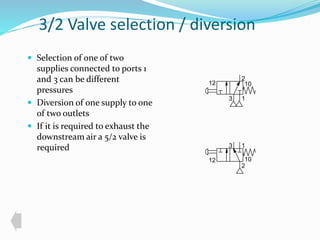
3/2 Valve selection / diversion 
 Selection of one of two 
supplies connected to ports 1 
and 3 can be different 
pressures 
 Diversion of one supply to one 
of two outlets 
 If it is required to exhaust the 
downstream air a 5/2 valve is 
required 
2 
12 10 
1 
3 
3 1 
12 10 
2
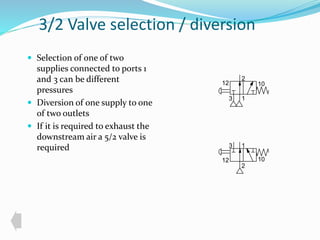
3/2 Valve selection / diversion 
 Selection of one of two 
supplies connected to ports 1 
and 3 can be different 
pressures 
 Diversion of one supply to one 
of two outlets 
 If it is required to exhaust the 
downstream air a 5/2 valve is 
required 
2 
12 10 
1 
3 
3 1 
12 10 
2
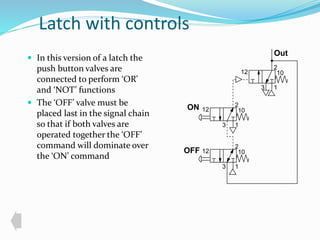
Latch with controls 
 In this version of a latch the 
push button valves are 
connected to perform ‘OR’ 
and ‘NOT’ functions 
 The ‘OFF’ valve must be 
placed last in the signal chain 
so that if both valves are 
operated together the ‘OFF’ 
command will dominate over 
the ‘ON’ command 
2 
12 10 
1 
3 
2 
12 10 
3 1 
2 
12 10 
3 1 
ON 
OFF 
Out
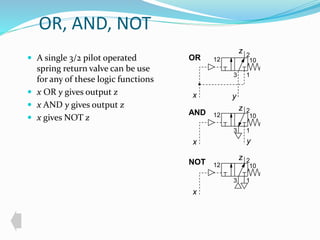
OR, AND, NOT 
 A single 3/2 pilot operated 
spring return valve can be use 
for any of these logic functions 
 x OR y gives output z 
 x AND y gives output z 
 x gives NOT z 
2 
12 10 
1 
3 
2 
x y 
z 
12 10 
1 
3 
2 
12 10 
1 
3 
OR 
AND 
NOT 
z 
x y 
x 
z
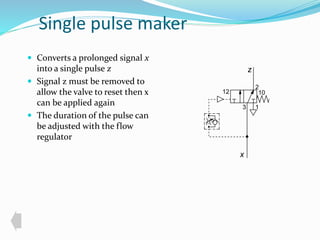
Single pulse maker 
 Converts a prolonged signal x 
into a single pulse z 
 Signal z must be removed to 
allow the valve to reset then x 
can be applied again 
 The duration of the pulse can 
be adjusted with the flow 
regulator 
2 
12 10 
1 
3 
x 
z
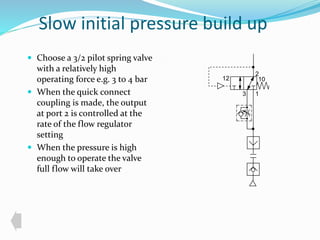
Slow initial pressure build up 
 Choose a 3/2 pilot spring valve 
with a relatively high 
operating force e.g. 3 to 4 bar 
 When the quick connect 
coupling is made, the output 
at port 2 is controlled at the 
rate of the flow regulator 
setting 
 When the pressure is high 
enough to operate the valve 
full flow will take over 
2 
12 10 
1 
3
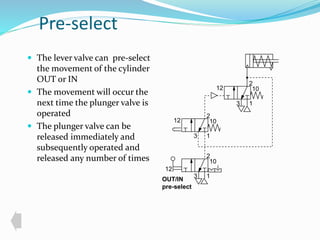
Pre-select 
 The lever valve can pre-select 
the movement of the cylinder 
OUT or IN 
 The movement will occur the 
next time the plunger valve is 
operated 
 The plunger valve can be 
released immediately and 
subsequently operated and 
released any number of times 
2 
12 10 
12 10 
1 
3 
2 
1 
3 
2 
1 
3 
12 
10 
OUT/IN 
pre-select
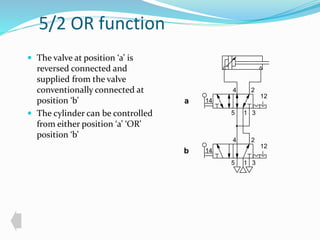
5/2 OR function 
 The valve at position ‘a’ is 
reversed connected and 
supplied from the valve 
conventionally connected at 
position ‘b’ 
 The cylinder can be controlled 
from either position ‘a’ ‘OR’ 
position ‘b’ 
4 2 
5 1 
3 
14 
12 
4 2 
5 1 
3 
14 
12 
a 
b
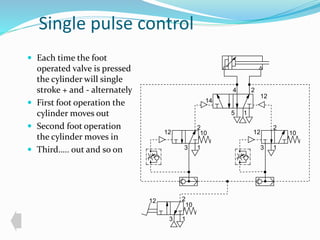
Single pulse control 
 Each time the foot 
operated valve is pressed 
the cylinder will single 
stroke + and - alternately 
 First foot operation the 
cylinder moves out 
 Second foot operation 
the cylinder moves in 
 Third….. out and so on 
4 2 
14 
12 
2 
12 10 
1 
3 
5 1 
2 
12 10 
1 
3 
2 
3 1 
12 
10
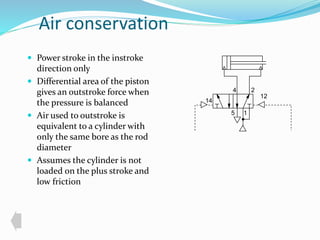
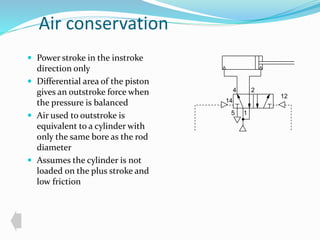
Air conservation 
 Power stroke in the instroke 
direction only 
 Differential area of the piston 
gives an outstroke force when 
the pressure is balanced 
 Air used to outstroke is 
equivalent to a cylinder with 
only the same bore as the rod 
diameter 
 Assumes the cylinder is not 
loaded on the plus stroke and 
low friction 
4 2 
5 1 
14 
12
Air conservation 
 Power stroke in the instroke 
direction only 
 Differential area of the piston 
gives an outstroke force when 
the pressure is balanced 
 Air used to outstroke is 
equivalent to a cylinder with 
only the same bore as the rod 
diameter 
 Assumes the cylinder is not 
loaded on the plus stroke and 
low friction 
4 2 
14 
5 1 
12
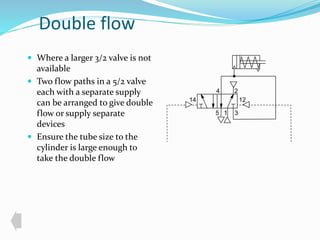
Double flow 
 Where a larger 3/2 valve is not 
available 
 Two flow paths in a 5/2 valve 
each with a separate supply 
can be arranged to give double 
flow or supply separate 
devices 
 Ensure the tube size to the 
cylinder is large enough to 
take the double flow 
4 2 
14 12 
1 
3 
5
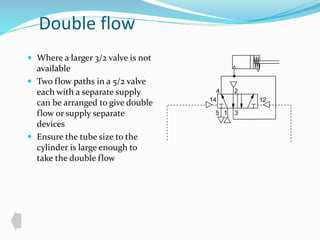
Double flow 
 Where a larger 3/2 valve is not 
available 
 Two flow paths in a 5/2 valve 
each with a separate supply 
can be arranged to give double 
flow or supply separate 
devices 
 Ensure the tube size to the 
cylinder is large enough to 
take the double flow 
4 2 
14 12 
1 3 
5
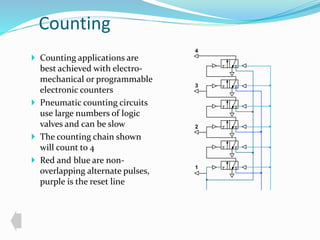
Counting 
 Counting applications are 
best achieved with electro-mechanical 
or programmable 
electronic counters 
 Pneumatic counting circuits 
use large numbers of logic 
valves and can be slow 
 The counting chain shown 
will count to 4 
 Red and blue are non-overlapping 
alternate pulses, 
purple is the reset line 
4 
3 
2 
1
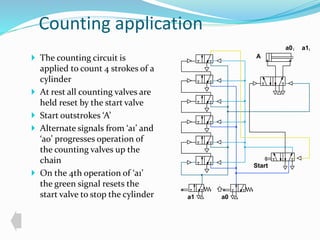
Counting application 
 The counting circuit is 
applied to count 4 strokes of a 
cylinder 
 At rest all counting valves are 
held reset by the start valve 
 Start outstrokes ‘A’ 
 Alternate signals from ‘a1’ and 
‘a0’ progresses operation of 
the counting valves up the 
chain 
 On the 4th operation of ‘a1’ 
the green signal resets the 
start valve to stop the cylinder 
A 
a1 a0 
a0 a1 
Start
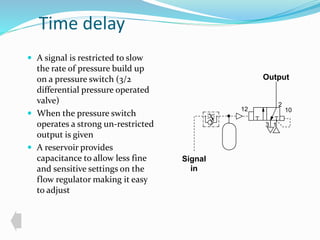
Time delay 
 A signal is restricted to slow 
the rate of pressure build up 
on a pressure switch (3/2 
differential pressure operated 
valve) 
 When the pressure switch 
operates a strong un-restricted 
output is given 
 A reservoir provides 
capacitance to allow less fine 
and sensitive settings on the 
flow regulator making it easy 
to adjust 
12 10 
1 
2 
3 
Signal 
in 
Output
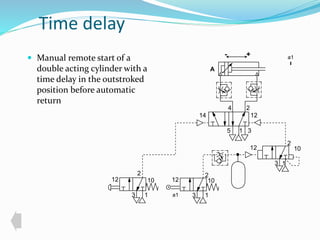
Time delay 
 Manual remote start of a 
double acting cylinder with a 
time delay in the outstroked 
position before automatic 
return 
2 
4 2 
14 12 
5 1 
3 
12 10 
3 1 
- + 
A 
a1 
2 
12 10 
1 
3 
a1 
12 10 
1 
2 
3
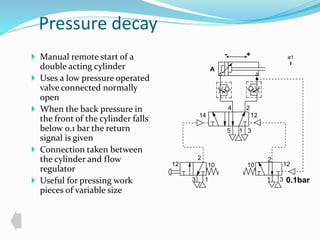
Pressure decay 
 Manual remote start of a 
double acting cylinder 
 Uses a low pressure operated 
valve connected normally 
open 
 When the back pressure in 
the front of the cylinder falls 
below 0.1 bar the return 
signal is given 
 Connection taken between 
the cylinder and flow 
regulator 
 Useful for pressing work 
pieces of variable size 
4 2 
14 12 
5 1 
3 
2 
12 10 
3 1 
- + 
A 
a1 
2 
10 12 
1 3 0.1bar
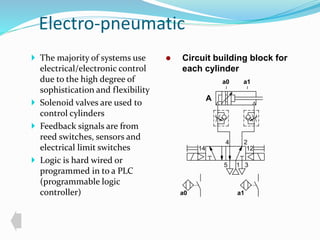
Electro-pneumatic 
 The majority of systems use 
electrical/electronic control 
due to the high degree of 
sophistication and flexibility 
 Solenoid valves are used to 
control cylinders 
 Feedback signals are from 
reed switches, sensors and 
electrical limit switches 
 Logic is hard wired or 
 Circuit building block for 
each cylinder 
a0 a1 
4 2 
A 
14 12 
5 1 
3 
programmed in to a PLC 
(programmable logic 
controller) a0 a1
Basic pneumatic circuit

Basic pneumatic circuit

  • 1.
    For control andautomation J.Majumder C.Engg M.I.E
  • 2.
    Contents  Symbols  Circuit layout  Actuator control 2/2 Valve  Actuator control 3/2 Valve  Actuator control 5/2 Valve  Sequential control  Sequence solution  5/3 Valves  Poppet/spool logic  Balanced spool logic  Feedback  Introduction
  • 3.
    Introduction  Thismodule shows the methods of application of pneumatic valves and components for control and automation  The methods of pure pneumatic sequential control are confined to simple examples  The majority of modern systems are controlled electronically and is the subject of electro-pneumatic modules  A message to pneumatic circuit designers:  Use proven and reliable design techniques  Produce circuits and documentation that are clear to read  Design for safety  Do not try to be too clever, the circuit will be difficult for others to read and maintain
  • 4.
    Symbols  Thestandard for fluid power symbols is ISO 1219-1. This is a set of basic shapes and rules for the construction of fluid power symbols  Cylinders can be drawn to show their extreme or intermediate positions of stroke and any length above their width  Valves show all states in the one symbol. The prevailing state is shown with the port connections  Other components are single state symbols
  • 5.
    Symbols single actingactuators  Single acting, sprung instroked  Single acting, sprung outstroked  Single acting, sprung instroked, magnetic  Single acting, sprung outstroked, magnetic
  • 6.
    Symbols double actingactuators  Double acting, non-cushioned  Double acting, adjustable cushions  Double acting, through rod, adjustable cushions  Double acting, magnetic, adjustable cushions  Double acting, rodless, magnetic, adjustable cushions
  • 7.
    Symbols rotary actuators  Semi-rotary double acting  Rotary motor single direction of rotation  Rotary motor bi-directional
  • 8.
    Symbols valves 2/2 Valve push button / spring  3/2 Valve push button / spring  3/2 Valve detented lever operated 2 12 10 3 1 2 12 10 1 2 1 3 12 10
  • 9.
    Symbols valves 3/2 Valve differential pressure operated  5/2 Valve push button / spring  5/3 Valve double pressure operated spring centre 4 2 14 12 5 1 3 2 12 10 4 2 5 1 3 1 3
  • 10.
    Symbols valves A valve function is known by a pair of numbers e.g. 3/2. This indicates the valve has 3 main ports and 2 states  The valve symbol shows both of the states  Port numbering is to CETOP RP68P and shows: ◦ when the valve is operated at the 12 end port 1 is connected to port 2 ◦ when reset to the normal state at the 10 end port 1 is connected to nothing (0) 2 12 10 3 1
  • 11.
    Symbols valves A valve function is known by a pair of numbers e.g. 3/2. This indicates the valve has 3 main ports and 2 states  The valve symbol shows both of the states  Port numbering is to CETOP RP68P and shows: ◦ when the valve is operated at the 12 end port 1 is connected to port 2 ◦ when reset to the normal state at the 10 end port 1 is connected to nothing (0) 2 12 10 3 1
  • 12.
    Symbols valves This example is for a 5/2 valve  This has 5 main ports and 2 states  When the valve is operated at the 14 end port 1 is connected to port 4 (also port 2 is connected to port 3)  When reset to the normal state at the 12 end port 1 is connected to port 2 (also port 4 is connected to port 5) 4 2 14 12 5 1 3
  • 13.
    Symbols valves This example is for a 5/2 valve  This has 5 main ports and 2 states  When the valve is operated at the 14 end port 1 is connected to port 4 (also port 2 is connected to port 3)  When reset to the normal state at the 12 end port 1 is connected to port 2 (also port 4 is connected to port 5) 4 2 14 12 5 1 3
  • 14.
    Symbols operators manual General manual Push button Pull button Push/pull button Lever Pedal Treadle Rotary knob
  • 15.
    Symbols operators mechanical Plunger Spring normally as a return Roller Uni-direction or one way trip Pressure Pilot pressure Differential pressure Detent in 3 positions
  • 16.
    Symbols 5/3 valves  All valves types shown in the normal position  Type 1. All ports blocked  Type 2. Outlets to exhaust  Type 3. Supply to outlets
  • 17.
    Symbols function components  Non-return valve  Flow regulator uni-directional  Flow regulator bi-directional  Two pressure ‘AND’  Shuttle valve ‘OR’  Silencer  Quick exhaust valve with silencer  Pressure to electric switch adjustable * Note: Traditional symbol in extensive use (preferred) * ISO 1219-1 Old
  • 18.
    Symbols air lineequipment  Water separator with automatic drain  Filter with manual drain  Filter with automatic drain  Filter with automatic drain and service indicator  Lubricator  Pressure regulator with gauge  F.R.L. filter, regulator, lubricator simplified symbol
  • 19.
    Circuit layout The standard for circuit diagrams is ISO 1219-2  A4 format or A3 folded to A4 height for inclusion in a manual with other A4 documentation  To be on several sheets if necessary with line identification code  Minimum crossing lines  Limit valves position of operation by actuators shown by a marker with reference code to symbol  Circuits should be drawn with all actuators at the top of the page in order of sequential operation  Other components to be drawn in sequential order from the bottom up and from left to right  Circuit should show the system with pressure applied and ready to start
  • 20.
    Component identification The ISO suggested component numbering system is suited for large circuits and those drawn on several pages  For this presentation a simple code is used  For cylinders: A,B,C etc.  For associated feedback valves: alpha-numeric code ‘a0’ for proof of instroke, ‘a1’ for proof of outstroke  For cylinder B: b0 and b1  Note: the a0 valve symbol is drawn in the operated position because the actuator A is instroked A a0 a1 2 12 10 1 3 a0 2 12 10 3 1 a1
  • 21.
    Example circuit A Run/End a0 a1 B b0 b1 C c0 c1 a0 a1 b1 b0 c1 c0 10 bar max 6 bar To all inlet ports marked Sequence Run/End A+ B+ B-C+ C-A-Repeat
  • 23.
    2/2 Valve actuatorcontrol  A pair of the most basic of all valve types the 2/2 can be used to control a single acting cylinder  The normally closed position of the valve is produced by the spring  The operated position is produced by the push button  One valve admits air the other valve exhausts it 2 12 10 1 1 12 10 2 OUT IN
  • 24.
    2/2 Valve actuatorcontrol  The button marked OUT is pushed to operate the valve  Air is connected to the cylinder and it outstrokes  Air cannot escape to atmosphere through the valve marked IN as this is closed  The air at atmospheric pressure in the front of the cylinder vents through the breather port 2 10 1 12 1 12 10 2 OUT IN
  • 25.
    2/2 Valve actuatorcontrol  The push button of the valve marked OUT is released and it returns to a normal closed position  Air is now trapped in the system and provided there are no leaks the piston rod will stay in the outstroked position  If the load increases beyond the force exerted by the air the piston rod will start to move in 2 10 1 12 1 12 10 2 OUT IN
  • 26.
    2/2 Valve actuatorcontrol  The button marked IN is pushed to operate the valve  Air escapes and the piston rod moves to the instroked position  The push button must be held operated until the piston rod is fully in  Atmospheric air will be drawn in to the front of the cylinder through the vent port 2 10 1 12 1 12 10 2 OUT IN
  • 27.
    2/2 Valve actuatorcontrol  If the button marked IN is released the piston rod will remain in the instroked position  Any leaks in the installation can cause the piston rod to creep 2 10 1 12 1 12 10 2 OUT IN
  • 28.
    2/2 Valve actuatorcontrol  To control the speed of the piston rod, flow restrictors are placed in the pipes close to each of the valves.  Adjustment of the restrictors will slow down the flow rate thereby giving independent outstroke and instroke speed control 2 12 10 12 10 1 OUT IN 1 2
  • 29.
    2/2 Valve actuatorcontrol  By repeated operation of either button during movement the piston rod can be moved in small steps for approximate positioning  This will only be successful under slow speeds 2 12 10 12 10 1 OUT IN 1 2
  • 30.
    2/2 Valve actuatorcontrol  With any compressed air system that intentionally traps air, the potential hazard of this must be recognised  Unintended release or application of pressure can give rise to unexpected movement of the piston rod  A pressure indicator or gauge must be fitted to warn of the presence of pressure 2 10 1 12 1 12 10 2 OUT IN
  • 32.
    3/2 valve actuatorcontrol  A 3 port valve provides the inlet and exhaust path and is the normal choice for the control of a single acting cylinder  In the normal position produced by the spring, the valve is closed  In the operated position produced by the push button the valve is open  The push button must be held down for as long as the cylinder is outstroked 2 12 10 1 3
  • 33.
    3/2 valve actuatorcontrol  A 3 port valve provides the inlet and exhaust path and is the normal choice for the control of a single acting cylinder  In the normal position produced by the spring, the valve is closed  In the operated position produced by the push button the valve is open  The push button must be held down for as long as the cylinder is outstroked 2 12 10 1 3
  • 34.
    3/2 valve actuatorcontrol  A 3 port valve provides the inlet and exhaust path and is the normal choice for the control of a single acting cylinder  In the normal position produced by the spring, the valve is closed  In the operated position produced by the push button the valve is open  The push button must be held down for as long as the cylinder is outstroked 2 12 10 1 3
  • 35.
    3/2 valve actuatorcontrol  To generally slow the cylinder speed an adjustable bi-directional flow regulator or fixed restrictor can be used  The flow regulator setting will be a compromise as the ideal outstroke speed may not produce the desired results for the instroke speed 2 12 10 1 3
  • 36.
    3/2 valve actuatorcontrol  To control the outstroke speed of a single acting cylinder without controlling the instroke speed, a uni-directional flow regulator is used  The flow into the cylinder closes the non return valve and can only pass through the adjustable restrictor  By adjusting the restrictor the outstroke speed of the cylinder can be set 2 12 10 1 3
  • 37.
    3/2 valve actuatorcontrol  For independent speed control in each direction two flow regulators are required  Installed in opposite directions to each other  Upper regulator controls the outstroke speed  Lower regulator controls the instroking speed 2 12 10 1 3
  • 38.
    3/2 valve actuatorcontrol  A 3 port valve provides the inlet and exhaust path and is the normal choice for the control of a single acting cylinder  In the normal position produced by the spring, the valve is closed  In the operated position produced by the push button the valve is open  The push button must be held down for as long as the cylinder is outstroked 2 12 10 1 3
  • 40.
    5/2 Valve actuatorcontrol  For a double acting cylinder the power and exhaust paths are switched simultaneously  When the button is pushed the supply at port 1 is connected to port 4 and the outlet port 2 connected to exhaust port 3. The cylinder moves plus  When the button is released port 1 is connected to port 2 and port 4 connected to port 5. Cylinder minus - + 4 2 14 12 5 1 3
  • 41.
    5/2 Valve actuatorcontrol  For a double acting cylinder the power and exhaust paths are switched simultaneously  When the button is pushed the supply at port 1 is connected to port 4 and the outlet port 2 connected to exhaust port 3. The cylinder moves plus  When the button is released port 1 is connected to port 2 and port 4 connected to port 5. Cylinder minus - + 4 2 14 12 5 1 3
  • 42.
    5/2 Valve actuatorcontrol  Independent speed control of the plus and minus movements  In most applications speed is controlled by restricting air out of a cylinder  Full power is developed to drive the piston with speed controlled by restricting the back pressure - + 4 2 14 12 5 1 3
  • 43.
    5/2 Valve actuatorcontrol  Independent speed control of the plus and minus movements  In most applications speed is controlled by restricting air out of a cylinder  Full power is developed to drive the piston with speed controlled by restricting the back pressure - + 4 2 14 12 5 1 3
  • 44.
    5/2 Valve actuatorcontrol  Valves with a spring return are mono-stable and need the operator to be held all the time that the cylinder is required in the plus position  Bi-stable valves will stay in the position they were last set  The lever valve example illustrated indicates a detent mechanism. The lever need not be held once the new position has been established - + 4 2 14 12 5 1 3
  • 45.
    Manual control Remote manual control of a double acting cylinder  Valve marked + will cause the cylinder to outstroke or move plus  Valve marked - will cause the cylinder to instroke or move minus  The 5/2 double pilot valve is bi-stable therefore the push button valves only need to be pulsed - + 4 2 14 12 5 1 3 2 12 10 1 3 2 12 10 1 3 + -
  • 46.
    Manual control Remote manual control of a double acting cylinder  Valve marked + will cause the cylinder to outstroke or move plus  Valve marked - will cause the cylinder to instroke or move minus  The 5/2 double pilot valve is bi-stable therefore the push button valves only need to be pulsed - + 4 2 14 12 5 1 3 2 12 10 1 3 2 12 10 1 3 + -
  • 47.
    Manual control Remote manual control of a double acting cylinder  Valve marked + will cause the cylinder to outstroke or move plus  Valve marked - will cause the cylinder to instroke or move minus  The 5/2 double pilot valve is bi-stable therefore the push button valves only need to be pulsed - + 4 2 14 12 5 1 3 2 12 10 1 3 2 12 10 1 3 + -
  • 48.
    Manual control Remote manual control of a double acting cylinder  Valve marked + will cause the cylinder to outstroke or move plus  Valve marked - will cause the cylinder to instroke or move minus  The 5/2 double pilot valve is bi-stable therefore the push button valves only need to be pulsed - + 4 2 14 12 5 1 3 2 12 10 1 3 2 12 10 1 3 + -
  • 49.
    Manual control Remote manual control of a double acting cylinder  Valve marked + will cause the cylinder to outstroke or move plus  Valve marked - will cause the cylinder to instroke or move minus  The 5/2 double pilot valve is bi-stable therefore the push button valves only need to be pulsed - + 4 2 14 12 5 1 3 2 12 10 1 3 2 12 10 1 3 + -
  • 50.
    Semi-automatic control Manual remote start of a double acting cylinder with automatic return  Cylinder identified as “A”  Trip valve operated at the completion of the plus stroke identified as “a1” - + 4 2 A 14 12 5 1 3 2 12 10 1 3 2 12 10 1 3 + - a1 a1
  • 51.
    Fully-automatic control Continuous automatic cycling from roller operated trip valves  Manual Run and End of the automatic cycling  Cylinder will come to rest in the instroked position regardless of when the valve is put to End  Tags for the roller feedback valves a0 and a1 show their relative positions 4 2 14 12 5 1 3 2 12 10 3 1 2 2 12 10 1 3 1 3 12 10 Run/End - + A a0 a1 a0 a1
  • 53.
    Circuit building blocks Run/End a0 a1 b0 b1 A B  These circuits can be considered as building blocks for larger sequential circuits consisting of two or more cylinders  Each actuator will have a power valve and two associated feedback valves. The first actuator to move also has a Run/End valve
  • 54.
    Repeat pattern sequence  A repeat pattern sequence is one where the order of the movements in the first half of the sequence is repeated in the second half  Each actuator may have one Out and In stroke only in the sequence  There may be any number of actuators in the sequence  The signal starting the first movement must pass through the Run/End valve  Needs only the basic building blocks to solve  Examples of repeat pattern sequences:  A+ B+ C+ D+ A- B- C- D-  A- B+ C- A+ B- C+  C+ A+ B- C- A- B+
  • 55.
    Repeat pattern sequence Run/End A B b0 b1 a1 a0  The two cylinders A and B are to perform a simple repeat pattern sequence as follows: A+ B+ A- B-  Apply the rule “The signal given by the completion of each movement will initiate the next movement”  In this way the roller valves can be identified and labelled a0 a1 b0 b1
  • 56.
    Repeat pattern sequence Run/End A c0 c1 a0 a1 B b0 b1 a1 a0  For three cylinders A, B and C also to perform a simple repeat pattern sequence as follows: A+ B+ C+ A- B- C-  Apply the rule “The signal given by the completion of each movement will initiate the next movement” C c0 c1 b1 b0
  • 57.
    Non-repeat pattern sequence End a0 a1 b0 b1 A B a0 b0 a1 b1  If the rule applied to a repeat pattern sequence is applied to any other sequence there will be opposed signals on one or more of the 5/2 valves preventing operation  This circuit demonstrates the problem  The sequence is A+ B+ B- A-Run/
  • 58.
    Opposed signals End a0 a1 b0 b1 A B a0 b0 a1 b1  When the valve is set to Run, cylinder A will not move because the 5/2 valve has an opposed signal, it is still being signalled to hold position by the feedback valve b0  If A was able to move + a similar problem will occur for the 5/2 valve of B once it was +  The sequence is A+ B+ B- A-Run/
  • 59.
    Mechanical solution Run/End a0 a1 b0 b1 A B a0 b0 a1 b1  The problem was caused by valves b0 and a1 being operated at the time the new opposing instruction is given  If these two valves were “one way trip” types and over tripped at the last movement of stroke, only a pulse would be obtained instead of a continuous signal
  • 60.
    Sequence solution methods  The main solutions to solving sequences are:  Cascade (pneumatic)  Shift register (pneumatic)  Electro-pneumatic  PLC (Programmable logic controller)  Cascade circuits provide a standard method of solving any sequence. It uses a minimum of additional logic hardware (one logic valve per group of sequential steps)  Shift register circuits are similar to cascade but use one logic valve for every step  Electro-pneumatic circuits use solenoid valves and electro-mechanical relays  PLC. The standard solution for medium to complex sequential systems (except where electrical equipment cannot be used)
  • 61.
    Cascade two group  The A+ B+ B- A- circuit is solved by the two group cascade method  The sequence is divided at the point where B immediately returns  The two parts are allocated groups l and ll  Gp l A+ B+ / Gp ll B- A-  Two signal supplies are provided from a 5/2 valve one is available only in group l the other is available only in group ll  Because only one group output is available at a time it is not possible to have opposed signals  A standard 5/2 double pressure operated valve is the cascade valve Group l Group ll 4 2 14 12 Select l 5 1 3 Select ll
  • 62.
    Cascade (two group) a0 a1 b0 b1 A B a1 b0 Run/End a0 b1 Sequence Gp l A+ B+ Gp ll B- A-Gp l Gp ll
  • 63.
    Cascade (two group) a0 a1 b0 b1 A B a1 b0 Run/End a0 b1 Sequence Gp l A+ B+ Gp ll B- A-Gp l Gp ll
  • 64.
    Cascade (two group) a0 a1 b0 b1 A B b0 Run/End a1 a0 b1 Sequence Gp l A+ B+ Gp ll B- A-Gp l Gp ll
  • 65.
    Cascade (two group) a0 a1 b0 b1 A B b0 Run/End a1 a0 b1 Sequence Gp l A+ B+ Gp ll B- A-Gp l Gp ll
  • 66.
    Cascade (two group) a0 a1 b0 b1 A B Run/End a1 a0 Sequence Gp l A+ B+ Gp ll B- A-Gp l Gp ll b0 b1
  • 67.
    Cascade (two group) a0 a1 b0 b1 A B Run/End Sequence Gp l A+ B+ Gp ll B- A-Gp l Gp ll b0 b1 a1 a0
  • 68.
    Cascade building blocks  A two group building block consists of a lever valve to run and end the sequence plus the 5/2 double pilot operated cascade valve  For a two group system consisting of any number of cylinders this building block and the cylinder building blocks are all that is required to solve the sequence 4 2 14 12 5 1 3 Run/End Sel ll 2 1 3 12 10 Gp l Gp ll Sel l
  • 69.
    Cascade building blocks  This three group building block establishes an interconnecting pattern that can be extended to any number of groups Gp l Gp ll Run/End Sel l Sel ll Gp lll Sel lll
  • 70.
    Dual trip buildingblocks  When a sequence has a cylinder operating twice in one overall sequence a dual trip building block may be required for each of the two feedback valves  The supply will be from different groups and the output go to different destinations  Example is for feedback valve a1 of cylinder A when A is sent + both in Group x and Group y Send A+ A+ in Group x A+ in Group y a1 a1 in x a1 in y Note: can often be rationalised to less than these three components
  • 71.
    Cascade rules Establish the correct sequence  Divide the sequence in to groups. Always start a sequence with the Run/End valve selecting group l e.g. R/E | A+ B+ | B- C+ | C- A-  Select the cylinder building blocks  Select the cascade building block  Select dual trip building blocks if required  Interconnect the blocks as follows:  The first function in each group is signalled directly by that group supply  The last trip valve operated in each group is supplied with main supply air and selects the next group  The remaining trip valves are supplied with air from their respective groups and initiate the next function  The “run/end” valve will control the signal from the last trip valve to be operated
  • 73.
    5/3 Valve 5/3 valves have a third mid position  The valve can be tri-stable e.g. a detented lever operator or mono-stable e.g. a double air or double solenoid with spring centre  There are three common configurations for the mid position:  All ports blocked  Centre open exhaust  Centre open pressure  The majority of applications are actuator positioning and safety 4 2 14 12 5 1 3 14 4 2 12 5 1 3 14 4 2 12 5 1 3
  • 74.
    5/3 Valve actuatorcontrol  The valve illustrated has “all ports blocked” in the mid position  Whenever the mid position is selected the pressure conditions in the cylinder will be frozen  This can be used to stop the piston at part stroke in some positioning applications  Flow regulators mounted close to the cylinder to minimise creep 4 2 14 12 5 1 3
  • 75.
    5/3 Valve actuatorcontrol  The valve illustrated has “all ports blocked” in the mid position  Whenever the mid position is selected the pressure conditions in the cylinder will be frozen  This can be used to stop the piston at part stroke in some positioning applications  Flow regulators mounted close to the cylinder to minimise creep 4 2 14 12 5 1 3
  • 76.
    5/3 Valve actuatorcontrol  The valve illustrated has “all ports blocked” in the mid position  Whenever the mid position is selected the pressure conditions in the cylinder will be frozen  This can be used to stop the piston at part stroke in some positioning applications  Flow regulators mounted close to the cylinder to minimise creep 4 2 14 12 5 1 3
  • 77.
    5/3 Valve actuatorcontrol  The valve illustrated has “all ports blocked” in the mid position  Whenever the mid position is selected the pressure conditions in the cylinder will be frozen  This can be used to stop the piston at part stroke in some positioning applications  Flow regulators mounted close to the cylinder to minimise creep 4 2 14 12 5 1 3
  • 78.
    5/3 Valve actuatorcontrol  The valve illustrated has “all ports blocked” in the mid position  Whenever the mid position is selected the pressure conditions in the cylinder will be frozen  This can be used to stop the piston at part stroke in some positioning applications  Flow regulators mounted close to the cylinder to minimise creep 4 2 14 12 5 1 3
  • 79.
    5/3 Valve actuatorcontrol  This version of a 5/3 valve is “centre open exhaust”  The supply at port 1 is isolated and the cylinder has power exhausted when this centre position is selected  The version illustrated shows a mono-stable version double pilot operated spring centre  The cylinder will be pre-exhausted when changing from the mid position 14 12 4 2 5 1 3
  • 80.
    5/3 Valve actuatorcontrol  This version of a 5/3 valve is “centre open pressure”  The supply at port 1 is connected to both sides of the cylinder and the exhaust ports isolated when this centre position is selected  Can be used to balance pressures in positioning applications  The version illustrated is mono-stable, double solenoid, spring centre 14 12 4 2 5 1 3
  • 82.
    Logic AND To obtain the output Z both plungers X AND Y must be operated and held  If X only is operated the air will be blocked at port 1 in valve Y  If Y only is operated there will be no pressure available at port 1  If either X or Y is released the output signal Z will be lost 2 12 10 1 3 2 12 10 1 3 Y X Z
  • 83.
    Logic AND To obtain the output Z both plungers X AND Y must be operated and held  If X only is operated the air will be blocked at port 1 in valve Y  If Y only is operated there will be no pressure available at port 1  If either X or Y is released the output signal Z will be lost 2 12 10 1 3 2 1 3 Y X Z 12 10
  • 84.
    Logic AND To obtain the output Z both plungers X AND Y must be operated and held  If X only is operated the air will be blocked at port 1 in valve Y  If Y only is operated there will be no pressure available at port 1  If either X or Y is released the output signal Z will be lost 2 12 10 1 3 2 12 10 1 3 Y X Z
  • 85.
    Logic AND To obtain the output Z both plungers X AND Y must be operated and held  If X only is operated the air will be blocked at port 1 in valve Y  If Y only is operated there will be no pressure available at port 1  If either X or Y is released the output signal Z will be lost 2 1 3 2 12 10 1 3 Y X Z 12 10
  • 86.
    Logic AND To obtain the output Z both plungers X AND Y must be operated and held  If X only is operated the air will be blocked at port 1 in valve Y  If Y only is operated there will be no pressure available at port 1  If either X or Y is released the output signal Z will be lost 2 12 10 1 3 2 1 3 Y X Z 12 10
  • 87.
    Logic AND To obtain the output Z both plungers X AND Y must be operated and held  If X only is operated the air will be blocked at port 1 in valve Y  If Y only is operated there will be no pressure available at port 1  If either X or Y is released the output signal Z will be lost 2 1 3 2 12 10 1 3 Y X Z 12 10
  • 88.
    Logic AND To obtain the output Z both plungers X AND Y must be operated and held  If X only is operated the air will be blocked at port 1 in valve Y  If Y only is operated there will be no pressure available at port 1  If either X or Y is released the output signal Z will be lost 2 12 10 1 3 2 12 10 1 3 Y X Z
  • 89.
    Logic AND This method must not be used as a two handed safety control  It is too easy to abuse. e.g. one of the buttons could be permanently fixed down and the system operated from the other button only  Use the purpose designed two handed safety control unit 2 12 10 1 3 2 12 10 1 3 Y X Z
  • 90.
    Logic OR Use of an ‘OR’ function shuttle valve  Source X and Y can be remote from each other and remote from the destination of Z  When X or Y is operated the shuttle valve seal moves across to prevent the signal Z from being lost through the exhaust of the other valve X Z Y 2 12 10 1 3 2 12 10 1 3
  • 91.
    Logic OR Use of an ‘OR’ function shuttle valve  Source X and Y can be remote from each other and remote from the destination of Z  When X or Y is operated the shuttle valve seal moves across to prevent the signal Z from being lost through the exhaust of the other valve X Z Y 2 12 10 1 3 2 12 10 1 3
  • 92.
    Logic OR Use of an ‘OR’ function shuttle valve  Source X and Y can be remote from each other and remote from the destination of Z  When X or Y is operated the shuttle valve seal moves across to prevent the signal Z from being lost through the exhaust of the other valve X Z Y 2 12 10 1 3 2 12 10 1 3
  • 93.
    Logic OR Use of an ‘OR’ function shuttle valve  Source X and Y can be remote from each other and remote from the destination of Z  When X or Y is operated the shuttle valve seal moves across to prevent the signal Z from being lost through the exhaust of the other valve X Z Y 2 12 10 1 3 2 12 10 1 3
  • 94.
    Logic OR Use of an ‘OR’ function shuttle valve  Source X and Y can be remote from each other and remote from the destination of Z  When X or Y is operated the shuttle valve seal moves across to prevent the signal Z from being lost through the exhaust of the other valve X Z Y 2 12 10 1 3 2 12 10 1 3
  • 95.
    Logic NOT A logic NOT applies to the state of the output when the operating signal is present (the output is simply an inversion of the operating signal)  The valve shown is a normally open type (inlet port numbered 1)  When the signal X is present there is NOT output Z  When X is removed output Z is given 2 Z 12 10 1 3 X
  • 96.
    Logic NOT A logic NOT applies to the state of the output when the operating signal is present (the output is simply an inversion of the operating signal)  The valve shown is a normally open type (inlet port numbered 1)  When the signal X is present there is NOT output Z  When X is removed output Z is given 2 Z 12 10 1 3 X
  • 97.
    Logic NOT A logic NOT applies to the state of the output when the operating signal is present (the output is simply an inversion of the operating signal)  The valve shown is a normally open type (inlet port numbered 1)  When the signal X is present there is NOT output Z  When X is removed output Z is given 2 Z 12 10 1 3 X
  • 98.
    Logic MEMORY A logic MEMORY allows the output signal state (ON or OFF) to be maintained after the input signal has been removed  Any bi-stable valve is a logic MEMORY  With this lever detented valve, once the lever has been moved X direction or Y direction it can be released and will stay in that position Z X 10 3 1 Y 12
  • 99.
    Logic MEMORY A logic MEMORY allows the output signal state (ON or OFF) to be maintained after the signal that set it has been removed Z X 12 10 Y 3 1
  • 100.
    Logic MEMORY A bi-stable double pilot valve can be set or reset simply by a pulse (push and release) on buttons X or Y Z 3 1 X Y 2 12 10 1 3 2 12 10 1 3 12 10
  • 101.
    Logic MEMORY A bi-stable double pilot valve can be set or reset simply by a pulse (push and release) on buttons X or Y Z 3 1 X Y 2 12 10 1 3 2 12 10 1 3 12 10
  • 102.
    Logic MEMORY A bi-stable double pilot valve can be set or reset simply by a pulse (push and release) on buttons X or Y Z 3 1 X Y 2 12 10 1 3 2 12 10 1 3 12 10
  • 103.
    Logic MEMORY A bi-stable double pilot valve can be set or reset simply by a pulse (push and release) on buttons X or Y Z 3 1 X Y 2 12 10 1 3 2 12 10 1 3 12 10
  • 104.
    Logic MEMORY A bi-stable double pilot valve can be set or reset simply by a pulse (push and release) on buttons X or Y Z 3 1 X Y 2 12 10 1 3 2 12 10 1 3 12 10
  • 105.
    Logic MEMORY (latch)  A popular memory circuit is the latch  Will not re-make after pneumatic power failure  A pulse on X operates the pilot / spring valve to give output Z  A feedback from Z runs through the normally open valve Y to latch the operation of Z when X is released  A pulse on Y breaks the latch and Z is exhausted Y X Z 3 1 2 12 10 1 3 12 10 3 2 1 12 10
  • 106.
    Logic MEMORY (latch)  A popular memory circuit is the latch  Will not re-make after pneumatic power failure  A pulse on X operates the pilot / spring valve to give output Z  A feedback from Z runs through the normally open valve Y to latch the operation of Z when X is released  A pulse on Y breaks the latch and Z is exhausted Y X Z 3 1 2 12 10 1 3 12 10 3 2 1 12 10
  • 107.
    Logic MEMORY (latch)  A popular memory circuit is the latch  Will not re-make after pneumatic power failure  A pulse on X operates the pilot / spring valve to give output Z  A feedback from Z runs through the normally open valve Y to latch the operation of Z when X is released  A pulse on Y breaks the latch and Z is exhausted Y X Z 3 1 2 12 10 1 3 12 10 3 2 1 12 10
  • 108.
    Logic MEMORY (latch)  A popular memory circuit is the latch  Will not re-make after pneumatic power failure  A pulse on X operates the pilot / spring valve to give output Z  A feedback from Z runs through the normally open valve Y to latch the operation of Z when X is released  A pulse on Y breaks the latch and Z is exhausted Y X Z 3 1 2 12 10 1 3 3 2 1 12 10 12 10
  • 109.
    Logic MEMORY (latch)  A popular memory circuit is the latch  Will not re-make after pneumatic power failure  A pulse on X operates the pilot / spring valve to give output Z  A feedback from Z runs through the normally open valve Y to latch the operation of Z when X is released  A pulse on Y breaks the latch and Z is exhausted Y X Z 3 1 2 12 10 1 3 3 2 1 12 10 12 10
  • 111.
    Logic circuits (spoolvalves)  NO / NC  5/2 OR  Selection / Diversion  Latch  OR, AND, NOT  Single pulse maker  Slow pressure build  Pre-select  Single pulse control  Air conservation  Double flow  Counting
  • 112.
    3/2 NO /NC  A fully balanced valve allows pressure on any pot or combination of ports  A single valve can be used normally open or normally closed  For normally open the supply pressure is connected to port 1  For normally closed the supply pressure is connected to port 3 2 12 10 1 3 2 12 10 3 1
  • 113.
    3/2 NO /NC  A fully balanced valve allows pressure on any pot or combination of ports  A single valve can be used normally open or normally closed  For normally open the supply pressure is connected to port 1  For normally closed the supply pressure is connected to port 3 2 12 10 1 3 2 12 10 3 1
  • 114.
    3/2 Valve selection/ diversion  Selection of one of two supplies connected to ports 1 and 3 can be different pressures  Diversion of one supply to one of two outlets  If it is required to exhaust the downstream air a 5/2 valve is required 2 12 10 1 3 3 1 12 10 2
  • 115.
    3/2 Valve selection/ diversion  Selection of one of two supplies connected to ports 1 and 3 can be different pressures  Diversion of one supply to one of two outlets  If it is required to exhaust the downstream air a 5/2 valve is required 2 12 10 1 3 3 1 12 10 2
  • 116.
    Latch with controls  In this version of a latch the push button valves are connected to perform ‘OR’ and ‘NOT’ functions  The ‘OFF’ valve must be placed last in the signal chain so that if both valves are operated together the ‘OFF’ command will dominate over the ‘ON’ command 2 12 10 1 3 2 12 10 3 1 2 12 10 3 1 ON OFF Out
  • 117.
    OR, AND, NOT  A single 3/2 pilot operated spring return valve can be use for any of these logic functions  x OR y gives output z  x AND y gives output z  x gives NOT z 2 12 10 1 3 2 x y z 12 10 1 3 2 12 10 1 3 OR AND NOT z x y x z
  • 118.
    Single pulse maker  Converts a prolonged signal x into a single pulse z  Signal z must be removed to allow the valve to reset then x can be applied again  The duration of the pulse can be adjusted with the flow regulator 2 12 10 1 3 x z
  • 119.
    Slow initial pressurebuild up  Choose a 3/2 pilot spring valve with a relatively high operating force e.g. 3 to 4 bar  When the quick connect coupling is made, the output at port 2 is controlled at the rate of the flow regulator setting  When the pressure is high enough to operate the valve full flow will take over 2 12 10 1 3
  • 120.
    Pre-select  Thelever valve can pre-select the movement of the cylinder OUT or IN  The movement will occur the next time the plunger valve is operated  The plunger valve can be released immediately and subsequently operated and released any number of times 2 12 10 12 10 1 3 2 1 3 2 1 3 12 10 OUT/IN pre-select
  • 121.
    5/2 OR function  The valve at position ‘a’ is reversed connected and supplied from the valve conventionally connected at position ‘b’  The cylinder can be controlled from either position ‘a’ ‘OR’ position ‘b’ 4 2 5 1 3 14 12 4 2 5 1 3 14 12 a b
  • 122.
    Single pulse control  Each time the foot operated valve is pressed the cylinder will single stroke + and - alternately  First foot operation the cylinder moves out  Second foot operation the cylinder moves in  Third….. out and so on 4 2 14 12 2 12 10 1 3 5 1 2 12 10 1 3 2 3 1 12 10
  • 123.
    Air conservation Power stroke in the instroke direction only  Differential area of the piston gives an outstroke force when the pressure is balanced  Air used to outstroke is equivalent to a cylinder with only the same bore as the rod diameter  Assumes the cylinder is not loaded on the plus stroke and low friction 4 2 5 1 14 12
  • 124.
    Air conservation Power stroke in the instroke direction only  Differential area of the piston gives an outstroke force when the pressure is balanced  Air used to outstroke is equivalent to a cylinder with only the same bore as the rod diameter  Assumes the cylinder is not loaded on the plus stroke and low friction 4 2 14 5 1 12
  • 125.
    Double flow Where a larger 3/2 valve is not available  Two flow paths in a 5/2 valve each with a separate supply can be arranged to give double flow or supply separate devices  Ensure the tube size to the cylinder is large enough to take the double flow 4 2 14 12 1 3 5
  • 126.
    Double flow Where a larger 3/2 valve is not available  Two flow paths in a 5/2 valve each with a separate supply can be arranged to give double flow or supply separate devices  Ensure the tube size to the cylinder is large enough to take the double flow 4 2 14 12 1 3 5
  • 127.
    Counting  Countingapplications are best achieved with electro-mechanical or programmable electronic counters  Pneumatic counting circuits use large numbers of logic valves and can be slow  The counting chain shown will count to 4  Red and blue are non-overlapping alternate pulses, purple is the reset line 4 3 2 1
  • 128.
    Counting application The counting circuit is applied to count 4 strokes of a cylinder  At rest all counting valves are held reset by the start valve  Start outstrokes ‘A’  Alternate signals from ‘a1’ and ‘a0’ progresses operation of the counting valves up the chain  On the 4th operation of ‘a1’ the green signal resets the start valve to stop the cylinder A a1 a0 a0 a1 Start
  • 130.
    Time delay A signal is restricted to slow the rate of pressure build up on a pressure switch (3/2 differential pressure operated valve)  When the pressure switch operates a strong un-restricted output is given  A reservoir provides capacitance to allow less fine and sensitive settings on the flow regulator making it easy to adjust 12 10 1 2 3 Signal in Output
  • 131.
    Time delay Manual remote start of a double acting cylinder with a time delay in the outstroked position before automatic return 2 4 2 14 12 5 1 3 12 10 3 1 - + A a1 2 12 10 1 3 a1 12 10 1 2 3
  • 132.
    Pressure decay Manual remote start of a double acting cylinder  Uses a low pressure operated valve connected normally open  When the back pressure in the front of the cylinder falls below 0.1 bar the return signal is given  Connection taken between the cylinder and flow regulator  Useful for pressing work pieces of variable size 4 2 14 12 5 1 3 2 12 10 3 1 - + A a1 2 10 12 1 3 0.1bar
  • 133.
    Electro-pneumatic  Themajority of systems use electrical/electronic control due to the high degree of sophistication and flexibility  Solenoid valves are used to control cylinders  Feedback signals are from reed switches, sensors and electrical limit switches  Logic is hard wired or  Circuit building block for each cylinder a0 a1 4 2 A 14 12 5 1 3 programmed in to a PLC (programmable logic controller) a0 a1