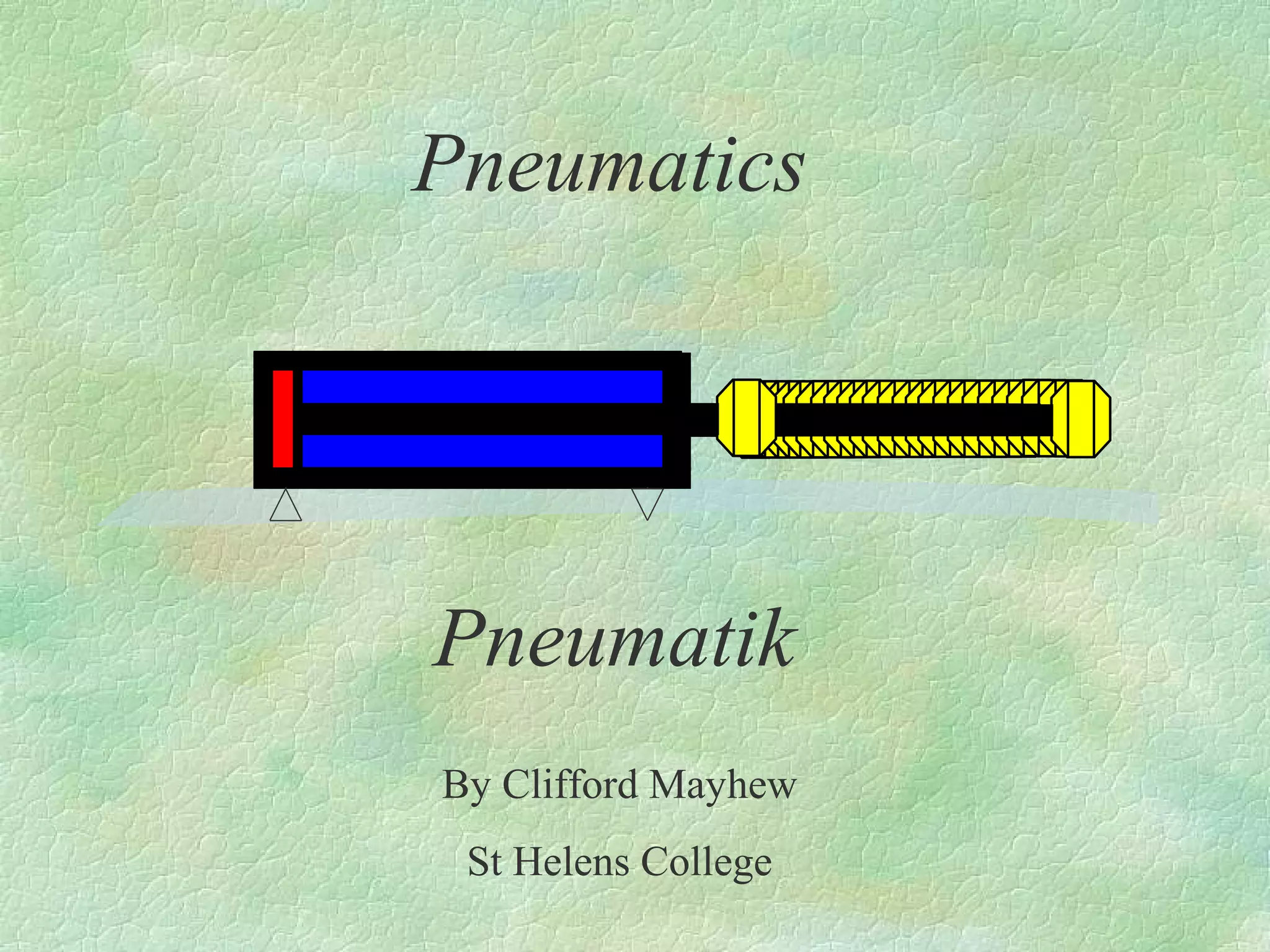
Pneumatics
Pneumatik
By Clifford Mayhew
St Helens College
Basic principles
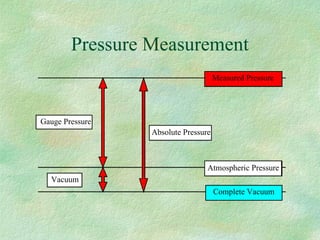
Atmospheric Pressure
Absolute Pressure
Complete Vacuum
Measured Pressure
Atmospheric Pressure
Vacuum
Absolute Pressure
Complete Vacuum
Measured Pressure
Pressure Measurement
Atmospheric Pressure
Vacuum
Gauge Pressure
Absolute Pressure
Complete Vacuum
Measured Pressure
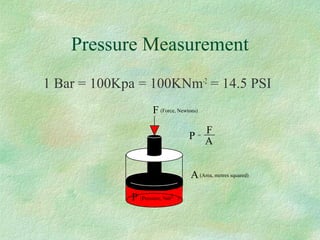
Pressure Measurement
1 Bar = 100Kpa = 100KNm-2
= 14.5 PSI
F (Force, Newtons)
A(Area, metres squared)
P =
F
A
P (Pressure, Nm )-2
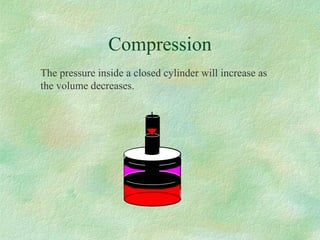
Compression
The pressure inside a closed cylinder will increase as
the volume decreases.
Gas Law’s
For a constant temperature, the volume and pressure
relationship will obey the law:
Pressure x Volume = Constant
(Boyle’s Law).
This means if volume halves, pressure will double.
If volume decreases by a factor of five, pressure will increase
by a factor of five etc.
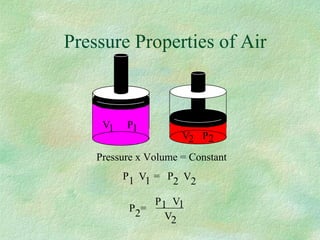
Pressure Properties of Air
P
V P
Pressure x Volume = Constant
V P
V = P V1 21 2
1 1
2 2
P
V
P =
V1 1
2
2
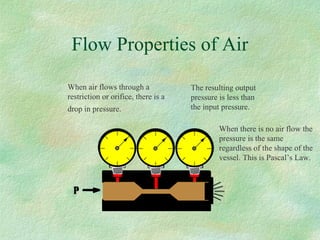
Flow Properties of Air
When air flows through a
restriction or orifice, there is a
drop in pressure.
The resulting output
pressure is less than
the input pressure.
When there is no air flow the
pressure is the same
regardless of the shape of the
vessel. This is Pascal’s Law.
PPPP
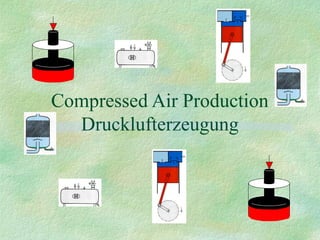
Compressed Air Production
Drucklufterzeugung
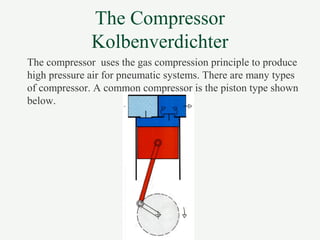
The Compressor
Kolbenverdichter
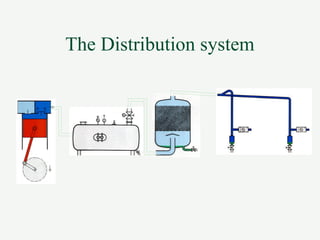
The compressor uses the gas compression principle to produce
high pressure air for pneumatic systems. There are many types
of compressor. A common compressor is the piston type shown
below.
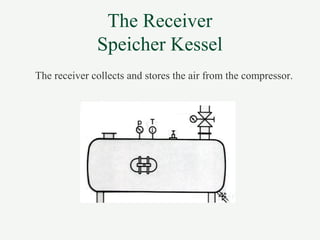
The Receiver
Speicher Kessel
The receiver collects and stores the air from the compressor.
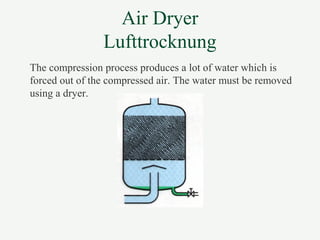
Air Dryer
Lufttrocknung
The compression process produces a lot of water which is
forced out of the compressed air. The water must be removed
using a dryer.
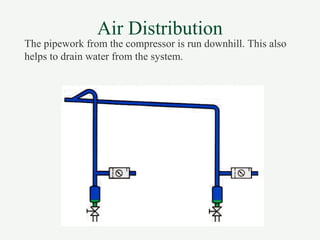
Air Distribution
The pipework from the compressor is run downhill. This also
helps to drain water from the system.
The Distribution system
Pneumatic Valves
Pneumatik Ventile
Pneumatic Circuits
Pneumatic devices are used for machine
control.
Actuating devices can be linear or rotary.
Valves can:
Condition
Regulate
Restrict
Direct
Decide
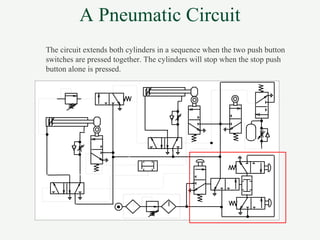
A Pneumatic Circuit
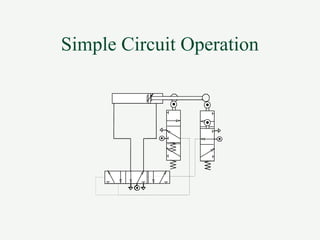
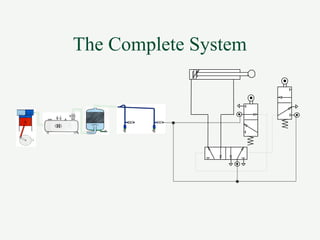
The circuit extends both cylinders in a sequence when the two push button
switches are pressed together. The cylinders will stop when the stop push
button alone is pressed.
Components
The previous circuit contains a filter
regulator lubricator unit (air delivery) which
is connected to the mains air supply from the
compressor.
Logic valves decide when the operation
begins.
Control valves direct the air.
Restrictors control the speed of the cylinders.
Symbols and Components
The following slides show some common
pneumatic devices and their symbols as used
on engineering drawings.
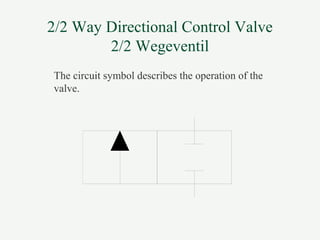
2/2 Way Directional Control Valve
2/2 Wegeventil
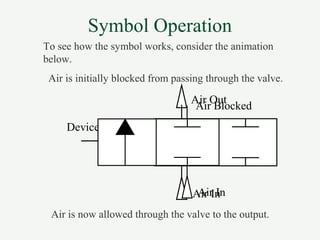
The circuit symbol describes the operation of the
valve.
Device Activated
Air In
Air Out
Symbol Operation
Air In
Air Blocked
To see how the symbol works, consider the animation
below.
Air is now allowed through the valve to the output.
Air is initially blocked from passing through the valve.
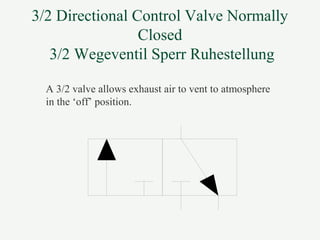
3/2 Directional Control Valve Normally
Closed
3/2 Wegeventil Sperr Ruhestellung
A 3/2 valve allows exhaust air to vent to atmosphere
in the ‘off’ position.
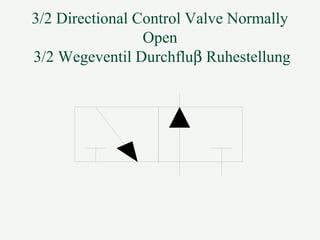
3/2 Directional Control Valve Normally
Open
3/2 Wegeventil Durchfluβ Ruhestellung
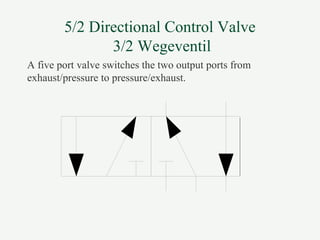
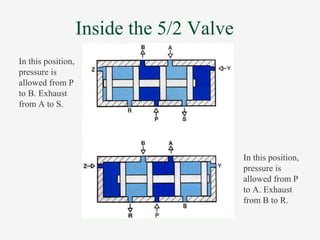
5/2 Directional Control Valve
3/2 Wegeventil
A five port valve switches the two output ports from
exhaust/pressure to pressure/exhaust.
Inside the 5/2 Valve
In this position,
pressure is
allowed from P
to B. Exhaust
from A to S.
In this position,
pressure is
allowed from P
to A. Exhaust
from B to R.
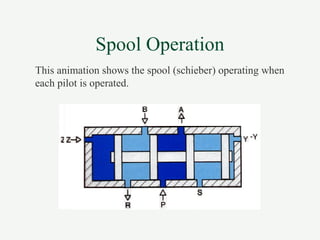
Spool Operation
This animation shows the spool (schieber) operating when
each pilot is operated.
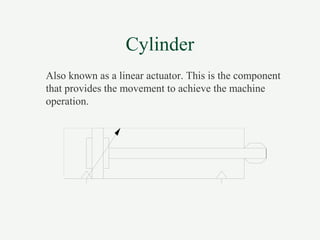
Cylinder
Also known as a linear actuator. This is the component
that provides the movement to achieve the machine
operation.
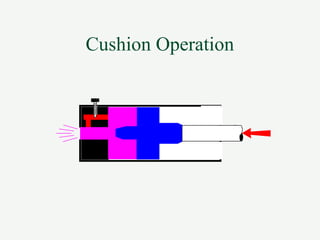
Cushion Operation
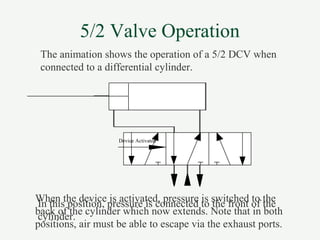
5/2 Valve Operation
Device Activated
The animation shows the operation of a 5/2 DCV when
connected to a differential cylinder.
In this position, pressure is connected to the front of the
cylinder.
When the device is activated, pressure is switched to the
back of the cylinder which now extends. Note that in both
positions, air must be able to escape via the exhaust ports.
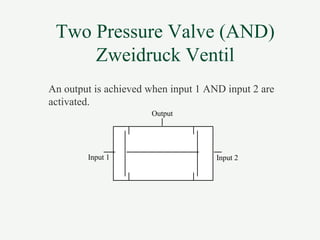
Two Pressure Valve (AND)
Zweidruck Ventil
Input 1 Input 2
Output
An output is achieved when input 1 AND input 2 are
activated.
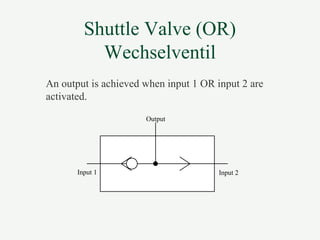
Shuttle Valve (OR)
Wechselventil
Input 1 Input 2
Output
An output is achieved when input 1 OR input 2 are
activated.
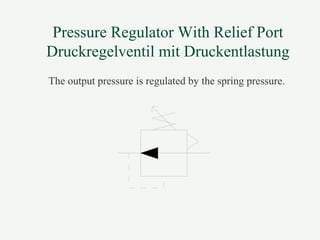
Pressure Regulator With Relief Port
Druckregelventil mit Druckentlastung
The output pressure is regulated by the spring pressure.
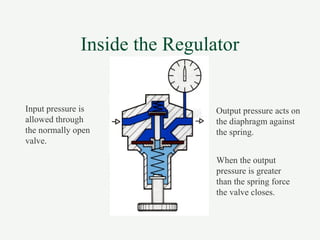
Inside the Regulator
Output pressure acts on
the diaphragm against
the spring.
Input pressure is
allowed through
the normally open
valve.
When the output
pressure is greater
than the spring force
the valve closes.
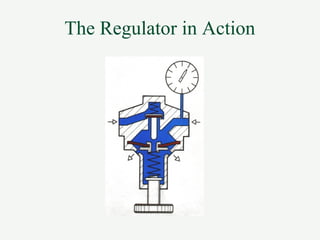
The Regulator in Action
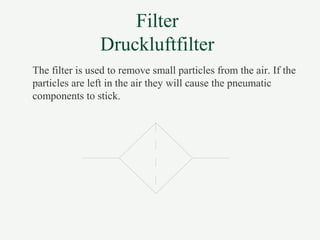
Filter
Druckluftfilter
The filter is used to remove small particles from the air. If the
particles are left in the air they will cause the pneumatic
components to stick.
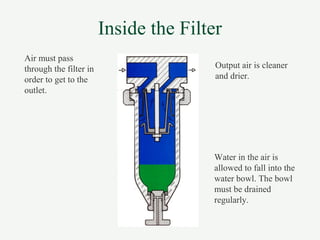
Inside the Filter
Air must pass
through the filter in
order to get to the
outlet.
Water in the air is
allowed to fall into the
water bowl. The bowl
must be drained
regularly.
Output air is cleaner
and drier.
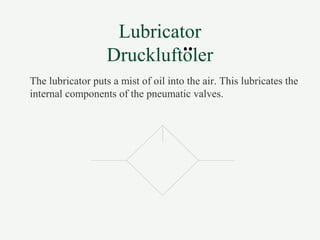
Lubricator
Druckluftoler
The lubricator puts a mist of oil into the air. This lubricates the
internal components of the pneumatic valves.
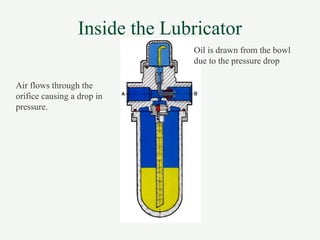
Inside the Lubricator
Air flows through the
orifice causing a drop in
pressure.
Oil is drawn from the bowl
due to the pressure drop
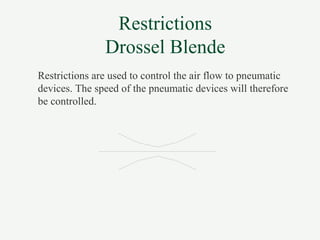
Restrictions
Drossel Blende
Restrictions are used to control the air flow to pneumatic
devices. The speed of the pneumatic devices will therefore
be controlled.
Non Return Valves
Ruckschlagventil
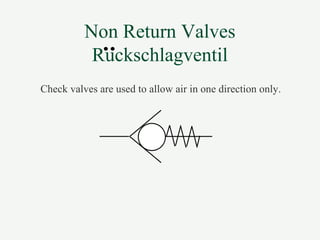
Check valves are used to allow air in one direction only.
Flow Control With Check Valve
Drossel Ruckschlagventil
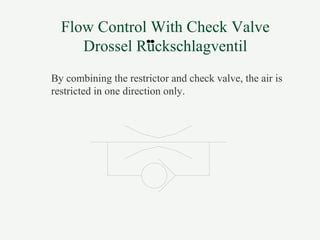
By combining the restrictor and check valve, the air is
restricted in one direction only.
Inside the Restrictor and Check
Valve
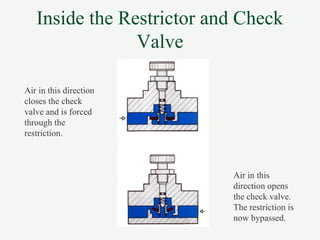
Air in this direction
closes the check
valve and is forced
through the
restriction.
Air in this
direction opens
the check valve.
The restriction is
now bypassed.
Valve Actuators
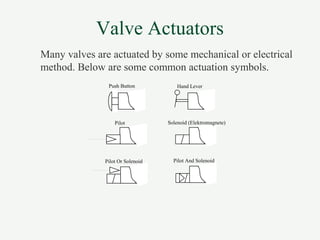
Push Button Hand Lever
Pilot Solenoid (Elektromagnete)
Pilot Or Solenoid Pilot And Solenoid
Many valves are actuated by some mechanical or electrical
method. Below are some common actuation symbols.
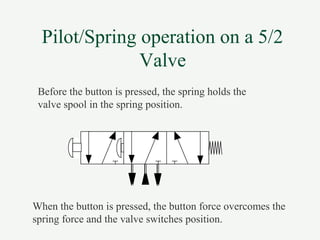
Pilot/Spring operation on a 5/2
Valve
Before the button is pressed, the spring holds the
valve spool in the spring position.
When the button is pressed, the button force overcomes the
spring force and the valve switches position.
Simple Circuit Operation
The Complete System

Pneumatics mainpresentation
  • 1.
  • 2.
  • 3.
    Atmospheric Pressure Absolute Pressure CompleteVacuum Measured Pressure Atmospheric Pressure Vacuum Absolute Pressure Complete Vacuum Measured Pressure Pressure Measurement Atmospheric Pressure Vacuum Gauge Pressure Absolute Pressure Complete Vacuum Measured Pressure
  • 4.
    Pressure Measurement 1 Bar= 100Kpa = 100KNm-2 = 14.5 PSI F (Force, Newtons) A(Area, metres squared) P = F A P (Pressure, Nm )-2
  • 5.
    Compression The pressure insidea closed cylinder will increase as the volume decreases.
  • 6.
    Gas Law’s For aconstant temperature, the volume and pressure relationship will obey the law: Pressure x Volume = Constant (Boyle’s Law). This means if volume halves, pressure will double. If volume decreases by a factor of five, pressure will increase by a factor of five etc.
  • 7.
    Pressure Properties ofAir P V P Pressure x Volume = Constant V P V = P V1 21 2 1 1 2 2 P V P = V1 1 2 2
  • 8.
    Flow Properties ofAir When air flows through a restriction or orifice, there is a drop in pressure. The resulting output pressure is less than the input pressure. When there is no air flow the pressure is the same regardless of the shape of the vessel. This is Pascal’s Law. PPPP
  • 9.
  • 10.
    The Compressor Kolbenverdichter The compressoruses the gas compression principle to produce high pressure air for pneumatic systems. There are many types of compressor. A common compressor is the piston type shown below.
  • 11.
    The Receiver Speicher Kessel Thereceiver collects and stores the air from the compressor.
  • 12.
    Air Dryer Lufttrocknung The compressionprocess produces a lot of water which is forced out of the compressed air. The water must be removed using a dryer.
  • 13.
    Air Distribution The pipeworkfrom the compressor is run downhill. This also helps to drain water from the system.
  • 14.
  • 15.
  • 16.
    Pneumatic Circuits Pneumatic devicesare used for machine control. Actuating devices can be linear or rotary. Valves can: Condition Regulate Restrict Direct Decide
  • 17.
    A Pneumatic Circuit Thecircuit extends both cylinders in a sequence when the two push button switches are pressed together. The cylinders will stop when the stop push button alone is pressed.
  • 18.
    Components The previous circuitcontains a filter regulator lubricator unit (air delivery) which is connected to the mains air supply from the compressor. Logic valves decide when the operation begins. Control valves direct the air. Restrictors control the speed of the cylinders.
  • 19.
    Symbols and Components Thefollowing slides show some common pneumatic devices and their symbols as used on engineering drawings.
  • 20.
    2/2 Way DirectionalControl Valve 2/2 Wegeventil The circuit symbol describes the operation of the valve.
  • 21.
    Device Activated Air In AirOut Symbol Operation Air In Air Blocked To see how the symbol works, consider the animation below. Air is now allowed through the valve to the output. Air is initially blocked from passing through the valve.
  • 22.
    3/2 Directional ControlValve Normally Closed 3/2 Wegeventil Sperr Ruhestellung A 3/2 valve allows exhaust air to vent to atmosphere in the ‘off’ position.
  • 23.
    3/2 Directional ControlValve Normally Open 3/2 Wegeventil Durchfluβ Ruhestellung
  • 24.
    5/2 Directional ControlValve 3/2 Wegeventil A five port valve switches the two output ports from exhaust/pressure to pressure/exhaust.
  • 25.
    Inside the 5/2Valve In this position, pressure is allowed from P to B. Exhaust from A to S. In this position, pressure is allowed from P to A. Exhaust from B to R.
  • 26.
    Spool Operation This animationshows the spool (schieber) operating when each pilot is operated.
  • 27.
    Cylinder Also known asa linear actuator. This is the component that provides the movement to achieve the machine operation.
  • 28.
  • 29.
    5/2 Valve Operation DeviceActivated The animation shows the operation of a 5/2 DCV when connected to a differential cylinder. In this position, pressure is connected to the front of the cylinder. When the device is activated, pressure is switched to the back of the cylinder which now extends. Note that in both positions, air must be able to escape via the exhaust ports.
  • 30.
    Two Pressure Valve(AND) Zweidruck Ventil Input 1 Input 2 Output An output is achieved when input 1 AND input 2 are activated.
  • 31.
    Shuttle Valve (OR) Wechselventil Input1 Input 2 Output An output is achieved when input 1 OR input 2 are activated.
  • 32.
    Pressure Regulator WithRelief Port Druckregelventil mit Druckentlastung The output pressure is regulated by the spring pressure.
  • 33.
    Inside the Regulator Outputpressure acts on the diaphragm against the spring. Input pressure is allowed through the normally open valve. When the output pressure is greater than the spring force the valve closes.
  • 34.
  • 35.
    Filter Druckluftfilter The filter isused to remove small particles from the air. If the particles are left in the air they will cause the pneumatic components to stick.
  • 36.
    Inside the Filter Airmust pass through the filter in order to get to the outlet. Water in the air is allowed to fall into the water bowl. The bowl must be drained regularly. Output air is cleaner and drier.
  • 37.
    Lubricator Druckluftoler The lubricator putsa mist of oil into the air. This lubricates the internal components of the pneumatic valves.
  • 38.
    Inside the Lubricator Airflows through the orifice causing a drop in pressure. Oil is drawn from the bowl due to the pressure drop
  • 39.
    Restrictions Drossel Blende Restrictions areused to control the air flow to pneumatic devices. The speed of the pneumatic devices will therefore be controlled.
  • 40.
    Non Return Valves Ruckschlagventil Checkvalves are used to allow air in one direction only.
  • 41.
    Flow Control WithCheck Valve Drossel Ruckschlagventil By combining the restrictor and check valve, the air is restricted in one direction only.
  • 42.
    Inside the Restrictorand Check Valve Air in this direction closes the check valve and is forced through the restriction. Air in this direction opens the check valve. The restriction is now bypassed.
  • 43.
    Valve Actuators Push ButtonHand Lever Pilot Solenoid (Elektromagnete) Pilot Or Solenoid Pilot And Solenoid Many valves are actuated by some mechanical or electrical method. Below are some common actuation symbols.
  • 44.
    Pilot/Spring operation ona 5/2 Valve Before the button is pressed, the spring holds the valve spool in the spring position. When the button is pressed, the button force overcomes the spring force and the valve switches position.
  • 45.
  • 46.