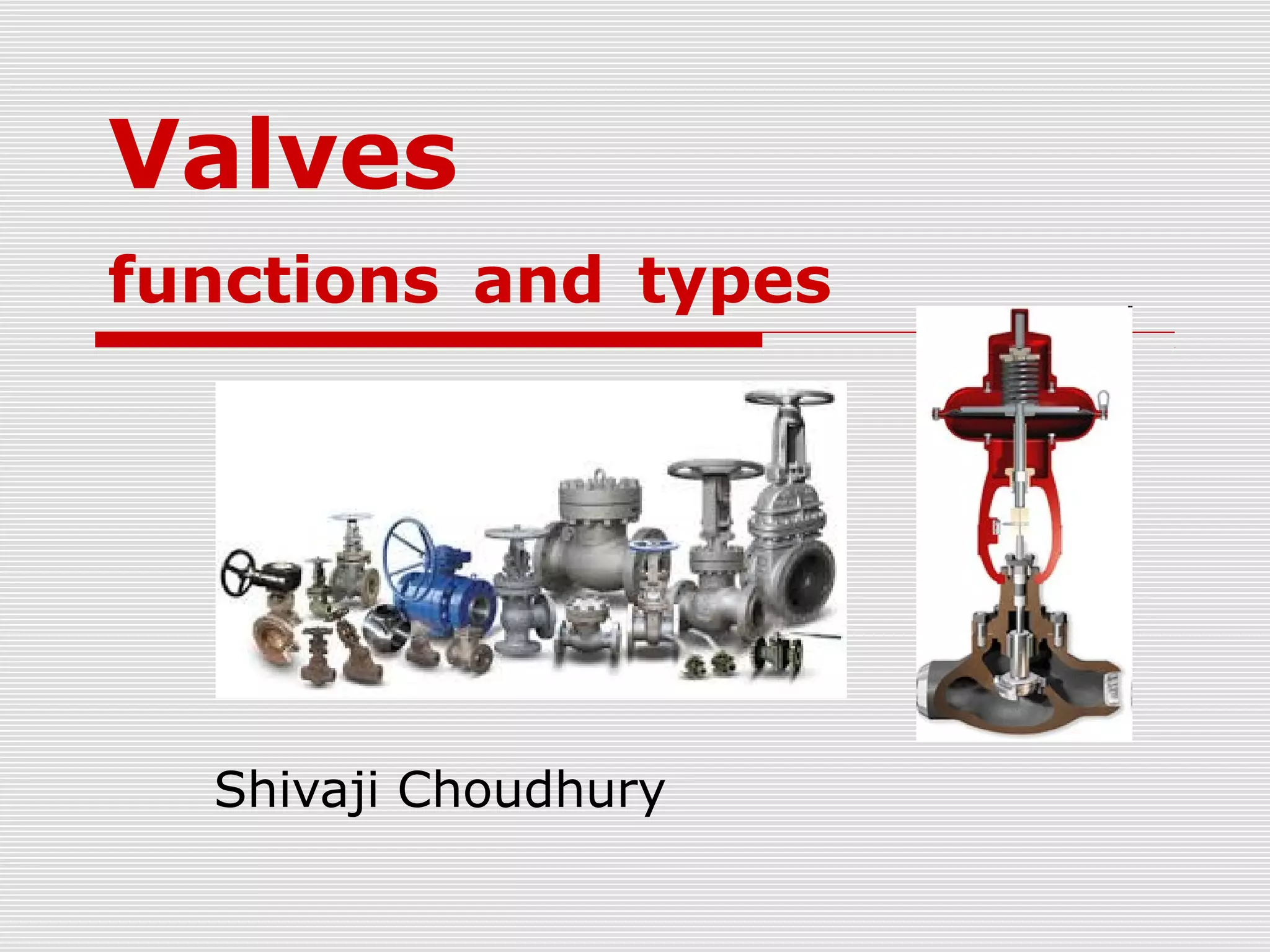
Valves 
functions and types 
Shivaji Choudhury
Valves 
 Many different types of valves are 
used in a industrial plants to perform 
various functions. 
 Valves are used for on-off service, 
modulating/throttling service, to 
protect components against 
overpressure, and to prevent 
backflow from occurring.
Types of Valves 
In general, valves may be categorized 
within the following four groups : 
1. Isolation Valves: 
2. Control Valves: 
3. Pressure Relief Valves: 
4. Check valves
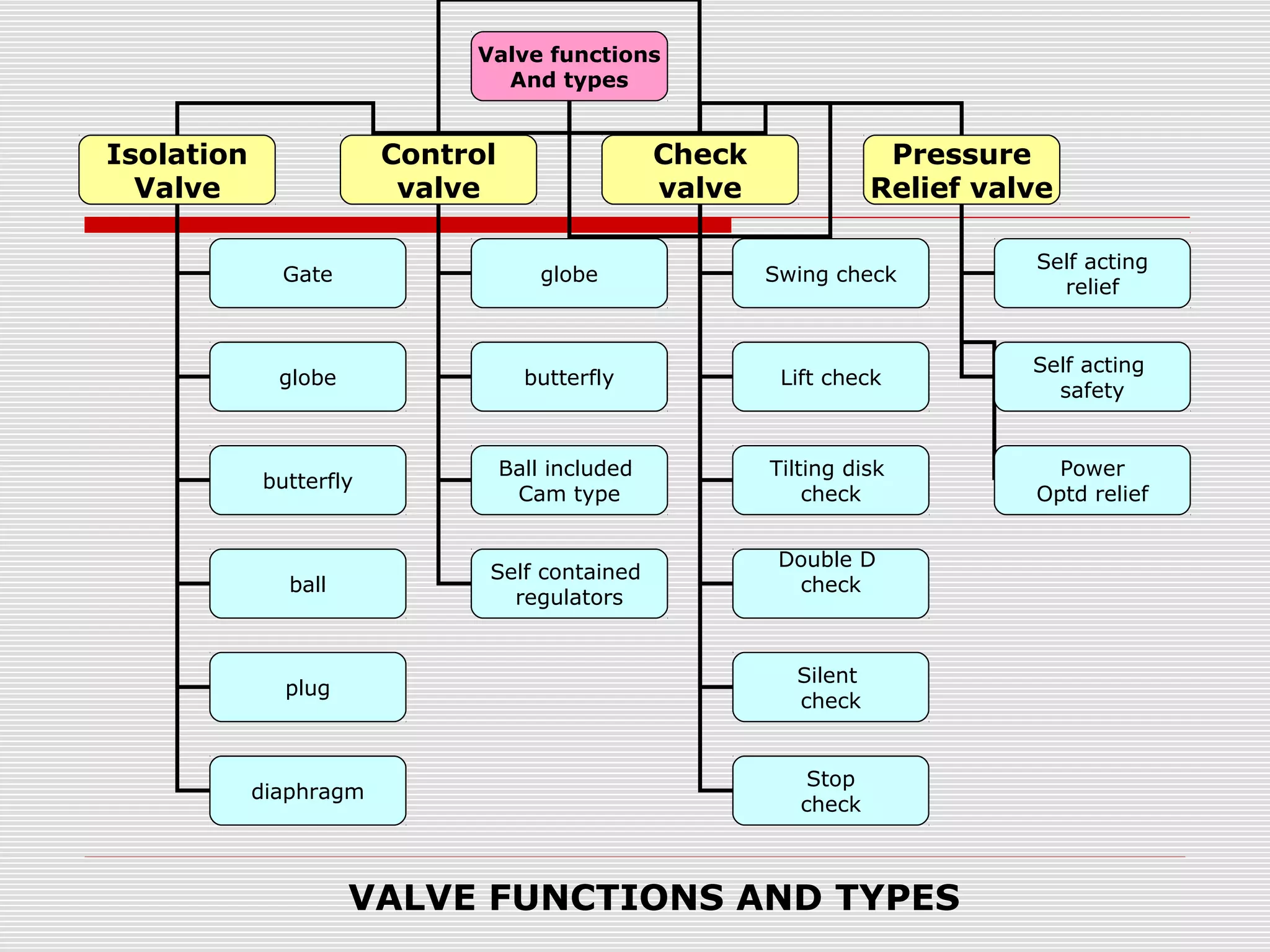
Valve functions 
And types 
Isolation 
Valve 
Control 
valve 
Check 
valve 
Pressure 
Relief valve 
Gate 
globe 
butterfly 
ball 
plug 
diaphragm 
globe 
butterfly 
Ball included 
Cam type 
Self contained 
regulators 
Swing check 
Lift check 
Tilting disk 
check 
Double D 
check 
Silent 
check 
Stop 
check 
Self acting 
relief 
Self acting 
safety 
Power 
Optd relief 
VALVE FUNCTIONS AND TYPES
Isolation Valves 
 Used for on-off service (including 
throttled position) with local or 
remote actuation. Depending on the 
particular application and operating 
conditions,
Isolation Valves 
 Isolation valves, both manual and power 
operated, are typically used to isolate a 
system component or a section of the 
piping system for: 
 Maintenance 
 Testing (for example, hydrostatic, 
pneumatic, operational, or functional) 
 Diversion of flow from one system 
component or piping section to another to 
facilitate load adjustments .
Gate valve- isolation functions 
 A gate valve, also 
known as a sluice 
valve, is a valve that 
opens by lifting a round 
or rectangular 
gate/wedge out of the 
path of the fluid. 
 The distinct feature of a 
gate valve is the sealing 
surfaces between the 
gate and seats are 
planar, so gate valves 
are often used when a 
straight-line flow of fluid 
and minimum restric-tion 
is desired.
GLOBE VALVES—ISOLATION FUNCTION 
 Globe valves are normally 
metal or hard-seated, but 
they can be furnished with 
resilient disc inserts or 
seats that are suited for 
compressed air, 
compressed gas, or fluids 
that contain small particles 
of foreign material.
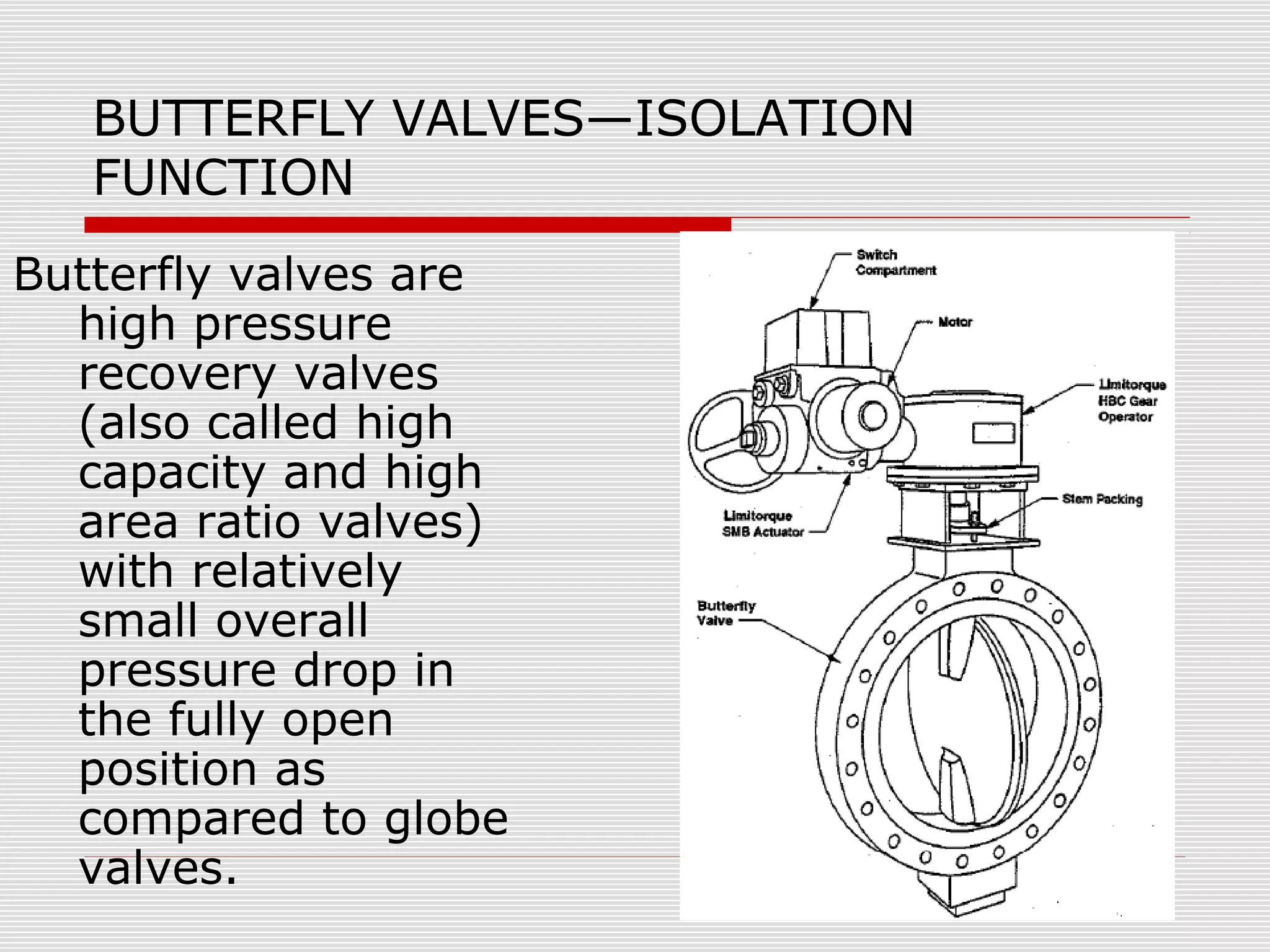
BUTTERFLY VALVES—ISOLATION 
FUNCTION 
Butterfly valves are 
high pressure 
recovery valves 
(also called high 
capacity and high 
area ratio valves) 
with relatively 
small overall 
pressure drop in 
the fully open 
position as 
compared to globe 
valves.
BALL VALVES—ISOLATION FUNCTION 
 Ball valves are quarter-turn 
valves, occupy less 
vertical space than rising 
stem valves,and can be 
installed in almost any 
orientation. 
 Ball valves are bi-directional 
except for 
some eccentric or 
wedged ball designs.
PLUG VALVES- isolation functions 
 Like the ball valve, 
the plug valve is a 
quarter-turn valve. 
It uses a 
cylindrical or 
conical-shaped 
closure member 
instead of the 
spherical shape 
used in the ball 
valve.
DIAPHRAGM VALVES—ISOLATION 
FUNCTION 
 The diaphragm valve is 
comprised of a bonnet, 
body, and flexible-sealing 
member. The flexible 
sealing member is 
available in a variety of 
materials such as Buna-N, 
Viton, TFE, polyethylene, 
or neoprene. 
 This valve is particularly 
suited for corrosive fluid, 
slurries, scale-forming 
service, and where zero 
stem leakage is 
mandatory
Control Valves 
 Used for modulating or throttling service. 
Their operation is automatic in response to 
continuous monitoring of some parameter 
in the controlled system. 
 In general, control valves require no 
manual operator action. 
 A control valve functions as a variable 
resistance in a pipeline.
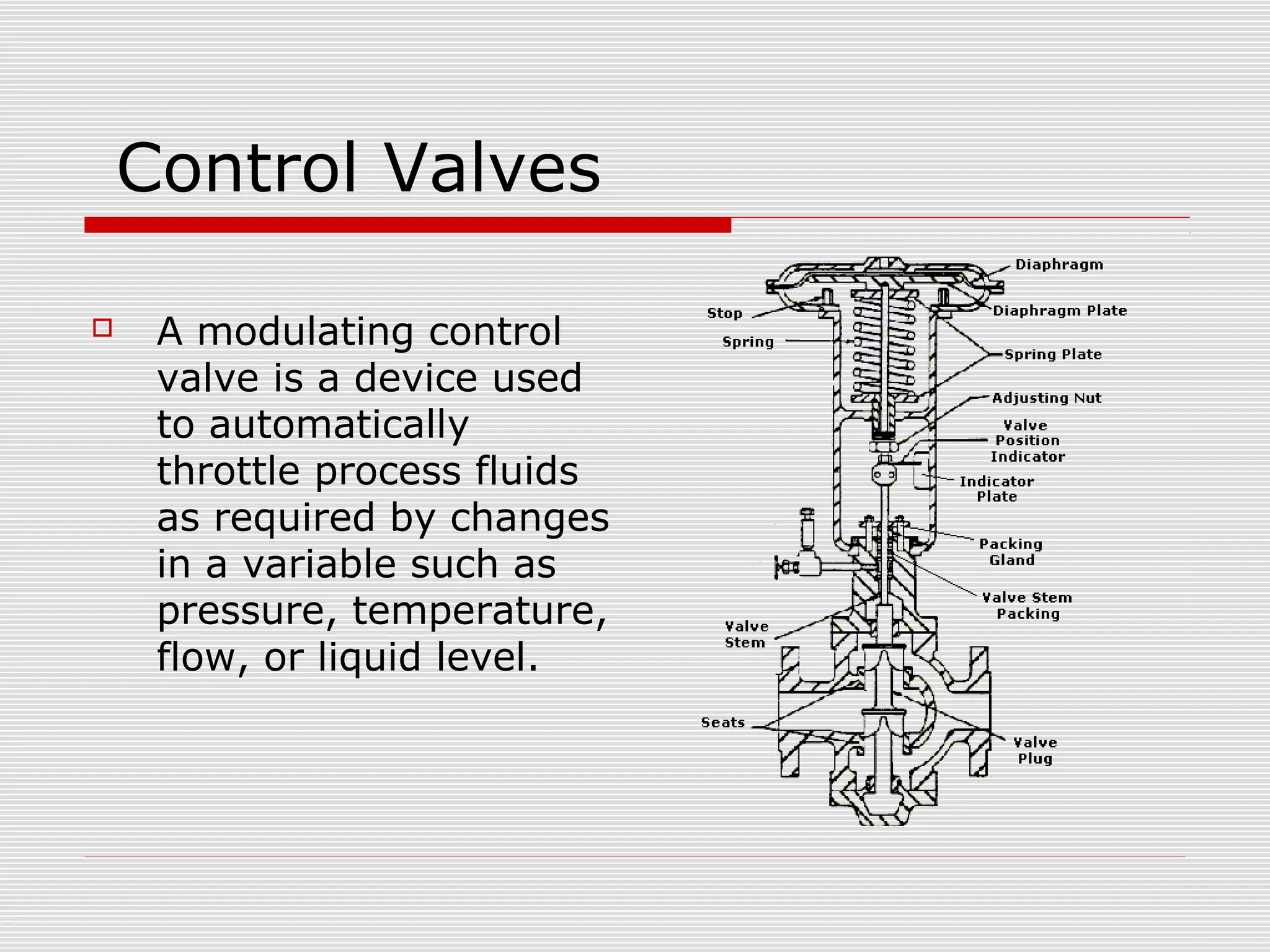
Control Valves 
 A modulating control 
valve is a device used 
to automatically 
throttle process fluids 
as required by changes 
in a variable such as 
pressure, temperature, 
flow, or liquid level.
TOP GUIDED CONTROL VALVE 
Top-guided, single-ported 
valves may be 
used for tight shutoff 
applications; however, 
because these valves 
are unbalanced, they can 
require more force from 
the actuator to achieve 
shutoff if the flow is 
under the plug.
CAGE GUIDED VALVES 
 Cage-guided valves 
have a cylindrical plug 
guided through a guide. 
 The increased guiding 
area is desirable for high 
pressure drop, high 
noise, and anticavitation 
applications 
 Unbalanced types can 
provide a tight shutoff if 
sufficient 
 For balanced styles, the 
plug is vented and the 
process pressure 
interacts with the top 
and bottom side of the 
plug.
DOUBLE SEATED CONTROL VALVE 
 Double-seated control 
valves are used to a 
lot of industrial 
applications due to 
advantages of 
reduction in actuator 
force, a great flow 
capacity and a deal of 
slurry fluids. 
 Double-seated valves 
cannot provide the 
same shutoff capability 
as the single-ported 
types.
Pressure Relief Valves 
 Used to provide protection against 
excessive pressure. 
 The valve opens automatically when 
pressure exceeds a preset level and closes 
after pressure recedes below a preset level. 
 Power-operated relief valves that open or 
close in response to command signals are 
also utilized.
Pressure relief valves
Check valves 
 Used to allow flow in the normal flow 
direction and to prevent flow in the 
opposite flow direction (reverse flow). 
 Check valves are typically opened 
and closed by the flow forces.
Check Valves 
 Check valves are self-actuated valves whose functions 
include: 
 Prevention of reverse flow 
 Keeping lines full of fluid 
 Prevention of loss of fluid when the system is not in 
operation 
 Prevention of reverse rotation of pumps 
 Prevention of outflow of fluid from vessel 
 Prevention of water column separation 
 Check functions are generally satisfied by using lift, 
swing, tilting disc, double disc, or silent (nozzle) check 
valves.
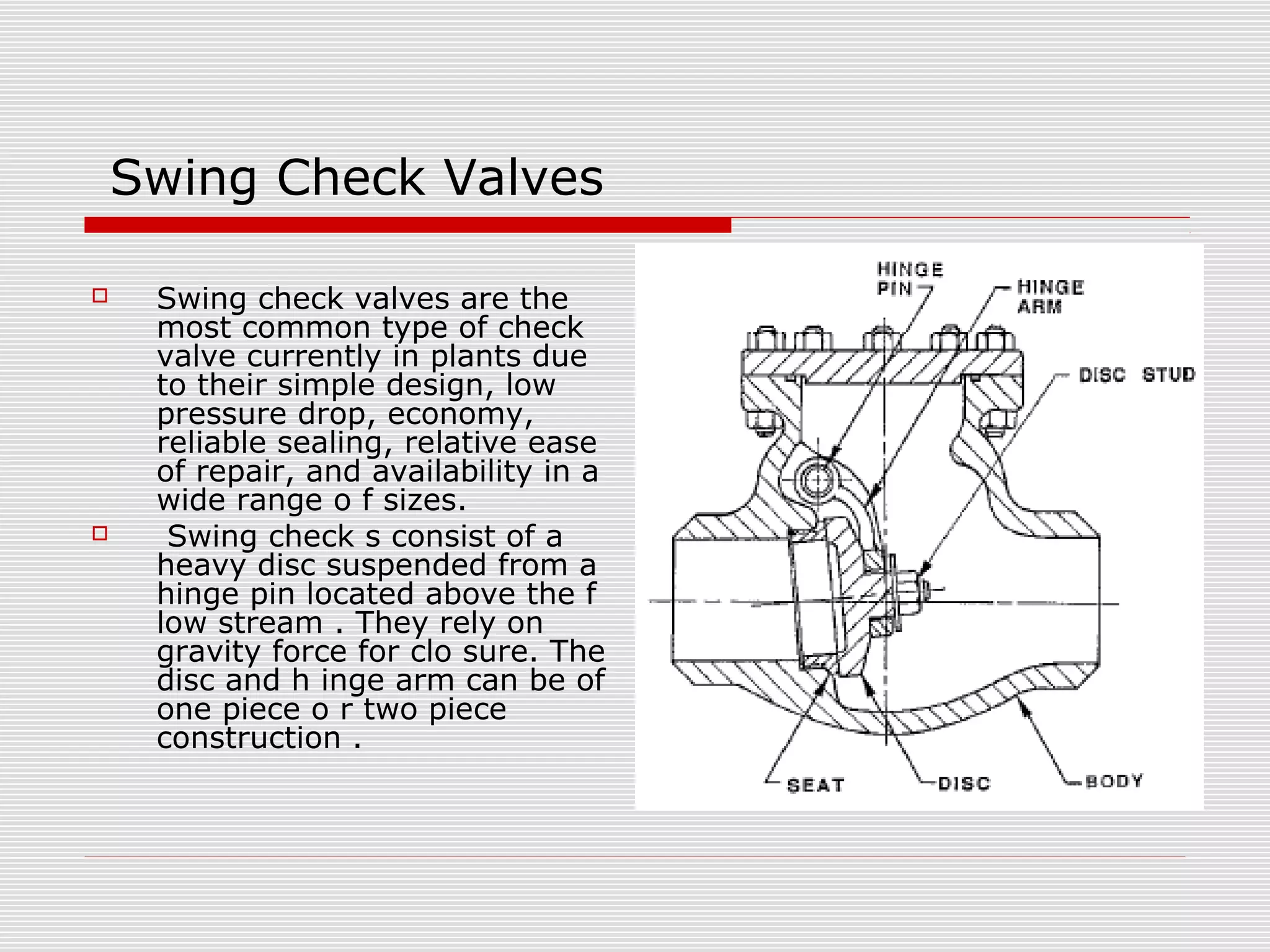
Swing Check Valves 
 Swing check valves are the 
most common type of check 
valve currently in plants due 
to their simple design, low 
pressure drop, economy, 
reliable sealing, relative ease 
of repair, and availability in a 
wide range o f sizes. 
 Swing check s consist of a 
heavy disc suspended from a 
hinge pin located above the f 
low stream . They rely on 
gravity force for clo sure. The 
disc and h inge arm can be of 
one piece o r two piece 
construction .
Tilt Disc Check Valves 
 Tilt check valves differ from the swing check 
valves in that the hinge pin is located in the 
flow stream , just above the center line of the 
disc . 
 The pressure loss, the flow rate at which the 
disc fully opens, and the speed o f closure are 
controlled primarily by the mass of the disc , 
the maximum angular rotation of disc, and the 
amount that the hinge pin is offset from the 
disc centerline.
Check valves 
 Tilt Disc Check 
Valves 
 Lift check valve
Valve End Connections 
Valves can be connected to pipes in 
several ways, including: 
 · Threads 
 · Welding 
 · Brazing 
 · Soldering 
 · Flanges and bolts 
 · Flared or hub ends
Valve Symbols
THANKING YOU

Valves

  • 1.
    Valves functions andtypes Shivaji Choudhury
  • 2.
    Valves  Manydifferent types of valves are used in a industrial plants to perform various functions.  Valves are used for on-off service, modulating/throttling service, to protect components against overpressure, and to prevent backflow from occurring.
  • 3.
    Types of Valves In general, valves may be categorized within the following four groups : 1. Isolation Valves: 2. Control Valves: 3. Pressure Relief Valves: 4. Check valves
  • 4.
    Valve functions Andtypes Isolation Valve Control valve Check valve Pressure Relief valve Gate globe butterfly ball plug diaphragm globe butterfly Ball included Cam type Self contained regulators Swing check Lift check Tilting disk check Double D check Silent check Stop check Self acting relief Self acting safety Power Optd relief VALVE FUNCTIONS AND TYPES
  • 5.
    Isolation Valves Used for on-off service (including throttled position) with local or remote actuation. Depending on the particular application and operating conditions,
  • 6.
    Isolation Valves Isolation valves, both manual and power operated, are typically used to isolate a system component or a section of the piping system for:  Maintenance  Testing (for example, hydrostatic, pneumatic, operational, or functional)  Diversion of flow from one system component or piping section to another to facilitate load adjustments .
  • 7.
    Gate valve- isolationfunctions  A gate valve, also known as a sluice valve, is a valve that opens by lifting a round or rectangular gate/wedge out of the path of the fluid.  The distinct feature of a gate valve is the sealing surfaces between the gate and seats are planar, so gate valves are often used when a straight-line flow of fluid and minimum restric-tion is desired.
  • 8.
    GLOBE VALVES—ISOLATION FUNCTION  Globe valves are normally metal or hard-seated, but they can be furnished with resilient disc inserts or seats that are suited for compressed air, compressed gas, or fluids that contain small particles of foreign material.
  • 9.
    BUTTERFLY VALVES—ISOLATION FUNCTION Butterfly valves are high pressure recovery valves (also called high capacity and high area ratio valves) with relatively small overall pressure drop in the fully open position as compared to globe valves.
  • 10.
    BALL VALVES—ISOLATION FUNCTION  Ball valves are quarter-turn valves, occupy less vertical space than rising stem valves,and can be installed in almost any orientation.  Ball valves are bi-directional except for some eccentric or wedged ball designs.
  • 11.
    PLUG VALVES- isolationfunctions  Like the ball valve, the plug valve is a quarter-turn valve. It uses a cylindrical or conical-shaped closure member instead of the spherical shape used in the ball valve.
  • 12.
    DIAPHRAGM VALVES—ISOLATION FUNCTION  The diaphragm valve is comprised of a bonnet, body, and flexible-sealing member. The flexible sealing member is available in a variety of materials such as Buna-N, Viton, TFE, polyethylene, or neoprene.  This valve is particularly suited for corrosive fluid, slurries, scale-forming service, and where zero stem leakage is mandatory
  • 13.
    Control Valves Used for modulating or throttling service. Their operation is automatic in response to continuous monitoring of some parameter in the controlled system.  In general, control valves require no manual operator action.  A control valve functions as a variable resistance in a pipeline.
  • 14.
    Control Valves A modulating control valve is a device used to automatically throttle process fluids as required by changes in a variable such as pressure, temperature, flow, or liquid level.
  • 15.
    TOP GUIDED CONTROLVALVE Top-guided, single-ported valves may be used for tight shutoff applications; however, because these valves are unbalanced, they can require more force from the actuator to achieve shutoff if the flow is under the plug.
  • 16.
    CAGE GUIDED VALVES  Cage-guided valves have a cylindrical plug guided through a guide.  The increased guiding area is desirable for high pressure drop, high noise, and anticavitation applications  Unbalanced types can provide a tight shutoff if sufficient  For balanced styles, the plug is vented and the process pressure interacts with the top and bottom side of the plug.
  • 17.
    DOUBLE SEATED CONTROLVALVE  Double-seated control valves are used to a lot of industrial applications due to advantages of reduction in actuator force, a great flow capacity and a deal of slurry fluids.  Double-seated valves cannot provide the same shutoff capability as the single-ported types.
  • 18.
    Pressure Relief Valves  Used to provide protection against excessive pressure.  The valve opens automatically when pressure exceeds a preset level and closes after pressure recedes below a preset level.  Power-operated relief valves that open or close in response to command signals are also utilized.
  • 19.
  • 20.
    Check valves Used to allow flow in the normal flow direction and to prevent flow in the opposite flow direction (reverse flow).  Check valves are typically opened and closed by the flow forces.
  • 21.
    Check Valves Check valves are self-actuated valves whose functions include:  Prevention of reverse flow  Keeping lines full of fluid  Prevention of loss of fluid when the system is not in operation  Prevention of reverse rotation of pumps  Prevention of outflow of fluid from vessel  Prevention of water column separation  Check functions are generally satisfied by using lift, swing, tilting disc, double disc, or silent (nozzle) check valves.
  • 22.
    Swing Check Valves  Swing check valves are the most common type of check valve currently in plants due to their simple design, low pressure drop, economy, reliable sealing, relative ease of repair, and availability in a wide range o f sizes.  Swing check s consist of a heavy disc suspended from a hinge pin located above the f low stream . They rely on gravity force for clo sure. The disc and h inge arm can be of one piece o r two piece construction .
  • 23.
    Tilt Disc CheckValves  Tilt check valves differ from the swing check valves in that the hinge pin is located in the flow stream , just above the center line of the disc .  The pressure loss, the flow rate at which the disc fully opens, and the speed o f closure are controlled primarily by the mass of the disc , the maximum angular rotation of disc, and the amount that the hinge pin is offset from the disc centerline.
  • 24.
    Check valves Tilt Disc Check Valves  Lift check valve
  • 25.
    Valve End Connections Valves can be connected to pipes in several ways, including:  · Threads  · Welding  · Brazing  · Soldering  · Flanges and bolts  · Flared or hub ends
  • 26.
  • 27.