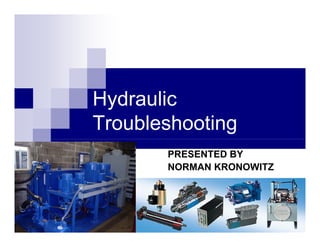
Hydraulic
 y
Troubleshooting
       PRESENTED BY
       NORMAN KRONOWITZ
Introduction
Introd ction
   Welcome to the CMA/Flodyne/Hydradyne’s
    Hydraulic Troubleshooting presentation.

   We will introduce many aspects of
    troubleshooting hydraulic systems and will
    share information that will help you to better
    understand and enhance the operation of
    your hydraulic equipment.
Agenda
   Mentally Prepare
   Documentation
   Starting the process
   Predictability
   System Isolation
   Pumps
   Overheating
   Actuators
   Valves
   Accumulators
   Questions and answers
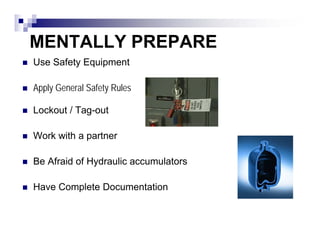
MENTALLY PREPARE
   Use Safety Equipment

   Apply General Safety Rules

   Lockout T
    L k t / Tag-out
                  t

   Work with a pa e
     o          partner

   Be Afraid of Hydraulic accumulators

   Have Complete Documentation
Obtain Documentation and
Determine a Direction


   Obtain ll H d li
    Obt i all Hydraulic and El t i l
                          d Electrical
    Schematics pertaining to the equipment

   Manuals on the machines operation

   Determine your starting point based on the
    symptoms.
    symptoms
Starting the Process
           g
   Understand the machine sequence and operation

   What is the machine doing or not doing?

   Intermittent or continuous
    I t   itt t        ti

   Smell, feel, listen, touch and see

   Machine running slow or fast

   Pressure low or high

   Shock, banging, vibration
Predictability
Expect a result – Be predictive
   Every ti
    E     time an adjustment i made predict what should h
                   dj t    t is  d     di t h t h ld happen.

   Every time you shift a valve predict what will happen.

   If your predication is correct continue troubleshooting.

   If your predication IS NOT correct find out why.

   Do t
    D not make a change j t t see what will happen.
            k     h     just to    h t ill h
   You must make a predication especially      when working with
    a partner!
Isolating Portions of the System

Isolating portions of the circuit is a good way to identify the area of concern
                                                                        concern.

 Lacking pressure? - Try to isolate the hydraulic system from the
  rest of the system by blocking the pressure source (close a ball
                                              source.
  valve, disconnect a line and plug, etc…)

 Lacking flow – The flow is taking the path of least resistance.
  (Isolate portions of the circuit, check all ball valves/safety valves,
  listen to relief valves, feel for heat, etc..)
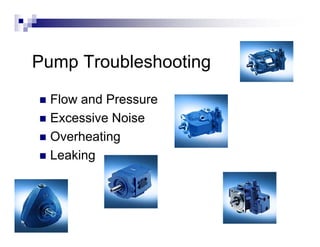
Pump Troubleshooting

 Flow and Pressure
 Excessive Noise
 Overheating
 Leaking
Flow and P
Fl     d Pressure
   Hydraulic pumps create flow not pressure
   Resistance to flow creates pressure
   Flow determines actuator speed
   Pressure determines actuator force
   Fluid ill l
    Fl id will always t k th path of l
                      take the th f least t
    resistance.
   When Fluid moves from an area of high
    pressure to an area of low pressure ( pressure drop)
    without performing work, heat is generated.
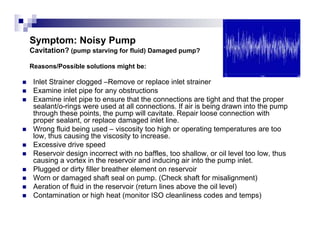
Symptom: Noisy Pump
    Cavitation? (pump starving for fluid) Damaged pump?

    Reasons/Possible solutions might be:

    Inlet Strainer clogged –Remove or replace inlet strainer
    Examine inlet pipe for any obstructions
    Examine inlet pipe to ensure that the connections are tight and that the proper
     sealant/o rings
     sealant/o-rings were used at all connections If air is being drawn into the pump
                                        connections.
     through these points, the pump will cavitate. Repair loose connection with
     proper sealant, or replace damaged inlet line.
    Wrong fluid being used – viscosity too high or operating temperatures are too
     low, thus causing the viscosity to increase.
         ,             g            y
    Excessive drive speed
    Reservoir design incorrect with no baffles, too shallow, or oil level too low, thus
     causing a vortex in the reservoir and inducing air into the pump inlet.
    Plugged or dirty filler breather element on reservoir
    Worn or damaged shaft seal on pump. (Check shaft for misalignment)
    Aeration of fluid in the reservoir (return lines above the oil level)
    Contamination or high heat (monitor ISO cleanliness codes and temps)
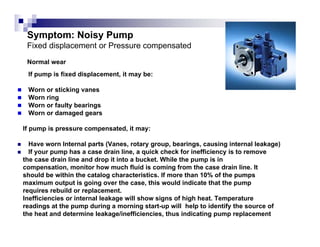
Symptom: Noisy Pump
     Fixed displacement or Pressure compensated
     Normal wear
     If pump is fixed displacement, it may be:
        p p              p        ,      y

    Worn or sticking vanes
    Worn ring
    Worn or faulty bearings
                  y       g
    Worn or damaged gears

    If pump is pressure compensated, it may:

   Have worn Internal parts (Vanes, rotary group, bearings, causing internal leakage)
   If your pump has a case drain line, a quick check for inefficiency is to remove
  the case drain line and drop it into a bucket. While the pump is in
  compensation, monitor how much fluid is coming from the case drain line. It
        p        ,                                  g
  should be within the catalog characteristics. If more than 10% of the pumps
  maximum output is going over the case, this would indicate that the pump
  requires rebuild or replacement.
  Inefficiencies or internal leakage will show signs of high heat. Temperature
                                  g              g        g            p
  readings at the pump during a morning start-up will help to identify the source of
  the heat and determine leakage/inefficiencies, thus indicating pump replacement
System Overheating?
 Determine the source
 What is too hot?
 Is the pump overheating?
 I a valve or actuator overheating?
  Is     l       t t        h ti ?
 General overheating
Symptom: Over heating of system
     y p                g     y
    What is the maximum temperature for a hydraulic system?
    For safety, efficiency, and oil quality, temperatures above 140 degrees F are not
    recommended for industrial hydraulic equipment.

Oil th t i t h t will degrade rapidly, drop in viscosity, and can lead to accelerated
    that is too hot ill d  d     idl d      i i      it     d     l dt        l t d
component wear and poor system performance. A broken hose or leak in a line can
seriously burn someone.

Causes of overheating systems:
C       f     h ti       t

   Contamination causing wear of components, thus creating internal leakage of the
    component and higher operating temperatures.
   Relief valve misadjusted
                  misadjusted.
   Compensator on pump may be set higher than the relief valve in the system
   Flow control valves may be set improperly.
   Water supply feeding heat exchanger may be shut-off or has insufficient flow or
    temperature for cooling
                       cooling.
   Heat exchanger may be clogged or water modulating valve may have failed.
   If an air to oil heat exchanger is in the system the cooling fins may need to be cleaned,
    or electric motor, or starter may have failed.
   Ambient air temperature may have increased and can no longer supply sufficient cooling
                       p          y                                 g    pp y                 g
    media. Inadequate ventilation or area of room size may have changed.
   Incorrect fluid used in hydraulic system
   Defective pump ( See Noisy pump)
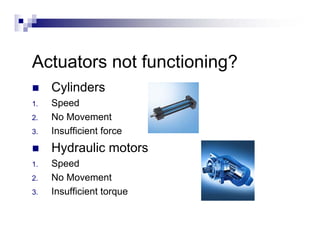
Actuators not functioning?
    Cylinders
1.   Speed
       p
2.   No Movement
3.   Insufficient force
    Hydraulic motors
1.   Speed
2.   No Movement
3.   Insufficient torque
Symptom: Actuator fails to move
     y p
    Reasons and possible solutions:
    Note: Usually, when an actuator doesn’t move, the problem is not the actuator.

   Directional valve not shifting.
   Electrical failure, bad solenoid, limit switch, PLC ect...
   Insufficient pilot pressure (If dual stage valve, check pilot and drain
    configuration) especially if valve h j t b
        fi    ti )         i ll      l has just been replaced.
                                                         l     d
   Look at any check valves or back pressure valves required to provide pilot
    pressure.
   System operating pressure to low (see low or erratic pressure)
   A valve elsewhere in the system is allowing flow to be diverted to the reservoir
   Interlock device not actuated
   Mechanical bind on machine or actuator (improper mounting of actuator)
   Faulty pump
   High heat – viscosity too low
   Previous contamination damage/high heat has caused component fatigue,
    wear,
    wear and failure
                failure.
   Worn/damaged actuator (cylinder or hydraulic motor blow-by or internal
    leakage.
Suggestions:
If you think that it may be internal leakage:
   Take temperature readings on the system and on both sides of actuator
                                                                   actuator.
    Actuator may be bypassing internally due to worn seals, geroter, gears vanes,
    ect…

   Extend cylinder fully and disconnect rod end port connection If fluid is
                                                       connection.
    continuing to flow from rod end port, the cylinder has internal leakage and
    requires rebuild or replacement. If no leakage is present, connect the line,
    retract the cylinder and remove cap end connection to check for same on
    opposite end.
     pp

Note: Depending on the seal design, It is possible for a cylinder to leak in one
   direction and not the other. A cylinder that leaks internally typically will drift in
   t e e te d direction,
   the extend d ect o , because o t e a ea d e e ces o t e p sto , e e when
                                  of the area differences on the piston, even          e
   mounted vertically rod up.

 If you experience this type of drifting, the issue is probably the actuator, and you
     should start your troubleshooting here.
Valves not f
V l      t functioning?
               ti i ?
 Pressure Controls
 Directional Controls
 Flow Controls
Symptoms: Low or Erratic Pressure
 y
Reasons and possible solutions:

   Pressure control setting too low (
                            g        (relief, compensator, reducing valve,
                                                  p                  g
    ect..)
   Contaminates in fluid or high heat/low viscosity
   Worn or sticking relief valve
   Dirt/debris stuck and holding a relief or other valve partially open
                                                                    open.

Suggestions:
   Check cleanliness of fluid and act accordingly.
   Take temperature readings at the various valves to identify a noticeable
    temperature rise (possible internal leakage)
   Put your hand on valve to feel or listen for leakage.
   If the valve discharges to tank, disconnect the tank line and connect a
    hose from the valve, feeding into a bucket. Start system and measure the
    leakage.
    leakage Act accordingly to repair or replace the valve
Symptoms: No pressure!
     Reasons and possible solutions:


   Unit not running or pump in reverse direction.
   Low oil level or no oil
   Drive coupling is damaged or disconnected.
                                  disconnected
   Full pump volume by-passing through a faulty valve or actuator.
   Suction line of pump obstructed or disconnected
   A manual valve may be shifted diverting volume to tank or a solenoid valve
                          y                 g
    may be un-intentionally energized/shifted or not shifted, due to an electrical
    problem. PLC?
   (Check all possible valves with a volt meter, or manual
    over-ride
    over ride if available)

Note: Don’t get stuck on hydraulic, as many times the hydraulic problem you
     are experiencing may be mechanical or electrical.
           p         g    y
Symptoms: Slow or Erratic Feed Rate /Operation
Reasons and possible solutions:
   Air or water in the fluid (will typically produce a milky appearance)
   Low fluid level
   Viscosity of the fluid is too high or temperature is too low
   Contamination
   Internal leakage through a valve or actuator
   Dirt/debris stuck and holding a valve partially open.
   Worn/Inefficient pump
   Pump drive speed too low
   Faulty or dirty flow control or other feed related valve
   Mechanical…misalignment-alignment, sticky warped
    Mechanical misalignment-alignment sticky, warped, or binding ways bent
                                                                        ways,
    bracket, or other

Suggestions:

   Check level, color, quality, and cleanliness of fluid and act accordingly.
   Take temperature readings at the pump, pump case, and various valves to
    identify a noticeable temperature rise (possible internal leakage)
   Put your hand on valve to feel or listen for leakage.
   If the valve discharges to tank, disconnect the tank line and connect a hose from
    the valve, feeding into a bucket. Start system and measure the leakage. Act
    accordingly to repair or replace the valve.
Hydraulic or Electrical ?
 H d   li     El t i l
Often an electrical issue will affect the hydraulic operation
                                                    operation.
  Don’t get focused on a hydraulic problem until you have
  also reviewed electrical issues such as:

   No or low voltage at a solenoid valve due to: a
    defective limit switch, misadjusted limit switch, PLC
    output, power supply, transformer, No control power.

   What has changed?

   A change to the PLC p g
            g            program?, a limit switch or other
                                   ,
    electrical component recently replaced?
Proportional & Servo valves
                  and Drivers
    Valves may have on board electronics or be controlled by an amplifier or
                       on-board
     motion control device.
    Proportional and servo valves are current driven using “Pulse Width
     Modulation”
    Before troubleshooting a proportional or servo valve obtain
     documentation for the valve and control.
    Shielded wire is required for the valve to operate without interference
    (electrical noise)
    Proportional and servo valves are controlled with either a current or
     voltage command to the valve or control device.
    Often the problem is not the valve but the amplifier, PLC, feedback
                p                                   p    ,     ,
     device or broken wire.
    What has changed? Ask Questions?
Accumulators
A     l t
 Why is the accumulator in the system?
 Nitrogen pressure can not be measured
  while system is running
 Potential to discharge unexpectedly
 Use your senses and ASK QUESTIONS !
Most I
M t Important Tools
         t tT l
 Eyes
 Ears
 Hands
NNose
 Use your senses and ASK QUESTIONS !
Where to Get More Information
Wh    t G tM      I f    ti

   Other training sessions

   Books, Trade magazine articles, Internet, etc..

   Consulting services, other sources

   Call us anytime!
This guide cannot cover all details or all variations in equipment
nor can it provide for every possible condition/solution of cause
and effect.

Feel free to contact us should further information be required.
Were always happy to help!

Hydraulic Maintenance and Troubleshooting

  • 1.
    Hydraulic y Troubleshooting PRESENTED BY NORMAN KRONOWITZ
  • 2.
    Introduction Introd ction  Welcome to the CMA/Flodyne/Hydradyne’s Hydraulic Troubleshooting presentation.  We will introduce many aspects of troubleshooting hydraulic systems and will share information that will help you to better understand and enhance the operation of your hydraulic equipment.
  • 3.
    Agenda  Mentally Prepare  Documentation  Starting the process  Predictability  System Isolation  Pumps  Overheating  Actuators  Valves  Accumulators  Questions and answers
  • 4.
    MENTALLY PREPARE  Use Safety Equipment  Apply General Safety Rules  Lockout T L k t / Tag-out t  Work with a pa e o partner  Be Afraid of Hydraulic accumulators  Have Complete Documentation
  • 5.
    Obtain Documentation and Determinea Direction  Obtain ll H d li Obt i all Hydraulic and El t i l d Electrical Schematics pertaining to the equipment  Manuals on the machines operation  Determine your starting point based on the symptoms. symptoms
  • 6.
    Starting the Process g  Understand the machine sequence and operation  What is the machine doing or not doing?  Intermittent or continuous I t itt t ti  Smell, feel, listen, touch and see  Machine running slow or fast  Pressure low or high  Shock, banging, vibration
  • 7.
    Predictability Expect a result– Be predictive  Every ti E time an adjustment i made predict what should h dj t t is d di t h t h ld happen.  Every time you shift a valve predict what will happen.  If your predication is correct continue troubleshooting.  If your predication IS NOT correct find out why.  Do t D not make a change j t t see what will happen. k h just to h t ill h  You must make a predication especially when working with a partner!
  • 8.
    Isolating Portions ofthe System Isolating portions of the circuit is a good way to identify the area of concern concern.  Lacking pressure? - Try to isolate the hydraulic system from the rest of the system by blocking the pressure source (close a ball source. valve, disconnect a line and plug, etc…)  Lacking flow – The flow is taking the path of least resistance. (Isolate portions of the circuit, check all ball valves/safety valves, listen to relief valves, feel for heat, etc..)
  • 9.
    Pump Troubleshooting  Flowand Pressure  Excessive Noise  Overheating  Leaking
  • 10.
    Flow and P Fl d Pressure  Hydraulic pumps create flow not pressure  Resistance to flow creates pressure  Flow determines actuator speed  Pressure determines actuator force  Fluid ill l Fl id will always t k th path of l take the th f least t resistance.  When Fluid moves from an area of high pressure to an area of low pressure ( pressure drop) without performing work, heat is generated.
  • 11.
    Symptom: Noisy Pump Cavitation? (pump starving for fluid) Damaged pump? Reasons/Possible solutions might be:  Inlet Strainer clogged –Remove or replace inlet strainer  Examine inlet pipe for any obstructions  Examine inlet pipe to ensure that the connections are tight and that the proper sealant/o rings sealant/o-rings were used at all connections If air is being drawn into the pump connections. through these points, the pump will cavitate. Repair loose connection with proper sealant, or replace damaged inlet line.  Wrong fluid being used – viscosity too high or operating temperatures are too low, thus causing the viscosity to increase. , g y  Excessive drive speed  Reservoir design incorrect with no baffles, too shallow, or oil level too low, thus causing a vortex in the reservoir and inducing air into the pump inlet.  Plugged or dirty filler breather element on reservoir  Worn or damaged shaft seal on pump. (Check shaft for misalignment)  Aeration of fluid in the reservoir (return lines above the oil level)  Contamination or high heat (monitor ISO cleanliness codes and temps)
  • 12.
    Symptom: Noisy Pump Fixed displacement or Pressure compensated Normal wear If pump is fixed displacement, it may be: p p p , y  Worn or sticking vanes  Worn ring  Worn or faulty bearings y g  Worn or damaged gears If pump is pressure compensated, it may:  Have worn Internal parts (Vanes, rotary group, bearings, causing internal leakage)  If your pump has a case drain line, a quick check for inefficiency is to remove the case drain line and drop it into a bucket. While the pump is in compensation, monitor how much fluid is coming from the case drain line. It p , g should be within the catalog characteristics. If more than 10% of the pumps maximum output is going over the case, this would indicate that the pump requires rebuild or replacement. Inefficiencies or internal leakage will show signs of high heat. Temperature g g g p readings at the pump during a morning start-up will help to identify the source of the heat and determine leakage/inefficiencies, thus indicating pump replacement
  • 13.
    System Overheating?  Determinethe source  What is too hot?  Is the pump overheating?  I a valve or actuator overheating? Is l t t h ti ?  General overheating
  • 14.
    Symptom: Over heatingof system y p g y What is the maximum temperature for a hydraulic system? For safety, efficiency, and oil quality, temperatures above 140 degrees F are not recommended for industrial hydraulic equipment. Oil th t i t h t will degrade rapidly, drop in viscosity, and can lead to accelerated that is too hot ill d d idl d i i it d l dt l t d component wear and poor system performance. A broken hose or leak in a line can seriously burn someone. Causes of overheating systems: C f h ti t  Contamination causing wear of components, thus creating internal leakage of the component and higher operating temperatures.  Relief valve misadjusted misadjusted.  Compensator on pump may be set higher than the relief valve in the system  Flow control valves may be set improperly.  Water supply feeding heat exchanger may be shut-off or has insufficient flow or temperature for cooling cooling.  Heat exchanger may be clogged or water modulating valve may have failed.  If an air to oil heat exchanger is in the system the cooling fins may need to be cleaned, or electric motor, or starter may have failed.  Ambient air temperature may have increased and can no longer supply sufficient cooling p y g pp y g media. Inadequate ventilation or area of room size may have changed.  Incorrect fluid used in hydraulic system  Defective pump ( See Noisy pump)
  • 15.
    Actuators not functioning?  Cylinders 1. Speed p 2. No Movement 3. Insufficient force  Hydraulic motors 1. Speed 2. No Movement 3. Insufficient torque
  • 16.
    Symptom: Actuator failsto move y p Reasons and possible solutions: Note: Usually, when an actuator doesn’t move, the problem is not the actuator.  Directional valve not shifting.  Electrical failure, bad solenoid, limit switch, PLC ect...  Insufficient pilot pressure (If dual stage valve, check pilot and drain configuration) especially if valve h j t b fi ti ) i ll l has just been replaced. l d  Look at any check valves or back pressure valves required to provide pilot pressure.  System operating pressure to low (see low or erratic pressure)  A valve elsewhere in the system is allowing flow to be diverted to the reservoir  Interlock device not actuated  Mechanical bind on machine or actuator (improper mounting of actuator)  Faulty pump  High heat – viscosity too low  Previous contamination damage/high heat has caused component fatigue, wear, wear and failure failure.  Worn/damaged actuator (cylinder or hydraulic motor blow-by or internal leakage.
  • 17.
    Suggestions: If you thinkthat it may be internal leakage:  Take temperature readings on the system and on both sides of actuator actuator. Actuator may be bypassing internally due to worn seals, geroter, gears vanes, ect…  Extend cylinder fully and disconnect rod end port connection If fluid is connection. continuing to flow from rod end port, the cylinder has internal leakage and requires rebuild or replacement. If no leakage is present, connect the line, retract the cylinder and remove cap end connection to check for same on opposite end. pp Note: Depending on the seal design, It is possible for a cylinder to leak in one direction and not the other. A cylinder that leaks internally typically will drift in t e e te d direction, the extend d ect o , because o t e a ea d e e ces o t e p sto , e e when of the area differences on the piston, even e mounted vertically rod up. If you experience this type of drifting, the issue is probably the actuator, and you should start your troubleshooting here.
  • 18.
    Valves not f Vl t functioning? ti i ?  Pressure Controls  Directional Controls  Flow Controls
  • 19.
    Symptoms: Low orErratic Pressure y Reasons and possible solutions:  Pressure control setting too low ( g (relief, compensator, reducing valve, p g ect..)  Contaminates in fluid or high heat/low viscosity  Worn or sticking relief valve  Dirt/debris stuck and holding a relief or other valve partially open open. Suggestions:  Check cleanliness of fluid and act accordingly.  Take temperature readings at the various valves to identify a noticeable temperature rise (possible internal leakage)  Put your hand on valve to feel or listen for leakage.  If the valve discharges to tank, disconnect the tank line and connect a hose from the valve, feeding into a bucket. Start system and measure the leakage. leakage Act accordingly to repair or replace the valve
  • 20.
    Symptoms: No pressure! Reasons and possible solutions:  Unit not running or pump in reverse direction.  Low oil level or no oil  Drive coupling is damaged or disconnected. disconnected  Full pump volume by-passing through a faulty valve or actuator.  Suction line of pump obstructed or disconnected  A manual valve may be shifted diverting volume to tank or a solenoid valve y g may be un-intentionally energized/shifted or not shifted, due to an electrical problem. PLC?  (Check all possible valves with a volt meter, or manual over-ride over ride if available) Note: Don’t get stuck on hydraulic, as many times the hydraulic problem you are experiencing may be mechanical or electrical. p g y
  • 21.
    Symptoms: Slow orErratic Feed Rate /Operation Reasons and possible solutions:  Air or water in the fluid (will typically produce a milky appearance)  Low fluid level  Viscosity of the fluid is too high or temperature is too low  Contamination  Internal leakage through a valve or actuator  Dirt/debris stuck and holding a valve partially open.  Worn/Inefficient pump  Pump drive speed too low  Faulty or dirty flow control or other feed related valve  Mechanical…misalignment-alignment, sticky warped Mechanical misalignment-alignment sticky, warped, or binding ways bent ways, bracket, or other Suggestions:  Check level, color, quality, and cleanliness of fluid and act accordingly.  Take temperature readings at the pump, pump case, and various valves to identify a noticeable temperature rise (possible internal leakage)  Put your hand on valve to feel or listen for leakage.  If the valve discharges to tank, disconnect the tank line and connect a hose from the valve, feeding into a bucket. Start system and measure the leakage. Act accordingly to repair or replace the valve.
  • 22.
    Hydraulic or Electrical? H d li El t i l Often an electrical issue will affect the hydraulic operation operation. Don’t get focused on a hydraulic problem until you have also reviewed electrical issues such as:  No or low voltage at a solenoid valve due to: a defective limit switch, misadjusted limit switch, PLC output, power supply, transformer, No control power.  What has changed?  A change to the PLC p g g program?, a limit switch or other , electrical component recently replaced?
  • 23.
    Proportional & Servovalves and Drivers  Valves may have on board electronics or be controlled by an amplifier or on-board motion control device.  Proportional and servo valves are current driven using “Pulse Width Modulation”  Before troubleshooting a proportional or servo valve obtain documentation for the valve and control.  Shielded wire is required for the valve to operate without interference (electrical noise)  Proportional and servo valves are controlled with either a current or voltage command to the valve or control device.  Often the problem is not the valve but the amplifier, PLC, feedback p p , , device or broken wire.  What has changed? Ask Questions?
  • 24.
    Accumulators A l t  Why is the accumulator in the system?  Nitrogen pressure can not be measured while system is running  Potential to discharge unexpectedly  Use your senses and ASK QUESTIONS !
  • 25.
    Most I M tImportant Tools t tT l  Eyes  Ears  Hands NNose  Use your senses and ASK QUESTIONS !
  • 26.
    Where to GetMore Information Wh t G tM I f ti  Other training sessions  Books, Trade magazine articles, Internet, etc..  Consulting services, other sources  Call us anytime!
  • 27.
    This guide cannotcover all details or all variations in equipment nor can it provide for every possible condition/solution of cause and effect. Feel free to contact us should further information be required. Were always happy to help!