HYDRAULIC PRESSURE
CONTROL VALVE
PRESENTED BY :- Vikram Golchha (A -65)
Shubham Sankhala (A -42)
keshav Patil (A -31)
GUIDE :-
S.P. Mankani Sir
Contents
Introduction
Classification of Pressure control valve
Pressure relief valve
Direct acting relief valve
Pilot operated relief valve
Sequence control valve
Conclusion
Reference
INTRODUCTION
Pressure development via restriction.
 control and check of the developing
pressure thus pressure relief valve is used.
manipulation of pressure and flow of oil in
different circuits.
Terms related to Pressure Valves
a. Cracking Pressure :-
 The pressure at which the valve just begins to bypass the
pressurized fluid to reservoir is called Cracking-Pressure.
At this pressure the force developed by fluid at ball or
poppet (which ever is used) just over-come the compressive
force of spring retaining ball or poppet on valve seat.
b. Full-Flow Pressure :-
As fluid start by-passing through the valve, the poppet gets lifted
from it seat. This lifting of poppet cause compression of spring. As
spring get compressed its force on poppet increases. Hence to further
compress spring and allow more passage to fluid for free flows require
more pressure.
Hence for full-flow of fluid through relief valve is at much high
pressure than cracking pressure.
The pressure at which full-flow of pump by-passes to reservoir is
called “Full-Flow Pressure”.
Types of Pressure Control Valves
There are six types of pressure-control valves are:
1. Pressure Relief valves
2. Unloading valves
3. Sequence valves
4. Pressure-reducing valves
5. Counter-balance valves
6. Safety value
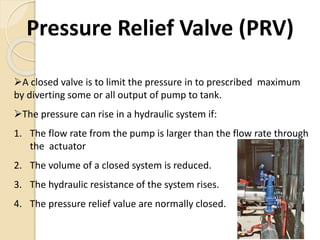
Pressure Relief Valve (PRV)
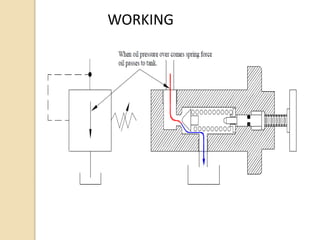
A closed valve is to limit the pressure in to prescribed maximum
by diverting some or all output of pump to tank.
The pressure can rise in a hydraulic system if:
1. The flow rate from the pump is larger than the flow rate through
the actuator
2. The volume of a closed system is reduced.
3. The hydraulic resistance of the system rises.
4. The pressure relief value are normally closed.
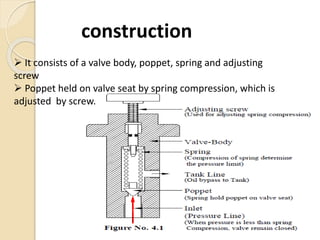
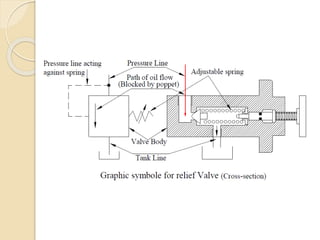
construction
 It consists of a valve body, poppet, spring and adjusting
screw
 Poppet held on valve seat by spring compression, which is
adjusted by screw.
WORKING
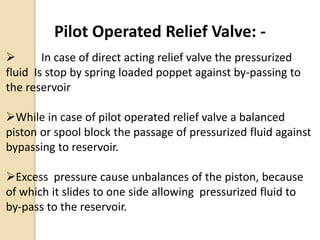
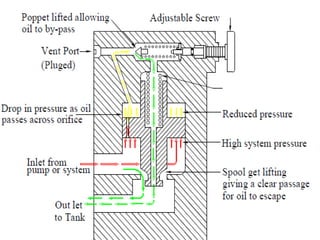
Pilot Operated Relief Valve: -
 In case of direct acting relief valve the pressurized
fluid Is stop by spring loaded poppet against by-passing to
the reservoir
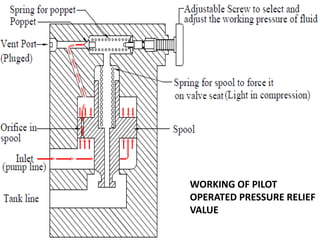
While in case of pilot operated relief valve a balanced
piston or spool block the passage of pressurized fluid against
bypassing to reservoir.
Excess pressure cause unbalances of the piston, because
of which it slides to one side allowing pressurized fluid to
by-pass to the reservoir.
WORKING OF PILOT
OPERATED PRESSURE RELIEF
VALUE
Advantages
a) Smaller package on larger pipe size
b) More option for control
c) Seals more tightly as system
pressure approaches but doesn’t
reach the set pressure.
d) Control pilot can be mounted
remotely
e) It can be used in engines
DISADVANTAGE
a) More complex ,resulting in various
fail –open failure modes
b) more expensive at smaller size
c) Small parts in pilot values are
sensitive to contaminants particles
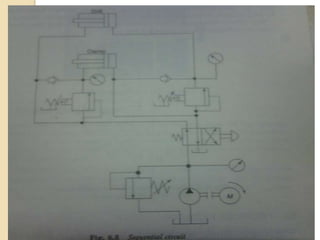
SEQUENCE VALVE
The function of sequence valve is to provide
flow to a second consumer in the case when the
pressure level at a particular consumer has
reached a threshold valve.
As the name implies it is used for sequencing
the operation one after another.
Such application is mostly for in “Tooling and
Automation” where several operation are
sequenced in pre determined manner.
A check valve is connected in parallel with
sequence valve so that both cylinder will retract
simultaneously ( no sequencing is desired in
retracting).
Applications
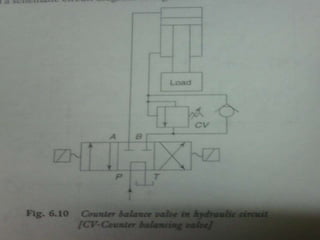
Counter balance valve
Control the vertical cylinder to not
allow it to fall freely.
Also known as back pressure valves.
APPLICATIONS
 Mainly Used in FORKLIFTS when heavy
loads are to be brought down
 Also used in loaders and JCB’S for easy
load pickup and lowering of loads .
 Hydrolic machines
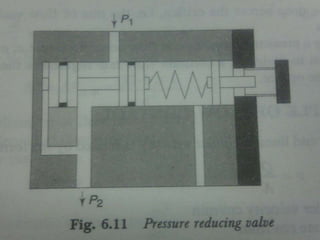
Pressure Reducing Valve
Open pressure control valves
Used to maintain reduced pressure in the
required portion.
 done by increasing the area where the
oil could release the pressure.
APPLICATIONS
 Air Compressors
 Used in inlet of flow of load in pressure
reactors.
 Aircrafts and Aerospoace
 Cooking water pressure reduction.
 Oxifuel welding and cutting.
 Propane/lpg gas – industrial.
transportation and storing.
 Mining industries
Safety values
 All the pressure relief values are kind of
safety values.
 Safety values are values that acts as a fail
safe in a thermal hydraulic plant.
 Safety value came to existence as the
early steam boilers ware prone to
explosion.
Questions…….??
Pressure control valves

Pressure control valves

  • 1.
    HYDRAULIC PRESSURE CONTROL VALVE PRESENTEDBY :- Vikram Golchha (A -65) Shubham Sankhala (A -42) keshav Patil (A -31) GUIDE :- S.P. Mankani Sir
  • 2.
    Contents Introduction Classification of Pressurecontrol valve Pressure relief valve Direct acting relief valve Pilot operated relief valve Sequence control valve Conclusion Reference
  • 3.
    INTRODUCTION Pressure development viarestriction.  control and check of the developing pressure thus pressure relief valve is used. manipulation of pressure and flow of oil in different circuits.
  • 4.
    Terms related toPressure Valves a. Cracking Pressure :-  The pressure at which the valve just begins to bypass the pressurized fluid to reservoir is called Cracking-Pressure. At this pressure the force developed by fluid at ball or poppet (which ever is used) just over-come the compressive force of spring retaining ball or poppet on valve seat.
  • 5.
    b. Full-Flow Pressure:- As fluid start by-passing through the valve, the poppet gets lifted from it seat. This lifting of poppet cause compression of spring. As spring get compressed its force on poppet increases. Hence to further compress spring and allow more passage to fluid for free flows require more pressure. Hence for full-flow of fluid through relief valve is at much high pressure than cracking pressure. The pressure at which full-flow of pump by-passes to reservoir is called “Full-Flow Pressure”.
  • 6.
    Types of PressureControl Valves There are six types of pressure-control valves are: 1. Pressure Relief valves 2. Unloading valves 3. Sequence valves 4. Pressure-reducing valves 5. Counter-balance valves 6. Safety value
  • 7.
    Pressure Relief Valve(PRV) A closed valve is to limit the pressure in to prescribed maximum by diverting some or all output of pump to tank. The pressure can rise in a hydraulic system if: 1. The flow rate from the pump is larger than the flow rate through the actuator 2. The volume of a closed system is reduced. 3. The hydraulic resistance of the system rises. 4. The pressure relief value are normally closed.
  • 8.
    construction  It consistsof a valve body, poppet, spring and adjusting screw  Poppet held on valve seat by spring compression, which is adjusted by screw.
  • 10.
  • 11.
    Pilot Operated ReliefValve: -  In case of direct acting relief valve the pressurized fluid Is stop by spring loaded poppet against by-passing to the reservoir While in case of pilot operated relief valve a balanced piston or spool block the passage of pressurized fluid against bypassing to reservoir. Excess pressure cause unbalances of the piston, because of which it slides to one side allowing pressurized fluid to by-pass to the reservoir.
  • 12.
    WORKING OF PILOT OPERATEDPRESSURE RELIEF VALUE
  • 14.
    Advantages a) Smaller packageon larger pipe size b) More option for control c) Seals more tightly as system pressure approaches but doesn’t reach the set pressure. d) Control pilot can be mounted remotely e) It can be used in engines
  • 15.
    DISADVANTAGE a) More complex,resulting in various fail –open failure modes b) more expensive at smaller size c) Small parts in pilot values are sensitive to contaminants particles
  • 16.
    SEQUENCE VALVE The functionof sequence valve is to provide flow to a second consumer in the case when the pressure level at a particular consumer has reached a threshold valve. As the name implies it is used for sequencing the operation one after another.
  • 18.
    Such application ismostly for in “Tooling and Automation” where several operation are sequenced in pre determined manner. A check valve is connected in parallel with sequence valve so that both cylinder will retract simultaneously ( no sequencing is desired in retracting). Applications
  • 19.
    Counter balance valve Controlthe vertical cylinder to not allow it to fall freely. Also known as back pressure valves.
  • 21.
    APPLICATIONS  Mainly Usedin FORKLIFTS when heavy loads are to be brought down  Also used in loaders and JCB’S for easy load pickup and lowering of loads .  Hydrolic machines
  • 22.
    Pressure Reducing Valve Openpressure control valves Used to maintain reduced pressure in the required portion.  done by increasing the area where the oil could release the pressure.
  • 24.
    APPLICATIONS  Air Compressors Used in inlet of flow of load in pressure reactors.  Aircrafts and Aerospoace  Cooking water pressure reduction.  Oxifuel welding and cutting.  Propane/lpg gas – industrial. transportation and storing.  Mining industries
  • 25.
    Safety values  Allthe pressure relief values are kind of safety values.  Safety values are values that acts as a fail safe in a thermal hydraulic plant.  Safety value came to existence as the early steam boilers ware prone to explosion.
  • 26.