APPLICATION OF REMOTE SENSING AND
GEOGRAPHICAL INFORMATION SYSTEM IN
CIVIL ENGINEERING
Date:
INSTRUCTOR
DR. MOHSIN SIDDIQUE
ASSIST. PROFESSOR
DEPARTMENT OF CIVIL ENGINEERING
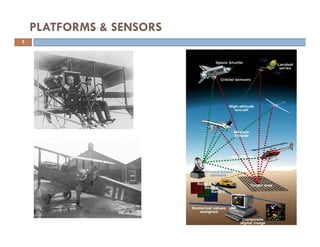
PLATFORMS & SENSORS
Source: http://employees.oneonta.edu/baumanpr/geosat2/RS%20History%20I/RS-History-Part-1.htm
2
PLATFORMS & SENSORS
3
Platform: the vehicle carrying the remote sensing device
Sensor: the remote sensing device recording wavelengths of energy
e.g. Aerial photography - the plane and the camera
Satellite image example:
Platform: Landsat (1, 5, 7 etc..)
Sensor: Multispectral Sensor (MSS) or Thematic Mapper (TM)
PLATFORMS & SENSORS
4
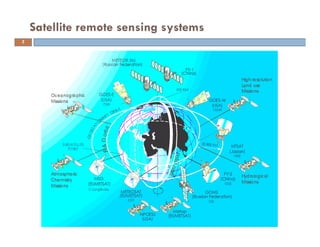
Satellite remote sensing systems
5
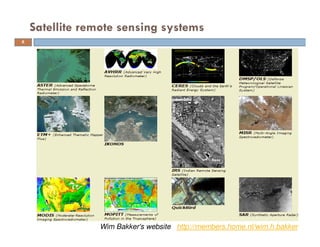
Satellite remote sensing systems
Wim Bakker's website http://members.home.nl/wim.h.bakker
6
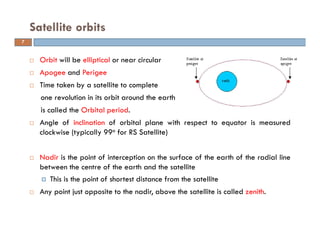
Orbit will be elliptical or near circular
Apogee and Perigee
Time taken by a satellite to complete
one revolution in its orbit around the earth
is called the Orbital period.
Angle of inclination of orbital plane with respect to equator is measured
clockwise (typically 99o for RS Satellite)
Nadir is the point of interception on the surface of the earth of the radial line
between the centre of the earth and the satellite
This is the point of shortest distance from the satellite
Any point just opposite to the nadir, above the satellite is called zenith.
Satellite orbits
7
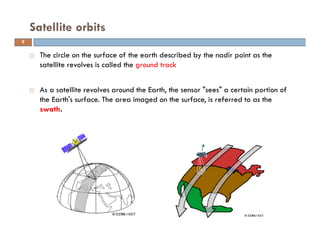
The circle on the surface of the earth described by the nadir point as the
satellite revolves is called the ground track
As a satellite revolves around the Earth, the sensor "sees" a certain portion of
the Earth's surface. The area imaged on the surface, is referred to as the
swath.
Satellite orbits
8
Satellite orbits
9
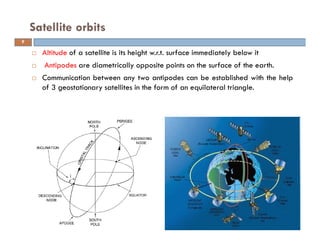
Altitude of a satellite is its height w.r.t. surface immediately below it
Antipodes are diametrically opposite points on the surface of the earth.
Communication between any two antipodes can be established with the help
of 3 geostationary satellites in the form of an equilateral triangle.
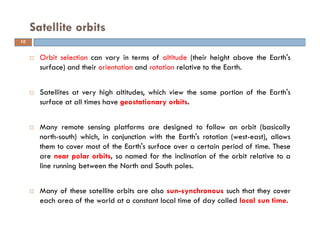
Orbit selection can vary in terms of altitude (their height above the Earth's
surface) and their orientation and rotation relative to the Earth.
Satellites at very high altitudes, which view the same portion of the Earth's
surface at all times have geostationary orbits.
Many remote sensing platforms are designed to follow an orbit (basically
north-south) which, in conjunction with the Earth's rotation (west-east), allows
them to cover most of the Earth's surface over a certain period of time. These
are near polar orbits, so named for the inclination of the orbit relative to a
line running between the North and South poles.
Many of these satellite orbits are also sun-synchronous such that they cover
each area of the world at a constant local time of day called local sun time.
Satellite orbits
10
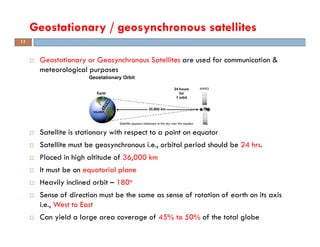
Geostationary or Geosynchronous Satellites are used for communication &
meteorological purposes
Satellite is stationary with respect to a point on equator
Satellite must be geosynchronous i.e., orbital period should be 24 hrs.
Placed in high altitude of 36,000 km
It must be on equatorial plane
Heavily inclined orbit – 180o
Sense of direction must be the same as sense of rotation of earth on its axis
i.e., West to East
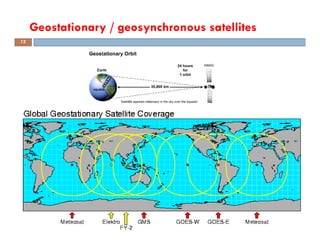
Can yield a large area coverage of 45% to 50% of the total globe
Geostationary / geosynchronous satellites
11
Geostationary / geosynchronous satellites
12
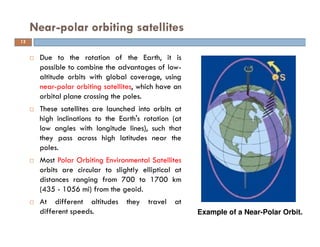
Due to the rotation of the Earth, it is
possible to combine the advantages of low-
altitude orbits with global coverage, using
near-polar orbiting satellites, which have an
orbital plane crossing the poles.
These satellites are launched into orbits at
high inclinations to the Earth's rotation (at
low angles with longitude lines), such that
they pass across high latitudes near the
poles.
Most Polar Orbiting Environmental Satellites
orbits are circular to slightly elliptical at
distances ranging from 700 to 1700 km
(435 - 1056 mi) from the geoid.
At different altitudes they travel at
different speeds.
Near-polar orbiting satellites
Example of a Near-Polar Orbit.
13
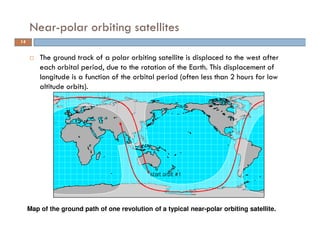
The ground track of a polar orbiting satellite is displaced to the west after
each orbital period, due to the rotation of the Earth. This displacement of
longitude is a function of the orbital period (often less than 2 hours for low
altitude orbits).
Near-polar orbiting satellites
Map of the ground path of one revolution of a typical near-polar orbiting satellite.
14
Near-polar orbiting satellites
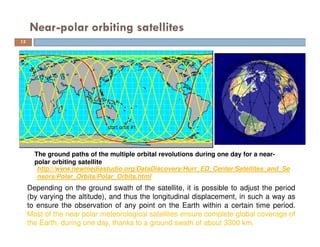
The ground paths of the multiple orbital revolutions during one day for a near-
polar orbiting satellite
http://www.newmediastudio.org/DataDiscovery/Hurr_ED_Center/Satellites_and_Se
nsors/Polar_Orbits/Polar_Orbits.html
15
Depending on the ground swath of the satellite, it is possible to adjust the period
(by varying the altitude), and thus the longitudinal displacement, in such a way as
to ensure the observation of any point on the Earth within a certain time period.
Most of the near polar meteorological satellites ensure complete global coverage of
the Earth, during one day, thanks to a ground swath of about 3300 km.
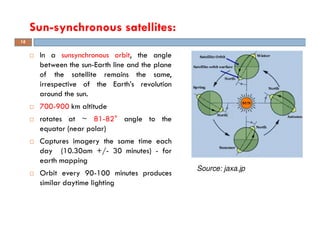
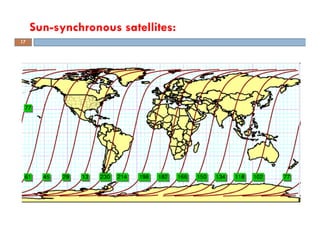
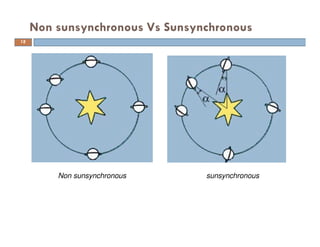
In a sunsynchronous orbit, the angle
between the sun-Earth line and the plane
of the satellite remains the same,
irrespective of the Earth’s revolution
around the sun.
700-900 km altitude
rotates at ~ 81-82° angle to the
equator (near polar)
Captures imagery the same time each
day (10.30am +/- 30 minutes) - for
earth mapping
Orbit every 90-100 minutes produces
similar daytime lighting
Sun-synchronous satellites:
16
Source: jaxa.jp
Sun-synchronous satellites:
17
Non sunsynchronous Vs Sunsynchronous
Non sunsynchronous sunsynchronous
18
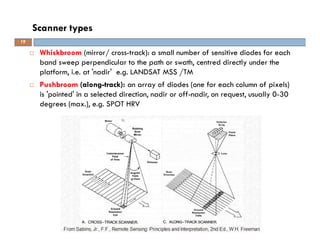
Whiskbroom (mirror/ cross-track): a small number of sensitive diodes for each
band sweep perpendicular to the path or swath, centred directly under the
platform, i.e. at 'nadir' e.g. LANDSAT MSS /TM
Pushbroom (along-track): an array of diodes (one for each column of pixels)
is 'pointed' in a selected direction, nadir or off-nadir, on request, usually 0-30
degrees (max.), e.g. SPOT HRV
Scanner types
19
Multi-spectral sensors record
bands in multiple
wavelengths:
Visible
Near IR
Mid IR
Thermal
Microwave
Sensor groups
And at different spatial
resolutions:
Low >1000m
Medium 100-500m
High 5-80m
Very high 0.5-5m
Many satellites carry multiple
sensors with different
resolutions
Some sensors have more than
one resolution
20
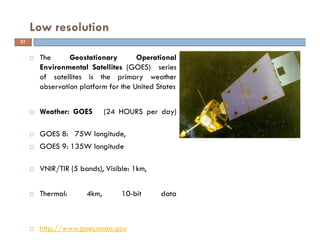
The Geostationary Operational
Environmental Satellites (GOES) series
of satellites is the primary weather
observation platform for the United States
Weather: GOES (24 HOURS per day)
GOES 8: 75W longitude,
GOES 9: 135W longitude
VNIR/TIR (5 bands), Visible: 1km,
Thermal: 4km, 10-bit data
http://www.goes.noaa.gov
Low resolution
21
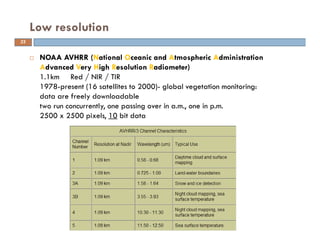
NOAA AVHRR (National Oceanic and Atmospheric Administration
Advanced Very High Resolution Radiometer)
1.1km Red / NIR / TIR
1978-present (16 satellites to 2000)- global vegetation monitoring:
data are freely downloadable
two run concurrently, one passing over in a.m., one in p.m.
2500 x 2500 pixels, 10 bit data
Low resolution
22
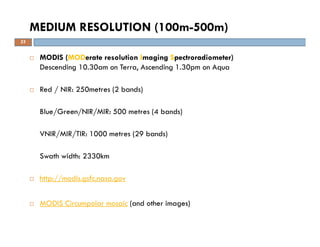
MODIS (MODerate resolution Imaging Spectroradiometer)
Descending 10.30am on Terra, Ascending 1.30pm on Aqua
Red / NIR: 250metres (2 bands)
Blue/Green/NIR/MIR: 500 metres (4 bands)
VNIR/MIR/TIR: 1000 metres (29 bands)
Swath width: 2330km
http://modis.gsfc.nasa.gov
MODIS Circumpolar mosaic (and other images)
MEDIUM RESOLUTION (100m-500m)
23
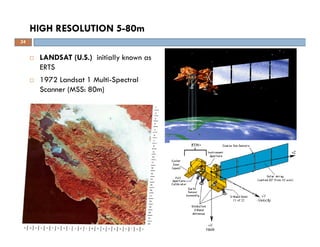
LANDSAT (U.S.) initially known as
ERTS
1972 Landsat 1 Multi-Spectral
Scanner (MSS: 80m)
HIGH RESOLUTION 5-80m
24
LANDSAT (U.S.) - the next generation
1982 Landsat 4 Thematic Mapper (TM: 30m) until 1987
1984 Landsat 5 TM ... still operational
1993 Landsat 6 Enhanced TM: (ETM+) failed shortly after launch
1999 Landsat 7 ETM+ ... malfunctionned April 2003
2005 Landsat imagery (ETM-2000) was used for Google Earth mosaic
Overlap for Landsat sensors is 14% at equator, 45% at 50 degrees
HIGH RESOLUTION
25
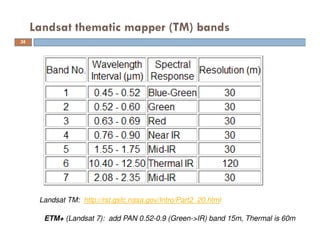
Landsat thematic mapper (TM) bands
Landsat TM: http://rst.gsfc.nasa.gov/Intro/Part2_20.html
ETM+ (Landsat 7): add PAN 0.52-0.9 (Green->IR) band 15m, Thermal is 60m
26
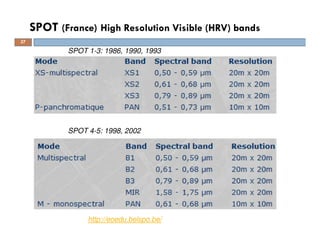
SPOT (France) High Resolution Visible (HRV) bands
http://eoedu.belspo.be/
SPOT 1-3: 1986, 1990, 1993
SPOT 4-5: 1998, 2002
27
SPOT 1 - 5: 1986 - 2002
programmable, pushbroom -60km wide
Can be viewed on 7 different passes (at equator) to 11 at 45 degrees, hence
may be revisited twice a week
SPOT 4: mid-IR added (1.53-1.75 mu), also a 1km 'vegetation sensor‘
PAN changes to .61-.68, but switched back for SPOT5 to match SPOT1-3
SPOT 5: PAN 2.5 or 5m, 10m multispectral (G / R / Near IR / mid IR)
http://www.spot.com
SPOT receiving station at U. Lethbridge (2005)
SPOT imagery (2005-2010) downloadable from geobase.ca
SPOT (France) Systeme Probatoire d'Observation de la Terre
28
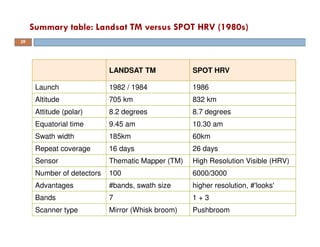
Summary table: Landsat TM versus SPOT HRV (1980s)
LANDSAT TM SPOT HRV
Launch 1982 / 1984 1986
Altitude 705 km 832 km
Attitude (polar) 8.2 degrees 8.7 degrees
Equatorial time 9.45 am 10.30 am
Swath width 185km 60km
Repeat coverage 16 days 26 days
Sensor Thematic Mapper (TM) High Resolution Visible (HRV)
Number of detectors 100 6000/3000
Advantages #bands, swath size higher resolution, #'looks'
Bands 7 1 + 3
Scanner type Mirror (Whisk broom) Pushbroom
29
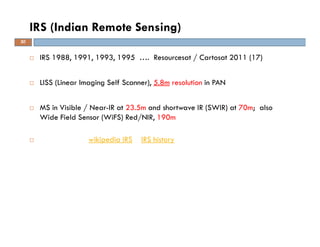
IRS 1988, 1991, 1993, 1995 …. Resourcesat / Cartosat 2011 (17)
LISS (Linear Imaging Self Scanner), 5.8m resolution in PAN
MS in Visible / Near-IR at 23.5m and shortwave IR (SWIR) at 70m; also
Wide Field Sensor (WiFS) Red/NIR, 190m
wikipedia IRS IRS history
IRS (Indian Remote Sensing)
30
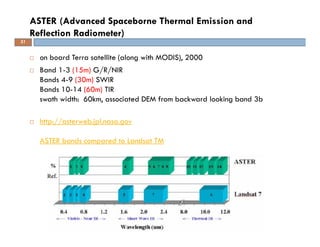
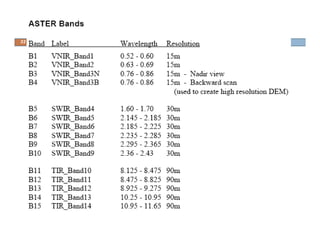
on board Terra satellite (along with MODIS), 2000
Band 1-3 (15m) G/R/NIR
Bands 4-9 (30m) SWIR
Bands 10-14 (60m) TIR
swath width: 60km, associated DEM from backward looking band 3b
http://asterweb.jpl.nasa.gov
ASTER bands compared to Landsat TM
ASTER (Advanced Spaceborne Thermal Emission and
Reflection Radiometer)
31
32
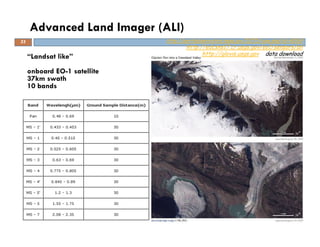
Advanced Land Imager (ALI)
“Landsat like”
onboard EO-1 satellite
37km swath
10 bands
http://earthobservatory.nasa.gov/IOTD/view.php?id=40169
http://edcsns17.cr.usgs.gov/eo1/sensors/ali
http://glovis.usgs.gov data download
33
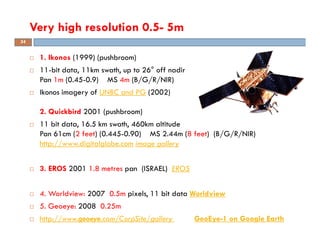
1. Ikonos (1999) (pushbroom)
11-bit data, 11km swath, up to 26° off nadir
Pan 1m (0.45-0.9) MS 4m (B/G/R/NIR)
Ikonos imagery of UNBC and PG (2002)
2. Quickbird 2001 (pushbroom)
11 bit data, 16.5 km swath, 460km altitude
Pan 61cm (2 feet) (0.445-0.90) MS 2.44m (8 feet) (B/G/R/NIR)
http://www.digitalglobe.com image gallery
3. EROS 2001 1.8 metres pan (ISRAEL) EROS
4. Worldview: 2007 0.5m pixels, 11 bit data Worldview
5. Geoeye: 2008 0.25m
http://www.geoeye.com/CorpSite/gallery GeoEye-1 on Google Earth
Very high resolution 0.5- 5m
34
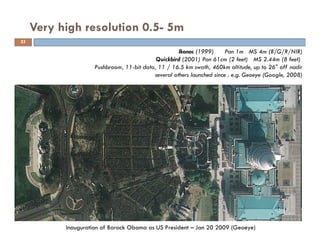
Very high resolution 0.5- 5m
Inauguration of Barack Obama as US President – Jan 20 2009 (Geoeye)
Ikonos (1999) Pan 1m MS 4m (B/G/R/NIR)
Quickbird (2001) Pan 61cm (2 feet) MS 2.44m (8 feet)
Pushbroom, 11-bit data, 11 / 16.5 km swath, 460km altitude, up to 26° off nadir
several others launched since . e.g. Geoeye (Google, 2008)
35
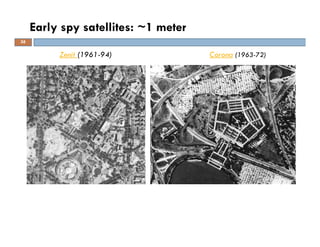
Early spy satellites: ~1 meter
Zenit (1961-94) Corona (1963-72)
36
Comments….
Questions….
Suggestions….
37
I am greatly thankful to all the information sources
(regarding remote sensing and GIS) on internet that I
accessed and utilized for the preparation of present
lecture.
Thank you !
Feel free contact

GIS Plateform and satellite

  • 1.
    APPLICATION OF REMOTESENSING AND GEOGRAPHICAL INFORMATION SYSTEM IN CIVIL ENGINEERING Date: INSTRUCTOR DR. MOHSIN SIDDIQUE ASSIST. PROFESSOR DEPARTMENT OF CIVIL ENGINEERING
  • 2.
    PLATFORMS & SENSORS Source:http://employees.oneonta.edu/baumanpr/geosat2/RS%20History%20I/RS-History-Part-1.htm 2
  • 3.
  • 4.
    Platform: the vehiclecarrying the remote sensing device Sensor: the remote sensing device recording wavelengths of energy e.g. Aerial photography - the plane and the camera Satellite image example: Platform: Landsat (1, 5, 7 etc..) Sensor: Multispectral Sensor (MSS) or Thematic Mapper (TM) PLATFORMS & SENSORS 4
  • 5.
  • 6.
    Satellite remote sensingsystems Wim Bakker's website http://members.home.nl/wim.h.bakker 6
  • 7.
    Orbit will beelliptical or near circular Apogee and Perigee Time taken by a satellite to complete one revolution in its orbit around the earth is called the Orbital period. Angle of inclination of orbital plane with respect to equator is measured clockwise (typically 99o for RS Satellite) Nadir is the point of interception on the surface of the earth of the radial line between the centre of the earth and the satellite This is the point of shortest distance from the satellite Any point just opposite to the nadir, above the satellite is called zenith. Satellite orbits 7
  • 8.
    The circle onthe surface of the earth described by the nadir point as the satellite revolves is called the ground track As a satellite revolves around the Earth, the sensor "sees" a certain portion of the Earth's surface. The area imaged on the surface, is referred to as the swath. Satellite orbits 8
  • 9.
    Satellite orbits 9 Altitude ofa satellite is its height w.r.t. surface immediately below it Antipodes are diametrically opposite points on the surface of the earth. Communication between any two antipodes can be established with the help of 3 geostationary satellites in the form of an equilateral triangle.
  • 10.
    Orbit selection canvary in terms of altitude (their height above the Earth's surface) and their orientation and rotation relative to the Earth. Satellites at very high altitudes, which view the same portion of the Earth's surface at all times have geostationary orbits. Many remote sensing platforms are designed to follow an orbit (basically north-south) which, in conjunction with the Earth's rotation (west-east), allows them to cover most of the Earth's surface over a certain period of time. These are near polar orbits, so named for the inclination of the orbit relative to a line running between the North and South poles. Many of these satellite orbits are also sun-synchronous such that they cover each area of the world at a constant local time of day called local sun time. Satellite orbits 10
  • 11.
    Geostationary or GeosynchronousSatellites are used for communication & meteorological purposes Satellite is stationary with respect to a point on equator Satellite must be geosynchronous i.e., orbital period should be 24 hrs. Placed in high altitude of 36,000 km It must be on equatorial plane Heavily inclined orbit – 180o Sense of direction must be the same as sense of rotation of earth on its axis i.e., West to East Can yield a large area coverage of 45% to 50% of the total globe Geostationary / geosynchronous satellites 11
  • 12.
  • 13.
    Due to therotation of the Earth, it is possible to combine the advantages of low- altitude orbits with global coverage, using near-polar orbiting satellites, which have an orbital plane crossing the poles. These satellites are launched into orbits at high inclinations to the Earth's rotation (at low angles with longitude lines), such that they pass across high latitudes near the poles. Most Polar Orbiting Environmental Satellites orbits are circular to slightly elliptical at distances ranging from 700 to 1700 km (435 - 1056 mi) from the geoid. At different altitudes they travel at different speeds. Near-polar orbiting satellites Example of a Near-Polar Orbit. 13
  • 14.
    The ground trackof a polar orbiting satellite is displaced to the west after each orbital period, due to the rotation of the Earth. This displacement of longitude is a function of the orbital period (often less than 2 hours for low altitude orbits). Near-polar orbiting satellites Map of the ground path of one revolution of a typical near-polar orbiting satellite. 14
  • 15.
    Near-polar orbiting satellites Theground paths of the multiple orbital revolutions during one day for a near- polar orbiting satellite http://www.newmediastudio.org/DataDiscovery/Hurr_ED_Center/Satellites_and_Se nsors/Polar_Orbits/Polar_Orbits.html 15 Depending on the ground swath of the satellite, it is possible to adjust the period (by varying the altitude), and thus the longitudinal displacement, in such a way as to ensure the observation of any point on the Earth within a certain time period. Most of the near polar meteorological satellites ensure complete global coverage of the Earth, during one day, thanks to a ground swath of about 3300 km.
  • 16.
    In a sunsynchronousorbit, the angle between the sun-Earth line and the plane of the satellite remains the same, irrespective of the Earth’s revolution around the sun. 700-900 km altitude rotates at ~ 81-82° angle to the equator (near polar) Captures imagery the same time each day (10.30am +/- 30 minutes) - for earth mapping Orbit every 90-100 minutes produces similar daytime lighting Sun-synchronous satellites: 16 Source: jaxa.jp
  • 17.
  • 18.
    Non sunsynchronous VsSunsynchronous Non sunsynchronous sunsynchronous 18
  • 19.
    Whiskbroom (mirror/ cross-track):a small number of sensitive diodes for each band sweep perpendicular to the path or swath, centred directly under the platform, i.e. at 'nadir' e.g. LANDSAT MSS /TM Pushbroom (along-track): an array of diodes (one for each column of pixels) is 'pointed' in a selected direction, nadir or off-nadir, on request, usually 0-30 degrees (max.), e.g. SPOT HRV Scanner types 19
  • 20.
    Multi-spectral sensors record bandsin multiple wavelengths: Visible Near IR Mid IR Thermal Microwave Sensor groups And at different spatial resolutions: Low >1000m Medium 100-500m High 5-80m Very high 0.5-5m Many satellites carry multiple sensors with different resolutions Some sensors have more than one resolution 20
  • 21.
    The Geostationary Operational EnvironmentalSatellites (GOES) series of satellites is the primary weather observation platform for the United States Weather: GOES (24 HOURS per day) GOES 8: 75W longitude, GOES 9: 135W longitude VNIR/TIR (5 bands), Visible: 1km, Thermal: 4km, 10-bit data http://www.goes.noaa.gov Low resolution 21
  • 22.
    NOAA AVHRR (NationalOceanic and Atmospheric Administration Advanced Very High Resolution Radiometer) 1.1km Red / NIR / TIR 1978-present (16 satellites to 2000)- global vegetation monitoring: data are freely downloadable two run concurrently, one passing over in a.m., one in p.m. 2500 x 2500 pixels, 10 bit data Low resolution 22
  • 23.
    MODIS (MODerate resolutionImaging Spectroradiometer) Descending 10.30am on Terra, Ascending 1.30pm on Aqua Red / NIR: 250metres (2 bands) Blue/Green/NIR/MIR: 500 metres (4 bands) VNIR/MIR/TIR: 1000 metres (29 bands) Swath width: 2330km http://modis.gsfc.nasa.gov MODIS Circumpolar mosaic (and other images) MEDIUM RESOLUTION (100m-500m) 23
  • 24.
    LANDSAT (U.S.) initiallyknown as ERTS 1972 Landsat 1 Multi-Spectral Scanner (MSS: 80m) HIGH RESOLUTION 5-80m 24
  • 25.
    LANDSAT (U.S.) -the next generation 1982 Landsat 4 Thematic Mapper (TM: 30m) until 1987 1984 Landsat 5 TM ... still operational 1993 Landsat 6 Enhanced TM: (ETM+) failed shortly after launch 1999 Landsat 7 ETM+ ... malfunctionned April 2003 2005 Landsat imagery (ETM-2000) was used for Google Earth mosaic Overlap for Landsat sensors is 14% at equator, 45% at 50 degrees HIGH RESOLUTION 25
  • 26.
    Landsat thematic mapper(TM) bands Landsat TM: http://rst.gsfc.nasa.gov/Intro/Part2_20.html ETM+ (Landsat 7): add PAN 0.52-0.9 (Green->IR) band 15m, Thermal is 60m 26
  • 27.
    SPOT (France) HighResolution Visible (HRV) bands http://eoedu.belspo.be/ SPOT 1-3: 1986, 1990, 1993 SPOT 4-5: 1998, 2002 27
  • 28.
    SPOT 1 -5: 1986 - 2002 programmable, pushbroom -60km wide Can be viewed on 7 different passes (at equator) to 11 at 45 degrees, hence may be revisited twice a week SPOT 4: mid-IR added (1.53-1.75 mu), also a 1km 'vegetation sensor‘ PAN changes to .61-.68, but switched back for SPOT5 to match SPOT1-3 SPOT 5: PAN 2.5 or 5m, 10m multispectral (G / R / Near IR / mid IR) http://www.spot.com SPOT receiving station at U. Lethbridge (2005) SPOT imagery (2005-2010) downloadable from geobase.ca SPOT (France) Systeme Probatoire d'Observation de la Terre 28
  • 29.
    Summary table: LandsatTM versus SPOT HRV (1980s) LANDSAT TM SPOT HRV Launch 1982 / 1984 1986 Altitude 705 km 832 km Attitude (polar) 8.2 degrees 8.7 degrees Equatorial time 9.45 am 10.30 am Swath width 185km 60km Repeat coverage 16 days 26 days Sensor Thematic Mapper (TM) High Resolution Visible (HRV) Number of detectors 100 6000/3000 Advantages #bands, swath size higher resolution, #'looks' Bands 7 1 + 3 Scanner type Mirror (Whisk broom) Pushbroom 29
  • 30.
    IRS 1988, 1991,1993, 1995 …. Resourcesat / Cartosat 2011 (17) LISS (Linear Imaging Self Scanner), 5.8m resolution in PAN MS in Visible / Near-IR at 23.5m and shortwave IR (SWIR) at 70m; also Wide Field Sensor (WiFS) Red/NIR, 190m wikipedia IRS IRS history IRS (Indian Remote Sensing) 30
  • 31.
    on board Terrasatellite (along with MODIS), 2000 Band 1-3 (15m) G/R/NIR Bands 4-9 (30m) SWIR Bands 10-14 (60m) TIR swath width: 60km, associated DEM from backward looking band 3b http://asterweb.jpl.nasa.gov ASTER bands compared to Landsat TM ASTER (Advanced Spaceborne Thermal Emission and Reflection Radiometer) 31
  • 32.
  • 33.
    Advanced Land Imager(ALI) “Landsat like” onboard EO-1 satellite 37km swath 10 bands http://earthobservatory.nasa.gov/IOTD/view.php?id=40169 http://edcsns17.cr.usgs.gov/eo1/sensors/ali http://glovis.usgs.gov data download 33
  • 34.
    1. Ikonos (1999)(pushbroom) 11-bit data, 11km swath, up to 26° off nadir Pan 1m (0.45-0.9) MS 4m (B/G/R/NIR) Ikonos imagery of UNBC and PG (2002) 2. Quickbird 2001 (pushbroom) 11 bit data, 16.5 km swath, 460km altitude Pan 61cm (2 feet) (0.445-0.90) MS 2.44m (8 feet) (B/G/R/NIR) http://www.digitalglobe.com image gallery 3. EROS 2001 1.8 metres pan (ISRAEL) EROS 4. Worldview: 2007 0.5m pixels, 11 bit data Worldview 5. Geoeye: 2008 0.25m http://www.geoeye.com/CorpSite/gallery GeoEye-1 on Google Earth Very high resolution 0.5- 5m 34
  • 35.
    Very high resolution0.5- 5m Inauguration of Barack Obama as US President – Jan 20 2009 (Geoeye) Ikonos (1999) Pan 1m MS 4m (B/G/R/NIR) Quickbird (2001) Pan 61cm (2 feet) MS 2.44m (8 feet) Pushbroom, 11-bit data, 11 / 16.5 km swath, 460km altitude, up to 26° off nadir several others launched since . e.g. Geoeye (Google, 2008) 35
  • 36.
    Early spy satellites:~1 meter Zenit (1961-94) Corona (1963-72) 36
  • 37.
    Comments…. Questions…. Suggestions…. 37 I am greatlythankful to all the information sources (regarding remote sensing and GIS) on internet that I accessed and utilized for the preparation of present lecture. Thank you ! Feel free contact