• Remote sensingis the acquiring of information from a
distance.
• NASA observes Earth and other planetary bodies via
remote sensors on satellites and aircraft that detect and
record reflected or emitted energy.
• Orbits
• Observing with the Electromagnetic Spectrum
• Sensors
• Resolution
• Data Processing, Interpretation, and
• Analysis
3.
Orbits
• Satellites canbe placed in several types of orbits around Earth.
• Low-Earth orbit (approximately 160 to 2,000 km above Earth),
• Medium-Earth orbit (approximately 2,000 to 35,500 km above
Earth), and
• High-Earth orbit (above 35,500 km above Earth).
• Satellites orbiting at 35,786 km are at an altitude at which their
orbital speed matches the planet's rotation, and are in what is
called geosynchronous orbit (GSO).
• In addition, a satellite in GSO directly over the equator will
have a geostationary orbit.
• A geostationary orbit enables a satellite to maintain its position
directly over the same place on Earth’s surface.
• Sun-synchronous; the satellite passes over the same location at
the same solar time each cycle, e.g. NASA’s Aqua satellite
Observing with theElectromagnetic Spectrum
• Visible light sits in the middle of that range of long to shortwave
radiation.
• human eye is able to detect a small portion.
• Instrumentation is needed to detect all other forms
6.
• The primarysource of the energy observed by satellites, is the Sun.
• Snow has a very high albedo and reflects up to 90% of incoming
solar radiation.
• The ocean, on the other hand, reflects only about 6%.
7.
Sensors
• Sensors thatuse natural energy from the Sun
are called passive sensors.
• Those that provide their own source of energy
are called active sensors.
8.
Resolution
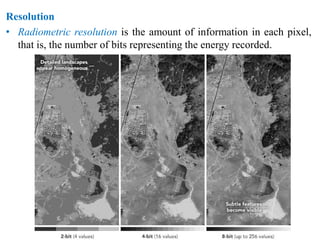
• Radiometric resolutionis the amount of information in each pixel,
that is, the number of bits representing the energy recorded.
9.
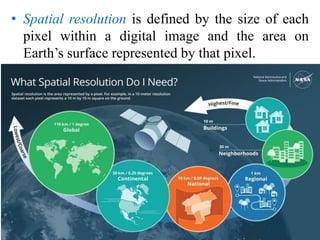
• Spatial resolutionis defined by the size of each
pixel within a digital image and the area on
Earth’s surface represented by that pixel.
• Spectral resolutionis the ability of a sensor to discern
finer wavelengths, or
• the ability of a sensor to define fine wavelength intervals.
or
• The range of wavelengths that a single band in an
imaging system can detect.
12.
• Temporal resolutionis the time it takes for a
satellite to complete an orbit and revisit the same
observation area.
• This resolution depends on the orbit, the sensor’s
characteristics, and the swath width.
• Because geostationary satellites match the rate at
which Earth is rotating, the temporal resolution is
much finer.
• Polar orbiting satellites have a temporal resolution
that can vary from 1 day to 16 days.
Interpretation of imagery
Lookfor a Scale
• One of the first things people want to do when they look at a
satellite image is identify the places that are familiar to them: