DR NILESH KATE
MBBS,MD
ASSOCIATE PROF
ESIC MEDICAL COLLEGE, GULBARGA.
DEPT. OF PHYSIOLOGY
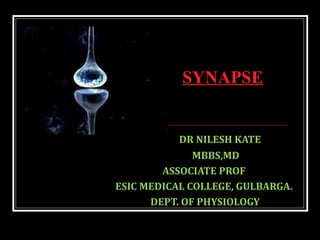
SYNAPSE
OBJECTIVES
 SYNAPSE
 Types
 CHEMICAL SYNAPSE
 Structure
 Process
 Inhibition
 properties
 NEUROTRANSMITTERS.
 APPLIED.
SYNAPSE
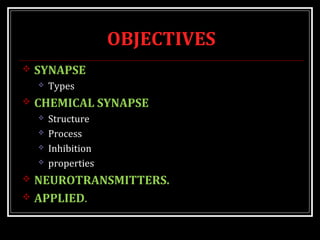
 Definition – Synapse
is the functional
communicating
junction between 2
nerve cells.
Thursday, February 1, 2018
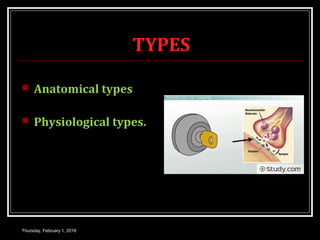
TYPES
 Anatomical types
 Physiological types.
Thursday, February 1, 2018
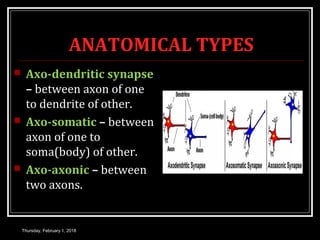
ANATOMICAL TYPES
 Axo-dendritic synapse
– between axon of one
to dendrite of other.
 Axo-somatic – between
axon of one to
soma(body) of other.
 Axo-axonic – between
two axons.
Thursday, February 1, 2018
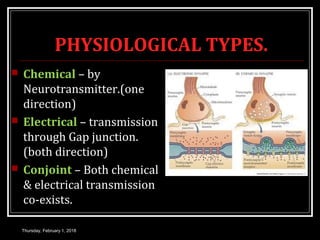
PHYSIOLOGICAL TYPES.
 Chemical – by
Neurotransmitter.(one
direction)
 Electrical – transmission
through Gap junction.
(both direction)
 Conjoint – Both chemical
& electrical transmission
co-exists.
Thursday, February 1, 2018
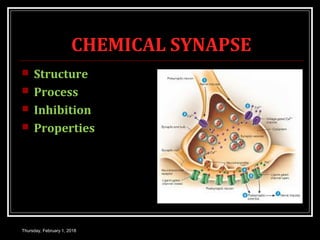
CHEMICAL SYNAPSE
 Structure
 Process
 Inhibition
 Properties
Thursday, February 1, 2018
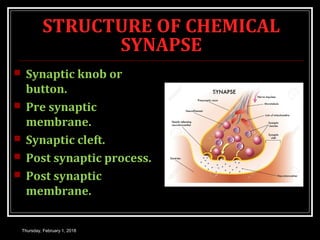
STRUCTURE OF CHEMICAL
SYNAPSE
 Synaptic knob or
button.
 Pre synaptic
membrane.
 Synaptic cleft.
 Post synaptic process.
 Post synaptic
membrane.
Thursday, February 1, 2018
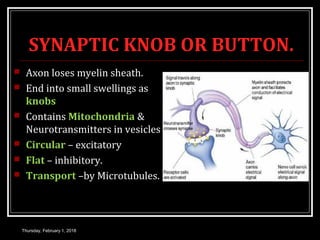
SYNAPTIC KNOB OR BUTTON.
 Axon loses myelin sheath.
 End into small swellings as
knobs
 Contains Mitochondria &
Neurotransmitters in vesicles
 Circular – excitatory
 Flat – inhibitory.
 Transport –by Microtubules.
Thursday, February 1, 2018
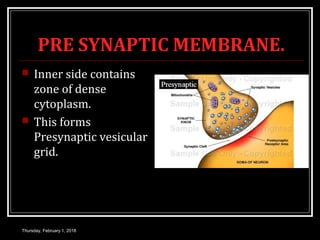
PRE SYNAPTIC MEMBRANE.
 Inner side contains
zone of dense
cytoplasm.
 This forms
Presynaptic vesicular
grid.
Thursday, February 1, 2018
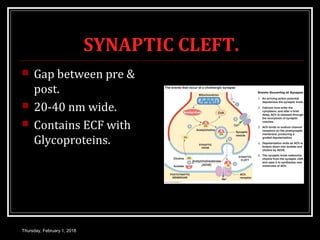
SYNAPTIC CLEFT.
 Gap between pre &
post.
 20-40 nm wide.
 Contains ECF with
Glycoproteins.
Thursday, February 1, 2018
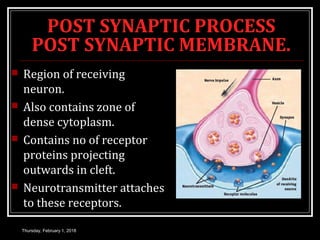
POST SYNAPTIC PROCESS
POST SYNAPTIC MEMBRANE.
 Region of receiving
neuron.
 Also contains zone of
dense cytoplasm.
 Contains no of receptor
proteins projecting
outwards in cleft.
 Neurotransmitter attaches
to these receptors.
Thursday, February 1, 2018
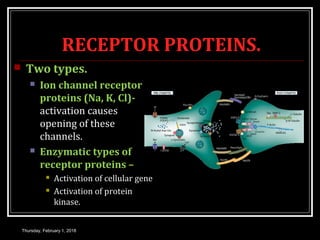
RECEPTOR PROTEINS.
 Two types.
 Ion channel receptor
proteins (Na, K, Cl)-
activation causes
opening of these
channels.
 Enzymatic types of
receptor proteins –
 Activation of cellular gene
 Activation of protein
kinase.
Thursday, February 1, 2018
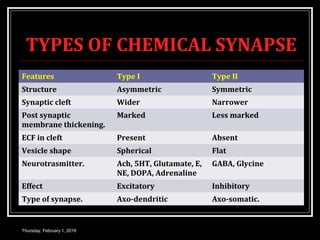
TYPES OF CHEMICAL SYNAPSE
Features Type I Type II
Structure Asymmetric Symmetric
Synaptic cleft Wider Narrower
Post synaptic
membrane thickening.
Marked Less marked
ECF in cleft Present Absent
Vesicle shape Spherical Flat
Neurotrasmitter. Ach, 5HT, Glutamate, E,
NE, DOPA, Adrenaline
GABA, Glycine
Effect Excitatory Inhibitory
Type of synapse. Axo-dendritic Axo-somatic.
Thursday, February 1, 2018
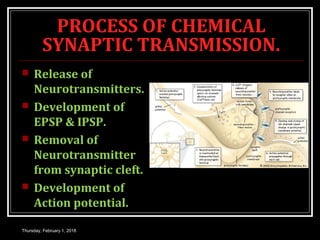
PROCESS OF CHEMICAL
SYNAPTIC TRANSMISSION.
 Release of
Neurotransmitters.
 Development of
EPSP & IPSP.
 Removal of
Neurotransmitter
from synaptic cleft.
 Development of
Action potential.
Thursday, February 1, 2018
RELEASE OF
NEUROTRANSMITTERS.
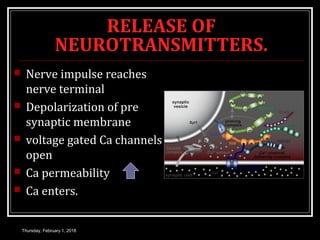
 Nerve impulse reaches
nerve terminal
 Depolarization of pre
synaptic membrane
 voltage gated Ca channels
open
 Ca permeability
 Ca enters.
Thursday, February 1, 2018
Dale’s Phenomenon.
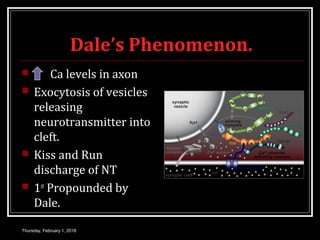
 Ca levels in axon
 Exocytosis of vesicles
releasing
neurotransmitter into
cleft.
 Kiss and Run
discharge of NT
 1st
Propounded by
Dale.
Thursday, February 1, 2018
DEVELOPMENT OF EPSP.
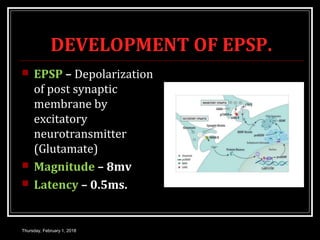
 EPSP – Depolarization
of post synaptic
membrane by
excitatory
neurotransmitter
(Glutamate)
 Magnitude – 8mv
 Latency – 0.5ms.
Thursday, February 1, 2018
EPSP
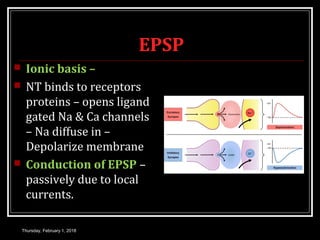
 Ionic basis –
 NT binds to receptors
proteins – opens ligand
gated Na & Ca channels
– Na diffuse in –
Depolarize membrane
 Conduction of EPSP –
passively due to local
currents.
Thursday, February 1, 2018
EPSP
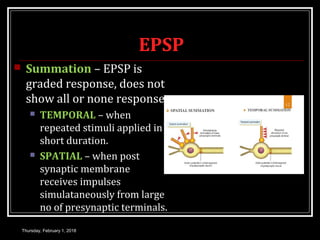
 Summation – EPSP is
graded response, does not
show all or none response.
 TEMPORAL – when
repeated stimuli applied in
short duration.
 SPATIAL – when post
synaptic membrane
receives impulses
simulataneously from large
no of presynaptic terminals.
Thursday, February 1, 2018
DEVELOPMENT OF IPSP.
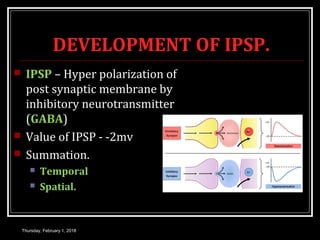
 IPSP – Hyper polarization of
post synaptic membrane by
inhibitory neurotransmitter
(GABA)
 Value of IPSP - -2mv
 Summation.
 Temporal
 Spatial.
Thursday, February 1, 2018
IPSP
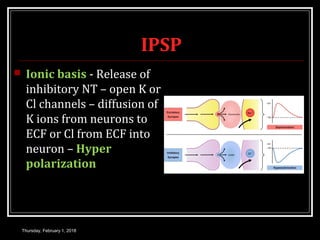
 Ionic basis - Release of
inhibitory NT – open K or
Cl channels – diffusion of
K ions from neurons to
ECF or Cl from ECF into
neuron – Hyper
polarization
Thursday, February 1, 2018
REMOVAL OF NEUROTRANSMITTER
FROM SYNAPTIC CLEFT.
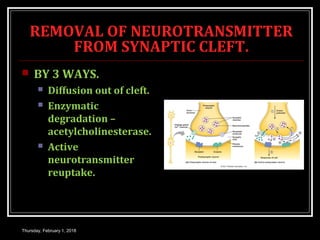
 BY 3 WAYS.
 Diffusion out of cleft.
 Enzymatic
degradation –
acetylcholinesterase.
 Active
neurotransmitter
reuptake.
Thursday, February 1, 2018
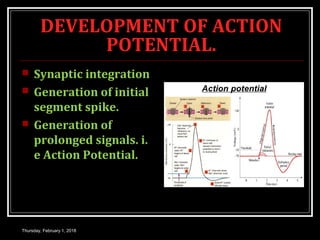
DEVELOPMENT OF ACTION
POTENTIAL.
 Synaptic integration
 Generation of initial
segment spike.
 Generation of
prolonged signals. i.
e Action Potential.
Thursday, February 1, 2018
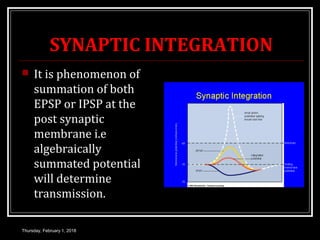
SYNAPTIC INTEGRATION
 It is phenomenon of
summation of both
EPSP or IPSP at the
post synaptic
membrane i.e
algebraically
summated potential
will determine
transmission.
Thursday, February 1, 2018
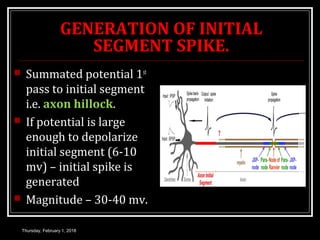
GENERATION OF INITIAL
SEGMENT SPIKE.
 Summated potential 1st
pass to initial segment
i.e. axon hillock.
 If potential is large
enough to depolarize
initial segment (6-10
mv) – initial spike is
generated
 Magnitude – 30-40 mv.
Thursday, February 1, 2018
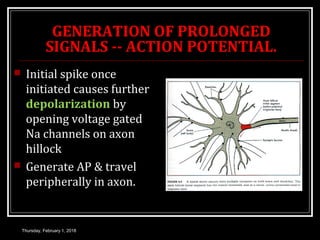
GENERATION OF PROLONGED
SIGNALS -- ACTION POTENTIAL.
 Initial spike once
initiated causes further
depolarization by
opening voltage gated
Na channels on axon
hillock
 Generate AP & travel
peripherally in axon.
Thursday, February 1, 2018
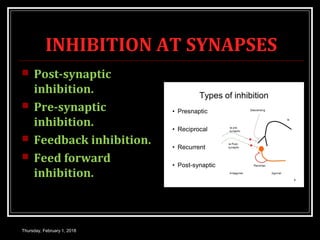
INHIBITION AT SYNAPSES
 Post-synaptic
inhibition.
 Pre-synaptic
inhibition.
 Feedback inhibition.
 Feed forward
inhibition.
Thursday, February 1, 2018
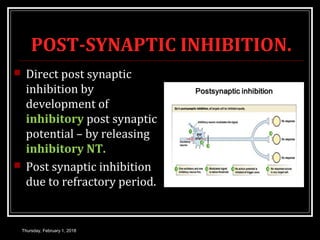
POST-SYNAPTIC INHIBITION.
 Direct post synaptic
inhibition by
development of
inhibitory post synaptic
potential – by releasing
inhibitory NT.
 Post synaptic inhibition
due to refractory period.
Thursday, February 1, 2018
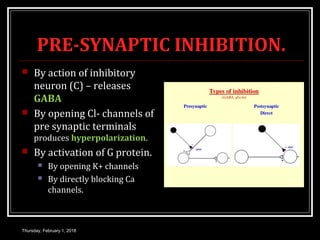
PRE-SYNAPTIC INHIBITION.
 By action of inhibitory
neuron (C) – releases
GABA
 By opening Cl- channels of
pre synaptic terminals
produces hyperpolarization.
 By activation of G protein.
 By opening K+ channels
 By directly blocking Ca
channels.
Thursday, February 1, 2018
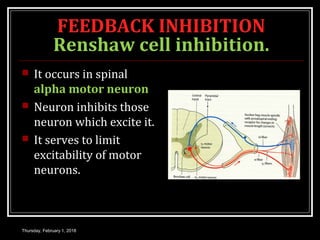
FEEDBACK INHIBITION
Renshaw cell inhibition.
 It occurs in spinal
alpha motor neuron
 Neuron inhibits those
neuron which excite it.
 It serves to limit
excitability of motor
neurons.
Thursday, February 1, 2018
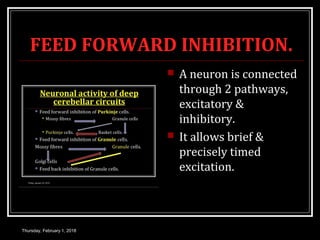
FEED FORWARD INHIBITION.
 A neuron is connected
through 2 pathways,
excitatory &
inhibitory.
 It allows brief &
precisely timed
excitation.
Thursday, February 1, 2018
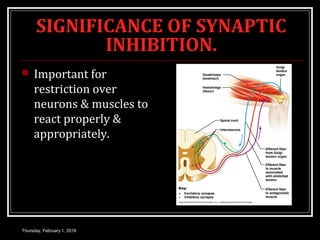
SIGNIFICANCE OF SYNAPTIC
INHIBITION.
 Important for
restriction over
neurons & muscles to
react properly &
appropriately.
Thursday, February 1, 2018
PROPERTIES OF SYNAPTIC
TRANSMISSION.
 One way conduction.
 Synaptic delay.
 Summation property of
synapse.
 Conversions &
divergence.
 Occlusion phenomenon.
 Subliminal fringe effect.
 Facilitation.
 Synaptic fatigue.
 Synaptic plasticity &
learning.
 Reverberation.
 Reciprocal inhibition.
 After discharge.
 Effect of acidosis &
Hypoxia
Thursday, February 1, 2018
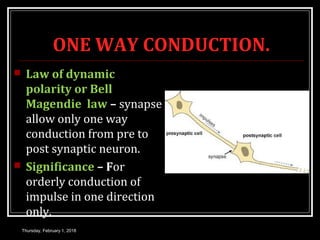
ONE WAY CONDUCTION.
 Law of dynamic
polarity or Bell
Magendie law – synapse
allow only one way
conduction from pre to
post synaptic neuron.
 Significance – For
orderly conduction of
impulse in one direction
only.
Thursday, February 1, 2018
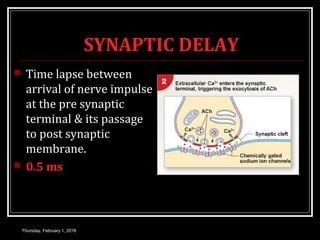
SYNAPTIC DELAY
 Time lapse between
arrival of nerve impulse
at the pre synaptic
terminal & its passage
to post synaptic
membrane.
 0.5 ms
Thursday, February 1, 2018
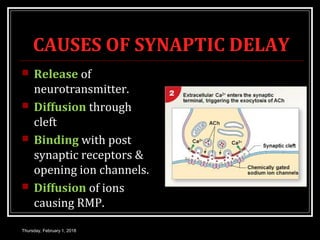
CAUSES OF SYNAPTIC DELAY
 Release of
neurotransmitter.
 Diffusion through
cleft
 Binding with post
synaptic receptors &
opening ion channels.
 Diffusion of ions
causing RMP.
Thursday, February 1, 2018
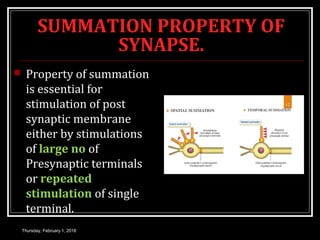
SUMMATION PROPERTY OF
SYNAPSE.
 Property of summation
is essential for
stimulation of post
synaptic membrane
either by stimulations
of large no of
Presynaptic terminals
or repeated
stimulation of single
terminal.
Thursday, February 1, 2018
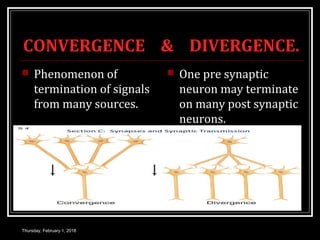
CONVERGENCE & DIVERGENCE.
 Phenomenon of
termination of signals
from many sources.
 One pre synaptic
neuron may terminate
on many post synaptic
neurons.
Thursday, February 1, 2018
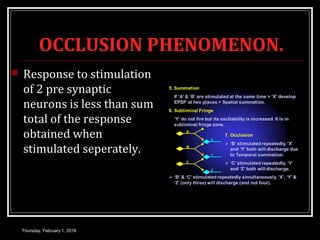
OCCLUSION PHENOMENON.
 Response to stimulation
of 2 pre synaptic
neurons is less than sum
total of the response
obtained when
stimulated seperately.
Thursday, February 1, 2018
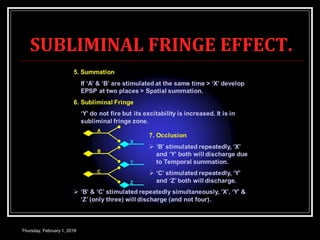
SUBLIMINAL FRINGE EFFECT.
Thursday, February 1, 2018
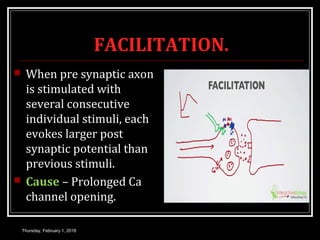
FACILITATION.
 When pre synaptic axon
is stimulated with
several consecutive
individual stimuli, each
evokes larger post
synaptic potential than
previous stimuli.
 Cause – Prolonged Ca
channel opening.
Thursday, February 1, 2018
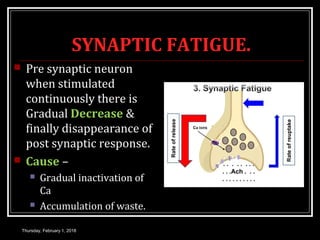
SYNAPTIC FATIGUE.
 Pre synaptic neuron
when stimulated
continuously there is
Gradual Decrease &
finally disappearance of
post synaptic response.
 Cause –
 Gradual inactivation of
Ca
 Accumulation of waste.
Thursday, February 1, 2018
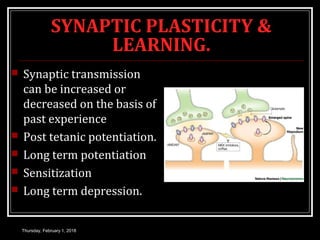
SYNAPTIC PLASTICITY &
LEARNING.
 Synaptic transmission
can be increased or
decreased on the basis of
past experience
 Post tetanic potentiation.
 Long term potentiation
 Sensitization
 Long term depression.
Thursday, February 1, 2018
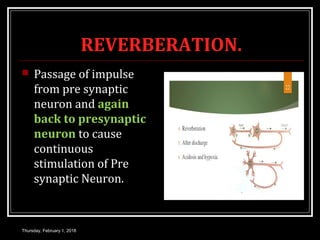
REVERBERATION.
 Passage of impulse
from pre synaptic
neuron and again
back to presynaptic
neuron to cause
continuous
stimulation of Pre
synaptic Neuron.
Thursday, February 1, 2018
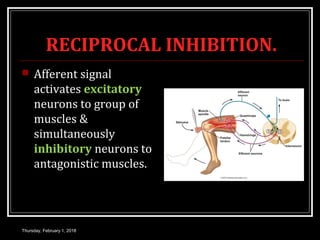
RECIPROCAL INHIBITION.
 Afferent signal
activates excitatory
neurons to group of
muscles &
simultaneously
inhibitory neurons to
antagonistic muscles.
Thursday, February 1, 2018
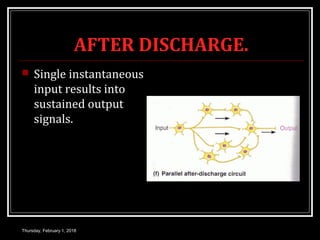
AFTER DISCHARGE.
 Single instantaneous
input results into
sustained output
signals.
Thursday, February 1, 2018
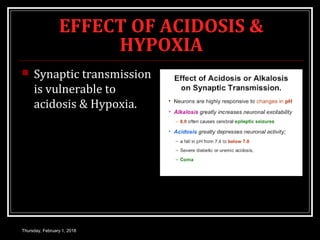
EFFECT OF ACIDOSIS &
HYPOXIA
 Synaptic transmission
is vulnerable to
acidosis & Hypoxia.
Thursday, February 1, 2018
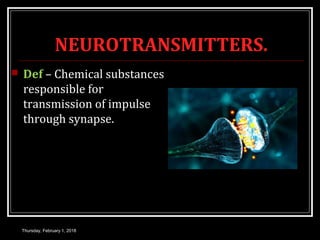
NEUROTRANSMITTERS.
 Def – Chemical substances
responsible for
transmission of impulse
through synapse.
Thursday, February 1, 2018
CRITERIA FOR
NEUROTRANSMITTER.
 Should be synthesized by pre synaptic neuron &
stored in vesicle.
 Should be released by stimulation of nerve.
 Travels a short distance of synaptic cleft.
 Associated with enzyme or enzyme system for
inactivation.
 When applied extrinsically should mimic effect of
nerve stimulation.
Thursday, February 1, 2018
CLASSIFICATION.
 Biochemical
 Small molecule
 Acetylcholine
 Biogenic amines. (E,NE, DA,5HT, Histamine)
 Amino acids (GABA, Glycine, Glutamate, Aspartate)
 Neuro peptide.
 Physiological
 Excitatory
 Inbitory
Thursday, February 1, 2018
ACETYLCHOLINE
 Principal NT released by cholinergic neurons.
 At N-M junction.
 Preganglionic & post-ganglionic Para-
sympathetic
 Preganglionic Sympathetic.
 Postganglionic sympathetic which innervates –
sweat glands & skeletal muscle blood vessels.
 Ending of Amacrine cells of retina.
Thursday, February 1, 2018
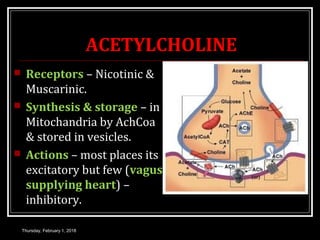
ACETYLCHOLINE
 Receptors – Nicotinic &
Muscarinic.
 Synthesis & storage – in
Mitochandria by AchCoa
& stored in vesicles.
 Actions – most places its
excitatory but few (vagus
supplying heart) –
inhibitory.
Thursday, February 1, 2018
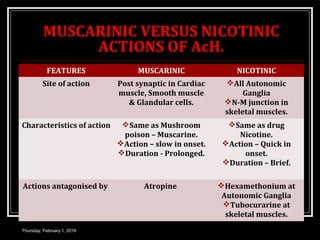
MUSCARINIC VERSUS NICOTINIC
ACTIONS OF AcH.
FEATURES MUSCARINIC NICOTINIC
Site of action Post synaptic in Cardiac
muscle, Smooth muscle
& Glandular cells.
All Autonomic
Ganglia
N-M junction in
skeletal muscles.
Characteristics of action Same as Mushroom
poison – Muscarine.
Action – slow in onset.
Duration - Prolonged.
Same as drug
Nicotine.
Action – Quick in
onset.
Duration – Brief.
Actions antagonised by Atropine Hexamethonium at
Autonomic Ganglia
Tubocurarine at
skeletal muscles.
Thursday, February 1, 2018
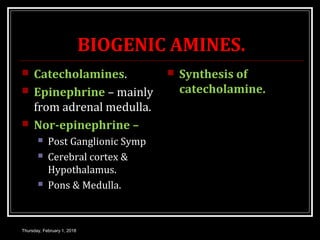
BIOGENIC AMINES.
 Catecholamines.
 Epinephrine – mainly
from adrenal medulla.
 Nor-epinephrine –
 Post Ganglionic Symp
 Cerebral cortex &
Hypothalamus.
 Pons & Medulla.
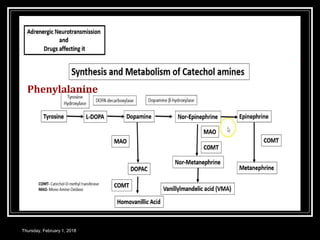
 Synthesis of
catecholamine.
Thursday, February 1, 2018
Phenylalanine
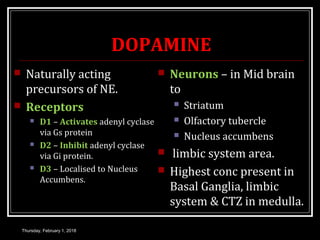
DOPAMINE
 Naturally acting
precursors of NE.
 Receptors
 D1 – Activates adenyl cyclase
via Gs protein
 D2 – Inhibit adenyl cyclase
via Gi protein.
 D3 – Localised to Nucleus
Accumbens.
 Neurons – in Mid brain
to
 Striatum
 Olfactory tubercle
 Nucleus accumbens
 limbic system area.
 Highest conc present in
Basal Ganglia, limbic
system & CTZ in medulla.
Thursday, February 1, 2018
FUNCTIONAL ROLES OF
DOPAMINE
 Control of Movements
 Induction of Vomiting.
 Inhibition of Prolactin secretion & stimulation of
GnRH.
 Retina – Inhibitory Neurons.
 Schizophrenia type of Psychosis due to Increased
levels of D2 receptors.
Thursday, February 1, 2018
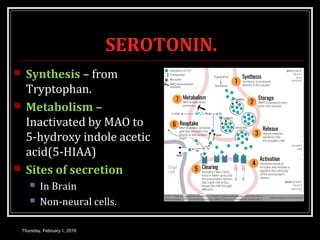
SEROTONIN.
 Synthesis – from
Tryptophan.
 Metabolism –
Inactivated by MAO to
5-hydroxy indole acetic
acid(5-HIAA)
 Sites of secretion
 In Brain
 Non-neural cells.
Thursday, February 1, 2018
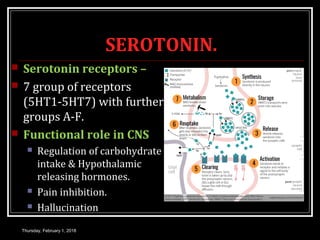
SEROTONIN.
 Serotonin receptors –
 7 group of receptors
(5HT1-5HT7) with further
groups A-F.
 Functional role in CNS
 Regulation of carbohydrate
intake & Hypothalamic
releasing hormones.
 Pain inhibition.
 Hallucination
Thursday, February 1, 2018
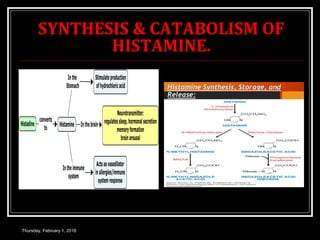
HISTAMINE
 Sites of secretion
 In Brain & Non-neural cells.
 Histamine receptors
 H1 – activates Phospholipase C
 H2 – increases intracellular cAMP
 H3 – inhibition of histamine via G protein.
 Functional role
 Excitatory
 Arousal & sexual behaviour, Regulation of ant pituitary,
Drinking, Pain threshold & Itch sensation.
Thursday, February 1, 2018
SYNTHESIS & CATABOLISM OF
HISTAMINE.
Thursday, February 1, 2018
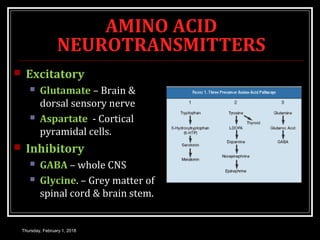
AMINO ACID
NEUROTRANSMITTERS
 Excitatory
 Glutamate – Brain &
dorsal sensory nerve
 Aspartate - Cortical
pyramidal cells.
 Inhibitory
 GABA – whole CNS
 Glycine. – Grey matter of
spinal cord & brain stem.
Thursday, February 1, 2018
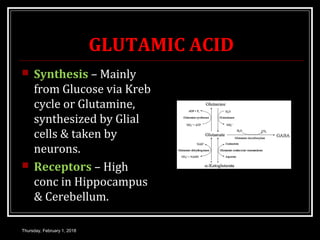
GLUTAMIC ACID
 Synthesis – Mainly
from Glucose via Kreb
cycle or Glutamine,
synthesized by Glial
cells & taken by
neurons.
 Receptors – High
conc in Hippocampus
& Cerebellum.
Thursday, February 1, 2018
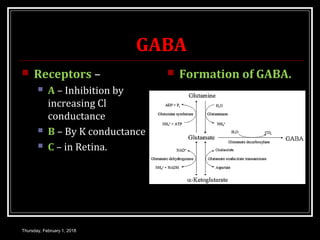
GABA
 Receptors –
 A – Inhibition by
increasing Cl
conductance
 B – By K conductance
 C – in Retina.
 Formation of GABA.
Thursday, February 1, 2018
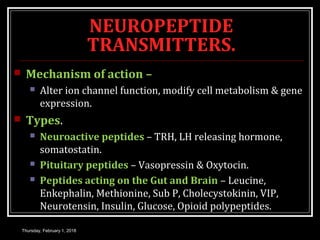
NEUROPEPTIDE
TRANSMITTERS.
 Mechanism of action –
 Alter ion channel function, modify cell metabolism & gene
expression.
 Types.
 Neuroactive peptides – TRH, LH releasing hormone,
somatostatin.
 Pituitary peptides – Vasopressin & Oxytocin.
 Peptides acting on the Gut and Brain – Leucine,
Enkephalin, Methionine, Sub P, Cholecystokinin, VIP,
Neurotensin, Insulin, Glucose, Opioid polypeptides.
Thursday, February 1, 2018
THANK YOU

SYNAPSE

  • 1.
    DR NILESH KATE MBBS,MD ASSOCIATEPROF ESIC MEDICAL COLLEGE, GULBARGA. DEPT. OF PHYSIOLOGY SYNAPSE
  • 2.
    OBJECTIVES  SYNAPSE  Types CHEMICAL SYNAPSE  Structure  Process  Inhibition  properties  NEUROTRANSMITTERS.  APPLIED.
  • 3.
    SYNAPSE  Definition –Synapse is the functional communicating junction between 2 nerve cells. Thursday, February 1, 2018
  • 4.
    TYPES  Anatomical types Physiological types. Thursday, February 1, 2018
  • 5.
    ANATOMICAL TYPES  Axo-dendriticsynapse – between axon of one to dendrite of other.  Axo-somatic – between axon of one to soma(body) of other.  Axo-axonic – between two axons. Thursday, February 1, 2018
  • 6.
    PHYSIOLOGICAL TYPES.  Chemical– by Neurotransmitter.(one direction)  Electrical – transmission through Gap junction. (both direction)  Conjoint – Both chemical & electrical transmission co-exists. Thursday, February 1, 2018
  • 7.
    CHEMICAL SYNAPSE  Structure Process  Inhibition  Properties Thursday, February 1, 2018
  • 8.
    STRUCTURE OF CHEMICAL SYNAPSE Synaptic knob or button.  Pre synaptic membrane.  Synaptic cleft.  Post synaptic process.  Post synaptic membrane. Thursday, February 1, 2018
  • 9.
    SYNAPTIC KNOB ORBUTTON.  Axon loses myelin sheath.  End into small swellings as knobs  Contains Mitochondria & Neurotransmitters in vesicles  Circular – excitatory  Flat – inhibitory.  Transport –by Microtubules. Thursday, February 1, 2018
  • 10.
    PRE SYNAPTIC MEMBRANE. Inner side contains zone of dense cytoplasm.  This forms Presynaptic vesicular grid. Thursday, February 1, 2018
  • 11.
    SYNAPTIC CLEFT.  Gapbetween pre & post.  20-40 nm wide.  Contains ECF with Glycoproteins. Thursday, February 1, 2018
  • 12.
    POST SYNAPTIC PROCESS POSTSYNAPTIC MEMBRANE.  Region of receiving neuron.  Also contains zone of dense cytoplasm.  Contains no of receptor proteins projecting outwards in cleft.  Neurotransmitter attaches to these receptors. Thursday, February 1, 2018
  • 13.
    RECEPTOR PROTEINS.  Twotypes.  Ion channel receptor proteins (Na, K, Cl)- activation causes opening of these channels.  Enzymatic types of receptor proteins –  Activation of cellular gene  Activation of protein kinase. Thursday, February 1, 2018
  • 14.
    TYPES OF CHEMICALSYNAPSE Features Type I Type II Structure Asymmetric Symmetric Synaptic cleft Wider Narrower Post synaptic membrane thickening. Marked Less marked ECF in cleft Present Absent Vesicle shape Spherical Flat Neurotrasmitter. Ach, 5HT, Glutamate, E, NE, DOPA, Adrenaline GABA, Glycine Effect Excitatory Inhibitory Type of synapse. Axo-dendritic Axo-somatic. Thursday, February 1, 2018
  • 15.
    PROCESS OF CHEMICAL SYNAPTICTRANSMISSION.  Release of Neurotransmitters.  Development of EPSP & IPSP.  Removal of Neurotransmitter from synaptic cleft.  Development of Action potential. Thursday, February 1, 2018
  • 16.
    RELEASE OF NEUROTRANSMITTERS.  Nerveimpulse reaches nerve terminal  Depolarization of pre synaptic membrane  voltage gated Ca channels open  Ca permeability  Ca enters. Thursday, February 1, 2018
  • 17.
    Dale’s Phenomenon.  Calevels in axon  Exocytosis of vesicles releasing neurotransmitter into cleft.  Kiss and Run discharge of NT  1st Propounded by Dale. Thursday, February 1, 2018
  • 18.
    DEVELOPMENT OF EPSP. EPSP – Depolarization of post synaptic membrane by excitatory neurotransmitter (Glutamate)  Magnitude – 8mv  Latency – 0.5ms. Thursday, February 1, 2018
  • 19.
    EPSP  Ionic basis–  NT binds to receptors proteins – opens ligand gated Na & Ca channels – Na diffuse in – Depolarize membrane  Conduction of EPSP – passively due to local currents. Thursday, February 1, 2018
  • 20.
    EPSP  Summation –EPSP is graded response, does not show all or none response.  TEMPORAL – when repeated stimuli applied in short duration.  SPATIAL – when post synaptic membrane receives impulses simulataneously from large no of presynaptic terminals. Thursday, February 1, 2018
  • 21.
    DEVELOPMENT OF IPSP. IPSP – Hyper polarization of post synaptic membrane by inhibitory neurotransmitter (GABA)  Value of IPSP - -2mv  Summation.  Temporal  Spatial. Thursday, February 1, 2018
  • 22.
    IPSP  Ionic basis- Release of inhibitory NT – open K or Cl channels – diffusion of K ions from neurons to ECF or Cl from ECF into neuron – Hyper polarization Thursday, February 1, 2018
  • 23.
    REMOVAL OF NEUROTRANSMITTER FROMSYNAPTIC CLEFT.  BY 3 WAYS.  Diffusion out of cleft.  Enzymatic degradation – acetylcholinesterase.  Active neurotransmitter reuptake. Thursday, February 1, 2018
  • 24.
    DEVELOPMENT OF ACTION POTENTIAL. Synaptic integration  Generation of initial segment spike.  Generation of prolonged signals. i. e Action Potential. Thursday, February 1, 2018
  • 25.
    SYNAPTIC INTEGRATION  Itis phenomenon of summation of both EPSP or IPSP at the post synaptic membrane i.e algebraically summated potential will determine transmission. Thursday, February 1, 2018
  • 26.
    GENERATION OF INITIAL SEGMENTSPIKE.  Summated potential 1st pass to initial segment i.e. axon hillock.  If potential is large enough to depolarize initial segment (6-10 mv) – initial spike is generated  Magnitude – 30-40 mv. Thursday, February 1, 2018
  • 27.
    GENERATION OF PROLONGED SIGNALS-- ACTION POTENTIAL.  Initial spike once initiated causes further depolarization by opening voltage gated Na channels on axon hillock  Generate AP & travel peripherally in axon. Thursday, February 1, 2018
  • 28.
    INHIBITION AT SYNAPSES Post-synaptic inhibition.  Pre-synaptic inhibition.  Feedback inhibition.  Feed forward inhibition. Thursday, February 1, 2018
  • 29.
    POST-SYNAPTIC INHIBITION.  Directpost synaptic inhibition by development of inhibitory post synaptic potential – by releasing inhibitory NT.  Post synaptic inhibition due to refractory period. Thursday, February 1, 2018
  • 30.
    PRE-SYNAPTIC INHIBITION.  Byaction of inhibitory neuron (C) – releases GABA  By opening Cl- channels of pre synaptic terminals produces hyperpolarization.  By activation of G protein.  By opening K+ channels  By directly blocking Ca channels. Thursday, February 1, 2018
  • 31.
    FEEDBACK INHIBITION Renshaw cellinhibition.  It occurs in spinal alpha motor neuron  Neuron inhibits those neuron which excite it.  It serves to limit excitability of motor neurons. Thursday, February 1, 2018
  • 32.
    FEED FORWARD INHIBITION. A neuron is connected through 2 pathways, excitatory & inhibitory.  It allows brief & precisely timed excitation. Thursday, February 1, 2018
  • 33.
    SIGNIFICANCE OF SYNAPTIC INHIBITION. Important for restriction over neurons & muscles to react properly & appropriately. Thursday, February 1, 2018
  • 34.
    PROPERTIES OF SYNAPTIC TRANSMISSION. One way conduction.  Synaptic delay.  Summation property of synapse.  Conversions & divergence.  Occlusion phenomenon.  Subliminal fringe effect.  Facilitation.  Synaptic fatigue.  Synaptic plasticity & learning.  Reverberation.  Reciprocal inhibition.  After discharge.  Effect of acidosis & Hypoxia Thursday, February 1, 2018
  • 35.
    ONE WAY CONDUCTION. Law of dynamic polarity or Bell Magendie law – synapse allow only one way conduction from pre to post synaptic neuron.  Significance – For orderly conduction of impulse in one direction only. Thursday, February 1, 2018
  • 36.
    SYNAPTIC DELAY  Timelapse between arrival of nerve impulse at the pre synaptic terminal & its passage to post synaptic membrane.  0.5 ms Thursday, February 1, 2018
  • 37.
    CAUSES OF SYNAPTICDELAY  Release of neurotransmitter.  Diffusion through cleft  Binding with post synaptic receptors & opening ion channels.  Diffusion of ions causing RMP. Thursday, February 1, 2018
  • 38.
    SUMMATION PROPERTY OF SYNAPSE. Property of summation is essential for stimulation of post synaptic membrane either by stimulations of large no of Presynaptic terminals or repeated stimulation of single terminal. Thursday, February 1, 2018
  • 39.
    CONVERGENCE & DIVERGENCE. Phenomenon of termination of signals from many sources.  One pre synaptic neuron may terminate on many post synaptic neurons. Thursday, February 1, 2018
  • 40.
    OCCLUSION PHENOMENON.  Responseto stimulation of 2 pre synaptic neurons is less than sum total of the response obtained when stimulated seperately. Thursday, February 1, 2018
  • 41.
  • 42.
    FACILITATION.  When presynaptic axon is stimulated with several consecutive individual stimuli, each evokes larger post synaptic potential than previous stimuli.  Cause – Prolonged Ca channel opening. Thursday, February 1, 2018
  • 43.
    SYNAPTIC FATIGUE.  Presynaptic neuron when stimulated continuously there is Gradual Decrease & finally disappearance of post synaptic response.  Cause –  Gradual inactivation of Ca  Accumulation of waste. Thursday, February 1, 2018
  • 44.
    SYNAPTIC PLASTICITY & LEARNING. Synaptic transmission can be increased or decreased on the basis of past experience  Post tetanic potentiation.  Long term potentiation  Sensitization  Long term depression. Thursday, February 1, 2018
  • 45.
    REVERBERATION.  Passage ofimpulse from pre synaptic neuron and again back to presynaptic neuron to cause continuous stimulation of Pre synaptic Neuron. Thursday, February 1, 2018
  • 46.
    RECIPROCAL INHIBITION.  Afferentsignal activates excitatory neurons to group of muscles & simultaneously inhibitory neurons to antagonistic muscles. Thursday, February 1, 2018
  • 47.
    AFTER DISCHARGE.  Singleinstantaneous input results into sustained output signals. Thursday, February 1, 2018
  • 48.
    EFFECT OF ACIDOSIS& HYPOXIA  Synaptic transmission is vulnerable to acidosis & Hypoxia. Thursday, February 1, 2018
  • 49.
    NEUROTRANSMITTERS.  Def –Chemical substances responsible for transmission of impulse through synapse. Thursday, February 1, 2018
  • 50.
    CRITERIA FOR NEUROTRANSMITTER.  Shouldbe synthesized by pre synaptic neuron & stored in vesicle.  Should be released by stimulation of nerve.  Travels a short distance of synaptic cleft.  Associated with enzyme or enzyme system for inactivation.  When applied extrinsically should mimic effect of nerve stimulation. Thursday, February 1, 2018
  • 51.
    CLASSIFICATION.  Biochemical  Smallmolecule  Acetylcholine  Biogenic amines. (E,NE, DA,5HT, Histamine)  Amino acids (GABA, Glycine, Glutamate, Aspartate)  Neuro peptide.  Physiological  Excitatory  Inbitory Thursday, February 1, 2018
  • 52.
    ACETYLCHOLINE  Principal NTreleased by cholinergic neurons.  At N-M junction.  Preganglionic & post-ganglionic Para- sympathetic  Preganglionic Sympathetic.  Postganglionic sympathetic which innervates – sweat glands & skeletal muscle blood vessels.  Ending of Amacrine cells of retina. Thursday, February 1, 2018
  • 53.
    ACETYLCHOLINE  Receptors –Nicotinic & Muscarinic.  Synthesis & storage – in Mitochandria by AchCoa & stored in vesicles.  Actions – most places its excitatory but few (vagus supplying heart) – inhibitory. Thursday, February 1, 2018
  • 54.
    MUSCARINIC VERSUS NICOTINIC ACTIONSOF AcH. FEATURES MUSCARINIC NICOTINIC Site of action Post synaptic in Cardiac muscle, Smooth muscle & Glandular cells. All Autonomic Ganglia N-M junction in skeletal muscles. Characteristics of action Same as Mushroom poison – Muscarine. Action – slow in onset. Duration - Prolonged. Same as drug Nicotine. Action – Quick in onset. Duration – Brief. Actions antagonised by Atropine Hexamethonium at Autonomic Ganglia Tubocurarine at skeletal muscles. Thursday, February 1, 2018
  • 55.
    BIOGENIC AMINES.  Catecholamines. Epinephrine – mainly from adrenal medulla.  Nor-epinephrine –  Post Ganglionic Symp  Cerebral cortex & Hypothalamus.  Pons & Medulla.  Synthesis of catecholamine. Thursday, February 1, 2018
  • 56.
    Thursday, February 1,2018 Phenylalanine
  • 57.
    DOPAMINE  Naturally acting precursorsof NE.  Receptors  D1 – Activates adenyl cyclase via Gs protein  D2 – Inhibit adenyl cyclase via Gi protein.  D3 – Localised to Nucleus Accumbens.  Neurons – in Mid brain to  Striatum  Olfactory tubercle  Nucleus accumbens  limbic system area.  Highest conc present in Basal Ganglia, limbic system & CTZ in medulla. Thursday, February 1, 2018
  • 58.
    FUNCTIONAL ROLES OF DOPAMINE Control of Movements  Induction of Vomiting.  Inhibition of Prolactin secretion & stimulation of GnRH.  Retina – Inhibitory Neurons.  Schizophrenia type of Psychosis due to Increased levels of D2 receptors. Thursday, February 1, 2018
  • 59.
    SEROTONIN.  Synthesis –from Tryptophan.  Metabolism – Inactivated by MAO to 5-hydroxy indole acetic acid(5-HIAA)  Sites of secretion  In Brain  Non-neural cells. Thursday, February 1, 2018
  • 60.
    SEROTONIN.  Serotonin receptors–  7 group of receptors (5HT1-5HT7) with further groups A-F.  Functional role in CNS  Regulation of carbohydrate intake & Hypothalamic releasing hormones.  Pain inhibition.  Hallucination Thursday, February 1, 2018
  • 61.
    HISTAMINE  Sites ofsecretion  In Brain & Non-neural cells.  Histamine receptors  H1 – activates Phospholipase C  H2 – increases intracellular cAMP  H3 – inhibition of histamine via G protein.  Functional role  Excitatory  Arousal & sexual behaviour, Regulation of ant pituitary, Drinking, Pain threshold & Itch sensation. Thursday, February 1, 2018
  • 62.
    SYNTHESIS & CATABOLISMOF HISTAMINE. Thursday, February 1, 2018
  • 63.
    AMINO ACID NEUROTRANSMITTERS  Excitatory Glutamate – Brain & dorsal sensory nerve  Aspartate - Cortical pyramidal cells.  Inhibitory  GABA – whole CNS  Glycine. – Grey matter of spinal cord & brain stem. Thursday, February 1, 2018
  • 64.
    GLUTAMIC ACID  Synthesis– Mainly from Glucose via Kreb cycle or Glutamine, synthesized by Glial cells & taken by neurons.  Receptors – High conc in Hippocampus & Cerebellum. Thursday, February 1, 2018
  • 65.
    GABA  Receptors – A – Inhibition by increasing Cl conductance  B – By K conductance  C – in Retina.  Formation of GABA. Thursday, February 1, 2018
  • 66.
    NEUROPEPTIDE TRANSMITTERS.  Mechanism ofaction –  Alter ion channel function, modify cell metabolism & gene expression.  Types.  Neuroactive peptides – TRH, LH releasing hormone, somatostatin.  Pituitary peptides – Vasopressin & Oxytocin.  Peptides acting on the Gut and Brain – Leucine, Enkephalin, Methionine, Sub P, Cholecystokinin, VIP, Neurotensin, Insulin, Glucose, Opioid polypeptides. Thursday, February 1, 2018
  • 67.