PLASMA PROTEINS
❑ INTRODUCTION
❑ NORMAL VALUES
❑ PROPERTIES
❑ FUNCTIONS OF PLASMA PROTEINS
❑ ORIGIN
❑ PLASMAPHERESIS
❑ APPLIED PHYSIOLOGY
BY ~Asodariya Krisha
~Muskan Bavaliya
~Divyesh Bhanderi
~Laxita Bhati
~Krisha Chaudhari
INTRODUCTION
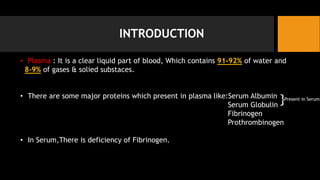
• Plasma : It is a clear liquid part of blood, Which contains 91-92% of water and
8-9% of gases & solied substaces.
• There are some major proteins which present in plasma like:Serum Albumin
Serum Globulin
Fibrinogen
Prothrombinogen
• In Serum,There is deficiency of Fibrinogen.
}Present in Serum
Normal Value
• Content: Normal value of plasma proteins is 6-8 g/dl.
Plasma Proteins Value (g/dL)
Serum Albumin 4.7
Serum Globulin 2.3
Fibrinogen 0.3
Total Value 7.3 (approximately 6-8%)
➢ A/G Ratio: It is important indicator of
some disease of liver,kidney…etc
➢ If, it increase- kidney disease
Infection
Thyroid disease
➢ If, it decrease- Hepatitis B
Hepatitis C
HIV/AIDS
(Swelling
Dried skin
Hair loss
Diarrhrea/Vomiting
Dehydration)
Properties of Plasma Protein
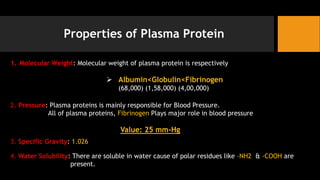
1. Molecular Weight: Molecular weight of plasma protein is respectively
➢ Albumin<Globulin<Fibrinogen
(68,000) (1,58,000) (4,00,000)
2. Pressure: Plasma proteins is mainly responsible for Blood Pressure.
All of plasma proteins, Fibrinogen Plays major role in blood pressure
Value: 25 mm-Hg
3. Specific Gravity: 1.026
4. Water Solubility: There are soluble in water cause of polar residues like –NH2 & -COOH are
present.
Function of Plasma Protein
5. Buffer Action: It has Amphoteric nature because of NH2 & -COOH . It act as efficient
buffer.
6. Electrophoretic Mobility:It act as ions in Alkaline solution & cation in Acidic
solution.
Because of this properties, they posses electrophoretic
mobility.
Functions of Plasma Proteins
1. Expert Osmotic pressure:Protein molecules are unable to pass capillary
membrane.
-So, they excreat 25 mm-Hg Colloid pressure on membrane.
- Out of them 70-80% Pressure is given by Albumin Fraction.
2. Coagulation of blood: Mainly, Fibrinogen & Prothrombin plays important role in
the coagulation of Blood.
3. Defence : Mainly 𝛾-Globulin plays important role in Immune system.It defence the
body from micro-organisms.
4. Acid-Base Balancing : Plasma Proteins play important role in balancing pH.
In acidic pH : -NH2 act as base and forms –NH3+.
In basic pH : -COOH acts as acid and forms –COO-.
5. Transportation : Plasma Proteins are essential for transport of various
substances in Blood.
-Albumin,Globulin(alpha,beta) are responsible for transportation of
enzymes,hormons……
- 𝛼 & 𝛽 𝐺𝑙𝑜𝑏𝑢𝑙𝑖𝑛𝑒 𝑎𝑟𝑒 𝑢𝑠𝑒𝑑 𝑖𝑛 𝐼𝑟𝑜𝑛 𝑡𝑟𝑎𝑛𝑠𝑝𝑜𝑟𝑡𝑎𝑡𝑖𝑜𝑛.
6. Viscosity of Blood: Plasma Proteins provides viscosity to the Blood. which is
important in Blood Pressure.
-Mainly Viscosity is Provide by Fibrinogen cause of molecular weight is highest.
7. Role in genetic info.: Many plasma proteins exhibit polymorphism.
8. Role as reserve proteins: Plasma proteins serve as reserve protein.
-It is utilised by Body tissue During: Fasting,
Inadequate protein intake,
Excessive catabolism of body proteins.
9.Role in production of trephone substances:
- Trephone substances promotes the growth of cell.
- There are necessary to nourishment of tissue cell in culture.
10. Role in ESR: Globulin & Fibrinogen accelerate the tendency of roulex formation
by RBC, Which is responsible for ESR.
Origin
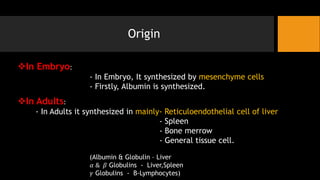
❖In Embryo:
- In Embryo, It synthesized by mesenchyme cells
- Firstly, Albumin is synthesized.
❖In Adults:
- In Adults it synthesized in mainly- Reticuloendothelial cell of liver
- Spleen
- Bone merrow
- General tissue cell.
(Albumin & Globulin – Liver
𝛼 & 𝛽 Globulins - Liver,Spleen
𝛾 Globulins - B-Lymphocytes)
Plasmapheresis
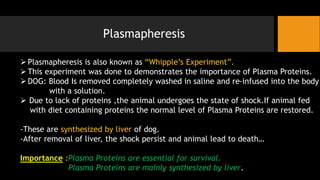
➢Plasmapheresis is also known as “Whipple’s Experiment”.
➢This experiment was done to demonstrates the importance of Plasma Proteins.
➢DOG: Blood Is removed completely washed in saline and re-infused into the body
with a solution.
➢ Due to lack of proteins ,the animal undergoes the state of shock.If animal fed
with diet containing proteins the normal level of Plasma Proteins are restored.
-These are synthesized by liver of dog.
-After removal of liver, the shock persist and animal lead to death…
Importance :Plasma Proteins are essential for survival.
Plasma Proteins are mainly synthesized by liver.
Applied Physiology
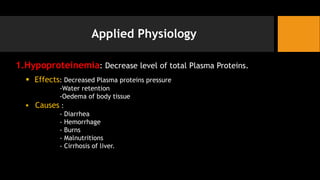
1.Hypoproteinemia: Decrease level of total Plasma Proteins.
▪ Effects: Decreased Plasma proteins pressure
-Water retention
-Oedema of body tissue
▪ Causes :
- Diarrhea
- Hemorrhage
- Burns
- Malnutritions
- Cirrhosis of liver.
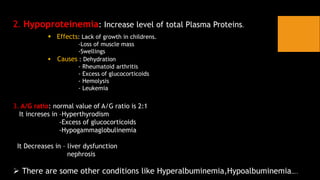
2. Hypoproteinemia: Increase level of total Plasma Proteins.
▪ Effects: Lack of growth in childrens.
-Loss of muscle mass
-Swellings
▪ Causes : Dehydration
- Rheumatoid arthritis
- Excess of glucocorticoids
- Hemolysis
- Leukemia
3. A/G ratio: normal value of A/G ratio is 2:1
It increses in –Hyperthyrodism
-Excess of glucocorticoids
-Hypogammaglobulinemia
It Decreases in – liver dysfunction
nephrosis
➢ There are some other conditions like Hyperalbuminemia,Hypoalbuminemia…..
THANK YOU

PLASMA PROTEINS full chapter contains properties,functions ..

  • 1.
    PLASMA PROTEINS ❑ INTRODUCTION ❑NORMAL VALUES ❑ PROPERTIES ❑ FUNCTIONS OF PLASMA PROTEINS ❑ ORIGIN ❑ PLASMAPHERESIS ❑ APPLIED PHYSIOLOGY BY ~Asodariya Krisha ~Muskan Bavaliya ~Divyesh Bhanderi ~Laxita Bhati ~Krisha Chaudhari
  • 2.
    INTRODUCTION • Plasma :It is a clear liquid part of blood, Which contains 91-92% of water and 8-9% of gases & solied substaces. • There are some major proteins which present in plasma like:Serum Albumin Serum Globulin Fibrinogen Prothrombinogen • In Serum,There is deficiency of Fibrinogen. }Present in Serum
  • 3.
    Normal Value • Content:Normal value of plasma proteins is 6-8 g/dl. Plasma Proteins Value (g/dL) Serum Albumin 4.7 Serum Globulin 2.3 Fibrinogen 0.3 Total Value 7.3 (approximately 6-8%) ➢ A/G Ratio: It is important indicator of some disease of liver,kidney…etc ➢ If, it increase- kidney disease Infection Thyroid disease ➢ If, it decrease- Hepatitis B Hepatitis C HIV/AIDS (Swelling Dried skin Hair loss Diarrhrea/Vomiting Dehydration)
  • 4.
    Properties of PlasmaProtein 1. Molecular Weight: Molecular weight of plasma protein is respectively ➢ Albumin<Globulin<Fibrinogen (68,000) (1,58,000) (4,00,000) 2. Pressure: Plasma proteins is mainly responsible for Blood Pressure. All of plasma proteins, Fibrinogen Plays major role in blood pressure Value: 25 mm-Hg 3. Specific Gravity: 1.026 4. Water Solubility: There are soluble in water cause of polar residues like –NH2 & -COOH are present.
  • 5.
    Function of PlasmaProtein 5. Buffer Action: It has Amphoteric nature because of NH2 & -COOH . It act as efficient buffer. 6. Electrophoretic Mobility:It act as ions in Alkaline solution & cation in Acidic solution. Because of this properties, they posses electrophoretic mobility.
  • 6.
    Functions of PlasmaProteins 1. Expert Osmotic pressure:Protein molecules are unable to pass capillary membrane. -So, they excreat 25 mm-Hg Colloid pressure on membrane. - Out of them 70-80% Pressure is given by Albumin Fraction. 2. Coagulation of blood: Mainly, Fibrinogen & Prothrombin plays important role in the coagulation of Blood. 3. Defence : Mainly 𝛾-Globulin plays important role in Immune system.It defence the body from micro-organisms.
  • 7.
    4. Acid-Base Balancing: Plasma Proteins play important role in balancing pH. In acidic pH : -NH2 act as base and forms –NH3+. In basic pH : -COOH acts as acid and forms –COO-. 5. Transportation : Plasma Proteins are essential for transport of various substances in Blood. -Albumin,Globulin(alpha,beta) are responsible for transportation of enzymes,hormons…… - 𝛼 & 𝛽 𝐺𝑙𝑜𝑏𝑢𝑙𝑖𝑛𝑒 𝑎𝑟𝑒 𝑢𝑠𝑒𝑑 𝑖𝑛 𝐼𝑟𝑜𝑛 𝑡𝑟𝑎𝑛𝑠𝑝𝑜𝑟𝑡𝑎𝑡𝑖𝑜𝑛. 6. Viscosity of Blood: Plasma Proteins provides viscosity to the Blood. which is important in Blood Pressure. -Mainly Viscosity is Provide by Fibrinogen cause of molecular weight is highest.
  • 8.
    7. Role ingenetic info.: Many plasma proteins exhibit polymorphism. 8. Role as reserve proteins: Plasma proteins serve as reserve protein. -It is utilised by Body tissue During: Fasting, Inadequate protein intake, Excessive catabolism of body proteins. 9.Role in production of trephone substances: - Trephone substances promotes the growth of cell. - There are necessary to nourishment of tissue cell in culture. 10. Role in ESR: Globulin & Fibrinogen accelerate the tendency of roulex formation by RBC, Which is responsible for ESR.
  • 9.
    Origin ❖In Embryo: - InEmbryo, It synthesized by mesenchyme cells - Firstly, Albumin is synthesized. ❖In Adults: - In Adults it synthesized in mainly- Reticuloendothelial cell of liver - Spleen - Bone merrow - General tissue cell. (Albumin & Globulin – Liver 𝛼 & 𝛽 Globulins - Liver,Spleen 𝛾 Globulins - B-Lymphocytes)
  • 10.
    Plasmapheresis ➢Plasmapheresis is alsoknown as “Whipple’s Experiment”. ➢This experiment was done to demonstrates the importance of Plasma Proteins. ➢DOG: Blood Is removed completely washed in saline and re-infused into the body with a solution. ➢ Due to lack of proteins ,the animal undergoes the state of shock.If animal fed with diet containing proteins the normal level of Plasma Proteins are restored. -These are synthesized by liver of dog. -After removal of liver, the shock persist and animal lead to death… Importance :Plasma Proteins are essential for survival. Plasma Proteins are mainly synthesized by liver.
  • 11.
    Applied Physiology 1.Hypoproteinemia: Decreaselevel of total Plasma Proteins. ▪ Effects: Decreased Plasma proteins pressure -Water retention -Oedema of body tissue ▪ Causes : - Diarrhea - Hemorrhage - Burns - Malnutritions - Cirrhosis of liver.
  • 12.
    2. Hypoproteinemia: Increaselevel of total Plasma Proteins. ▪ Effects: Lack of growth in childrens. -Loss of muscle mass -Swellings ▪ Causes : Dehydration - Rheumatoid arthritis - Excess of glucocorticoids - Hemolysis - Leukemia 3. A/G ratio: normal value of A/G ratio is 2:1 It increses in –Hyperthyrodism -Excess of glucocorticoids -Hypogammaglobulinemia It Decreases in – liver dysfunction nephrosis ➢ There are some other conditions like Hyperalbuminemia,Hypoalbuminemia…..
  • 13.