Blood composion & function
General introduction
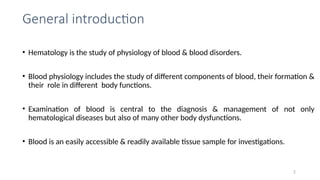
• Hematology is the study of physiology of blood & blood disorders.
• Blood physiology includes the study of different components of blood, their formation &
their role in different body functions.
• Examination of blood is central to the diagnosis & management of not only
hematological diseases but also of many other body dysfunctions.
• Blood is an easily accessible & readily available tissue sample for investigations.
2
3
The Blood
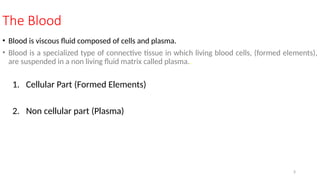
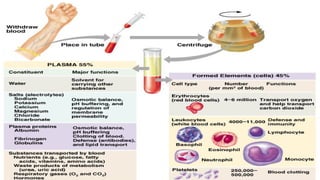
• Blood is viscous fluid composed of cells and plasma.
• Blood is a specialized type of connective tissue in which living blood cells, (formed elements),
are suspended in a non living fluid matrix called plasma..
1. Cellular Part (Formed Elements)
2. Non cellular part (Plasma)
4
Blood
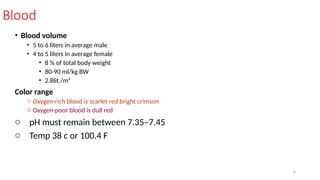
• Blood volume
• 5 to 6 liters in average male
• 4 to 5 liters in average female
• 8 % of total body weight
• 80-90 ml/kg BW
• 2.8lit./m²
Color range
o Oxygen-rich blood is scarlet red bright crimson
o Oxygen-poor blood is dull red
o pH must remain between 7.35–7.45
o Temp 38 c or 100.4 F
Blood Composition
• Blood Composition
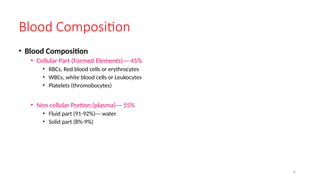
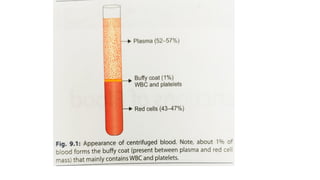
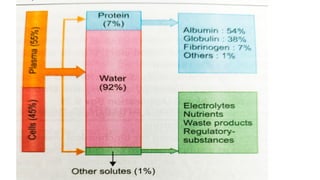
• Cellular Part (Formed Elements)--- 45%
• RBCs, Red blood cells or erythrocytes
• WBCs, white blood cells or Leukocytes
• Platelets (thromobocytes)
• Non cellular Portion (plasma)--- 55%
• Fluid part (91-92%)--- water
• Solid part (8%-9%)
5
7
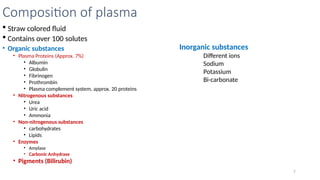
 Straw colored fluid
 Contains over 100 solutes
• Organic substances
• Plasma Proteins (Approx. 7%)
• Albumin
• Globulin
• Fibrinogen
• Prothrombin
• Plasma complement system, approx. 20 proteins
• Nitrogenous substances
• Urea
• Uric acid
• Ammonia
• Non-nitrogenous substances
• carbohydrates
• Lipids
• Enzymes
• Amylase
• Carbonic Anhydrase
• Pigments (Bilirubin)
Composition of plasma
Inorganic substances
Different ions
Sodium
Potassium
Bi-carbonate
9
Functions of plasma
• Helps in transport of substances in the body.
• Maintains colloid osmotic pressure of blood.
• Causes blood clotting because it contains the fibrinogen and prothrombin.
• Stores proteins for supply in needs.
• Helps in maintaining blood pressure and blood viscosity.
• Contains antibodies and antitoxins.
10
11
Physical Properties of Blood and plasma
• Specific Gravity of plasma is 1.024
• Specific Gravity of blood is 1.055 - 1.062
• Male: 1.057
• Female: 1.053
• Blood is 5 times thicker or viscous than distilled water.
• Blood----- blood cells
• Plasma----Plasma Proteins
• Relative viscosity of water, plasma and blood are 1, 1.8, 4.7 respectively.
• Plasma-(clotting factor and fibrinogen) = serum
Functions of blood
 Blood performs a number of functions.
1. Distribution
2. Regulation
3. Protection
 Distribution Functions
 Nutritive Function:
 Nutrients from GIT to whole body
 Respiratory Function:
 O2 and Co2 Transport
 Excretory Function:
 Metabolic Wastes to kidneys
 Transport Function:
 Enzymes
 Hormones
 Vitamins
12
Functions of blood
• Regulation Functions
• Maintenance Functions
• Body Temperature maintenance through skin
• Blood Volume, salts and blood proteins prevent excessive fluid loss.
• Blood Pressure
• Buffering Functions
• Maintaining normal pH in body with the help of blood proteins
and other solutes
• Acts as body’s alkaline reserve of HCO3
-
ions.
13
Functions of blood
•Protection Functions
• Preventing blood loss
• Platelets and plasma proteins initiate clot formation in case of damage.
• Defensive function
• Prevents body from being infected from invaders eg bacteria and
viruses with the help of antibodies, compliment proteins and WBCs.
14
Blood Doping
• Injecting previously stored RBC’s before an athletic event
• more cells available to deliver oxygen to tissues
• Dangerous
• increases blood viscosity
• forces heart to work harder
• Banned by Olympic committee
19-15
Plasma Proteins
16
• Most are produced by liver, except for hormones and gamma globulins
• Not used up by cells as fuels
• Plasma proteins account for almost 7% by weight of plasma volume
• 6 - 8 grams of protein in a volume of 100 milliliters of blood (referred to as g/dl)
• The plasma proteins include:
• Albumins(4-5.5 g%)
• Globulins(1.5-3g%)
• Fibrinogen(0.3g%) & prothrombin
• Regulatory proteins
• Enzymes – coagulation enzymes, complement factors
• C-reactive protein – acute phase reactant
Albumins (MW66000)
• Smallest and most abundant of the plasma proteins almost 58% of total plasma
proteins.
• Soluble in distilled water
• Precipitated by saturated ammonium sulphate
• Coagulated by heat
• 20-Days half life
• At pH 7.4 it is anionic with 20 negative charges per molecule
• Highly polar
• Functions:
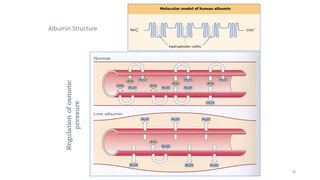
• Regulate water movement between the blood and interstitial fluid. (Maintain osmotic pressure)
• Albumins act as transport proteins that carry ions, hormones, and some lipids in the blood.
• Kidney diseases albuminuria causes hypo albuminuria it also occurs in liver disease due to less
formation of albumin
17
Albumin Structure
18
Regulation
of
osmotic
pressure
19
Causes of decreased plasma albumin:
• Decreased synthesis
A. malnutrition
B. malabsorption
C. advanced chronic liver disease
• Abnormal distribution or dilution
A. over hydration
B. increased capillary permeability like in septicemia
• Abnormal excretion or degradation
A. nephrotic syndrome
B. burns
C. hemorrhage
D. loss of protein from the digestive tract
• Rare congenital defects
A. hypoalbuminemia
B. analbuminemia
Globulins (MW90000-156000)
• Not soluble in distilled water
• 38 % of plasma proteins
• More easily precipitated by saturated ammonium sulphate
• They are coagulated by heat
• Series of slightly different globulins may be separated by using different concentrations of
alcohol.
• Electrophoresis can also result in separation and identification of different globulins
(alpha, beta, gamma)
• Functions:
• Alpha & beta: produced by liver; transport proteins that bind to lipids, metal ions, and fat – soluble vitamins
• Gamma: Antibodies released primarily by plasma cells during immune response.
20
• A/G RATIO
• Normal 1.5 to 2.5:1
• In many diseases it is altered.
• Detection of A/G ratio helps in diagnosis & prognosis of various
diseases especially immunological & inflammatory
Fibrinogen & prothrombin
• Fibrinogen: (MW340000)
• Produced by liver.
• converted to web like substance of clot.
• Prothrombin:
• produced by liver.
• formation requires vitamin K.
• converted to thrombin which enzymatically converts fibrinogen to fibrin.
22
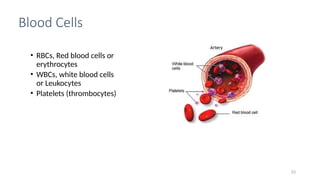
Blood Cells
• RBCs, Red blood cells or
erythrocytes
• WBCs, white blood cells
or Leukocytes
• Platelets (thrombocytes)
23
THANK YOU

Blood composion function & plasma proteine.pptx

  • 1.
  • 2.
    General introduction • Hematologyis the study of physiology of blood & blood disorders. • Blood physiology includes the study of different components of blood, their formation & their role in different body functions. • Examination of blood is central to the diagnosis & management of not only hematological diseases but also of many other body dysfunctions. • Blood is an easily accessible & readily available tissue sample for investigations. 2
  • 3.
    3 The Blood • Bloodis viscous fluid composed of cells and plasma. • Blood is a specialized type of connective tissue in which living blood cells, (formed elements), are suspended in a non living fluid matrix called plasma.. 1. Cellular Part (Formed Elements) 2. Non cellular part (Plasma)
  • 4.
    4 Blood • Blood volume •5 to 6 liters in average male • 4 to 5 liters in average female • 8 % of total body weight • 80-90 ml/kg BW • 2.8lit./m² Color range o Oxygen-rich blood is scarlet red bright crimson o Oxygen-poor blood is dull red o pH must remain between 7.35–7.45 o Temp 38 c or 100.4 F
  • 5.
    Blood Composition • BloodComposition • Cellular Part (Formed Elements)--- 45% • RBCs, Red blood cells or erythrocytes • WBCs, white blood cells or Leukocytes • Platelets (thromobocytes) • Non cellular Portion (plasma)--- 55% • Fluid part (91-92%)--- water • Solid part (8%-9%) 5
  • 7.
    7  Straw coloredfluid  Contains over 100 solutes • Organic substances • Plasma Proteins (Approx. 7%) • Albumin • Globulin • Fibrinogen • Prothrombin • Plasma complement system, approx. 20 proteins • Nitrogenous substances • Urea • Uric acid • Ammonia • Non-nitrogenous substances • carbohydrates • Lipids • Enzymes • Amylase • Carbonic Anhydrase • Pigments (Bilirubin) Composition of plasma Inorganic substances Different ions Sodium Potassium Bi-carbonate
  • 9.
  • 10.
    Functions of plasma •Helps in transport of substances in the body. • Maintains colloid osmotic pressure of blood. • Causes blood clotting because it contains the fibrinogen and prothrombin. • Stores proteins for supply in needs. • Helps in maintaining blood pressure and blood viscosity. • Contains antibodies and antitoxins. 10
  • 11.
    11 Physical Properties ofBlood and plasma • Specific Gravity of plasma is 1.024 • Specific Gravity of blood is 1.055 - 1.062 • Male: 1.057 • Female: 1.053 • Blood is 5 times thicker or viscous than distilled water. • Blood----- blood cells • Plasma----Plasma Proteins • Relative viscosity of water, plasma and blood are 1, 1.8, 4.7 respectively. • Plasma-(clotting factor and fibrinogen) = serum
  • 12.
    Functions of blood Blood performs a number of functions. 1. Distribution 2. Regulation 3. Protection  Distribution Functions  Nutritive Function:  Nutrients from GIT to whole body  Respiratory Function:  O2 and Co2 Transport  Excretory Function:  Metabolic Wastes to kidneys  Transport Function:  Enzymes  Hormones  Vitamins 12
  • 13.
    Functions of blood •Regulation Functions • Maintenance Functions • Body Temperature maintenance through skin • Blood Volume, salts and blood proteins prevent excessive fluid loss. • Blood Pressure • Buffering Functions • Maintaining normal pH in body with the help of blood proteins and other solutes • Acts as body’s alkaline reserve of HCO3 - ions. 13
  • 14.
    Functions of blood •ProtectionFunctions • Preventing blood loss • Platelets and plasma proteins initiate clot formation in case of damage. • Defensive function • Prevents body from being infected from invaders eg bacteria and viruses with the help of antibodies, compliment proteins and WBCs. 14
  • 15.
    Blood Doping • Injectingpreviously stored RBC’s before an athletic event • more cells available to deliver oxygen to tissues • Dangerous • increases blood viscosity • forces heart to work harder • Banned by Olympic committee 19-15
  • 16.
    Plasma Proteins 16 • Mostare produced by liver, except for hormones and gamma globulins • Not used up by cells as fuels • Plasma proteins account for almost 7% by weight of plasma volume • 6 - 8 grams of protein in a volume of 100 milliliters of blood (referred to as g/dl) • The plasma proteins include: • Albumins(4-5.5 g%) • Globulins(1.5-3g%) • Fibrinogen(0.3g%) & prothrombin • Regulatory proteins • Enzymes – coagulation enzymes, complement factors • C-reactive protein – acute phase reactant
  • 17.
    Albumins (MW66000) • Smallestand most abundant of the plasma proteins almost 58% of total plasma proteins. • Soluble in distilled water • Precipitated by saturated ammonium sulphate • Coagulated by heat • 20-Days half life • At pH 7.4 it is anionic with 20 negative charges per molecule • Highly polar • Functions: • Regulate water movement between the blood and interstitial fluid. (Maintain osmotic pressure) • Albumins act as transport proteins that carry ions, hormones, and some lipids in the blood. • Kidney diseases albuminuria causes hypo albuminuria it also occurs in liver disease due to less formation of albumin 17
  • 18.
  • 19.
    19 Causes of decreasedplasma albumin: • Decreased synthesis A. malnutrition B. malabsorption C. advanced chronic liver disease • Abnormal distribution or dilution A. over hydration B. increased capillary permeability like in septicemia • Abnormal excretion or degradation A. nephrotic syndrome B. burns C. hemorrhage D. loss of protein from the digestive tract • Rare congenital defects A. hypoalbuminemia B. analbuminemia
  • 20.
    Globulins (MW90000-156000) • Notsoluble in distilled water • 38 % of plasma proteins • More easily precipitated by saturated ammonium sulphate • They are coagulated by heat • Series of slightly different globulins may be separated by using different concentrations of alcohol. • Electrophoresis can also result in separation and identification of different globulins (alpha, beta, gamma) • Functions: • Alpha & beta: produced by liver; transport proteins that bind to lipids, metal ions, and fat – soluble vitamins • Gamma: Antibodies released primarily by plasma cells during immune response. 20
  • 21.
    • A/G RATIO •Normal 1.5 to 2.5:1 • In many diseases it is altered. • Detection of A/G ratio helps in diagnosis & prognosis of various diseases especially immunological & inflammatory
  • 22.
    Fibrinogen & prothrombin •Fibrinogen: (MW340000) • Produced by liver. • converted to web like substance of clot. • Prothrombin: • produced by liver. • formation requires vitamin K. • converted to thrombin which enzymatically converts fibrinogen to fibrin. 22
  • 23.
    Blood Cells • RBCs,Red blood cells or erythrocytes • WBCs, white blood cells or Leukocytes • Platelets (thrombocytes) 23
  • 24.

Editor's Notes

  • #19 Septicemia(blood poisoning)