



PLASMA PROTEINS
Dr SAI PRIYANKA NERUSU
INTRODUCTION
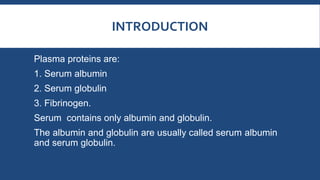
Plasma proteins are:
1. Serum albumin
2. Serum globulin
3. Fibrinogen.
Serum contains only albumin and globulin.
The albumin and globulin are usually called serum albumin
and serum globulin.
INTRODUCTION
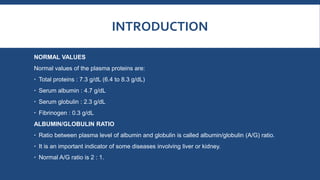
NORMAL VALUES
Normal values of the plasma proteins are:
 Total proteins : 7.3 g/dL (6.4 to 8.3 g/dL)
 Serum albumin : 4.7 g/dL
 Serum globulin : 2.3 g/dL
 Fibrinogen : 0.3 g/dL
ALBUMIN/GLOBULIN RATIO
 Ratio between plasma level of albumin and globulin is called albumin/globulin (A/G) ratio.
 It is an important indicator of some diseases involving liver or kidney.
 Normal A/G ratio is 2 : 1.
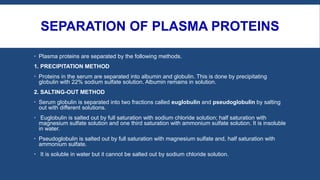
SEPARATION OF PLASMA PROTEINS
 Plasma proteins are separated by the following methods.
1. PRECIPITATION METHOD
 Proteins in the serum are separated into albumin and globulin. This is done by precipitating
globulin with 22% sodium sulfate solution. Albumin remains in solution.
2. SALTING-OUT METHOD
 Serum globulin is separated into two fractions called euglobulin and pseudoglobulin by salting
out with different solutions.
 Euglobulin is salted out by full saturation with sodium chloride solution; half saturation with
magnesium sulfate solution and one third saturation with ammonium sulfate solution. It is insoluble
in water.
 Pseudoglobulin is salted out by full saturation with magnesium sulfate and, half saturation with
ammonium sulfate.
 It is soluble in water but it cannot be salted out by sodium chloride solution.
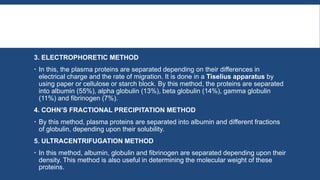
3. ELECTROPHORETIC METHOD
 In this, the plasma proteins are separated depending on their differences in
electrical charge and the rate of migration. It is done in a Tiselius apparatus by
using paper or cellulose or starch block. By this method, the proteins are separated
into albumin (55%), alpha globulin (13%), beta globulin (14%), gamma globulin
(11%) and fibrinogen (7%).
4. COHN’S FRACTIONAL PRECIPITATION METHOD
 By this method, plasma proteins are separated into albumin and different fractions
of globulin, depending upon their solubility.
5. ULTRACENTRIFUGATION METHOD
 In this method, albumin, globulin and fibrinogen are separated depending upon their
density. This method is also useful in determining the molecular weight of these
proteins.
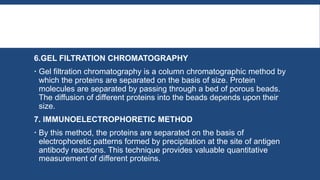
6.GEL FILTRATION CHROMATOGRAPHY
 Gel filtration chromatography is a column chromatographic method by
which the proteins are separated on the basis of size. Protein
molecules are separated by passing through a bed of porous beads.
The diffusion of different proteins into the beads depends upon their
size.
7. IMMUNOELECTROPHORETIC METHOD
 By this method, the proteins are separated on the basis of
electrophoretic patterns formed by precipitation at the site of antigen
antibody reactions. This technique provides valuable quantitative
measurement of different proteins.
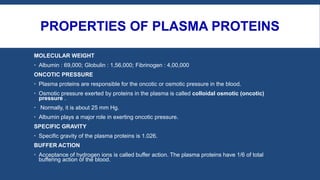
PROPERTIES OF PLASMA PROTEINS
MOLECULAR WEIGHT
 Albumin : 69,000; Globulin : 1,56,000; Fibrinogen : 4,00,000
ONCOTIC PRESSURE
 Plasma proteins are responsible for the oncotic or osmotic pressure in the blood.
 Osmotic pressure exerted by proteins in the plasma is called colloidal osmotic (oncotic)
pressure .
 Normally, it is about 25 mm Hg.
 Albumin plays a major role in exerting oncotic pressure.
SPECIFIC GRAVITY
 Specific gravity of the plasma proteins is 1.026.
BUFFER ACTION
 Acceptance of hydrogen ions is called buffer action. The plasma proteins have 1/6 of total
buffering action of the blood.
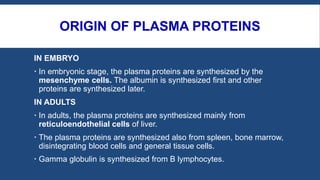
ORIGIN OF PLASMA PROTEINS
IN EMBRYO
 In embryonic stage, the plasma proteins are synthesized by the
mesenchyme cells. The albumin is synthesized first and other
proteins are synthesized later.
IN ADULTS
 In adults, the plasma proteins are synthesized mainly from
reticuloendothelial cells of liver.
 The plasma proteins are synthesized also from spleen, bone marrow,
disintegrating blood cells and general tissue cells.
 Gamma globulin is synthesized from B lymphocytes.
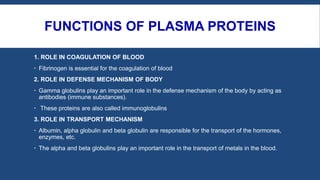
FUNCTIONS OF PLASMA PROTEINS
1. ROLE IN COAGULATION OF BLOOD
 Fibrinogen is essential for the coagulation of blood
2. ROLE IN DEFENSE MECHANISM OF BODY
 Gamma globulins play an important role in the defense mechanism of the body by acting as
antibodies (immune substances).
 These proteins are also called immunoglobulins
3. ROLE IN TRANSPORT MECHANISM
 Albumin, alpha globulin and beta globulin are responsible for the transport of the hormones,
enzymes, etc.
 The alpha and beta globulins play an important role in the transport of metals in the blood.
FUNCTIONS OF PLASMA PROTEINS
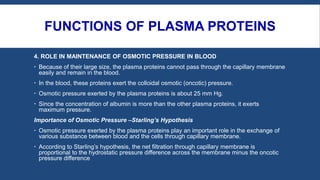
4. ROLE IN MAINTENANCE OF OSMOTIC PRESSURE IN BLOOD
 Because of their large size, the plasma proteins cannot pass through the capillary membrane
easily and remain in the blood.
 In the blood, these proteins exert the colloidal osmotic (oncotic) pressure.
 Osmotic pressure exerted by the plasma proteins is about 25 mm Hg.
 Since the concentration of albumin is more than the other plasma proteins, it exerts
maximum pressure.
Importance of Osmotic Pressure –Starling’s Hypothesis
 Osmotic pressure exerted by the plasma proteins play an important role in the exchange of
various substance between blood and the cells through capillary membrane.
 According to Starling’s hypothesis, the net filtration through capillary membrane is
proportional to the hydrostatic pressure difference across the membrane minus the oncotic
pressure difference
FUNCTIONS OF PLASMA PROTEINS
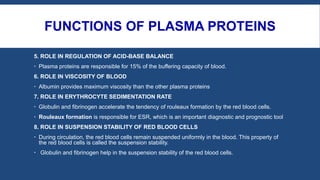
5. ROLE IN REGULATION OF ACID-BASE BALANCE
 Plasma proteins are responsible for 15% of the buffering capacity of blood.
6. ROLE IN VISCOSITY OF BLOOD
 Albumin provides maximum viscosity than the other plasma proteins
7. ROLE IN ERYTHROCYTE SEDIMENTATION RATE
 Globulin and fibrinogen accelerate the tendency of rouleaux formation by the red blood cells.
 Rouleaux formation is responsible for ESR, which is an important diagnostic and prognostic tool
8. ROLE IN SUSPENSION STABILITY OF RED BLOOD CELLS
 During circulation, the red blood cells remain suspended uniformly in the blood. This property of
the red blood cells is called the suspension stability.
 Globulin and fibrinogen help in the suspension stability of the red blood cells.
FUNCTIONS OF PLASMA PROTEINS
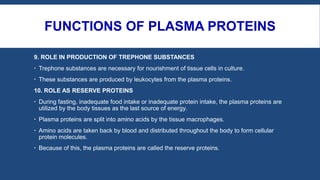
9. ROLE IN PRODUCTION OF TREPHONE SUBSTANCES
 Trephone substances are necessary for nourishment of tissue cells in culture.
 These substances are produced by leukocytes from the plasma proteins.
10. ROLE AS RESERVE PROTEINS
 During fasting, inadequate food intake or inadequate protein intake, the plasma proteins are
utilized by the body tissues as the last source of energy.
 Plasma proteins are split into amino acids by the tissue macrophages.
 Amino acids are taken back by blood and distributed throughout the body to form cellular
protein molecules.
 Because of this, the plasma proteins are called the reserve proteins.
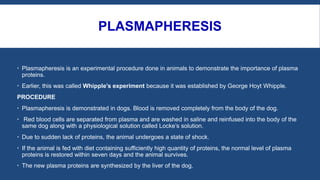
PLASMAPHERESIS
 Plasmapheresis is an experimental procedure done in animals to demonstrate the importance of plasma
proteins.
 Earlier, this was called Whipple’s experiment because it was established by George Hoyt Whipple.
PROCEDURE
 Plasmapheresis is demonstrated in dogs. Blood is removed completely from the body of the dog.
 Red blood cells are separated from plasma and are washed in saline and reinfused into the body of the
same dog along with a physiological solution called Locke’s solution.
 Due to sudden lack of proteins, the animal undergoes a state of shock.
 If the animal is fed with diet containing sufficiently high quantity of proteins, the normal level of plasma
proteins is restored within seven days and the animal survives.
 The new plasma proteins are synthesized by the liver of the dog.
PLASMAPHERESIS
 If the experiment is done in animals after removal of liver, even if the diet contains adequate
quantity of proteins, the plasma proteins are not produced.
 The shock persists in the animal and leads to death.
 Thus, the experiment ‘plasmapheresis’ is used to demonstrate:
1. Importance of plasma proteins for survival
2. Synthesis of plasma proteins by the liver.
CLINICAL SIGNIFICANCE OF PLASMAPHERESIS – THERAPEUTIC PLASMA EXCHANGE
 Plasmapheresis is used as a blood purification procedure for an effective temporary
treatment of many auto because immune diseases. It is also called therapeutic plasma
exchange.
USES OF PLASMAPHERESIS
Myasthenia gravis – autoimmune disease causing muscle weakness
Thrombocytopenic purpura – bleeding disorder
Paraproteinemic peripheral neuropathy – dysfunction of peripheral nervous system due to an
abnormal immunoglobulin called paraprotein.
Chronic demyelinating polyneuropathy – neurological disorder characterized by progressive
weakness and impaired sensory function in the legs and arms due to the damage of
myelin sheath in peripheral nerves.
Guillain-Barré syndrome – autoimmune disease causing weakness, abnormal sensations
(like tingling) in the limbs and paralysis.
Lambert-Eaton myasthenic syndrome – autoimmune disorder of the neuromuscular junction.
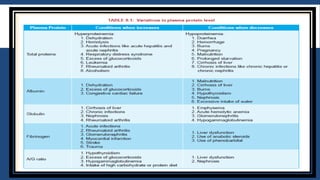
VARIATIONS IN PLASMA PROTEIN
LEVEL
In several conditions, the quantity of albumin
and globulin change in opposite direction.
Elevation of all fractions of plasma proteins is
called hyperproteinemia and decrease in all
fractions of plasma proteins is called
hypoproteinemia.
THANKYOU

PLASMA PROTEINS.pptx

  • 1.
    PLASMA PROTEINS Dr SAIPRIYANKA NERUSU
  • 2.
    INTRODUCTION Plasma proteins are: 1.Serum albumin 2. Serum globulin 3. Fibrinogen. Serum contains only albumin and globulin. The albumin and globulin are usually called serum albumin and serum globulin.
  • 3.
    INTRODUCTION NORMAL VALUES Normal valuesof the plasma proteins are:  Total proteins : 7.3 g/dL (6.4 to 8.3 g/dL)  Serum albumin : 4.7 g/dL  Serum globulin : 2.3 g/dL  Fibrinogen : 0.3 g/dL ALBUMIN/GLOBULIN RATIO  Ratio between plasma level of albumin and globulin is called albumin/globulin (A/G) ratio.  It is an important indicator of some diseases involving liver or kidney.  Normal A/G ratio is 2 : 1.
  • 4.
    SEPARATION OF PLASMAPROTEINS  Plasma proteins are separated by the following methods. 1. PRECIPITATION METHOD  Proteins in the serum are separated into albumin and globulin. This is done by precipitating globulin with 22% sodium sulfate solution. Albumin remains in solution. 2. SALTING-OUT METHOD  Serum globulin is separated into two fractions called euglobulin and pseudoglobulin by salting out with different solutions.  Euglobulin is salted out by full saturation with sodium chloride solution; half saturation with magnesium sulfate solution and one third saturation with ammonium sulfate solution. It is insoluble in water.  Pseudoglobulin is salted out by full saturation with magnesium sulfate and, half saturation with ammonium sulfate.  It is soluble in water but it cannot be salted out by sodium chloride solution.
  • 5.
    3. ELECTROPHORETIC METHOD In this, the plasma proteins are separated depending on their differences in electrical charge and the rate of migration. It is done in a Tiselius apparatus by using paper or cellulose or starch block. By this method, the proteins are separated into albumin (55%), alpha globulin (13%), beta globulin (14%), gamma globulin (11%) and fibrinogen (7%). 4. COHN’S FRACTIONAL PRECIPITATION METHOD  By this method, plasma proteins are separated into albumin and different fractions of globulin, depending upon their solubility. 5. ULTRACENTRIFUGATION METHOD  In this method, albumin, globulin and fibrinogen are separated depending upon their density. This method is also useful in determining the molecular weight of these proteins.
  • 6.
    6.GEL FILTRATION CHROMATOGRAPHY Gel filtration chromatography is a column chromatographic method by which the proteins are separated on the basis of size. Protein molecules are separated by passing through a bed of porous beads. The diffusion of different proteins into the beads depends upon their size. 7. IMMUNOELECTROPHORETIC METHOD  By this method, the proteins are separated on the basis of electrophoretic patterns formed by precipitation at the site of antigen antibody reactions. This technique provides valuable quantitative measurement of different proteins.
  • 7.
    PROPERTIES OF PLASMAPROTEINS MOLECULAR WEIGHT  Albumin : 69,000; Globulin : 1,56,000; Fibrinogen : 4,00,000 ONCOTIC PRESSURE  Plasma proteins are responsible for the oncotic or osmotic pressure in the blood.  Osmotic pressure exerted by proteins in the plasma is called colloidal osmotic (oncotic) pressure .  Normally, it is about 25 mm Hg.  Albumin plays a major role in exerting oncotic pressure. SPECIFIC GRAVITY  Specific gravity of the plasma proteins is 1.026. BUFFER ACTION  Acceptance of hydrogen ions is called buffer action. The plasma proteins have 1/6 of total buffering action of the blood.
  • 8.
    ORIGIN OF PLASMAPROTEINS IN EMBRYO  In embryonic stage, the plasma proteins are synthesized by the mesenchyme cells. The albumin is synthesized first and other proteins are synthesized later. IN ADULTS  In adults, the plasma proteins are synthesized mainly from reticuloendothelial cells of liver.  The plasma proteins are synthesized also from spleen, bone marrow, disintegrating blood cells and general tissue cells.  Gamma globulin is synthesized from B lymphocytes.
  • 9.
    FUNCTIONS OF PLASMAPROTEINS 1. ROLE IN COAGULATION OF BLOOD  Fibrinogen is essential for the coagulation of blood 2. ROLE IN DEFENSE MECHANISM OF BODY  Gamma globulins play an important role in the defense mechanism of the body by acting as antibodies (immune substances).  These proteins are also called immunoglobulins 3. ROLE IN TRANSPORT MECHANISM  Albumin, alpha globulin and beta globulin are responsible for the transport of the hormones, enzymes, etc.  The alpha and beta globulins play an important role in the transport of metals in the blood.
  • 10.
    FUNCTIONS OF PLASMAPROTEINS 4. ROLE IN MAINTENANCE OF OSMOTIC PRESSURE IN BLOOD  Because of their large size, the plasma proteins cannot pass through the capillary membrane easily and remain in the blood.  In the blood, these proteins exert the colloidal osmotic (oncotic) pressure.  Osmotic pressure exerted by the plasma proteins is about 25 mm Hg.  Since the concentration of albumin is more than the other plasma proteins, it exerts maximum pressure. Importance of Osmotic Pressure –Starling’s Hypothesis  Osmotic pressure exerted by the plasma proteins play an important role in the exchange of various substance between blood and the cells through capillary membrane.  According to Starling’s hypothesis, the net filtration through capillary membrane is proportional to the hydrostatic pressure difference across the membrane minus the oncotic pressure difference
  • 11.
    FUNCTIONS OF PLASMAPROTEINS 5. ROLE IN REGULATION OF ACID-BASE BALANCE  Plasma proteins are responsible for 15% of the buffering capacity of blood. 6. ROLE IN VISCOSITY OF BLOOD  Albumin provides maximum viscosity than the other plasma proteins 7. ROLE IN ERYTHROCYTE SEDIMENTATION RATE  Globulin and fibrinogen accelerate the tendency of rouleaux formation by the red blood cells.  Rouleaux formation is responsible for ESR, which is an important diagnostic and prognostic tool 8. ROLE IN SUSPENSION STABILITY OF RED BLOOD CELLS  During circulation, the red blood cells remain suspended uniformly in the blood. This property of the red blood cells is called the suspension stability.  Globulin and fibrinogen help in the suspension stability of the red blood cells.
  • 12.
    FUNCTIONS OF PLASMAPROTEINS 9. ROLE IN PRODUCTION OF TREPHONE SUBSTANCES  Trephone substances are necessary for nourishment of tissue cells in culture.  These substances are produced by leukocytes from the plasma proteins. 10. ROLE AS RESERVE PROTEINS  During fasting, inadequate food intake or inadequate protein intake, the plasma proteins are utilized by the body tissues as the last source of energy.  Plasma proteins are split into amino acids by the tissue macrophages.  Amino acids are taken back by blood and distributed throughout the body to form cellular protein molecules.  Because of this, the plasma proteins are called the reserve proteins.
  • 13.
    PLASMAPHERESIS  Plasmapheresis isan experimental procedure done in animals to demonstrate the importance of plasma proteins.  Earlier, this was called Whipple’s experiment because it was established by George Hoyt Whipple. PROCEDURE  Plasmapheresis is demonstrated in dogs. Blood is removed completely from the body of the dog.  Red blood cells are separated from plasma and are washed in saline and reinfused into the body of the same dog along with a physiological solution called Locke’s solution.  Due to sudden lack of proteins, the animal undergoes a state of shock.  If the animal is fed with diet containing sufficiently high quantity of proteins, the normal level of plasma proteins is restored within seven days and the animal survives.  The new plasma proteins are synthesized by the liver of the dog.
  • 14.
    PLASMAPHERESIS  If theexperiment is done in animals after removal of liver, even if the diet contains adequate quantity of proteins, the plasma proteins are not produced.  The shock persists in the animal and leads to death.  Thus, the experiment ‘plasmapheresis’ is used to demonstrate: 1. Importance of plasma proteins for survival 2. Synthesis of plasma proteins by the liver. CLINICAL SIGNIFICANCE OF PLASMAPHERESIS – THERAPEUTIC PLASMA EXCHANGE  Plasmapheresis is used as a blood purification procedure for an effective temporary treatment of many auto because immune diseases. It is also called therapeutic plasma exchange.
  • 15.
    USES OF PLASMAPHERESIS Myastheniagravis – autoimmune disease causing muscle weakness Thrombocytopenic purpura – bleeding disorder Paraproteinemic peripheral neuropathy – dysfunction of peripheral nervous system due to an abnormal immunoglobulin called paraprotein. Chronic demyelinating polyneuropathy – neurological disorder characterized by progressive weakness and impaired sensory function in the legs and arms due to the damage of myelin sheath in peripheral nerves. Guillain-Barré syndrome – autoimmune disease causing weakness, abnormal sensations (like tingling) in the limbs and paralysis. Lambert-Eaton myasthenic syndrome – autoimmune disorder of the neuromuscular junction.
  • 16.
    VARIATIONS IN PLASMAPROTEIN LEVEL In several conditions, the quantity of albumin and globulin change in opposite direction. Elevation of all fractions of plasma proteins is called hyperproteinemia and decrease in all fractions of plasma proteins is called hypoproteinemia.
  • 18.