Xerophytes
Dr. Ravindra. D. Madhekar
Assistant professor,
Department of Botany,
S. B. E. S. College of Science,
Aurangabad
(Maharashtra)
India
Xerophytes
• Plants which grow in dry habitats or xeric conditions.
• Characteristic plants of desert and semi-desert regions,
yet they can grow in mesophytic conditions where
available water is in sufficient quantity.
• Withstand extreme dry conditions, low humidity and high
temperature.
• Develop special structural and physiological characteristics
which mainly aims at :
(i) To absorb as much water as they can get from the
surroundings;
(ii) To retain water in their organs for very long time;
(iii) To reduce the transpiration rate to minimum; and
(iv) To check high consumption of water
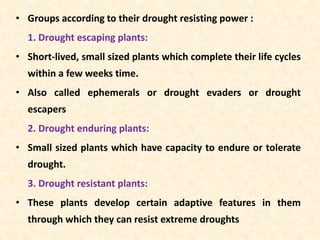
• Groups according to their drought resisting power :
1. Drought escaping plants:
• Short-lived, small sized plants which complete their life cycles
within a few weeks time.
• Also called ephemerals or drought evaders or drought
escapers
2. Drought enduring plants:
• Small sized plants which have capacity to endure or tolerate
drought.
3. Drought resistant plants:
• These plants develop certain adaptive features in them
through which they can resist extreme droughts
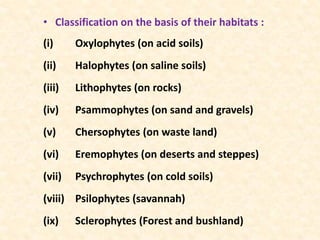
• Classification on the basis of their habitats :
(i) Oxylophytes (on acid soils)
(ii) Halophytes (on saline soils)
(iii) Lithophytes (on rocks)
(iv) Psammophytes (on sand and gravels)
(v) Chersophytes (on waste land)
(vi) Eremophytes (on deserts and steppes)
(vii) Psychrophytes (on cold soils)
(viii) Psilophytes (savannah)
(ix) Sclerophytes (Forest and bushland)
Xerophytic Adaptations:
• These structural modifications in xerophytic plants may be of
two types
(i) Xeromorphic characters:
• characters that are genetically fixed and inherited.
• Appear in the xerophytes irrespective of conditions whether
they are growing in deserts or in humid regions.
(ii) Xeroplastic characters:
• These features are induced by drought and are always
associated with dry conditions. They are never inherited.
• Depending upon fleshy organs :
(1) Succulent xerophytes.
(2) Non-succulents, also called true xerophytes.
A. Morphological adaptations :
(I) Roots :
 well developed root systems which may be profusely
branched.
 Extensive and more elaborate than shoot system.
 Many desert plants develop superficial root system
where the supply of water is restricted to surface layer
of the earth.
 In perennial xerophytes grow very deep in the earth
and reach the layers where water is available in plenty.
 Root hairs : densely developed near the growing tips of
the rootlets which enable the roots to absorb sufficient
quantity of water.
(II) Stem:
• In some xerophytes become very hard and woody. May be
either aerial or subterranean.
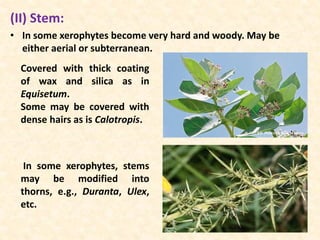
Covered with thick coating
of wax and silica as in
Equisetum.
Some may be covered with
dense hairs as is Calotropis.
In some xerophytes, stems
may be modified into
thorns, e.g., Duranta, Ulex,
etc.
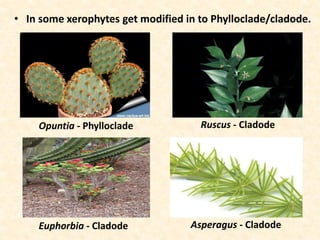
• In some xerophytes get modified in to Phylloclade/cladode.
Opuntia - Phylloclade Ruscus - Cladode
Euphorbia - Cladode Asperagus - Cladode
(III) Leaves:
 If present, are greatly caducous,
i.e., they fall early in the season
or reduced to scales, as in
Casuarina, Ruscus, Asparagus,
etc.
 Some evergreen xerophytes
have needle-shaped leaves, e.g.,
Pinus
 In leaf succulents, the leaves
swell remarkably and become
very fleshy owing to storage of
excess amount of water and
latex in them. E.g. Sedum , Aloe,
several members of family
Chaenopodiaceae.
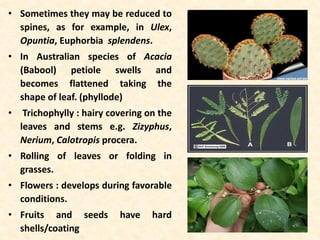
• Sometimes they may be reduced to
spines, as for example, in Ulex,
Opuntia, Euphorbia splendens.
• In Australian species of Acacia
(Babool) petiole swells and
becomes flattened taking the
shape of leaf. (phyllode)
• Trichophylly : hairy covering on the
leaves and stems e.g. Zizyphus,
Nerium, Calotropis procera.
• Rolling of leaves or folding in
grasses.
• Flowers : develops during favorable
conditions.
• Fruits and seeds have hard
shells/coating
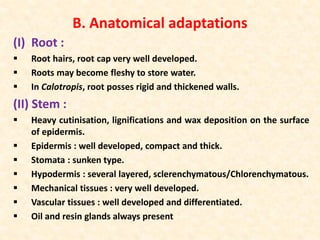
B. Anatomical adaptations
(I) Root :
 Root hairs, root cap very well developed.
 Roots may become fleshy to store water.
 In Calotropis, root posses rigid and thickened walls.
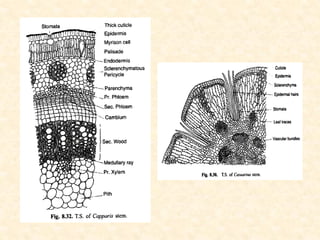
(II) Stem :
 Heavy cutinisation, lignifications and wax deposition on the surface
of epidermis.
 Epidermis : well developed, compact and thick.
 Stomata : sunken type.
 Hypodermis : several layered, sclerenchymatous/Chlorenchymatous.
 Mechanical tissues : very well developed.
 Vascular tissues : well developed and differentiated.
 Oil and resin glands always present
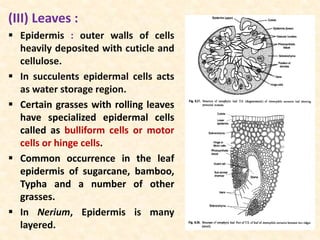
(III) Leaves :
 Epidermis : outer walls of cells
heavily deposited with cuticle and
cellulose.
 In succulents epidermal cells acts
as water storage region.
 Certain grasses with rolling leaves
have specialized epidermal cells
called as bulliform cells or motor
cells or hinge cells.
 Common occurrence in the leaf
epidermis of sugarcane, bamboo,
Typha and a number of other
grasses.
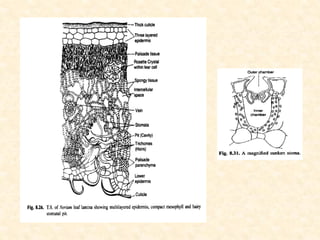
 In Nerium, Epidermis is many
layered.
• Stomata :
• Generally of sunken type. In some cases, may be found in
the furrows or pits.
• Walls of the guard cells and subsidiary cells are heavily
cutinized and lignified in many xeric plants.
• In dorsi-ventral leaves, generally found on the lower surface.
• In rolling leaves, they are scattered mostly on the upper
surface.
• Hairs found in the depressions protecting the stomata from
the direct strokes of strong wind
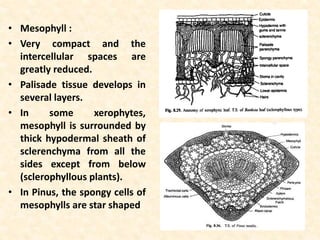
• Mesophyll :
• Very compact and the
intercellular spaces are
greatly reduced.
• Palisade tissue develops in
several layers.
• In some xerophytes,
mesophyll is surrounded by
thick hypodermal sheath of
sclerenchyma from all the
sides except from below
(sclerophyllous plants).
• In Pinus, the spongy cells of
mesophylls are star shaped
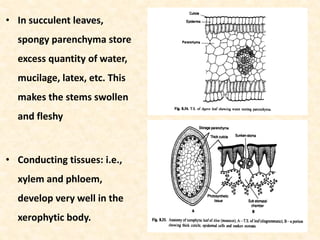
• In succulent leaves,
spongy parenchyma store
excess quantity of water,
mucilage, latex, etc. This
makes the stems swollen
and fleshy
• Conducting tissues: i.e.,
xylem and phloem,
develop very well in the
xerophytic body.
C. Physiological Adaptations
 Succulents are well known to contain polysaccharides, pentosans
and a number of acids.
 In succulent plants, stomata open during night hours and remain
closed during the day.
 Some enzymes, such as catalases, peroxidases, are more active in
xerophytes than in mesophytes.
 Presence of the cuticle, polished surface, compact cells and sunken
stomata protected by stomatal hairs regulate the transpiration.
 The xerophytes have very high osmotic pressure which increases
the turgidity wilting of cell is prevented and also affects the
absorption of water.

Xerophytes

  • 1.
    Xerophytes Dr. Ravindra. D.Madhekar Assistant professor, Department of Botany, S. B. E. S. College of Science, Aurangabad (Maharashtra) India
  • 2.
    Xerophytes • Plants whichgrow in dry habitats or xeric conditions. • Characteristic plants of desert and semi-desert regions, yet they can grow in mesophytic conditions where available water is in sufficient quantity. • Withstand extreme dry conditions, low humidity and high temperature. • Develop special structural and physiological characteristics which mainly aims at : (i) To absorb as much water as they can get from the surroundings; (ii) To retain water in their organs for very long time; (iii) To reduce the transpiration rate to minimum; and (iv) To check high consumption of water
  • 3.
    • Groups accordingto their drought resisting power : 1. Drought escaping plants: • Short-lived, small sized plants which complete their life cycles within a few weeks time. • Also called ephemerals or drought evaders or drought escapers 2. Drought enduring plants: • Small sized plants which have capacity to endure or tolerate drought. 3. Drought resistant plants: • These plants develop certain adaptive features in them through which they can resist extreme droughts
  • 4.
    • Classification onthe basis of their habitats : (i) Oxylophytes (on acid soils) (ii) Halophytes (on saline soils) (iii) Lithophytes (on rocks) (iv) Psammophytes (on sand and gravels) (v) Chersophytes (on waste land) (vi) Eremophytes (on deserts and steppes) (vii) Psychrophytes (on cold soils) (viii) Psilophytes (savannah) (ix) Sclerophytes (Forest and bushland)
  • 5.
    Xerophytic Adaptations: • Thesestructural modifications in xerophytic plants may be of two types (i) Xeromorphic characters: • characters that are genetically fixed and inherited. • Appear in the xerophytes irrespective of conditions whether they are growing in deserts or in humid regions. (ii) Xeroplastic characters: • These features are induced by drought and are always associated with dry conditions. They are never inherited. • Depending upon fleshy organs : (1) Succulent xerophytes. (2) Non-succulents, also called true xerophytes.
  • 6.
    A. Morphological adaptations: (I) Roots :  well developed root systems which may be profusely branched.  Extensive and more elaborate than shoot system.  Many desert plants develop superficial root system where the supply of water is restricted to surface layer of the earth.  In perennial xerophytes grow very deep in the earth and reach the layers where water is available in plenty.  Root hairs : densely developed near the growing tips of the rootlets which enable the roots to absorb sufficient quantity of water.
  • 7.
    (II) Stem: • Insome xerophytes become very hard and woody. May be either aerial or subterranean. Covered with thick coating of wax and silica as in Equisetum. Some may be covered with dense hairs as is Calotropis. In some xerophytes, stems may be modified into thorns, e.g., Duranta, Ulex, etc.
  • 8.
    • In somexerophytes get modified in to Phylloclade/cladode. Opuntia - Phylloclade Ruscus - Cladode Euphorbia - Cladode Asperagus - Cladode
  • 9.
    (III) Leaves:  Ifpresent, are greatly caducous, i.e., they fall early in the season or reduced to scales, as in Casuarina, Ruscus, Asparagus, etc.  Some evergreen xerophytes have needle-shaped leaves, e.g., Pinus  In leaf succulents, the leaves swell remarkably and become very fleshy owing to storage of excess amount of water and latex in them. E.g. Sedum , Aloe, several members of family Chaenopodiaceae.
  • 10.
    • Sometimes theymay be reduced to spines, as for example, in Ulex, Opuntia, Euphorbia splendens. • In Australian species of Acacia (Babool) petiole swells and becomes flattened taking the shape of leaf. (phyllode) • Trichophylly : hairy covering on the leaves and stems e.g. Zizyphus, Nerium, Calotropis procera. • Rolling of leaves or folding in grasses. • Flowers : develops during favorable conditions. • Fruits and seeds have hard shells/coating
  • 11.
    B. Anatomical adaptations (I)Root :  Root hairs, root cap very well developed.  Roots may become fleshy to store water.  In Calotropis, root posses rigid and thickened walls. (II) Stem :  Heavy cutinisation, lignifications and wax deposition on the surface of epidermis.  Epidermis : well developed, compact and thick.  Stomata : sunken type.  Hypodermis : several layered, sclerenchymatous/Chlorenchymatous.  Mechanical tissues : very well developed.  Vascular tissues : well developed and differentiated.  Oil and resin glands always present
  • 13.
    (III) Leaves : Epidermis : outer walls of cells heavily deposited with cuticle and cellulose.  In succulents epidermal cells acts as water storage region.  Certain grasses with rolling leaves have specialized epidermal cells called as bulliform cells or motor cells or hinge cells.  Common occurrence in the leaf epidermis of sugarcane, bamboo, Typha and a number of other grasses.  In Nerium, Epidermis is many layered.
  • 14.
    • Stomata : •Generally of sunken type. In some cases, may be found in the furrows or pits. • Walls of the guard cells and subsidiary cells are heavily cutinized and lignified in many xeric plants. • In dorsi-ventral leaves, generally found on the lower surface. • In rolling leaves, they are scattered mostly on the upper surface. • Hairs found in the depressions protecting the stomata from the direct strokes of strong wind
  • 16.
    • Mesophyll : •Very compact and the intercellular spaces are greatly reduced. • Palisade tissue develops in several layers. • In some xerophytes, mesophyll is surrounded by thick hypodermal sheath of sclerenchyma from all the sides except from below (sclerophyllous plants). • In Pinus, the spongy cells of mesophylls are star shaped
  • 17.
    • In succulentleaves, spongy parenchyma store excess quantity of water, mucilage, latex, etc. This makes the stems swollen and fleshy • Conducting tissues: i.e., xylem and phloem, develop very well in the xerophytic body.
  • 18.
    C. Physiological Adaptations Succulents are well known to contain polysaccharides, pentosans and a number of acids.  In succulent plants, stomata open during night hours and remain closed during the day.  Some enzymes, such as catalases, peroxidases, are more active in xerophytes than in mesophytes.  Presence of the cuticle, polished surface, compact cells and sunken stomata protected by stomatal hairs regulate the transpiration.  The xerophytes have very high osmotic pressure which increases the turgidity wilting of cell is prevented and also affects the absorption of water.